

ISO 24835-2:2025
(Main)Natural gas upstream area — Determination and calculation of shale brittleness index — Part 2: Determination of shale mechanical characteristics based on triaxial testing method
General Information
- Abstract
This document specifies the principles, instruments, materials and experimental conditions for testing Young’s modulus and Poisson’s ratio using triaxial testing method. It also specifies the sampling and mechanical testing procedures, as well as the method and precision requirements for calculating shale mechanical brittleness index based on Young’s modulus and Poisson’s ratio. This document is applicable to reservoir quality evaluation and sweet spot identification in shale gas production.
- Status
- Published
- Publication Date
- 12-Nov-2025
- Technical Committee
- ISO/TC 193/SC 3 - Upstream area
- Drafting Committee
- ISO/TC 193/SC 3 - Upstream area
- Current Stage
- 6060 - International Standard published
- Start Date
- 13-Nov-2025
- Due Date
- 19-Feb-2027
- Completion Date
- 13-Nov-2025
Buy Documents
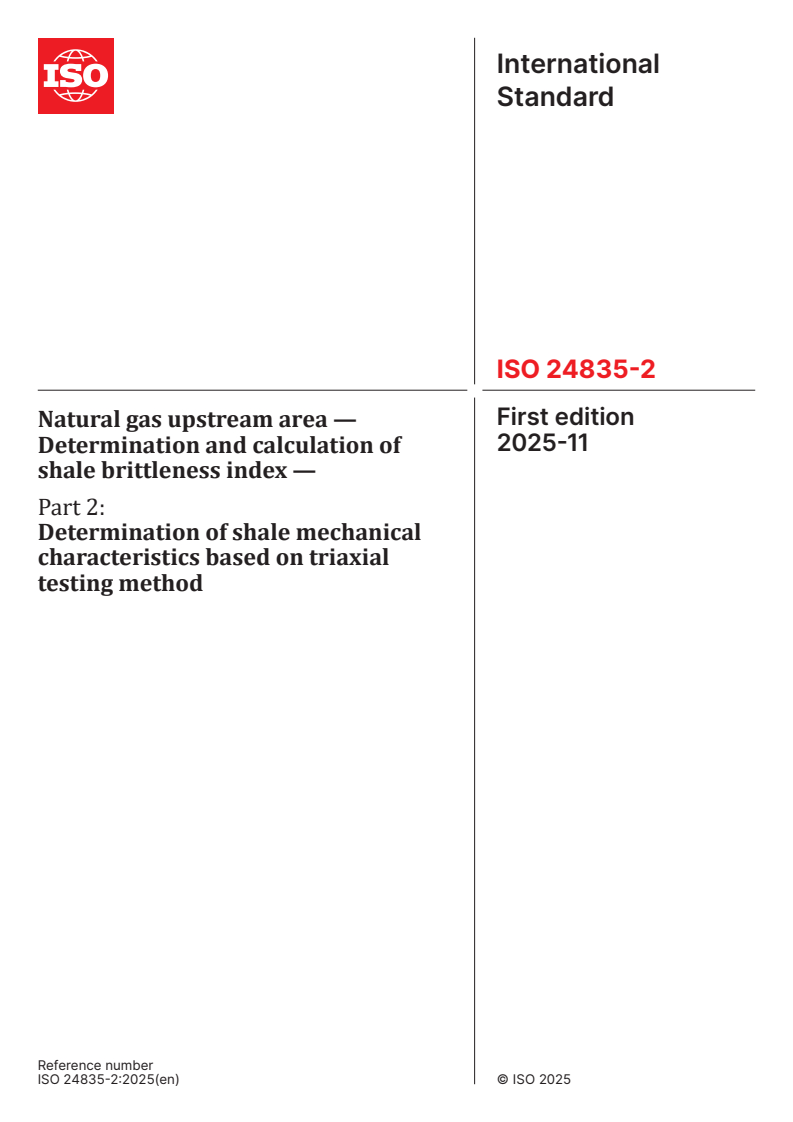

ISO 24835-2:2025 - Natural gas upstream area — Determination and calculation of shale brittleness index — Part 2: Determination of shale mechanical characteristics based on triaxial testing method Released:13. 11. 2025
Overview
ISO 24835-2:2025 defines a standardized triaxial testing method for determining shale mechanical properties used to calculate a shale mechanical brittleness index. The standard specifies principles, instruments, materials, sampling and testing procedures, calculation steps and precision requirements for measuring Young’s modulus and Poisson’s ratio under controlled temperature and confining pressure. Its primary purpose is to support reservoir quality evaluation and sweet spot identification in shale gas production and hydraulic fracturing planning.
Key topics and technical requirements
- Testing scope: Triaxial rock mechanics tests to obtain stress–strain curves, derive Young’s modulus (E) and Poisson’s ratio (ν), and calculate a normalized shale mechanical brittleness index.
- Apparatus and accuracy: Requirements include a triaxial tester with specified load capacity ( > 500 kN), high frame stiffness, load sensor accuracy (better than 0.001 kN), confining pressure control (±0.5 MPa) and temperature control (±0.5 K). Deformation sensors (extensometers or LVDTs) must have high resolution (better than 0.0025%).
- Sample preparation: Downhole full-hole cores, drilled to ~25 mm diameter (25 mm ± 1.5 mm) with aspect ratio 2.0–2.5; end-face parallelism < 0.02 mm and perpendicularity < 0.05°. Samples are dried in a convection oven (331.15 K) until mass change < 0.01 g.
- Test procedure: Install axial and radial sensors, equilibrate temperature and confining pressure (pressure rise rate ~5 MPa/min), load axially at a near-constant strain rate, and record axial load, axial/radial deformation, temperature and confining pressure at ≥10 Hz.
- Calculations and precision: The standard provides formulae for axial stress, axial and radial strain and prescribes how to select the linear portion of the stress–strain curve to compute E (Δσ/Δε) and ν (strain ratio). Precision, repeatability and reproducibility criteria reference ISO 5725 series.
Applications and users
- Who uses it: Reservoir engineers, petrophysicists, laboratory technicians, oilfield service companies, completion engineers, regulators and investors evaluating shale gas prospects.
- Practical uses:
- Reservoir quality evaluation and comparative brittleness ranking
- Sweet-spot identification for hydraulic fracturing optimization
- Forecasting fracture complexity and planning completion design
- Standardized data for cross-well and cross-operator comparisons and investment decisions
Related standards
- ISO 5725-2 and ISO 5725-6 (accuracy, repeatability/reproducibility)
- ISO 14532 (natural gas vocabulary)
- Other parts of the ISO 24835 series (mineral composition and alternative brittleness methods)
Keywords: ISO 24835-2:2025, shale brittleness index, triaxial testing, Young’s modulus, Poisson’s ratio, shale gas, reservoir quality, sweet spot identification.
Buy Documents
ISO 24835-2:2025 - Natural gas upstream area — Determination and calculation of shale brittleness index — Part 2: Determination of shale mechanical characteristics based on triaxial testing method Released:13. 11. 2025
Get Certified
Connect with accredited certification bodies for this standard

Element Materials Technology
Materials testing and product certification.

ABS Group Brazil
ABS Group certification services in Brazil.

ABS Quality Evaluations Inc.
American Bureau of Shipping quality certification.
Sponsored listings
Frequently Asked Questions
ISO 24835-2:2025 is a standard published by the International Organization for Standardization (ISO). Its full title is "Natural gas upstream area — Determination and calculation of shale brittleness index — Part 2: Determination of shale mechanical characteristics based on triaxial testing method". This standard covers: This document specifies the principles, instruments, materials and experimental conditions for testing Young’s modulus and Poisson’s ratio using triaxial testing method. It also specifies the sampling and mechanical testing procedures, as well as the method and precision requirements for calculating shale mechanical brittleness index based on Young’s modulus and Poisson’s ratio. This document is applicable to reservoir quality evaluation and sweet spot identification in shale gas production.
This document specifies the principles, instruments, materials and experimental conditions for testing Young’s modulus and Poisson’s ratio using triaxial testing method. It also specifies the sampling and mechanical testing procedures, as well as the method and precision requirements for calculating shale mechanical brittleness index based on Young’s modulus and Poisson’s ratio. This document is applicable to reservoir quality evaluation and sweet spot identification in shale gas production.
ISO 24835-2:2025 is classified under the following ICS (International Classification for Standards) categories: 75.060 - Natural gas. The ICS classification helps identify the subject area and facilitates finding related standards.
ISO 24835-2:2025 is available in PDF format for immediate download after purchase. The document can be added to your cart and obtained through the secure checkout process. Digital delivery ensures instant access to the complete standard document.
Standards Content (Sample)
International
Standard
ISO 24835-2
First edition
Natural gas upstream area —
2025-11
Determination and calculation of
shale brittleness index —
Part 2:
Determination of shale mechanical
characteristics based on triaxial
testing method
Reference number
© ISO 2025
All rights reserved. Unless otherwise specified, or required in the context of its implementation, no part of this publication may
be reproduced or utilized otherwise in any form or by any means, electronic or mechanical, including photocopying, or posting on
the internet or an intranet, without prior written permission. Permission can be requested from either ISO at the address below
or ISO’s member body in the country of the requester.
ISO copyright office
CP 401 • Ch. de Blandonnet 8
CH-1214 Vernier, Geneva
Phone: +41 22 749 01 11
Email: copyright@iso.org
Website: www.iso.org
Published in Switzerland
ii
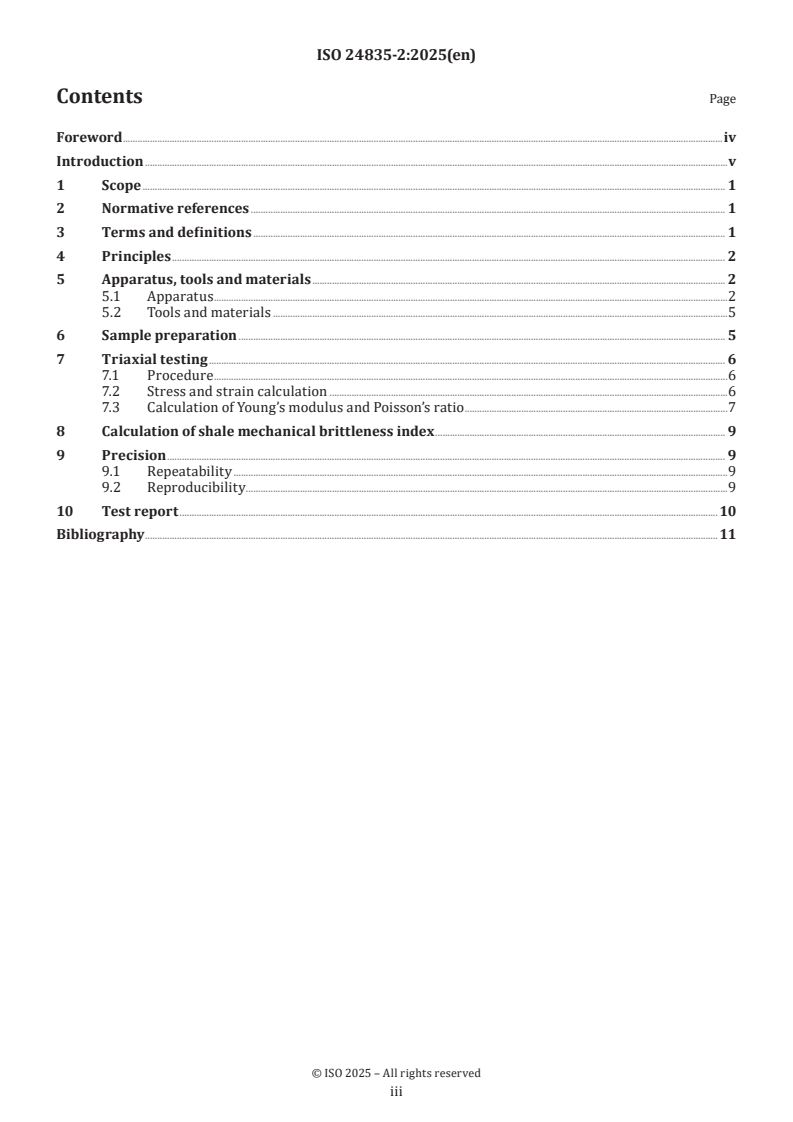
Contents Page
Foreword .iv
Introduction .v
1 Scope . 1
2 Normative references . 1
3 Terms and definitions . 1
4 Principles . 2
5 Apparatus, tools and materials . 2
5.1 Apparatus .2
5.2 Tools and materials .5
6 Sample preparation . 5
7 Triaxial testing . 6
7.1 Procedure .6
7.2 Stress and strain calculation .6
7.3 Calculation of Young’s modulus and Poisson’s ratio .7
8 Calculation of shale mechanical brittleness index . 9
9 Precision . 9
9.1 Repeatability .9
9.2 Reproducibility .9
10 Test report . 10
Bibliography .11
iii
Foreword
ISO (the International Organization for Standardization) is a worldwide federation of national standards
bodies (ISO member bodies). The work of preparing International Standards is normally carried out through
ISO technical committees. Each member body interested in a subject for which a technical committee
has been established has the right to be represented on that committee. International organizations,
governmental and non-governmental, in liaison with ISO, also take part in the work. ISO collaborates closely
with the International Electrotechnical Commission (IEC) on all matters of electrotechnical standardization.
The procedures used to develop this document and those intended for its further maintenance are described
in the ISO/IEC Directives, Part 1. In particular, the different approval criteria needed for the different types
of ISO document should be noted. This document was drafted in accordance with the editorial rules of the
ISO/IEC Directives, Part 2 (see www.iso.org/directives).
ISO draws attention to the possibility that the implementation of this document may involve the use of (a)
patent(s). ISO takes no position concerning the evidence, validity or applicability of any claimed patent
rights in respect thereof. As of the date of publication of this document, ISO had not received notice of (a)
patent(s) which may be required to implement this document. However, implementers are cautioned that
this may not represent the latest information, which may be obtained from the patent database available at
www.iso.org/patents. ISO shall not be held responsible for identifying any or all such patent rights.
Any trade name used in this document is information given for the convenience of users and does not
constitute an endorsement.
For an explanation of the voluntary nature of standards, the meaning of ISO specific terms and expressions
related to conformity assessment, as well as information about ISO’s adherence to the World Trade
Organization (WTO) principles in the Technical Barriers to Trade (TBT), see www.iso.org/iso/foreword.html.
This document was prepared by Technical Committee ISO/TC 193, Natural gas, Subcommittee SC 3,
Upstream area.
A list of all parts in the ISO 24835 series can be found on the ISO website.
Any feedback or questions on this document should be directed to the user’s national standards body. A
complete listing of these bodies can be found at www.iso.org/members.html.
iv
Introduction
This document has been developed to address the need for evaluating shale brittleness in the production
of shale gas. In order to boost shale gas production, it is essential to create flow paths within shale gas
reservoirs through hydraulic fracturing. The shale brittleness index, which serves as a crucial parameter for
forecasting the complexity of hydraulic fracturing cracks, is a vital benchmark for identifying high-quality
shale gas reservoirs. Therefore, a standardized approach for calculating the shale brittleness index can help
stakeholders (e.g. oil companies, oilfield service providers, investment firms and governments) to accurately
pinpoint “sweet spots” within shale gas reservoirs, select promising areas with development potential and
facilitate efficient shale gas development.
In the global shale gas production industry, two types of optimal methods for characterizing shale
brittleness index are preferred: the mineral composition method and the rock mechanics method. This is
due to their theoretical effectiveness, operational generality and result reliability. The ISO 24835 series has
been developed on the basis of these two methods.
v
International Standard ISO 24835-2:2025(en)
Natural gas upstream area — Determination and calculation
of shale brittleness index —
Part 2:
Determination of shale mechanical characteristics based on
triaxial testing method
1 Scope
This document specifies the principles, instruments, materials and experimental conditions for testing
Young’s modulus and Poisson’s ratio using triaxial testing method. It also specifies the sampling and
mechanical testing procedures, as well as the method and precision requirements for calculating shale
mechanical brittleness index based on Young’s modulus and Poisson’s ratio.
This document is applicable to reservoir quality evaluation and sweet spot identification in shale gas
production.
2 Normative references
The following documents are essential to the application of the standard. For dated references, only the
edition cited applies. For undated references, their latest edition of the referenced document (including any
amendments) applies.
ISO 5725-2, Accuracy (trueness and precision) of measurement methods and results Part 2: Basic method for the
determination of repeatability and reproducibility of a standard measurement method
ISO 5725-6, Accuracy (trueness and precision) of measurement methods and results — Part 6: Use in practice of
accuracy values
ISO 14532, Natural gas — Vocabulary
3 Terms and definitions
For the purposes of this document, the terms and definitions in ISO 14532 and the following apply:
ISO and IEC maintain terminology databases for use in standardization at the following addresses:
— ISO Online browsing platform: available at https:// www .iso .org/ obp
— IEC Electropedia: available at https:// www .electropedia .org/
3.1
triaxial testing
method of conducting rock mechanics tests by continuously applying axial stress (3.4) on a sample under
equal lateral confining pressure
3.2
Young’s modulus
ratio of change in axial stress (3.4) to the corresponding axial strain (3.5) in the linear portion of the
compression stress – compression strain curve of the experimental sample
Note 1 to entry: The Young’s modulus in this document refers to the average Young’s modulus, i.e. the average slope of
the linear portion of the axial stress-strain curve.
Note 2 to entry: Adapted from ISO 22932-3:2023 3.4.1.
3.3
Poisson’s ratio
ratio of the shortening in the transverse direction to the elongation in the direction of an applied force in a
body under tension below the proportional limit
[SOURCE: ISO 22932-3:2023, 3.4.8]
3.4
axial stress
stress component in the direction of the applied force
[SOURCE: ISO 23718:2007, 1.1.10.3]
3.5
axial strain
linear strain in the direction of the applied force
[SOURCE: ISO 23718:2007, 1.1.10.2]
3.6
radial strain
relative deformation of a cylindrical experimental sample under axial load along the diameter direction
3.7
shale brittleness index
index derived from a particular brittleness characterization principle and algorithm among various options,
used for comparing the brittleness levels of different shales
3.8
shale mechanical brittleness index
shale brittleness index (3.8) obtained through calculation based on the shale mechanical parameters
4 Principles
Based on the principle that Young’s modulus and Poisson’s ratio can characterize the tendency of rocks to
fracture under stress without significant plastic deformation, use a triaxial method to test the stress – strain
curves of shale samples under formation temperature and pressure. Then, calculate Young’s modulus and
Poisson’s ratio. Obtain the shale brittleness index through normalized calculation.
NOTE References [3], [4] and [5] elaborate on the methods for calculating shale mechanical brittleness index
using Young’s modulus and Poisson’s ratio.
5 Apparatus, tools and materials
5.1 Apparatus
5.1.1 Triaxial rock mechanics tester (see Figure 1), which shall meet the followi
...