

ISO 10334:1994
(Main)Implants for surgery — Malleable wires for use as sutures and other surgical applications
General Information
- Abstract
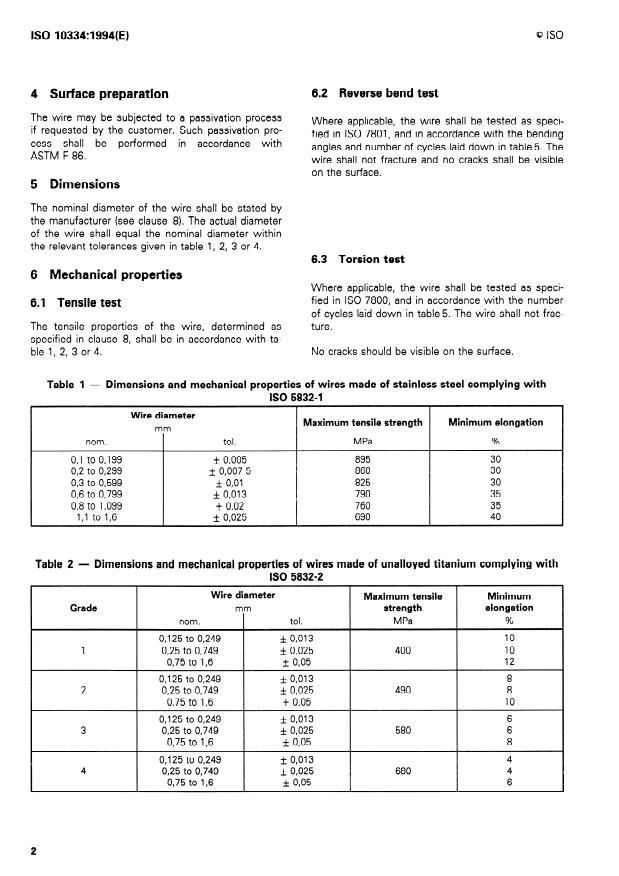
Specifies the dimensions and mechanical properties and gives test methods. The mechanical properties specified are tensile strength, elongation, and resistance to damage in bending and in torsion. Surface finish is not covered.
- Status
- Published
- Publication Date
- 27-Jul-1994
- Technical Committee
- ISO/TC 150/SC 5 - Osteosynthesis and spinal devices
- Drafting Committee
- ISO/TC 150/SC 5 - Osteosynthesis and spinal devices
- Current Stage
- 9093 - International Standard confirmed
- Start Date
- 08-Dec-2022
- Completion Date
- 29-Aug-2026
Buy Documents
ISO 10334:1994 - Implants for surgery — Malleable wires for use as sutures and other surgical applications Released:7/28/1994
ISO 10334:1994 - Implants chirurgicaux — Fils malléables pour sutures et autres applications chirurgicales Released:7/28/1994
ISO 10334:1994 - Implants chirurgicaux — Fils malléables pour sutures et autres applications chirurgicales Released:7/28/1994
Overview
ISO 10334:1994 is an international standard developed by the International Organization for Standardization (ISO) for implants for surgery-specifically malleable wires intended for use as sutures and other surgical applications. The document defines the dimensions, mechanical properties, and appropriate test methods for these surgical wires. This standard is essential for manufacturers, regulatory bodies, and healthcare providers to ensure product safety, reliability, and compatibility with other medical devices.
Key Topics
ISO 10334:1994 covers essential requirements for malleable surgical wires, focusing on:
- Dimensions: Specifies nominal wire diameters and tolerated deviations to ensure product consistency.
- Mechanical Properties: Sets minimum performance criteria, including:
- Tensile strength
- Elongation
- Resistance to bending and torsion
- Material Compatibility: Wires are to be manufactured from:
- Wrought stainless steel (as per ISO 5832-1)
- Unalloyed titanium (as per ISO 5832-2)
- Wrought cobalt-chromium-tungsten-nickel alloy (as per ISO 5832-5)
- High-nitrogen stainless steel (as per ISO 5832-9)
- Testing Methods: Detailed procedures for:
- Tensile testing (ISO 6892)
- Reverse bend testing (ISO 7801)
- Torsion testing (ISO 7800)
- Packaging and Marking: Guidelines for identification, protection against contamination, and prevention of wire shape deformation.
Note: Surface finish requirements are explicitly not covered in this standard, and users must consult relevant standards if surface characteristics are critical.
Applications
The requirements defined in ISO 10334:1994 make it directly applicable across various surgical and medical device scenarios, including:
- Suturing of tissue during surgeries, particularly where a durable yet malleable wire is necessary.
- Fixation of implants and tissues, ensuring secure attachment during orthopedic, dental, and reconstructive procedures.
- Use in osteosynthesis, where wires are commonly employed to join bone fragments or secure prosthetic components.
This standard supports patient safety by minimizing risk factors such as fracture, corrosion (when material compatibility guidelines are followed), or failure of the wire during surgical procedures. Additionally, ISO 10334 harmonizes purchasing specifications for healthcare providers and streamlines regulatory submissions for manufacturers.
Related Standards
For comprehensive compliance and best practices, ISO 10334:1994 should be used in conjunction with related international standards, including:
- ISO 5832 series: Specifications for materials such as stainless steel, titanium, and cobalt-chromium alloys used in surgical implants.
- ISO 6018: General requirements for marking, packaging, and labeling of orthopedic implants.
- ISO 6892: Methods for tensile testing of metallic materials.
- ISO 7800: Simple torsion testing procedure for metallic wires.
- ISO 7801: Reverse bend testing for metallic wires.
- ASTM F86: Practice for surface preparation and marking of metallic surgical implants.
Implementing ISO 10334:1994 ensures alignment with global best practices, minimizes regulatory hurdles, and supports optimal surgical outcomes through the reliable use of malleable surgical wires.
Relations
- Consolidated By
ISO 9003:1994 - Quality systems — Model for quality assurance in final inspection and test - Effective Date
- 06-Jun-2022
Buy Documents
ISO 10334:1994 - Implants for surgery — Malleable wires for use as sutures and other surgical applications Released:7/28/1994
ISO 10334:1994 - Implants chirurgicaux — Fils malléables pour sutures et autres applications chirurgicales Released:7/28/1994
ISO 10334:1994 - Implants chirurgicaux — Fils malléables pour sutures et autres applications chirurgicales Released:7/28/1994
Get Certified
Connect with accredited certification bodies for this standard

BSI Group
BSI (British Standards Institution) is the business standards company that helps organizations make excellence a habit.

TÜV Rheinland
TÜV Rheinland is a leading international provider of technical services.

TÜV SÜD
TÜV SÜD is a trusted partner of choice for safety, security and sustainability solutions.
Sponsored listings
Frequently Asked Questions
ISO 10334:1994 is a standard published by the International Organization for Standardization (ISO). Its full title is "Implants for surgery — Malleable wires for use as sutures and other surgical applications". This standard covers: Specifies the dimensions and mechanical properties and gives test methods. The mechanical properties specified are tensile strength, elongation, and resistance to damage in bending and in torsion. Surface finish is not covered.
Specifies the dimensions and mechanical properties and gives test methods. The mechanical properties specified are tensile strength, elongation, and resistance to damage in bending and in torsion. Surface finish is not covered.
ISO 10334:1994 is classified under the following ICS (International Classification for Standards) categories: 11.040.40 - Implants for surgery, prosthetics and orthotics. The ICS classification helps identify the subject area and facilitates finding related standards.
ISO 10334:1994 has the following relationships with other standards: It is inter standard links to ISO 9003:1994. Understanding these relationships helps ensure you are using the most current and applicable version of the standard.
ISO 10334:1994 is available in PDF format for immediate download after purchase. The document can be added to your cart and obtained through the secure checkout process. Digital delivery ensures instant access to the complete standard document.
Standards Content (Sample)
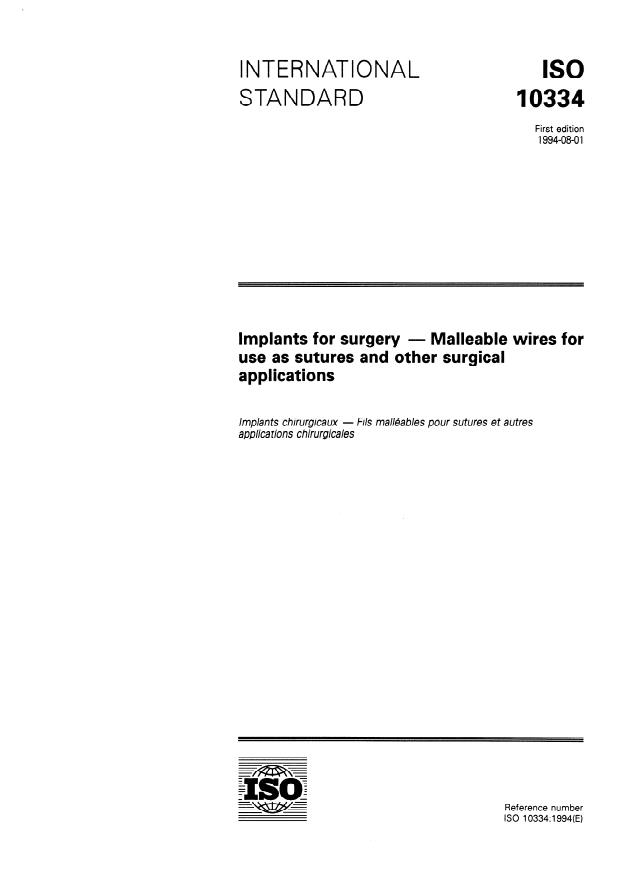
INTERNATIONAL ISO
STANDARD 10334
First edition
1994-08-01
lmplants for surgery - Malleable wires for
use as sutures and other surgical
applications
- Fils mall6ables pour sutures et autres
lmplants chirurgicaux
applica tions chirurgicales
Reference number
OS0 10334:1994(E)
Foreword
ISO (the International Organization for Standardization) is a worldwide
federation of national Standards bodies (ISO member bodies). The work
of preparing International Standards is normally carried out through ISO
technical committees. Esch member body interested in a subject for
which a technical committee has been established has the right to be
represented on that committee. International organizations, governmental
and non-governmental, in liaison with ISO, also take part in the work. ISO
collaborates closely with the lnternational Electrotechnical Commission
(IEC) on all matters of electrotechnical standardization.
Draft International Standards adopted by the technical committees are
circulated to the member bodies for voting. Publication as an International
Standard requires approval by at least 75 % of the member bodies casting
a vote.
International Standard ISO 10334 was prepared by Technical Committee
ISO/TC 150, Implants Fox surgery, Subcommittee SC 5, Osteosynthesis.
0 ISO 1994
All rights reserved. Unless otherwise specified, no part sf this publication may be reproduced
or utilized in any form or by any means, electronie or mechanical, including photocopying and
microfilm, without Permission in writing from the publisher.
lnternational Organization for Standardization
Case Postale 56 l CH-l 21 ‘l Geneve 20 l Switzerland
Printed in Switzerland
ii
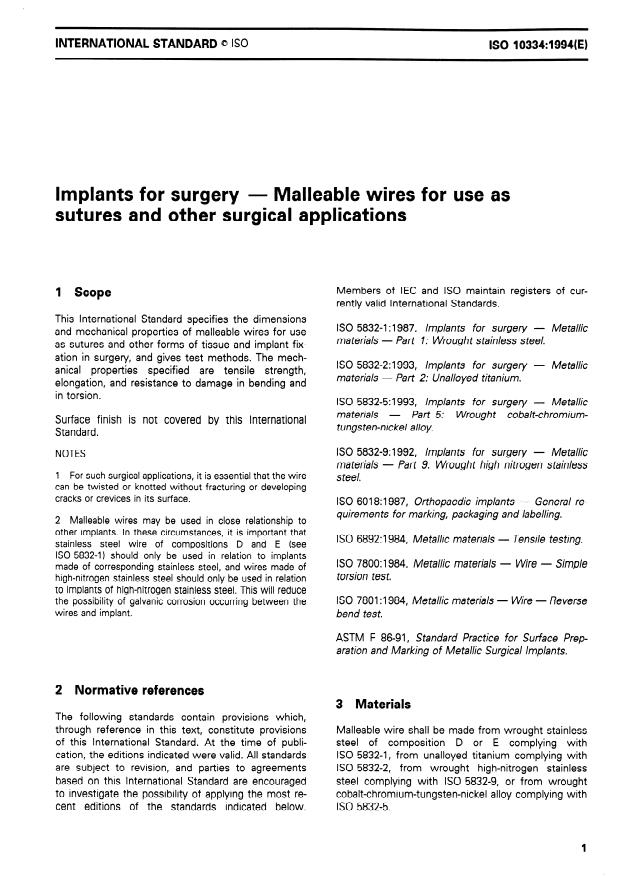
INTERNATIONAL STANDARD 0 ISO
Malleable wires for use as
Implants for surgery -
sutures and other surgical applications
Members of IEC and ISO maintain registers of cur-
1 Scope
rently valid International Standards.
This International Standard specifies the dimensions
ISO 5832-1 :1987, lmplants for surgery - Metallic
and mechanical properties of malleable wires for use
ma terials - Part 1: Wrough t stainless s teel.
as sutures and other forms of tissue and implant fix-
ation in surgery, and gives test methods. The mech-
ISO 5832-2:1993, Implants for surgery - Metallic
anical properties specified are tensile strength,
1738 terials - Part 2: Unalloyed titanium.
elongation, and resistance to darnage in bending and
in torsion.
ISO 5832,5:1993, lmplants for surgery - Metallic
ma terials - Part 5: Wrought cobalt-chromium-
Surface finish is not covered by this International
tungs ten-nicke/ alloy.
Standard.
ISO 5832.9:1992, lmplants for surgery - Metallic
NOTES
- Part 9: Wrought high nitrogen s tainless
ma terials
1 For such surgical applications, it is essential that the wire
steel.
tan be twisted or knotted without fracturing or developing
Cracks or crevices in its surface.
ISO 60 18: 1987, Orthopaedic implants - General re-
quiremen ts for marking, packaging and labelling.
2 Malleable wires may be used in close relationship to
other implants. In these circumstances, it is important that
ISO 6892:1984, Metallic materials - Tensile testing.
stainless steel wire of compositions D and E (see
ISO 58324) should only be used in relation to implants
ISO 7800: 1984, Metallic materials - Wire - Simple
made of corresponding stainless steel, and wires made of
torsion tes t.
high-nitrogen stainless steel should only be used in relation
to implants of high-nitrogen stainless steel. This will reduce
ISO 7801 :1984, Metallic materials - Wire - Reverse
the possibility of galvanic corrosion occurring between the
wires and implant.
bend test.
ASTM F 86-91, Standard Practice for Surface Prep-
aration and Marking of Metallic Surgical Implants.
2 Normative references
3 Materials
The following Standards contain provisions which,
through reference in this text, constitute provisions Malleable wire shall be made from wrought stainless
of this International Standard. At the time of publi- steel of composition D or E complying with
cation, the editions indicated were valid. All Standards ISO 5832-1, from unalloyed titanium complying with
ISO 5832-2, from wrought high-nitrogen stainless
are subject to revision, and Parties to agreements
based on this International Standard are encouraged steel complying with ISO 58
...
NORME
ISO
INTERNATIONALE
Premibre 6dition
1994-08-01
lmplants chirurgicaux - Fils malléables
pour sutures et autres applications
chirurgicales
Implants for surgery - Malleable wires for use as sutures and other
surgical applications
Numéro de référence
ISO 10334: 1994(F)
Avant-propos
L’ISO (Organisation internationale de normalisation) est une fedération
mondiale d’organismes nationaux de normalisation (comites membres de
I’ISO). L’elaboration des Normes internationales est en général confiee aux
comites techniques de I’ISO. Chaque comité membre intéressé par une
etude a le droit de faire partie du comité technique cree à cet effet. Les
organisations internationales, gouvernementales et non gouvernemen-
tales, en liaison avec I’ISO participent egalement aux travaux. L’ISO colla-
bore étroitement avec la Commission électrotechnique internationale (CEI)
en ce qui concerne la normalisation électrotechnique.
Les projets de Normes internationales adoptes par les comites techniques
sont soumis aux comités membres pour vote. Leur publication comme
Normes internationales requiert l’approbation de 75 % au moins des co-
mites membres votants.
La Norme internationale ISO 10334 a éte élaboree par le comite technique
ISOFC 150, lmplants chirurgicaux, sous-comite SC 5, Ostéosynthése.
0 ISO 1994
Droits de reproduction réservés. Sauf prescription différente, aucune partie de cette publi-
cation ne peut être reproduite ni utilisee sous quelque forme que ce soit et par aucun pro-
cédé, electronique ou mécanique, y compris la photocopie et les microfilms, sans l’accord
ecrit de l’editeur.
Organisation internationale de normalisation
Case Postale 56 l CH-l 211 Geneve 20 l Suisse
Imprime en Suisse
ii
NORME INTERNATIONALE Q 60
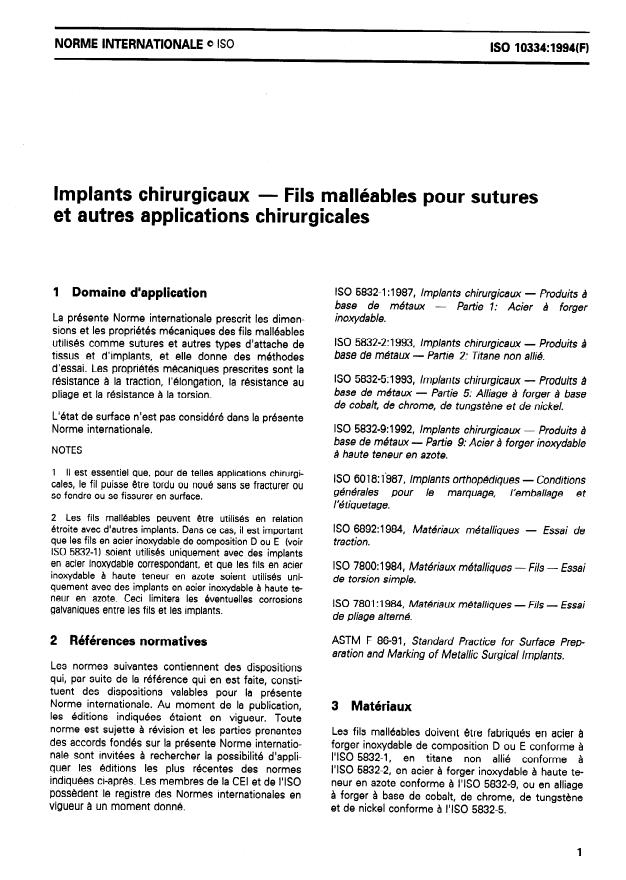
Implants chirurgicaux - Fils malléables pour sutures
et autres applications chirurgicales
ISO 5832-1: 1987, Implan ts chirurgicaux - Produits a
1 Domaine d’application
base de metaux
- Partie 1: Acier a forger
inoxydable.
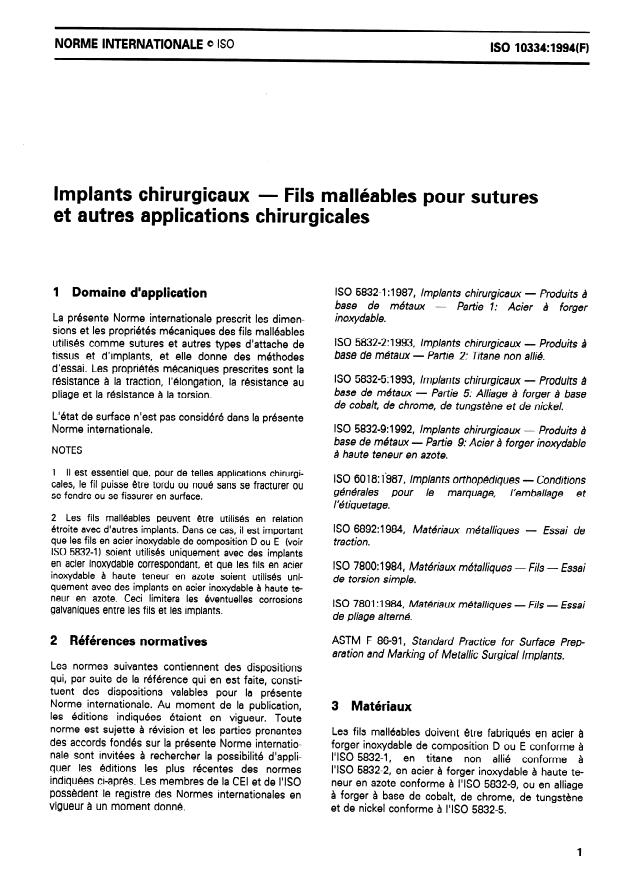
La présente Norme internationale prescrit les dimen-
sions et les propriétés mécaniques des fils malléables
ISO 5832-2: 1993, Implants chirurgicaux - Produits a
utilises comme sutures et autres types d’attache de
base de métaux - Partie 2: Titane non allie.
tissus et d’implants, et elle donne des methodes
d’essai. Les proprietés mécaniques prescrites sont la
ISO 5832-5: 1993, Implants chirurgicaux - Produits a
résistance à la traction, I’elongation, la resistance au
base de metaux - Partie 5: Alliage a forger a base
pliage et la resistance à la torsion.
de cobalt, de chrome, de tungstene et de nickel.
L’etat de surface n’est pas considere dans la présente
ISO 5832-9: 1992, Implants chirurgicaux - Produits a
Norme internationale.
base de metaux - Partie 9: Acier à forger inoxydable
NOTES
a haute teneur en azote.
1 II est essentiel que, pour de telles applications chirurgi-
I SO 60 18: 1987, lmplan ts orthopédiques - Conditions
cales, le fil puisse être tordu ou noué sans se fracturer ou
génerales pour le marquage, l’emballage et
se fendre ou se fissurer en surface.
1% tique tage.
2 Les fils malléables peuvent @tre utilisés en relation
ISO 6892: 1984, Materiaux metalliques - Essai de
étroite avec d’autres implants. Dans ce cas, il est important
que les fils en acier inoxydable de composition D ou E (voir traction.
ISO 5832-l) soient utilisés uniquement avec des implants
en acier inoxydable correspondant, et que les fils en acier
ISO 7800: 1984, Matériaux métalliques - Fils - Essai
inoxydable à haute teneur en azote soient utilisés uni-
de torsion simple.
quement avec des implants en acier inoxydable à haute te-
neur en azote. Ceci limitera les éventuelles corrosions
ISO 780111984, Matériaux métalliques - Fils - Essai
galvaniques entre les fils et les implants.
de pliage alterne.
ASTM F 8691, Standard Practice for Surface Prep-
2 Références normatives
aration and Marking of Metallic Surgical lmplants.
Les normes suivantes contiennent des dispositions
qui, par suite de la reference qui en est faite, consti-
tuent des dispositions valables pour la présente
Norme internationale. Au moment de la publication,
3 Matériaux
les editions indiquees étaient en vigueur. Toute
norme est sujette à revision et les parties prenantes Les fils malleables doivent etre fabriques en acier à
des accords fondes sur la présente Norme internatio-
forger inoxydable de composition D ou E conforme à
nale sont invitees à rechercher la possibilité d’appli-
I’ISO 5832-1, en titane non allié conforme à
quer les editions les plus recentes des normes I’ISO 58322, en acier à forger inoxydable à haute te-
indiquées ci-aprés. Les membres de la CEI et de I’ISO neur en azote conforme à I’ISO 5832-9, ou en alliage
possédent le registre des No
...
NORME
ISO
INTERNATIONALE
Premibre 6dition
1994-08-01
lmplants chirurgicaux - Fils malléables
pour sutures et autres applications
chirurgicales
Implants for surgery - Malleable wires for use as sutures and other
surgical applications
Numéro de référence
ISO 10334: 1994(F)
Avant-propos
L’ISO (Organisation internationale de normalisation) est une fedération
mondiale d’organismes nationaux de normalisation (comites membres de
I’ISO). L’elaboration des Normes internationales est en général confiee aux
comites techniques de I’ISO. Chaque comité membre intéressé par une
etude a le droit de faire partie du comité technique cree à cet effet. Les
organisations internationales, gouvernementales et non gouvernemen-
tales, en liaison avec I’ISO participent egalement aux travaux. L’ISO colla-
bore étroitement avec la Commission électrotechnique internationale (CEI)
en ce qui concerne la normalisation électrotechnique.
Les projets de Normes internationales adoptes par les comites techniques
sont soumis aux comités membres pour vote. Leur publication comme
Normes internationales requiert l’approbation de 75 % au moins des co-
mites membres votants.
La Norme internationale ISO 10334 a éte élaboree par le comite technique
ISOFC 150, lmplants chirurgicaux, sous-comite SC 5, Ostéosynthése.
0 ISO 1994
Droits de reproduction réservés. Sauf prescription différente, aucune partie de cette publi-
cation ne peut être reproduite ni utilisee sous quelque forme que ce soit et par aucun pro-
cédé, electronique ou mécanique, y compris la photocopie et les microfilms, sans l’accord
ecrit de l’editeur.
Organisation internationale de normalisation
Case Postale 56 l CH-l 211 Geneve 20 l Suisse
Imprime en Suisse
ii
NORME INTERNATIONALE Q 60
Implants chirurgicaux - Fils malléables pour sutures
et autres applications chirurgicales
ISO 5832-1: 1987, Implan ts chirurgicaux - Produits a
1 Domaine d’application
base de metaux
- Partie 1: Acier a forger
inoxydable.
La présente Norme internationale prescrit les dimen-
sions et les propriétés mécaniques des fils malléables
ISO 5832-2: 1993, Implants chirurgicaux - Produits a
utilises comme sutures et autres types d’attache de
base de métaux - Partie 2: Titane non allie.
tissus et d’implants, et elle donne des methodes
d’essai. Les proprietés mécaniques prescrites sont la
ISO 5832-5: 1993, Implants chirurgicaux - Produits a
résistance à la traction, I’elongation, la resistance au
base de metaux - Partie 5: Alliage a forger a base
pliage et la resistance à la torsion.
de cobalt, de chrome, de tungstene et de nickel.
L’etat de surface n’est pas considere dans la présente
ISO 5832-9: 1992, Implants chirurgicaux - Produits a
Norme internationale.
base de metaux - Partie 9: Acier à forger inoxydable
NOTES
a haute teneur en azote.
1 II est essentiel que, pour de telles applications chirurgi-
I SO 60 18: 1987, lmplan ts orthopédiques - Conditions
cales, le fil puisse être tordu ou noué sans se fracturer ou
génerales pour le marquage, l’emballage et
se fendre ou se fissurer en surface.
1% tique tage.
2 Les fils malléables peuvent @tre utilisés en relation
ISO 6892: 1984, Materiaux metalliques - Essai de
étroite avec d’autres implants. Dans ce cas, il est important
que les fils en acier inoxydable de composition D ou E (voir traction.
ISO 5832-l) soient utilisés uniquement avec des implants
en acier inoxydable correspondant, et que les fils en acier
ISO 7800: 1984, Matériaux métalliques - Fils - Essai
inoxydable à haute teneur en azote soient utilisés uni-
de torsion simple.
quement avec des implants en acier inoxydable à haute te-
neur en azote. Ceci limitera les éventuelles corrosions
ISO 780111984, Matériaux métalliques - Fils - Essai
galvaniques entre les fils et les implants.
de pliage alterne.
ASTM F 8691, Standard Practice for Surface Prep-
2 Références normatives
aration and Marking of Metallic Surgical lmplants.
Les normes suivantes contiennent des dispositions
qui, par suite de la reference qui en est faite, consti-
tuent des dispositions valables pour la présente
Norme internationale. Au moment de la publication,
3 Matériaux
les editions indiquees étaient en vigueur. Toute
norme est sujette à revision et les parties prenantes Les fils malleables doivent etre fabriques en acier à
des accords fondes sur la présente Norme internatio-
forger inoxydable de composition D ou E conforme à
nale sont invitees à rechercher la possibilité d’appli-
I’ISO 5832-1, en titane non allié conforme à
quer les editions les plus recentes des normes I’ISO 58322, en acier à forger inoxydable à haute te-
indiquées ci-aprés. Les membres de la CEI et de I’ISO neur en azote conforme à I’ISO 5832-9, ou en alliage
possédent le registre des No
...