

ISO 18192-3:2025
(Main)Implants for surgery — Wear of total intervertebral spinal disc prostheses — Part 3: Impingement-wear testing and corresponding environmental conditions for test of lumbar and cervical prostheses
General Information
- Abstract
This document specifies a test procedure to simulate and to evaluate lumbar and cervical spinal disc prostheses wear under adverse impingement conditions.
- Status
- Published
- Publication Date
- 20-Nov-2025
- Technical Committee
- ISO/TC 150/SC 5 - Osteosynthesis and spinal devices
- Drafting Committee
- ISO/TC 150/SC 5/WG 2 - Spinal devices
- Current Stage
- 6060 - International Standard published
- Start Date
- 21-Nov-2025
- Due Date
- 21-May-2026
- Completion Date
- 21-Nov-2025
Buy Documents
ISO 18192-3:2025 - Implants for surgery — Wear of total intervertebral spinal disc prostheses — Part 3: Impingement-wear testing and corresponding environmental conditions for test of lumbar and cervical prostheses Released:21. 11. 2025
Overview
ISO 18192-3:2025 - Implants for surgery - Wear of total intervertebral spinal disc prostheses - Part 3 describes a standardized impingement-wear testing procedure and corresponding environmental conditions for evaluating wear of lumbar and cervical spinal disc prostheses under adverse impingement scenarios. The second edition extends the scope to cervical prostheses and integrates cervical testing parameters alongside lumbar guidance. The document defines test principles, required materials, apparatus, test methods and reporting requirements to simulate clinically relevant impingement and assess prosthesis performance.
Key Topics
- Scope and purpose: Simulate and evaluate wear caused by impingement (contact/restriction) during flexion, extension, lateral bending and combined motions (including axial rotation when clinically relevant).
- Test medium: Calf serum diluted with de-ionized water to 20 g ± 2 g protein per litre, prepared in accordance with ISO 18192-1 to replicate physiological lubrication.
- Specimens: Recommended minimum of six specimens (fewer allowed with justification). For polymers, include a load-soak control to measure creep and fluid uptake.
- Apparatus and control: Test machines compliant with ISO 7500-1, ISO 23788 and ISO 18192-1. Motion control accuracy of ±1° at maxima/minima and phasing tolerance of ±5%; force control phasing and magnitude tolerances of ±5%.
- Kinematics and coordinate system: Defined origin at the intersection of flexion/extension, lateral bending and axial rotation axes; axial load vector aligned with the rotation axis. Range of motion shall exceed impingement by at least 2° in the impingement direction and the impingement region must be offloaded each cycle.
- Test development: Identification of nominal centre of rotation, points of impingement (DCI), and development of time-varying load/displacement profiles prior to testing. Gravimetric measurement and method justification are provided in annexes.
Applications
- Who uses it: Spinal implant manufacturers, biomechanical test laboratories, regulatory reviewers, design engineers and R&D teams performing preclinical wear evaluation and risk assessments.
- Practical uses:
- Pre-market verification of disc prosthesis durability under worst-case impingement.
- Comparative testing of designs and materials (e.g., polymer vs. metal articulations).
- Support for regulatory submissions, design iterations, and failure-mode analysis.
- Establishing test setups and machine validation for repeatable impingement-wear results.
Related Standards
- ISO 18192-1 - Loading and displacement parameters and environmental conditions for wear testing.
- ISO 7500-1 - Calibration and verification of force-measuring systems for testing machines.
- ISO 23788 - Verification of alignment of fatigue testing machines.
For authoritative test protocols, machine setup details, and annex methods (gravimetric measurement, method justification), obtain the full ISO 18192-3:2025 standard from ISO.
Relations
- Effective Date
- 25-May-2024
Buy Documents
ISO 18192-3:2025 - Implants for surgery — Wear of total intervertebral spinal disc prostheses — Part 3: Impingement-wear testing and corresponding environmental conditions for test of lumbar and cervical prostheses Released:21. 11. 2025
Get Certified
Connect with accredited certification bodies for this standard

BSI Group
BSI (British Standards Institution) is the business standards company that helps organizations make excellence a habit.

TÜV Rheinland
TÜV Rheinland is a leading international provider of technical services.

TÜV SÜD
TÜV SÜD is a trusted partner of choice for safety, security and sustainability solutions.
Sponsored listings
Frequently Asked Questions
ISO 18192-3:2025 is a standard published by the International Organization for Standardization (ISO). Its full title is "Implants for surgery — Wear of total intervertebral spinal disc prostheses — Part 3: Impingement-wear testing and corresponding environmental conditions for test of lumbar and cervical prostheses". This standard covers: This document specifies a test procedure to simulate and to evaluate lumbar and cervical spinal disc prostheses wear under adverse impingement conditions.
This document specifies a test procedure to simulate and to evaluate lumbar and cervical spinal disc prostheses wear under adverse impingement conditions.
ISO 18192-3:2025 is classified under the following ICS (International Classification for Standards) categories: 11.040.40 - Implants for surgery, prosthetics and orthotics. The ICS classification helps identify the subject area and facilitates finding related standards.
ISO 18192-3:2025 has the following relationships with other standards: It is inter standard links to ISO 18192-3:2017. Understanding these relationships helps ensure you are using the most current and applicable version of the standard.
ISO 18192-3:2025 is available in PDF format for immediate download after purchase. The document can be added to your cart and obtained through the secure checkout process. Digital delivery ensures instant access to the complete standard document.
Standards Content (Sample)
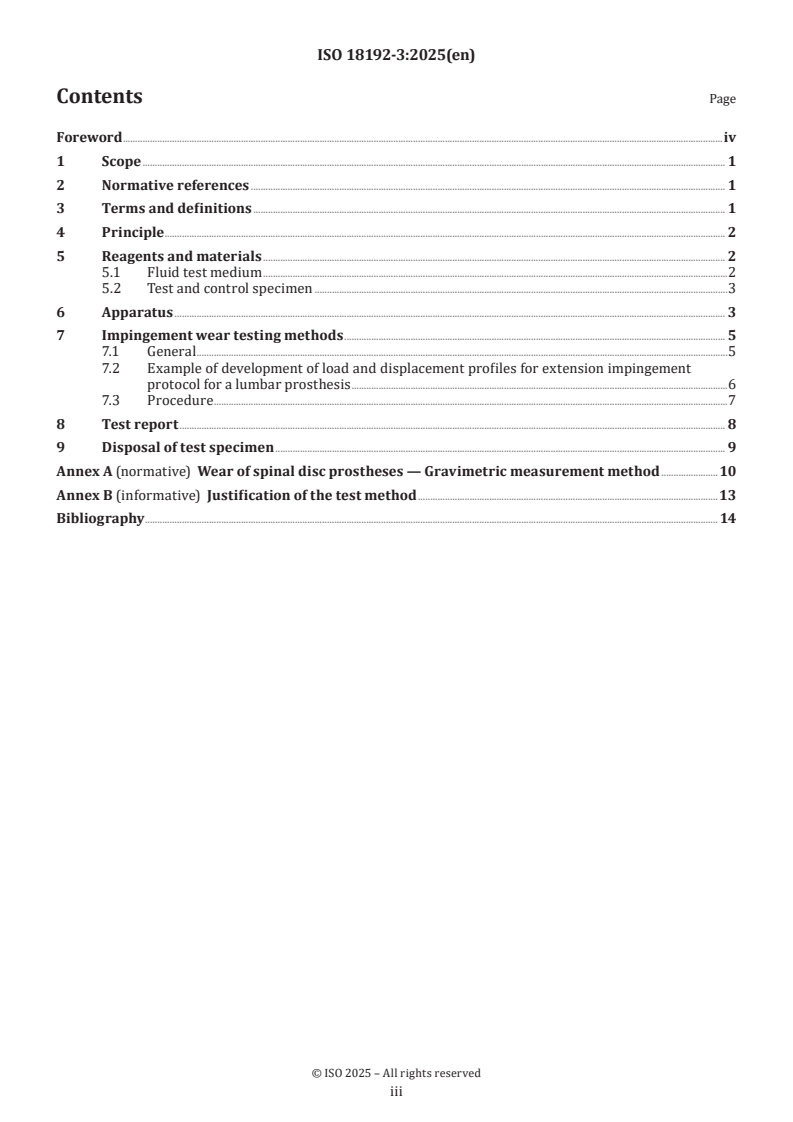
International
Standard
ISO 18192-3
Second edition
Implants for surgery — Wear of
2025-11
total intervertebral spinal disc
prostheses —
Part 3:
Impingement-wear testing and
corresponding environmental
conditions for test of lumbar and
cervical prostheses
Reference number
© ISO 2025
All rights reserved. Unless otherwise specified, or required in the context of its implementation, no part of this publication may
be reproduced or utilized otherwise in any form or by any means, electronic or mechanical, including photocopying, or posting on
the internet or an intranet, without prior written permission. Permission can be requested from either ISO at the address below
or ISO’s member body in the country of the requester.
ISO copyright office
CP 401 • Ch. de Blandonnet 8
CH-1214 Vernier, Geneva
Phone: +41 22 749 01 11
Email: copyright@iso.org
Website: www.iso.org
Published in Switzerland
ii
Contents Page
Foreword .iv
1 Scope . 1
2 Normative references . 1
3 Terms and definitions . 1
4 Principle . 2
5 Reagents and materials . 2
5.1 Fluid test medium .2
5.2 Test and control specimen .3
6 Apparatus . 3
7 Impingement wear testing methods . 5
7.1 General .5
7.2 Example of development of load and displacement profiles for extension impingement
protocol for a lumbar prosthesis .6
7.3 Procedure .7
8 Test report . 8
9 Disposal of test specimen . 9
Annex A (normative) Wear of spinal disc prostheses — Gravimetric measurement method .10
Annex B (informative) Justification of the test method .13
Bibliography . 14
iii
Foreword
ISO (the International Organization for Standardization) is a worldwide federation of national standards
bodies (ISO member bodies). The work of preparing International Standards is normally carried out through
ISO technical committees. Each member body interested in a subject for which a technical committee
has been established has the right to be represented on that committee. International organizations,
governmental and non-governmental, in liaison with ISO, also take part in the work. ISO collaborates closely
with the International Electrotechnical Commission (IEC) on all matters of electrotechnical standardization.
The procedures used to develop this document and those intended for its further maintenance are described
in the ISO/IEC Directives, Part 1. In particular, the different approval criteria needed for the different types
of ISO document should be noted. This document was drafted in accordance with the editorial rules of the
ISO/IEC Directives, Part 2 (see www.iso.org/directives).
ISO draws attention to the possibility that the implementation of this document may involve the use of (a)
patent(s). ISO takes no position concerning the evidence, validity or applicability of any claimed patent
rights in respect thereof. As of the date of publication of this document, ISO had not received notice of (a)
patent(s) which may be required to implement this document. However, implementers are cautioned that
this may not represent the latest information, which may be obtained from the patent database available at
www.iso.org/patents. ISO shall not be held responsible for identifying any or all such patent rights.
Any trade name used in this document is information given for the convenience of users and does not
constitute an endorsement.
For an explanation of the voluntary nature of standards, the meaning of ISO specific terms and expressions
related to conformity assessment, as well as information about ISO's adherence to the World Trade
Organization (WTO) principles in the Technical Barriers to Trade (TBT), see www.iso.org/iso/foreword.html.
This document was prepared by Technical Committee ISO/TC 150, Implants for surgery, Subcommittee SC 5,
Osteosynthesis and spinal devices.
This second edition cancels and replaces the first edition (ISO 18192-3:2017), which has been technically
revised.
The main changes are as follows:
— the scope of this document has been extended to cervical prosthesis;
— values for the impingement testing of cervical prothesis have been integrated.
A list of all parts in the ISO 18192 series can be found on the ISO website.
Any feedback or questions on this document should be directed to the user’s national standards body. A
complete listing of these bodies can be found at www.iso.org/members.html.
iv
International Standard ISO 18192-3:2025(en)
Implants for surgery — Wear of total intervertebral spinal
disc prostheses —
Part 3:
Impingement-wear testing and corresponding environmental
conditions for test of lumbar and cervical prostheses
1 Scope
This document specifies a test procedure to simulate and to evaluate lumbar and cervical spinal disc
prostheses wear under adverse impingement conditions.
2 Normative references
The following documents are referred to in the text in such a way that some or all of their content constitutes
requirements of this document. For dated references, only the edition cited applies. For undated references,
the latest edition of the referenced document (including any amendments) applies.
ISO 7500-1, Metallic materials — Calibration and verification of static uniaxial testing machines — Part 1:
Tension/compression testing machines — Calibration and verification of the force-measuring system
ISO 18192-1, Implants for surgery — Wear of total intervertebral spinal disc prostheses — Part 1: Loading and
displacement parameters for wear testing and corresponding environmental conditions for test
ISO 23788, Metallic materials — Verification of the alignment of fatigue testing machines
3 Terms and definitions
For the purposes of this document, the terms and definitions given in ISO 18192-1 and the following apply.
ISO and IEC maintain terminology databases for use in standardization at the following addresses:
— ISO Online browsing platform: available at https:// www .iso .org/ obp
— IEC Electropedia: available at https:// www .electropedia .org/
3.1
impingement
point at which two opposing components collide or restrict motion usually indicated by a sharp change in
force or moment
3.2
range of motion
ROM
amount of angular displacement that a total disk replacement prosthesis can undergo from the device
neutral position to the point at which impingement (3.1) occurs around a defined global axis
Note 1 to entry: If an implant impinges at 15° from the implant neutral position in flexion and 20° from the implant
neutral position in extension, the implant range of motion can be defined as +15°/-20° in flexion and extension.
3.3
distance between centre of rotation and point of impingement
DCI
distance between the point of impingement (3.1) and the nominal centre of rotation for the flexion, extension
or lateral bending motions
3.4
axial load during impingement
ALI
axial load applied to the device in newtons while the device is in an impinged condition
3.5
axial load minimum
ALM
minimum of the time-varying axial load applied to the device in newtons during the repeated test cycle
3.6
point of impingement
point of contact between two opposing components that results in impingement (3.1)
4 Principle
Based on current clinical evidence, lumbar and cervical spinal disc prostheses have experienced impingement
in extension/flexion, lateral bending, axial rotation and combinations thereof with extension being the most
commonly reported mode.
Adverse impingement testing conditions are determined based on available clinical data, engineering
analysis and other relevant information in the literature. This information is summarized in Annex B and a
justification for the test method is also given in Annex B.
An axial load and a time-varying angular displacement are applied to the test specimens to simulate repeated
contact between design features of the specimens.
Four possible individual impingement scenarios have been identified in the literature:
a) flexion;
b) extension;
c) lateral bending;
d) combined flexion and lateral bending.
In addition, combined axial rotation with any of the aforementioned motion modes should be considered, if
necessary to achieve either a clinically relevant impingement wear scar or worst case impingement scenario,
or both.
A load soak control specimen, if polymers are the object of investigation, is subjected to the same time-
varying force to determine either the creep of the test specimen or the amount of mass change, due to fluid
transfer or both. The test takes place in a controlled environment simulating physiological conditions.
5 Reagents and materials
5.1 Fluid test medium
The fluid test medium consisting of calf serum diluted with de-ionized water (balance) to a concentration of
20 g ± 2 g of protein per litre shall be prepared in accordance with ISO 18192-1. If routine monitoring of the
pH of the fluid test medium is undertaken, the values shall be included in the test report [see Clause 8 m) 7)]
[1]
as an increase in pH can indicate an increase in microbial activity .
5.2 Test and control specimen
Between the inferior and superior components shall be the articulating surface of the inferior and superior
components, attached by its normal immediate backing (e.g. bone cement or a machined replica of the inner
surface of the backing), unless this is impractical due to physical features of the implant system. If the
component forming the articulating surface is fixed to the backing by a rim/snap-fit system, the machined
replica shall provide the same fixation conditions.
If it is not practical to use the normal backing or cement fixation due to physical features of the implant
system, the support system for either the inferior component or the superior component, or both, should
represent normal design features and conditions of use but should allow removal of the component for
measurement of wear without destruction.
It is recommended that six specimens be tested for the impingement-wear test. If less than six specimens are
tested, appropriate justification shall be given.
NOTE The number of specimens tested can be the subject of national legislation.
If polymers are the object of investigation, a load soak control specimen is to be subjected to the same axial
load to determine either the creep of the test specimen or the amount of mass change due to fluid transfer,
or both. The test should take place in a controlled environment of test medium to simulate physiological
conditions (see 5.1).
In the test cases where surrounding fluid is not absorbed by the specimens, test specimens shall be weighed
prior to testing with an instrument having a precision of 0,1 mg.
The tested implant size should be selected by an engineering analysis including theoretical, computational
or experimental methods. If computational methods are used, experimental verification that considers the
point of impingement, the materials in contact and the range of motion of the specimens is recommended.
The point of impingement and the centre of rotation of the bearing are detected in all testing directions. The
combination of implant components with the highest contact stress in the tested direction is selected for the
test. If the materials in contact during impingement change with size, then tests with different implant sizes
should be considered. The number of test specimens of each size should not be less than three with no less
than six test specimens in total.
6 Apparatus
For the kinematical analysis the following testing configuration shall be applied. Deviation from this testing
configuration shall be justified.
6.1 Test machine, in accordance with ISO 7500-1, ISO 23788 and ISO 18192-1 for lumbar and cervical
prosthesis, and capable of associating and replacing the required corresponding angular displacements and
forces (see Clause 7) for each specific protocol of movement.
6.2 Means of mounting and enclosing the test specimen, as specified in ISO 18192-1 for lumbar and
cervical prosthesis.
6.3 Means of aligning and positioning, as specified in ISO 18192-1 for lumbar and cervical prosthesis.
6.4 Motion control system, capable of generating the required angular movements of the inferior
component with an accuracy of ±1° at the maxima and minima of the motion and ±5 % of cycle time phasing.
For multi-station test systems, capabilities shall be assessed with all stations active.
6.5 Force control system, capable of generating a force in the z-direction (see Figure 1), which varies for
each specific protocol of movement, and capable of maintaining the magnitude of the maxima and minima of
this force cycle to a tolerance of ±5 % of the maximum force value for the cycle and ±5 % of the full cycle time
for phasing. For multi-station test systems, capabilities shall be assessed with all stations active.
6.6 Lubrication system, capable of maintaining the contact surfaces immersed in the fluid test medium.
6.7 Temperature control system, as specified in ISO 18192-1.
6.8 Control station(s), capable of applying the loading regime for specific protocol of movement and
incorporating the requirements given in 6.1, 6.2, 6.5, 6.6 and 6.7.
6.9 Coordinate system of the test machine. The origin of the fixed coordinate system of the test
machine (which is consistent with the centre of rotation of the implant) shall be the intersection of the axis
for lateral bending, flexion extension and axial rotation. The machine's former sequence shall be the Euler
sequence used for coordinate transformation. The coordinate system of the test machine shall coincide with
the coordinate system of the upper endplate. All other parts of the specimens shall move relative to this
coordinate system (see Figure 1).
The axial load vector shall be perpendicular to the flexion (Y) and lateral bending (X) axis and shall coincide
with axial rotation (Z) axis in a fixed coordinate system.
The superior endplate may translate along the Z axis and in the XY plane (to avoid shear forces). The inferior
endplate may rotate around all three axis.
The intended movement shall be applied via the inferior endplate. The load shall be applied via the superior
endplate.
Key
1 flexion/extension
2 lateral bending
3 axial rotation
Figure 1 — Coordinate system of the test machine
7 Impingement wear testing methods
7.1 General
Extension, flexion and lateral bending impingement boundary conditions shall be analysed to determine
the worst case clinically relevant conditions to be tested. In addition, the manufacturer should consider
combining axial rotation with any of the aforementioned motion modes, if necessary to achieve a clinically
relevant impingement wear scar and worst case impingement wear or damage.
The nominal device centre of rotation in flexion, extension, lateral bending and axial rotation shall be
determined.
The points of impingement in all testing directions shall be detected and the respective perpendicular
distance the point of impingement and the nominal centre of rotation for the flexion, extension or lateral
bending motions (DCI) determined.
The load and displacement profile shall be developed prior to running the test.
During impingement testing, the device range of motion shall be exceeded by at least 2° in the impingement
direction. In addition, the impingement region shall be offloaded completely each cycle.
The angular displacements applying either flexion, extension, lateral bending or rotation, or all, should be
sinusoidal.
Establish the pattern of load and movement for each selected movement protocol. An example of development
of load and displacement profiles for extension impingement protocol is presented in 7.2.
Table 1 — Recommended impingement motion and loading parameters for lumbar and cervical
total intervertebral spinal disc prostheses
Angular displacement Angular displacement ALM ALI per DCI
minimum in non- limit in impingement
N N·m
impingement direction direction
Lumbar prosthesis 300 7,5
3° past neutral position of ≥2° past point of impinge-
prosthesis ment
Cervical prosthesis 50 3,0
NOTE The ALI, expressed in newtons, is calculated by dividing the value for ALI per DCI from the relevant cell by the value for
DCI, expressed in metres.
7.2 Example of development of load and displacement profiles for extension impingement
protocol for a lumbar prosthesis
Figure 2 shows an example of an impingement load and displacement profile in extension that is based
on applying a moment of 7,5 'N·m' to the device during impingement. In this example, the test starts with
the device in the 0-point position and progresses 3° in flexion. Subsequently, the motion progresses back
through the neutral position to 2° beyond the device range of motion in extension. In this example, lateral
bending and axial rotation are held at neutral.
For some bearing combination, force overshoot can be observed at the point of impingement. Force overshoot
should be minimized.
To apply a 7,5 'N·m' extension moment, the horizontal distance between the centre of the device and DCI
should be measured. The ALI necessary to apply the 7,5 'N·m' impingement motion mode moment during
impingement shall be determined by dividing 7,5 'N·m' by the DCI, expressed in metres.
NOTE 1 The extension moment values a
...