

ISO 15142-3:2003
(Main)Implants for surgery — Metal intramedullary nailing systems — Part 3: Connection devices and reamer diameter measurements
General Information
- Abstract
ISO 15142-3:2003 specifies metallic medical devices used for the temporary intramedullary stabilization of long bones by surgical implantation, classifying and giving other requirements and dimensions for the devices used to insert, remove or both insert and remove intramedullary nails. It also provides a means of measuring reamer diameter. It is applicable to all metal intramedullary fixation devices used for temporary fixation of long bones in the human body, except drive connections for locking elements.
- Status
- Published
- Publication Date
- 12-Aug-2003
- Technical Committee
- ISO/TC 150/SC 5 - Osteosynthesis and spinal devices
- Drafting Committee
- ISO/TC 150/SC 5 - Osteosynthesis and spinal devices
- Current Stage
- 9093 - International Standard confirmed
- Start Date
- 04-May-2022
- Completion Date
- 29-Aug-2026
Overview
ISO 15142-3:2003 sets international requirements for metal intramedullary nailing systems, specifically focusing on connection devices and the measurement of reamer diameters used in surgical procedures. Developed by the International Organization for Standardization (ISO), this standard applies to metallic medical devices intended for the temporary stabilization of long bones through surgical implantation. It classifies and details the requirements and dimensions for devices designed to insert, remove, or both insert and remove intramedullary nails, and provides methods for measuring reamer diameters accurately. These specifications are central in ensuring compatibility, safety, and quality in orthopedic implants and surgical tools.
Key Topics
- Connection Devices: Defines essential requirements for devices used to connect surgical instruments to intramedullary nails during insertion and removal.
- Classification: Categorizes insertion/removal devices by their connection features, such as hooks or parallel external threads.
- Standardized Dimensions: Specifies critical sizes and thread types for connection elements to promote interchangeability among systems.
- Reamer Diameter Measurement: Provides a consistent method to measure the diameter of reamers using ring gauges, ensuring precise sizing and proper function.
- Scope Exclusions: While broadly covering intramedullary nailing systems, drive connections for locking elements are addressed separately in ISO 15142-2.
Applications
ISO 15142-3:2003 is highly relevant for manufacturers, designers, and quality assurance teams within the medical device industry, particularly those involved with orthopedic implants and surgical instrumentation. Practical applications include:
- Product Development: Ensuring new intramedullary nailing systems are designed with standardized connection devices to facilitate safe and efficient surgical procedures.
- Quality Assurance: Providing benchmarks for inspecting device dimensions and verifying the adequacy of reamer diameter markings, thereby helping meet regulatory conformity and improve patient outcomes.
- Interoperability: Facilitating compatibility between different brands or generations of intramedullary nailing systems and accompanying surgical tools through standardized design.
- Training and Education: Offering a clear reference for surgical teams and biomedical engineers on the proper selection and usage of connection devices and reamers during orthopedic surgery.
By adhering to ISO 15142-3, stakeholders can enhance the reliability and safety of temporary bone fixation procedures, reducing the risk of intraoperative complications related to device mismatch or improper sizing.
Related Standards
For comprehensive compliance and best practices within the field of orthopedic surgical implants, the following ISO standards are closely related to ISO 15142-3:
- ISO 15142-1: Intramedullary nails - Outlines requirements for the nail implants themselves.
- ISO 15142-2: Locking components - Covers drive connections for locking elements, supplementing the provisions of Part 3.
- ISO 8319 (all parts): Orthopaedic instruments - Establishes standardized drive connections for orthopedic tools and devices.
- ANSI B1.1: Unified Inch Screw Threads (UN & UNR Thread Forms) - Informative reference for parallel external threads used in connection devices.
Ensuring alignment with ISO 15142-3:2003 and its related standards helps medical device stakeholders promote global harmonization, facilitate regulatory approval, and improve overall surgical outcomes in orthopedics.
Get Certified
Connect with accredited certification bodies for this standard

BSI Group
BSI (British Standards Institution) is the business standards company that helps organizations make excellence a habit.

TÜV Rheinland
TÜV Rheinland is a leading international provider of technical services.

TÜV SÜD
TÜV SÜD is a trusted partner of choice for safety, security and sustainability solutions.
Sponsored listings
Frequently Asked Questions
ISO 15142-3:2003 is a standard published by the International Organization for Standardization (ISO). Its full title is "Implants for surgery — Metal intramedullary nailing systems — Part 3: Connection devices and reamer diameter measurements". This standard covers: ISO 15142-3:2003 specifies metallic medical devices used for the temporary intramedullary stabilization of long bones by surgical implantation, classifying and giving other requirements and dimensions for the devices used to insert, remove or both insert and remove intramedullary nails. It also provides a means of measuring reamer diameter. It is applicable to all metal intramedullary fixation devices used for temporary fixation of long bones in the human body, except drive connections for locking elements.
ISO 15142-3:2003 specifies metallic medical devices used for the temporary intramedullary stabilization of long bones by surgical implantation, classifying and giving other requirements and dimensions for the devices used to insert, remove or both insert and remove intramedullary nails. It also provides a means of measuring reamer diameter. It is applicable to all metal intramedullary fixation devices used for temporary fixation of long bones in the human body, except drive connections for locking elements.
ISO 15142-3:2003 is classified under the following ICS (International Classification for Standards) categories: 11.040.40 - Implants for surgery, prosthetics and orthotics. The ICS classification helps identify the subject area and facilitates finding related standards.
ISO 15142-3:2003 is available in PDF format for immediate download after purchase. The document can be added to your cart and obtained through the secure checkout process. Digital delivery ensures instant access to the complete standard document.
Standards Content (Sample)
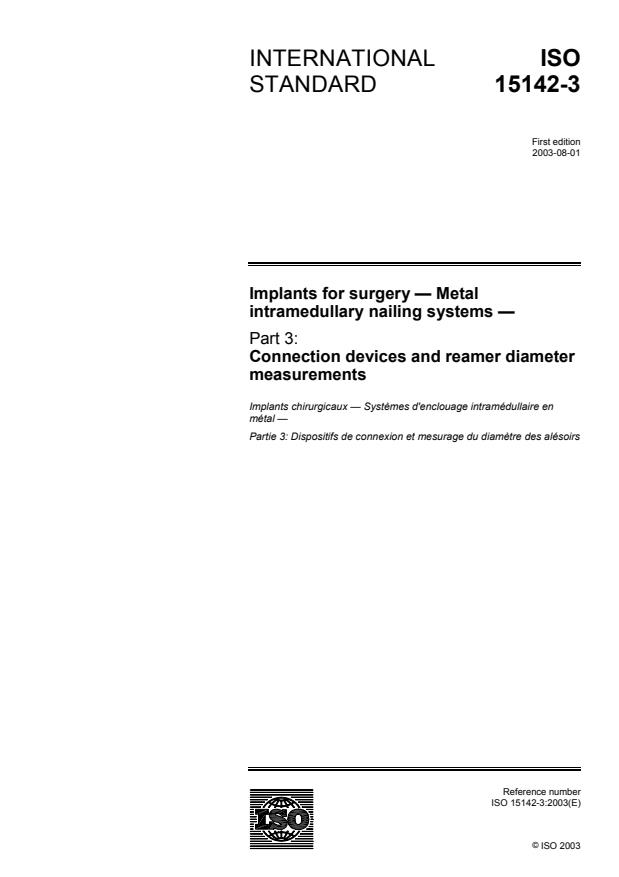
INTERNATIONAL ISO
STANDARD 15142-3
First edition
2003-08-01
Implants for surgery — Metal
intramedullary nailing systems —
Part 3:
Connection devices and reamer diameter
measurements
Implants chirurgicaux — Systèmes d'enclouage intramédullaire en
métal —
Partie 3: Dispositifs de connexion et mesurage du diamètre des alésoirs
Reference number
©
ISO 2003
PDF disclaimer
This PDF file may contain embedded typefaces. In accordance with Adobe's licensing policy, this file may be printed or viewed but
shall not be edited unless the typefaces which are embedded are licensed to and installed on the computer performing the editing. In
downloading this file, parties accept therein the responsibility of not infringing Adobe's licensing policy. The ISO Central Secretariat
accepts no liability in this area.
Adobe is a trademark of Adobe Systems Incorporated.
Details of the software products used to create this PDF file can be found in the General Info relative to the file; the PDF-creation
parameters were optimized for printing. Every care has been taken to ensure that the file is suitable for use by ISO member bodies. In
the unlikely event that a problem relating to it is found, please inform the Central Secretariat at the address given below.
© ISO 2003
All rights reserved. Unless otherwise specified, no part of this publication may be reproduced or utilized in any form or by any means,
electronic or mechanical, including photocopying and microfilm, without permission in writing from either ISO at the address below or
ISO's member body in the country of the requester.
ISO copyright office
Case postale 56 • CH-1211 Geneva 20
Tel. + 41 22 749 01 11
Fax + 41 22 749 09 47
E-mail copyright@iso.org
Web www.iso.org
Published in Switzerland
ii © ISO 2003 — All rights reserved
Contents Page
Foreword. iv
Introduction . v
1 Scope. 1
2 Normative references. 1
3 Terms and definitions. 1
4 Classification and designation . 1
5 Insertion/removal device requirements. 2
6 Measurement of reamer diameter . 2
7 Drive connections for insertion and removal of locking components. 2
Annex A (normative) Hook connection element dimensions . 3
Annex B (informative) ANSI B1.1 parallel external threads. 4
Bibliography . 5
Foreword
ISO (the International Organization for Standardization) is a worldwide federation of national standards bodies
(ISO member bodies). The work of preparing International Standards is normally carried out through ISO
technical committees. Each member body interested in a subject for which a technical committee has been
established has the right to be represented on that committee. International organizations, governmental and
non-governmental, in liaison with ISO, also take part in the work. ISO collaborates closely with the
International Electrotechnical Commission (IEC) on all matters of electrotechnical standardization.
International Standards are drafted in accordance with the rules given in the ISO/IEC Directives, Part 2.
The main task of technical committees is to prepare International Standards. Draft International Standards
adopted by the technical committees are circulated to the member bodies for voting. Publication as an
International Standard requires approval by at least 75 % of the member bodies casting a vote.
Attention is drawn to the possibility that some of the elements of this document may be the subject of patent
rights. ISO shall not be held responsible for identifying any or all such patent rights.
ISO 15142-3 was prepared by Technical Committee ISO/TC 150, Implants for surgery, Subcommittee SC 5,
Osteosynthesis and spinal devices.
ISO 15142 consists of the following parts, under the general title Implants for surgery — Metal intramedullary
nailing systems:
Part 1: Intramedullary nails
Part 2: Locking components
Part 3: Connection devices and reamer diameter measurements
iv © ISO 2003 — All ri
...