


ISO 13628-1:1999
(Main)Petroleum and natural gas industries — Design and operation of subsea production systems — Part 1: General requirements and recommendations
Petroleum and natural gas industries — Design and operation of subsea production systems — Part 1: General requirements and recommendations
La présente partie de l'ISO 13628 constitue un document de base régissant d'autres normes de sous-systèmes qui font partie d'un système de production immergé.Le système de production immergé complet comprend plusieurs sous-systèmes nécessaires pour produire des hydrocarbures provenant d'un ou de plusieurs puits sous-marins à une installation de traitement en mer (fixe, flottante ou sous-marine) ou à terre, ou pour injecter de l'eau / du gaz dans des puits sous-marins. La présente partie de l'ISO 13628 ainsi que les normes de sous-systèmes correspondantes s'appliquent dans les limites des interfaces décrites dans l'article 4.Les équipements spécialisés tels que arbres démontables, arbres de Noël et manifolds dans des enceintes atmosphériques, ne sont pas traités de manière spécifique du fait de leur utilisation limitée, mais les informations fournies s'appliquent à ces types d'équipement.
Industries du pétrole et du gaz naturel — Conception et exploitation des systèmes de production immergés — Partie 1: Exigences générales et recommandations
General Information
- Status
- Withdrawn
- Publication Date
- 10-Mar-1999
- Withdrawal Date
- 10-Mar-1999
- Technical Committee
- ISO/TC 67/SC 4 - Drilling and production equipment
- Drafting Committee
- ISO/TC 67/SC 4/WG 6 - Subsea equipment
- Current Stage
- 9599 - Withdrawal of International Standard
- Start Date
- 15-Nov-2005
- Completion Date
- 12-Feb-2026
Relations
- Effective Date
- 12-Feb-2026
- Effective Date
- 28-Feb-2023
- Effective Date
- 15-Apr-2008
Get Certified
Connect with accredited certification bodies for this standard

ABS Quality Evaluations Inc.
American Bureau of Shipping quality certification.

Element Materials Technology
Materials testing and product certification.

ABS Group Brazil
ABS Group certification services in Brazil.
Sponsored listings
Frequently Asked Questions
ISO 13628-1:1999 is a standard published by the International Organization for Standardization (ISO). Its full title is "Petroleum and natural gas industries — Design and operation of subsea production systems — Part 1: General requirements and recommendations". This standard covers: La présente partie de l'ISO 13628 constitue un document de base régissant d'autres normes de sous-systèmes qui font partie d'un système de production immergé.Le système de production immergé complet comprend plusieurs sous-systèmes nécessaires pour produire des hydrocarbures provenant d'un ou de plusieurs puits sous-marins à une installation de traitement en mer (fixe, flottante ou sous-marine) ou à terre, ou pour injecter de l'eau / du gaz dans des puits sous-marins. La présente partie de l'ISO 13628 ainsi que les normes de sous-systèmes correspondantes s'appliquent dans les limites des interfaces décrites dans l'article 4.Les équipements spécialisés tels que arbres démontables, arbres de Noël et manifolds dans des enceintes atmosphériques, ne sont pas traités de manière spécifique du fait de leur utilisation limitée, mais les informations fournies s'appliquent à ces types d'équipement.
La présente partie de l'ISO 13628 constitue un document de base régissant d'autres normes de sous-systèmes qui font partie d'un système de production immergé.Le système de production immergé complet comprend plusieurs sous-systèmes nécessaires pour produire des hydrocarbures provenant d'un ou de plusieurs puits sous-marins à une installation de traitement en mer (fixe, flottante ou sous-marine) ou à terre, ou pour injecter de l'eau / du gaz dans des puits sous-marins. La présente partie de l'ISO 13628 ainsi que les normes de sous-systèmes correspondantes s'appliquent dans les limites des interfaces décrites dans l'article 4.Les équipements spécialisés tels que arbres démontables, arbres de Noël et manifolds dans des enceintes atmosphériques, ne sont pas traités de manière spécifique du fait de leur utilisation limitée, mais les informations fournies s'appliquent à ces types d'équipement.
ISO 13628-1:1999 is classified under the following ICS (International Classification for Standards) categories: 75.180.10 - Exploratory, drilling and extraction equipment. The ICS classification helps identify the subject area and facilitates finding related standards.
ISO 13628-1:1999 has the following relationships with other standards: It is inter standard links to EN ISO 13628-1:1999, ISO/R 67:1958, ISO 13628-1:2005. Understanding these relationships helps ensure you are using the most current and applicable version of the standard.
ISO 13628-1:1999 is available in PDF format for immediate download after purchase. The document can be added to your cart and obtained through the secure checkout process. Digital delivery ensures instant access to the complete standard document.
Standards Content (Sample)
INTERNATIONAL ISO
STANDARD 13628-1
First edition
1999-02-15
Petroleum and natural gas industries —
Design and operation of subsea production
systems —
Part 1:
General requirements and recommendations
Industries du pétrole et du gaz naturel — Conception et exploitation des
systèmes de production immergés —
Partie 1: Exigences générales et recommandations
A
Reference number
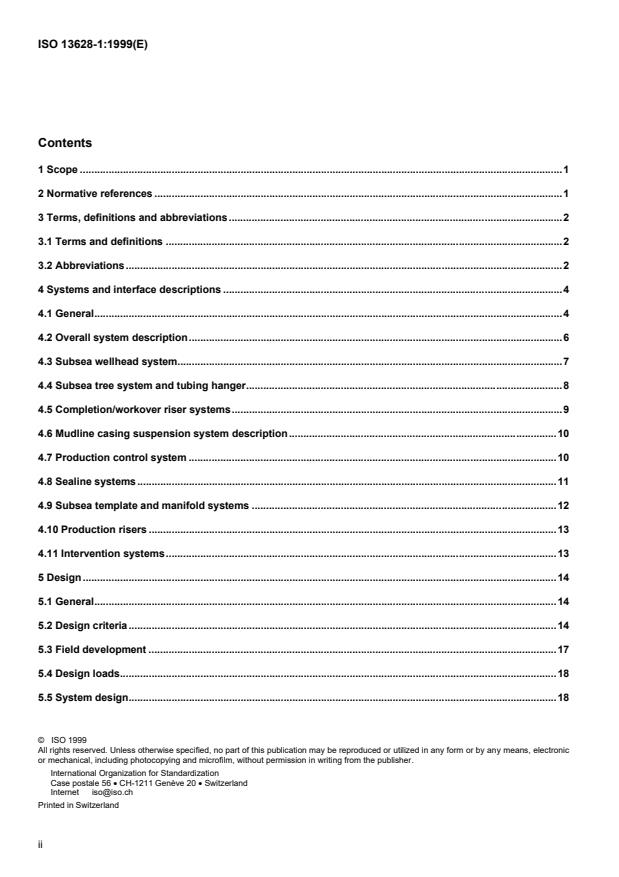
Contents
1 Scope .1
2 Normative references .1
3 Terms, definitions and abbreviations.2
3.1 Terms and definitions .2
3.2 Abbreviations.2
4 Systems and interface descriptions .4
4.1 General.4
4.2 Overall system description.6
4.3 Subsea wellhead system.7
4.4 Subsea tree system and tubing hanger.8
4.5 Completion/workover riser systems.9
4.6 Mudline casing suspension system description.10
4.7 Production control system .10
4.8 Sealine systems.11
4.9 Subsea template and manifold systems .12
4.10 Production risers .13
4.11 Intervention systems.13
5 Design.14
5.1 General.14
5.2 Design criteria.14
5.3 Field development .17
5.4 Design loads.18
5.5 System design.18
© ISO 1999
All rights reserved. Unless otherwise specified, no part of this publication may be reproduced or utilized in any form or by any means, electronic
or mechanical, including photocopying and microfilm, without permission in writing from the publisher.
International Organization for Standardization
Case postale 56 • CH-1211 Genève 20 • Switzerland
Internet iso@iso.ch
Printed in Switzerland
ii
© ISO
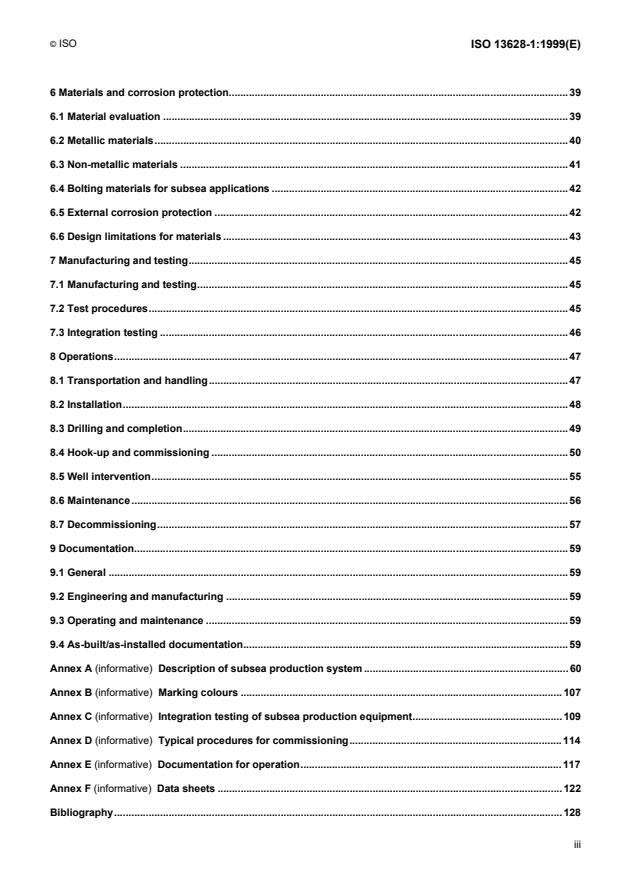
6 Materials and corrosion protection. 39
6.1 Material evaluation . 39
6.2 Metallic materials. 40
6.3 Non-metallic materials . 41
6.4 Bolting materials for subsea applications . 42
6.5 External corrosion protection . 42
6.6 Design limitations for materials . 43
7 Manufacturing and testing. 45
7.1 Manufacturing and testing. 45
7.2 Test procedures. 45
7.3 Integration testing . 46
8 Operations. 47
8.1 Transportation and handling. 47
8.2 Installation. 48
8.3 Drilling and completion. 49
8.4 Hook-up and commissioning . 50
8.5 Well intervention. 55
8.6 Maintenance . 56
8.7 Decommissioning. 57
9 Documentation. 59
9.1 General . 59
9.2 Engineering and manufacturing . 59
9.3 Operating and maintenance . 59
9.4 As-built/as-installed documentation. 59
Annex A (informative) Description of subsea production system . 60
Annex B (informative) Marking colours . 107
Annex C (informative) Integration testing of subsea production equipment. 109
Annex D (informative) Typical procedures for commissioning. 114
Annex E (informative) Documentation for operation. 117
Annex F (informative) Data sheets . 122
Bibliography. 128
iii
© ISO
Foreword
ISO (the International Organization for Standardization) is a worldwide federation of national standards bodies (ISO
member bodies). The work of preparing International Standards is normally carried out through ISO technical
committees. Each member body interested in a subject for which a technical committee has been established has
the right to be represented on that committee. International organizations, governmental and non-governmental, in
liaison with ISO, also take part in the work. ISO collaborates closely with the International Electrotechnical
Commission (IEC) on all matters of electrotechnical standardization.
International Standards are drafted in accordance with the rules given in the ISO/IEC Directives, Part 3.
Draft International Standards adopted by the technical committees are circulated to the member bodies for voting.
Publication as an International Standard requires approval by at least 75 % of the member bodies casting a vote.
International Standard ISO 13628-1 was prepared by Technical Committee ISO/TC 67, Materials, equipment and
offshore structures for petroleum and natural gas industries, Subcommittee SC 4, Drilling and production
equipment.
ISO 13628 consists of the following parts, under the general title Petroleum and natural gas industries — Design
and operation of subsea production systems:
Part 1: General requirements and recommendations
Part 2: Flexible pipe systems for subsea and marine applications
Part 3: Through flowline (TFL) systems
Part 4: Subsea wellhead and tree equipment
Part 5: Subsea control umbilicals
Part 6: Subsea production control systems
Part 7: Workover/completion riser systems
Part 8: Remotely Operated Vehicle (ROV) interfaces on subsea production systems
Part 9: Remotely Operated Tool (ROT) intervention systems
Annexes A, B, C, D, E and F of this part of ISO 13628 are for information only.
iv
© ISO
Introduction
This part of ISO 13628 has been prepared to provide general requirements, recommendations and overall guidance
for the user to the various areas requiring consideration during development of a subsea production system for the
petroleum and natural gas industries. The functional requirements defined in this part of ISO 13628 will allow
alternatives in order to suit specific field requirements. The intention is to facilitate and complement the decision
process rather than replace individual engineering judgement and, where requirements are non-mandatory, provide
positive guidance for the selection of an optimum solution.
This part of ISO 13628 constitutes the overall subsea production system standard, with the intention that the more
detailed requirements for the subsystems are retained in the complementary parts of ISO 13628. However, in some
areas (e.g. structures, manifolds, marking) detailed requirements are included herein, as these subjects are not
covered in a subsystem standard.
This part of ISO 13628 was developed on the basis of API RP 17A, Design and Operation of Subsea Production
Systems, and other relevant documents on subsea production systems.
v
INTERNATIONAL STANDARD © ISO ISO 13628-1:1999(E)
Petroleum and natural gas industries — Design and operation of
subsea production systems —
Part 1:
General requirements and recommendations
1 Scope
This part of ISO 13628 provides general requirements and overall recommendations for development of complete
subsea production systems from the design phase to decommissioning. This part of ISO 13628 forms a top-level
document to govern other standards dealing with subsystems typically forming a part of a subsea production
system.
The complete subsea production system comprises several subsystems necessary to produce hydrocarbons from
one or more subsea wells to a given processing facility located offshore (fixed, floating or subsea) or onshore, or to
inject water/gas through subsea wells. This part of ISO 13628 and the subsystem standards apply as far as the
interface limits described in clause 4.
Specialized equipment, such as split trees and trees and manifolds in atmospheric chambers, are not specifically
discussed because of their limited use. However, the information presented is applicable to those types of
equipment.
2 Normative references
The following normative documents contain provisions which, through reference in this text, constitute provisions of
this part of ISO 13628. For dated references, subsequent amendments to, or revisions of, any of these publications
do not apply. However, parties to agreements based on this part of ISO 13628 are encouraged to investigate the
possibility of applying the most recent editions of the normative documents indicated below. For undated
references, the latest edition of the normative document referred to applies. Members of ISO and IEC maintain
registers of currently valid International Standards.
ISO 898-1, Mechanical properties of fasteners made of carbon steel and alloy steel — Part 1: Bolts, screws and
studs.
ISO 898-2, Mechanical properties of fasteners made of carbon steel and alloy steel — Part 2: Nuts with specified
proof load value.
ISO 10423, Petroleum and natural gas industries — Drilling and production equipment — Wellhead and christmas
tree equipment.
ISO 13628-3, Petroleum and natural gas industries — Design and operation of subsea production systems —
Part 3: Through flowline (TFL) systems.
1)
ISO 13628-4:— , Petroleum and natural gas industries — Design and operation of subsea production systems —
Part 4: Subsea wellhead and tree equipment.
1)
To be published.
© ISO
ISO 13628-6, —
Petroleum and natural gas industries — Design and operation of subsea production systems
Part 6: Subsea production control systems.
ISO 13819-1, Petroleum and natural gas industries — Offshore structures — Part 1: General requirements.
ISO 13819-2, Petroleum and natural gas industries — Offshore structures — Part 2: Fixed steel structures.
ANSI/ASME B31.8, Gas Transmission and Distribution Piping Systems.
2)
API RP 17C , TFL (Trough Flowline) Systems.
3)
API RP 17G , Design and Operation of Completion/Workover Riser Systems.
ASTM A 193, Specification for Alloy — Steel and Stainless Steel Bolting Materials for High Temperature Service.
ASTM A 320, Specification for Alloy Steel Bolting Materials for Low-Temperature Service.
3 Terms, definitions and abbreviations
For the purposes of this part of ISO 13628, the following terms, definitions and abbreviations apply.
3.1 Terms and definitions
3.1.1
sealine
flowline, service line, cable, umbilical or pipeline
NOTE For description of pressure and temperature ratings, the definition given in the applicable subsystem standard and
other relevant standards and design codes is used.
3.2 Abbreviations
ADS atmospheric diving suit
API American Petroleum Institute
BOP blow-out preventer
BS&W basic sediment and water
CRA corrosion-resistant alloy
DCV directional control valve
DFI design, fabrication, installation
DFO documentation for operation
EDP emergency disconnect package
EFC European Federation of Corrosion
ESD emergency shutdown
2)
For the purposes of this part of ISO 13628, API RP 17C will be replaced by ISO 13628-3 when the latter becomes publicly
available.
3)
For the purposes of this part of ISO 13628, API RP 17G will be replaced by ISO 13628-7 when the latter becomes publicly
available.
© ISO
ESP electrical submersible pump
FAT factory acceptance test
FPU floating production unit
GOR gas-oil ratio
GRP glass-fibre-reinforced plastic
HAT highest astronomical tide level
HAZOP hazards in operation analysis
HB Brinell hardness
HIPPS high integrity pipeline protection system
HPU hydraulic power unit
HV Vickers hardness
IMR inspection, maintenance and repair
IRJ instrument riser joint
ISO International Organization for Standardization
LAT lowest astronomical tide level
LMRP lower marine riser package (for drilling)
LMV lower master valve
LRP lower riser package (for workover)
MIV methanol injection valve
NACE National Association of Corrosion Engineers
NDE nondestructive examination
PC personal computer
PCDA plant control and data acquisition system
PCS production control system
PGB permanent guide base
PLC programmable logical controller
PMV production master valve
PRE pitting-resistance equivalent
PSD process shutdown
PSV production swab valve
PWV production wing valve
© ISO
P&A plug and abandonment
RAL “Reichsausschuss für Lieferbedingungen”. A colour system used by German paint manufacturers
ROT remotely operated tool
ROV remotely operated vehicle
SAS safety and automation system
SAFOP safety in operation analysis
SCM subsea control module
SCSSV surface-controlled subsurface safety valve
SEM subsea electronic module
SMYS specified minimum yield strength
TFL through-flowline system
THRT tubing hanger running tool
TLP tension leg platform
TRSCSSV tubing-retrievable surface-controlled subsurface safety valve
TRT tree running tool
UNS unified numbering system
UPS uninterruptable power supply
UTM universal transversal mercator
VDU visual display unit
WHP wellhead pressure
XT tree
XTRT tree running tool
4 Systems and interface descriptions
4.1 General
Complete subsea production systems range in complexity from a single satellite well with a flowline linked to a fixed
platform, to several wells on a template producing to a floating facility.
The elements of a typical subsea production system are shown in Figure 1. These are wellheads (both subsea and
mudline casing suspension systems) and trees, sealines and end connections, controls, control lines, single-well
structures, templates and manifolds, ROVs/ROTs and completion/workover and production risers (both rigid and
flexible). In some areas (not covered by subsystem standards), detailed requirements are included (these apply to
structures, manifold piping, materials, colour and marking).
The objective of this subclause is to describe the systems in general and define the subsystem interfaces. For a
detailed description of subsystems and components, see annex A.
© ISO
A schematic drawing illustrating typical elements of a subsea production system is shown in Figure 2.
Key
1 Running and retrieving tools 7 Production controls
2 Installation and workover controls 8 Production riser
3 Completion riser and control lines 9 Riser base
4 Satellite well 10 Manifold
5 Template 11 Export
6 Sealines
Figure 1 — Typical development scenarios
© ISO
NOTE For satellite wells directly tied back to the platform, several of the above-mentioned elements are eliminated.
Figure 2 — Typical elements in a subsea production system
4.2 Overall system description
4.2.1 General
Subsea production or injection systems are used to develop reservoirs, or parts of reservoirs, of a nature which
dictates drilling of the wells from more than one location. Subsea production systems may also be used to develop
reservoirs or parts of reservoirs beyond the reach of platform drilling facilities. Deep water may also in itself dictate
development of a field by means of subsea completions.
The main elements of a subsea production or injection system are:
a wellhead system with associated casing strings and production/injection tubing;
a structural foundation and a guidance system for orientation and lateral guidance of modules during
installation/retrieval. This unit is not always used;
a set of flow and pressure control valves normally integrated in a tree;
a production control system for remote monitoring and control of all subsea functions;
© ISO
a protective structure (optional);
a sealine system;
a manifold system (optional);
installation and intervention equipment and tools with associated control systems.
The elements of the subsea production/injection system may be configured in numerous ways, dictated by specific
field requirements and by operator strategy.
The most common configurations are:
single satellite wells tied individually to a surface processing facility;
one or more satellite wells tied individually to a subsea manifold located a given distance from the surface
processing facility;
multiple wells located on a common template incorporating a manifold.
In the following, the main characteristics of these scenarios are briefly described.
4.2.2 Single satellites
For relatively shallow water, this configuration is characterized by short offset (outside the drilling reach of the host
platform if this is a combined drilling production facility) and, if an infrastructure with a surplus of tie-in capacity
exists, this scenario can be very effective. In terms of required permanent works this is basically a single satellite
development copied a number of times over. Usually the flowline and umbilical are required to be installed as first-
end tie-in at the infrastructure and second end pull-in at the satellites in order to limit congestion on the seabed
around the infrastructure.
Flowline and umbilical are for some systems connected directly to the tree structure. This approach offers some
rationalization in hardware.
4.2.3 Manifold/satellite cluster
This concept is based on tie-in of a number of single satellites to a central manifold. The manifold in turn is tied to
the infrastructure by means of one or more sealines. An arrangement including two production flowlines with same
size, service and control lines is quite common. This arrangement facilitates operation of wells at two different
pressure levels simultaneously, as well as convenient round-trip pigging.
The system has flexibility with respect to simultaneous drilling and production, which can save some drilling time,
and has flexibility with respect to installing wells in optimal locations rather than in batches at the same location, ref.
template arrangement described below.
4.2.4 Template
This concept includes some of the features described in the previous subclause, but with some notable differences.
The wells and the manifolds are located on the same structure. Headers and lines often have much of the same
configuration as the manifold/cluster option. Template designs have some additional mechanical tolerance problems
relative to cluster designs.
4.3 Subsea wellhead system
4.3.1 General
The main function of a subsea wellhead system is to serve as a structural and pressure-containing anchoring point
on the seabed for the drilling and completion systems and for the casing strings in the well. The wellhead system
incorporates internal profiles for support of the casing strings and isolation of the annuli. In addition, the system
incorporates facilities for guidance, mechanical support and connection of the systems used to drill and complete
the well.
© ISO
4.3.2 Wellhead system elements
A typical wellhead system consists of the following elements:
a) a drilling guidebase with a central opening for drilling of the first section of the well and facilities for attachment
of guidelines. The temporary guidebase, acts as a support for the permanent guidebase, providing a controlled
reference point for wellhead elevation. Note that on single satellite wells the drilling guidebase may be omitted if
there are no requirements for accurately controlled elevation of the wellhead. On multiple well templates, the
drilling guidebase forms an integral part of the template;
b) a permanent guidebase with facilities for attachment to the conductor housing, and guidance of the drilling and
completion equipment (universal guide frame, BOP, production tree). If used together with a temporary
guidebase, the permanent guidebase incorporates a gimbal arrangement on the under side (curved profiles
that interfaces with a cone landing area on the temporary guidebase) to compensate for any angular
misalignment between the temporary guidebase and the permanent guidebase due to the seabed topography,
and the verticality of the well;
NOTE On satellite wells, depending on the overall tree configuration, the permanent guidebase may be replaced by
a production guidebase, prior to installation of the tree, incorporating facilities for pull-in and connection of the sealines
and connection to the tree. Alternatively, a production guidebase can be designed to serve as both the drilling guidebase
and the production guidebase. It can be either permanent or retrievable. The sealines may also be connected directly to
the tree.
c) a conductor housing welded to the conductor casing, which forms the initial anchoring point to the seabed. The
conductor housing incorporates an internal landing shoulder for the wellhead housing, and facilities on the
outside for attachment of the permanent guidebase. The conductor housing may be installed together with the
permanent guidebase;
d) a wellhead housing with internal profiles for support of all subsequent casing strings and the tubing hanger, and
external profiles for attachment of the drilling and completion equipment (BOP, tree) and landing in 762 mm
(30 in) housing;
e) casing hangers with seal and lock-down assemblies for suspension of the casing strings and isolation of the
annuli.
4.3.3 Running and retrieving tools
Dedicated tools are used to install, test and retrieve the various elements of the wellhead system. The tools are
activated by either mechanical manipulation of the drill string (push, pull, rotation) or in some cases by hydraulic
functions through the drill string or dedicated hydraulic lines. These tools interface with dedicated handling profiles
in the associated equipment.
4.3.4 Miscellaneous wellhead equipment
A set of wear bushings is used to protect the internals of the wellhead at various stages of the drilling/completion
operation.
4.4 Subsea tree system and tubing hanger
4.4.1 General
The equipment required to complete a subsea well for production or injection operations incorporates a tubing
hanger and a tree. The subsea tree and the wellhead system form the barrier between the reservoir and the
environment in the production mode. In the installation/ workover mode the barrier function is transferred to a LRP
or BOP.
There are two main categories of trees, conventional and horizontal. The conventional tree is described as the main
option, whilst the characteristics of the horizontal tree are described in 4.4.6.
In conventional subsea completions, the tubing hanger is installed inside the wellhead. The tree is installed on top of
the wellhead. The tubing hanger forms the connection between the production/injection tubing and the tree. During
installation and workover, the tree production/injection and annulus valves are locked open or held open
© ISO
hydraulically to allow access to the wellbores. The well barrier function is then covered by a lower riser package
installed between the riser and the tree.
4.4.2 Tubing hanger
The tubing hanger system supports the tubing string and isolates the annulus between the tubing and the casing.
The tubing hanger is locked down inside the wellhead and includes seal bores for connection with bore extension
subs from the tree.
4.4.3 Tree
The tree consists of a valve block with bores and valves configured in such a manner that fluid flow and pressure
from the well can be controlled for both safety and operational purposes. The tree includes a connector for
attachment to the wellhead. The connector forms a pressure-sealing connection to the wellhead and includes bore
extension subs from the tree to the tubing hanger, forming pressure-sealing conduits from the main bore and
annulus of the well to the tree and additional conduits as required.
External flow loops provide fluid paths between the bores of the tree and the flowline connection point. The flowline
may be connected either directly to the tree, or via flow loops on a production guidebase. The flowline connection
joins the tree with the subsea flowline, using a choice of connections described in annex A.
4.4.4 Tree cap
A tree cap is usually installed on top of the tree to prevent marine growth on the tree upper connection and seal
bores. The cap may either be pressure-containing or purely a protective cap, depending on the barrier configuration
of the tree. The tree cap could incorporate facilities to convert certain functions of the tree from workover control
mode to production control mode.
4.4.5 Tree running tool/lower riser package
The tree running tool is used to install the tree, and consists of a connector interfacing the top of the tree. It is often
combined with a lower riser package containing a set of safety valves to control the well during installation/workover
operations. The lower riser package may include valves capable of cutting wire and coiled tubing.
4.4.6 Horizontal tree
The main difference between a conventional tree and a horizontal tree is that the horizontal tree is designed to be
installed prior to the tubing hanger, and that the tubing hanger, when installed, is located inside the tree instead of
the wellhead. Horizontal trees are configured with the valves located in the horizontal bore sections of the tree, in
order to provide a large vertical bore through the tree. In installation/workover mode the well barrier function is
covered by a conventional drilling BOP connected to the top of the tree, with a tubing safety valve inside the BOP,
as part of the tubing hanger running string.
4.5 Completion/workover riser systems
4.5.1 A completion riser is generally used to run the tubing hanger and tubing through the drilling riser and BOP
into the wellbore. A workover riser is typically used in place of a drilling riser to reenter the well through the tree. The
completion and workover riser may be a common system with items added or removed to suit the task being
performed.
4.5.2 Either type of riser provides communication between the wellbore and surface equipment. Both resist mass
and pressure loads and accommodate wireline tools for necessary operations. The workover riser also resists
external loading.
4.5.3 The interfaces are naturally defined at the physical connection points with the other subsea and surface
equipment to which they attach. For the completion riser, these are typically the subsea tree mandrel and surface
tree riser-tensioning system.
© ISO
4.6 Mudline casing suspension system description
Mudline casing suspension systems are designed to be used with bottom-supported drilling rigs (jack-ups),
4.6.1
tension leg platforms, etc. The systems provide a suspension point near the mudline to support the mass of casing
strings within the wellbore. The conductor and casing strings with their respective annuli are tied back to the
surface, where they are terminated in conventional wellhead equipment with a surface BOP, or surface tree.
4.6.2 Wells drilled with mudline casing suspension systems can be completed with a subsea tree, provided proper
adaptation for subsea completion is made.
4.6.3 In general, mudline suspension completions are best suited for shallow-water applications where wellhead
strength/robustness is not an issue.
4.7 Production control system
4.7.1 General
Production control systems appear in several major architectures (see annex A). Only the two most common
systems are described in this subclause.
4.7.2 Direct hydraulic control system
This is a simple type of system, characterized by cost-effectiveness and high-reliability for simple tasks, i.e. control
of single satellites tied back to an infrastructure located at a short distance. For more complex scenarios with
manifolded multiple-well completions, long offsets and/or deep water, this system architecture is not cost-effective
and does not offer optimum performance.
The system consists basically of an HPU and a valve panel (often controlled by means of a PLC-type industrial
computer) located at the infrastructure usually with one control umbilical per well and a simple interface to the tree
actuators. Normally the instrument requirements for single satellites are modest, and most of the sensors may be
located on the surface infrastructure. For several satellites tied back to a platform, congestion and requirements for
J-tubes can represent a complication (one umbilical per tree).
Single satellites typically require only a few subsea process sensors. Direct wiring back to the infrastructure for one
or two instruments is typical.
4.7.3 Electrohydraulic multiplexed systems
For any combination of manifolded wells, long offsets, and/or deep water, this system architecture is preferred for
cost and performance effectiveness. Electrohydraulic systems usually include the following components:
a) topside computer;
This is usually a dedicated unit which interfaces with the ESD system, the SAS system, the UPS and the HPU.
b) the HPU;
This unit provides the hydraulic power supply, usually two pressure levels, for actuation of subsea and
downhole valve actuators. It interfaces with the SAS system.
c) electrical power unit;
This unit provides power at the desired voltage and frequency to feed the subsea users. It may interface with
the UPS.
d) modem units;
These units modulate communication signals for transmission on the control umbilical. Some systems use
communication superimposed on the power lines.
e) control umbilical;
The control umbilical has electrical wires for power and communication, hydraulic conduits for chemical
injection purposes, annulus access, and hydraulic power transmission. It interfaces with the platform hangoff
arrangement topsides and well tree/structure (satellite case) or the manifold subsea (manifolded option). In
some cases electrical and hydraulic functions are provided in separate umbilicals.
© ISO
f)
control modules and base plates;
These modules represent the most critical components with respect to reliability. They invariably contain one or
two SEMs as interface circuitry for sensors, modems, valve drivers, etc. The hydraulic outputs from the control
modules are directed to tree actuators and downhole functions. The interface with the tree is of particular
importance in terms of system design. A control module usually has hydraulic accumulators for storage of
energy. A control module also contains a hydraulic manifold with DCVs which facilitate control of hydraulic
pressure in the tree actuators.
The base plate which interfaces with the control module has stab connectors (electrical and hydraulic) to match
those of the control module. This is the interface point between the tree and the SCM. The latter also has an
interface with the SCM running tool which is used to replace failed modules.
g) process sensors;
An installation of this type is usually equipped with several process sensors. They are interfaced to the control
module via the base plate. Most process sensors are only retrievable with the tree and are thus required to be
of highly reliable design.
h) manifold/tree wiring and tubing;
Both the manifold and the trees have electrical and hydraulic distribution for power, communication and
output/input functions. Wet mateable stab connectors are used to interface with the control module base plate,
umbilical, etc.
i) interface with the workover control system.
It is common practice that some valve actuator function lines from the SCM are routed via the tree cap such as
to isolate all connections between the PCS and the valve actuators. Thus only the rig-based control system
may operate vertical valves in the tree during workover operations. Certain control module functions may be
used from the work-over control system during work-over operations.
4.8 Sealine systems
4.8.1 This subclause describes in general subsea sealines and end connectors used in a subsea production
system, and covers the unique factors of subsea systems which are: high pressure, multiphase flow, multiple lines,
subsea connections, TLFs and pigging traps.
4.8.2 Sealines may be dedicated to a number of purposes, including the following:
a) flowlines for production;
b) gathering lines;
c) injection lines;
d) service lines (test, kill, etc.).
4.8.3 Components used in a sealine system may include the following:
a) connector;
b) spool (short piping segment commonly used in connecting pipelines);
c) safety joint (weak links) (device designed to fail at a predetermined structural load).
4.8.4 Purpose-built special tools are often used for pulling in and making sealine connections, particularly in water
depths requiring diverless operations.
4.8.5 After placing a sealine on the seabed, it may be necessary to reposition the ends, modify them (by adding
extensions), or both, so that a connection can be made without further gross adjustment. If TFL or pigging is
specified, then the bends, welds, etc., of the line configuration should comply with API RP 17C or specific pigging
requirements.
© ISO
A sealine system begins with both halves of the connector used at the subsea facility and ends with one of
4.8.6
the following:
a) both halves of a connector used at another subsea facility;
b) the sealine side of a surface connection or weld at the top of a platform riser;
c) at the static flowline to dynamic riser interface/connection;
d) the interface to the flexible pipe is typically at the flanges on the end fitting.
4.8.7 Sealines may be buried (trenched or rockdumped) for protection and/or thermal insulation purposes.
Protection may also be necessary in order to avoid buckling/expansion problems.
4.9 Subsea template and manifold systems
4.9.1 General
The description includes all template and manifold systems supported on the seabed which may incorporate and
physically support wellheads, drilling and production risers, pipeline connections, trees, manifolds, control system
components and protective framing.
4.9.1.1 Template
Production from the templates may flow to floating production systems, platforms, shore or other remote facilities. A
template typically comprises a structure that provides a guide for drilling and/or support for other equipment, and
provisions for establishing a foundation (piled or gravity-based).
The template is typically used to group several subsea wells at a single seabed location. Templates may be of a
unitized or modular design. Several types of template are described below. Actual templates may combine features
of more than one of these types.
4.9.1.2 Well spacer/tieback template
A multiwell template used as a drilling guide to pre-drill wells prior to installing a surface facility. The wells are
typically tied back to the surface facility during completion. The wells could also be completed subsea, with
individual risers back to the surface.
4.9.1.3 Multiwell/manifold template
A template with multiple wells drilled through it and supporting a manifold system.
4.9.1.4 Manifold template
A template used to support a manifold for produced or injected fluids. Wells would not be drilled through such a
template, but may be located near it or in the vicinity of the template.
4.9.1.5 Riser base
A template which supports a marine production riser or loading terminal, and which serves to react loads on the
riser throughout its service life.
4.9.1.6 Modular template
A template assembled in modules around a base structure (often the first well). These modules may or may not be
of a cantilevered design.
4.9.2 Manifold
A system of headers, branched piping and valves used to gather produced fluids or to distribute injected fluids. A
manifold system may also provide for well testing and well servicing if TFL capability is included along with annulus
monitoring and bleed capability. The associated equipment may include valves, connectors for pipeline and tree
© ISO
interfaces, chokes for flow control, and TFL diverters. The manifold system may also include control system
equipment such as a distribution system for hydraulic and electrical functions, as well as providing interface
connections to control modules. All or part of the manifold may be retrievable such that it can be installed with the
template or separately at a later date if required.
4.9.3 Interfaces
The manifold and associated flowlines shall be made to a piping code, e.g. ANSI/ASME B31.8, with interfaces at the
weld, flange or coupling to connecting equipment.
4.10 Production risers
4.10.1 The portion of a pipeline extending from the seabed to the surface is termed a production riser. Examples
include
a) conventional riser, consisting of rigid piping attached to the platform structure and serving as the pipeline;
b) J-tube riser, for rigid pipe, and J-tube or I-tube riser, for flexible pipe which permits installation of the pipeline
without connections on the seafloor and consists of rigid conduit attached to the platform through which the
pipelines are pulled;
c) flexible pipe riser, consisting of flexible pipe attached to a platform (in a manner similar to a conventional riser)
or suspended from a floating facility;
d) riser from a subsea template.
The function of a subsea production riser is to provide conduit(s) for hydrocarbons or injection fluids between the
sea-floor equipment and the production facility. The risers and support structures may also provide support for
auxiliary lines and control umbilicals.
4.10.2 Production risers fall into three broad design types: rigid pipe riser, flexible pipe riser and combinations of
rigid and flexible pipe.
4.11 Intervention systems
Remotely operated intervention systems fall into two principal categories: swimming vehicles and surface-run
tooling.
Intervention systems may be operated by divers (including ADS), remotely operated vehicles (ROVs) or dedicated
remotely operated tooling (ROTs), and are typically used for
inspection;
operation of valves;
injection or sampling of fluids;
installation and recovery of equipment;
connection of sealines.
ROVs are near-neutral buoyant submersible vehicles that may be used to perform tasks such as valve operations,
hydraulic stab and general manipulator tasks. They can also carry tooling packages to undertake specific tasks,
such as pull-in and connection of sealines, and component replacem
...
Questions, Comments and Discussion
Ask us and Technical Secretary will try to provide an answer. You can facilitate discussion about the standard in here.
Loading comments...