

ISO 13354:2014
(Main)Petroleum and natural gas industries — Drilling and production equipment — Shallow gas diverter equipment
General Information
- Abstract
ISO 13354:2014 specifies requirements for the selection of the diverter equipment for rigs used to drill shallow-gas-bearing formations. It covers both onshore and offshore drilling operations, and considers also the auxiliary equipment associated with floating rigs. The specified requirements concern the following diverter equipment: annular sealing devices; vent outlets; diverter valves; diverter piping. ISO 13554:2014 highlights the concerns associated with the selection of a marine floating drilling support. It covers safety issues concerning key rig equipment, and important steps of action required prior to starting the drilling operations. It provides only general guidelines regarding the response to be given to a shallow-gas flow.
- Status
- Published
- Publication Date
- 15-May-2014
- Technical Committee
- ISO/TC 67/SC 4 - Drilling and production equipment
- Drafting Committee
- ISO/TC 67/SC 4/WG 2 - Drilling well control equipment
- Current Stage
- 9093 - International Standard confirmed
- Start Date
- 07-Sep-2026
- Completion Date
- 12-Sep-2026
Buy Documents




ISO 13354:2014 - Petroleum and natural gas industries -- Drilling and production equipment -- Shallow gas diverter equipment


ISO 13354:2014 - Petroleum and natural gas industries — Drilling and production equipment — Shallow gas diverter equipment/16/2014



ISO 13354:2014 - Industries du pétrole et du gaz naturel -- Équipements de forage et de production -- Équipement déflecteur pour gaz de surface

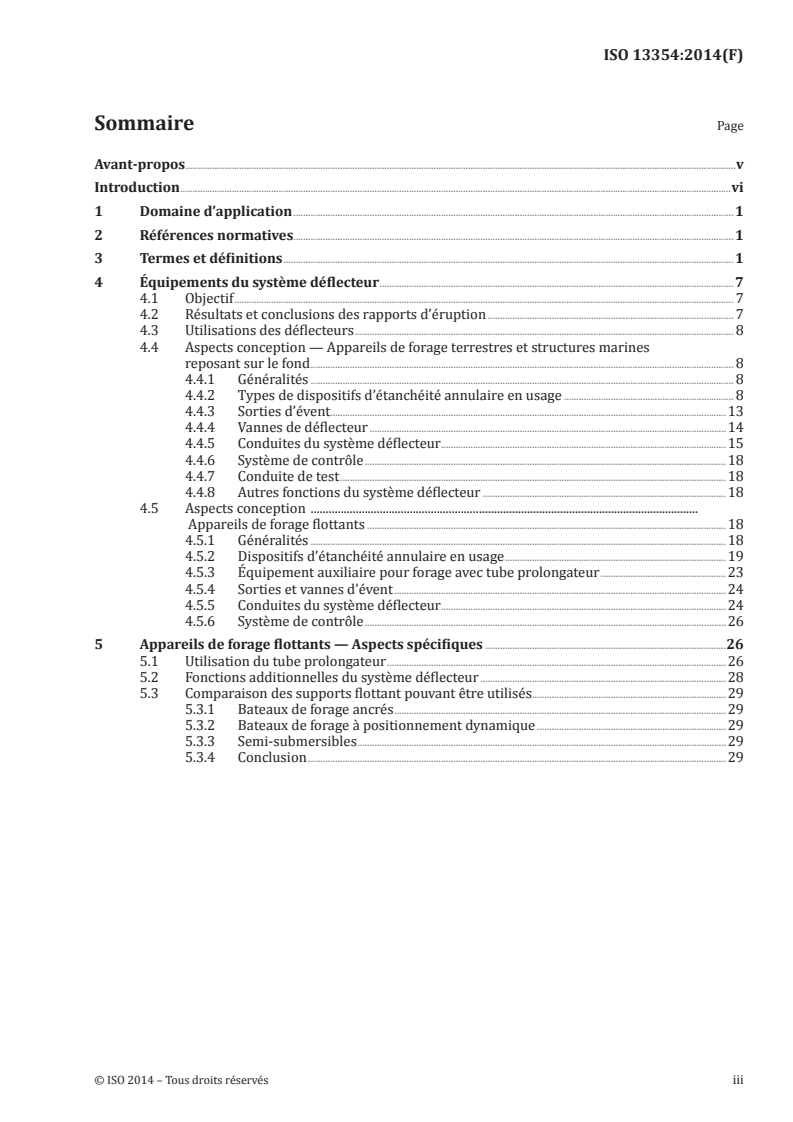
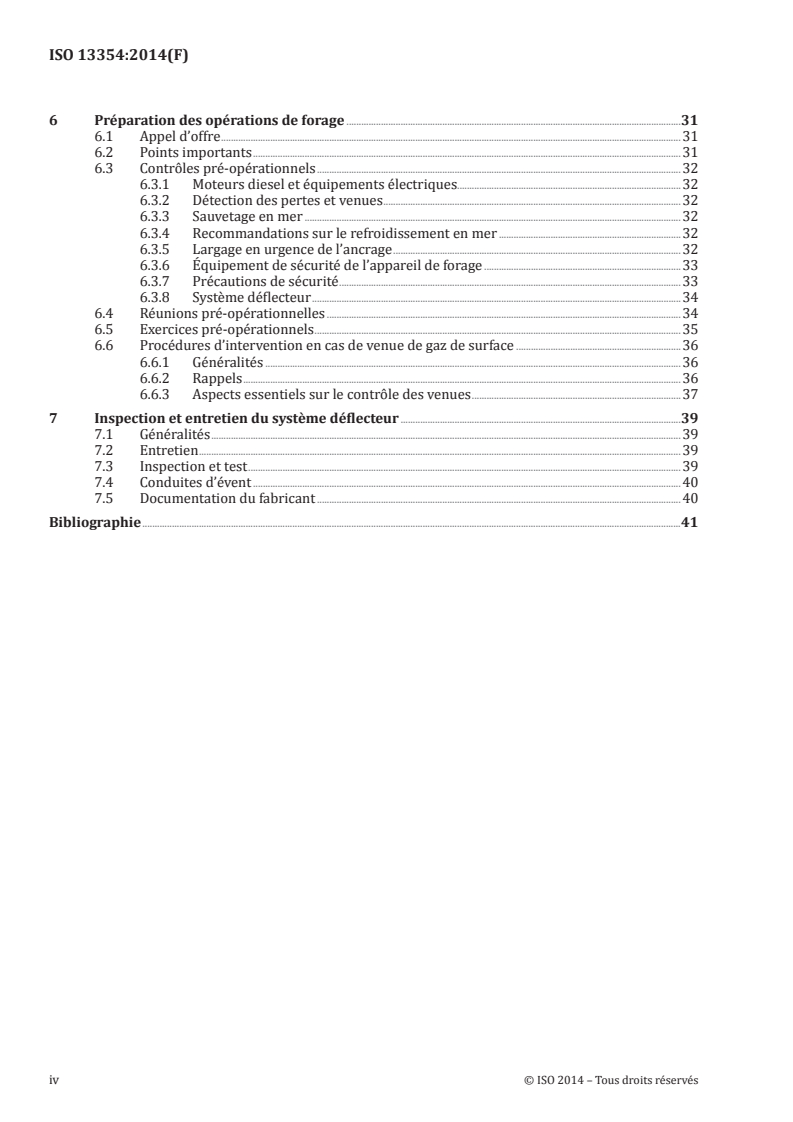
ISO 13354:2014 - Industries du pétrole et du gaz naturel — Équipements de forage et de production — Équipement déflecteur pour gaz de surface/15/2015
Overview
ISO 13354:2014 - Petroleum and natural gas industries - Drilling and production equipment - Shallow gas diverter equipment specifies requirements for selecting and applying diverter systems used when drilling shallow-gas‑bearing formations. The standard covers both onshore and offshore operations and addresses auxiliary equipment for floating rigs. It focuses on the safe selection, design considerations and operation of primary diverter components including annular sealing devices, vent outlets, diverter valves and diverter piping. ISO 13354:2014 also highlights safety concerns for marine floating drilling supports and prescribes important pre‑spud actions and preparedness measures, while giving general guidance on responding to shallow‑gas flows.
Key topics and technical requirements
- Scope and definitions: Terms and definitions for components such as annular sealing devices, bag preventers, and control functions.
- Diverter system equipment: Selection and functional requirements for:
- Annular sealing devices (torus‑shaped housings and packing elements)
- Vent outlets and their placement
- Diverter valves (types and actuation)
- Diverter piping and associated fittings
- Design considerations: Separate guidance for land/bottom‑supported rigs and floating rigs, including control systems, kill‑line provisions and auxiliary equipment for riser drilling.
- Floating rig specifics: Use of marine risers, additional diverter functions, and differences among moored drill ships, DP drill ships and semi‑submersibles.
- Preparation and operations: Requirements for pre‑spud checks, pre‑spud meetings/drills, crew preparedness and basic well‑control measures.
- Maintenance and certification: Guidance on diverter system maintenance, certification/recertification and manufacturer documentation.
(Note: ISO 13354:2014 provides selection and procedural requirements and general guidelines; it does not replace site‑specific engineering analysis.)
Applications and practical value
- Helps operators and drilling contractors specify and select diverter equipment appropriate for shallow‑gas risk environments.
- Guides rig designers and equipment suppliers in integrating diverter systems into new or modified rigs (land and offshore).
- Supports drilling supervisors, HSE teams and well‑control specialists in preparing pre‑spud plans, drills and emergency response procedures for shallow‑gas scenarios.
- Improves safety by standardizing considerations for dynamic loads, erosion risks, vent routing and control systems on floating supports.
Who should use this standard
- Oil & gas operators and drilling contractors
- Rig designers and equipment manufacturers
- Well‑control engineers and HSE professionals
- Regulatory bodies and certification authorities evaluating diverter system compliance
Related standards
- ISO 13533:2001 - Drill‑through equipment
- API 16D:2005 - Specification for Control Systems for Drilling Well Control Equipment and Control Systems for Diverter Equipment
Using ISO 13354:2014 helps reduce shallow‑gas drilling risks by aligning equipment selection, rig preparation and operational practices with internationally recognized guidance.
Relations
- Effective Date
- 12-Feb-2026
Buy Documents
ISO 13354:2014 - Petroleum and natural gas industries -- Drilling and production equipment -- Shallow gas diverter equipment
ISO 13354:2014 - Petroleum and natural gas industries — Drilling and production equipment — Shallow gas diverter equipment/16/2014
ISO 13354:2014 - Industries du pétrole et du gaz naturel -- Équipements de forage et de production -- Équipement déflecteur pour gaz de surface
ISO 13354:2014 - Industries du pétrole et du gaz naturel — Équipements de forage et de production — Équipement déflecteur pour gaz de surface/15/2015
Get Certified
Connect with accredited certification bodies for this standard

Element Materials Technology
Materials testing and product certification.

ABS Group Brazil
ABS Group certification services in Brazil.

ABS Quality Evaluations Inc.
American Bureau of Shipping quality certification.
Sponsored listings
Frequently Asked Questions
ISO 13354:2014 is a standard published by the International Organization for Standardization (ISO). Its full title is "Petroleum and natural gas industries — Drilling and production equipment — Shallow gas diverter equipment". This standard covers: ISO 13354:2014 specifies requirements for the selection of the diverter equipment for rigs used to drill shallow-gas-bearing formations. It covers both onshore and offshore drilling operations, and considers also the auxiliary equipment associated with floating rigs. The specified requirements concern the following diverter equipment: annular sealing devices; vent outlets; diverter valves; diverter piping. ISO 13554:2014 highlights the concerns associated with the selection of a marine floating drilling support. It covers safety issues concerning key rig equipment, and important steps of action required prior to starting the drilling operations. It provides only general guidelines regarding the response to be given to a shallow-gas flow.
ISO 13354:2014 specifies requirements for the selection of the diverter equipment for rigs used to drill shallow-gas-bearing formations. It covers both onshore and offshore drilling operations, and considers also the auxiliary equipment associated with floating rigs. The specified requirements concern the following diverter equipment: annular sealing devices; vent outlets; diverter valves; diverter piping. ISO 13554:2014 highlights the concerns associated with the selection of a marine floating drilling support. It covers safety issues concerning key rig equipment, and important steps of action required prior to starting the drilling operations. It provides only general guidelines regarding the response to be given to a shallow-gas flow.
ISO 13354:2014 is classified under the following ICS (International Classification for Standards) categories: 75.180.10 - Exploratory, drilling and extraction equipment. The ICS classification helps identify the subject area and facilitates finding related standards.
ISO 13354:2014 has the following relationships with other standards: It is inter standard links to EN ISO 13354:2014. Understanding these relationships helps ensure you are using the most current and applicable version of the standard.
ISO 13354:2014 is available in PDF format for immediate download after purchase. The document can be added to your cart and obtained through the secure checkout process. Digital delivery ensures instant access to the complete standard document.
Standards Content (Sample)
INTERNATIONAL ISO
STANDARD 13354
First edition
2014-05-15
Petroleum and natural gas
industries — Drilling and production
equipment — Shallow gas diverter
equipment
Industries du pétrole et du gaz naturel — Équipements de forage et
de production — Équipement déflecteur pour gaz de surface
Reference number
©
ISO 2014
© ISO 2014
All rights reserved. Unless otherwise specified, no part of this publication may be reproduced or utilized otherwise in any form
or by any means, electronic or mechanical, including photocopying, or posting on the internet or an intranet, without prior
written permission. Permission can be requested from either ISO at the address below or ISO’s member body in the country of
the requester.
ISO copyright office
Case postale 56 • CH-1211 Geneva 20
Tel. + 41 22 749 01 11
Fax + 41 22 749 09 47
E-mail copyright@iso.org
Web www.iso.org
Published in Switzerland
ii © ISO 2014 – All rights reserved
Contents Page
Foreword .iv
Introduction .v
1 Scope . 1
2 Normative references . 1
3 Terms and definitions . 1
4 Diverter system equipment . 7
4.1 General purpose . 7
4.2 Findings of blowout reports . 7
4.3 Applications of diverter systems . 8
4.4 Layout considerations — Land rigs and bottom-supported marine structures . 8
4.5 Layout considerations — Floating rigs .18
5 Floating rigs — Specific aspects .26
5.1 Use of the marine riser .26
5.2 Additional functions of the diverter system .28
5.3 Comparison of types of floating support .28
6 Preparation for shallow gas operations .31
6.1 Call for tender .31
6.2 Important issues .31
6.3 Pre-spud checks .32
6.4 Pre-spud meetings .34
6.5 Pre-spud drills .35
6.6 Preparing the response to a shallow-gas flow .36
7 Diverter system inspection and maintenance .39
7.1 General .39
7.2 Maintenance .39
7.3 Inspection and testing .39
7.4 Diverter system piping .39
7.5 Manufacturer documentation .40
Bibliography .41
Foreword
ISO (the International Organization for Standardization) is a worldwide federation of national standards
bodies (ISO member bodies). The work of preparing International Standards is normally carried out
through ISO technical committees. Each member body interested in a subject for which a technical
committee has been established has the right to be represented on that committee. International
organizations, governmental and non-governmental, in liaison with ISO, also take part in the work.
ISO collaborates closely with the International Electrotechnical Commission (IEC) on all matters of
electrotechnical standardization.
The procedures used to develop this document and those intended for its further maintenance are
described in the ISO/IEC Directives, Part 1. In particular the different approval criteria needed for the
different types of ISO documents should be noted. This document was drafted in accordance with the
editorial rules of the ISO/IEC Directives, Part 2 (see www.iso.org/directives).
Attention is drawn to the possibility that some of the elements of this document may be the subject of
patent rights. ISO shall not be held responsible for identifying any or all such patent rights. Details of any
patent rights identified during the development of the document will be in the Introduction and/or on
the ISO list of patent declarations received (see www.iso.org/patents).
Any trade name used in this document is information given for the convenience of users and does not
constitute an endorsement.
For an explanation on the meaning of ISO specific terms and expressions related to conformity
assessment, as well as information about ISO’s adherence to the WTO principles in the Technical Barriers
to Trade (TBT) see the following URL: Foreword - Supplementary information
The committee responsible for this document is ISO/TC 67, Petroleum and Natural gas industries,
Subcommittee SC 4, Drilling and production equipment.
iv © ISO 2014 – All rights reserved
Introduction
Drilling into shallow-gas-bearing formations is a very delicate and challenging operation. If the drilling
operations are seriously complicated by the reduced safety margin available between kick and loss, the
situation in case of a gas influx becomes extremely hazardous, due to a combination of the following
adverse factors.
— Shallow gas flows are extremely fast-developing events; there is only a short transition time
between influx detection and well unloading, resulting in a reduced time for the driller to take the
right decision, and leaving little room for error.
— Past blowout reports have disclosed the magnitude of severe dynamic loads applied to surface
diverting equipment. One of the associated effects is erosion, which adds a high potential for fire
and explosion due to flow impingement on rig facilities which gives the gas flow access to various
sources of ignition.
— Many past shallow-gas kicks turned into uncontrolled blowouts due to the failure of former diverter
systems installed several decades ago. Failure is seen as a result of the system’s complexity, its lack
of functional reliability and its inability to cope with the severe dynamic loads.
— Certain drilling supports are exposed to specific threats associated with shallow gas blowouts, e.g.
risk of cratering, risk of ship-shaped vessel capsize.
— Unprepared or inadequately trained drilling crews experience a high level of stress when facing a
violent shallow gas flow.
In the aftermath of shallow gas blowouts during the last four decades, comprehensive inquiries and
reports have been carried out, in particular by the specialists involved in combating these events, and
significant findings and conclusions have been published. In the meantime, the manufacturing industry
has developed various equipment aimed at significantly improving the safety of shallow-gas drilling
operations.
This International Standard has been prepared taking these aspects into consideration.
INTERNATIONAL STANDARD ISO 13354:2014(E)
Petroleum and natural gas industries — Drilling and
production equipment — Shallow gas diverter equipment
1 Scope
This International Standard specifies requirements for the selection of the diverter equipment for rigs
used to drill shallow-gas-bearing formations. It covers both onshore and offshore drilling operations,
and considers also the auxiliary equipment associated with floating rigs.
The specified requirements concern the following diverter equipment:
— annular sealing devices;
— vent outlets;
— diverter valves;
— diverter piping.
This International Standard highlights the concerns associated with the selection of a marine floating
drilling support. It covers safety issues concerning key rig equipment, and important steps of action
required prior to starting the drilling operations.
It provides only general guidelines regarding the response to be given to a shallow-gas flow.
2 Normative references
The following documents, in whole or in part, are normatively referenced in this document and are
indispensable for its application. For dated references, only the edition cited applies. For undated
references, the latest edition of the referenced document (including any amendments) applies.
ISO 13533, Petroleum and natural gas industries — Drilling and production equipment — Drill-through
equipment
API 16D (latest revision), Specification for Control Systems for Drilling Well Control Equipment and Control
Systems for Diverter Equipment
3 Terms and definitions
For the purposes of this document, the following terms and definitions apply.
3.1
actuator
device used to open or close a valve by means of applied manual, hydraulic, pneumatic or electrical
energy
3.2
annular packing element
doughnut-shaped rubber/elastomer element that creates a seal in an annular preventer or diverter
Note 1 to entry: The annular packing element is displaced toward the bore centre by the upward movement of an
annular piston.
3.3
annular sealing device
torus-shaped steel housing containing an annular packing element which facilitates closure of the
annulus by constricting to seal on the pipe or kelly in the wellbore
Note 1 to entry: Some annular sealing devices also facilitate shutoff of the open hole.
3.4
bag preventer
device that can seal around any object in the wellbore or upon itself
Note 1 to entry: Compression of a reinforced rubber/elastomer packing element by hydraulic pressure creates
the seal.
3.5
ball valve
valve that employs a rotating ball to open or close the flow passage
3.6
blowout
uncontrolled flow of well fluids and/or formation fluids from the wellbore or into lower-pressured
subsurface zones
Note 1 to entry: When the uncontrolled flow of fluids goes into lower-pressured subsurface zones, it is termed an
underground blowout.
3.7
blowout preventer stack
BOP stack
device that allows the well to be sealed to confine the well fluids in the wellbore
3.8
bottom-supported marine structure
drilling structure supported by the soil on the seabed while in the operating mode
Note 1 to entry: Rigs of this type include fixed platforms, submersibles, swamp barges and jack-up drilling rigs.
3.9
cleanout
point in the flow-line piping where the internal area of the pipe can be accessed to remove accumulated
debris and drill cuttings
3.10
closing unit
assemblage of pumps, valves, lines, accumulators and other items necessary to open and close the BOP
equipment and diverter system
3.11
control function
control system circuit (hydraulic, pneumatic, electrical, mechanical, or a combination thereof) used to
operate the position selection of a diverter unit, BOP, valve or regulator
EXAMPLE Diverter “close” function, starboard vent valve “open” function.
3.12
control function
each position of a diverter unit, BOP or valve and each regulator assignment that is operated by the
control system
2 © ISO 2014 – All rights reserved
3.13
diverter
device attached to the wellhead or marine riser to close the vertical access and to direct any flow into a
set of vent lines and away from the drilling unit
3.14
diverter control system
assemblage of pumps, accumulators, manifolds, control panels, valves, lines, etc., used to operate the
diverter system
3.15
diverter housing
permanent installation under the rotary table which houses the insert-type diverter assembly
3.16
diverter packer
annular sealing device of the diverter
3.17
diverter piping
vent lines of the diverter
3.18
diverter system
assemblage, comprising an annular sealing device, flow control means, vent system components and
control system, which facilitates closure of the upward flow path of the well fluid and opening of the
vent to the atmosphere
3.19
diverter unit
device that embodies the annular sealing device and its actuating means
3.20
drill floor substructure
foundation structure on which the derrick, rotary table, draw-works and other drilling equipment are
supported
3.21
drilling spool
flanged joint placed between the BOP and casing-head that serves as a spacer or crossover
3.22
drill ship
self-propelled, floating, ship-shaped vessel equipped with drilling equipment
3.23
dump valve
device used to control bottom-riser annulus pressure by establishing direct communication with the
sea
3.24
dynamically positioned drilling vessel
DP drilling vessel
drill-ship or semi-submersible drilling rig equipped with computer-controlled thrusters which enable it
to maintain a constant position relative to a fixed point on the sea floor without the use of anchors and
mooring lines while conducting floating drilling operations
3.25
elastomer
any of various elastic compounds or substances resembling rubber
3.26
fill-up line
line, usually connected into the bell nipple above the BOP, to allow addition of drilling fluid to the hole
while simultaneously pulling out of the hole to compensate for the metal volume displacement of the
drill string being pulled
3.27
flex/ball joint
device installed directly above the subsea BOP stack and at the top of the telescopic riser joint to permit
relative angular movement of the riser, thus reducing stresses due to vessel motions and environmental
forces
3.28
flow-line
shaker line
piping that exits the bell nipple and conducts drilling fluid and cuttings to the shale shaker and drilling
fluid pits
3.29
formation fracture pessure
value of pressure required to initiate a fracture in a subsurface formation (geologic strata)
3.30
function test
closing and opening (cycling) equipment to verify operability
3.31
gate valve
valve that employs a sliding gate to open or close the flow passage
3.32
hydrostatic head
true vertical length of fluid column
3.33
hydrostatic pressure
pressure that exists at any point in the wellbore due to the weight of the vertical column of fluid above
that point
3.34
inner barrel
part of the telescopic slip joint on a marine riser that is attached to the flex joint beneath the diverter
3.35
insert-type packer
diverter element that uses inserts designed to close and seal on specific ranges of pipe diameter
3.36
integral valve
valve embodied in the diverter unit that operates integrally with the annular sealing device
3.37
interlock
arrangement of control system functions designed to require the actuation of one function as a
prerequisite to actuate another
4 © ISO 2014 – All rights reserved
3.38
kelly
joint of pipe with flat or fluted sides that is free to move vertically through a bushing in the rotary table
Note 1 to entry: The bushing is termed a “kelly bushing”, and it imparts torque to the kelly thereby rotating the
drill string.
3.39
kick
influx of gas, oil or other well fluids which, if not controlled, can result in a blowout
3.40
kill mud
drilling fluid with sufficient mud weight used to overcome the borehole pressure in case of well influx
3.41
knife valve
valve using a portal plate or blade to facilitate open and close operations
Note 1 to entry: A knife valve differs from a gate valve in that the bonnet area is open, i.e. not sealed.
3.42
lost circulation
loss of drilling fluid to the wellbore
3.43
marine riser
extension of the well-bore from the subsea conductor pipe housing or wellhead to the floating drilling
vessel which provides for fluid returns to the drilling vessel and guides tools into the well
3.44
moored vessel
offshore floating drilling vessel which relies on anchors, chain and mooring lines extended to the ocean
floor to maintain a constant location relative to the ocean floor
3.45
mud line
floor of an ocean, lake, bay or swamp
3.46
outer barrel
part of the telescopic slip joint on a marine riser that is attached to tensioner lines
Note 1 to entry: Tension is transferred through the outer barrel into the riser.
3.47
pre-spud
period of time which precedes the start of drilling activities
3.48
poor-boy separator
pressure vessel designed to provide effective separation of gas from drilling fluid at atmospheric
pressure while circulating out a wellbore kick through the choke manifold
3.49
primary well control
prevention of formation fluid flow by maintaining a hydrostatic pressure equal to or greater than the
formation pressure
3.50
production platform
permanently installed bottom-supported/connected offshore structure, fitted with drilling and/or
production equipment for drilling and/or development of offshore oil and gas reservoirs
3.51
riser hydraulic connector
hydraulic latch which connects the 762 mm (30 in) conductor pipe housing and the bottom of the marine
riser
Note 1 to entry: O-ring seals prevent leaks between the latch and the housing.
3.52
rotary table
device through which the bit and drill string pass and which transmits rotational action to the kelly
3.53
subsea diverter
seabed diverter
set-up of equipment attached to the bottom of the marine riser and connected to the 762 mm (30 in)
subsea wellhead housing, designed to close the well in case of shallow-gas influx and to direct it through
two subsea lateral vent outlets
3.54
semi-submersible
floating offshore drilling vessel which is ballasted at the drilling location and conducts drilling operations
in a stable, partly submerged position
3.55
target
bull plug or blind flange at the end of a tee to reduce erosion at a point where change in flow direction
occurs
3.56
targeted
having a type of fluid piping system in which flow impinges upon a lead (or other material)-filled end
(target) or a piping tee when the fluid flow changes direction
3.57
telescopic joint packer
torus-shaped, hydraulically, pneumatically or mechanically actuated, resilient element between the
inner and outer barrels of the telescopic joint which serves to retain drilling fluid inside the marine riser
3.58
vent line
conduit that directs the flow of diverted wellbore fluids away from the drill floor and to the atmosphere
3.59
vent line valve
full-opening valve which allows passage of diverted wellbore fluids through the vent line
3.60
vent outlet
point at which fluids exit the wellbore below the annular sealing device via the vent line
3.61
wellhead
apparatus or structure, placed on the top of the casings, that supports the internal tubular, seals the well
and permits access to the casing annulus
6 © ISO 2014 – All rights reserved
3.62
working pressure rating
WP rating
maximum internal pressure that the equipment is designed to contain or control
4 Diverter system equipment
4.1 General purpose
The diverter system is designed to permit the drilling crew to blow down shallow-gas accumulations
downwind of the rig. Until a sufficient casing length has been set to allow a well to be shut-in during a kick,
the diverter system is the only line of defence, and is only expected to contain the hazard temporarily,
although as long as possible.
The diverter system is not intended to be a well-control device. It simply allows the flow to be diverted
in a safe manner in order to allow enough time to attempt regaining primary control of the well and,
should the latter fail, enough time for proper evacuation of the drilling crew or for proper move-off of
the drilling unit from the location (floating rigs), until the flow stops due to gas accumulation blow-
down, hole bridging, hole collapse, etc.
Traditional diverter system components comprise:
— the annular sealing device;
— vent outlet(s) and vent line(s);
— valves;
— the control system.
4.2 Findings of blowout reports
Blowout inquiries have concluded that the original designs underestimated the fact that shallow-gas
blowouts produce huge amounts of gas, together with abrasive solids, flowing at very high speed,
producing severe dynamic loads, and eroding and destroying many parts of the existing diverter
systems.
The failure of these diverter systems led unfortunately to the loss of many lives.
It is therefore of paramount importance to select suitable equipment able to function in a reliable and safe
manner, i.e. able to operate whenever required under the worst possible conditions. Diverter equipment
shall also be able to cope with the prevailing dynamic loads and associated effects.
The most frequent findings from blowout reports are as follows.
— Insert-type diverters have too many components.
— The locking mechanism of insert-type diverters is not really designed to contend with severe
dynamic loads.
— Insert-type diverter packers cannot close on open-hole and on some drilling assemblies.
— Piston-actuated bag preventers are stronger and less complex, but close too slowly.
— Diverter outlets often promote erosion.
— Diverter vent lines are usually thin-walled, too small in diameter, have a tortuous path, and are
inadequately supported, fastened and secured.
— Some valve systems are inadequate and unreliable.
— Layouts for control systems are too complex.
— Power sources of some control systems are not reliable.
— The maintenance of diverter systems is not given the same importance compared to BOPs.
4.3 Applications of diverter systems
Diverters are primarily used to divert flow from the rig in three situations:
— shallow fluid and gas flows;
— drilling with a rotating head;
— drilling with a marine riser.
This International Standard will not discuss the specific aspects associated with rotating-head drilling.
4.4 Layout considerations — Land rigs and bottom-supported marine structures
4.4.1 General
Drilling operations into shallow-gas-bearing formations include drilling from a land rig, or from a marine
structure supported by a mat-type base, by legs, or drilling from a barge that rests on the bottom, e.g.
jack-up drilling rigs, production platforms rigs and swamp-barge rigs.
Land rigs and bottom-supported marine structures have at their disposal a wide range of equipment to
build diverter arrangements.
4.4.2 Types of annular sealing devices in use
4.4.2.1 Insert-type diverter assembly
In the insert-type diverter assembly, the insert packing is latched in place into a diverter assembly, which
in turn is locked inside the support housing. This housing provides two outlets, one for the mud returns
to flow towards the shakers, one for the diverted fluids to flow out through the vent line(s). The insert is
removed prior to pulling or running the bottom-hole assembly (see Figure 1).
The rig substructure and the diverter assembly locking dogs shall be able to withstand the upward
forces of the diverted fluid.
4.4.2.2 Annular packing element
This set-up requires a conventional bag-type preventer and a drilling spool (or diverter spool) which are
directly located on top of the first casing (conductor pipe, drive pipe). This set-up is therefore below the
rotary table and below the flow-line, unlike the insert-type diverter assembly (see Figure 2).
The connections shall be in accordance with the applicable provisions of ISO 13533. The annular
packing element should be of sufficient internal diameter to pass the various bottom-hole assemblies
and casing/liner strings required for subsequent drilling operations.
NOTE For the purposes of this provision, ANSI/API 16A is equivalent to ISO 13533.
8 © ISO 2014 – All rights reserved
Key
1 insert packing
2 piston
3 support housing
4 flow line outlet
5 vent line outlet
Figure 1 — Example of insert-type diverter assembly
Key
1 bell nipple 6 vent line
2 flow line 7 diverter spool
3 fill-up line 8 hydraulically operated full opening valve
4 annular packing element 9 drive/conductor pipe
5 standard bag-type preventer
Figure 2 — Example of diverter assembly with annular packing element
4.4.2.3 Comparison of systems
The two systems can be compared as follows.
a) Insert-type diverter assembly
10 © ISO 2014 – All rights reserved
— Advantages:
— quick assembly;
— flow-line, fill-up line and vent line permanently hooked up;
— faster shut-in time;
— light equipment, not cumbersome.
— Drawbacks:
— the insert-type diverter system cannot withstand more than 3 447 kPa (500 psi) beneath the
packer; this can be a problem when coping with severe gas flows;
— insert-type packer never providing complete pack-off on open hole;
— requires a significant number of valves, adding potential failure points;
— requires complex sequencing operations and interlocks to activate the vent and flow-line valves;
— requires complex control system and several power sources (pneumatic and hydraulic) to
perform the closing sequence, adding potential failure points;
— location likely to create potential erosion points in the flow-line if the latter is not properly
designed;
— overshot packer located below the diverter system, hence exposed to shallow gas flow;
— ease of hook-up is largely outweighed by the potential for failure and leaks.
b) Classical annular packing assembly
— Advantages:
— dynamic loads absorbed by the conductor pipe and the diverter system connection (clamp or
flange);
— reduced number of remotely controlled valves, due to the system position directly on top of the
first casing and below the flow-line;
— full-bore closing capacity often available;
— no more overshot packer exposed to gas flow pressure below the diverter system.
— Drawbacks:
— cumbersome equipment;
— longer nippling-up and nipple-down operations, hence including more initial expense;
— vent lines require handling and adjustment,
— excessive closing time of packing element.
4.4.2.4 Requirements for safe operation
4.4.2.4.1 General
Safe operation requires a standard hook-up including a bag-type preventer, together with a two-outlet
drilling spool, made-up straight on top of the first casing string (drive pipe, conductor pipe).
The bag preventer shall be full-bore closing, with adequate internal diameter, and the response time
kept equal to or even below the value given in API 16D. This can be achieved by means of e.g. bigger
control lines, twin control lines, boosters.
Different sizes of bag-type preventers exist, e.g. from 508 mm to 749,3 mm (20 in to 291/2 in) with
different pressure ratings. Although it is easy to find 508 mm (20 in) bag preventers rated 13 789 kPa
(2 000 psi) working pressure (WP), the WP of most large-bore bag preventers ranges from 3 447 kPa
(500 psi) to 6 895 kPa (1 000 psi). Nevertheless, in areas where shallow-gas risk is significant, a 13 789 kPa
(2 000 psi) WP shall be considered, whatever the size of the bag-type preventer. Some manufacturers
provide 711,2 mm (28 in) equipment rated up to 13 789 kPa (2 000 psi).
The standard hook-up option eliminates the need for a flow-line valve, as the flow-line is located at the
level of the bell nipple, well above the diverter set-up.
The use of an overshot packer, required for length adjustment below the diverter system, is also
eliminated, hence removing a potential leak point at pack-off level. Conversely, this adjustment joint
and its packer can be used without risk above the bag preventer, as it will not experience any gas flow
pressure.
4.4.2.4.2 The integral diverter system
Another safe alternative is to use an integral diverter assembly, which integrates the diverter spool and
the annular packing into a single piece of equipment.
In this system the motion of the annular piston is used, in one stroke, to first open the vent lines and
then stop the upward flow. The flow-line is located at the level of the bell-nipple, well above the integral
diverter assembly, hence eliminating the need for a specific flow-line valve (see Figures 3 and 4).
An integral diverter system
— eliminates the need for a diverter spool and for the associated valves;
— reduces the number of components and functions;
— eliminates sequencing or interconnected control lines;
— eliminates the hazard associated with stagnant space;
— by design, prevents the vent lines from remaining closed while the well is already shut in;
— provides a faster shut-in time on 127 mm (5 in) drill pipes (20 s), compared to standard bag
preventers;
— provides a large wellbore of size up to 711,2 mm (28 in);
— provides one or two large-bore vent outlets of size up to 406,4 mm (16 in);
— provides high structural strength to withstand the extreme dynamic loads of shallow-gas flows.
4.4.3 Vent outlets
The vent outlets for the diverter system are located below the annular packing element.
Vent outlets may be
— incorporated in the diverter support housing, as for the insert-type diverter assembly;
— part of a drilling spool used below a conventional bag preventer;
— part of an integral diverter assembly (see Figures 3 and 4).
12 © ISO 2014 – All rights reserved
The internal cross-sectional areas of the vent outlets shall be greater than or equal to that of the diverter
vent lines.
Design considerations for the connection between the vent outlets and vent lines should include ease of
installation, leak-free construction and freedom from solids accumulation.
3 3
a) Normal drilling operations
b) Diverting with pipe in hole
Key
1 packing unit (open position)
2 piston down
3 vent line shut in
4 packing unit (close position)
5 piston up
6 vent line open
Figure 3 — Principle of the integral diverter assembly (land and marine bottom-supported
rigs)
Key
1 bell nipple
2 flow line
3 vent line
Figure 4 — Basic hook-up with an integral diverter assembly
4.4.4 Diverter valves
4.4.4.1 Review of equipment in use
Several types of valve are commonly associated with diverter systems: gate valves, ball valves, switchable
three-way target valves, knife valves, valves integral to the diverter unit and sometimes burst disks.
Past experience has disclosed a high potential for failure of a large number of these valves:
— failure to open/close as required when subject to gas-flow pressure and dynamic loads;
— erosion of internal surfaces;
— failure of the sequencing and interlock systems;
— clogging and blocking with trapped sediments, ice, etc.
14 © ISO 2014 – All rights reserved
4.4.4.2 Selection criteria
Valves to be used in the diverter system shall:
— be reliable under severe shallow-gas flow conditions, i.e. be likely to work whenever required
without any likelihood of failure;
— be full-opening;
— be of equal size as the diverter vent line;
— be remotely controlled;
— be capable of opening with maximum anticipated pressure across the valve;
— be installed in such a way as to limit the space for solids to accumulate;
— be easily maintained.
4.4.4.3 Requirements for safe operation
Safe operation requires the use of hydraulically operated full-opening ball valves, driven by an
independent power source.
Valves shall be installed as close as possible to the annular sealing device, in order to minimize the space
where debris could accumulate and plug the vent lines.
For insert-type diverter systems requiring actuation of valves on both shaker and vent lines, an interlock
system shall prevent the diverter from closing before the valves are in the correct position (i.e. shaker
valve closed, vent line valve open). This is of paramount importance with these systems, where the
response time of the insert packer is much lower than that of the shaker and vent line valves [usually less
than 10 s to close on a 127 mm (5 in) drill pipe].
Actuators fitted to a diverter valve shall be sized to open the valve with the rated working pressure
(WP) of the diverter system applied across the valve.
4.4.5 Diverter piping
4.4.5.1 Pipe sizing and number
Erosion and pressure drop are major considerations in the design of diverter system piping.
Undersized and tortuous vent piping is subject to the hazardous effects of erosion due to cavitation,
impingement of fluid and solid particles, etc., as revealed from blowouts during past decades.
It also
— is subject to elevated back-pressures and consequently to leaking/failure hazards in the diverter
equipment;
— contributes significantly to an increase in the overall pressure of the well, adding the risk of
formation fracturing and possible seabed cratering.
Many rigs have undersized vent lines ranging from 152,4 mm (6 in) to 254 mm (10 in). This is often due
to the fact that models used for back-pressure calculations have widely underestimated the actual flow
conditions. In particular, critical flow effects and multiphase conditions have not been accounted for,
and shallow-gas blowout flow rates have been widely underestimated.
The consequences due to an undersized piping network are likely to be catastrophic.
The sizing requirements are mentioned in 4.4.5.7.
4.4.5.2 Pipe material
Diverter vent lines shall be made of steel piping.
4.4.5.3 Pipe routing
At the rig design stage, routing of the vent lines shall be planned to be as straight as possible, with
no bends and branches, in order to minimize erosion, flow resistance, fluid-solid settling points and
associated back-pressures. If routing changes are unavoidable, these should be as gradual as practicable,
with a bend radius at least 20 times the inside diameter of the pipe (long-radius curvature).
For old generation rigs still having 90° bends, they shall include tees equipped with a targeted blind
flange or a targeted plug. To prevent their failure, the tees shall be purpose-manufactured to withstand
the significant loads and erosion potential from impinging well fluids. No branch is best, but use of
Y-type branches is preferable to use of tee-branch connections.
Tees and other short-radius bends (if any) shall not be located at critical places, e.g. near power rooms,
workshops or electrical rooms (see bibliography on the West Vanguard blowout report [6]).
The vent line(s) shall be sloped along its length (down, never up) to avoid low spots that can accumulate
drilling fluid and debris.
4.4.5.4 Pipe heading
At the rig site location, the diverter vent lines shall extend a sufficient distance in the most appropriate
direction from the rig to permit safe venting of diverted well fluids.
The following criteria shall be met:
— the flow shall be prevented from being carried back to the rig (i.e. no vent line heading upwind);
— the flow shall be prevented from being carried towards populated areas, access/egress roads, etc.
A comprehensive review of local prevailing winds is necessary prior to selecting the appropriate piping
heading. Unless major issues prevent doing so, the best option is to position the two lines opposite and
crosswind, or with a V-shaped downwind layout (see Figure 5).
2 2
a) Crosswind heading
16 © ISO 2014 – All rights reserved
b) V shape downwind heading
Key
1 prevailing winds
2 vent line
3 hydraulically operated vent valves
Figure 5 — Heading of diverter lines
4.4.5.5 Pipe support and securing
Vent lines shall be firmly supported and fastened at least every 3 m, in order to withstand the dynamic
effect of high-volume gas flow and the impact of drilling solids. On land, the use of large heavy bags can
be considered to secure the vent lines until their termination.
Supports and fasteners located at points (if any) where piping changes direction shall be capable of
restraining pipe deflection.
Special attention should be paid to the end sections of the vent lines, as diverter piping tends to whip and
vibrate at this location.
4.4.5.6 Additional risks
Cleanout provisions are sometimes available for cleaning and flushing out accumulated debris upstream
of valves and sharp changes in direction. These provisions nevertheless pose additional potential leak
points, whenever subject to pressure of the gas flow at surface.
No flow-line or fill-up line shall be below the diverter packing element.
4.4.5.7 Requirements for safe operation
Safe operation requires the use of two straight steel vent lines, firmly supported and fastened at least
every 3 m.
The required nominal ID of diverter outlets and vent lines shall be 355,6 mm (14 in) or larger. The vent
lines’ piping wall thickness shall not be less than 19,05 mm (0,75 in).
Hard-facing or extra thickness on the pipe outside diameter (OD) can be usefully considered in erosion-
sensitive areas, such as bends and turbulent areas e.g. up/downstream of valves.
Changes in diameter shall be avoided. Welded flanges or hub connections are mandatory. Quick
connections are not allowed in diverter vent lines.
A risk assessment including involved parties (operator and contractor as a minimum) for all exploratory
and development wells engaged in shallow gas prone areas is required.
4.4.6 The control system
The diverter control system should be designed and sized in accordance with API 16D latest revision,
section 5.5. It shall contain the minimum of functions. Preferably, a one-button or lever-activated
function shall operate the entire diverter system.
A 38,1 mm (11/2 in) hydraulic operating line should be used for diverter systems with a 11/2 in NPT
closing and opening chamber port size.
NOTE NPT stands for National Pipe Thread Taper [according to ANSI B1.20.1], US standard sizes for hydraulic
connections.
As mentioned in 4.4.2.4, if a bag preventer is used, its response time shall be kept equal to or even better
below the value given in API 16D. The use of e.g. two 38,1 mm (11/2 in) hydraulic operating lines on
separate ports of the closing chamber is frequently recommended and used by manufacturers for large-
bore bag preventers to decrease the response time to 20 s.
At least one pump of the hydraulic power unit which operates the diverter system and valves shall be
powered by the emergency generator.
Many shallow-gas blowout reports have mentioned failures of the pneumatic control system used to
operate diverter valves (e.g. failure to work as required when valves stems are blocked with solids). A
pneumatic control system shall therefore be avoided on rigs, if possible.
4.4.7 Test-line facility
Each diverter system shall incorporate a test-line facility (including a check valve) to allow pressure-
testing of the annular packing element closed on open hole, with no pipe in hole. This facility can also be
used to periodically flush the system clean.
Another advantage of a test-line facility is to pump water through the diverter system during a gas-flow
diverting operation, in order to wet the gas and accordingly reduce the fire risk.
4.4.8 Additional functions for the diverter system
The use of a diverter system (alone or combined with a BOP set-up) should be considered on multi-well
platforms, due to potential hazards such as collision with adjacent wells or surface-gas accumulations
due to poorly cemented casings.
4.5 Layout considerations — Floating rigs
4.5.1 General
Drilling operations into shallow-gas-bearing formations also include those carried out from moored or
dynamically positioned drill-ships and semi-submersibles.
Once the initial casing (conductor pipe) has been set, drilling operations from these vessels may be
conducted with or without a marine riser system.
Though many parts of the diverter system are identical to those used on land rigs and bottom-supported
marine structures, others are specific to floating units and are reviewed hereafter.
When drilling shallow-gas-bearing formations with a riser, two types of sealing device may be used: the
surface insert-type diverter assembly and the subsea diverter.
18 © ISO 2014 – All rights reserved
4.5.2
...
INTERNATIONAL ISO
STANDARD 13354
First edition
2014-05-15
Petroleum and natural gas
industries — Drilling and production
equipment — Shallow gas diverter
equipment
Industries du pétrole et du gaz naturel — Équipements de forage et
de production — Équipement déflecteur pour gaz de surface
Reference number
©
ISO 2014
© ISO 2014
All rights reserved. Unless otherwise specified, no part of this publication may be reproduced or utilized otherwise in any form
or by any means, electronic or mechanical, including photocopying, or posting on the internet or an intranet, without prior
written permission. Permission can be requested from either ISO at the address below or ISO’s member body in the country of
the requester.
ISO copyright office
Case postale 56 • CH-1211 Geneva 20
Tel. + 41 22 749 01 11
Fax + 41 22 749 09 47
E-mail copyright@iso.org
Web www.iso.org
Published in Switzerland
ii © ISO 2014 – All rights reserved
Contents Page
Foreword .iv
Introduction .v
1 Scope . 1
2 Normative references . 1
3 Terms and definitions . 1
4 Diverter system equipment . 7
4.1 General purpose . 7
4.2 Findings of blowout reports . 7
4.3 Applications of diverter systems . 8
4.4 Layout considerations — Land rigs and bottom-supported marine structures . 8
4.5 Layout considerations — Floating rigs .18
5 Floating rigs — Specific aspects .26
5.1 Use of the marine riser .26
5.2 Additional functions of the diverter system .28
5.3 Comparison of types of floating support .28
6 Preparation for shallow gas operations .31
6.1 Call for tender .31
6.2 Important issues .31
6.3 Pre-spud checks .32
6.4 Pre-spud meetings .34
6.5 Pre-spud drills .35
6.6 Preparing the response to a shallow-gas flow .36
7 Diverter system inspection and maintenance .39
7.1 General .39
7.2 Maintenance .39
7.3 Inspection and testing .39
7.4 Diverter system piping .39
7.5 Manufacturer documentation .40
Bibliography .41
Foreword
ISO (the International Organization for Standardization) is a worldwide federation of national standards
bodies (ISO member bodies). The work of preparing International Standards is normally carried out
through ISO technical committees. Each member body interested in a subject for which a technical
committee has been established has the right to be represented on that committee. International
organizations, governmental and non-governmental, in liaison with ISO, also take part in the work.
ISO collaborates closely with the International Electrotechnical Commission (IEC) on all matters of
electrotechnical standardization.
The procedures used to develop this document and those intended for its further maintenance are
described in the ISO/IEC Directives, Part 1. In particular the different approval criteria needed for the
different types of ISO documents should be noted. This document was drafted in accordance with the
editorial rules of the ISO/IEC Directives, Part 2 (see www.iso.org/directives).
Attention is drawn to the possibility that some of the elements of this document may be the subject of
patent rights. ISO shall not be held responsible for identifying any or all such patent rights. Details of any
patent rights identified during the development of the document will be in the Introduction and/or on
the ISO list of patent declarations received (see www.iso.org/patents).
Any trade name used in this document is information given for the convenience of users and does not
constitute an endorsement.
For an explanation on the meaning of ISO specific terms and expressions related to conformity
assessment, as well as information about ISO’s adherence to the WTO principles in the Technical Barriers
to Trade (TBT) see the following URL: Foreword - Supplementary information
The committee responsible for this document is ISO/TC 67, Petroleum and Natural gas industries,
Subcommittee SC 4, Drilling and production equipment.
iv © ISO 2014 – All rights reserved
Introduction
Drilling into shallow-gas-bearing formations is a very delicate and challenging operation. If the drilling
operations are seriously complicated by the reduced safety margin available between kick and loss, the
situation in case of a gas influx becomes extremely hazardous, due to a combination of the following
adverse factors.
— Shallow gas flows are extremely fast-developing events; there is only a short transition time
between influx detection and well unloading, resulting in a reduced time for the driller to take the
right decision, and leaving little room for error.
— Past blowout reports have disclosed the magnitude of severe dynamic loads applied to surface
diverting equipment. One of the associated effects is erosion, which adds a high potential for fire
and explosion due to flow impingement on rig facilities which gives the gas flow access to various
sources of ignition.
— Many past shallow-gas kicks turned into uncontrolled blowouts due to the failure of former diverter
systems installed several decades ago. Failure is seen as a result of the system’s complexity, its lack
of functional reliability and its inability to cope with the severe dynamic loads.
— Certain drilling supports are exposed to specific threats associated with shallow gas blowouts, e.g.
risk of cratering, risk of ship-shaped vessel capsize.
— Unprepared or inadequately trained drilling crews experience a high level of stress when facing a
violent shallow gas flow.
In the aftermath of shallow gas blowouts during the last four decades, comprehensive inquiries and
reports have been carried out, in particular by the specialists involved in combating these events, and
significant findings and conclusions have been published. In the meantime, the manufacturing industry
has developed various equipment aimed at significantly improving the safety of shallow-gas drilling
operations.
This International Standard has been prepared taking these aspects into consideration.
INTERNATIONAL STANDARD ISO 13354:2014(E)
Petroleum and natural gas industries — Drilling and
production equipment — Shallow gas diverter equipment
1 Scope
This International Standard specifies requirements for the selection of the diverter equipment for rigs
used to drill shallow-gas-bearing formations. It covers both onshore and offshore drilling operations,
and considers also the auxiliary equipment associated with floating rigs.
The specified requirements concern the following diverter equipment:
— annular sealing devices;
— vent outlets;
— diverter valves;
— diverter piping.
This International Standard highlights the concerns associated with the selection of a marine floating
drilling support. It covers safety issues concerning key rig equipment, and important steps of action
required prior to starting the drilling operations.
It provides only general guidelines regarding the response to be given to a shallow-gas flow.
2 Normative references
The following documents, in whole or in part, are normatively referenced in this document and are
indispensable for its application. For dated references, only the edition cited applies. For undated
references, the latest edition of the referenced document (including any amendments) applies.
ISO 13533, Petroleum and natural gas industries — Drilling and production equipment — Drill-through
equipment
API 16D (latest revision), Specification for Control Systems for Drilling Well Control Equipment and Control
Systems for Diverter Equipment
3 Terms and definitions
For the purposes of this document, the following terms and definitions apply.
3.1
actuator
device used to open or close a valve by means of applied manual, hydraulic, pneumatic or electrical
energy
3.2
annular packing element
doughnut-shaped rubber/elastomer element that creates a seal in an annular preventer or diverter
Note 1 to entry: The annular packing element is displaced toward the bore centre by the upward movement of an
annular piston.
3.3
annular sealing device
torus-shaped steel housing containing an annular packing element which facilitates closure of the
annulus by constricting to seal on the pipe or kelly in the wellbore
Note 1 to entry: Some annular sealing devices also facilitate shutoff of the open hole.
3.4
bag preventer
device that can seal around any object in the wellbore or upon itself
Note 1 to entry: Compression of a reinforced rubber/elastomer packing element by hydraulic pressure creates
the seal.
3.5
ball valve
valve that employs a rotating ball to open or close the flow passage
3.6
blowout
uncontrolled flow of well fluids and/or formation fluids from the wellbore or into lower-pressured
subsurface zones
Note 1 to entry: When the uncontrolled flow of fluids goes into lower-pressured subsurface zones, it is termed an
underground blowout.
3.7
blowout preventer stack
BOP stack
device that allows the well to be sealed to confine the well fluids in the wellbore
3.8
bottom-supported marine structure
drilling structure supported by the soil on the seabed while in the operating mode
Note 1 to entry: Rigs of this type include fixed platforms, submersibles, swamp barges and jack-up drilling rigs.
3.9
cleanout
point in the flow-line piping where the internal area of the pipe can be accessed to remove accumulated
debris and drill cuttings
3.10
closing unit
assemblage of pumps, valves, lines, accumulators and other items necessary to open and close the BOP
equipment and diverter system
3.11
control function
control system circuit (hydraulic, pneumatic, electrical, mechanical, or a combination thereof) used to
operate the position selection of a diverter unit, BOP, valve or regulator
EXAMPLE Diverter “close” function, starboard vent valve “open” function.
3.12
control function
each position of a diverter unit, BOP or valve and each regulator assignment that is operated by the
control system
2 © ISO 2014 – All rights reserved
3.13
diverter
device attached to the wellhead or marine riser to close the vertical access and to direct any flow into a
set of vent lines and away from the drilling unit
3.14
diverter control system
assemblage of pumps, accumulators, manifolds, control panels, valves, lines, etc., used to operate the
diverter system
3.15
diverter housing
permanent installation under the rotary table which houses the insert-type diverter assembly
3.16
diverter packer
annular sealing device of the diverter
3.17
diverter piping
vent lines of the diverter
3.18
diverter system
assemblage, comprising an annular sealing device, flow control means, vent system components and
control system, which facilitates closure of the upward flow path of the well fluid and opening of the
vent to the atmosphere
3.19
diverter unit
device that embodies the annular sealing device and its actuating means
3.20
drill floor substructure
foundation structure on which the derrick, rotary table, draw-works and other drilling equipment are
supported
3.21
drilling spool
flanged joint placed between the BOP and casing-head that serves as a spacer or crossover
3.22
drill ship
self-propelled, floating, ship-shaped vessel equipped with drilling equipment
3.23
dump valve
device used to control bottom-riser annulus pressure by establishing direct communication with the
sea
3.24
dynamically positioned drilling vessel
DP drilling vessel
drill-ship or semi-submersible drilling rig equipped with computer-controlled thrusters which enable it
to maintain a constant position relative to a fixed point on the sea floor without the use of anchors and
mooring lines while conducting floating drilling operations
3.25
elastomer
any of various elastic compounds or substances resembling rubber
3.26
fill-up line
line, usually connected into the bell nipple above the BOP, to allow addition of drilling fluid to the hole
while simultaneously pulling out of the hole to compensate for the metal volume displacement of the
drill string being pulled
3.27
flex/ball joint
device installed directly above the subsea BOP stack and at the top of the telescopic riser joint to permit
relative angular movement of the riser, thus reducing stresses due to vessel motions and environmental
forces
3.28
flow-line
shaker line
piping that exits the bell nipple and conducts drilling fluid and cuttings to the shale shaker and drilling
fluid pits
3.29
formation fracture pessure
value of pressure required to initiate a fracture in a subsurface formation (geologic strata)
3.30
function test
closing and opening (cycling) equipment to verify operability
3.31
gate valve
valve that employs a sliding gate to open or close the flow passage
3.32
hydrostatic head
true vertical length of fluid column
3.33
hydrostatic pressure
pressure that exists at any point in the wellbore due to the weight of the vertical column of fluid above
that point
3.34
inner barrel
part of the telescopic slip joint on a marine riser that is attached to the flex joint beneath the diverter
3.35
insert-type packer
diverter element that uses inserts designed to close and seal on specific ranges of pipe diameter
3.36
integral valve
valve embodied in the diverter unit that operates integrally with the annular sealing device
3.37
interlock
arrangement of control system functions designed to require the actuation of one function as a
prerequisite to actuate another
4 © ISO 2014 – All rights reserved
3.38
kelly
joint of pipe with flat or fluted sides that is free to move vertically through a bushing in the rotary table
Note 1 to entry: The bushing is termed a “kelly bushing”, and it imparts torque to the kelly thereby rotating the
drill string.
3.39
kick
influx of gas, oil or other well fluids which, if not controlled, can result in a blowout
3.40
kill mud
drilling fluid with sufficient mud weight used to overcome the borehole pressure in case of well influx
3.41
knife valve
valve using a portal plate or blade to facilitate open and close operations
Note 1 to entry: A knife valve differs from a gate valve in that the bonnet area is open, i.e. not sealed.
3.42
lost circulation
loss of drilling fluid to the wellbore
3.43
marine riser
extension of the well-bore from the subsea conductor pipe housing or wellhead to the floating drilling
vessel which provides for fluid returns to the drilling vessel and guides tools into the well
3.44
moored vessel
offshore floating drilling vessel which relies on anchors, chain and mooring lines extended to the ocean
floor to maintain a constant location relative to the ocean floor
3.45
mud line
floor of an ocean, lake, bay or swamp
3.46
outer barrel
part of the telescopic slip joint on a marine riser that is attached to tensioner lines
Note 1 to entry: Tension is transferred through the outer barrel into the riser.
3.47
pre-spud
period of time which precedes the start of drilling activities
3.48
poor-boy separator
pressure vessel designed to provide effective separation of gas from drilling fluid at atmospheric
pressure while circulating out a wellbore kick through the choke manifold
3.49
primary well control
prevention of formation fluid flow by maintaining a hydrostatic pressure equal to or greater than the
formation pressure
3.50
production platform
permanently installed bottom-supported/connected offshore structure, fitted with drilling and/or
production equipment for drilling and/or development of offshore oil and gas reservoirs
3.51
riser hydraulic connector
hydraulic latch which connects the 762 mm (30 in) conductor pipe housing and the bottom of the marine
riser
Note 1 to entry: O-ring seals prevent leaks between the latch and the housing.
3.52
rotary table
device through which the bit and drill string pass and which transmits rotational action to the kelly
3.53
subsea diverter
seabed diverter
set-up of equipment attached to the bottom of the marine riser and connected to the 762 mm (30 in)
subsea wellhead housing, designed to close the well in case of shallow-gas influx and to direct it through
two subsea lateral vent outlets
3.54
semi-submersible
floating offshore drilling vessel which is ballasted at the drilling location and conducts drilling operations
in a stable, partly submerged position
3.55
target
bull plug or blind flange at the end of a tee to reduce erosion at a point where change in flow direction
occurs
3.56
targeted
having a type of fluid piping system in which flow impinges upon a lead (or other material)-filled end
(target) or a piping tee when the fluid flow changes direction
3.57
telescopic joint packer
torus-shaped, hydraulically, pneumatically or mechanically actuated, resilient element between the
inner and outer barrels of the telescopic joint which serves to retain drilling fluid inside the marine riser
3.58
vent line
conduit that directs the flow of diverted wellbore fluids away from the drill floor and to the atmosphere
3.59
vent line valve
full-opening valve which allows passage of diverted wellbore fluids through the vent line
3.60
vent outlet
point at which fluids exit the wellbore below the annular sealing device via the vent line
3.61
wellhead
apparatus or structure, placed on the top of the casings, that supports the internal tubular, seals the well
and permits access to the casing annulus
6 © ISO 2014 – All rights reserved
3.62
working pressure rating
WP rating
maximum internal pressure that the equipment is designed to contain or control
4 Diverter system equipment
4.1 General purpose
The diverter system is designed to permit the drilling crew to blow down shallow-gas accumulations
downwind of the rig. Until a sufficient casing length has been set to allow a well to be shut-in during a kick,
the diverter system is the only line of defence, and is only expected to contain the hazard temporarily,
although as long as possible.
The diverter system is not intended to be a well-control device. It simply allows the flow to be diverted
in a safe manner in order to allow enough time to attempt regaining primary control of the well and,
should the latter fail, enough time for proper evacuation of the drilling crew or for proper move-off of
the drilling unit from the location (floating rigs), until the flow stops due to gas accumulation blow-
down, hole bridging, hole collapse, etc.
Traditional diverter system components comprise:
— the annular sealing device;
— vent outlet(s) and vent line(s);
— valves;
— the control system.
4.2 Findings of blowout reports
Blowout inquiries have concluded that the original designs underestimated the fact that shallow-gas
blowouts produce huge amounts of gas, together with abrasive solids, flowing at very high speed,
producing severe dynamic loads, and eroding and destroying many parts of the existing diverter
systems.
The failure of these diverter systems led unfortunately to the loss of many lives.
It is therefore of paramount importance to select suitable equipment able to function in a reliable and safe
manner, i.e. able to operate whenever required under the worst possible conditions. Diverter equipment
shall also be able to cope with the prevailing dynamic loads and associated effects.
The most frequent findings from blowout reports are as follows.
— Insert-type diverters have too many components.
— The locking mechanism of insert-type diverters is not really designed to contend with severe
dynamic loads.
— Insert-type diverter packers cannot close on open-hole and on some drilling assemblies.
— Piston-actuated bag preventers are stronger and less complex, but close too slowly.
— Diverter outlets often promote erosion.
— Diverter vent lines are usually thin-walled, too small in diameter, have a tortuous path, and are
inadequately supported, fastened and secured.
— Some valve systems are inadequate and unreliable.
— Layouts for control systems are too complex.
— Power sources of some control systems are not reliable.
— The maintenance of diverter systems is not given the same importance compared to BOPs.
4.3 Applications of diverter systems
Diverters are primarily used to divert flow from the rig in three situations:
— shallow fluid and gas flows;
— drilling with a rotating head;
— drilling with a marine riser.
This International Standard will not discuss the specific aspects associated with rotating-head drilling.
4.4 Layout considerations — Land rigs and bottom-supported marine structures
4.4.1 General
Drilling operations into shallow-gas-bearing formations include drilling from a land rig, or from a marine
structure supported by a mat-type base, by legs, or drilling from a barge that rests on the bottom, e.g.
jack-up drilling rigs, production platforms rigs and swamp-barge rigs.
Land rigs and bottom-supported marine structures have at their disposal a wide range of equipment to
build diverter arrangements.
4.4.2 Types of annular sealing devices in use
4.4.2.1 Insert-type diverter assembly
In the insert-type diverter assembly, the insert packing is latched in place into a diverter assembly, which
in turn is locked inside the support housing. This housing provides two outlets, one for the mud returns
to flow towards the shakers, one for the diverted fluids to flow out through the vent line(s). The insert is
removed prior to pulling or running the bottom-hole assembly (see Figure 1).
The rig substructure and the diverter assembly locking dogs shall be able to withstand the upward
forces of the diverted fluid.
4.4.2.2 Annular packing element
This set-up requires a conventional bag-type preventer and a drilling spool (or diverter spool) which are
directly located on top of the first casing (conductor pipe, drive pipe). This set-up is therefore below the
rotary table and below the flow-line, unlike the insert-type diverter assembly (see Figure 2).
The connections shall be in accordance with the applicable provisions of ISO 13533. The annular
packing element should be of sufficient internal diameter to pass the various bottom-hole assemblies
and casing/liner strings required for subsequent drilling operations.
NOTE For the purposes of this provision, ANSI/API 16A is equivalent to ISO 13533.
8 © ISO 2014 – All rights reserved
Key
1 insert packing
2 piston
3 support housing
4 flow line outlet
5 vent line outlet
Figure 1 — Example of insert-type diverter assembly
Key
1 bell nipple 6 vent line
2 flow line 7 diverter spool
3 fill-up line 8 hydraulically operated full opening valve
4 annular packing element 9 drive/conductor pipe
5 standard bag-type preventer
Figure 2 — Example of diverter assembly with annular packing element
4.4.2.3 Comparison of systems
The two systems can be compared as follows.
a) Insert-type diverter assembly
10 © ISO 2014 – All rights reserved
— Advantages:
— quick assembly;
— flow-line, fill-up line and vent line permanently hooked up;
— faster shut-in time;
— light equipment, not cumbersome.
— Drawbacks:
— the insert-type diverter system cannot withstand more than 3 447 kPa (500 psi) beneath the
packer; this can be a problem when coping with severe gas flows;
— insert-type packer never providing complete pack-off on open hole;
— requires a significant number of valves, adding potential failure points;
— requires complex sequencing operations and interlocks to activate the vent and flow-line valves;
— requires complex control system and several power sources (pneumatic and hydraulic) to
perform the closing sequence, adding potential failure points;
— location likely to create potential erosion points in the flow-line if the latter is not properly
designed;
— overshot packer located below the diverter system, hence exposed to shallow gas flow;
— ease of hook-up is largely outweighed by the potential for failure and leaks.
b) Classical annular packing assembly
— Advantages:
— dynamic loads absorbed by the conductor pipe and the diverter system connection (clamp or
flange);
— reduced number of remotely controlled valves, due to the system position directly on top of the
first casing and below the flow-line;
— full-bore closing capacity often available;
— no more overshot packer exposed to gas flow pressure below the diverter system.
— Drawbacks:
— cumbersome equipment;
— longer nippling-up and nipple-down operations, hence including more initial expense;
— vent lines require handling and adjustment,
— excessive closing time of packing element.
4.4.2.4 Requirements for safe operation
4.4.2.4.1 General
Safe operation requires a standard hook-up including a bag-type preventer, together with a two-outlet
drilling spool, made-up straight on top of the first casing string (drive pipe, conductor pipe).
The bag preventer shall be full-bore closing, with adequate internal diameter, and the response time
kept equal to or even below the value given in API 16D. This can be achieved by means of e.g. bigger
control lines, twin control lines, boosters.
Different sizes of bag-type preventers exist, e.g. from 508 mm to 749,3 mm (20 in to 291/2 in) with
different pressure ratings. Although it is easy to find 508 mm (20 in) bag preventers rated 13 789 kPa
(2 000 psi) working pressure (WP), the WP of most large-bore bag preventers ranges from 3 447 kPa
(500 psi) to 6 895 kPa (1 000 psi). Nevertheless, in areas where shallow-gas risk is significant, a 13 789 kPa
(2 000 psi) WP shall be considered, whatever the size of the bag-type preventer. Some manufacturers
provide 711,2 mm (28 in) equipment rated up to 13 789 kPa (2 000 psi).
The standard hook-up option eliminates the need for a flow-line valve, as the flow-line is located at the
level of the bell nipple, well above the diverter set-up.
The use of an overshot packer, required for length adjustment below the diverter system, is also
eliminated, hence removing a potential leak point at pack-off level. Conversely, this adjustment joint
and its packer can be used without risk above the bag preventer, as it will not experience any gas flow
pressure.
4.4.2.4.2 The integral diverter system
Another safe alternative is to use an integral diverter assembly, which integrates the diverter spool and
the annular packing into a single piece of equipment.
In this system the motion of the annular piston is used, in one stroke, to first open the vent lines and
then stop the upward flow. The flow-line is located at the level of the bell-nipple, well above the integral
diverter assembly, hence eliminating the need for a specific flow-line valve (see Figures 3 and 4).
An integral diverter system
— eliminates the need for a diverter spool and for the associated valves;
— reduces the number of components and functions;
— eliminates sequencing or interconnected control lines;
— eliminates the hazard associated with stagnant space;
— by design, prevents the vent lines from remaining closed while the well is already shut in;
— provides a faster shut-in time on 127 mm (5 in) drill pipes (20 s), compared to standard bag
preventers;
— provides a large wellbore of size up to 711,2 mm (28 in);
— provides one or two large-bore vent outlets of size up to 406,4 mm (16 in);
— provides high structural strength to withstand the extreme dynamic loads of shallow-gas flows.
4.4.3 Vent outlets
The vent outlets for the diverter system are located below the annular packing element.
Vent outlets may be
— incorporated in the diverter support housing, as for the insert-type diverter assembly;
— part of a drilling spool used below a conventional bag preventer;
— part of an integral diverter assembly (see Figures 3 and 4).
12 © ISO 2014 – All rights reserved
The internal cross-sectional areas of the vent outlets shall be greater than or equal to that of the diverter
vent lines.
Design considerations for the connection between the vent outlets and vent lines should include ease of
installation, leak-free construction and freedom from solids accumulation.
3 3
a) Normal drilling operations
b) Diverting with pipe in hole
Key
1 packing unit (open position)
2 piston down
3 vent line shut in
4 packing unit (close position)
5 piston up
6 vent line open
Figure 3 — Principle of the integral diverter assembly (land and marine bottom-supported
rigs)
Key
1 bell nipple
2 flow line
3 vent line
Figure 4 — Basic hook-up with an integral diverter assembly
4.4.4 Diverter valves
4.4.4.1 Review of equipment in use
Several types of valve are commonly associated with diverter systems: gate valves, ball valves, switchable
three-way target valves, knife valves, valves integral to the diverter unit and sometimes burst disks.
Past experience has disclosed a high potential for failure of a large number of these valves:
— failure to open/close as required when subject to gas-flow pressure and dynamic loads;
— erosion of internal surfaces;
— failure of the sequencing and interlock systems;
— clogging and blocking with trapped sediments, ice, etc.
14 © ISO 2014 – All rights reserved
4.4.4.2 Selection criteria
Valves to be used in the diverter system shall:
— be reliable under severe shallow-gas flow conditions, i.e. be likely to work whenever required
without any likelihood of failure;
— be full-opening;
— be of equal size as the diverter vent line;
— be remotely controlled;
— be capable of opening with maximum anticipated pressure across the valve;
— be installed in such a way as to limit the space for solids to accumulate;
— be easily maintained.
4.4.4.3 Requirements for safe operation
Safe operation requires the use of hydraulically operated full-opening ball valves, driven by an
independent power source.
Valves shall be installed as close as possible to the annular sealing device, in order to minimize the space
where debris could accumulate and plug the vent lines.
For insert-type diverter systems requiring actuation of valves on both shaker and vent lines, an interlock
system shall prevent the diverter from closing before the valves are in the correct position (i.e. shaker
valve closed, vent line valve open). This is of paramount importance with these systems, where the
response time of the insert packer is much lower than that of the shaker and vent line valves [usually less
than 10 s to close on a 127 mm (5 in) drill pipe].
Actuators fitted to a diverter valve shall be sized to open the valve with the rated working pressure
(WP) of the diverter system applied across the valve.
4.4.5 Diverter piping
4.4.5.1 Pipe sizing and number
Erosion and pressure drop are major considerations in the design of diverter system piping.
Undersized and tortuous vent piping is subject to the hazardous effects of erosion due to cavitation,
impingement of fluid and solid particles, etc., as revealed from blowouts during past decades.
It also
— is subject to elevated back-pressures and consequently to leaking/failure hazards in the diverter
equipment;
— contributes significantly to an increase in the overall pressure of the well, adding the risk of
formation fracturing and possible seabed cratering.
Many rigs have undersized vent lines ranging from 152,4 mm (6 in) to 254 mm (10 in). This is often due
to the fact that models used for back-pressure calculations have widely underestimated the actual flow
conditions. In particular, critical flow effects and multiphase conditions have not been accounted for,
and shallow-gas blowout flow rates have been widely underestimated.
The consequences due to an undersized piping network are likely to be catastrophic.
The sizing requirements are mentioned in 4.4.5.7.
4.4.5.2 Pipe material
Diverter vent lines shall be made of steel piping.
4.4.5.3 Pipe routing
At the rig design stage, routing of the vent lines shall be planned to be as straight as possible, with
no bends and branches, in order to minimize erosion, flow resistance, fluid-solid settling points and
associated back-pressures. If routing changes are unavoidable, these should be as gradual as practicable,
with a bend radius at least 20 times the inside diameter of the pipe (long-radius curvature).
For old generation rigs still having 90° bends, they shall include tees equipped with a targeted blind
flange or a targeted plug. To prevent their failure, the tees shall be purpose-manufactured to withstand
the significant loads and erosion potential from impinging well fluids. No branch is best, but use of
Y-type branches is preferable to use of tee-branch connections.
Tees and other short-radius bends (if any) shall not be located at critical places, e.g. near power rooms,
workshops or electrical rooms (see bibliography on the West Vanguard blowout report [6]).
The vent line(s) shall be sloped along its length (down, never up) to avoid low spots that can accumulate
drilling fluid and debris.
4.4.5.4 Pipe heading
At the rig site location, the diverter vent lines shall extend a sufficient distance in the most appropriate
direction from the rig to permit safe venting of diverted well fluids.
The following criteria shall be met:
— the flow shall be prevented from being carried back to the rig (i.e. no vent line heading upwind);
— the flow shall be prevented from being carried towards populated areas, access/egress roads, etc.
A comprehensive review of local prevailing winds is necessary prior to selecting the appropriate piping
heading. Unless major issues prevent doing so, the best option is to position the two lines opposite and
crosswind, or with a V-shaped downwind layout (see Figure 5).
2 2
a) Crosswind heading
16 © ISO 2014 – All rights reserved
b) V shape downwind heading
Key
1 prevailing winds
2 vent line
3 hydraulically operated vent valves
Figure 5 — Heading of diverter lines
4.4.5.5 Pipe support and securing
Vent lines shall be firmly supported and fastened at least every 3 m, in order to withstand the dynamic
effect of high-volume gas flow and the impact of drilling solids. On land, the use of large heavy bags can
be considered to secure the vent lines until their termination.
Supports and fasteners located at points (if any) where piping changes direction shall be capable of
restraining pipe deflection.
Special attention should be paid to the end sections of the vent lines, as diverter piping tends to whip and
vibrate at this location.
4.4.5.6 Additional risks
Cleanout provisions are sometimes available for cleaning and flushing out accumulated debris upstream
of valves and sharp changes in direction. These provisions nevertheless pose additional potential leak
points, whenever subject to pressure of the gas flow at surface.
No flow-line or fill-up line shall be below the diverter packing element.
4.4.5.7 Requirements for safe operation
Safe operation requires the use of two straight steel vent lines, firmly supported and fastened at least
every 3 m.
The required nominal ID of diverter outlets and vent lines shall be 355,6 mm (14 in) or larger. The vent
lines’ piping wall thickness shall not be less than 19,05 mm (0,75 in).
Hard-facing or extra thickness on the pipe outside diameter (OD) can be usefully considered in erosion-
sensitive areas, such as bends and turbulent areas e.g. up/downstream of valves.
Changes in diameter shall be avoided. Welded flanges or hub connections are mandatory. Quick
connections are not allowed in diverter vent lines.
A risk assessment including involved parties (operator and contractor as a minimum) for all exploratory
and development wells engaged in shallow gas prone areas is required.
4.4.6 The control system
The diverter control system should be designed and sized in accordance with API 16D latest revision,
section 5.5. It shall contain the minimum of functions. Preferably, a one-button or lever-activated
function shall operate the entire diverter system.
A 38,1 mm (11/2 in) hydraulic operating line should be used for diverter systems with a 11/2 in NPT
closing and opening chamber port size.
NOTE NPT stands for National Pipe Thread Taper [according to ANSI B1.20.1], US standard sizes for hydraulic
connections.
As mentioned in 4.4.2.4, if a bag preventer is used, its response time shall be kept equal to or even better
below the value given in API 16D. The use of e.g. two 38,1 mm (11/2 in) hydraulic operating lines on
separate ports of the closing chamber is frequently recommended and used by manufacturers for large-
bore bag preventers to decrease the response time to 20 s.
At least one pump of the hydraulic power unit which operates the diverter system and valves shall be
powered by the emergency generator.
Many shallow-gas blowout reports have mentioned failures of the pneumatic control system used to
operate diverter valves (e.g. failure to work as required when valves stems are blocked with solids). A
pneumatic control system shall therefore be avoided on rigs, if possible.
4.4.7 Test-line facility
Each diverter system shall incorporate a test-line facility (including a check valve) to allow pressure-
testing of the annular packing element closed on open hole, with no pipe in hole. This facility can also be
used to periodically flush the system clean.
Another advantage of a test-line facility is to pump water through the diverter system during a gas-flow
diverting operation, in order to wet the gas and accordingly reduce the fire risk.
4.4.8 Additional functions for the diverter system
The use of a diverter system (alone or combined with a BOP set-up) should be considered on multi-well
platforms, due to potential hazards such as collision with adjacent wells or surface-gas accumulations
due to poorly cemented casings.
4.5 Layout considerations — Floating rigs
4.5.1 General
Drilling operations into shallow-gas-bearing formations also include those carried out from moored or
dynamically positioned drill-ships and semi-submersibles.
Once the initial casing (conductor pipe) has been set, drilling operations from these vessels may be
conducted with or without a marine riser system.
Though many parts of the diverter system are identical to those used on land rigs and bottom-supported
marine structures, others are specific to floating units and are reviewed hereafter.
When drilling shallow-gas-bearing formations with a riser, two types of sealing device may be used: the
surface insert-type diverter assembly and the subsea diverter.
18 © ISO 2014 – All rights reserved
4.5.2
...
NORME ISO
INTERNATIONALE 13354
Première édition
2014-05-15
Industries du pétrole et du gaz
naturel — Équipements de forage
et de production — Équipement
déflecteur pour gaz de surface
Petroleum and natural gas industries — Drilling and production
equipment — Shallow gas diverter equipment
Numéro de référence
©
ISO 2014
DOCUMENT PROTÉGÉ PAR COPYRIGHT
© ISO 2014
Droits de reproduction réservés. Sauf indication contraire, aucune partie de cette publication ne peut être reproduite ni utilisée
sous quelque forme que ce soit et par aucun procédé, électronique ou mécanique, y compris la photocopie, l’affichage sur
l’internet ou sur un Intranet, sans autorisation écrite préalable. Les demandes d’autorisation peuvent être adressées à l’ISO à
l’adresse ci-après ou au comité membre de l’ISO dans le pays du demandeur.
ISO copyright office
Case postale 56 • CH-1211 Geneva 20
Tel. + 41 22 749 01 11
Fax + 41 22 749 09 47
E-mail copyright@iso.org
Web www.iso.org
Publié en Suisse
ii © ISO 2014 – Tous droits réservés
Sommaire Page
Avant-propos .v
Introduction .vi
1 Domaine d’application . 1
2 Références normatives . 1
3 Termes et définitions . 1
4 Équipements du système déflecteur . 7
4.1 Objectif . 7
4.2 Résultats et conclusions des rapports d’éruption . 7
4.3 Utilisations des déflecteurs . 8
4.4 Aspects conception — Appareils de forage terrestres et structures marines
reposant sur le fond . 8
4.4.1 Généralités . 8
4.4.2 Types de dispositifs d’étanchéité annulaire en usage . 8
4.4.3 Sorties d’évent.13
4.4.4 Vannes de déflecteur .14
4.4.5 Conduites du système déflecteur .15
4.4.6 Système de contrôle .18
4.4.7 Conduite de test .18
4.4.8 Autres fonctions du système déflecteur .18
4.5 Aspects conception .
Appareils de forage flottants .18
4.5.1 Généralités .18
4.5.2 Dispositifs d’étanchéité annulaire en usage .19
4.5.3 Équipement auxiliaire pour forage avec tube prolongateur .23
4.5.4 Sorties et vannes d’évent .24
4.5.5 Conduites du système déflecteur .24
4.5.6 Système de contrôle .26
5 Appareils de forage flottants — Aspects spécifiques .26
5.1 Utilisation du tube prolongateur .26
5.2 Fonctions additionnelles du système déflecteur .28
5.3 Comparaison des supports flottant pouvant être utilisés . .29
5.3.1 Bateaux de forage ancrés .29
5.3.2 Bateaux de forage à positionnement dynamique .29
5.3.3 Semi-submersibles .29
5.3.4 Conclusion .29
6 Préparation des opérations de forage .31
6.1 Appel d’offre .31
6.2 Points importants .31
6.3 Contrôles pré-opérationnels .32
6.3.1 Moteurs diesel et équipements électriques.32
6.3.2 Détection des pertes et venues .32
6.3.3 Sauvetage en mer .32
6.3.4 Recommandations sur le refroidissement en mer .32
6.3.5 Largage en urgence de l’ancrage .32
6.3.6 Équipement de sécurité de l’appareil de forage .33
6.3.7 Précautions de sécurité .33
6.3.8 Système déflecteur .34
6.4 Réunions pré-opérationnelles .34
6.5 Exercices pré-opérationnels .35
6.6 Procédures d’intervention en cas de venue de gaz de surface .36
6.6.1 Généralités .36
6.6.2 Rappels .36
6.6.3 Aspects essentiels sur le contrôle des venues .37
7 Inspection et entretien du système déflecteur .39
7.1 Généralités .39
7.2 Entretien .39
7.3 Inspection et test .39
7.4 Conduites d’évent .40
7.5 Documentation du fabricant .40
Bibliographie .41
iv © ISO 2014 – Tous droits réservés
Avant-propos
L’ISO (Organisation internationale de normalisation) est une fédération mondiale d’organismes
nationaux de normalisation (comités membres de l’ISO). L’élaboration des Normes internationales est
en général confiée aux comités techniques de l’ISO. Chaque comité membre intéressé par une étude
a le droit de faire partie du comité technique créé à cet effet. Les organisations internationales,
gouvernementales et non gouvernementales, en liaison avec l’ISO participent également aux travaux.
L’ISO collabore étroitement avec la Commission électrotechnique internationale (IEC) en ce qui concerne
la normalisation électrotechnique.
Les procédures utilisées pour élaborer le présent document et celles destinées à sa mise à jour sont
décrites dans les Directives ISO/IEC, Partie 1. Il convient, en particulier, de prendre note des différents
critères d’approbation requis pour les différents types de documents ISO. Le présent document a été
rédigé conformément aux règles de rédaction données dans les Directives ISO/IEC, Partie 2 (voir www.
iso.org/directives).
L’attention est appelée sur le fait que certains des éléments du présent document peuvent faire l’objet de
droits de propriété intellectuelle ou de droits analogues. L’ISO ne saurait être tenue pour responsable
de ne pas avoir identifié de tels droits de propriété et averti de leur existence. Les détails concernant les
références aux droits de propriété intellectuelle ou autres droits analogues identifiés lors de l’élaboration
du document sont indiqués dans l’Introduction et/ou dans la liste des déclarations de brevets reçues par
l’ISO (voir www.iso.org/brevets).
Les appellations commerciales éventuellement mentionnées dans le présent document sont données pour
information, par souci de commodité, à l’intention des utilisateurs et ne sauraient constituer un engagement.
Pour une explication de la signification des termes et expressions spécifiques de l’ISO liés à l’évaluation
de la conformité, ou pour toute information au sujet de l’adhésion de l’ISO aux principes de l’OMC
concernant les obstacles techniques au commerce (OTC), voir le lien suivant: Avant-propos - Informations
supplémentaires.
Le comité chargé de l’élaboration du présent document est l’ISO/TC 67, Matériel, équipement et structures
en mer pour les industries pétrolière, pétrochimique et du gaz naturel, sous-comité SC 4, Équipement de
forage et de production.
Introduction
Le forage des formations contenant du gaz de surface est une opération délicate et pleine de défi. Si ces
opérations sont assez compliquées en raison de la disponibilité d’une marge de sécurité réduite entre
pertes et gains, la situation en cas de venue devient dangereuse du fait de la combinaison de plusieurs
facteurs défavorables:
— les éruptions de gaz de surface sont des évènements extrêmement rapides; le temps séparant la
détection de la venue du vidage du puits est court, laissant peu de temps au foreur pour prendre la
bonne décision et laissant peu de place à l’erreur;
— les rapports d’éruption ont révélé la magnitude et la sévérité des impacts dynamiques imposés aux
équipements déflecteurs de surface. L’un des effets associés est l’érosion, avec comme conséquence
le risque élevé d’incendie et d’explosion, la collision du gaz avec les installations du support de forage
donnant accès à d’éventuelles sources d’inflammation;
— de nombreuses venues de gaz de surface se sont transformées dans le passé en éruptions incontrôlées
du fait de la défaillance des équipements déflecteurs anciens installés il y a plusieurs dizaines
d’années, en raison de leur complexité, de leur manque de fiabilité fonctionnelle et de leur incapacité
à résister aux sévères impacts dynamiques;
— certains supports de forage sont exposés à des risques spécifiques en cas d’éruption de gaz de surface,
notamment le risque de formation de cratère ou le risque de chavirage pour les bateaux de forage,
— un personnel de chantier non-préparé ou insuffisamment entraîné ressent un niveau de stress élevé
lors de venues violentes de gaz de surface.
Suite aux éruptions de gaz de surface survenues durant les quatre dernières décennies, des enquêtes
et rapports complets ont été réalisés, notamment par les spécialistes impliqués pour lutter contre
ces évènements, et des résultats et conclusions significatifs ont été publiés. Entre-temps, l’industrie
manufacturière a développé des équipements destinés à améliorer de manière significative la sécurité
lors des opérations de forage des gaz de surface.
La présente Norme internationale a été préparée tout en prenant ces aspects en considération.
vi © ISO 2014 – Tous droits réservés
NORME INTERNATIONALE ISO 13354:2014(F)
Industries du pétrole et du gaz naturel — Équipements de
forage et de production — Équipement déflecteur pour
gaz de surface
1 Domaine d’application
La présente Norme internationale spécifie les exigences pour le choix de l’équipement déflecteur des
appareils de forage qui sont requis pour forer des formations contenant du gaz de surface. Elle couvre
les opérations terrestres et en mer, ainsi que les équipements auxiliaires requis sur les engins flottants.
Les exigences spécifiées concernent les équipements suivants:
— dispositif d’obturation annulaire;
— sorties d’évent;
— vannes du système déflecteur;
— conduites du système déflecteur.
La présente Norme internationale met en lumière les préoccupations associées à la sélection d’un support
de forage flottant. Elle couvre les aspects sécurité liés à des équipements essentiels de l’appareil de forage,
ainsi que les actions importantes devant être réalisées avant le démarrage des activités de forage.
Elle ne fournit que des recommandations d’ordre général à propos des actions à mener en cas de venue
de gaz de surface.
2 Références normatives
Les documents ci-après, dans leur intégralité ou non, sont des références normatives indispensables à
l’application du présent document. Pour les références datées, seule l’édition citée s’applique. Pour les
références non datées, la dernière édition du document de référence s’applique (y compris les éventuels
amendements).
ISO 13533, Industries du pétrole et du gaz naturel — Équipements de forage et de production — Équipements
à travers lesquels s’effectue le forage
API 16D (dernière révision), Specification for Control Systems for Drilling Well Control Equipment and
Control Systems for Diverter Equipment
3 Termes et définitions
Pour les besoins du présent document, les termes et définitions suivants s’appliquent.
3.1
servomoteur
dispositif utilisé pour ouvrir ou fermer une vanne au moyen d’une énergie manuelle, hydraulique,
pneumatique ou électrique
3.2
garniture annulaire
élément en caoutchouc ou élastomère en forme d’anneau qui effectue une étanchéité dans un obturateur
annulaire ou un déflecteur
Note 1 à l’article: La garniture annulaire est déplacée vers le centre du puits sous l’action verticale d’un piston annulaire.
3.3
dispositif d’étanchéité annulaire
équipement torique en acier contenant une garniture annulaire qui effectue la fermeture de l’espace
annulaire par constriction autour d’une tige de forage ou d’une tige carrée présente dans le puits
Note 1 à l’article: Certains dispositifs d’étanchéité annulaire réalisent une fermeture complète du puits ouvert.
3.4
obturateur annulaire
dispositif pouvant faire étanchéité autour de n’importe quel objet présent dans le puits ou pouvant
obturer intégralement le puits
Note 1 à l’article: Une garniture renforcée en caoutchouc ou élastomère est comprimée par pression hydraulique
pour réaliser l’étanchéité.
3.5
vanne à boisseau sphérique
vanne utilisant une sphère percée d’un trou pour ouvrir ou obturer le passage du fluide
3.6
éruption
débit incontrôlé de fluides de forage et/ou de formation en surface ou dans une formation souterraine à
pression inférieure (éruption souterraine)
Note 1 à l’article: Lorsque le débit incontrôlé de fluide pénètre dans les couches de sub-surface, on parle alors
d’éruption souterraine.
3.7
bloc d’obturation de puits
BOP
dispositif permettant de fermer le puits afin d’y confiner les fluides de forage ou de formation
3.8
structure marine reposant sur le fond
structure de forage reposant sur le fond marin durant les opérations de forage
Note 1 à l’article: Ceci inclue les plates-formes fixes, les engins submersibles, les barges de marais et les plates-
formes auto-élévatrices.
3.9
point de débouchage
point situé sur la ligne de goulotte, permettant d’y avoir accès afin de réaliser l’évacuation des déblais de
forage qui peuvent éventuellement s’y accumuler
3.10
unité de contrôle
ensemble de pompes, vannes, conduits, accumulateurs et autres équipements requis pour ouvrir et
fermer les BOP et le déflecteur
3.11
fonction de contrôle
se réfère au circuit du système de contrôle (hydraulique, pneumatique, électrique, mécanique, seul ou
en combinaison) utilisé pour opérer le sélecteur de position d’un déflecteur, d’un BOP, d’une vanne ou
d’un régulateur
EXEMPLE Fonction déflecteur «fermé», fonction vanne d’évent tribord «ouvert».
3.12
fonction de contrôle
se réfère aussi à chaque position du déflecteur, BOP, vanne et à chaque affectation de régulateur opéré
par le système de contrôle
2 © ISO 2014 – Tous droits réservés
3.13
déflecteur
dispositif fixé à la tête de puits ou au tube prolongateur marin pour stopper la progression verticale
d’une quelconque venue et la diriger vers un ensemble de lignes d’évent qui l’éloigne de l’unité de forage
3.14
système de contrôle du déflecteur
ensemble de pompes, accumulateurs, manifolds, panneaux de contrôle, vannes, conduites, etc. utilisés
pour opérer le déflecteur
3.15
logement support du déflecteur
installation permanente sous la table de rotation dans laquelle vient se loger le déflecteur à insert
3.16
garniture de déflecteur
dispositif d’étanchéité annulaire du déflecteur
3.17
conduite de déflecteur
se réfère à la ligne d’évent
3.18
système déflecteur
ensemble comprenant étanchéité annulaire, moyens de contrôle de débit, lignes d’évents et système
de contrôle qui facilitent l’arrêt dans la progression verticale d’une venue de fluide et sa dérivation
vers l’atmosphère
3.19
unité déflecteur
ensemble comprenant le dispositif d’étanchéité annulaire et son système d’activation
3.20
infrastructure du plancher de forage
fondation sur laquelle le derrick, la table de rotation, le treuil et autre équipement de forage sont installés
3.21
raccord (ou entretoise) de forage
joint à brides situé entre BOP et tête de puits, utilisé comme entretoise ou adaptateur
3.22
bateau de forage
navire flottant autopropulsé, à profil de bateau, équipé d’équipements de forage
3.23
vanne de décharge
dispositif utilisé pour contrôler la pression en pied de tube prolongateur, grâce à l’établissement d’une
communication directe avec l’eau de mer
3.24
support de forage à positionnement dynamique
bateau ou engin semi-submersible de forage équipé de propulseurs pilotés par ordinateur, permettant
de maintenir une position constante par rapport à un point fixe sur le fond marin sans l’aide d’ancre et
de lignes d’ancrage durant les opérations de forage
3.25
élastomère
composé élastique ou substance ressemblant à du caoutchouc
3.26
ligne de remplissage
ligne habituellement reliée au tube fontaine au-dessus des BOP, permettant l’ajout de fluide de forage
dans le trou lors de la remontée du train de forage afin de compenser le volume de métal retiré du trou
3.27
joint flexible/à rotule
dispositif installé directement au-dessus des BOP sous-marins et au sommet du joint télescopique du tube
prolongateur, permettant un mouvement angulaire relatif de ce dernier afin de réduire les contraintes
induites par les déplacements du support marin et par les forces environnementales
3.28
goulotte
ligne des vibrateurs
conduite conduisant les déblais de forage depuis le tube fontaine vers les vibrateurs et les bassins de forage
3.29
pression de fracturation de la formation
pression requise pour initier une fracture dans une formation géologique souterraine
3.30
test de fonction
cycle d’ouverture et fermeture d’un équipement pour en vérifier sa capacité à fonctionner
3.31
vanne-porte
vanne utilisant une porte coulissante pour ouvrir ou obturer le circuit d’écoulement
3.32
hauteur hydrostatique
hauteur vraie d’une colonne de fluide
3.33
pression hydrostatique
pression qui existe en tout point dans le sondage en raison du poids de la colonne verticale de fluide
existant au-dessus de ce point
3.34
cylindre intérieur
partie du joint télescopique du tube prolongateur marin qui est attachée au joint flexible sous le
système déflecteur
3.35
garniture de type insert
dispositif utilisant un insert destiné à fermer le puits et faire étanchéité autour d’une gamme spécifique
de diamètres de tube de forage
3.36
vanne intégrale
vanne faisant partie intégrante du déflecteur et fonctionnant intégralement avec le dispositif
d’étanchéité annulaire
3.37
inter-verrouillage
organisation des fonctions du système de contrôle conçue pour que l’activation d’une fonction donnée
soit la condition préalable à l’activation d’une autre fonction
4 © ISO 2014 – Tous droits réservés
3.38
tige carrée
tige de forage à flancs plats ou cannelés, mue par un carré d’entraînement situé dans la table de rotation
Note 1 à l’article: Le carré (appelé carré d’entraînement) transmet du couple à la tige carrée, permettant ainsi au
train de forage de tourner.
3.39
venue
débit de gaz, d’huile ou autre fluide en provenance du puits, pouvant résulter en une éruption s’il
n’est pas contrôlé
3.40
boue lourde
fluide de forage de densité suffisante pour contrebalancer la pression de gisement en cas de venue
3.41
vanne à guillotine
vanne utilisant une pelle coulissante afin de réaliser les opérations d’ouverture-fermeture
Note 1 à l’article: Elle diffère de la vanne-porte dans la mesure où le chapeau de vanne est ouvert et n’est donc pas
étanche.
3.42
perte de circulation
perte de fluide de forage dans le sondage
3.43
tube prolongateur marin
extension du sondage entre la tête de puits sous-marine et le support de forage flottant, permettant de
remonter les déblais de forage vers ce dernier et de guider les outils dans le puits
3.44
navire ancré
support de forage flottant, qui a besoin d’ancres, de chaînes et de lignes d’ancrage entre le fond marin et
le navire pour conserver une position constante par rapport au fond marin
3.45
fond marin
plancher océanique, ou fond d’un lac, d’une baie, d’un marais
3.46
cylindre extérieur
partie du joint télescopique du tube prolongateur marin qui est attaché aux lignes du dispositif de
tensionnement
Note 1 à l’article: La tension est transférée au tube prolongateur via ce cylindre extérieur.
3.47
période pré-opérationnelle
période qui précède le démarrage des activités de forage
3.48
séparateur vertical atmosphérique
réservoir sous pression prévu pour effectuer la séparation et la détente à pression atmosphérique du
gaz présent dans le fluide de forage, lors de la circulation d’une venue à travers le manifold de duses
3.49
contrôle primaire du puits
méthode pour prévenir tout débit du puits grâce au maintien d’une pression hydrostatique égale ou
supérieure à celle de la pression de gisement
3.50
plate-forme de production
structure installée de manière permanente sur le fond marin, équipée d’installations pour le forage
et/ou le développement de réservoirs sous-marins
3.51
connecteur hydraulique du tube prolongateur
système de verrou hydraulique reliant l’extrémité du tube conducteur et la base du tube prolongateur marin
Note 1 à l’article: Des joints d’étanchéité contiennent les fuites entre le verrou hydraulique et l’extrémité du
tube conducteur.
3.52
table de rotation
dispositif à travers lequel passent l’outil de forage et le train de sonde, et qui transmet la rotation à
la tige carrée
3.53
système déflecteur sous-marin
ensemble fixé à la base du tube prolongateur marin, relié à l’extrémité du tube conducteur, conçu pour fermer
le puits en cas de venue de gaz de surface et pour diriger celle-ci vers deux évents latéraux sous-marins
3.54
semi-submersible
support de forage flottant ballasté sur le site de forage, pouvant mener à bien les opérations en condition
stable, dans une position partiellement submergée
3.55
cible anti-érosion
bouchon plein forgé ou bride installé au fond d’un raccord en T pour réduire l’érosion à l’endroit où le
changement de direction du fluide a lieu
3.56
conduite protégée
se réfère à un système de conduite dans lequel un écoulement de fluide percute une cible anti-érosion
remplie de plomb (ou de tout autre matériau), à un endroit où il y a changement de direction d’écoulement
3.57
garniture d’étanchéité du joint télescopique
élément résilient torique, activé par une source d’énergie hydraulique, pneumatique ou mécanique,
situé entre les deux cylindres du joint télescopique, servant à contenir le fluide de forage à l’intérieur du
tube prolongateur
3.58
ligne d’évent
conduite dirigeant l’écoulement des fluides en provenance du puits à l’atmosphère, loin du plancher de forage
3.59
vanne de ligne d’évent
vanne à ouverture complète permettant le passage des fluides en provenance du puits à travers la
ligne d’évent
3.60
sortie d’évent
point où le fluide sort du puits à travers la ligne d’évent, sous le dispositif d’étanchéité annulaire
3.61
tête de puits
assemblage en tête des tubages, supportant les tubulaires internes, assurant l’étanchéité du puits et
permettant d’avoir accès aux espaces annulaires
6 © ISO 2014 – Tous droits réservés
3.62
spécification de la pression de travail
pression interne maximum que l’équipement est conçu pour contenir ou contrôler
4 Équipements du système déflecteur
4.1 Objectif
Le déflecteur est conçu pour permettre au personnel d’un chantier de forage de purger des accumulations
de gaz de surface sous le vent d’un appareil de forage. Tant qu’une longueur suffisante de tubage n’a pas
été mise en place pour autoriser la fermeture totale du puits, le déflecteur constitue la seule ligne de
défense supposée contenir le danger le plus longtemps possible.
Le déflecteur n’est pas conçu comme un dispositif de contrôle de puits: il permet simplement d’évacuer
le flux en sécurité afin de laisser assez de temps pour regagner le contrôle primaire du puits et, en
cas d’insuccès, pour évacuer correctement le personnel de chantier ou pour le déplacement correct
du support flottant de forage, jusqu’à l’arrêt du débit (vidange de l’accumulation de gaz, bouchage ou
écroulement du puits, etc.).
Les composants traditionnels du déflecteur sont:
— le dispositif d’étanchéité annulaire;
— les sorties et lignes d’évent;
— les vannes;
— le système de contrôle.
4.2 Résultats et conclusions des rapports d’éruption
Les conclusions des enquêtes menées lors des éruptions ont révélé que les conceptions initiales des
systèmes déflecteurs ont sous-estimé le fait que d’énormes quantités de gaz avec des solides abrasifs
s’écoulant à grande vitesse, induisant de sévères charges dynamiques et érodant et détruisant de
nombreux éléments du déflecteur étaient produits lors des éruptions de gaz de surface.
De nombreux employés ont malheureusement perdu la vie en raison de la défaillance de ces systèmes
durant ces éruptions.
Il est par conséquent d’une importance primordiale de choisir un équipement approprié capable de
remplir sa fonction de manière fiable et sûre, en d’autres termes capable d’opérer comme et quand il
le faut dans les pires conditions. Il doit également être capable de supporter les efforts dynamiques
prédominants et les effets associés.
Les conclusions les plus fréquentes des rapports d’enquête sont les suivantes:
— les déflecteurs à insert comportent trop de composants;
— le système de verrouillage des déflecteurs à insert n’est pas parfaitement conçu pour affronter de
sévères efforts dynamiques;
— les déflecteurs à insert ne réalisent pas de fermeture plein trou et ne ferment pas sur certaines
garnitures de forage;
— les obturateurs annulaires mus par piston sont plus résistants, moins complexes, mais nécessitent
un temps de fermeture plus long;
— les sorties latérales des déflecteurs sont souvent sujettes à érosion;
— les conduits d’évent des déflecteurs ont souvent une faible épaisseur, un diamètre trop faible, suivent
un cheminement tortueux et ne sont pas supportés, fixés et sécurisés de manière adéquate;
— certaines vannes sont inadéquates et peu fiables;
— les agencements des systèmes de contrôle sont trop complexes;
— certaines sources de puissance des systèmes de contrôle ne sont pas fiables;
— on ne donne pas la même importance à l’entretien des déflecteurs par comparaison aux BOP.
4.3 Utilisations des déflecteurs
Les déflecteurs sont essentiellement utilisés pour dévier un débit de fluide dans les trois cas suivants:
— venues de gaz et fluides de surface;
— forage avec une tête rotative;
— forage avec un tube prolongateur marin.
La présente Norme internationale ne traite pas des aspects relatifs au forage avec une tête rotative.
4.4 Aspects conception — Appareils de forage terrestres et structures marines
reposant sur le fond
4.4.1 Généralités
Les opérations de forage dans des formations contenant du gaz de surface incluent le forage à terre ou
depuis une structure marine supportée par une embase, par des pattes ou reposant directement sur le
fond, par exemple les plates-formes autoélévatrices de forage, les plates-formes de forage/production et
les barges de marais.
Les appareils de forage terrestres et les structures marines reposant sur le fond disposent d’un large
éventail d’équipement pour constituer un système de déflecteur.
4.4.2 Types de dispositifs d’étanchéité annulaire en usage
4.4.2.1 Système avec garniture de type insert
Avec ce système, la garniture de type insert est verrouillée en place dans le déflecteur, verrouillé lui-
même dans le logement support. Ce logement contient deux sorties, une donnant accès aux vibrateurs
pour la boue de forage, une vers les conduites d’évent pour les fluides déviés. L’insert doit être enlevé lors
des manœuvres du train de forage (voir Figure 1).
L’infrastructure de l’appareil de forage et les verrous du déflecteur doivent pouvoir résister aux forces
verticales imposées par le fluide dévié.
4.4.2.2 Système avec garniture annulaire
Ce système requiert un obturateur annulaire conventionnel et un raccord à brides situés directement en
tête du premier cuvelage (tube conducteur, tube de fonçage). Cet ensemble est situé par conséquent sous
la table de rotation et la goulotte, contrairement au système à insert (voir Figure 2).
Les connexions doivent être en conformité avec l’ISO 13533. Il est recommandé que le diamètre intérieur
de la garniture annulaire soit suffisant pour permettre le passage des diverses garnitures de forage et
des divers tubages requis pour les opérations de forage.
NOTE Dans le cadre de cette disposition, l’ANSI/API 16A est équivalent à l’ISO 13533.
8 © ISO 2014 – Tous droits réservés
Légende
1 garniture insert
2 piston
3 logement support
4 sortie goulotte
5 sortie ligne d’évent
Figure 1 — Exemple de déflecteur à insert
Légende
1 tube fontaine 6 ligne d’évent
2 goulotte 7 entretoise de déflecteur
3 ligne de remplissage 8 vanne hydraulique
4 garniture annulaire 9 tube conducteur/de fonçage
5 obturateur annulaire standard
Figure 2 — Exemple de déflecteur avec garniture annulaire standard
10 © ISO 2014 – Tous droits réservés
4.4.2.3 Comparaison des systèmes
Les deux systèmes se comparent comme suit:
a) Système avec garniture de type insert
— Avantages:
— assemblage rapide;
— goulotte, ligne de remplissage et ligne d’évent installés en permanence;
— fermeture plus rapide de la garniture;
— équipement léger, peu encombrant.
— Inconvénients:
— le système déflecteur à insert ne peut pas résister à plus de 3 447 kPa (500 psi) sous la garniture;
ceci peut poser problème pour faire face à des venues de gaz importantes;
— la garniture de type insert n’assure pas de fermeture plein trou;
— système nécessitant de nombreuses vannes, ce qui ajoute des points potentiels de défaillance;
— système nécessitant un système complexe d’opérations en séquence et d’inter-verrouillages
pour activer les vannes de goulotte et de lignes d’évent;
— système nécessitant un système complexe de contrôle et plusieurs sources de puissance
(pneumatique et hydraulique) pour réaliser la séquence de fermeture, ce qui ajoute des points
potentiels de défaillance;
— système dont le positionnement peut induire des points potentiels d’érosion dans la ligne d’évent
si l’agencement de son tracé n’est pas correct;
— la garniture d’étanchéité du tube d’ajustement en hauteur, situé sous le déflecteur, est exposée
à la pression du flux de gaz;
— les points potentiels de défaillance et de fuites prévalent largement sur la facilité d’installation.
b) Système avec garniture annulaire
— Avantages:
— les chocs dynamiques sont absorbés par le tube conducteur et la connexion du déflecteur (collier
de serrage ou bride);
— nombre réduit de vannes pilotées en raison de la position du système directement en tête du
premier cuvelage et sous la goulotte;
— possibilité de fermeture plein trou souvent disponible;
— plus de tube d’ajustement exposé sous le déflecteur à la pression du flux de gaz.
— Inconvénients:
— équipement encombrant et volumineux;
— opérations longues, donc plus coûteuses, de montage - démontage;
— manipulation et ajustement des conduites d’évent requis;
— temps de fermeture de la garniture excessif.
4.4.2.4 Exigences pour assurer la sécurité des opérations
4.4.2.4.1 Généralités
L’exigence pour assurer la sécurité des opérations est d’installer directement en tête du premier
cuvelage (tube conducteur ou tube de fonçage) un ensemble standard incluant un obturateur annulaire
avec raccord à brides à deux sorties latérales.
L’obturateur annulaire doit permettre une fermeture plein trou, doit avoir un diamètre intérieur approprié
et son temps de fermeture doit être égal ou même inférieur à la valeur préconisée dans l’API 16D, par
exemple en utilisant des lignes de contrôle plus grosses, en utilisant deux lignes de contrôle, en utilisant
une unité de suralimentation, etc.
Il y a différentes tailles d’obturateurs annulaires, par exemple de 508 mm à 749,3 mm (20” à 29½”)
avec différentes spécifications en pression de travail. S’il est aisé de trouver des obturateurs annulaires
de 508 mm (20”) ayant une pression de travail de 13 789 kPa (2 000 psi), la pression de travail de
la plupart des obturateurs de grande taille évolue entre 3 447 kPa (500 psi) et 6 895 kPa (1 000 psi).
Néanmoins, dans les zones où le risque de gaz de surface est significatif, une pression de travail de
13 789 kPa (2 000 psi) doit être sélectionnée, quelle que soit la dimension de l’obturateur annulaire.
Certains fabricants proposent des équipements de 711,2 mm (28”) avec une pression de travail de
13 789 kPa (2 000 psi).
Avec l’ensemble standard «obturateur annulaire - raccord à brides», il n’y a plus besoin de vanne sur la
goulotte, cette dernière étant située au niveau du tube fontaine, bien au-dessus du déflecteur.
L’utilisation du tube télescopique d’ajustement (overshot packer) sous le déflecteur n’est plus requise, ce
qui ôte un point potentiel de fuite au niveau de sa garniture d’étanchéité. Par contre, ce tube d’ajustement
peut être installé sans risque au-dessus de l’obturateur annulaire où il ne sera pas exposé au flux de gaz.
4.4.2.4.2 Déflecteur de type intégral
Une autre alternative sûre consiste à utiliser le déflecteur de type intégral, qui réunit la garniture
annulaire et le raccord de forage dans une pièce d’équipement unique.
Avec cet équipement, le mouvement du piston annulaire sert, dans un déplacement unique, à ouvrir
d’abord les lignes d’évent puis ensuite à stopper le flux de gaz vers le haut. La goulotte située au niveau du
tube fontaine, bien au-dessus du déflecteur, ne nécessite donc pas de vanne pilotée (voir Figures 3 et 4).
Un déflecteur de type intégral
— élimine le besoin d’une entretoise (ou raccord) de forage avec vannes latérales associées;
— réduit le nombre de composants et fonctions diverses;
— élimine les opérations en séquence et les lignes interconnectées;
— élimine les risques associés aux espaces stagnants;
— de par sa conception, empêche que les lignes d’évent ne soient obturées alors que le puits est fermé;
— permet une fermeture plus rapide sur tige de forage de 127 mm (5”) (20 s), comparé aux obturateurs
annulaires standards;
— procure un diamètre intérieur pouvant atteindre 711,2 mm (28”);
— procure une ou deux larges sorties d’évent d’un diamètre pouvant atteindre 406,4 mm (16”);
— possède une résistance structurelle élevée pour faire face aux impacts dynamiques extrêmes
associés aux venues de gaz de surface.
12 © ISO 2014 – Tous droits réservés
4.4.3 Sorties d’évent
Les sorties d’évent du déflecteur sont situées sous la garniture annulaire.
Elles peuvent:
— être incorporées au logement support du déflecteur comme c’est le cas pour le déflecteur à insert;
— faire partie d’une entretoise de forage utilisée sous un obturateur annulaire conventionnel;
— faire partie d’un déflecteur de type intégral (voir Figures 3 et 4).
La surface de section transversale interne des sorties d’évent doit être supérieure ou égale à celle des
conduites d’évent.
Il convient que les connexions entre sorties et conduites d’évent soient faciles à réaliser, soient étanches
et ne favorisent pas l’accumulation de débris.
a) Mode forage
b) Mode dérivation avec tige dans le trou
Légende
1 garniture en position ouverte 4 garniture en position fermée
2 piston en position basse 5 piston en position haute
3 évent en position fermée 6 évent en position ouverte
Figure 3 — Principe du déflecteur de type intégral (appareils de forage terrestres et structures
marines reposant sur le fond)
Légende
1 tube fontaine
2 goulotte
3 ligne d’évent
Figure 4 — Assemblage type avec un déflecteur de type intégral
4.4.4 Vannes de déflecteur
4.4.4.1 Revue des équipements en usage
Plusieurs types de vannes sont communément associés aux systèmes de déflecteur: vanne porte, vanne
à boisseau sphérique, vanne trois voies, vanne à guillotine, vanne intégrée au déflecteur et parfois
disque de rupture.
L’expérience a démontré le haut potentiel de défaillance pour un grand nombre de ces vannes:
— échec d’une commande d’ouverture/fermeture en étant soumis à la pression et à l’impact dynamique
d’un flux de gaz;
— érosion des surfaces internes;
— échec des systèmes de mise en séquence et d’inter-verrouillage;
14 © ISO 2014 – Tous droits réservés
— bouchage et blocage avec des sédiments piégés, de la glace, etc.
4.4.4.2 Critères de sélection
Les vannes devant être utilisées dans le système de déflecteur doivent:
— être fiables dans les conditions sévères d’un flux de gaz de surface, en d’autres termes être capables
de fonctionner comme il le faut et quand il le faut sans le moindre risque de défaillance;
— procurer une ouverture plein diamètre;
— avoir le même diamètre intérieur que la ligne d’évent du déflecteur;
— être pilotées à distance;
— être capables d’ouvrir en étant soumises à la pression maximum anticipée;
— être installées de manière à limiter l’espace où peuvent s’accumuler les débris;
— être faciles à entretenir.
4.4.4.3 Exigences pour assurer la sécur
...
NORME ISO
INTERNATIONALE 13354
Première édition
2014-05-15
Industries du pétrole et du gaz
naturel — Équipements de forage
et de production — Équipement
déflecteur pour gaz de surface
Petroleum and natural gas industries — Drilling and production
equipment — Shallow gas diverter equipment
Numéro de référence
©
ISO 2014
DOCUMENT PROTÉGÉ PAR COPYRIGHT
© ISO 2014
Droits de reproduction réservés. Sauf indication contraire, aucune partie de cette publication ne peut être reproduite ni utilisée
sous quelque forme que ce soit et par aucun procédé, électronique ou mécanique, y compris la photocopie, l’affichage sur
l’internet ou sur un Intranet, sans autorisation écrite préalable. Les demandes d’autorisation peuvent être adressées à l’ISO à
l’adresse ci-après ou au comité membre de l’ISO dans le pays du demandeur.
ISO copyright office
Case postale 56 • CH-1211 Geneva 20
Tel. + 41 22 749 01 11
Fax + 41 22 749 09 47
E-mail copyright@iso.org
Web www.iso.org
Publié en Suisse
ii © ISO 2014 – Tous droits réservés
Sommaire Page
Avant-propos .v
Introduction .vi
1 Domaine d’application . 1
2 Références normatives . 1
3 Termes et définitions . 1
4 Équipements du système déflecteur . 7
4.1 Objectif . 7
4.2 Résultats et conclusions des rapports d’éruption . 7
4.3 Utilisations des déflecteurs . 8
4.4 Aspects conception — Appareils de forage terrestres et structures marines
reposant sur le fond . 8
4.4.1 Généralités . 8
4.4.2 Types de dispositifs d’étanchéité annulaire en usage . 8
4.4.3 Sorties d’évent.13
4.4.4 Vannes de déflecteur .14
4.4.5 Conduites du système déflecteur .15
4.4.6 Système de contrôle .18
4.4.7 Conduite de test .18
4.4.8 Autres fonctions du système déflecteur .18
4.5 Aspects conception .
Appareils de forage flottants .18
4.5.1 Généralités .18
4.5.2 Dispositifs d’étanchéité annulaire en usage .19
4.5.3 Équipement auxiliaire pour forage avec tube prolongateur .23
4.5.4 Sorties et vannes d’évent .24
4.5.5 Conduites du système déflecteur .24
4.5.6 Système de contrôle .26
5 Appareils de forage flottants — Aspects spécifiques .26
5.1 Utilisation du tube prolongateur .26
5.2 Fonctions additionnelles du système déflecteur .28
5.3 Comparaison des supports flottant pouvant être utilisés . .29
5.3.1 Bateaux de forage ancrés .29
5.3.2 Bateaux de forage à positionnement dynamique .29
5.3.3 Semi-submersibles .29
5.3.4 Conclusion .29
6 Préparation des opérations de forage .31
6.1 Appel d’offre .31
6.2 Points importants .31
6.3 Contrôles pré-opérationnels .32
6.3.1 Moteurs diesel et équipements électriques.32
6.3.2 Détection des pertes et venues .32
6.3.3 Sauvetage en mer .32
6.3.4 Recommandations sur le refroidissement en mer .32
6.3.5 Largage en urgence de l’ancrage .32
6.3.6 Équipement de sécurité de l’appareil de forage .33
6.3.7 Précautions de sécurité .33
6.3.8 Système déflecteur .34
6.4 Réunions pré-opérationnelles .34
6.5 Exercices pré-opérationnels .35
6.6 Procédures d’intervention en cas de venue de gaz de surface .36
6.6.1 Généralités .36
6.6.2 Rappels .36
6.6.3 Aspects essentiels sur le contrôle des venues .37
7 Inspection et entretien du système déflecteur .39
7.1 Généralités .39
7.2 Entretien .39
7.3 Inspection et test .39
7.4 Conduites d’évent .40
7.5 Documentation du fabricant .40
Bibliographie .41
iv © ISO 2014 – Tous droits réservés
Avant-propos
L’ISO (Organisation internationale de normalisation) est une fédération mondiale d’organismes
nationaux de normalisation (comités membres de l’ISO). L’élaboration des Normes internationales est
en général confiée aux comités techniques de l’ISO. Chaque comité membre intéressé par une étude
a le droit de faire partie du comité technique créé à cet effet. Les organisations internationales,
gouvernementales et non gouvernementales, en liaison avec l’ISO participent également aux travaux.
L’ISO collabore étroitement avec la Commission électrotechnique internationale (IEC) en ce qui concerne
la normalisation électrotechnique.
Les procédures utilisées pour élaborer le présent document et celles destinées à sa mise à jour sont
décrites dans les Directives ISO/IEC, Partie 1. Il convient, en particulier, de prendre note des différents
critères d’approbation requis pour les différents types de documents ISO. Le présent document a été
rédigé conformément aux règles de rédaction données dans les Directives ISO/IEC, Partie 2 (voir www.
iso.org/directives).
L’attention est appelée sur le fait que certains des éléments du présent document peuvent faire l’objet de
droits de propriété intellectuelle ou de droits analogues. L’ISO ne saurait être tenue pour responsable
de ne pas avoir identifié de tels droits de propriété et averti de leur existence. Les détails concernant les
références aux droits de propriété intellectuelle ou autres droits analogues identifiés lors de l’élaboration
du document sont indiqués dans l’Introduction et/ou dans la liste des déclarations de brevets reçues par
l’ISO (voir www.iso.org/brevets).
Les appellations commerciales éventuellement mentionnées dans le présent document sont données pour
information, par souci de commodité, à l’intention des utilisateurs et ne sauraient constituer un engagement.
Pour une explication de la signification des termes et expressions spécifiques de l’ISO liés à l’évaluation
de la conformité, ou pour toute information au sujet de l’adhésion de l’ISO aux principes de l’OMC
concernant les obstacles techniques au commerce (OTC), voir le lien suivant: Avant-propos - Informations
supplémentaires.
Le comité chargé de l’élaboration du présent document est l’ISO/TC 67, Matériel, équipement et structures
en mer pour les industries pétrolière, pétrochimique et du gaz naturel, sous-comité SC 4, Équipement de
forage et de production.
Introduction
Le forage des formations contenant du gaz de surface est une opération délicate et pleine de défi. Si ces
opérations sont assez compliquées en raison de la disponibilité d’une marge de sécurité réduite entre
pertes et gains, la situation en cas de venue devient dangereuse du fait de la combinaison de plusieurs
facteurs défavorables:
— les éruptions de gaz de surface sont des évènements extrêmement rapides; le temps séparant la
détection de la venue du vidage du puits est court, laissant peu de temps au foreur pour prendre la
bonne décision et laissant peu de place à l’erreur;
— les rapports d’éruption ont révélé la magnitude et la sévérité des impacts dynamiques imposés aux
équipements déflecteurs de surface. L’un des effets associés est l’érosion, avec comme conséquence
le risque élevé d’incendie et d’explosion, la collision du gaz avec les installations du support de forage
donnant accès à d’éventuelles sources d’inflammation;
— de nombreuses venues de gaz de surface se sont transformées dans le passé en éruptions incontrôlées
du fait de la défaillance des équipements déflecteurs anciens installés il y a plusieurs dizaines
d’années, en raison de leur complexité, de leur manque de fiabilité fonctionnelle et de leur incapacité
à résister aux sévères impacts dynamiques;
— certains supports de forage sont exposés à des risques spécifiques en cas d’éruption de gaz de surface,
notamment le risque de formation de cratère ou le risque de chavirage pour les bateaux de forage,
— un personnel de chantier non-préparé ou insuffisamment entraîné ressent un niveau de stress élevé
lors de venues violentes de gaz de surface.
Suite aux éruptions de gaz de surface survenues durant les quatre dernières décennies, des enquêtes
et rapports complets ont été réalisés, notamment par les spécialistes impliqués pour lutter contre
ces évènements, et des résultats et conclusions significatifs ont été publiés. Entre-temps, l’industrie
manufacturière a développé des équipements destinés à améliorer de manière significative la sécurité
lors des opérations de forage des gaz de surface.
La présente Norme internationale a été préparée tout en prenant ces aspects en considération.
vi © ISO 2014 – Tous droits réservés
NORME INTERNATIONALE ISO 13354:2014(F)
Industries du pétrole et du gaz naturel — Équipements de
forage et de production — Équipement déflecteur pour
gaz de surface
1 Domaine d’application
La présente Norme internationale spécifie les exigences pour le choix de l’équipement déflecteur des
appareils de forage qui sont requis pour forer des formations contenant du gaz de surface. Elle couvre
les opérations terrestres et en mer, ainsi que les équipements auxiliaires requis sur les engins flottants.
Les exigences spécifiées concernent les équipements suivants:
— dispositif d’obturation annulaire;
— sorties d’évent;
— vannes du système déflecteur;
— conduites du système déflecteur.
La présente Norme internationale met en lumière les préoccupations associées à la sélection d’un support
de forage flottant. Elle couvre les aspects sécurité liés à des équipements essentiels de l’appareil de forage,
ainsi que les actions importantes devant être réalisées avant le démarrage des activités de forage.
Elle ne fournit que des recommandations d’ordre général à propos des actions à mener en cas de venue
de gaz de surface.
2 Références normatives
Les documents ci-après, dans leur intégralité ou non, sont des références normatives indispensables à
l’application du présent document. Pour les références datées, seule l’édition citée s’applique. Pour les
références non datées, la dernière édition du document de référence s’applique (y compris les éventuels
amendements).
ISO 13533, Industries du pétrole et du gaz naturel — Équipements de forage et de production — Équipements
à travers lesquels s’effectue le forage
API 16D (dernière révision), Specification for Control Systems for Drilling Well Control Equipment and
Control Systems for Diverter Equipment
3 Termes et définitions
Pour les besoins du présent document, les termes et définitions suivants s’appliquent.
3.1
servomoteur
dispositif utilisé pour ouvrir ou fermer une vanne au moyen d’une énergie manuelle, hydraulique,
pneumatique ou électrique
3.2
garniture annulaire
élément en caoutchouc ou élastomère en forme d’anneau qui effectue une étanchéité dans un obturateur
annulaire ou un déflecteur
Note 1 à l’article: La garniture annulaire est déplacée vers le centre du puits sous l’action verticale d’un piston annulaire.
3.3
dispositif d’étanchéité annulaire
équipement torique en acier contenant une garniture annulaire qui effectue la fermeture de l’espace
annulaire par constriction autour d’une tige de forage ou d’une tige carrée présente dans le puits
Note 1 à l’article: Certains dispositifs d’étanchéité annulaire réalisent une fermeture complète du puits ouvert.
3.4
obturateur annulaire
dispositif pouvant faire étanchéité autour de n’importe quel objet présent dans le puits ou pouvant
obturer intégralement le puits
Note 1 à l’article: Une garniture renforcée en caoutchouc ou élastomère est comprimée par pression hydraulique
pour réaliser l’étanchéité.
3.5
vanne à boisseau sphérique
vanne utilisant une sphère percée d’un trou pour ouvrir ou obturer le passage du fluide
3.6
éruption
débit incontrôlé de fluides de forage et/ou de formation en surface ou dans une formation souterraine à
pression inférieure (éruption souterraine)
Note 1 à l’article: Lorsque le débit incontrôlé de fluide pénètre dans les couches de sub-surface, on parle alors
d’éruption souterraine.
3.7
bloc d’obturation de puits
BOP
dispositif permettant de fermer le puits afin d’y confiner les fluides de forage ou de formation
3.8
structure marine reposant sur le fond
structure de forage reposant sur le fond marin durant les opérations de forage
Note 1 à l’article: Ceci inclue les plates-formes fixes, les engins submersibles, les barges de marais et les plates-
formes auto-élévatrices.
3.9
point de débouchage
point situé sur la ligne de goulotte, permettant d’y avoir accès afin de réaliser l’évacuation des déblais de
forage qui peuvent éventuellement s’y accumuler
3.10
unité de contrôle
ensemble de pompes, vannes, conduits, accumulateurs et autres équipements requis pour ouvrir et
fermer les BOP et le déflecteur
3.11
fonction de contrôle
se réfère au circuit du système de contrôle (hydraulique, pneumatique, électrique, mécanique, seul ou
en combinaison) utilisé pour opérer le sélecteur de position d’un déflecteur, d’un BOP, d’une vanne ou
d’un régulateur
EXEMPLE Fonction déflecteur «fermé», fonction vanne d’évent tribord «ouvert».
3.12
fonction de contrôle
se réfère aussi à chaque position du déflecteur, BOP, vanne et à chaque affectation de régulateur opéré
par le système de contrôle
2 © ISO 2014 – Tous droits réservés
3.13
déflecteur
dispositif fixé à la tête de puits ou au tube prolongateur marin pour stopper la progression verticale
d’une quelconque venue et la diriger vers un ensemble de lignes d’évent qui l’éloigne de l’unité de forage
3.14
système de contrôle du déflecteur
ensemble de pompes, accumulateurs, manifolds, panneaux de contrôle, vannes, conduites, etc. utilisés
pour opérer le déflecteur
3.15
logement support du déflecteur
installation permanente sous la table de rotation dans laquelle vient se loger le déflecteur à insert
3.16
garniture de déflecteur
dispositif d’étanchéité annulaire du déflecteur
3.17
conduite de déflecteur
se réfère à la ligne d’évent
3.18
système déflecteur
ensemble comprenant étanchéité annulaire, moyens de contrôle de débit, lignes d’évents et système
de contrôle qui facilitent l’arrêt dans la progression verticale d’une venue de fluide et sa dérivation
vers l’atmosphère
3.19
unité déflecteur
ensemble comprenant le dispositif d’étanchéité annulaire et son système d’activation
3.20
infrastructure du plancher de forage
fondation sur laquelle le derrick, la table de rotation, le treuil et autre équipement de forage sont installés
3.21
raccord (ou entretoise) de forage
joint à brides situé entre BOP et tête de puits, utilisé comme entretoise ou adaptateur
3.22
bateau de forage
navire flottant autopropulsé, à profil de bateau, équipé d’équipements de forage
3.23
vanne de décharge
dispositif utilisé pour contrôler la pression en pied de tube prolongateur, grâce à l’établissement d’une
communication directe avec l’eau de mer
3.24
support de forage à positionnement dynamique
bateau ou engin semi-submersible de forage équipé de propulseurs pilotés par ordinateur, permettant
de maintenir une position constante par rapport à un point fixe sur le fond marin sans l’aide d’ancre et
de lignes d’ancrage durant les opérations de forage
3.25
élastomère
composé élastique ou substance ressemblant à du caoutchouc
3.26
ligne de remplissage
ligne habituellement reliée au tube fontaine au-dessus des BOP, permettant l’ajout de fluide de forage
dans le trou lors de la remontée du train de forage afin de compenser le volume de métal retiré du trou
3.27
joint flexible/à rotule
dispositif installé directement au-dessus des BOP sous-marins et au sommet du joint télescopique du tube
prolongateur, permettant un mouvement angulaire relatif de ce dernier afin de réduire les contraintes
induites par les déplacements du support marin et par les forces environnementales
3.28
goulotte
ligne des vibrateurs
conduite conduisant les déblais de forage depuis le tube fontaine vers les vibrateurs et les bassins de forage
3.29
pression de fracturation de la formation
pression requise pour initier une fracture dans une formation géologique souterraine
3.30
test de fonction
cycle d’ouverture et fermeture d’un équipement pour en vérifier sa capacité à fonctionner
3.31
vanne-porte
vanne utilisant une porte coulissante pour ouvrir ou obturer le circuit d’écoulement
3.32
hauteur hydrostatique
hauteur vraie d’une colonne de fluide
3.33
pression hydrostatique
pression qui existe en tout point dans le sondage en raison du poids de la colonne verticale de fluide
existant au-dessus de ce point
3.34
cylindre intérieur
partie du joint télescopique du tube prolongateur marin qui est attachée au joint flexible sous le
système déflecteur
3.35
garniture de type insert
dispositif utilisant un insert destiné à fermer le puits et faire étanchéité autour d’une gamme spécifique
de diamètres de tube de forage
3.36
vanne intégrale
vanne faisant partie intégrante du déflecteur et fonctionnant intégralement avec le dispositif
d’étanchéité annulaire
3.37
inter-verrouillage
organisation des fonctions du système de contrôle conçue pour que l’activation d’une fonction donnée
soit la condition préalable à l’activation d’une autre fonction
4 © ISO 2014 – Tous droits réservés
3.38
tige carrée
tige de forage à flancs plats ou cannelés, mue par un carré d’entraînement situé dans la table de rotation
Note 1 à l’article: Le carré (appelé carré d’entraînement) transmet du couple à la tige carrée, permettant ainsi au
train de forage de tourner.
3.39
venue
débit de gaz, d’huile ou autre fluide en provenance du puits, pouvant résulter en une éruption s’il
n’est pas contrôlé
3.40
boue lourde
fluide de forage de densité suffisante pour contrebalancer la pression de gisement en cas de venue
3.41
vanne à guillotine
vanne utilisant une pelle coulissante afin de réaliser les opérations d’ouverture-fermeture
Note 1 à l’article: Elle diffère de la vanne-porte dans la mesure où le chapeau de vanne est ouvert et n’est donc pas
étanche.
3.42
perte de circulation
perte de fluide de forage dans le sondage
3.43
tube prolongateur marin
extension du sondage entre la tête de puits sous-marine et le support de forage flottant, permettant de
remonter les déblais de forage vers ce dernier et de guider les outils dans le puits
3.44
navire ancré
support de forage flottant, qui a besoin d’ancres, de chaînes et de lignes d’ancrage entre le fond marin et
le navire pour conserver une position constante par rapport au fond marin
3.45
fond marin
plancher océanique, ou fond d’un lac, d’une baie, d’un marais
3.46
cylindre extérieur
partie du joint télescopique du tube prolongateur marin qui est attaché aux lignes du dispositif de
tensionnement
Note 1 à l’article: La tension est transférée au tube prolongateur via ce cylindre extérieur.
3.47
période pré-opérationnelle
période qui précède le démarrage des activités de forage
3.48
séparateur vertical atmosphérique
réservoir sous pression prévu pour effectuer la séparation et la détente à pression atmosphérique du
gaz présent dans le fluide de forage, lors de la circulation d’une venue à travers le manifold de duses
3.49
contrôle primaire du puits
méthode pour prévenir tout débit du puits grâce au maintien d’une pression hydrostatique égale ou
supérieure à celle de la pression de gisement
3.50
plate-forme de production
structure installée de manière permanente sur le fond marin, équipée d’installations pour le forage
et/ou le développement de réservoirs sous-marins
3.51
connecteur hydraulique du tube prolongateur
système de verrou hydraulique reliant l’extrémité du tube conducteur et la base du tube prolongateur marin
Note 1 à l’article: Des joints d’étanchéité contiennent les fuites entre le verrou hydraulique et l’extrémité du
tube conducteur.
3.52
table de rotation
dispositif à travers lequel passent l’outil de forage et le train de sonde, et qui transmet la rotation à
la tige carrée
3.53
système déflecteur sous-marin
ensemble fixé à la base du tube prolongateur marin, relié à l’extrémité du tube conducteur, conçu pour fermer
le puits en cas de venue de gaz de surface et pour diriger celle-ci vers deux évents latéraux sous-marins
3.54
semi-submersible
support de forage flottant ballasté sur le site de forage, pouvant mener à bien les opérations en condition
stable, dans une position partiellement submergée
3.55
cible anti-érosion
bouchon plein forgé ou bride installé au fond d’un raccord en T pour réduire l’érosion à l’endroit où le
changement de direction du fluide a lieu
3.56
conduite protégée
se réfère à un système de conduite dans lequel un écoulement de fluide percute une cible anti-érosion
remplie de plomb (ou de tout autre matériau), à un endroit où il y a changement de direction d’écoulement
3.57
garniture d’étanchéité du joint télescopique
élément résilient torique, activé par une source d’énergie hydraulique, pneumatique ou mécanique,
situé entre les deux cylindres du joint télescopique, servant à contenir le fluide de forage à l’intérieur du
tube prolongateur
3.58
ligne d’évent
conduite dirigeant l’écoulement des fluides en provenance du puits à l’atmosphère, loin du plancher de forage
3.59
vanne de ligne d’évent
vanne à ouverture complète permettant le passage des fluides en provenance du puits à travers la
ligne d’évent
3.60
sortie d’évent
point où le fluide sort du puits à travers la ligne d’évent, sous le dispositif d’étanchéité annulaire
3.61
tête de puits
assemblage en tête des tubages, supportant les tubulaires internes, assurant l’étanchéité du puits et
permettant d’avoir accès aux espaces annulaires
6 © ISO 2014 – Tous droits réservés
3.62
spécification de la pression de travail
pression interne maximum que l’équipement est conçu pour contenir ou contrôler
4 Équipements du système déflecteur
4.1 Objectif
Le déflecteur est conçu pour permettre au personnel d’un chantier de forage de purger des accumulations
de gaz de surface sous le vent d’un appareil de forage. Tant qu’une longueur suffisante de tubage n’a pas
été mise en place pour autoriser la fermeture totale du puits, le déflecteur constitue la seule ligne de
défense supposée contenir le danger le plus longtemps possible.
Le déflecteur n’est pas conçu comme un dispositif de contrôle de puits: il permet simplement d’évacuer
le flux en sécurité afin de laisser assez de temps pour regagner le contrôle primaire du puits et, en
cas d’insuccès, pour évacuer correctement le personnel de chantier ou pour le déplacement correct
du support flottant de forage, jusqu’à l’arrêt du débit (vidange de l’accumulation de gaz, bouchage ou
écroulement du puits, etc.).
Les composants traditionnels du déflecteur sont:
— le dispositif d’étanchéité annulaire;
— les sorties et lignes d’évent;
— les vannes;
— le système de contrôle.
4.2 Résultats et conclusions des rapports d’éruption
Les conclusions des enquêtes menées lors des éruptions ont révélé que les conceptions initiales des
systèmes déflecteurs ont sous-estimé le fait que d’énormes quantités de gaz avec des solides abrasifs
s’écoulant à grande vitesse, induisant de sévères charges dynamiques et érodant et détruisant de
nombreux éléments du déflecteur étaient produits lors des éruptions de gaz de surface.
De nombreux employés ont malheureusement perdu la vie en raison de la défaillance de ces systèmes
durant ces éruptions.
Il est par conséquent d’une importance primordiale de choisir un équipement approprié capable de
remplir sa fonction de manière fiable et sûre, en d’autres termes capable d’opérer comme et quand il
le faut dans les pires conditions. Il doit également être capable de supporter les efforts dynamiques
prédominants et les effets associés.
Les conclusions les plus fréquentes des rapports d’enquête sont les suivantes:
— les déflecteurs à insert comportent trop de composants;
— le système de verrouillage des déflecteurs à insert n’est pas parfaitement conçu pour affronter de
sévères efforts dynamiques;
— les déflecteurs à insert ne réalisent pas de fermeture plein trou et ne ferment pas sur certaines
garnitures de forage;
— les obturateurs annulaires mus par piston sont plus résistants, moins complexes, mais nécessitent
un temps de fermeture plus long;
— les sorties latérales des déflecteurs sont souvent sujettes à érosion;
— les conduits d’évent des déflecteurs ont souvent une faible épaisseur, un diamètre trop faible, suivent
un cheminement tortueux et ne sont pas supportés, fixés et sécurisés de manière adéquate;
— certaines vannes sont inadéquates et peu fiables;
— les agencements des systèmes de contrôle sont trop complexes;
— certaines sources de puissance des systèmes de contrôle ne sont pas fiables;
— on ne donne pas la même importance à l’entretien des déflecteurs par comparaison aux BOP.
4.3 Utilisations des déflecteurs
Les déflecteurs sont essentiellement utilisés pour dévier un débit de fluide dans les trois cas suivants:
— venues de gaz et fluides de surface;
— forage avec une tête rotative;
— forage avec un tube prolongateur marin.
La présente Norme internationale ne traite pas des aspects relatifs au forage avec une tête rotative.
4.4 Aspects conception — Appareils de forage terrestres et structures marines
reposant sur le fond
4.4.1 Généralités
Les opérations de forage dans des formations contenant du gaz de surface incluent le forage à terre ou
depuis une structure marine supportée par une embase, par des pattes ou reposant directement sur le
fond, par exemple les plates-formes autoélévatrices de forage, les plates-formes de forage/production et
les barges de marais.
Les appareils de forage terrestres et les structures marines reposant sur le fond disposent d’un large
éventail d’équipement pour constituer un système de déflecteur.
4.4.2 Types de dispositifs d’étanchéité annulaire en usage
4.4.2.1 Système avec garniture de type insert
Avec ce système, la garniture de type insert est verrouillée en place dans le déflecteur, verrouillé lui-
même dans le logement support. Ce logement contient deux sorties, une donnant accès aux vibrateurs
pour la boue de forage, une vers les conduites d’évent pour les fluides déviés. L’insert doit être enlevé lors
des manœuvres du train de forage (voir Figure 1).
L’infrastructure de l’appareil de forage et les verrous du déflecteur doivent pouvoir résister aux forces
verticales imposées par le fluide dévié.
4.4.2.2 Système avec garniture annulaire
Ce système requiert un obturateur annulaire conventionnel et un raccord à brides situés directement en
tête du premier cuvelage (tube conducteur, tube de fonçage). Cet ensemble est situé par conséquent sous
la table de rotation et la goulotte, contrairement au système à insert (voir Figure 2).
Les connexions doivent être en conformité avec l’ISO 13533. Il est recommandé que le diamètre intérieur
de la garniture annulaire soit suffisant pour permettre le passage des diverses garnitures de forage et
des divers tubages requis pour les opérations de forage.
NOTE Dans le cadre de cette disposition, l’ANSI/API 16A est équivalent à l’ISO 13533.
8 © ISO 2014 – Tous droits réservés
Légende
1 garniture insert
2 piston
3 logement support
4 sortie goulotte
5 sortie ligne d’évent
Figure 1 — Exemple de déflecteur à insert
Légende
1 tube fontaine 6 ligne d’évent
2 goulotte 7 entretoise de déflecteur
3 ligne de remplissage 8 vanne hydraulique
4 garniture annulaire 9 tube conducteur/de fonçage
5 obturateur annulaire standard
Figure 2 — Exemple de déflecteur avec garniture annulaire standard
10 © ISO 2014 – Tous droits réservés
4.4.2.3 Comparaison des systèmes
Les deux systèmes se comparent comme suit:
a) Système avec garniture de type insert
— Avantages:
— assemblage rapide;
— goulotte, ligne de remplissage et ligne d’évent installés en permanence;
— fermeture plus rapide de la garniture;
— équipement léger, peu encombrant.
— Inconvénients:
— le système déflecteur à insert ne peut pas résister à plus de 3 447 kPa (500 psi) sous la garniture;
ceci peut poser problème pour faire face à des venues de gaz importantes;
— la garniture de type insert n’assure pas de fermeture plein trou;
— système nécessitant de nombreuses vannes, ce qui ajoute des points potentiels de défaillance;
— système nécessitant un système complexe d’opérations en séquence et d’inter-verrouillages
pour activer les vannes de goulotte et de lignes d’évent;
— système nécessitant un système complexe de contrôle et plusieurs sources de puissance
(pneumatique et hydraulique) pour réaliser la séquence de fermeture, ce qui ajoute des points
potentiels de défaillance;
— système dont le positionnement peut induire des points potentiels d’érosion dans la ligne d’évent
si l’agencement de son tracé n’est pas correct;
— la garniture d’étanchéité du tube d’ajustement en hauteur, situé sous le déflecteur, est exposée
à la pression du flux de gaz;
— les points potentiels de défaillance et de fuites prévalent largement sur la facilité d’installation.
b) Système avec garniture annulaire
— Avantages:
— les chocs dynamiques sont absorbés par le tube conducteur et la connexion du déflecteur (collier
de serrage ou bride);
— nombre réduit de vannes pilotées en raison de la position du système directement en tête du
premier cuvelage et sous la goulotte;
— possibilité de fermeture plein trou souvent disponible;
— plus de tube d’ajustement exposé sous le déflecteur à la pression du flux de gaz.
— Inconvénients:
— équipement encombrant et volumineux;
— opérations longues, donc plus coûteuses, de montage - démontage;
— manipulation et ajustement des conduites d’évent requis;
— temps de fermeture de la garniture excessif.
4.4.2.4 Exigences pour assurer la sécurité des opérations
4.4.2.4.1 Généralités
L’exigence pour assurer la sécurité des opérations est d’installer directement en tête du premier
cuvelage (tube conducteur ou tube de fonçage) un ensemble standard incluant un obturateur annulaire
avec raccord à brides à deux sorties latérales.
L’obturateur annulaire doit permettre une fermeture plein trou, doit avoir un diamètre intérieur approprié
et son temps de fermeture doit être égal ou même inférieur à la valeur préconisée dans l’API 16D, par
exemple en utilisant des lignes de contrôle plus grosses, en utilisant deux lignes de contrôle, en utilisant
une unité de suralimentation, etc.
Il y a différentes tailles d’obturateurs annulaires, par exemple de 508 mm à 749,3 mm (20” à 29½”)
avec différentes spécifications en pression de travail. S’il est aisé de trouver des obturateurs annulaires
de 508 mm (20”) ayant une pression de travail de 13 789 kPa (2 000 psi), la pression de travail de
la plupart des obturateurs de grande taille évolue entre 3 447 kPa (500 psi) et 6 895 kPa (1 000 psi).
Néanmoins, dans les zones où le risque de gaz de surface est significatif, une pression de travail de
13 789 kPa (2 000 psi) doit être sélectionnée, quelle que soit la dimension de l’obturateur annulaire.
Certains fabricants proposent des équipements de 711,2 mm (28”) avec une pression de travail de
13 789 kPa (2 000 psi).
Avec l’ensemble standard «obturateur annulaire - raccord à brides», il n’y a plus besoin de vanne sur la
goulotte, cette dernière étant située au niveau du tube fontaine, bien au-dessus du déflecteur.
L’utilisation du tube télescopique d’ajustement (overshot packer) sous le déflecteur n’est plus requise, ce
qui ôte un point potentiel de fuite au niveau de sa garniture d’étanchéité. Par contre, ce tube d’ajustement
peut être installé sans risque au-dessus de l’obturateur annulaire où il ne sera pas exposé au flux de gaz.
4.4.2.4.2 Déflecteur de type intégral
Une autre alternative sûre consiste à utiliser le déflecteur de type intégral, qui réunit la garniture
annulaire et le raccord de forage dans une pièce d’équipement unique.
Avec cet équipement, le mouvement du piston annulaire sert, dans un déplacement unique, à ouvrir
d’abord les lignes d’évent puis ensuite à stopper le flux de gaz vers le haut. La goulotte située au niveau du
tube fontaine, bien au-dessus du déflecteur, ne nécessite donc pas de vanne pilotée (voir Figures 3 et 4).
Un déflecteur de type intégral
— élimine le besoin d’une entretoise (ou raccord) de forage avec vannes latérales associées;
— réduit le nombre de composants et fonctions diverses;
— élimine les opérations en séquence et les lignes interconnectées;
— élimine les risques associés aux espaces stagnants;
— de par sa conception, empêche que les lignes d’évent ne soient obturées alors que le puits est fermé;
— permet une fermeture plus rapide sur tige de forage de 127 mm (5”) (20 s), comparé aux obturateurs
annulaires standards;
— procure un diamètre intérieur pouvant atteindre 711,2 mm (28”);
— procure une ou deux larges sorties d’évent d’un diamètre pouvant atteindre 406,4 mm (16”);
— possède une résistance structurelle élevée pour faire face aux impacts dynamiques extrêmes
associés aux venues de gaz de surface.
12 © ISO 2014 – Tous droits réservés
4.4.3 Sorties d’évent
Les sorties d’évent du déflecteur sont situées sous la garniture annulaire.
Elles peuvent:
— être incorporées au logement support du déflecteur comme c’est le cas pour le déflecteur à insert;
— faire partie d’une entretoise de forage utilisée sous un obturateur annulaire conventionnel;
— faire partie d’un déflecteur de type intégral (voir Figures 3 et 4).
La surface de section transversale interne des sorties d’évent doit être supérieure ou égale à celle des
conduites d’évent.
Il convient que les connexions entre sorties et conduites d’évent soient faciles à réaliser, soient étanches
et ne favorisent pas l’accumulation de débris.
a) Mode forage
b) Mode dérivation avec tige dans le trou
Légende
1 garniture en position ouverte 4 garniture en position fermée
2 piston en position basse 5 piston en position haute
3 évent en position fermée 6 évent en position ouverte
Figure 3 — Principe du déflecteur de type intégral (appareils de forage terrestres et structures
marines reposant sur le fond)
Légende
1 tube fontaine
2 goulotte
3 ligne d’évent
Figure 4 — Assemblage type avec un déflecteur de type intégral
4.4.4 Vannes de déflecteur
4.4.4.1 Revue des équipements en usage
Plusieurs types de vannes sont communément associés aux systèmes de déflecteur: vanne porte, vanne
à boisseau sphérique, vanne trois voies, vanne à guillotine, vanne intégrée au déflecteur et parfois
disque de rupture.
L’expérience a démontré le haut potentiel de défaillance pour un grand nombre de ces vannes:
— échec d’une commande d’ouverture/fermeture en étant soumis à la pression et à l’impact dynamique
d’un flux de gaz;
— érosion des surfaces internes;
— échec des systèmes de mise en séquence et d’inter-verrouillage;
14 © ISO 2014 – Tous droits réservés
— bouchage et blocage avec des sédiments piégés, de la glace, etc.
4.4.4.2 Critères de sélection
Les vannes devant être utilisées dans le système de déflecteur doivent:
— être fiables dans les conditions sévères d’un flux de gaz de surface, en d’autres termes être capables
de fonctionner comme il le faut et quand il le faut sans le moindre risque de défaillance;
— procurer une ouverture plein diamètre;
— avoir le même diamètre intérieur que la ligne d’évent du déflecteur;
— être pilotées à distance;
— être capables d’ouvrir en étant soumises à la pression maximum anticipée;
— être installées de manière à limiter l’espace où peuvent s’accumuler les débris;
— être faciles à entretenir.
4.4.4.3 Exigences pour assurer la sécur
...