

ISO 24581:2024
(Main)Road vehicles — General requirements and test methods of in-vehicle optical harnesses for up to 100 Gbit/s communication
General Information
- Abstract
This document specifies the performance requirements and test methods for optical harnesses for up to 100 Gbit/s per fibre channel for in-vehicle data communication between electronic devices including in-line connections. The optical harness consists of cables and connectors, including cable to cable (in-line) connectors and electronic device (header) connectors. Safety (electrical safety, protection, fire, etc.) and electromagnetic compatibility (EMC) requirements are outside the scope of this document. Specific to the optical header connector, only mechanical reference plane (MRP), optical reference plane (ORP) and relevant mechanical dimensions are within the scope of this document. The optical coupling system inside an optical header connector and the optoelectronic component itself are beyond the scope of this document.
- Status
- Published
- Publication Date
- 23-Sep-2024
- Current Stage
- 6060 - International Standard published
- Start Date
- 24-Sep-2024
- Due Date
- 29-Oct-2024
- Completion Date
- 24-Sep-2024

Overview
ISO 24581:2024 - Road vehicles - General requirements and test methods of in-vehicle optical harnesses for up to 100 Gbit/s communication defines performance requirements and laboratory test methods for automotive optical harnesses carrying up to 100 Gbit/s per fibre channel. The standard covers cables and connectors used for in-vehicle data links, including cable-to-cable (in-line) connectors and electronic-device (header) connectors, and specifies mechanical reference planes (MRP) and optical reference planes (ORP) and relevant mechanical dimensions for header connectors.
Note: electrical safety, protection, fire and electromagnetic compatibility (EMC) are explicitly outside the scope. The internal optical coupling system of a header connector and optoelectronic components are also beyond the standard’s scope.
Key Topics and Technical Requirements
ISO 24581:2024 addresses both optical and mechanical aspects of in-vehicle harnesses. Major technical topics include:
- Optical channel & harness definitions - structure and application examples for in-vehicle optical harnesses.
- Optical fibre and cable requirements - covered fibre types (e.g., GI-MMF), buffered fibre structure and cable construction.
- Attenuation and bending performance - cable attenuation, bending-induced attenuation, residual bending stress limits and minimum/maximum bending attenuation.
- Mechanical robustness tests - tensile strength, crush toughness, impact resistance, static torsion, cable retention and durability of repeated mating/un-mating.
- Connector specifications - header, plug and socket dimension criteria, mechanical coding, coupling attenuation, optical return loss, insertion forces, lock cancellation force and vibration resistance.
- Temperature and environmental exposures - high/low storage, operating temperature tests, sequential and combined environmental examinations.
- Measurement & test methods - substituted transmitter/receiver methods, measurement light source and equipment setup, measurement points and substitution method for optical performance verification.
- Safety and optical power - eye-safety considerations and requirements for in-vehicle optical links.
Practical Applications and Who Uses This Standard
ISO 24581:2024 is intended for organizations involved in designing, manufacturing, testing and integrating automotive high-speed optical data links:
- Automotive OEMs specifying in-vehicle networks for ADAS, autonomous-driving sensor backbones, domain controllers and high-bandwidth infotainment.
- Cable and connector suppliers developing automotive-grade optical harnesses, header connectors and in-line couplers.
- Component and transceiver manufacturers aligning mechanical interfaces (MRP/ORP) and verifying link performance.
- Test laboratories and certification bodies performing standardized mechanical, optical and environmental tests.
- System integrators validating harness performance in vehicle architectures.
Keywords: ISO 24581:2024, in-vehicle optical harnesses, 100 Gbit/s, optical connectors, optical fibre cable, automotive optical harness, header connector, test methods.
Related Standards
Refer to relevant standards on optical-fibre characterization, transceiver interfaces and automotive EMC/electrical safety (outside ISO 24581’s scope) when specifying complete vehicle-level requirements.
Relations
- Effective Date
- 18-Nov-2023
Get Certified
Connect with accredited certification bodies for this standard

TÜV Rheinland
TÜV Rheinland is a leading international provider of technical services.

TÜV SÜD
TÜV SÜD is a trusted partner of choice for safety, security and sustainability solutions.

DEKRA Certification Inc.
DEKRA US certification services.
Sponsored listings
Frequently Asked Questions
ISO 24581:2024 is a standard published by the International Organization for Standardization (ISO). Its full title is "Road vehicles — General requirements and test methods of in-vehicle optical harnesses for up to 100 Gbit/s communication". This standard covers: This document specifies the performance requirements and test methods for optical harnesses for up to 100 Gbit/s per fibre channel for in-vehicle data communication between electronic devices including in-line connections. The optical harness consists of cables and connectors, including cable to cable (in-line) connectors and electronic device (header) connectors. Safety (electrical safety, protection, fire, etc.) and electromagnetic compatibility (EMC) requirements are outside the scope of this document. Specific to the optical header connector, only mechanical reference plane (MRP), optical reference plane (ORP) and relevant mechanical dimensions are within the scope of this document. The optical coupling system inside an optical header connector and the optoelectronic component itself are beyond the scope of this document.
This document specifies the performance requirements and test methods for optical harnesses for up to 100 Gbit/s per fibre channel for in-vehicle data communication between electronic devices including in-line connections. The optical harness consists of cables and connectors, including cable to cable (in-line) connectors and electronic device (header) connectors. Safety (electrical safety, protection, fire, etc.) and electromagnetic compatibility (EMC) requirements are outside the scope of this document. Specific to the optical header connector, only mechanical reference plane (MRP), optical reference plane (ORP) and relevant mechanical dimensions are within the scope of this document. The optical coupling system inside an optical header connector and the optoelectronic component itself are beyond the scope of this document.
ISO 24581:2024 is classified under the following ICS (International Classification for Standards) categories: 43.040.10 - Electrical and electronic equipment. The ICS classification helps identify the subject area and facilitates finding related standards.
ISO 24581:2024 has the following relationships with other standards: It is inter standard links to ISO 10993-23:2021/Amd 1:2025. Understanding these relationships helps ensure you are using the most current and applicable version of the standard.
ISO 24581:2024 is available in PDF format for immediate download after purchase. The document can be added to your cart and obtained through the secure checkout process. Digital delivery ensures instant access to the complete standard document.
Standards Content (Sample)
International
Standard
ISO 24581
First edition
Road vehicles — General
2024-09
requirements and test methods of
in-vehicle optical harnesses for up
to 100 Gbit/s communication
Véhicules routiers — Exigences générales et méthodes d'essai des
faisceaux optiques embarqués pour les communications jusqu'à
100 Gbit/s
Reference number
© ISO 2024
All rights reserved. Unless otherwise specified, or required in the context of its implementation, no part of this publication may
be reproduced or utilized otherwise in any form or by any means, electronic or mechanical, including photocopying, or posting on
the internet or an intranet, without prior written permission. Permission can be requested from either ISO at the address below
or ISO’s member body in the country of the requester.
ISO copyright office
CP 401 • Ch. de Blandonnet 8
CH-1214 Vernier, Geneva
Phone: +41 22 749 01 11
Email: copyright@iso.org
Website: www.iso.org
Published in Switzerland
ii
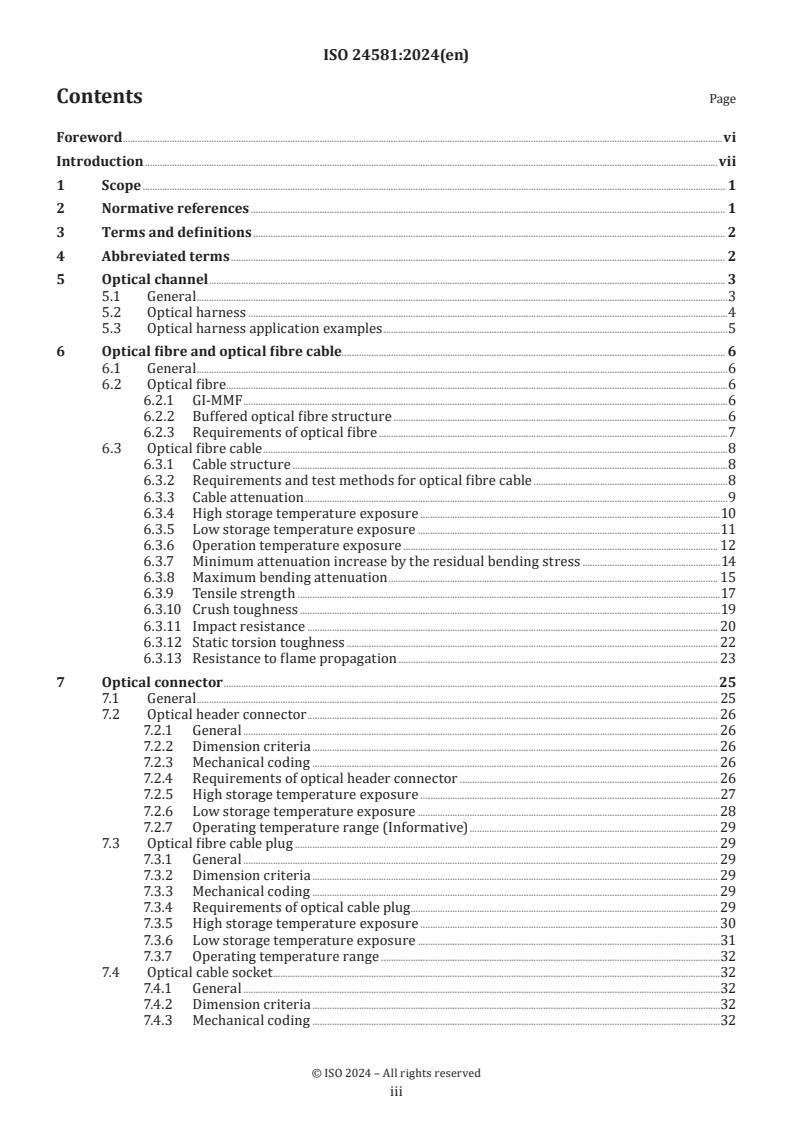
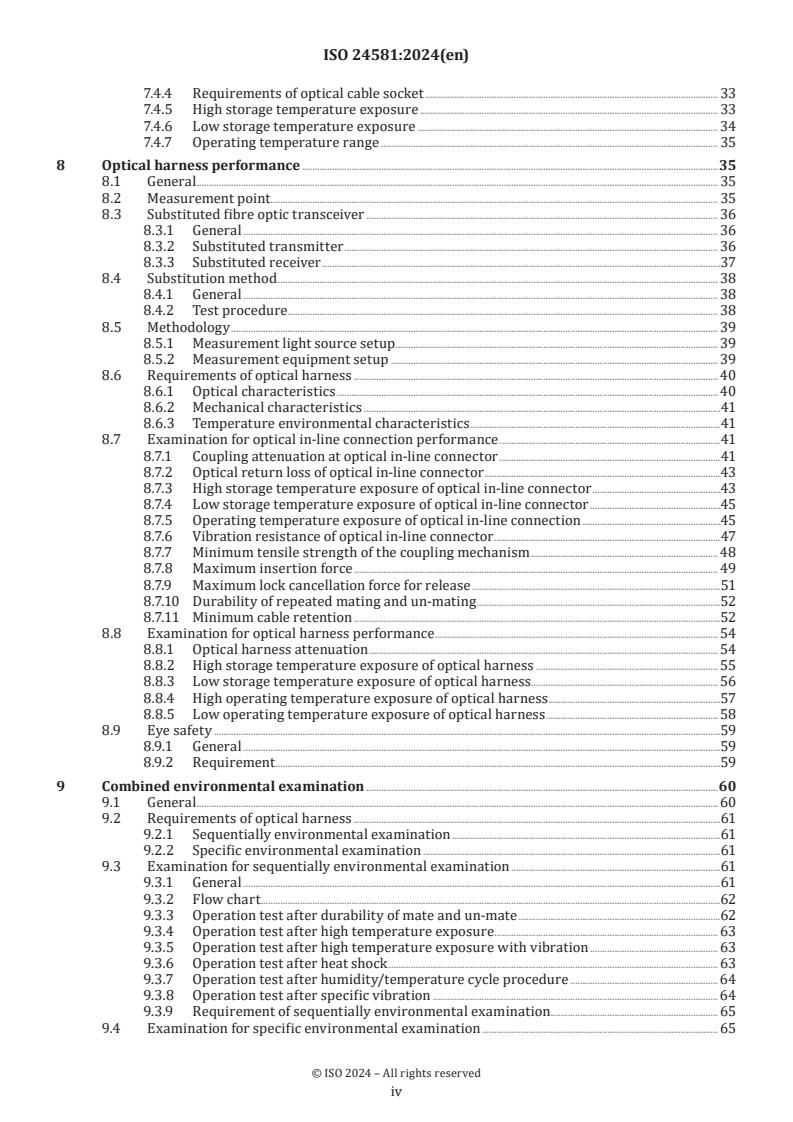
Contents Page
Foreword .vi
Introduction .vii
1 Scope . 1
2 Normative references . 1
3 Terms and definitions . 2
4 Abbreviated terms . 2
5 Optical channel . 3
5.1 General .3
5.2 Optical harness .4
5.3 Optical harness application examples .5
6 Optical fibre and optical fibre cable. 6
6.1 General .6
6.2 Optical fibre . . .6
6.2.1 GI-MMF .6
6.2.2 Buffered optical fibre structure .6
6.2.3 Requirements of optical fibre .7
6.3 Optical fibre cable .8
6.3.1 Cable structure .8
6.3.2 Requirements and test methods for optical fibre cable .8
6.3.3 Cable attenuation .9
6.3.4 High storage temperature exposure .10
6.3.5 Low storage temperature exposure .11
6.3.6 Operation temperature exposure . 12
6.3.7 Minimum attenuation increase by the residual bending stress .14
6.3.8 Maximum bending attenuation . 15
6.3.9 Tensile strength .17
6.3.10 Crush toughness .19
6.3.11 Impact resistance . 20
6.3.12 Static torsion toughness . 22
6.3.13 Resistance to flame propagation . 23
7 Optical connector .25
7.1 General . 25
7.2 Optical header connector . 26
7.2.1 General . 26
7.2.2 Dimension criteria . 26
7.2.3 Mechanical coding . 26
7.2.4 Requirements of optical header connector . 26
7.2.5 High storage temperature exposure .27
7.2.6 Low storage temperature exposure . 28
7.2.7 Operating temperature range (Informative) . 29
7.3 Optical fibre cable plug . 29
7.3.1 General . 29
7.3.2 Dimension criteria . 29
7.3.3 Mechanical coding . 29
7.3.4 Requirements of optical cable plug . 29
7.3.5 High storage temperature exposure . 30
7.3.6 Low storage temperature exposure .31
7.3.7 Operating temperature range .32
7.4 Optical cable socket .32
7.4.1 General .32
7.4.2 Dimension criteria .32
7.4.3 Mechanical coding .32
iii
7.4.4 Requirements of optical cable socket . 33
7.4.5 High storage temperature exposure . 33
7.4.6 Low storage temperature exposure . 34
7.4.7 Operating temperature range . 35
8 Optical harness performance .35
8.1 General . 35
8.2 Measurement point . . 35
8.3 Substituted fibre optic transceiver . 36
8.3.1 General . 36
8.3.2 Substituted transmitter . 36
8.3.3 Substituted receiver .37
8.4 Substitution method . 38
8.4.1 General . 38
8.4.2 Test procedure. 38
8.5 Methodology . 39
8.5.1 Measurement light source setup . 39
8.5.2 Measurement equipment setup . 39
8.6 Requirements of optical harness . 40
8.6.1 Optical characteristics . 40
8.6.2 Mechanical characteristics .41
8.6.3 Temperature environmental characteristics.41
8.7 Examination for optical in-line connection performance .41
8.7.1 Coupling attenuation at optical in-line connector .41
8.7.2 Optical return loss of optical in-line connector .43
8.7.3 High storage temperature exposure of optical in-line connector .43
8.7.4 Low storage temperature exposure of optical in-line connector .45
8.7.5 Operating temperature exposure of optical in-line connection .45
8.7.6 Vibration resistance of optical in-line connector .47
8.7.7 Minimum tensile strength of the coupling mechanism . 48
8.7.8 Maximum insertion force . 49
8.7.9 Maximum lock cancellation force for release .51
8.7.10 Durability of repeated mating and un-mating .52
8.7.11 Minimum cable retention .52
8.8 Examination for optical harness performance . 54
8.8.1 Optical harness attenuation . 54
8.8.2 High storage temperature exposure of optical harness . 55
8.8.3 Low storage temperature exposure of optical harness. 56
8.8.4 High operating temperature exposure of optical harness .57
8.8.5 Low operating temperature exposure of optical harness . 58
8.9 Eye safety .59
8.9.1 General .59
8.9.2 Requirement .59
9 Combined environmental examination .60
9.1 General . 60
9.2 Requirements of optical harness .61
9.2.1 Sequentially environmental examination .61
9.2.2 Specific environmental examination .61
9.3 Examination for sequentially environmental examination .61
9.3.1 General .61
9.3.2 Flow chart .62
9.3.3 Operation test after durability of mate and un-mate .62
9.3.4 Operation test after high temperature exposure . . 63
9.3.5 Operation test after high temperature exposure with vibration . 63
9.3.6 Operation test after heat shock . 63
9.3.7 Operation test after humidity/temperature cycle procedure . 64
9.3.8 Operation test after specific vibration . 64
9.3.9 Requirement of sequentially environmental examination . 65
9.4 Examination for specific environmental examination . 65
iv
9.4.1 General . 65
9.4.2 Operation test after specific physical shock . 65
9.4.3 Operation test after chemical durability procedure . 66
9.4.4 Operation test after noxious gas exposure .67
9.4.5 Operation test after specific dust condition exposure .67
9.4.6 Operation test after specific drop impact procedure . 68
9.4.7 Requirements of specific environmental examination . 68
Annex A (informative) System parameters of different transmission applications .70
Annex B (informative) Optical harness design guideline .72
Annex C (informative) Dimensions and reference planes of optical connectors . 74
Annex D (informative) Modal noise penalty .80
Bibliography .84
v
Foreword
ISO (the International Organization for Standardization) is a worldwide federation of national standards
bodies (ISO member bodies). The work of preparing International Standards is normally carried out through
ISO technical committees. Each member body interested in a subject for which a technical committee
has been established has the right to be represented on that committee. International organizations,
governmental and non-governmental, in liaison with ISO, also take part in the work. ISO collaborates closely
with the International Electrotechnical Commission (IEC) on all matters of electrotechnical standardization.
The procedures used to develop this document and those intended for its further maintenance are described
in the ISO/IEC Directives, Part 1. In particular, the different approval criteria needed for the different types
of ISO document should be noted. This document was drafted in accordance with the editorial rules of the
ISO/IEC Directives, Part 2 (see www.iso.org/directives).
ISO draws attention to the possibility that the implementation of this document may involve the use of (a)
patent(s). ISO takes no position concerning the evidence, validity or applicability of any claimed patent
rights in respect thereof. As of the date of publication of this document, ISO had not received notice of (a)
patent(s) which may be required to implement this document. However, implementers are cautioned that
this may not represent the latest information, which may be obtained from the patent database available at
www.iso.org/patents. ISO shall not be held responsible for identifying any or all such patent rights.
Any trade name used in this document is information given for the convenience of users and does not
constitute an endorsement.
For an explanation of the voluntary nature of standards, the meaning of ISO specific terms and expressions
related to conformity assessment, as well as information about ISO's adherence to the World Trade
Organization (WTO) principles in the Technical Barriers to Trade (TBT), see www.iso.org/iso/foreword.html.
This document was prepared by Technical Committee ISO/TC 22, Road vehicles, Subcommittee SC 32,
Electrical and electronic components and general system aspects.
Any feedback or questions on this document should be directed to the user’s national standards body. A
complete listing of these bodies can be found at www.iso.org/members.html.
vi
Introduction
This document contains general requirements and test methods for in-vehicle optical harnesses used for high
speed communication. Reliable and robust data communication at high data rates is becoming increasingly
crucial for the safe operation of automotive systems. Optical communication using graded index all-silica
multimode fibre offers superior bandwidth and immunity to electro-magnetic noise. Optical fibre cables
and connectors need equal processability, reliability and robustness against environmental influences to be
integrated into the vehicle’s wire harness. This document provides a set of test methods and requirements
to verify the suitability of optical fibre cables and connectors for in-vehicle harness integration. Optical
fibre cables can be used for different data transmission standards, such as Ethernet or other proprietary
protocols. This means that some performance related requirements have limits depending on the physical
layer they are intended for.
ISO 21111-4 is limited to the use of the 1000BASE-RH physical layer. Thus, the transmission rate is 1 Gbit/s
and the communication distance is 15 m maximum with four in-line connections.
The optical harnesses defined in this document may cover any applications at high data rates as well as
long distances, regardless of the physical layer (by OSI model). Therefore, this document is applicable for
articulated-bus for public transportation and/or large-trailer for logistics.
vii
International Standard ISO 24581:2024(en)
Road vehicles — General requirements and test methods
of in-vehicle optical harnesses for up to 100 Gbit/s
communication
1 Scope
This document specifies the performance requirements and test methods for optical harnesses for up to
100 Gbit/s per fibre channel for in-vehicle data communication between electronic devices including in-
line connections. The optical harness consists of cables and connectors, including cable to cable (in-line)
connectors and electronic device (header) connectors. Safety (electrical safety, protection, fire, etc.) and
electromagnetic compatibility (EMC) requirements are outside the scope of this document.
Specific to the optical header connector, only mechanical reference plane (MRP), optical reference plane
(ORP) and relevant mechanical dimensions are within the scope of this document.
The optical coupling system inside an optical header connector and the optoelectronic component itself are
beyond the scope of this document.
2 Normative references
The following documents are referred to in the text in such a way that some or all of their content constitutes
requirements of this document. For dated references, only the edition cited applies. For undated references,
the latest edition of the referenced document (including any amendments) applies.
ISO 16750-3, Road vehicles — Environmental conditions and testing for electrical and electronic equipment —
Part 3: Mechanical loads
ISO 16750-4, Road vehicles — Environmental conditions and testing for electrical and electronic equipment —
Part 4: Climatic loads
ISO 19642-1, Road vehicles — Automotive cables — Part 1: Vocabulary and design guidelines
ISO 19642-2, Road vehicles — Automotive cables — Part 2: Test methods
ISO 8092-2, Road vehicles — Connections for on-board electrical wiring harnesses — Part 2: Terminology, test
methods and general performance requirements
ISO 21111-4, Road vehicles — In-vehicle Ethernet — Part 4: General requirements and test methods of optical
gigabit Ethernet components
IEC 60068-2-60, Tests — Test Ke: Flowing mixed gas corrosion test
IEC 60793-1-46, Optical fibres — Part 1-46: Measurement methods and test procedures — Monitoring of
changes in optical transmittance
IEC 60793-1-47, Optical fibres — Part 1-47: Measurement methods and test procedures — Macrobending loss
IEC 60794-1-21, Optical fibre cables — Part 1-21: Generic specification — Basic optical cable test procedures —
Mechanical tests methods
IEC 60794-1-22, Optical fibre cables — Part 1-22: Generic specification — Basic optical cable test procedures —
Environmental test methods
IEC 61300-1, Fibre optic interconnecting devices and passive components — Basic test and measurement
procedures — Part 1: General and guidance
IEC 61300-2-22, Fibre optic interconnecting devices and passive components — Basic test and measurement
procedures — Part 2-22: Tests — Change of temperature
IEC 61300-3-4, Fibre optic interconnecting devices and passive components — Basic test and measurement
procedures — Part 3-4: Examinations and measurements – Attenuation
IEC 61300-3-6, Fibre optic interconnecting devices and passive components — Basic test and measurement
procedures — Part 3-6: Examinations and measurements — Return loss
3 Terms and definitions
For the purposes of this document, the following terms and definitions apply.
ISO and IEC maintain terminology databases for use in standardization at the following addresses:
— ISO Online browsing platform: available at https:// www .iso .org/ obp
— IEC Electropedia: available at https:// www .electropedia .org/
3.1
buffered optical fibre
optical fibre with an additional layer that surrounds the fibre for the purpose of mechanical insulation and
protection from physical damage
3.2
optical header connector
connector which may include an optical transceiver, media dependent interface and socket connector
portion that is mated with the cable plug
3.3
optical in-line connector
connector prepared for relaying optical signals, obtained by mating an optical cable plug and an optical
cable socket
3.4
system power budget
allocation of available optical power in order to ensure that adequate signal strength is available at the
receiver
4 Abbreviated terms
AOP average optical power
DC direct current
DUT device under test
ECU electronic control unit
FOT fibre optic transceiver
GI-MMF graded index – all-silica multimode fibre (excluding GI-POF)
LD laser diode
MRP mechanical reference plane
ORP optical reference plane
PCB printed circuit board
PD photodiode
PMD physical media dependent
TIA trans impedance amplifier
VCSEL vertical cavity surface emitting laser
5 Optical channel
5.1 General
The optical channel is composed of all optical elements that guide the optical signal from the light source
of the optical transmitter in a first ECU to the photodetector of the optical receiver in a second ECU. The
objective of the optical harness is to carry the optical signal between these ECUs with minimum loss and
signal distortion. The optical harness may consist of multiple segments of optical fibre cable as defined in
6.3. Each end of a cable segment is terminated by an optical cable plug as defined in 7.3 or an optical cable
socket as defined in 7.4. To connect two cable segments, one cable end shall be terminated with a cable plug.
The other end that mated with the opposing cable shall be terminated with a cable socket accordingly. The
mated combination of a cable plug and a cable socket is referred to as an in-line connection. See Figure 1.
Key
1 ECU-1 or other device-1
2 ECU-2 or other device-2
3 optical transmitter (light source)
4 optical receiver (photodetector)
5 optical header connector
6 optical cable plug
7 optical cable socket
8 optical fibre cable
9 optical channel
Figure 1 — Optical channel connecting ECUs
In this document, the mating socket of the ECU (header connector) is only defined with regards to its
mechanical and optical mating interface to ensure its mating compatibility with the optical harness. Any
optical guiding structures within the ECU or active components of the PMD are beyond the scope of this
document.
The optical header connector is defined in 7.2. It shall follow the mechanical interface definitions of a socket
connector to mate with an optical cable plug of a specified connector family. The optical path within the ECU
and thus inside a header connector is not part of this document. The optical channel consists of optical fibre
cables based on GI-MMF defined in Clause 6 and cable connectors defined in Clause 7 without any active
(optoelectronic) power consuming sub-component.
5.2 Optical harness
The optical harness consists of one or more segments of optical fibre cable with optical cable plugs and/
or optical cable sockets attached. The mated connection of two segments by a cable plug and a socket is
referred to as an in-line connection. See Figure 2. The dashed line in Figure 2 encloses the optical harness
and the housing parts of the header connector that are defined in this document. The total attenuation of the
optical harness is also affected by the layout shape (bending and number of in-line connections) mounted
on the vehicle. It shall not exceed the sum of the system power budget and system margin of the optical
transceiver of the communication system. Optical harness design guidelines are provided in Annex B.
The length and number of segments allowed depend on each communication system specification (e.g.
ISO/IEC/IEEE 8802-3). Additionally, when constructing a multi-giga optical Ethernet as specified in
IEEE802.3cz:2023, the modal noise penalty listed in Annex D shall be satisfied.
Key
1 header connector housing
2 cable plug
3 cable socket
4 optical fibre cable
5 MRP
6 ORP
7 optical transmitter (light source)
8 optical receiver (photodetector)
9 optical in-line connection
10 optical harness
Figure 2 — Optical harness and relation between connectors
5.3 Optical harness application examples
Since the route of the long optical harness may correspond to the vicinity of the ceiling or the exposed part
of the vehicle, various qualification tests shown in Clauses 6 to 9 of this document shall be required.
The optical harness is applicable to the engine compartment harness (see Figure 3), the roof harness (see
Figure 4) and the exposure harness (see Figure 5). These harnesses should conform to individually specified
temperature ranges.
Key
1 engine compartment harness
2 in-line connection
3 backbone ECU
Figure 3 — Optical harness application example for the passenger car
Key
1 roof harness
2 in-line connection
3 backbone ECU
Figure 4 — Optical harness application example for the articulated bus
Key
1 exposure harness
2 in-line connection
3 backbone ECU
Figure 5 — Optical harness application example for the trailer
6 Optical fibre and optical fibre cable
6.1 General
Optical fibres with appropriate bandwidth characteristics at the wavelength of the selected PMD shall be
implemented as the optical harnesses according to this document and used for communication with the
specified data rates. IEC 60793-2-10 defines different subcategories of GI-MMF. Cables used in an automotive
harness shall protect the optical fibre from environmental loads during shipment, storage, processing,
installation into the vehicle and during a vehicle’s operation. As a wire harness is typically deeply woven
through a vehicle’s body, it needs to last the entire lifetime of a vehicle. In many in-vehicle applications, the
optical fibre cable shares the same installation space or even the same harness as other general wires for
electrical functions. Thus, the optical fibre cable should to be able to withstand the same environmental
loads such as temperature, humidity, chemicals, shock, vibration, bending, abrasion and pull and sheer
forces as electrical cables intended for the same installation space.
6.2 Optical fibre
6.2.1 GI-MMF
IEC 60793-2-10 defines the dimensional requirements of optical fibre types with their core and cladding
properties. See Figure 6. Optical fibres of subcategory A1-OM3 and A1-OM4 are defined for link length and
signal bandwidth suitable to the requirements of the applications this document is targeting.
All optical cables specified in this document shall conform to subcategories A1-OM3 or A1-OM4 as specified
in IEC 60793-2-10 and have an operating temperature range of up to +125 °C.
6.2.2 Buffered optical fibre structure
GI-MMF 50 µm is commercially available to cable manufacturers as a pre-product. For processability reasons,
the all-silica fibre is protected by a primary coating applied during the fibre manufacturing process. Typical
primary coatings have an outer diameter of 250 µm. Other coating diameters and/or additional coating
layers may be applied depending on the application and cable requirements. Figure 6 shows an example of a
typical GI-MMF buffered optical fibre structure.
Key
1 primary coating
2 cladding
3 core
4 nominal core diameter (50 μm)
5 nominal cladding diameter (125 μm)
6 nominal primary coating diameter (250 μm)
Figure 6 — Typical structure of a buffered optical fibre (GI-MMF 50 µm)
6.2.3 Requirements of optical fibre
Table 1 shows the optical fibre requirements covered in this document and the references that define their
test methods. The structural requirements of the optical fibre itself as well as the propagation characteristics
are specified for ultra-high-speed optical communication.
Table 1 — Requirements of optical fibre
No. Requirement Reference
IEC 60793-1-20
1 Cladding diameter
IEC 60793-2-10
IEC 60793-1-20
2 Core diameter
IEC 60793-2-10
IEC 60793-1-20
3 Cladding non-circularity
IEC 60793-2-10
IEC 60793-1-20
4 Core non-circularity
IEC 60793-2-10
IEC 60793-1-21
5 Primary coating diameter
IEC 60793-2-10
IEC 60793-1-21
6 Primary coating non-circularity
IEC 60793-2-10
IEC 60793-1-40
7 Attenuation coefficient
IEC 60793-2-10
IEC 60793-1-41
8 Modal bandwidth
IEC 60793-2-10
IEC 60793-1-43
9 Numerical aperture
IEC 60793-2-10
IEC 60793-1-42
10 Chromatic dispersion
IEC 60793-2-10
IEC 60793-1-46
11 Change of optical transmission
IEC 60793-2-10
IEC 60793-1-49
12 Differential mode delay
IEC 60793-2-10
6.3 Optical fibre cable
6.3.1 Cable structure
The optical fibre cable shall have the optical performance specified in 6.3.2. It shall also be subjected to
the equivalent mechanical and environmental tests on automotive electrical wires and cables specified in
ISO 19642-2. Therefore, tough and flame-resistant jacketing materials shall be used.
An example of the optical fibre cable is shown in Figure 7. Strength members may be built into the cable
structure to ensure the specified tensile strength.
Key
1 optical fibre or buffered optical fibre
2 strength members
3 jacket
Figure 7 — Optical fibre cable structure
6.3.2 Requirements and test methods for optical fibre cable
Table 2 shows the references that contain requirements and test methods that the optical fibre cable shall
also conform to in addition to the requirements and test methods defined in each subclause in this document.
When the requirements specified in the subclause in this document deviate from the specifications in the
reference document, the requirements in the subclauses in this document prevail.
Table 2 — Requirements and test methods for optical fibre cable
Subclause
in this Requirement Reference
document
6.3.3 Cable attenuation IEC 60793-1-40
6.3.4 High storage temperature exposure ISO 19642-1
6.3.5 Low storage temperature exposure ISO 19642-1
ISO 19642-1
6.3.6 Operation temperature range
IEC 60794-1-22
Minimum attenuation increase by the residual bending stress
6.3.7 IEC 60793-1-47
(temporarily allowable bending radius)
6.3.8 Maximum bending attenuation IEC 60793-1-47
6.3.9 Tensile strength ISO 19642-2
IEC 60794-1-21
6.3.10 Crush toughness
IEC 60793-1-46
IEC 60794-1-21
6.3.11 Impact resistance
IEC 60793-1-46
6.3.12 Static torsion toughness IEC 60793-1-46
ISO 19642-2
6.3.13 Resistance to flame propagation
ISO 21111-4
6.3.3 Cable attenuation
6.3.3.1 Purpose
The buffered optical fibre with 50 µm GI core is a key parameter for determining the maximum link length
of the optical channel. Optical fibre cable attenuation is a measure of the decrease in optical power of a fibre
at a particular wavelength. Cable attenuation depends on the measurement conditions and the configuration
and length of the optical fibre cable. Cable attenuation should therefore be properly allocated to the link
power budget of the optical communication system that is shown in Annex A.
6.3.3.2 Test setup
An optical cable of 51 m is prepared as the DUT. Both fibre ends of the DUT shall be cut and polished or
otherwise prepared (according to the test equipment specifications for testing, e.g. for splicing). One end of
the DUT is connected to the optical power meter set at a designated wavelength. The other end is connected
to the stabilized light source defined in 8.5.1 via the launch optics defined in 8.5.2.1. See Figure 8 for the
attenuation measurement system.
Key
1 stabilized light source as defined in 8.5.1
2 launch optics as defined in 8.5.2.1
3 DUT
4 optical power meter as defined in 8.5.2.1
5 the cutting length of the DUT (50 m ± 0,5 m)
6 initial length of the DUT (51 m ± 0,5 m)
C measurement point of the fibre end of initial DUT
C measurement point of the fibre end of short DUT that is cut 50m from optical output end
Figure 8 — Cable attenuation measurement system
6.3.3.3 Test method
The optical power at C is measured as the initial value before fibre cutting. The launching condition shall be
retained while the fibre is cut at C and the fibre cross-section is polished. After that, optical power at C is
2 2
measured.
The attenuation of the optical fibre cable between the two cross sections C and C on the DUT is calculated
1 2
using Formula (1).
P
A =− 10log (1)
10
P
2
where
A
is the attenuation at the designated wavelength, expressed in dB;
P
is the AOP at cross-section C , at the designated wavelength;
...