

ISO 11452-8:2015
(Main)Road vehicles — Component test methods for electrical disturbances from narrowband radiated electromagnetic energy — Part 8: Immunity to magnetic fields
General Information
- Abstract
ISO 11452-8:2015 specifies tests for electromagnetic immunity of electronic components for passenger cars and commercial vehicles, regardless of the propulsion system (e.g. spark-ignition engine, diesel engine, electric motor), to magnetic fields. These sources are classified into "internal magnetic field" (sources internal to the vehicle, e.g. vehicle electro-mechanical motors, actuators,...) and "external magnetic field" (sources external to the vehicle e.g. power transmission lines, generating stations,?). To perform this test, the device under test (DUT) is exposed to a magnetic disturbance field. The radiating loop method can be applied to small DUTs or to larger DUTs by positioning the coil in multiple locations. The Helmholtz coil is sometimes used as an alternative method. This technique is limited by the relationship between the size of the DUT and the size of the coils. The electromagnetic disturbances considered in this ISO 11452-8:2015 are limited to continuous narrowband electromagnetic fields.
- Status
- Published
- Publication Date
- 01-Jun-2015
- Technical Committee
- ISO/TC 22/SC 32 - Electrical and electronic components and general system aspects
- Drafting Committee
- ISO/TC 22/SC 32/WG 3 - Electromagnetic compatibility
- Current Stage
- 9092 - International Standard to be revised
- Start Date
- 18-Jun-2021
- Completion Date
- 29-Aug-2026

Overview
ISO 11452-8:2015 - "Road vehicles - Component test methods for electrical disturbances from narrowband radiated electromagnetic energy - Part 8: Immunity to magnetic fields" defines laboratory test methods to verify the magnetic-field immunity of electronic components used in passenger cars and commercial vehicles (regardless of propulsion: ICE, diesel, electric). The standard covers exposure to continuous narrowband magnetic fields from internal sources (motors, actuators) and external sources (power transmission lines, generating stations) and prescribes how to generate, monitor and report these magnetic disturbance tests.
Key technical topics and requirements
- Scope & frequency range: Tests are specified for d.c. and 15 Hz to 150 kHz. Specific frequencies include d.c., 16.67 Hz, 50 Hz, 60 Hz, 150 Hz and 180 Hz; step sizes (linear/log) are defined and configurable when susceptibility thresholds are near the test level.
- Test methods: Two primary field-generating techniques:
- Radiating loop method - suitable for small DUTs or larger DUTs by scanning/positioning the coil; MIL‑STD‑461F style loop recommended (120 mm diameter, 20 turns). Not suitable for high-level d.c. fields without specialized coils.
- Helmholtz coil method - used to produce a uniform magnetic field (±10%) over a volume (minimum ~300×300×300 mm). Coil geometry and current determine field strength; coils must avoid self-resonance below 150 kHz.
- Instrumentation & monitoring:
- Current monitor: true‑RMS measurement across d.c. and 15 Hz–150 kHz (clamp probe or shunt).
- Magnetic field monitor: Hall sensors for d.c. (capable to at least 3 000 A/m) and loop sensors for f ≥ 15 Hz (typical loop: 40 mm diameter, 51 turns).
- Test set-up & reporting: References ISO 11452-1 for general test conditions (temperature, supply voltage, dwell time), defines test locations, test harness placement, and requires documentation of test severity levels and frequency steps. Annex A provides function performance status classification (FPSC) and suggested severity levels.
- Safety & normative refs: Follow personnel protection guidelines (national regs, ICNIRP). Normative references include ISO 11452-1 and VG 95377-13.
Practical applications - who uses ISO 11452-8
- Automotive OEMs and tier‑1 suppliers validating ECUs, sensors, actuators, and power electronics against magnetic disturbances.
- EMC test laboratories performing component-level immunity testing during R&D, pre‑compliance, and production verification.
- Design and validation engineers using the standard to reproduce internal (vehicle) and external (grid/lines) magnetic interference scenarios and to identify robustness issues.
- Quality and safety teams documenting compliance and creating test reports for vehicle integration.
Related standards
- ISO 11452 series (Part 1 general principles; Part 2 absorber‑lined enclosure; Part 3 TEM cell; Part 4 harness excitation; Part 5 stripline; Part 7 direct RF injection; Part 9 portable transmitter; Part 10 extended audio freq.; Part 11 reverberation chamber)
- VG 95377‑13 (measuring coils / field probes)
- MIL‑STD‑461F (radiating loop reference)
Keywords: ISO 11452-8, immunity to magnetic fields, radiating loop, Helmholtz coil, automotive EMC, component test, magnetic field strength, narrowband electromagnetic fields.
Relations
- Effective Date
- 09-Apr-2011
Get Certified
Connect with accredited certification bodies for this standard

TÜV Rheinland
TÜV Rheinland is a leading international provider of technical services.

TÜV SÜD
TÜV SÜD is a trusted partner of choice for safety, security and sustainability solutions.

DEKRA Certification Inc.
DEKRA US certification services.
Sponsored listings
Frequently Asked Questions
ISO 11452-8:2015 is a standard published by the International Organization for Standardization (ISO). Its full title is "Road vehicles — Component test methods for electrical disturbances from narrowband radiated electromagnetic energy — Part 8: Immunity to magnetic fields". This standard covers: ISO 11452-8:2015 specifies tests for electromagnetic immunity of electronic components for passenger cars and commercial vehicles, regardless of the propulsion system (e.g. spark-ignition engine, diesel engine, electric motor), to magnetic fields. These sources are classified into "internal magnetic field" (sources internal to the vehicle, e.g. vehicle electro-mechanical motors, actuators,...) and "external magnetic field" (sources external to the vehicle e.g. power transmission lines, generating stations,?). To perform this test, the device under test (DUT) is exposed to a magnetic disturbance field. The radiating loop method can be applied to small DUTs or to larger DUTs by positioning the coil in multiple locations. The Helmholtz coil is sometimes used as an alternative method. This technique is limited by the relationship between the size of the DUT and the size of the coils. The electromagnetic disturbances considered in this ISO 11452-8:2015 are limited to continuous narrowband electromagnetic fields.
ISO 11452-8:2015 specifies tests for electromagnetic immunity of electronic components for passenger cars and commercial vehicles, regardless of the propulsion system (e.g. spark-ignition engine, diesel engine, electric motor), to magnetic fields. These sources are classified into "internal magnetic field" (sources internal to the vehicle, e.g. vehicle electro-mechanical motors, actuators,...) and "external magnetic field" (sources external to the vehicle e.g. power transmission lines, generating stations,?). To perform this test, the device under test (DUT) is exposed to a magnetic disturbance field. The radiating loop method can be applied to small DUTs or to larger DUTs by positioning the coil in multiple locations. The Helmholtz coil is sometimes used as an alternative method. This technique is limited by the relationship between the size of the DUT and the size of the coils. The electromagnetic disturbances considered in this ISO 11452-8:2015 are limited to continuous narrowband electromagnetic fields.
ISO 11452-8:2015 is classified under the following ICS (International Classification for Standards) categories: 33.100.20 - Immunity; 43.040.10 - Electrical and electronic equipment. The ICS classification helps identify the subject area and facilitates finding related standards.
ISO 11452-8:2015 has the following relationships with other standards: It is inter standard links to ISO 11452-8:2007. Understanding these relationships helps ensure you are using the most current and applicable version of the standard.
ISO 11452-8:2015 is available in PDF format for immediate download after purchase. The document can be added to your cart and obtained through the secure checkout process. Digital delivery ensures instant access to the complete standard document.
Standards Content (Sample)
INTERNATIONAL ISO
STANDARD 11452-8
Second edition
2015-06-01
Road vehicles — Component test
methods for electrical disturbances
from narrowband radiated
electromagnetic energy —
Part 8:
Immunity to magnetic fields
Véhicules routiers — Méthodes d’essai d’un équipement soumis
à des perturbations électriques par rayonnement d’énergie
électromagnétique en bande étroite —
Partie 8: Méthodes d’immunité aux champs magnétiques
Reference number
©
ISO 2015
© ISO 2015, Published in Switzerland
All rights reserved. Unless otherwise specified, no part of this publication may be reproduced or utilized otherwise in any form
or by any means, electronic or mechanical, including photocopying, or posting on the internet or an intranet, without prior
written permission. Permission can be requested from either ISO at the address below or ISO’s member body in the country of
the requester.
ISO copyright office
Ch. de Blandonnet 8 • CP 401
CH-1214 Vernier, Geneva, Switzerland
Tel. +41 22 749 01 11
Fax +41 22 749 09 47
copyright@iso.org
www.iso.org
ii © ISO 2015 – All rights reserved
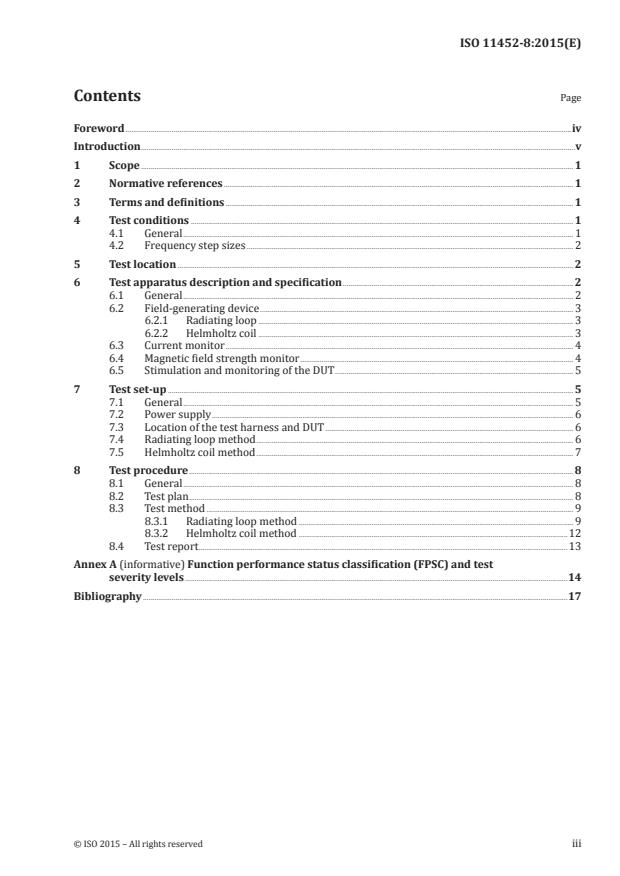
Contents Page
Foreword .iv
Introduction .v
1 Scope . 1
2 Normative references . 1
3 Terms and definitions . 1
4 Test conditions . 1
4.1 General . 1
4.2 Frequency step sizes . 2
5 Test location . 2
6 Test apparatus description and specification . 2
6.1 General . 2
6.2 Field-generating device . 3
6.2.1 Radiating loop . 3
6.2.2 Helmholtz coil . 3
6.3 Current monitor . 4
6.4 Magnetic field strength monitor . 4
6.5 Stimulation and monitoring of the DUT . 5
7 Test set-up . 5
7.1 General . 5
7.2 Power supply . 6
7.3 Location of the test harness and DUT . 6
7.4 Radiating loop method . 6
7.5 Helmholtz coil method . 7
8 Test procedure . 8
8.1 General . 8
8.2 Test plan . 8
8.3 Test method . 9
8.3.1 Radiating loop method . 9
8.3.2 Helmholtz coil method .12
8.4 Test report .13
Annex A (informative) Function performance status classification (FPSC) and test
severity levels .14
Bibliography .17
Foreword
ISO (the International Organization for Standardization) is a worldwide federation of national standards
bodies (ISO member bodies). The work of preparing International Standards is normally carried out
through ISO technical committees. Each member body interested in a subject for which a technical
committee has been established has the right to be represented on that committee. International
organizations, governmental and non-governmental, in liaison with ISO, also take part in the work.
ISO collaborates closely with the International Electrotechnical Commission (IEC) on all matters of
electrotechnical standardization.
The procedures used to develop this document and those intended for its further maintenance are
described in the ISO/IEC Directives, Part 1. In particular the different approval criteria needed for the
different types of ISO documents should be noted. This document was drafted in accordance with the
editorial rules of the ISO/IEC Directives, Part 2 (see www.iso.org/directives).
Attention is drawn to the possibility that some of the elements of this document may be the subject of
patent rights. ISO shall not be held responsible for identifying any or all such patent rights. Details of any
patent rights identified during the development of the document will be in the Introduction and/or on
the ISO list of patent declarations received (see www.iso.org/patents).
Any trade name used in this document is information given for the convenience of users and does not
constitute an endorsement.
For an explanation on the meaning of ISO specific terms and expressions related to conformity
assessment, as well as information about ISO’s adherence to the WTO principles in the Technical Barriers
to Trade (TBT) see the following URL: Foreword - Supplementary information
The committee responsible for this document is ISO/TC 22, Road vehicles, Subcommittee SC 32, Electrical
and electronic components and general system aspects.
This second edition cancels and replaces the first edition (ISO 11452-8:2007), of which it constitutes a
minor revision.
ISO 11452 consists of the following parts, under the general title Road vehicles — Component test methods
for electrical disturbances for narrowband radiated electromagnetic energy:
— Part 1: General principles and terminology
— Part 2: Absorber-lined shielded enclosure
— Part 3: Transverse electromagnetic mode (TEM) cell
— Part 4: Harness excitation methods
— Part 5: Stripline
— Part 7: Direct radio frequency (RF) power injection
— Part 8: Immunity to magnetic fields
— Part 9: Portable transmitter
— Part 10: Immunity to conducted disturbances in the extended audio frequency range
— Part 11: Reverberation chamber
Annex A of this part of ISO 11452 is for information only.
iv © ISO 2015 – All rights reserved
Introduction
Immunity measurements of complete road vehicles are generally able to be carried out only by the
vehicle manufacturer, owing to, for example, high costs of absorber-lined shielded enclosures, the desire
to preserve the secrecy of prototypes, or a large number of different vehicle models.
For research, development, and quality control, a laboratory measuring method can be used by both
vehicle manufacturers and equipment suppliers to test electronic components.
ISO 11452-1 specifies general test conditions, definitions, practical use, and basic principles of the test
procedure.
INTERNATIONAL STANDARD ISO 11452-8:2015(E)
Road vehicles — Component test methods for electrical
disturbances from narrowband radiated electromagnetic
energy —
Part 8:
Immunity to magnetic fields
1 Scope
This part of ISO 11452 specifies tests for electromagnetic immunity of electronic components for
passenger cars and commercial vehicles, regardless of the propulsion system (e.g. spark-ignition engine,
diesel engine, electric motor), to magnetic fields. These sources are classified into “internal magnetic
field” (sources internal to the vehicle, e.g. vehicle electro-mechanical motors, actuators,.) and “external
magnetic field” (sources external to the vehicle e.g. power transmission lines, generating stations,…). To
perform this test, the device under test (DUT) is exposed to a magnetic disturbance field.
The radiating loop method can be applied to small DUTs or to larger DUTs by positioning the coil in
multiple locations.
The Helmholtz coil is sometimes used as an alternative method. This technique is limited by the
relationship between the size of the DUT and the size of the coils. The electromagnetic disturbances
considered in this part of ISO 11452 are limited to continuous narrowband electromagnetic fields.
2 Normative references
The following documents, in whole or in part, are normatively referenced in this document and are
indispensable for its application. For dated references, only the edition cited applies. For undated
references, the latest edition of the referenced document (including any amendments) applies.
ISO 11452-1, Road vehicles — Component test methods for electrical disturbances from narrowband
radiated electromagnetic energy — Part 1: General principles and terminology
VG 95377-13:1993, Electromagnetic compatibility — Measuring devices and measuring equipment —
measuring antennas, measuring coils and field probes
3 Terms and definitions
For the purposes of this document, the terms and definitions given in ISO 11452-1 apply.
4 Test conditions
4.1 General
The applicable frequency range of this test method is d.c. and 15 Hz to 150 kHz.
The users shall specify the test severity level(s) over the frequency range. Suggested test severity levels
are included in Annex A.
Standard test conditions are given in ISO 11452-1 for the following:
— test temperature;
— supply voltage;
— dwell time;
— definition of test severity levels.
4.2 Frequency step sizes
The tests shall be conducted at d.c. and at frequencies of 16,67 Hz, 50 Hz, 60 Hz, 150 Hz, and 180 Hz and
with frequency step sizes (logarithmic or linear) not greater than those specified in Table 1. The step
sizes agreed upon by the users of this part of ISO 11452 shall be documented in the test report.
Table 1 — Maximum frequency steps sizes
Frequency band Linear steps Logarithmic steps
kHz kHz %
0 (d.c.) - -
0,015 to 0,1 0,01 10
0,1 to 1 0,1 10
1 to 10 1 10
10 to 150 10 10
NOTE The 5th harmonic of 16,67 Hz, 50 Hz and 60 Hz can also be tested.
If it appears that the susceptibility thresholds of the DUT are very near to the chosen test level, these
frequency step sizes should be reduced in the frequency range concerned in order to find the minimum
susceptibility thresholds.
5 Test location
A shielded room is not required.
[2][3]
IMPORTANT — The appropriate guidelines (national regulation, ICNIRP, etc.) shall be
followed for the protection of the test personnel.
6 Test apparatus description and specification
6.1 General
The test apparatus shall consist of the following:
— field-generating device(s): radiating loop or Helmholtz coil;
— magnetic field strength monitor;
— low-frequency (LF) generator;
— low-frequency (LF) amplifier (capable of driving inductive load);
— voltmeter;
— current monitor;
— artificial network(s) (AN) (optional, see ISO 11452-1 for characteristics).
2 © ISO 2015 – All rights reserved
6.2 Field-generating device
6.2.1 Radiating loop
The radiating loop of MIL STD 461 F is recommended (not suitable for high level d.c. fields), but any
similar coil may be used. The MIL STD 461 F coil has the following characteristics:
— diameter: 120 mm;
— number of turns: 20;
— wire: approximate diameter 2,0 mm (AWG12).
For d.c. fields up to 3 000 A/m, a specialized coil is required in accordance with VG 95377-13.
The magnetic flux density B of this radiating loop of MIL STD 461 F with a current I at a distance of
50mm
50 mm from the plane of the loop is given by Formula (1):
BH==μ 95I (1)
50mm0
where
B is the magnetic flux density, in microtesla;
H is the magnetic field, in amperes per metre;
95 is a constant, in volt. second per ampere per square meter;
I is the coil current, in amperes.
The magnetic field strength H of this radiating loop of MIL STD 461 F with a current I at a distance
50mm
of 50 mm from the plane of the loop is given by Formula (2):
HI=75,6 (2)
50mm
where
H is the magnetic field, in amperes per metre;
75,6 is a constant, per metre;
I is the coil current, in amperes.
The radiating loop should be characterized over the frequency range. Linearity characteristics shall be
considered in determining the calculated current value for the DUT test.
6.2.2 Helmholtz coil
Ideally, Helmholtz coils set up a region of uniform magnetic fields. The primary usage of the coils is to
expose the DUT to a uniform magnetic field.
The radius of the coils is determined by the size of the DUT. In order to obtain a
...