

ISO 11451-3:2024
(Main)Road vehicles — Vehicle test methods for electrical disturbances from narrowband radiated electromagnetic energy — Part 3: On-board transmitter simulation
General Information
- Abstract
This document specifies methods for testing the immunity of passenger cars and commercial vehicles to electromagnetic disturbances from on-board transmitters connected to an external antenna and portable transmitters with integral antennas, regardless of the vehicle propulsion system (e.g. spark ignition engine, diesel engine, electric motor).
- Status
- Published
- Publication Date
- 10-Jun-2024
- Current Stage
- 6060 - International Standard published
- Start Date
- 11-Jun-2024
- Due Date
- 18-Jun-2024
- Completion Date
- 11-Jun-2024

Overview
ISO 11451-3:2024 - "Road vehicles - Vehicle test methods for electrical disturbances from narrowband radiated electromagnetic energy - Part 3: On-board transmitter simulation" defines standardized methods to test the immunity of passenger cars and commercial vehicles to electromagnetic disturbances produced by on‑board transmitters and portable transmitters with integral antennas. The standard applies across vehicle propulsion types (spark-ignition, diesel, electric) and covers the frequency range 1.8 MHz to 6 GHz. It is the fourth edition and forms Part 3 of the ISO 11451 series on vehicle EMC testing.
Key Topics and Requirements
- Scope and test conditions: Specifies frequency range (1.8 MHz–6 GHz), test severity levels (user-specified; suggested levels in Annex D), and references general conditions from ISO 11451-1 (temperature, supply voltage, dwell time, modulation, etc.).
- Test locations: Primary use of an absorber lined shielded enclosure (ALSE) per ISO 11451-2; outdoor test site allowed where regulations permit.
- Test instrumentation: RF generator with modulation, power amplifier, dual directional coupler, low-loss 50 Ω coaxial cable, vector network analyser (VNA), transmit antennas, and artificial networks (DC charging AN, AMN, AAN).
- Power monitoring: Forward/reflected power measurement via power sensors or spectrum analyser. Requirements include sensor VSWR < 1.2 and measurement accuracy < 0.5 dB; guidance for peak/average/pulsed measurements and broadband channel power.
- Coupler and cable specs: Coupler coupling factor > 20 dB (40 dB recommended), directivity > 18 dB, mainline VSWR < 1.3; coax assembly VSWR < 1.1 and transmission loss < 6 dB.
- Signal source approaches: Simulated on‑board transmitters (external signal generator + amplifier feeding test or OEM antenna) and simulated portable transmitters (power delivered to small passive antenna inside the vehicle). Ferrite RF chokes recommended on antenna feed to better simulate installed transmitters.
- Annexes: Annex A (net power characterization), Annex B (typical transmitter characteristics), Annex C (simulated portable transmitter antennas), Annex D (function performance status classification).
Applications and Who Uses It
- Automotive OEMs and suppliers for vehicle EMC design and validation
- Accredited EMC test laboratories implementing on-board transmitter simulation procedures
- Compliance and certification teams assessing vehicle immunity to Bluetooth, cellular, GNSS, WLAN and other narrowband sources
- Electromagnetic compatibility (EMC) engineers and test technicians creating test plans and reports
Related Standards
- ISO 11451-1: General principles and terminology (referenced normative)
- ISO 11451-2: ALSE characteristics for radiated immunity testing
Keywords: ISO 11451-3:2024, vehicle EMC testing, on-board transmitter simulation, narrowband radiated electromagnetic energy, immunity testing, ALSE, dual directional coupler, power monitoring, VNA.
Relations
- Effective Date
- 06-Jun-2022
Get Certified
Connect with accredited certification bodies for this standard

TÜV Rheinland
TÜV Rheinland is a leading international provider of technical services.

TÜV SÜD
TÜV SÜD is a trusted partner of choice for safety, security and sustainability solutions.

DEKRA Certification Inc.
DEKRA US certification services.
Sponsored listings
Frequently Asked Questions
ISO 11451-3:2024 is a standard published by the International Organization for Standardization (ISO). Its full title is "Road vehicles — Vehicle test methods for electrical disturbances from narrowband radiated electromagnetic energy — Part 3: On-board transmitter simulation". This standard covers: This document specifies methods for testing the immunity of passenger cars and commercial vehicles to electromagnetic disturbances from on-board transmitters connected to an external antenna and portable transmitters with integral antennas, regardless of the vehicle propulsion system (e.g. spark ignition engine, diesel engine, electric motor).
This document specifies methods for testing the immunity of passenger cars and commercial vehicles to electromagnetic disturbances from on-board transmitters connected to an external antenna and portable transmitters with integral antennas, regardless of the vehicle propulsion system (e.g. spark ignition engine, diesel engine, electric motor).
ISO 11451-3:2024 is classified under the following ICS (International Classification for Standards) categories: 33.100.20 - Immunity; 43.040.10 - Electrical and electronic equipment. The ICS classification helps identify the subject area and facilitates finding related standards.
ISO 11451-3:2024 has the following relationships with other standards: It is inter standard links to ISO 11451-3:2015. Understanding these relationships helps ensure you are using the most current and applicable version of the standard.
ISO 11451-3:2024 is available in PDF format for immediate download after purchase. The document can be added to your cart and obtained through the secure checkout process. Digital delivery ensures instant access to the complete standard document.
Standards Content (Sample)
International
Standard
ISO 11451-3
Fourth edition
Road vehicles — Vehicle test
2024-06
methods for electrical disturbances
from narrowband radiated
electromagnetic energy —
Part 3:
On-board transmitter simulation
Véhicules routiers — Méthodes d'essai d'un véhicule soumis
à des perturbations électriques par rayonnement d'énergie
électromagnétique en bande étroite —
Partie 3: Simulation des émetteurs embarqués
Reference number
© ISO 2024
All rights reserved. Unless otherwise specified, or required in the context of its implementation, no part of this publication may
be reproduced or utilized otherwise in any form or by any means, electronic or mechanical, including photocopying, or posting on
the internet or an intranet, without prior written permission. Permission can be requested from either ISO at the address below
or ISO’s member body in the country of the requester.
ISO copyright office
CP 401 • Ch. de Blandonnet 8
CH-1214 Vernier, Geneva
Phone: +41 22 749 01 11
Email: copyright@iso.org
Website: www.iso.org
Published in Switzerland
ii
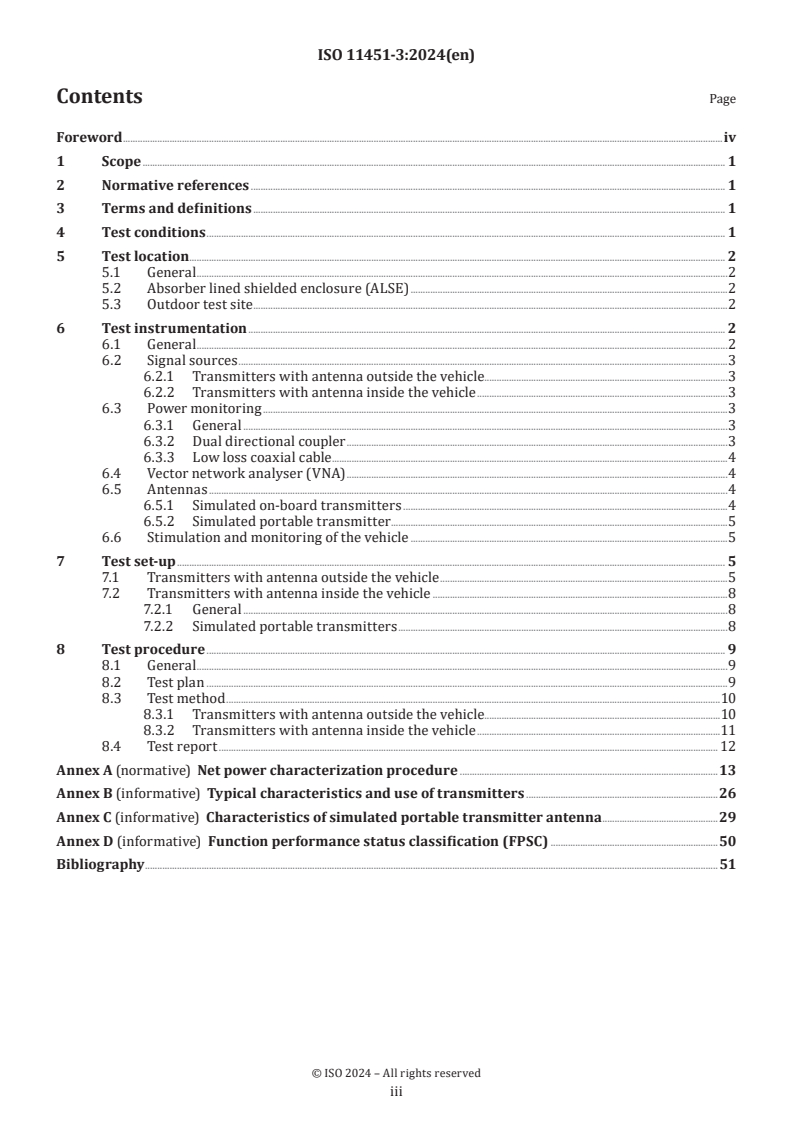
Contents Page
Foreword .iv
1 Scope . 1
2 Normative references . 1
3 Terms and definitions . 1
4 Test conditions . 1
5 Test location . 2
5.1 General .2
5.2 Absorber lined shielded enclosure (ALSE) .2
5.3 Outdoor test site .2
6 Test instrumentation . 2
6.1 General .2
6.2 Signal sources .3
6.2.1 Transmitters with antenna outside the vehicle.3
6.2.2 Transmitters with antenna inside the vehicle .3
6.3 Power monitoring .3
6.3.1 General .3
6.3.2 Dual directional coupler .3
6.3.3 Low loss coaxial cable .4
6.4 Vector network analyser (VNA) .4
6.5 Antennas .4
6.5.1 Simulated on-board transmitters .4
6.5.2 Simulated portable transmitter .5
6.6 Stimulation and monitoring of the vehicle .5
7 Test set-up . 5
7.1 Transmitters with antenna outside the vehicle .5
7.2 Transmitters with antenna inside the vehicle .8
7.2.1 General .8
7.2.2 Simulated portable transmitters .8
8 Test procedure . 9
8.1 General .9
8.2 Test plan .9
8.3 Test method .10
8.3.1 Transmitters with antenna outside the vehicle.10
8.3.2 Transmitters with antenna inside the vehicle .11
8.4 Test report . 12
Annex A (normative) Net power characterization procedure .13
Annex B (informative) Typical characteristics and use of transmitters .26
Annex C (informative) Characteristics of simulated portable transmitter antenna .29
Annex D (informative) Function performance status classification (FPSC) .50
Bibliography .51
iii
Foreword
ISO (the International Organization for Standardization) is a worldwide federation of national standards
bodies (ISO member bodies). The work of preparing International Standards is normally carried out through
ISO technical committees. Each member body interested in a subject for which a technical committee
has been established has the right to be represented on that committee. International organizations,
governmental and non-governmental, in liaison with ISO, also take part in the work. ISO collaborates closely
with the International Electrotechnical Commission (IEC) on all matters of electrotechnical standardization.
The procedures used to develop this document and those intended for its further maintenance are described
in the ISO/IEC Directives, Part 1. In particular, the different approval criteria needed for the different types
of ISO document should be noted. This document was drafted in accordance with the editorial rules of the
ISO/IEC Directives, Part 2 (see www.iso.org/directives).
ISO draws attention to the possibility that the implementation of this document may involve the use of (a)
patent(s). ISO takes no position concerning the evidence, validity or applicability of any claimed patent
rights in respect thereof. As of the date of publication of this document, ISO had not received notice of (a)
patent(s) which may be required to implement this document. However, implementers are cautioned that
this may not represent the latest information, which may be obtained from the patent database available at
www.iso.org/patents. ISO shall not be held responsible for identifying any or all such patent rights.
Any trade name used in this document is information given for the convenience of users and does not
constitute an endorsement.
For an explanation of the voluntary nature of standards, the meaning of ISO specific terms and expressions
related to conformity assessment, as well as information about ISO's adherence to the World Trade
Organization (WTO) principles in the Technical Barriers to Trade (TBT), see www.iso.org/iso/foreword.html.
This document was prepared by Technical Committee ISO/TC 22, Road vehicles, Subcommittee SC 32,
Electrical and electronic components and general system aspects.
This fourth edition cancels and replaces the third edition (ISO 11451-3:2015), which has been technically
revised.
The main changes are as follows:
— change of the frequency range from 1,8 MHz – 5,85 GHz to 1,8 MHz – 6 GHz;
— suppression of test methodology with commercial transmitters;
— use of modulation from ISO 11451-1;
— addition of new Annex A with description of test methodology for net power characterization procedure;
— addition in Annex C of microwave broadband dipole antenna and HF broadband sleeve antenna;
— addition of Annex D on function performance status classification (FPSC).
A list of all parts in the ISO 11451 series can be found on the ISO website.
Any feedback or questions on this document should be directed to the user’s national standards body. A
complete listing of these bodies can be found at www.iso.org/members.html.
iv
International Standard ISO 11451-3:2024(en)
Road vehicles — Vehicle test methods for electrical
disturbances from narrowband radiated electromagnetic
energy —
Part 3:
On-board transmitter simulation
1 Scope
This document specifies methods for testing the immunity of passenger cars and commercial vehicles to
electromagnetic disturbances from on-board transmitters connected to an external antenna and portable
transmitters with integral antennas, regardless of the vehicle propulsion system (e.g. spark ignition engine,
diesel engine, electric motor).
2 Normative references
The following documents are referred to in the text in such a way that some or all of their content constitutes
requirements of this document. For dated references, only the edition cited applies. For undated references,
the latest edition of the referenced document (including any amendments) applies.
ISO 11451-1, Road vehicles — Vehicle test methods for electrical disturbances from narrowband radiated
electromagnetic energy — Part 1: General principles and terminology
3 Terms and definitions
For the purposes of this document, the terms and definitions given in ISO 11451-1 and the following apply.
ISO and IEC maintain terminology databases for use in standardization at the following addresses:
— ISO Online browsing platform: available at https:// www .iso .org/ obp
— IEC Electropedia: available at https:// www .electropedia .org/
3.1
integral antenna
permanent fixed antenna which may be built-in, designed as an indispensable part of the portable
transmitting device
3.2
peak power sensor
power sensor that allows direct measurement of the peak power of the modulated carrier signal
3.3
average power sensor
power sensor that allows direct measurement of the average power of the modulated carrier signal
4 Test conditions
The applicable frequency range of the test method is 1,8 MHz to 6 GHz.
The user shall specify the test severity level(s) over the frequency range. Suggested test levels are included
in Annex D. Typical on-board transmitter characteristics (frequency bands, power level and modulation) are
given in Annex B.
Standard test conditions are given in ISO 11451-1 for the following:
— test temperature;
— supply voltage;
— dwell time;
— frequency step;
— modulation;
— test signal quality.
NOTE Alternate modulations, if required, can be found in Annex B. Users of this document are advised that
Annex B is for information only and cannot be considered as an exhaustive description of various portable transmitters
available in all countries.
5 Test location
5.1 General
This test should typically be performed in an absorber lined shielded enclosure (ALSE). Where national
regulations permit, the test can also be performed at an outdoor test site.
5.2 Absorber lined shielded enclosure (ALSE)
An absorber lined shielded enclosure with the characteristics specified in ISO 11451-2 should be used for
this test.
NOTE At frequencies where absorbers are not effective, the reflections in the chamber can affect the exposure of
the vehicle.
5.3 Outdoor test site
Where national regulations permit the use of an outdoor test site, the outdoor test site should have an area
with a radius of 10 m free from large metal structures or objects. When performing outdoor test-site tests, it
is important to be aware of harmonic suppression regulations.
6 Test instrumentation
6.1 General
The following test instrumentation is used:
— radio frequency (RF) generator with internal or external modulation capability;
— power amplifier;
— power measuring instrumentation to measure the forward and reverse power;
— dual directional coupler;
— low loss coaxial cables;
— vector network analyser (VNA);
— transmit antenna;
— direct current charging artificial network (DC- charging AN), and/or artificial mains networks (AMN),
and/or asymmetric artificial networks (AAN).
6.2 Signal sources
6.2.1 Transmitters with antenna outside the vehicle
Signal sources for transmitters with antenna outside the vehicle should be simulated on-board transmitters
(use of a signal generator and broadband power amplifier located external to the vehicle capable of
generating radio frequency (RF) power in their operational frequency ranges with specific output power
delivered to a test antenna or original equipment manufacturer (OEM) antenna fitted to the vehicle).
When using simulated on-board transmitters located external to the vehicle, it is advisable to place an RF
choke (ferrite or powdered iron toroid) around the coaxial cable to the antenna to produce a minimum lossy
impedance of 200 ohms. This reduces the cable shield skin currents and more closely simulate a transmitter
installed in the vehicle.
6.2.2 Transmitters with antenna inside the vehicle
Signal sources for transmitters with antenna inside the vehicle should be simulated portable transmitters
(use of a signal generator and broadband power amplifier located external to the vehicle capable of
generating radio frequency (RF) power in their operational frequency ranges with specific output power).
The power is delivered to a small passive antenna within the vehicle. Antennas used for this testing are
described in Annex C.
6.3 Power monitoring
6.3.1 General
Either power sensors or a spectrum analyser (or measurement receiver) shall be used for measurement of
the forward and reflected power at the dual directional coupler. When power sensors are used to measure
forward and reflected power:
— CW or AM signal shall be measured either with an average power sensor or a peak power sensor (peak
conservation may be applied for AM per ISO 11451-1);
— pulsed power modulation shall be measured with a peak power sensor;
— when applying broadband test signal, power measurement instrumentation shall be capable of measuring
average and peak values of the channel power;
— power sensors should be connected directly to the coupler ports;
— power sensors shall exhibit a VSWR < 1,2 and measurement accuracy < 0,5 dB.
When a spectrum analyser (or measurement receiver) is used to measure forward and reflected power, it
shall exhibit the same VSWR and measurement accuracy as required for power sensors. When the sensors
or a spectrum analyser (or measurement receiver) are connected to the coupler via coaxial cables, the cable’s
transmission loss shall be taken into account during characterization. See Annex A for details.
6.3.2 Dual directional coupler
The coupler shall exhibit the following characteristics:
— coupling factor: > 20 dB (40 dB recommended),
— mainline port VSWR < 1,3,
— coupling port VSWR: < 1,5,
— mainline transmission loss: < 0,5 dB,
— directivity: > 18 dB,
— power rating compatible with testing needs.
6.3.3 Low loss coaxial cable
The 50 Ω coaxial cable assembly (including all adaptors, switches, etc.) connecting the dual directional
coupler to the transmit antenna shall exhibit a VSWR < 1,1 and transmission loss < 6 dB. Verification shall be
performed in accordance with Annex A.
6.4 Vector network analyser (VNA)
The VNA shall exhibit the following characteristics:
— frequency range: 1,8 MHz to 6 GHz,
— dynamic range: > 60 dB (IF bandwidth < 3 kHz),
— return loss: > 32 dB,
— transmission loss accuracy: < 0,1 dB,
— minimum number of points: 401,
— IF bandwidth: selected to meet return and transmission loss requirements (typically 1 kHz),
— VNA calibration kit to facilitate TOSM (through, open, short, matched) measurements:
— termination through: return loss > 35 dB,
— termination short/open: deviation in nominal phase < 2°,
— termination match: return loss > 40 dB.
The following characteristics are recommended:
— frequency step: specified by the manufacturer (logarithmic step recommended),
— power level: 0 dBm (recommended value),
— averaging capability (optional),
— it is recommended to use the same connector type to match that of the interconnecting cable assembly
and transmit antenna (avoid using adaptors).
6.5 Antennas
6.5.1 Simulated on-board transmitters
When an OEM antenna is not installed on the vehicle, the antenna(s) described below shall be used.
— For frequency ranges ≤ 30 MHz, loaded antennas shall be used. Loaded antennas employ lumped or
distributed reactive components with a radiating element physically shorter than quarter wave at
resonance. It is recommended to use a “screw-driver” antenna which allows use of a single antenna thus
reducing installation time. Use of this antenna also facilitates automation techniques.
— For frequency ranges > 30 MHz, for example, for the very high frequency (VHF) and ultra-high frequency
(UHF) bands, quarter wave antennas should be given preference over 5/8 wave antennas, since there are
higher skin currents created by quarter wave antennas.
NOTE A screwdriver antenna is a vertical antenna for mobile operation in amateur HF band. It can cover from
10 m to 160 m band according to adjust a centre loading coil remotely. It is named from an electric screwdriver,
because of its tuning method by a reversible DC electric motor.
All antennas shall be tuned on the vehicle for minimum voltage standing wave ratio (VSWR, typically less
than 2:1) unless otherwise specified in the test plan. As a minimum, the VSWR value shall be measured and
recorded with the antenna on the vehicle at the lower and upper band edge and at a middle frequency. See
Annex A for procedures to make these measurements.
6.5.2 Simulated portable transmitter
Unless otherwise specified, the simulated portable transmitter antenna shall be a passive antenna. For
characteristics of a passive antenna, see Annex C.
6.6 Stimulation and monitoring of the vehicle
If remote stimulation and monitoring are required in the test plan, the vehicle shall be operated by actuators
which have a minimum effect on the electromagnetic characteristics, e.g. plastic blocks on the push-buttons,
pneumatic actuators with plastic tubes.
Connections to monitoring equipment can be accomplished by using fibre-optics or high resistance leads.
Other types of leads can be used, but they require extreme care to minimize interactions. The orientation,
length and location of such leads shall be carefully documented to ensure repeatability of test results.
Any electrical connection of monitoring equipment to the vehicle can cause malfunctions of the vehicle.
Extreme care shall be taken to avoid such an effect.
7 Test set-up
7.1 Transmitters with antenna outside the vehicle
The test can be performed with test antenna(s) or with the vehicle’s OEM antenna, as defined in 6.5.1.
When a test antenna is used, the location(s) of the antenna on the vehicle shall be defined in the test plan.
If no specific location(s) are agreed between the users of this document, the following location (s) are
recommended, as illustrated in Figure 1:
— locations 1 (vehicle roof, front) and 2 (vehicle roof, rear) are the default locations for frequencies ≥ 30 MHz.
Locations 3 through 8 are optional.
— location 9 (bumper) is the default location for frequencies < 30 MHz. Location 10 is optional.
Key
1 vehicle roof (front) 6 fender (rear, right)
2 vehicle roof (rear) 7 fender (rear, left)
3 vehicle roof (middle) 8 trunk lid (middle)
4 fender (front, right) 9 bumper (middle) < 30 MHz only
5 fender (front, left) 10 front bumper < 30 MHz only
Figure 1 — Recommended locations for antennas outside the vehicle
Examples of test set-up for simulated on-board transmitters are shown in Figure 2 (use of test antenna) and
Figure 3 (use of vehicle OEM antenna).
When the vehicle OEM antenna is used, it should be used as it is installed in the vehicle without any change
of antenna characteristics (location, VSWR, etc.).
When the vehicle OEM antenna is used for multiple transmitters/receivers frequency, it is advisable not
to use a simulated on-board transmitter (with “broadband” amplifier). The amplifier noise level can be
sufficient to degrade some vehicle functions, like GPS satellite reception. The validation of such functions
(relative to vehicle on-board-transmitter immunity) can only be performed with the vehicle OEM on-board
transmitter. In this case, it might be necessary to operate the on-board vehicle transmitter in real conditions.
This can be performed by using specific equipment, like a GSM base station simulator.
Key
1 ALSE
2 RF signal generator (can be outside test facility)
3 power amplifier (can be outside test facility)
4 dual directional coupler (can be outside test facility)
5 power meter (can be outside test facility)
6 test antenna (positions defined in test plan)
7 RF choke (see 6.2.1)
Figure 2 — Example of test set-up for simulated on-board transmitter and test antenna
Key
1 ALSE
2 RF signal generator (can be outside test facility)
3 power amplifier (can be outside test facility)
4 dual directional coupler (can be outside test facility)
5 power meter (can be outside test facility)
6 vehicle OEM antenna
7 on-board transmitter (disconnected from vehicle antenna)
8 vehicle antenna cable connector
9 RF choke (see 6.2.1)
Figure 3 — Example of test set-up for simulated on-board transmitter and vehicle OEM antenna
7.2 Transmitters with antenna inside the vehicle
7.2.1 General
The location(s) of a simulated portable transmitter in the vehicle shall be defined in the test plan. If no
specific location(s) are agreed between the users of this document, it is recommended to specify places
where the portable transmitter can be placed or used. Examples include:
— between front seats,
— on the vehicle’s centre console,
— storage compartments,
— in any specified places where a portable transmitter can be placed or used.
7.2.2 Simulated portable transmitters
An example of test set-up for simulated portable transmitters is shown in Figure 4.
Key
1 ALSE
2 RF signal generator (can be outside test facility)
3 power amplifier (can be outside test facility)
4 dual directional coupler (can be outside test facility)
5 power meter (can be outside test facility)
6 test antenna (positions defined in test plan)
Figure 4 — Example of test set-up for simulated portable transmitters
8 Test procedure
8.1 General
CAUTION — Hazardous voltages and fields can exist within the test area. Ensure that all requirements
for limiting the exposure of humans to RF energy and high voltage are met.
The general arrangement of vehicle, transmitter(s) and associated equipment represents a standardized test
condition. Any deviations from the standard test configuration shall be agreed upon prior to testing and
recorded in the test report.
The vehicle shall be made to operate under typical loading and operating conditions. These operating
conditions shall be clearly defined in the test plan.
8.2 Test plan
Prior to performing the tests, a test plan shall be generated which shall include:
— test set-up;
— frequency range(s) and associated modulation(s);
— duration of transmission;
— antenna location and polarization;
— routing of the coaxial cable to the antenna in the vehicle (for simulated on-board transmitters);
— vehicle mode of operation;
— vehicle monitoring conditions;
— vehicle acceptance criteria;
— simulated portable transmitter antenna location;
— definition of test severity levels;
— definition of signal modulation;
— maximum antenna VSWR value if necessary;
— test report content;
— any special instructions and changes from the standard test.
8.3 Test method
8.3.1 Transmitters with antenna outside the vehicle
8.3.1.1 General
The vehicle, antenna(s) and associated equipment are installed as described in 7.1.
Test severity levels are based on the antenna configuration used. This means that:
— when using an OEM antenna configuration, the reference parameter is the forward power delivered to
the attached OEM antenna cable;
— when using test antennas, the reference parameter is the net power delivered directly to the antenna.
See Annex A for procedures for net power characterization.
In either configuration, measurement of the reflected power serves only as a means to monitor the stability
of the signal source during testing.
8.3.1.2 OEM antenna configuration
Testing is based on test setup shown in Figure 3. The test shall at least be performed with this configuration
even if tests are also performed with test antenna(s).
Increase the forward power level until the predetermined forward power level is achieved. For modulated
signals, the peak conservation principle shall be applied as defined in ISO 11451-1 or alternatively use of
wideband peak power sensors (see 6.3). Perform the test at frequencies within the designed bandwidth of
the OEM antenna (at least at the lower and upper band edge and at a middle frequency and at frequency
steps not greater than those defined in ISO 11451-1).
Continue testing until all frequency bands, modulations, polarizations and antenna locations specified in the
test plan are completed.
When required in the test plan, the immunity threshold shall be determined.
8.3.1.3 Test antenna configuration
Testing is based on test setup shown in Figure 2.
Increase the forward power level until the predetermined net power level is achieved. For modulated signals,
the peak conservation principle shall be applied as defined in ISO 11451-1 or alternatively use of peak power
sensors (see 6.3). Perform the test at frequencies within the designed bandwidth of the test antenna (at least
at the lower and upper band edge and at a middle frequency). The use of more than one test antenna can be
necessary to cover an entire frequency band.
Continue testing until all frequency bands, modulations, polarizations and antenna locations specified in the
test plan are completed.
When required in the test plan, the immunity threshold shall be determined.
8.3.2 Transmitters with antenna inside the vehicle
8.3.2.1 Simulated portable transmitters
This method is performed in two phases:
— Phase 1: test level setting;
— Phase 2: test of the vehicle.
8.3.2.2 Test level setting
Testing is based on a specified net power applied to the transmit antenna. The net power level is derived from
the forward power measured at the dual directional coupler, which is remotely connected to the transmit
antenna via low loss coaxial cable. The measured reflected power serves as a means to monitor the stability
of the test setup between characterizations. See Annex A for procedures for net power characterization.
The adjustment of the net power level shall be performed with the simulated portable transmitter antenna
placed at a minimum distance of 1 m from any part of the vehicle, from the ground plane and from the test
enclosure, and 0,5 m from any absorber, until the predetermined net power level is achieved (see Annex B).
For amplitude modulation (AM) and pulse modulation (PM) signals, the power level adjustment shall
conform to the peak conservation principle given in ISO 11451-1 or direct measurement with peak power
sensors (see 6.3). Alternative modulations including Broadband test signal may also be considered.
The forward power shall be adjusted within (−0/+0,5) dB from that recorded during the net power
characterization (see Annex A).
8.3.2.3 Vehicle test
There are two alternative ways, either of which can be used, to expose the vehicle after the test level
setting phase.
a) Approach the simulated portable transmitter at the various positions indicated in the test plan without
switching off the power of the simulated portable transmitter.
b) Switch off the power of the simulated portable transmitter and approach the various positions indicated
in the test plan, then switch on the power of the simulated portable transmitter.
The test on the vehicle shall be performed at the various positions indicated in the test plan, with either CW
or modulated signals indicated in Annex B, or both.
The test on the vehicle shall be performed without any change in the forward power level recorded during
net power characterization. See Annex A for net power characterization
Due to the position of the simulated portable transmitter antenna close to the vehicle, variation in
transmitter net power can occur. Although changes in net power may occur when the transmitter antenna is
close to the vehicle, the forward power shall not be changed.
If manual positioning of the antenna is required while the RF power is switched on, then care shall be taken,
[2]
according to ICNIRP Guidelines, to minimize the exposure of the operator to the generated field. It is
recommended that a minimum distance of 0,5 m from the operator to the simulated portable transmitter be
maintained in order to limit operator influence.
Perform the test at frequencies within the designed bandwidth of the test antenna (at least at the lower and
upper band edge and at a middle frequency).
Continue testing until all frequency bands, modulations, polarizations and simulated portable transmitter
antenna locations specified in the test plan are completed.
NOTE Because it is not practical to perform the test at every possible location of a portable transmitter inside the
vehicle, the test can be performed as a first step for limited defined locations with power levels higher than the typical
one given in Annex B.
8.4 Test report
As required by the test plan, a test report shall be submitted, including a reference to this document (i.e.
tested, frequencies, power levels, the antenna used, the portable transmitter used, VSWR values, system
interactions, and any other information relevant to the test.
Annex A
(normative)
Net power characterization procedure
A.1 Introduction
The calibration procedure detailed herein facilitates accurate delivery of net power to the transmit antenna
used for simulated on-board external transmitters or internal portable transmitters. Reflected power is not
required for net power characterization. The procedure fully considers the effects of mismatch losses that, if
not controlled, will impact the accuracy of the net power delivered to the transmit antenna.
Figure A.1 illustrates a simplified test equipment setup for simulated transmitter testing. In this setup, there
is a single cable connecting the directional coupler directly to the transmit antenna. Also, power sensors (CW
or Peak) are connected directly to the coupler (i.e. no interconnecting cable). Power sensors shall exhibit a
VSWR < 1,2 and a measurement accuracy < 0,5 dB.
Key
1 RF signal generator and amplifier P measured forward power at the directional coupler
FM
2 dual directional coupler P measured reverse power at the directional coupler
RM
3 power sensor P net power delivered to antenna
NA
4 transmit antenna
5 low loss coaxial cable with transmission loss A
Figure A.1 — Simplified simulated portable transmitter equipment setup
The relationship between the measured forward and reflected power (P , P ) and net power (P )
FM RM NA
delivered to the antenna is presented in Formulae (A.1) and (A.2).
CP⋅
FF NA
P = (A.1)
FM
AA ⋅⋅ 1- ρ
()
()
DC
CA ⋅⋅ ρ ⋅ P
FR NA
P = (A.2)
RM
1- ρ
()
where
P is the net power (watts) delivered to antenna;
NA
P is the measured forward power (watts) at the directional coupler;
FM
P is the measured reflected power (watts) at the directional coupler;
RM
ρ is the magnitude of reflection coefficient of transmit antenna:
V −1
SWR
ρ ==S
V +1
SWR
V is the voltage standing wave ratio of transmit antenna;
SWR
1− S
V =
SWR
1+ S
A is the transmission loss of the cable (< 1):
A
lg
A < 0;
lg
Α =10
A is the transmission loss of the cable in dB;
lg
A is the transmission loss of the directional coupler:
DC
A
DClg A < 0;
DClg
A =10
DC
A is the transmission loss of the directional coupler in dB;
DClg
C is the forward coupling factor (< 1):
FF
C
FFlg C < 0;
FFlg
C =10
FF
C is the forward coupling factor in dB;
FFlg
C is the reflected coupling factor (< 1):
FR
C
FRlg C < 0;
FRlg
C =10
FR
C is the reflected coupling factor in dB.
FRlg
As stated above, the reflected power measured at the directional coupler, is not required for determining
the net power delivered to the transmit antenna. However, the reflected power should be monitored and
recorded during characterization to provide feedback regarding the stability of the net power over time.
For this reason, this annex includes procedures for parameter characterization required to facilitate
measurement of the reflected power during characterization.
In most implementations of the test equipment setup, other components (e.g. adaptors, bulkhead connectors)
may be included in the test setup. Figure A.2 illustrates an example of a more complex test equipment setup.
Key
1 RF signal generator and amplifier 7 low loss coaxial cable with transmission loss A
2 dual directional coupler 8 low loss coaxial cable with transmission loss A
3 power sensor 9 low loss coaxial cable with transmission loss A
4 transmit antenna 10 low loss coaxial cable with transmission loss A
5 coaxial in-line connectors, adaptors, etc. P measured forward power
FM
6 low loss coaxial cable with transmission loss A P measured reverse power
1 RM
P net power delivered to antenna
NA
Figure A.2 — Typical simulated portable transmitter test equipment setup
For this more general test setup, the relationship between the measured forward and reflected power (P ,
FM
P ) and net power (P ) delivered to the antenna is presented in Formulae (A.3) and (A.4).
RM NA
TP⋅
3 NA
P = (A.3)
FM
T ⋅ 1- ρ
()
TT ⋅⋅ ρ ⋅ P
4 1 NA
P = (A.4)
RM
1- ρ
()
where
TA = ⋅⋅AA
is the transmission loss between coupler output and antenna
11 23
(T A , A , A < 1);
1, 1 2 3
TA = ⋅⋅AA ⋅ A
is the transmission loss between coupler input and antenna
21 23 DC
(T A , A , A , A < 1);
2, 1 2 3 DC
TA = ⋅ C
is the transmission loss between coupler input and forward power measure-
34 FF
ment point
(T , A , C < 1);
3 4 FF
TA = ⋅ C
is the transmission loss between coupler output and reflected power meas-
45 FR
urement point
(T , A , C < 1);
4 5 FR
A , A , A , A , A are the transmission losses of interconnecting cables;
1 2 3 4 5
A is the transmission loss of dual directional coupler
DC
(A < 1).
DC
The formulae for the measured forward and reflected power do not include the transmission losses due
to the adaptors and coaxial interconnects (e.g. test chamber bulkhead connectors). More importantly, the
formulae neglect the effect of mismatch losses, which can affect the net power if not controlled.
To ensure accurate delivery of the net power to the transmit antenna, all transmission and mismatch losses
shall be accounted for. For this reason, characterization requires:
1) VSWR and transmission loss measurements of selected individual components that comprise the
simulated portable transmitter setup;
2) in situ characterization measurements of the VSWR and transmission losses of the interconnection system.
A.2 Vector network analyser calibration
All measurements shall be performed using a vector network analyser (VNA) with S-parameter measurement
capability. The VNA shall be calibrated using the TOSM (through, open, short, matched) method via high
quality reference (traceable) standards. VNA calibration shall be performed over the frequency band used
for performing testing. Cable connections between the VNA and sample shall consist of low loss cables of
sufficient length to facilitate connection. Cable length shall not exceed 3 000 mm. The cables shall be included
in the VNA calibration per Figure A.3. Adaptors should be avoided, but if used, they shall be included in the
VNA calibration.
Refer to Figure A.2 for component references for all measurements presented herein.
Dimensions in millimetres
Key
1 vector network analyser (VNA)
2 low loss 50 Ω coaxial cable
3 measurement reference plane per TOSM calibration
R port facilitates measurement of S and S
11 12
T port facilitates measurement of S and S
22 21
Figure A.3 — VNA TOSM calibration
It is important to realize that S parameters relate to voltages of an N-port network. VNA measurements of
these parameters may be reported in a variety of formats as shown in Formulae (A.5) to (A.7) (example
given for reporting of S ).
Linear-complex: SR=+ jI (A.5)
21 em
Linear-magnitude: SR=+ jI =+RI where S <1 (A.6)
21 em em 21
dB: SS=⋅20 log (A.7)
21lg 10 21
However, when determining the transmission loss parameters for Formulae (A.1) and (A.2), the format is
linear-magnitude and are in terms of power. This relationship is shown in Formula (A.8) for T :
N
S
21lg
2 22
TS==10 =+()RI (A.8)
Ne21 m
where T = T , T , T , T .
N 1 2 3 4
It is critical to understand this relationship so that accurate characterization may occur.
A.3 Directional coupler parameter verification
A.3.1 General
The directional coupler used in the test setup shall be characterized using the following procedures.
A.3.2 VSWR and transmission loss measurement procedure
1) Connect the VNA to the directional coupler as illustrated in Figure A.4. Connect 50 Ω terminations to the
P3 and P4. The termination shall have a VSWR less than 1,1 over the test frequency range.
2) Measure and record the magnitude of S and S of P1 and P2 over the test frequency range. Calculate
11 22
and verify that the VSWR at P1 (Formula A.9) and P2 (Formula A.10) is less than 1,3.
1+ S
V = (A.9)
SWRP1
1− S
1+ S
V = (A.10)
SWRP2
1− S
S
11lg
S =10 (A.11)
S
22lg
S =10 SS and < 1 (A.12)
()
22 11 22
3) Measure and record |S | over the test frequency range. Record the transmission loss A
21 DC
(Formula A.13), where:
AS= (A.13)
DC 21
4) Verify |A | is less than 0,5 dB (Formula A.14), where:
DClg
AS=⋅20 log (A.14)
DClg 10 21
Key
1 vector network analyser (VNA) T transmission port
2 low loss 50 Ω coaxial cable R reflection port
3 dual directional coupler P1 coupler input
4 50 Ω termination (VSWR < 1,1) P2 coupler output
P3 forward power measurement port
P4 reflected power measurement port
Figure A.4 — P1, P2 VSWR and transmission loss verification
A.3.3 VSWR and forward coupling factor measurement
1) Connect the VNA to the directional coupler as illustrated in Figure A.5. Connect a reference matched
50 Ω termination (used for VNA calibration) to P2. Connec
...