

ISO 7627-6:1985
(Main)Hardmetals — Chemical analysis by flame atomic absorption spectrometry — Part 6: Determination of chromium in contents from 0,01 to 2 % (m/m)
General Information
- Abstract
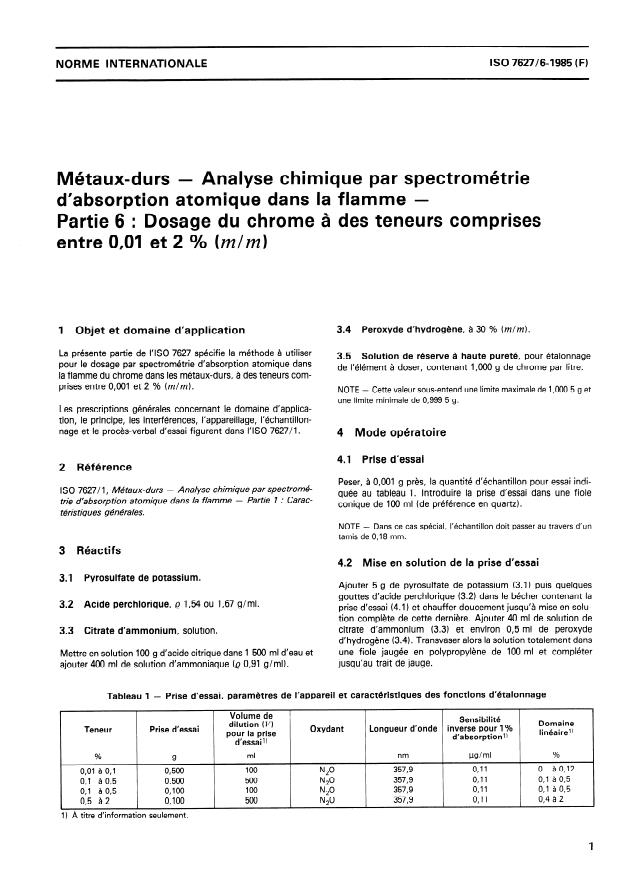
General requirements concerning the field of application, principle, interfering elements, apparatus, sampling and test report are given in ISO 7627-1.
- Status
- Published
- Publication Date
- 03-Apr-1985
- Technical Committee
- ISO/TC 119/SC 4 - Sampling and testing methods for hardmetals
- Drafting Committee
- ISO/TC 119/SC 4 - Sampling and testing methods for hardmetals
- Current Stage
- 9093 - International Standard confirmed
- Start Date
- 12-Dec-2025
- Completion Date
- 29-Aug-2026
Buy Documents

ISO 7627-6:1985 - Hardmetals — Chemical analysis by flame atomic absorption spectrometry — Part 6: Determination of chromium in contents from 0,01 to 2 % (m/m) Released:4/4/1985

ISO 7627-6:1985 - Métaux-durs — Analyse chimique par spectrométrie d'absorption atomique dans la flamme — Partie 6: Dosage du chrome a des teneurs comprises entre 0,01 % et 2 % (m/m) Released:4/4/1985

ISO 7627-6:1985 - Métaux-durs — Analyse chimique par spectrométrie d'absorption atomique dans la flamme — Partie 6: Dosage du chrome a des teneurs comprises entre 0,01 % et 2 % (m/m) Released:4/4/1985
Overview
ISO 7627-6:1985 specifies a validated procedure for the chemical analysis of hardmetals by flame atomic absorption spectrometry (FAAS) to determine chromium (Cr) contents in the range 0,01 to 2 % (m/m). It defines sample preparation, dissolution, calibration, measurement and reporting practices specific to chromium in cemented carbides and related powder‑metallurgy materials. General requirements on scope, principle, interfering elements, apparatus, sampling and test report are given in ISO 7627-1.
Key topics and requirements
- Scope: Quantitative determination of chromium between 0,01 and 2 % (m/m) in hardmetals by FAAS.
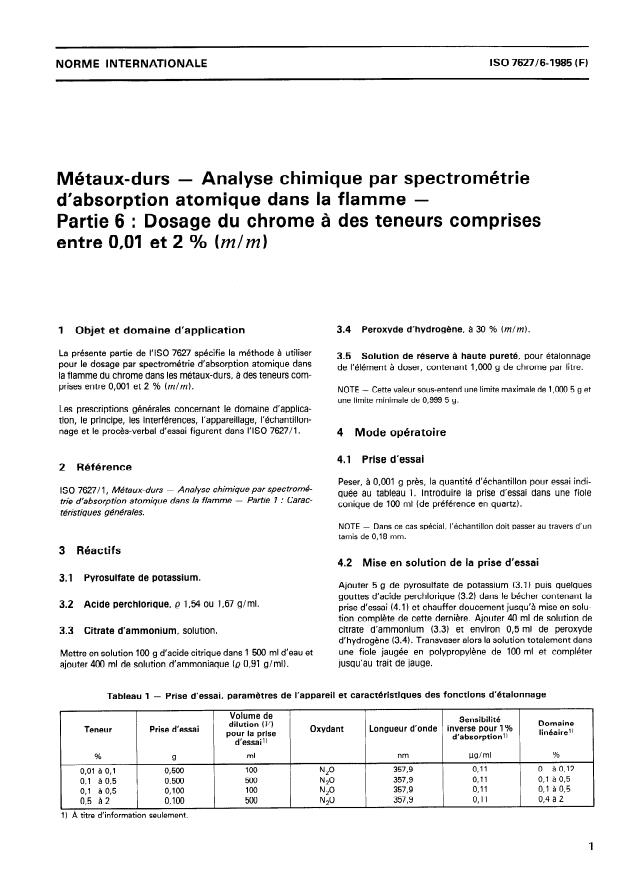
- Sample preparation: Test portions are weighed to 0,001 g resolution; samples for this method shall pass a 0,18 mm sieve.
- Dissolution chemistry: Fusion/acid digestion using potassium pyrosulfate and perchloric acid, followed by addition of ammonium citrate and about 0,5 ml hydrogen peroxide (30 % m/m) before dilution to volume.
- Volumetric handling: Final solutions are made up in 100 ml or 500 ml volumetric flasks (polypropylene recommended for some steps) depending on expected chromium content to achieve appropriate dilution for FAAS measurement.
- Calibration: Use a high‑purity chromium stock solution (nominal 1 000 g/L) diluted to prepare at least six matrix‑matched standards plus a blank. Matrix composition of calibration solutions should match the dissolved sample matrix as closely as possible.
- Instrumentation parameters: FAAS measurement at 357,9 nm with an N2O oxidant (as specified), instrument optimization and burner preheating required. Aspirate blank, calibration solutions and test solutions consecutively; make at least two readings per solution.
- Quality control and tolerance: Acceptable repeatability and permissible tolerances for three independent determinations are specified by the standard (tables referenced). Report the arithmetic mean of acceptable determinations and round results according to the standard’s rounding rules.
- Safety note: Follow instrument manufacturer’s instructions for flame ignition/extinguishing and handle reagents (perchloric acid, hydrogen peroxide) with appropriate precautions.
Applications and users
- Laboratories performing chemical analysis of hardmetals and cemented carbides.
- Quality control and R&D in powder metallurgy and cutting tool manufacturing where accurate Cr content (0,01–2 % m/m) is required.
- Suppliers and materials testers certifying raw powders, sintered parts or coatings for compliance with composition specifications.
- Analytical chemists implementing FAAS methods for trace/low‑level chromium in metallurgical matrices.
Related standards
- ISO 7627-1 - General requirements for chemical analysis by flame atomic absorption spectrometry in hardmetals (referenced for broader field of application, interfering elements, apparatus, sampling and test report).
Keywords: ISO 7627-6:1985, hardmetals, chemical analysis, flame atomic absorption spectrometry, chromium determination, powder metallurgy, FAAS, chromium 0.01–2%
Relations
- Effective Date
- 06-Jun-2022
Buy Documents
ISO 7627-6:1985 - Hardmetals — Chemical analysis by flame atomic absorption spectrometry — Part 6: Determination of chromium in contents from 0,01 to 2 % (m/m) Released:4/4/1985
ISO 7627-6:1985 - Métaux-durs — Analyse chimique par spectrométrie d'absorption atomique dans la flamme — Partie 6: Dosage du chrome a des teneurs comprises entre 0,01 % et 2 % (m/m) Released:4/4/1985
ISO 7627-6:1985 - Métaux-durs — Analyse chimique par spectrométrie d'absorption atomique dans la flamme — Partie 6: Dosage du chrome a des teneurs comprises entre 0,01 % et 2 % (m/m) Released:4/4/1985
Get Certified
Connect with accredited certification bodies for this standard

Element Materials Technology
Materials testing and product certification.

Inštitut za kovinske materiale in tehnologije
Institute of Metals and Technology. Materials testing, metallurgical analysis, NDT.
Sponsored listings
Frequently Asked Questions
ISO 7627-6:1985 is a standard published by the International Organization for Standardization (ISO). Its full title is "Hardmetals — Chemical analysis by flame atomic absorption spectrometry — Part 6: Determination of chromium in contents from 0,01 to 2 % (m/m)". This standard covers: General requirements concerning the field of application, principle, interfering elements, apparatus, sampling and test report are given in ISO 7627-1.
General requirements concerning the field of application, principle, interfering elements, apparatus, sampling and test report are given in ISO 7627-1.
ISO 7627-6:1985 is classified under the following ICS (International Classification for Standards) categories: 77.160 - Powder metallurgy. The ICS classification helps identify the subject area and facilitates finding related standards.
ISO 7627-6:1985 has the following relationships with other standards: It is inter standard links to ISO 10360-2:2001. Understanding these relationships helps ensure you are using the most current and applicable version of the standard.
ISO 7627-6:1985 is available in PDF format for immediate download after purchase. The document can be added to your cart and obtained through the secure checkout process. Digital delivery ensures instant access to the complete standard document.
Standards Content (Sample)
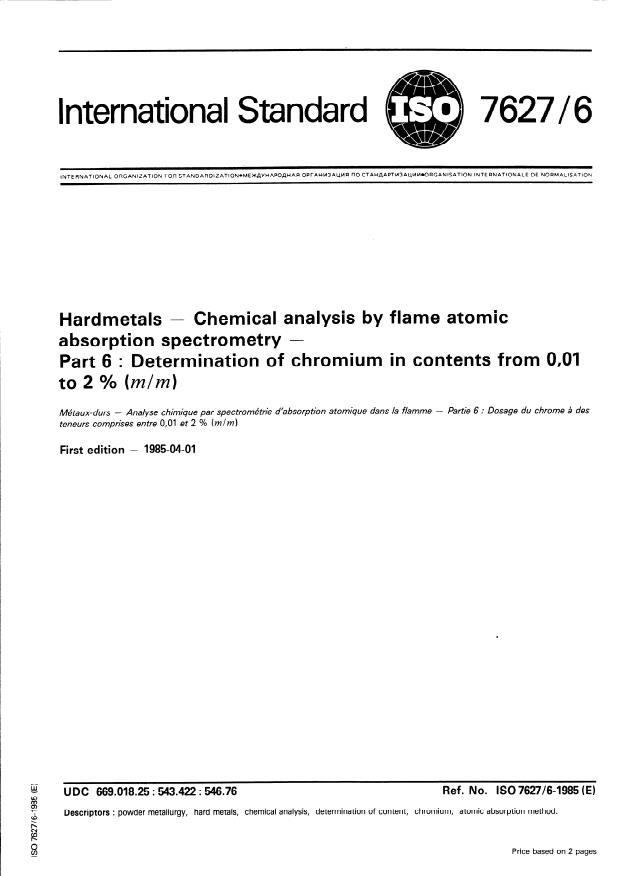
International Standard 762716
INTERNATIONAL ORGANIZATION FOR STANDARDIZATION.MEIKI(LLYHAPOAHAR OPTAHM3AWlR IlO CTAHAAPTl’l3ALlWl.ORGANlSATlON INTERNATIONALE DE NORMALlSATlON
Chemical analysis by flame atomic
Hardmetals -
absorption spectrometry -
Part 6 : Determination of chromium in contents from 0,Ol
to 2 % (mlm)
- Partie 6 : Dosage du chrome ;i des
Aktaux-durs - Analyse chimique par spectromktrie d’absorption atomique dans la flamme
teneurs comprises entre O,Ol et 2 % Mm)
First edition - 1985-04-01
Ref. No. IS0 7627/6-1985 (E)
UDC 669.018.25 : 543.422 : 546.76
hard metals, chemical analysis, determination of content, chromium, atomic absorption method.
Descriptors : powder metallurgy,
Price based on 2 pages
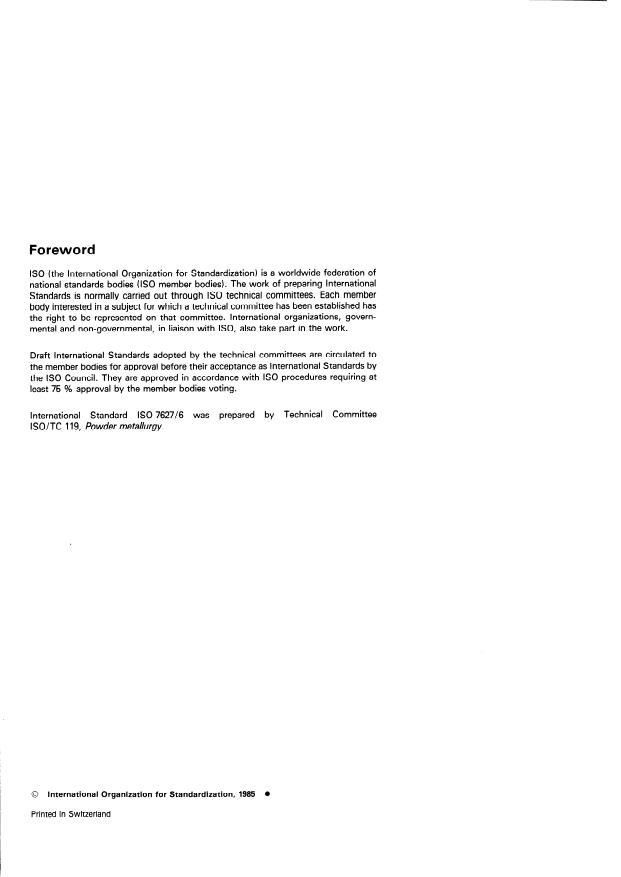
Foreword
IS0 (the International Organization for Standardization) is a worldwide federation of
national standards bodies (IS0 member bodies). The work of preparing International
Standards is normally carried out through IS0 technical committees. Each member
body interested in a subject for which a technical committee has been established has
the right to be represented on that committee. International organizations, govern-
mental and non-governmental, in liaison with ISO, also take part in the work.
Draft International Standards adopted by the technical committees are circulated to
the member bodies for approval before their acceptance as International Standards by
the IS0 Council. They are approved in accordance with IS0 procedures requiring at
least 75 % approval by the member bodies voting.
International Standard IS0 7627/6 was prepared by Technical Committee
ISO/TC 119, Powder metallurgy.
International Organization for Standardization, 1985
Printed in Switzerland
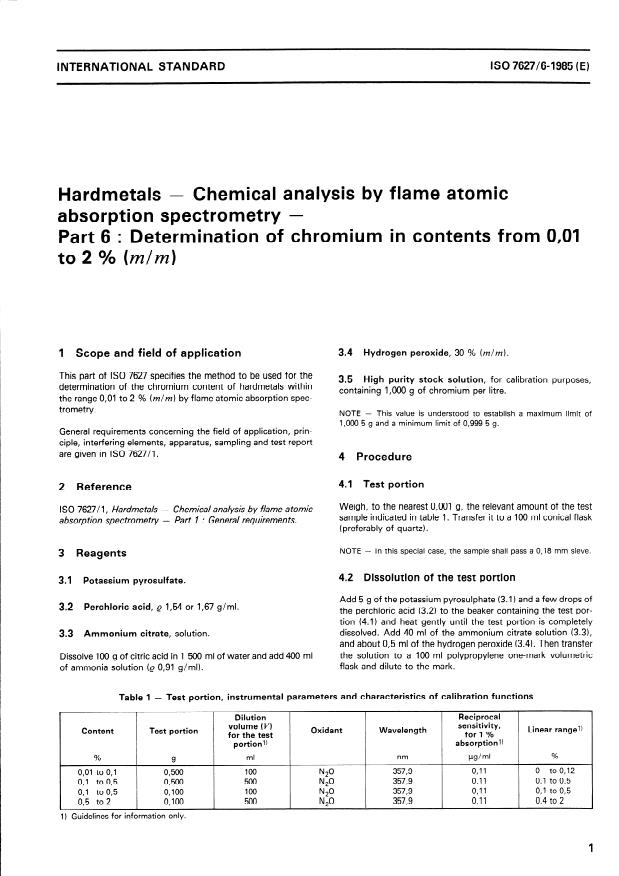
IS0 7627/6-1985 (E)
INTERNATIONAL STANDARD
Hardmetals - Chemical analysis by flame atomic
absorption spectrometry -
Part 6 : Determination of chromium in contents from 0,Ol
to 2 % (m/m)
3.4 Hydrogen peroxide, 30 % (m/m).
1 Scope and field of application
This part of IS0 7627 specifies the method to be used for the
3.5 High purity stock solution, for calibration purposes,
determination of the chromium content of hardmetals within
containing 1,000 g of chromium per litre.
the range 0,Ol to 2 % (m/m) by flame atomic absorption spec-
trometry.
NOTE
- This value is understood to establish a maximum limit of
1,000 5 g and a minimum limit of 0,999 5 g.
General requirements concerning the field of application, prin-
ciple, interfering elements, apparatus, sampling and test report
are given in IS0 7627/l.
4 Procedure
4.1 Test portion
2 Reference
Weigh, to the nearest 0,001 g, the relevant amount of the test
Chemical analysis by flame atomic
IS0 762711, Hardmetals -
sample indicated in table 1. Transfer it to a 100 ml conical flask
absorption spectrometry - Part 7 : General requirements.
(preferably of quartz).
NOTE - In this special case, the sample shall pass a 0,18 mm sieve.
3 Reagents
4.2 Dissolution of the test portion
3.1 Potassium pyrosulfate.
Add 5 g of the potassium pyrosulphate (3.1) and a few drops of
3.2 Perchloric acid, Q 1,54 or 1,67 g/ml.
the perchloric acid (3.2) to the beaker containing the test por-
tion (4.1) and heat gently until the test portion is completely
dissolved. Add 40 ml of the ammonium citrate solution (3.3),
3.3 Ammonium citrate, solution.
and about 0,5 ml of the hydrogen peroxide (3.4). Then transfer
the solution to a 100 ml polypropylene one-mark volumetric
Dissolve 100 g of citric acid in 1 500 ml of water and add 400 ml
flask and dilute to the mark.
of ammonia s
...
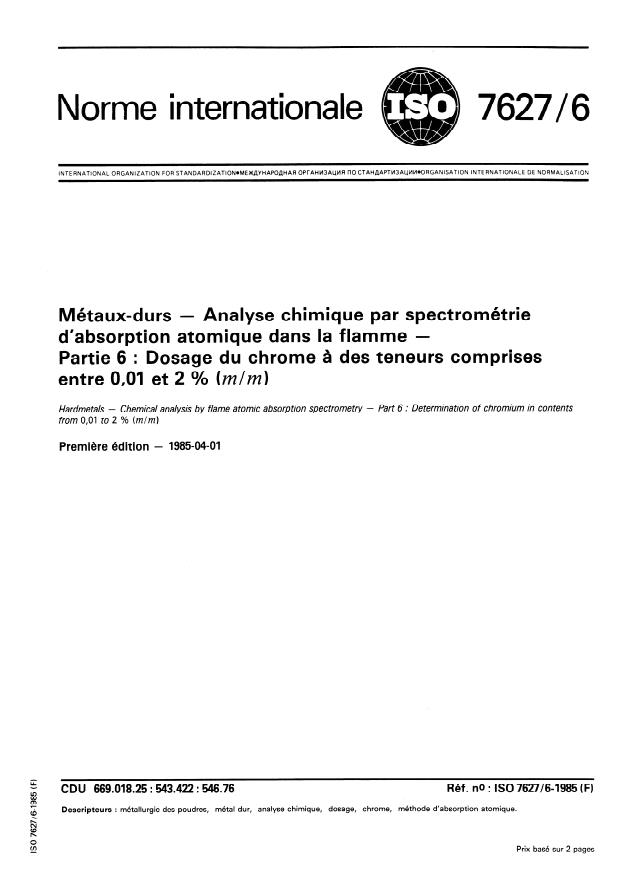
Norme internationale 762716
INTERNATIONAL ORGANIZATION FOR STANDARDIZATION~MEX~YHAPO~HAR OPfAHM3ALblR fl0 CTAH~APTbl3A~klt4~0RGANISA~ION INTERNATIONALE DE NORMALISATION
Métaux-durs - Analyse chimique par spectrométrie
d’absorption atomique dans la flamme -
Partie 6 : Dosage du chrome à des teneurs comprises
entre 0,Ol et 2 % (mlm)
Chemical analysis by flame atomic absorption spectrometry - Part 6 : Determination of chromium in contents
Hardmetals -
from O,Ol to 2 % (mlm)
Première édition - 1985-04-01
CDU 669.018.25 : 543.422 : 546.76 Réf. no : ISO 7627/6-1985 (F)
méthode d’absorption atomique.
Descripteurs : métallurgie des poudres, métal dur, analyse chimique, dosage, chrome,
Prix basé sur 2 pages
Avant-propos
L’ISO (Organisation internationale de normalisation) est une fédération mondiale
d’organismes nationaux de normalisation (comités membres de I’ISO). L’élaboration
des Normes internationales est confiée aux comités techniques de I’ISO. Chaque
comité membre intéressé par une étude a le droit de faire partie du comité technique
créé à cet effet. Les organisations internationales, gouvernementales et non gouverne-
mentales, en liaison avec I’ISO, participent également aux travaux.
Les projets de Normes internationales adoptés par les comités techniques sont soumis
aux comités membres pour approbation, avant leur acceptation comme Normes inter-
nationales par le Conseil de I’ISO. Les Normes internationales sont approuvées confor-
mément aux procédures de I’ISO qui requièrent l’approbation de 75 % au moins des
comités membres votants.
La Norme internationale ISO 7627/6 a été élaborée par le comité technique
ISO/TC 119, Métallurgie des poudres.
0 Organisation internationale de normalisation, 1985
Imprimé en Suisse
ISO 7627/6-1985 (F)
NORME INTERNATIONALE
Métaux-durs - Analyse chimique par spectrométrie
d’absorption atomique dans la flamme -
Partie 6 : Dosage du chrome à des teneurs comprises
entre 0,Ol et 2 % (mlm)
3.4 Peroxyde d’hydrogène, à 30 % (mlm).
1 Objet et domaine d’application
La présente partie de I’ISO 7627 spécifie la méthode à utiliser
3.5 Solution de réserve à haute pureté, pour étalonnage
pour le dosage par spectrométrie d’absorption atomique dans
de l’élément à doser, contenant 1,000 g de chrome par litre.
la flamme du chrome dans les métaux-durs, à des teneurs com-
prises entre 0,001 et 2 % (mlm).
NOTE - Cette valeur sous-entend une limite maximale de 1,000 5 g et
une limite minimale de 0,999 5 g.
Les prescriptions générales concernant le domaine d’applica-
tion, le principe, les interférences, l’appareillage, I’échantillon-
nage et le procès-verbal d’essai figurent dans I’ISO 7627/1.
4 Mode opératoire
4.1 Prise d’essai
2 Référence
Peser, à 0,001 g près, la quantité d’échantillon pour essai indi-
Analyse chimique par spec tromé-
ISO 762711, M&aux-durs -
quée au tableau 1. Introduire la prise d’essai dans une fiole
trie d’absorption atomique dans la flamme - Partie 1 : carac-
conique de 100 ml (de préférence en quartz).
t&is tiques générales.
NOTE - Dans ce cas spécial, l’échantillon doit passer au travers d’un
tamis de 0,18 mm.
3 Réactifs
4.2 Mise en solution de la prise d’essai
3.1 Pyrosulfate de potassium.
Ajouter 5 g de pyrosulfate de potassium (3.1) puis quelques
gouttes d’acide perchlorique (3.2) dans le bécher contenant la
3.2 Acide perchlorique, Q 1,54 ou 1,67 g/ml.
prise d’essai (4.1) et chauffer doucement jusqu’à mise en solu-
tion complète de cette dernière. Ajouter 40 ml de solution de
citrate d’ammonium (3.3) et environ 0,5 ml de peroxyde
3.3 Citrate d’ammonium, solution.
d’hydrogène (3.4). Transvaser alors la solution totalement dans
une fiole jaugée en polypropylène de 100 ml et compléter
Mlettre en solution 100 g d’acide citrique dans 1 500 ml d’eau et
jusqu’au trait de jauge.
ajouter 400 ml de solution d’ammoniaque (Q 0,91 g/ml).
Tableau 1 - Prise d’essai, paramètres de l’appar
...
Norme internationale 762716
INTERNATIONAL ORGANIZATION FOR STANDARDIZATION~MEX~YHAPO~HAR OPfAHM3ALblR fl0 CTAH~APTbl3A~klt4~0RGANISA~ION INTERNATIONALE DE NORMALISATION
Métaux-durs - Analyse chimique par spectrométrie
d’absorption atomique dans la flamme -
Partie 6 : Dosage du chrome à des teneurs comprises
entre 0,Ol et 2 % (mlm)
Chemical analysis by flame atomic absorption spectrometry - Part 6 : Determination of chromium in contents
Hardmetals -
from O,Ol to 2 % (mlm)
Première édition - 1985-04-01
CDU 669.018.25 : 543.422 : 546.76 Réf. no : ISO 7627/6-1985 (F)
méthode d’absorption atomique.
Descripteurs : métallurgie des poudres, métal dur, analyse chimique, dosage, chrome,
Prix basé sur 2 pages
Avant-propos
L’ISO (Organisation internationale de normalisation) est une fédération mondiale
d’organismes nationaux de normalisation (comités membres de I’ISO). L’élaboration
des Normes internationales est confiée aux comités techniques de I’ISO. Chaque
comité membre intéressé par une étude a le droit de faire partie du comité technique
créé à cet effet. Les organisations internationales, gouvernementales et non gouverne-
mentales, en liaison avec I’ISO, participent également aux travaux.
Les projets de Normes internationales adoptés par les comités techniques sont soumis
aux comités membres pour approbation, avant leur acceptation comme Normes inter-
nationales par le Conseil de I’ISO. Les Normes internationales sont approuvées confor-
mément aux procédures de I’ISO qui requièrent l’approbation de 75 % au moins des
comités membres votants.
La Norme internationale ISO 7627/6 a été élaborée par le comité technique
ISO/TC 119, Métallurgie des poudres.
0 Organisation internationale de normalisation, 1985
Imprimé en Suisse
ISO 7627/6-1985 (F)
NORME INTERNATIONALE
Métaux-durs - Analyse chimique par spectrométrie
d’absorption atomique dans la flamme -
Partie 6 : Dosage du chrome à des teneurs comprises
entre 0,Ol et 2 % (mlm)
3.4 Peroxyde d’hydrogène, à 30 % (mlm).
1 Objet et domaine d’application
La présente partie de I’ISO 7627 spécifie la méthode à utiliser
3.5 Solution de réserve à haute pureté, pour étalonnage
pour le dosage par spectrométrie d’absorption atomique dans
de l’élément à doser, contenant 1,000 g de chrome par litre.
la flamme du chrome dans les métaux-durs, à des teneurs com-
prises entre 0,001 et 2 % (mlm).
NOTE - Cette valeur sous-entend une limite maximale de 1,000 5 g et
une limite minimale de 0,999 5 g.
Les prescriptions générales concernant le domaine d’applica-
tion, le principe, les interférences, l’appareillage, I’échantillon-
nage et le procès-verbal d’essai figurent dans I’ISO 7627/1.
4 Mode opératoire
4.1 Prise d’essai
2 Référence
Peser, à 0,001 g près, la quantité d’échantillon pour essai indi-
Analyse chimique par spec tromé-
ISO 762711, M&aux-durs -
quée au tableau 1. Introduire la prise d’essai dans une fiole
trie d’absorption atomique dans la flamme - Partie 1 : carac-
conique de 100 ml (de préférence en quartz).
t&is tiques générales.
NOTE - Dans ce cas spécial, l’échantillon doit passer au travers d’un
tamis de 0,18 mm.
3 Réactifs
4.2 Mise en solution de la prise d’essai
3.1 Pyrosulfate de potassium.
Ajouter 5 g de pyrosulfate de potassium (3.1) puis quelques
gouttes d’acide perchlorique (3.2) dans le bécher contenant la
3.2 Acide perchlorique, Q 1,54 ou 1,67 g/ml.
prise d’essai (4.1) et chauffer doucement jusqu’à mise en solu-
tion complète de cette dernière. Ajouter 40 ml de solution de
citrate d’ammonium (3.3) et environ 0,5 ml de peroxyde
3.3 Citrate d’ammonium, solution.
d’hydrogène (3.4). Transvaser alors la solution totalement dans
une fiole jaugée en polypropylène de 100 ml et compléter
Mlettre en solution 100 g d’acide citrique dans 1 500 ml d’eau et
jusqu’au trait de jauge.
ajouter 400 ml de solution d’ammoniaque (Q 0,91 g/ml).
Tableau 1 - Prise d’essai, paramètres de l’appar
...