


ISO/IEC 19592-1:2016
(Main)Information technology — Security techniques — Secret sharing — Part 1: General
Information technology — Security techniques — Secret sharing — Part 1: General
ISO/IEC 19592-1:2016 specifies cryptographic secret sharing schemes and their properties. This document defines the parties involved in a secret sharing scheme, the terminology used in the context of secret sharing schemes, the parameters and the properties of such a scheme.
Technologies de l'information — Techniques de sécurité — Partage de secret — Partie 1: Général
General Information
- Status
- Published
- Publication Date
- 03-Nov-2016
- Drafting Committee
- ISO/IEC JTC 1/SC 27/WG 2 - Cryptography and security mechanisms
- Current Stage
- 9093 - International Standard confirmed
- Start Date
- 19-May-2022
- Completion Date
- 12-Feb-2026
Overview
ISO/IEC 19592-1:2016 - Information technology - Security techniques - Secret sharing - Part 1: General - defines the general model, terminology and parameters for cryptographic secret sharing schemes. The standard specifies the parties (dealer, share-holder, receiver), the components of a scheme (message sharing and message reconstruction algorithms), and fundamental concepts such as message space, share space, share vector, number of shares, access structure and thresholds. It also describes required and optional properties (confidentiality, recoverability, homomorphicity, verifiability) and implementation considerations like erasing dealer copies after distribution.
Key Topics and Requirements
- Roles and processes
- Dealer: runs the message sharing algorithm and distributes shares.
- Share-holder: stores assigned shares.
- Receiver: collects shares and runs the reconstruction algorithm.
- Parameters every instantiation must define
- Message space and share space - the domains for secrets and shares.
- Number of shares (n) and any permitted range.
- Access structure - the minimal subsets of share-holders that can reconstruct the secret; may be threshold-based (k-of-n) or custom.
- Core properties
- Message confidentiality - unauthorized subsets learn nothing about the secret.
- Message recoverability - authorized subsets can reconstruct the secret.
- Optional properties include homomorphicity (support for operations on shares) and verifiability (detection of incorrect shares).
- Other considerations
- Complexity, information rate, and confidentiality guarantees are addressed to compare and evaluate schemes.
- Practical implementation notes such as secure storage of shares and potential erasure of dealer copies.
Applications
ISO/IEC 19592-1:2016 frames secret sharing for practical security use cases:
- Protecting cryptographic keys and confidential values in distributed storage.
- Enabling secure multi-party computation by distributing inputs across parties.
- Building resilient key management systems, threshold cryptography, and split-trust architectures.
- Use in blockchain custodial solutions, hardware security module (HSM) backup strategies, and secure cloud storage where no single party should hold a complete secret.
Who should use this standard
- Security architects and system designers implementing distributed key storage or threshold schemes.
- Cryptographers and protocol developers defining secret sharing instantiations.
- Auditors, compliance officers and product teams verifying interoperability and security properties.
- Standards bodies and implementers integrating secret sharing into distributed systems and secure multi-party computation.
Related Standards
- Part of the ISO/IEC 19592 series (see ISO website for other parts). Developed by ISO/IEC JTC 1/SC 27 (IT Security techniques) to ensure interoperability and consistent terminology across secret sharing implementations.
Keywords: ISO/IEC 19592-1:2016, secret sharing, secret sharing schemes, access structure, threshold secret sharing, message sharing algorithm, message reconstruction, cryptographic secret sharing, secure multi-party computation.
Get Certified
Connect with accredited certification bodies for this standard

BSI Group
BSI (British Standards Institution) is the business standards company that helps organizations make excellence a habit.

Bureau Veritas
Bureau Veritas is a world leader in laboratory testing, inspection and certification services.

DNV
DNV is an independent assurance and risk management provider.
Sponsored listings
Frequently Asked Questions
ISO/IEC 19592-1:2016 is a standard published by the International Organization for Standardization (ISO). Its full title is "Information technology — Security techniques — Secret sharing — Part 1: General". This standard covers: ISO/IEC 19592-1:2016 specifies cryptographic secret sharing schemes and their properties. This document defines the parties involved in a secret sharing scheme, the terminology used in the context of secret sharing schemes, the parameters and the properties of such a scheme.
ISO/IEC 19592-1:2016 specifies cryptographic secret sharing schemes and their properties. This document defines the parties involved in a secret sharing scheme, the terminology used in the context of secret sharing schemes, the parameters and the properties of such a scheme.
ISO/IEC 19592-1:2016 is classified under the following ICS (International Classification for Standards) categories: 35.030 - IT Security; 35.040 - Information coding. The ICS classification helps identify the subject area and facilitates finding related standards.
ISO/IEC 19592-1:2016 is available in PDF format for immediate download after purchase. The document can be added to your cart and obtained through the secure checkout process. Digital delivery ensures instant access to the complete standard document.
Standards Content (Sample)
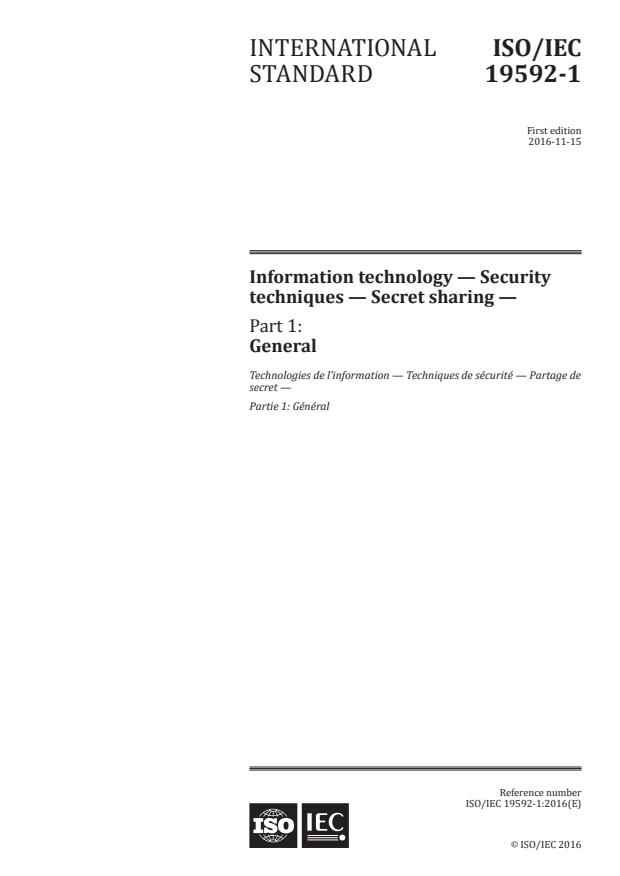
INTERNATIONAL ISO/IEC
STANDARD 19592-1
First edition
2016-11-15
Information technology — Security
techniques — Secret sharing —
Part 1:
General
Technologies de l’information — Techniques de sécurité — Partage de
secret —
Partie 1: Général
Reference number
©
ISO/IEC 2016
© ISO/IEC 2016, Published in Switzerland
All rights reserved. Unless otherwise specified, no part of this publication may be reproduced or utilized otherwise in any form
or by any means, electronic or mechanical, including photocopying, or posting on the internet or an intranet, without prior
written permission. Permission can be requested from either ISO at the address below or ISO’s member body in the country of
the requester.
ISO copyright office
Ch. de Blandonnet 8 • CP 401
CH-1214 Vernier, Geneva, Switzerland
Tel. +41 22 749 01 11
Fax +41 22 749 09 47
copyright@iso.org
www.iso.org
ii © ISO/IEC 2016 – All rights reserved
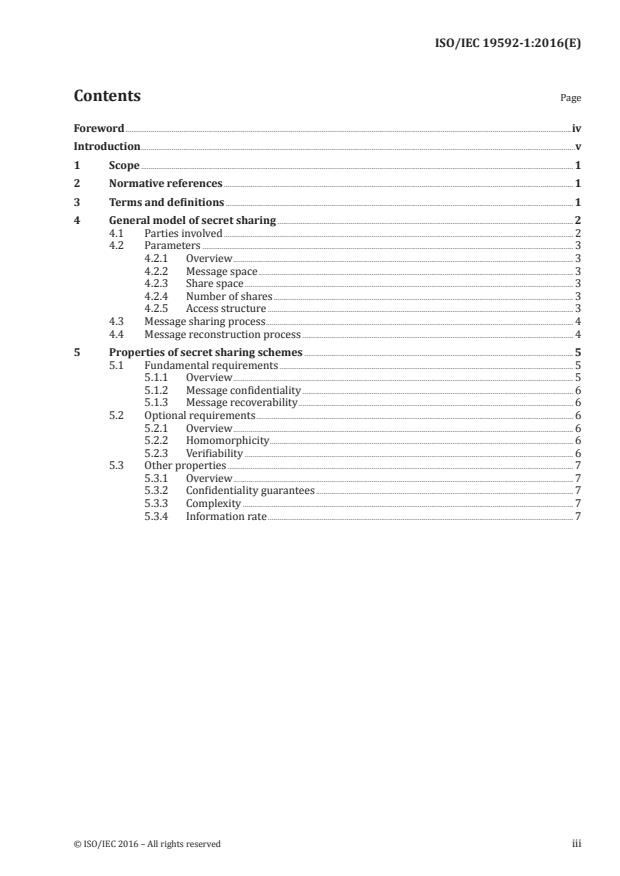
Contents Page
Foreword .iv
Introduction .v
1 Scope . 1
2 Normative references . 1
3 Terms and definitions . 1
4 General model of secret sharing . 2
4.1 Parties involved . 2
4.2 Parameters . 3
4.2.1 Overview . 3
4.2.2 Message space . 3
4.2.3 Share space . 3
4.2.4 Number of shares . 3
4.2.5 Access structure . 3
4.3 Message sharing process . 4
4.4 Message reconstruction process . 4
5 Properties of secret sharing schemes . 5
5.1 Fundamental requirements . 5
5.1.1 Overview . 5
5.1.2 Message confidentiality . 6
5.1.3 Message recoverability . 6
5.2 Optional requirements . 6
5.2.1 Overview . 6
5.2.2 Homomorphicity . 6
5.2.3 Verifiability . 6
5.3 Other properties . 7
5.3.1 Overview . 7
5.3.2 Confidentiality guarantees . 7
5.3.3 Complexity . 7
5.3.4 Information rate . 7
© ISO/IEC 2016 – All rights reserved iii
Foreword
ISO (the International Organization for Standardization) and IEC (the International Electrotechnical
Commission) form the specialized system for worldwide standardization. National bodies that are
members of ISO or IEC participate in the development of International Standards through technical
committees established by the respective organization to deal with particular fields of technical
activity. ISO and IEC technical committees collaborate in fields of mutual interest. Other international
organizations, governmental and non-governmental, in liaison with ISO and IEC, also take part in the
work. In the field of information technology, ISO and IEC have established a joint technical committee,
ISO/IEC JTC 1.
The procedures used to develop this document and those intended for its further maintenance are
described in the ISO/IEC Directives, Part 1. In particular the different approval criteria needed for
the different types of document should be noted. This document was drafted in accordance with the
editorial rules of the ISO/IEC Directives, Part 2 (see www.iso.org/directives).
Attention is drawn to the possibility that some of the elements of this document may be the subject
of patent rights. ISO and IEC shall not be held responsible for identifying any or all such patent
rights. Details of any patent rights identified during the development of the document will be in the
Introduction and/or on the ISO list of patent declarations received (see www.iso.org/patents).
Any trade name used in this document is information given for the convenience of users and does not
constitute an endorsement.
For an explanation on the meaning of ISO specific terms and expressions related to conformity assessment,
as well as information about ISO’s adherence to the World Trade Organization (WTO) principles in the
Technical Barriers to Trade (TBT) see the following URL: www.iso.org/iso/foreword.html.
The committee responsible for this document is ISO/IEC JTC 1, Information Technology, Subcommittee
SC 27, IT Security techniques.
A list of all parts in the ISO/IEC 19592 series can be found on the ISO website.
iv © ISO/IEC 2016 – All rights reserved
Introduction
A secret sharing scheme is a cryptographic technique used to protect the confidentiality of a message by
dividing it into a number of pieces called shares. A secret sharing scheme has two main parts: a message
sharing algorithm for dividing the message into shares and a message reconstruction algorithm for
recovering the message from all or a subset of the shares.
Secret sharing can be used to store data (for example, confidential values or cryptographic keys)
securely in distributed systems. Moreover, secret sharing is a fundamental technology for secure
multi-party computation that can be used to protect the processing of data in a distributed system. To
facilitate the effective use of the technology and to maintain interoperability, ISO/IEC 19592 (all parts)
specifies secret sharing and related technology.
© ISO/IEC 2016 – All rights reserved v
INTERNATIONAL STANDARD ISO/IEC 19592-1:2016(E)
Information technology — Security techniques — Secret
sharing —
Part 1:
General
1 Scope
ISO/IEC 19592 (all parts) specifies cryptographic secret sharing schemes and their properties. This
document defines the parties involved in a secret sharing scheme, the terminology used in the context
of secret sharing schemes, the parameters and the properties of such a scheme.
2 Normative references
There are no normative references in this document.
3 Terms and definitions
For the purposes of this document, the following terms and definitions apply.
ISO and IEC maintain terminological databases for use in standardization at the following addresses:
— IEC Electropedia: available at http://www.electropedia.org/
— ISO Online browsing platform: available at http://www.iso.org/obp
3.1
access structure
set of subsets of all share-holders (3.11), A ⊂ {S | S ⊂ {1,…,n}}, such that for all S,T ∈ A, S is not a subset of
T and T is not a subset of S and the shares (3.10) held by share-holders in S are sufficient to successfully
reconstruct the message (3.4) using the message reconstruction algorithm (3.5)
3.2
adversary structure
set of subsets of all share-holders (3.11), D ⊂ {S | S ⊂ {1,…,n}}, such that for all S,T ∈ D, S is not a subset of
T and T is not a subset of S and it is not possible to reconstruct the message (3.4) from the shares (3.10)
held by share-holders in S
3.3
dealer
party running the message sharing algorithm (3.6)
3.4
message
secret information that is to be protected
EXAMPLE A confidential value or cryptographic key.
3.5
message reconstruction algorithm
process which transforms a recoverable subset of elements in a share vector (3.13) into the original
message (3.4)
© ISO/IEC 2016 – All rights reserved 1
3.6
message sharing algorithm
process which transforms messages (3.4) into a share vector (3.13)
3.7
message space
set of messages (3.4) that can be shared by a secret sharing scheme (3.9)
3.8
receiver
party running the message reconstruction algorithm (3.5)
3.9
secret sharing scheme
cryptographic technique used to protect the confidentiality of a message (3.4) by dividing it into a
number of pieces called shares (3.10)
Note 1 to entry: It consists of two component processes: a message sharing algorithm and a message
reconstruction algorithm.
3.10
share
element of the share vector (3.13)
3.11
share-holder
party storing a share output by the message sharing algorithm (3.6)
3.12
share space
set of elements that can occur in a share vector (3.13) of a secret sharing scheme (3.9)
3.13
share vector
vector of values output by the message sharing algorithm (3.6)
3.14
threshold
minimal number of unmodified elements in the share vector (3.13) that are needed to successfully
reconstruct the message (3.4)
4 General model of secret sharing
4.1 Parties involved
The operation of a secret sharing scheme involves the following three roles:
a) the dealer;
b) the share-holder;
c) the receiver.
The dealer is the party that has a message and runs the message sharing algorithm.
...
Questions, Comments and Discussion
Ask us and Technical Secretary will try to provide an answer. You can facilitate discussion about the standard in here.
Loading comments...