


ISO 15673:2005
(Main)Guidelines for the simplified design of structural reinforced concrete for buildings
Guidelines for the simplified design of structural reinforced concrete for buildings
ISO 15673:2005 applies to the planning, design and construction of structural reinforced concrete structures to be used in new low-rise buildings with restricted occupancy, number of stories, and area. The purpose of ISO 15673:2005 is to provide a registered civil engineer or architect with sufficient information to design the reinforced-concrete structural framing of a low-rise building that complies with these limitations. The rules of design as set forth in ISO 15673:2005 are simplifications of the more elaborate requirements. ISO 15673:2005 may be used as an alternative to the development of a national concrete building code, or equivalent document, in countries where no national design codes themselves are available, or as an alternative to the national concrete building code in countries where it is specifically considered and accepted by the national standard body or other appropriate regulatory organization.
Lignes directrices pour la conception simplifiée du béton armé pour les structures de bâtiments
Smernice za poenostavljeno projektiranje armirano betonskih konstrukcij stavb
Ta mednarodni standard velja za načrtovanje, projektiranje in gradnjo armiranobetonskih konstrukcij, ki se uporabljajo pri novih nizkih stavbah z omejeno zasedenostjo, številom nadstropij in površino. Namen tega mednarodnega standarda je registriranemu gradbenemu inženirju ali arhitektu zagotoviti dovolj informacij za projektiranje armiranobetonskega konstrukcijskega ogrodja nizke stavbe, ki ustreza navedenim omejitvam; glej točko 6.1. Pravila projektiranja, kot jih določa ta dokument, so poenostavitve podrobnejših zahtev.
Ta dokument se lahko uporablja kot alternativa pripravi nacionalnih predpisov za betonsko gradnjo ali enakovrednega dokumenta v državah, kjer nacionalni predpisi za projektiranje niso na voljo, ali kot alternativa nacionalnim predpisom za betonsko gradnjo v državah, kjer ga posebej obravnava in sprejme organ za nacionalne standarde ali druga ustrezna regulatorna organizacija.
Čeprav so bile določbe v tem dokumentu, če se primerno uporabljajo, vzpostavljene za izvedbo armiranobetonske konstrukcije z ustrezno mejo varnosti, ta mednarodni standard ni nadomestek za preudarno in izkušeno gradbeništvo. Da bi bila konstrukcija pojektirana v skladu s temi določbami in da bi dosegla nameravano mejo varnosti, se mora dokument uporabljati v celoti, alternativni postopki pa se lahko uporabljajo le, če to izrecno dovoljujejo določbe. Minimalne dimenzijske določbe, kot jih predpisuje dokument, večinoma nadomeščajo podrobnejše postopke, kot so postopki, ki jih predpisujejo nacionalni gradbeni predpisi, morebitni gospodarski učinek pa je posledica preprostosti predpisanih postopkov.
Strokovnjak, ki izvaja konstrukcijsko projektiranje v skladu s tem mednarodnim standardom, mora izpolnjevati zakonske zahteve za konstrukcijske projektante v državi sprejetja in mora biti usposobljen in imeti minimalno ustrezno znanje iz konstrukcijske mehanike, statike, trdnosti materialov, konstrukcijske analize ter projektiranja in gradnje iz armiranega betona.
General Information
- Status
- Withdrawn
- Publication Date
- 19-Jul-2005
- Withdrawal Date
- 19-Jul-2005
- Technical Committee
- ISO/TC 71/SC 5 - Simplified design standard for concrete structures
- Drafting Committee
- ISO/TC 71/SC 5 - Simplified design standard for concrete structures
- Current Stage
- 9599 - Withdrawal of International Standard
- Start Date
- 25-Nov-2016
- Completion Date
- 12-Feb-2026
Relations
- Effective Date
- 28-Mar-2009





Get Certified
Connect with accredited certification bodies for this standard

ICC Evaluation Service
Building products evaluation and certification.

QAI Laboratories
Building and construction product testing and certification.

Aboma Certification B.V.
Specialized in construction, metal, and transport sectors.
Sponsored listings
Frequently Asked Questions
ISO 15673:2005 is a standard published by the International Organization for Standardization (ISO). Its full title is "Guidelines for the simplified design of structural reinforced concrete for buildings". This standard covers: ISO 15673:2005 applies to the planning, design and construction of structural reinforced concrete structures to be used in new low-rise buildings with restricted occupancy, number of stories, and area. The purpose of ISO 15673:2005 is to provide a registered civil engineer or architect with sufficient information to design the reinforced-concrete structural framing of a low-rise building that complies with these limitations. The rules of design as set forth in ISO 15673:2005 are simplifications of the more elaborate requirements. ISO 15673:2005 may be used as an alternative to the development of a national concrete building code, or equivalent document, in countries where no national design codes themselves are available, or as an alternative to the national concrete building code in countries where it is specifically considered and accepted by the national standard body or other appropriate regulatory organization.
ISO 15673:2005 applies to the planning, design and construction of structural reinforced concrete structures to be used in new low-rise buildings with restricted occupancy, number of stories, and area. The purpose of ISO 15673:2005 is to provide a registered civil engineer or architect with sufficient information to design the reinforced-concrete structural framing of a low-rise building that complies with these limitations. The rules of design as set forth in ISO 15673:2005 are simplifications of the more elaborate requirements. ISO 15673:2005 may be used as an alternative to the development of a national concrete building code, or equivalent document, in countries where no national design codes themselves are available, or as an alternative to the national concrete building code in countries where it is specifically considered and accepted by the national standard body or other appropriate regulatory organization.
ISO 15673:2005 is classified under the following ICS (International Classification for Standards) categories: 91.080.40 - Concrete structures. The ICS classification helps identify the subject area and facilitates finding related standards.
ISO 15673:2005 has the following relationships with other standards: It is inter standard links to ISO 15673:2016. Understanding these relationships helps ensure you are using the most current and applicable version of the standard.
ISO 15673:2005 is available in PDF format for immediate download after purchase. The document can be added to your cart and obtained through the secure checkout process. Digital delivery ensures instant access to the complete standard document.
Standards Content (Sample)
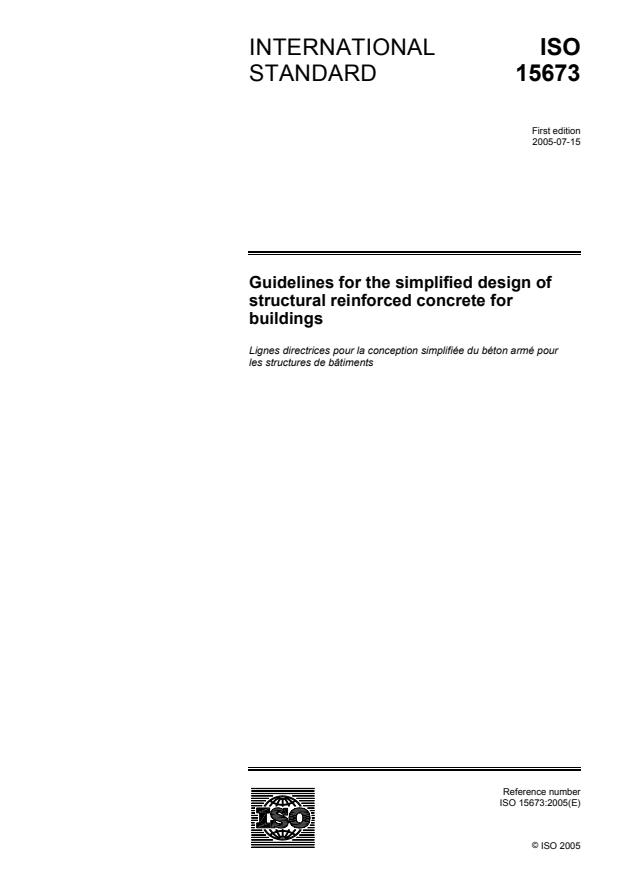
INTERNATIONAL ISO
STANDARD 15673
First edition
2005-07-15
Guidelines for the simplified design of
structural reinforced concrete for
buildings
Lignes directrices pour la conception simplifiée du béton armé pour
les structures de bâtiments
Reference number
©
ISO 2005
PDF disclaimer
This PDF file may contain embedded typefaces. In accordance with Adobe's licensing policy, this file may be printed or viewed but
shall not be edited unless the typefaces which are embedded are licensed to and installed on the computer performing the editing. In
downloading this file, parties accept therein the responsibility of not infringing Adobe's licensing policy. The ISO Central Secretariat
accepts no liability in this area.
Adobe is a trademark of Adobe Systems Incorporated.
Details of the software products used to create this PDF file can be found in the General Info relative to the file; the PDF-creation
parameters were optimized for printing. Every care has been taken to ensure that the file is suitable for use by ISO member bodies. In
the unlikely event that a problem relating to it is found, please inform the Central Secretariat at the address given below.
© ISO 2005
All rights reserved. Unless otherwise specified, no part of this publication may be reproduced or utilized in any form or by any means,
electronic or mechanical, including photocopying and microfilm, without permission in writing from either ISO at the address below or
ISO's member body in the country of the requester.
ISO copyright office
Case postale 56 • CH-1211 Geneva 20
Tel. + 41 22 749 01 11
Fax + 41 22 749 09 47
E-mail copyright@iso.org
Web www.iso.org
Published in Switzerland
ii © ISO 2005 – All rights reserved
Contents Page
Foreword. iv
Introduction . v
1 Scope . 1
2 Normative references . 1
3 Terms and definitions. 2
4 Symbols and abbreviated terms . 12
4.1 Symbols . 12
4.2 Abbreviated terms . 17
5 Design and construction procedure. 18
5.1 Procedure . 18
5.2 Design documentation . 20
6 General provisions . 20
6.1 Limitations. 20
6.2 Limit states . 22
6.3 Ultimate limit state design format. 22
6.4 Serviceability limit state design format. 24
7 Specific provisions. 24
7.1 Structural systems and layout . 24
7.2 Actions (loads) . 29
7.3 General reinforced concrete requirements. 31
7.4 Floor system. 69
7.5 Solid slabs supported on girders, beams, joists or structural concrete walls . 79
7.6 Girders, beams and joists. 106
7.7 Columns. 131
7.8 Lateral force resistance . 143
7.9 Structural concrete walls . 157
7.10 Foundations . 165
Annex A (normative) Equivalent equations for material factors. 168
Foreword
ISO (the International Organization for Standardization) is a worldwide federation of national standards bodies
(ISO member bodies). The work of preparing International Standards is normally carried out through ISO
technical committees. Each member body interested in a subject for which a technical committee has been
established has the right to be represented on that committee. International organizations, governmental and
non-governmental, in liaison with ISO, also take part in the work. ISO collaborates closely with the
International Electrotechnical Commission (IEC) on all matters of electrotechnical standardization.
International Standards are drafted in accordance with the rules given in the ISO/IEC Directives, Part 2.
The main task of technical committees is to prepare International Standards. Draft International Standards
adopted by the technical committees are circulated to the member bodies for voting. Publication as an
International Standard requires approval by at least 75 % of the member bodies casting a vote.
Attention is drawn to the possibility that some of the elements of this document may be the subject of patent
rights. ISO shall not be held responsible for identifying any or all such patent rights.
ISO 15673 was prepared by Technical Committee ISO/TC 71, Concrete, reinforced concrete and pre-stressed
concrete, Subcommittee SC 5, Simplified design standard for concrete structures.
iv © ISO 2005 – All rights reserved
Introduction
The aim of this International Standard is to provide rules for the design and construction of low-rise concrete
structures of small floor area to be built in the less developed areas of the world. The document is developed
for countries that do not have existing national standards. This document shall not be used in place of a
national standard unless specifically considered and accepted by the national standard body or other
appropriate regulatory organization. The design rules are based in simplified worldwide-accepted strength
models. The document is self-contained; therefore actions (loads) and simplified analysis procedures are
included, as well as minimum acceptable construction practice guidelines.
The minimum dimensional provisions contained in this document are intended to account for undesirable side
effects that will require more sophisticated analysis and design procedures. Material and construction
provisions are aimed at site-mixed concrete as well as ready-mixed concrete, and steel of the minimum
available strength grades.
The earthquake-resistance provisions are included to account for the fact that numerous underdeveloped
regions of the world occur in earthquake-prone areas. The earthquake resistance is based upon the
employment of structural concrete walls (shear walls) that limit the lateral deformations of the structure and
provide for its lateral strength.
The document contains provisions that can be modified by the national standards body due to local design
and construction requirements and practices. The specifications that can be modified are indicated using
[“boxed values”]. The authorities in each member country are expected to review the “boxed values” and may
substitute alternative definitive values for these elements for use in the national application of the document.
A great effort was made to include self-explanatory tables, graphics, and design aids to simplify the use of the
document and provide foolproof procedures. Notwithstanding, the economic implications of the conservatism
inherent in approximate procedures as a substitution to sound and experienced engineering should be a
matter of concern to the designer who employs the document, and to the owner who hires him.
INTERNATIONAL STANDARD ISO 15673:2005(E)
Guidelines for the simplified design of structural reinforced
concrete for buildings
1 Scope
This International Standard applies to the planning, design and construction of structural reinforced concrete
structures to be used in new low-rise buildings with restricted occupancy, number of stories, and area. The
purpose of this International Standard is to provide a registered civil engineer or architect with sufficient
information to design the reinforced-concrete structural framing of a low-rise building that complies with these
limitations; see 6.1. The rules of design as set forth in the present document are simplifications of the more
elaborate requirements.
This document may be used as an alternative to the development of a national concrete building code, or
equivalent document, in countries where no national design codes themselves are available, or as an
alternative to the national concrete building code in countries where it is specifically considered and accepted
by the national standard body or other appropriate regulatory organization.
Although the provisions contained in this document were established to produce, when properly employed, a
reinforced concrete structure with an appropriate margin of safety, this International Standard is not a
substitute for sound and experienced engineering. In order for the resulting structure designed in accordance
with these provisions to attain the intended margin of safety, the document must be used as a whole, and
alternative procedures should be employed only when explicitly permitted by the provisions. The minimum
dimensional provisions as prescribed in the document replace, in most cases, more elaborate procedures
such as those prescribed in the national building code, and an eventual economic impact is realized from the
simplicity of the procedures prescribed.
The professional performing the structural design in accordance with this International Standard should meet
the legal requirements for structural designers in the country of adoption and have training and a minimum of
appropriate knowledge of structural mechanics, statics, strength of materials, structural analysis, and
reinforced concrete design and construction.
2 Normative references
The following referenced documents are indispensable for the application of this document. For dated
references, only the edition cited applies. For undated references, the latest edition of the referenced
document (including any amendments) applies.
ISO 679, Methods of testing cements — Determination of strength
ISO 680, Cement — Test methods — Chemical analysis
ISO 863, Cement — Test methods — Pozzolanicity test for pozzolanic cements
ISO 2103, Loads due to use and occupancy in residential and public buildings
ISO 2633, Determination of imposed floor loads in production buildings and warehouses
ISO 3010, Basis for design of structures — Seismic actions on structures
ISO/TR 3956, Principles of structural fire-engineering design with special regard to the connection between
real fire exposure and the heating conditions of the standard fire-resistance test (ISO 834)
ISO 4354, Wind actions on structures
ISO 4355, Bases for design of structures — Determination of snow loads on roofs
ISO 6274, Concrete — Sieve analysis of aggregates
ISO 6782, Aggregates for concrete — Determination of bulk density
ISO 6783, Coarse aggregates for concrete — Determination of particle density and water absorption —
Hydrostatic balance method
ISO 6935-1, Steel for the reinforcement of concrete — Part 1: Plain bars
ISO 6935-2, Steel for the reinforcement of concrete — Part 2: Ribbed bars
ISO 6935-3:1992, (as amended in 2000), Steel for the reinforcement of concrete — Part 3: Welded fabric
ISO 7033, Fine and coarse aggregates for concrete — Determination of the particle mass-per-volume and
water absorption — Pycnometer method
ISO 9194, Bases for design of structures — Actions due to the self-weight of structures, non-structural
elements and stored materials — Density
ISO 9597, Cements — Test methods — Determination of setting time and soundness
ISO 10144, Certification scheme for steel bars and wires for the reinforcement of concrete structures
3 Terms and definitions
For the purposes of this document, the following terms and definitions apply.
3.1
acceleration of gravity
g
acceleration produced by gravity at the surface of earth
NOTE For the purposes of this International Standard, its value can be approximated as g ≈ [10] m/s .
3.2
admixture
material other than water, aggregate, or hydraulic cement, used as an ingredient of concrete and added to
concrete before or during its mixing to modify its properties
3.3
aggregate
granular material, such as sand, gravel, crushed stone, and iron blast-furnace slag, used in conjunction with a
cementing medium to form a hydraulic cement concrete or mortar
3.4
anchorage
device used to anchor a non-structural element to the structural framing
3.5
bar diameter, nominal
approximate diameter of a steel reinforcing bar, often used as a class designation
NOTE The nominal diameter for deformed bars is usually taken as the diameter of a plain bar having the same area.
2 © ISO 2005 – All rights reserved
3.6
base of structure
level at which earthquake motions are assumed to be imparted to a building
NOTE This level does not necessarily coincide with the ground level.
3.7
beam
horizontal, or nearly horizontal, structural member supported at one (such as a cantilever) or more points, but
not throughout its length, transversely supporting a load, and subjected primarily to flexure
3.8
bearing capacity of the soil
maximum permissible stress on the foundation soil that provides adequate safety against bearing failure of the
soil, or settlement of the foundation of such magnitude as to impair the structure
NOTE The value of the bearing capacity of the soil is defined at the working stress level.
3.9
bending moment
product of a force and the distance to a particular axis, producing bending effects in a structural element
3.10
boundary element
portion along a wall edge strengthened by longitudinal and transverse reinforcement
NOTE A boundary element does not necessarily require an increase in thickness of the wall.
3.11
building
structure, usually enclosed by walls and a roof, constructed to provide support or shelter intended for
occupancy
3.12
caisson
foundation pile of large diameter, built partly or totally above ground and sunk below ground usually by digging
out the soil inside
3.13
cement
material as specified in the corresponding referenced International Standards, which, when mixed with water,
has hardening properties, used either in concrete or by itself
3.14
column
vertical member used primarily to support axial compressive loads
3.15
collector element
element that serves to transmit the inertia forces within the diaphragm to members of the lateral-force resisting
system
3.16
combined footing
footing that transmits to the supporting soil the load carried by several columns or structural concrete walls
3.17
compression reinforcement
reinforcement provided to resist compression stresses induced by flexural moments acting on the member
section
3.18
concrete
mixture of Portland cement and any other hydraulic cement, fine aggregate, coarse aggregate, and water, with
or without admixtures
3.19
concrete mix design
choice and proportioning of the ingredients of concrete
3.20
confinement hook
hook on a stirrup, hoop, or crosstie having a bend of not less than 135° with a six-diameter (but not less than
75 mm) extension that engages the longitudinal reinforcement and projects into the interior of the stirrup or
hoop
3.21
confinement stirrup
tie
closed stirrup, tie or continuously wound spiral
NOTE A closed stirrup or tie can be made up of several reinforcement elements, each having a confinement hook at
both ends. A continuously wound spiral should have a confinement hook at both ends.
3.22
corrosion
gradual removal or weakening of metal from its surface that requires the presence of humidity and oxygen,
and is helped by the presence of other materials
3.23
cover
〈concrete〉 thickness of concrete between the surface of any reinforcing bar and the nearest face of the
concrete member
3.24
crosstie
continuous reinforcing bar having a 135° hook at one end and a hook of not less than 90° at least a
six-diameter extension at the other end
NOTE The hooks normally engage peripheral longitudinal bars. The 90° hooks of two successive crossties engaging
the same longitudinal bars are normally alternated end for end.
3.25
curing
keeping the concrete damp for a period of time, usually several days, starting from the moment it is cast, in
order to provide the cement with enough water to harden and attain the intended strength
NOTE Appropriate curing will greatly reduce shrinkage, increase strength of concrete, and normally reduces surface
cracking. Curing time will depend on the temperature and the relative humidity of the surrounding air, the amount of wind,
the direct sunlight exposure, the type of concrete mix employed, and other factors.
3.26
curtain wall
wall that is part of the façade or enclosure of the building
3.27
deformed reinforcement
steel reinforcement that has deformations in its surface to increase its bond to the concrete
NOTE The following steel reinforcement are normally considered deformed reinforcement under this International
Standard: deformed reinforcing bars, deformed wire, welded plain wire fabric, and welded deformed wire fabric conforming
to the appropriate International Standards.
4 © ISO 2005 – All rights reserved
3.28
depth of member
h
vertical size of a cross-section of a horizontal structural element
3.29
design load combination
combination of factored loads and forces as specified in this International Standard
3.30
design strength
product of the nominal strength multiplied by a strength reduction factor, φ
3.31
development length
length of embedded reinforcement required to develop the design strength of reinforcement at a critical
section
3.32
development length
〈bar with a standard hook〉 the shortest distance between the critical section (where the strength of the bar is
to be developed) and a tangent to the outer edge of the 90° or 180° hook
3.33
differential settlement
movement of the foundation of different parts of a structure by different amounts
3.34
effective depth of section
d
distance measured from the extreme compression fibre to the centroid of tension reinforcement
3.35
embedment length
length of embedded reinforcement provided beyond a critical section
3.36
essential facility
building or other structure that is intended to remain operational in the event of extreme environmental loading
from wind, snow, or earthquakes
3.37
factored load
factored force
specified nominal load or force multiplied by the load factors specified in this International Standard
3.38
fire protection of reinforcement
amount of concrete cover necessary to insulate the reinforcement against the effects of the high temperatures
produced by fire
NOTE The concrete cover is a function of the number of hours of exposure to the fire.
3.39
flange
top or bottom part of an I-shaped section separated by the web
3.40
flexural
pertaining to the flexure bending moment
3.41
flexural reinforcement
reinforcement provided to resist the tensile stresses induced by flexural moments acting on the member
section
3.42
floor system
structural elements that comprise the floor of a story in a building
NOTE The floor system includes the beams and girders, the joists (if employed), and the slab that spans between
them.
3.43
footing
portion of the foundation that transmits loads directly to the soil
NOTE The footing is often the widened part of a column, a structural concrete wall or several columns, in a combined
footing.
3.44
formwork
temporary construction to contain concrete in a plastic state while it is cast and setting and which forms the
final shape of the element as the concrete hardens
3.45
foundation
any part of the structure that serves to transmit loads to the underlying soil, or to contain it
3.46
foundation beam
beam that rests on the foundation soil and spans between footings, used either to support walls or to limit
differential settlement of the foundation
3.47
foundation mat
continuous slab laid over the ground as part of the foundation and that transmits to the underlying soil the
loads from the structure
3.48
girder
main horizontal support beam, usually supporting other beams
3.49
gravity load
load that acts downward and is caused by the acceleration of gravity, g, acting on the mass of the elements
that causes the dead and live loads
3.50
hook
bend at the end of a reinforcing bar
NOTE Hooks are classified by the angle that the bend forms with the bar as 90°, 135° or 180° hooks.
3.51
joist
T-shaped beam used in parallel series to directly support floor and ceiling loads, and are supported in turn by
larger girders, beams, or bearing structural concrete walls
6 © ISO 2005 – All rights reserved
3.52
lap splice
splice between two reinforcing bars obtained by overlapping them for a specified length
3.53
lateral-force resisting system
that portion of the structure composed of members proportioned to resist loads related to earthquake effects
3.54
lightweight aggregate concrete
concrete made with coarse granular material that weighs less than the granular material used in normal-
weight aggregates
NOTE This type of concrete is not covered in this International Standard.
3.55
limit state
condition beyond which a structure or member becomes unfit for service and is judged either to be no longer
useful for its intended function (serviceability limit state) or to be unsafe (strength limit state)
3.56
live load
load produced by environmental factors or the use and occupancy of the building and do not include
construction or environmental loads
EXAMPLE Wind load, snow load, rain load, earthquake load, flood load, or dead load (without load factors).
3.57
load effect
force and deformation produced in structural members by the applied loads
3.58
load factor
factor that accounts for deviations of the actual load from the nominal load, for uncertainties in the analysis
that transforms the load into a load effect and for the probability that more than one extreme load will occur
simultaneously
3.59
load
force or other action that results from the weight of all building materials, occupants and their possessions,
environmental effects, differential movement, and restrained dimensional changes
3.60
longitudinal reinforcement
reinforcement that is laid parallel to the longitudinal axis of the element, generally to account for flexural
effects
3.61
mass
quantity of matter in a body
3.62
mesh wire
welded-wire fabric reinforcement
3.63
modulus of elasticity
ratio of the normal stress to the corresponding strain for tensile or compressive stresses below the
proportional limit of the material
3.64
negative moment
flexural moment that produces tension stresses at the upper part of the section of a horizontal, or nearly
horizontal element, and that requires placing negative flexural reinforcement in the upper part of the element
section
3.65
negative reinforcement
flexural reinforcement in horizontal or nearly horizontal elements, required for negative moment and which is
placed in the upper part of the section of the element
3.66
nominal load
magnitude of the load specified in this International Standard (dead, live, soil, wind, snow, rain, flood, and
earthquake)
3.67
nominal strength
capacity of a structure or member to resist the effects of loads, as determined by computations using specified
material strengths and dimensions and the formulas set forth in this International Standard
NOTE The specified material strengths and dimensions in turn are derived from accepted principles of structural
mechanics or by field tests or laboratory tests of scaled models, allowing for modelling effects and differences between
laboratory and field conditions.
3.68
non-structural element
element corresponding to an architectural, a mechanical or an electrical component or system permanently
attached to the building
3.69
occupancy
purpose for which a building or other structure, or part thereof, is used or intended to be used
3.70
partition
non-structural wall that is employed to divide spaces
NOTE A non-structural wall does not support parts of the building other than itself. When it is on the exterior, it is
sometimes referred as a curtain wall.
3.71
pedestal
upright compression member with a ratio of unsupported height to average least lateral dimension of less
than 3
3.72
permanent load
load for which the variations over time are rare or of small magnitude
NOTE All other loads are variable loads (see also nominal loads).
3.73
pile
slender timber, concrete or structural steel element embedded in the ground to support loads
3.74
plain reinforcement
smooth-surfaced steel reinforcement or reinforcement that does not conform to the definition of deformed
reinforcement
8 © ISO 2005 – All rights reserved
3.75
positive moment
flexural moment that produces tension stresses at the lower part of the section of a horizontal or nearly
horizontal element and that requires placing positive flexural reinforcement in the lower part of the element
section
3.76
positive reinforcement
flexural reinforcement in horizontal or nearly horizontal elements required for positive moment and that is
placed in the lower part of the section of the element
3.77
reaction
resistance to a force or load, or upward resistance of a support such as a structural concrete wall or column
against the downward pressure of a loaded member such as a beam
3.78
reinforcement
steel bars, wire, or mesh wire, used for reinforcing the concrete where tensile stresses are expected, due
either to the applied loads or to environmental effects such as variation of temperature
3.79
required factored strength
strength of a member or cross-section required to resist factored loads or related internal moments and forces
in such combinations as are stipulated by this International Standard
3.80
retaining wall
wall built to hold back earth
3.81
selfweight
weight of the structural element, due to the material that composes the element
3.82
service load
load specified by this International Standard (without load factors)
3.83
settlement
downward movement of the supporting soil
3.84
shear
internal force acting tangential to the plane where it acts
NOTE Also called diagonal tension.
3.85
shear reinforcement
reinforcement designed to resist shear
3.86
shores
vertical or inclined support members designed to carry the weight of the formwork, concrete and construction
loads above
3.87
shrinkage and temperature reinforcement
reinforcement normal to flexural reinforcement provided for shrinkage and temperature stresses in structural
solid slabs and footings where flexural reinforcement extends in only one direction
3.88
slab
upper flat part of a reinforced concrete floor carried by supporting joists or beams or columns
3.89
slab on grade
slab set directly on the ground that serves either as an internal traffic surface or as part of the foundation
3.90
solid slab
slab of uniform thickness that does not have voids to make it lighter
3.91
span length
horizontal distance between supports of a horizontal structural element
NOTE Such as a slab, joist, beam, or girder.
3.92
specification
written document describing in detail the scope of work, materials to be used, method of installation and
quality of workmanship
3.93
specified compressive strength
f′
c
〈concrete〉 compressive cylinder strength of concrete used in design and evaluated in accordance with the
appropriate International Standard
NOTE 1 The specified compressive strength is expressed in units of megapascals, MPa.
′
NOTE 2 Whenever the quantity f′ is under a radical sign f , the positive square root of the numerical value only is
( c )
c
intended, and result has units of megapascals.
3.94
specified lateral earthquake forces
lateral forces corresponding to the appropriate distribution of the design base shear force prescribed by this
International Standard for an earthquake-resistant design
3.95
specified wind forces
nominal pressure of the wind to be used in design in accordance with this International Standard
3.96
spiral reinforcement
continuously wound reinforcement in the form of a cylindrical helix
3.97
spread footing
isolated footing that transmits to the supporting soil the load carried by a single column
3.98
stairway
flight of steps leading from one level to another
10 © ISO 2005 – All rights reserved
3.99
stirrup
reinforcement used to resist shear and torsion stresses in a structural member
NOTE Typically, bars, wires, or welded wire fabric, either plain or deformed, either single leg or bent into an “L”, a “U”,
or rectangular shapes, and located perpendicular to or at an angle to the longitudinal reinforcement. (The term “stirrups” is
usually applied to lateral reinforcement in girders, beams, and joists and the term “ties” to those in columns and walls.)
See also tie (3.109).
3.100
story height
vertical distance between the upper part of the slab of a story and the upper part of the slab of the floor below
3.101
strength reduction factor
φ
coefficient that accounts for deviations of the actual strength from the nominal strength, according to the
manner and consequences of failure
NOTE A strength reduction factor includes the probability of understrength members due to variations in material
strengths and dimensions and approximations in the design equations, to reflect the degree of ductility and required
reliability on the member under the load effects being considered and the importance of the element in the structure.
3.102
stress
intensity of force per unit area
3.103
structural concrete
all concrete used for structural purposes including plain and reinforced concrete
3.104
structural concrete walls
walls proportioned to resist combinations of shear, moments and axial forces
NOTE A shearwall is a structural wall.
3.105
structural diaphragm
structural member, such as floor and roof slabs, which transmits the effects induced by earthquakes
3.106
support
structural element that provides support to an other structural element
3.107
tank
container for the storage of water or other fluids
3.108
temporary facility
building or other structure that is to be in service for a limited time and has a limited period of exposure to
environmental loadings
3.109
tie
loop of reinforcing bar or wire enclosing longitudinal reinforcement
NOTE A continuously wound bar or wire in the form of a circle, rectangle, or other polygon shape without re-entrant
corners is acceptable.
3.110
tie element
element which serves to transmit internal forces and to prevent separation of such building components as
footings and walls
3.111
transverse reinforcement
reinforcement, such as stirrups, ties, spiral reinforcement, etc., located perpendicular to the longitudinal axis of
the element
3.112
wall
member, usually vertical, used to enclose or separate spaces
3.113
web
thin vertical portion with an I-shaped section that connects the flanges
3.114
weight
vertical downward force exerted by a mass when subjected to the acceleration of gravity
NOTE The weight is equal to the value of the mass multiplied by the acceleration of gravity, g.
3.115
wire
reinforcing bar of small diameter
3.116
working stress
allowable stress to be used with unfactored loads
3.117
yield strength
f
y
specified minimum yield strength or yield point of reinforcement
NOTE 1 The yield strength is denominated in units of megapascals, MPa.
NOTE 2 Applicable International Standards specify that the yield strength or yield point be determined in tension.
4 Symbols and abbreviated terms
4.1 Symbols
a depth of equivalent uniform compressive stress block, expressed in millimetres
a narrowest dimension between the sides of a form
f
A area of an individual reinforcement bar or wire, expressed in square millimetres
b
A loaded area of bearing on concrete or the area of the confined column core, in a column with
c
spiral reinforcement, measured centre to centre of the spiral, expressed in square millimetres
A gross area of the section of an element, expressed in square millimetres
g
12 © ISO 2005 – All rights reserved
A effective cross-sectional area within a joint for shear evaluation or area of additional hanger
j
reinforcement, where beams are supported by girders or other beams, expressed in square
millimetres
A area of longitudinal tension reinforcement, expressed in square millimetres
s
′
A area of longitudinal compression reinforcement, expressed in square millimetres
s
A minimum area of longitudinal tension reinforcement, expressed in square millimetres
s,min
A total extreme steel area in a column or structural concrete wall for computation of the balanced
se
moment strength, expressed in square millimetres
A total side steel area in a column or structural concrete wall for computation of the balanced
ss
moment strength, expressed in square millimetres
A total area of longitudinal reinforcement, expressed in square millimetres
st
A wind exposed surface area, expressed in square metres
su
A area of shear reinforcement within a distance s, expressed in square millimetres
v
b width of the compression face of the member, or width of the section of the member, expressed
in millimetres
b average value of b
ave
b width of the column section, or largest plan dimension of capital or drop panel, for punching shear
c
evaluation, expressed in millimetres
b dimension of the column section in the direction perpendicular to the girder span, expressed in
col
metres
b effective width of the compression flange in a T-shaped section, expressed in millimetres
f
b web width in a T-shaped section, or web width of girders, beams or joists, or thickness of the web
w
in a structural concrete wall, expressed in millimetres
b perimeter of the critical section for punching shear in slabs, expressed in millimetres
d effective depth, which should be taken as the distance from the extreme compression fibre to the
centroid of tension reinforcement, expressed in millimetres
d' distance from the extreme compression fibre to the centroid of compression reinforcement,
expressed in millimetres
d nominal diameter of reinforcing bar or wire, expressed in millimetres
b
d distance from the extreme tension fibre to the centroid of tension reinforcement or diameter of the
c
confined core of a column with spiral reinforcement, expressed in millimetres
D dead loads, or related internal moments and forces
E load effects of an earthquake or related internal moments and forces
E modulus of elasticity of concrete, expressed in megapascals
c
f ′ specified compressive strength of concrete, expressed in megapascals
c
′
f positive square root of the specified compressive strength of concrete, expressed in
c
megapascals
f compressive strength of concrete reduced by the material factor, expressed in megapascals
cd
f extreme fibre-factored compressive stress at the edges of structural walls, expressed in
cu
megapascals
f specified yield strength of reinforcement, expressed in megapascals
y
f yield strength of reinforcement reduced by the material factor, expressed in megapascals
yd
f probable specified maximum strength of reinforcement (f = 1,25 ⋅ f), expressed in
ypr ypr y
megapascals
f specified yield strength of transverse or spiral reinforcement, expressed in megapascals
ys
f yield strength of transverse or spiral reinforcement reduced by the material factor, expressed in
ysd
megapascals
F loads due to the weight and the pressure of fluids with well-defined densities and controllable
maximum heights, or related internal moments and forces
F , F design wind or seismic force applied at level i or x, respectively, expressed in kilonewtons
i x
F , F factored design lateral force applied to the wall at level i or x, respectively, expressed in newtons
iu xu
h depth or thickness of a structural element, expressed in millimetres
h vertical distance measured from the bottom of the supporting girder to the bottom of the
b
supported beam, expressed in millimetres
h dimension of a column section in the direction parallel to the girder span, expressed in metres
cp
h height of the column section, expressed in millimetres
c
h slab thickness, expressed in millimetres
f
h , h height above the base to level i or x, respectively, expressed in metres
i x
h clear vertical distance between lateral supports of columns and walls, expressed in millimetres
n
h story height of floor i, measured from floor finish of the story to floor finish of the story
pi
immediately below, expressed in millimetres
h total height of the supporting girder, in expressed in millimetres
s
h height of entire structural concrete wall from base to top, expressed in millimetres
w
H loads due to the weight and pressure of soil, water in soil, or other materials, or related internal
moments and forces
I moment of inertia of the column section, expressed in metres to the fourth power
c
l span of a structural element or length of a span measured centre-to-centre of beams or other
supports
l length of clear span in the short direction of two-way slabs, measured face-to-face of beams or
a
other supports, expressed in metres
14 © ISO 2005 – All rights reserved
l length of clear span in the long direction of two-way slabs, measured face-to-face of beams or
b
other supports, expressed in metres
l development length for reinforcing bar, expressed in millimetres
d
l clear spacing between joists, expressed in metres
j
l length of clear span in the direction that moments are being determined, measured face-to-face
m
of supports, expressed in metres
l length of clear span in the long direction of two-way construction, measured face-to-face of
n
supports in slabs without beams and face-to-face of beams or other supports in other cases or
length of clear span, measured face-to-face of supports in slabs without beams, and face-to-face
of beams or other supports in other cases, expressed in millimetres
l horizontal length of structural concrete wall, expressed in millimetres
w
l column confinement length
o
L live loads or related internal moments and forces
L sloping-roof live load or related internal moments and forces
r
M nominal flexural moment strength at section at balanced conditions, expressed in
bn
neweton⋅millimetres
M flexural moment strength at section at balanced conditions, expressed in newton⋅millimetres
br
M , M factored story moment caused by lateral loads at story i or x, respectively, expressed in newtons
iu xu
M nominal flexural moment strength at section, expressed in newton⋅millimetres
n
M flexural moment strength at section, expressed in newton⋅millimetres
r
M probable flexural moment strength of the element at the joint face, computed using f and φ = 1,
pr ypr
expressed in newton⋅metres
M factored flexural moment at section, expressed in newton⋅metres
u
−
M factored negative flexural moment at section, expressed in newton⋅metres
u
+
M factored positive flexural moment at section, expressed in newton⋅metres
u
ΣM sum of the lowest flexural strengths (φ ⋅ M ) of columns framing into a joint, expressed in
c n
newton⋅metres
ΣM sum of flexural strengths (φ ⋅ M ) of girders framing into a joint, expressed in newton⋅metres
g n
∆M factored unbalanced moment at a column-girder joint or factored unbalanced moment at a wall-
u
girder joint, expressed in newton⋅metres
N nominal strength, P , the non-factored dead-load axial force at section or non-factored
st d
concentrated dead load applied directly to the element, expressed in newtons
N is the number of bars in a layer
b
P nominal compression axial load strength at section at balanced conditions, expressed in newtons
bn
P nominal compression axial load strength at section at balanced conditions, expressed in newtons
br
P factored compression load on a wall-boundary element, including earthquake effects
cu
P non-factored live-load axial force at section or non-factored concentrated live load applied directly
l
to the element, expressed in newtons
P nominal axial load strength at section, expressed in newtons
n
P maximum compression nominal axial load strength at section, expressed in newtons
n(max)
P axial tension strength at section, expressed in newtons
tn
P factored tension force on a wall boundary element, including earthquake effects
tu
P factored axial load at section or factored concentrated design load applied directly to the element
u
or factored axial load on column or wall, expressed in newtons
P axial compressive st
...
SLOVENSKI STANDARD
oSIST ISO 15673:2011
01-februar-2011
Smernice za poenostavljene ocene konstrukcije armiranih betonskih stavb
Guidelines for the simplified design of structural reinforced concrete for buildings
Lignes directrices pour la conception simplifiée du béton armé pour les structures de
bâtiments
Ta slovenski standard je istoveten z: ISO 15673:2005
ICS:
91.080.40 Betonske konstrukcije Concrete structures
oSIST ISO 15673:2011 en
2003-01.Slovenski inštitut za standardizacijo. Razmnoževanje celote ali delov tega standarda ni dovoljeno.
oSIST ISO 15673:2011
oSIST ISO 15673:2011
INTERNATIONAL ISO
STANDARD 15673
First edition
2005-07-15
Guidelines for the simplified design of
structural reinforced concrete for
buildings
Lignes directrices pour la conception simplifiée du béton armé pour
les structures de bâtiments
Reference number
©
ISO 2005
oSIST ISO 15673:2011
PDF disclaimer
This PDF file may contain embedded typefaces. In accordance with Adobe's licensing policy, this file may be printed or viewed but
shall not be edited unless the typefaces which are embedded are licensed to and installed on the computer performing the editing. In
downloading this file, parties accept therein the responsibility of not infringing Adobe's licensing policy. The ISO Central Secretariat
accepts no liability in this area.
Adobe is a trademark of Adobe Systems Incorporated.
Details of the software products used to create this PDF file can be found in the General Info relative to the file; the PDF-creation
parameters were optimized for printing. Every care has been taken to ensure that the file is suitable for use by ISO member bodies. In
the unlikely event that a problem relating to it is found, please inform the Central Secretariat at the address given below.
© ISO 2005
All rights reserved. Unless otherwise specified, no part of this publication may be reproduced or utilized in any form or by any means,
electronic or mechanical, including photocopying and microfilm, without permission in writing from either ISO at the address below or
ISO's member body in the country of the requester.
ISO copyright office
Case postale 56 • CH-1211 Geneva 20
Tel. + 41 22 749 01 11
Fax + 41 22 749 09 47
E-mail copyright@iso.org
Web www.iso.org
Published in Switzerland
ii © ISO 2005 – All rights reserved
oSIST ISO 15673:2011
Contents Page
Foreword. iv
Introduction . v
1 Scope . 1
2 Normative references . 1
3 Terms and definitions. 2
4 Symbols and abbreviated terms . 12
4.1 Symbols . 12
4.2 Abbreviated terms . 17
5 Design and construction procedure. 18
5.1 Procedure . 18
5.2 Design documentation . 20
6 General provisions . 20
6.1 Limitations. 20
6.2 Limit states . 22
6.3 Ultimate limit state design format. 22
6.4 Serviceability limit state design format. 24
7 Specific provisions. 24
7.1 Structural systems and layout . 24
7.2 Actions (loads) . 29
7.3 General reinforced concrete requirements. 31
7.4 Floor system. 69
7.5 Solid slabs supported on girders, beams, joists or structural concrete walls . 79
7.6 Girders, beams and joists. 106
7.7 Columns. 131
7.8 Lateral force resistance . 143
7.9 Structural concrete walls . 157
7.10 Foundations . 165
Annex A (normative) Equivalent equations for material factors. 168
oSIST ISO 15673:2011
Foreword
ISO (the International Organization for Standardization) is a worldwide federation of national standards bodies
(ISO member bodies). The work of preparing International Standards is normally carried out through ISO
technical committees. Each member body interested in a subject for which a technical committee has been
established has the right to be represented on that committee. International organizations, governmental and
non-governmental, in liaison with ISO, also take part in the work. ISO collaborates closely with the
International Electrotechnical Commission (IEC) on all matters of electrotechnical standardization.
International Standards are drafted in accordance with the rules given in the ISO/IEC Directives, Part 2.
The main task of technical committees is to prepare International Standards. Draft International Standards
adopted by the technical committees are circulated to the member bodies for voting. Publication as an
International Standard requires approval by at least 75 % of the member bodies casting a vote.
Attention is drawn to the possibility that some of the elements of this document may be the subject of patent
rights. ISO shall not be held responsible for identifying any or all such patent rights.
ISO 15673 was prepared by Technical Committee ISO/TC 71, Concrete, reinforced concrete and pre-stressed
concrete, Subcommittee SC 5, Simplified design standard for concrete structures.
iv © ISO 2005 – All rights reserved
oSIST ISO 15673:2011
Introduction
The aim of this International Standard is to provide rules for the design and construction of low-rise concrete
structures of small floor area to be built in the less developed areas of the world. The document is developed
for countries that do not have existing national standards. This document shall not be used in place of a
national standard unless specifically considered and accepted by the national standard body or other
appropriate regulatory organization. The design rules are based in simplified worldwide-accepted strength
models. The document is self-contained; therefore actions (loads) and simplified analysis procedures are
included, as well as minimum acceptable construction practice guidelines.
The minimum dimensional provisions contained in this document are intended to account for undesirable side
effects that will require more sophisticated analysis and design procedures. Material and construction
provisions are aimed at site-mixed concrete as well as ready-mixed concrete, and steel of the minimum
available strength grades.
The earthquake-resistance provisions are included to account for the fact that numerous underdeveloped
regions of the world occur in earthquake-prone areas. The earthquake resistance is based upon the
employment of structural concrete walls (shear walls) that limit the lateral deformations of the structure and
provide for its lateral strength.
The document contains provisions that can be modified by the national standards body due to local design
and construction requirements and practices. The specifications that can be modified are indicated using
[“boxed values”]. The authorities in each member country are expected to review the “boxed values” and may
substitute alternative definitive values for these elements for use in the national application of the document.
A great effort was made to include self-explanatory tables, graphics, and design aids to simplify the use of the
document and provide foolproof procedures. Notwithstanding, the economic implications of the conservatism
inherent in approximate procedures as a substitution to sound and experienced engineering should be a
matter of concern to the designer who employs the document, and to the owner who hires him.
oSIST ISO 15673:2011
oSIST ISO 15673:2011
INTERNATIONAL STANDARD ISO 15673:2005(E)
Guidelines for the simplified design of structural reinforced
concrete for buildings
1 Scope
This International Standard applies to the planning, design and construction of structural reinforced concrete
structures to be used in new low-rise buildings with restricted occupancy, number of stories, and area. The
purpose of this International Standard is to provide a registered civil engineer or architect with sufficient
information to design the reinforced-concrete structural framing of a low-rise building that complies with these
limitations; see 6.1. The rules of design as set forth in the present document are simplifications of the more
elaborate requirements.
This document may be used as an alternative to the development of a national concrete building code, or
equivalent document, in countries where no national design codes themselves are available, or as an
alternative to the national concrete building code in countries where it is specifically considered and accepted
by the national standard body or other appropriate regulatory organization.
Although the provisions contained in this document were established to produce, when properly employed, a
reinforced concrete structure with an appropriate margin of safety, this International Standard is not a
substitute for sound and experienced engineering. In order for the resulting structure designed in accordance
with these provisions to attain the intended margin of safety, the document must be used as a whole, and
alternative procedures should be employed only when explicitly permitted by the provisions. The minimum
dimensional provisions as prescribed in the document replace, in most cases, more elaborate procedures
such as those prescribed in the national building code, and an eventual economic impact is realized from the
simplicity of the procedures prescribed.
The professional performing the structural design in accordance with this International Standard should meet
the legal requirements for structural designers in the country of adoption and have training and a minimum of
appropriate knowledge of structural mechanics, statics, strength of materials, structural analysis, and
reinforced concrete design and construction.
2 Normative references
The following referenced documents are indispensable for the application of this document. For dated
references, only the edition cited applies. For undated references, the latest edition of the referenced
document (including any amendments) applies.
ISO 679, Methods of testing cements — Determination of strength
ISO 680, Cement — Test methods — Chemical analysis
ISO 863, Cement — Test methods — Pozzolanicity test for pozzolanic cements
ISO 2103, Loads due to use and occupancy in residential and public buildings
ISO 2633, Determination of imposed floor loads in production buildings and warehouses
ISO 3010, Basis for design of structures — Seismic actions on structures
ISO/TR 3956, Principles of structural fire-engineering design with special regard to the connection between
real fire exposure and the heating conditions of the standard fire-resistance test (ISO 834)
oSIST ISO 15673:2011
ISO 4354, Wind actions on structures
ISO 4355, Bases for design of structures — Determination of snow loads on roofs
ISO 6274, Concrete — Sieve analysis of aggregates
ISO 6782, Aggregates for concrete — Determination of bulk density
ISO 6783, Coarse aggregates for concrete — Determination of particle density and water absorption —
Hydrostatic balance method
ISO 6935-1, Steel for the reinforcement of concrete — Part 1: Plain bars
ISO 6935-2, Steel for the reinforcement of concrete — Part 2: Ribbed bars
ISO 6935-3:1992, (as amended in 2000), Steel for the reinforcement of concrete — Part 3: Welded fabric
ISO 7033, Fine and coarse aggregates for concrete — Determination of the particle mass-per-volume and
water absorption — Pycnometer method
ISO 9194, Bases for design of structures — Actions due to the self-weight of structures, non-structural
elements and stored materials — Density
ISO 9597, Cements — Test methods — Determination of setting time and soundness
ISO 10144, Certification scheme for steel bars and wires for the reinforcement of concrete structures
3 Terms and definitions
For the purposes of this document, the following terms and definitions apply.
3.1
acceleration of gravity
g
acceleration produced by gravity at the surface of earth
NOTE For the purposes of this International Standard, its value can be approximated as g ≈ [10] m/s .
3.2
admixture
material other than water, aggregate, or hydraulic cement, used as an ingredient of concrete and added to
concrete before or during its mixing to modify its properties
3.3
aggregate
granular material, such as sand, gravel, crushed stone, and iron blast-furnace slag, used in conjunction with a
cementing medium to form a hydraulic cement concrete or mortar
3.4
anchorage
device used to anchor a non-structural element to the structural framing
3.5
bar diameter, nominal
approximate diameter of a steel reinforcing bar, often used as a class designation
NOTE The nominal diameter for deformed bars is usually taken as the diameter of a plain bar having the same area.
2 © ISO 2005 – All rights reserved
oSIST ISO 15673:2011
3.6
base of structure
level at which earthquake motions are assumed to be imparted to a building
NOTE This level does not necessarily coincide with the ground level.
3.7
beam
horizontal, or nearly horizontal, structural member supported at one (such as a cantilever) or more points, but
not throughout its length, transversely supporting a load, and subjected primarily to flexure
3.8
bearing capacity of the soil
maximum permissible stress on the foundation soil that provides adequate safety against bearing failure of the
soil, or settlement of the foundation of such magnitude as to impair the structure
NOTE The value of the bearing capacity of the soil is defined at the working stress level.
3.9
bending moment
product of a force and the distance to a particular axis, producing bending effects in a structural element
3.10
boundary element
portion along a wall edge strengthened by longitudinal and transverse reinforcement
NOTE A boundary element does not necessarily require an increase in thickness of the wall.
3.11
building
structure, usually enclosed by walls and a roof, constructed to provide support or shelter intended for
occupancy
3.12
caisson
foundation pile of large diameter, built partly or totally above ground and sunk below ground usually by digging
out the soil inside
3.13
cement
material as specified in the corresponding referenced International Standards, which, when mixed with water,
has hardening properties, used either in concrete or by itself
3.14
column
vertical member used primarily to support axial compressive loads
3.15
collector element
element that serves to transmit the inertia forces within the diaphragm to members of the lateral-force resisting
system
3.16
combined footing
footing that transmits to the supporting soil the load carried by several columns or structural concrete walls
3.17
compression reinforcement
reinforcement provided to resist compression stresses induced by flexural moments acting on the member
section
oSIST ISO 15673:2011
3.18
concrete
mixture of Portland cement and any other hydraulic cement, fine aggregate, coarse aggregate, and water, with
or without admixtures
3.19
concrete mix design
choice and proportioning of the ingredients of concrete
3.20
confinement hook
hook on a stirrup, hoop, or crosstie having a bend of not less than 135° with a six-diameter (but not less than
75 mm) extension that engages the longitudinal reinforcement and projects into the interior of the stirrup or
hoop
3.21
confinement stirrup
tie
closed stirrup, tie or continuously wound spiral
NOTE A closed stirrup or tie can be made up of several reinforcement elements, each having a confinement hook at
both ends. A continuously wound spiral should have a confinement hook at both ends.
3.22
corrosion
gradual removal or weakening of metal from its surface that requires the presence of humidity and oxygen,
and is helped by the presence of other materials
3.23
cover
〈concrete〉 thickness of concrete between the surface of any reinforcing bar and the nearest face of the
concrete member
3.24
crosstie
continuous reinforcing bar having a 135° hook at one end and a hook of not less than 90° at least a
six-diameter extension at the other end
NOTE The hooks normally engage peripheral longitudinal bars. The 90° hooks of two successive crossties engaging
the same longitudinal bars are normally alternated end for end.
3.25
curing
keeping the concrete damp for a period of time, usually several days, starting from the moment it is cast, in
order to provide the cement with enough water to harden and attain the intended strength
NOTE Appropriate curing will greatly reduce shrinkage, increase strength of concrete, and normally reduces surface
cracking. Curing time will depend on the temperature and the relative humidity of the surrounding air, the amount of wind,
the direct sunlight exposure, the type of concrete mix employed, and other factors.
3.26
curtain wall
wall that is part of the façade or enclosure of the building
3.27
deformed reinforcement
steel reinforcement that has deformations in its surface to increase its bond to the concrete
NOTE The following steel reinforcement are normally considered deformed reinforcement under this International
Standard: deformed reinforcing bars, deformed wire, welded plain wire fabric, and welded deformed wire fabric conforming
to the appropriate International Standards.
4 © ISO 2005 – All rights reserved
oSIST ISO 15673:2011
3.28
depth of member
h
vertical size of a cross-section of a horizontal structural element
3.29
design load combination
combination of factored loads and forces as specified in this International Standard
3.30
design strength
product of the nominal strength multiplied by a strength reduction factor, φ
3.31
development length
length of embedded reinforcement required to develop the design strength of reinforcement at a critical
section
3.32
development length
〈bar with a standard hook〉 the shortest distance between the critical section (where the strength of the bar is
to be developed) and a tangent to the outer edge of the 90° or 180° hook
3.33
differential settlement
movement of the foundation of different parts of a structure by different amounts
3.34
effective depth of section
d
distance measured from the extreme compression fibre to the centroid of tension reinforcement
3.35
embedment length
length of embedded reinforcement provided beyond a critical section
3.36
essential facility
building or other structure that is intended to remain operational in the event of extreme environmental loading
from wind, snow, or earthquakes
3.37
factored load
factored force
specified nominal load or force multiplied by the load factors specified in this International Standard
3.38
fire protection of reinforcement
amount of concrete cover necessary to insulate the reinforcement against the effects of the high temperatures
produced by fire
NOTE The concrete cover is a function of the number of hours of exposure to the fire.
3.39
flange
top or bottom part of an I-shaped section separated by the web
3.40
flexural
pertaining to the flexure bending moment
oSIST ISO 15673:2011
3.41
flexural reinforcement
reinforcement provided to resist the tensile stresses induced by flexural moments acting on the member
section
3.42
floor system
structural elements that comprise the floor of a story in a building
NOTE The floor system includes the beams and girders, the joists (if employed), and the slab that spans between
them.
3.43
footing
portion of the foundation that transmits loads directly to the soil
NOTE The footing is often the widened part of a column, a structural concrete wall or several columns, in a combined
footing.
3.44
formwork
temporary construction to contain concrete in a plastic state while it is cast and setting and which forms the
final shape of the element as the concrete hardens
3.45
foundation
any part of the structure that serves to transmit loads to the underlying soil, or to contain it
3.46
foundation beam
beam that rests on the foundation soil and spans between footings, used either to support walls or to limit
differential settlement of the foundation
3.47
foundation mat
continuous slab laid over the ground as part of the foundation and that transmits to the underlying soil the
loads from the structure
3.48
girder
main horizontal support beam, usually supporting other beams
3.49
gravity load
load that acts downward and is caused by the acceleration of gravity, g, acting on the mass of the elements
that causes the dead and live loads
3.50
hook
bend at the end of a reinforcing bar
NOTE Hooks are classified by the angle that the bend forms with the bar as 90°, 135° or 180° hooks.
3.51
joist
T-shaped beam used in parallel series to directly support floor and ceiling loads, and are supported in turn by
larger girders, beams, or bearing structural concrete walls
6 © ISO 2005 – All rights reserved
oSIST ISO 15673:2011
3.52
lap splice
splice between two reinforcing bars obtained by overlapping them for a specified length
3.53
lateral-force resisting system
that portion of the structure composed of members proportioned to resist loads related to earthquake effects
3.54
lightweight aggregate concrete
concrete made with coarse granular material that weighs less than the granular material used in normal-
weight aggregates
NOTE This type of concrete is not covered in this International Standard.
3.55
limit state
condition beyond which a structure or member becomes unfit for service and is judged either to be no longer
useful for its intended function (serviceability limit state) or to be unsafe (strength limit state)
3.56
live load
load produced by environmental factors or the use and occupancy of the building and do not include
construction or environmental loads
EXAMPLE Wind load, snow load, rain load, earthquake load, flood load, or dead load (without load factors).
3.57
load effect
force and deformation produced in structural members by the applied loads
3.58
load factor
factor that accounts for deviations of the actual load from the nominal load, for uncertainties in the analysis
that transforms the load into a load effect and for the probability that more than one extreme load will occur
simultaneously
3.59
load
force or other action that results from the weight of all building materials, occupants and their possessions,
environmental effects, differential movement, and restrained dimensional changes
3.60
longitudinal reinforcement
reinforcement that is laid parallel to the longitudinal axis of the element, generally to account for flexural
effects
3.61
mass
quantity of matter in a body
3.62
mesh wire
welded-wire fabric reinforcement
3.63
modulus of elasticity
ratio of the normal stress to the corresponding strain for tensile or compressive stresses below the
proportional limit of the material
oSIST ISO 15673:2011
3.64
negative moment
flexural moment that produces tension stresses at the upper part of the section of a horizontal, or nearly
horizontal element, and that requires placing negative flexural reinforcement in the upper part of the element
section
3.65
negative reinforcement
flexural reinforcement in horizontal or nearly horizontal elements, required for negative moment and which is
placed in the upper part of the section of the element
3.66
nominal load
magnitude of the load specified in this International Standard (dead, live, soil, wind, snow, rain, flood, and
earthquake)
3.67
nominal strength
capacity of a structure or member to resist the effects of loads, as determined by computations using specified
material strengths and dimensions and the formulas set forth in this International Standard
NOTE The specified material strengths and dimensions in turn are derived from accepted principles of structural
mechanics or by field tests or laboratory tests of scaled models, allowing for modelling effects and differences between
laboratory and field conditions.
3.68
non-structural element
element corresponding to an architectural, a mechanical or an electrical component or system permanently
attached to the building
3.69
occupancy
purpose for which a building or other structure, or part thereof, is used or intended to be used
3.70
partition
non-structural wall that is employed to divide spaces
NOTE A non-structural wall does not support parts of the building other than itself. When it is on the exterior, it is
sometimes referred as a curtain wall.
3.71
pedestal
upright compression member with a ratio of unsupported height to average least lateral dimension of less
than 3
3.72
permanent load
load for which the variations over time are rare or of small magnitude
NOTE All other loads are variable loads (see also nominal loads).
3.73
pile
slender timber, concrete or structural steel element embedded in the ground to support loads
3.74
plain reinforcement
smooth-surfaced steel reinforcement or reinforcement that does not conform to the definition of deformed
reinforcement
8 © ISO 2005 – All rights reserved
oSIST ISO 15673:2011
3.75
positive moment
flexural moment that produces tension stresses at the lower part of the section of a horizontal or nearly
horizontal element and that requires placing positive flexural reinforcement in the lower part of the element
section
3.76
positive reinforcement
flexural reinforcement in horizontal or nearly horizontal elements required for positive moment and that is
placed in the lower part of the section of the element
3.77
reaction
resistance to a force or load, or upward resistance of a support such as a structural concrete wall or column
against the downward pressure of a loaded member such as a beam
3.78
reinforcement
steel bars, wire, or mesh wire, used for reinforcing the concrete where tensile stresses are expected, due
either to the applied loads or to environmental effects such as variation of temperature
3.79
required factored strength
strength of a member or cross-section required to resist factored loads or related internal moments and forces
in such combinations as are stipulated by this International Standard
3.80
retaining wall
wall built to hold back earth
3.81
selfweight
weight of the structural element, due to the material that composes the element
3.82
service load
load specified by this International Standard (without load factors)
3.83
settlement
downward movement of the supporting soil
3.84
shear
internal force acting tangential to the plane where it acts
NOTE Also called diagonal tension.
3.85
shear reinforcement
reinforcement designed to resist shear
3.86
shores
vertical or inclined support members designed to carry the weight of the formwork, concrete and construction
loads above
oSIST ISO 15673:2011
3.87
shrinkage and temperature reinforcement
reinforcement normal to flexural reinforcement provided for shrinkage and temperature stresses in structural
solid slabs and footings where flexural reinforcement extends in only one direction
3.88
slab
upper flat part of a reinforced concrete floor carried by supporting joists or beams or columns
3.89
slab on grade
slab set directly on the ground that serves either as an internal traffic surface or as part of the foundation
3.90
solid slab
slab of uniform thickness that does not have voids to make it lighter
3.91
span length
horizontal distance between supports of a horizontal structural element
NOTE Such as a slab, joist, beam, or girder.
3.92
specification
written document describing in detail the scope of work, materials to be used, method of installation and
quality of workmanship
3.93
specified compressive strength
f′
c
〈concrete〉 compressive cylinder strength of concrete used in design and evaluated in accordance with the
appropriate International Standard
NOTE 1 The specified compressive strength is expressed in units of megapascals, MPa.
′
NOTE 2 Whenever the quantity f′ is under a radical sign f , the positive square root of the numerical value only is
( c )
c
intended, and result has units of megapascals.
3.94
specified lateral earthquake forces
lateral forces corresponding to the appropriate distribution of the design base shear force prescribed by this
International Standard for an earthquake-resistant design
3.95
specified wind forces
nominal pressure of the wind to be used in design in accordance with this International Standard
3.96
spiral reinforcement
continuously wound reinforcement in the form of a cylindrical helix
3.97
spread footing
isolated footing that transmits to the supporting soil the load carried by a single column
3.98
stairway
flight of steps leading from one level to another
10 © ISO 2005 – All rights reserved
oSIST ISO 15673:2011
3.99
stirrup
reinforcement used to resist shear and torsion stresses in a structural member
NOTE Typically, bars, wires, or welded wire fabric, either plain or deformed, either single leg or bent into an “L”, a “U”,
or rectangular shapes, and located perpendicular to or at an angle to the longitudinal reinforcement. (The term “stirrups” is
usually applied to lateral reinforcement in girders, beams, and joists and the term “ties” to those in columns and walls.)
See also tie (3.109).
3.100
story height
vertical distance between the upper part of the slab of a story and the upper part of the slab of the floor below
3.101
strength reduction factor
φ
coefficient that accounts for deviations of the actual strength from the nominal strength, according to the
manner and consequences of failure
NOTE A strength reduction factor includes the probability of understrength members due to variations in material
strengths and dimensions and approximations in the design equations, to reflect the degree of ductility and required
reliability on the member under the load effects being considered and the importance of the element in the structure.
3.102
stress
intensity of force per unit area
3.103
structural concrete
all concrete used for structural purposes including plain and reinforced concrete
3.104
structural concrete walls
walls proportioned to resist combinations of shear, moments and axial forces
NOTE A shearwall is a structural wall.
3.105
structural diaphragm
structural member, such as floor and roof slabs, which transmits the effects induced by earthquakes
3.106
support
structural element that provides support to an other structural element
3.107
tank
container for the storage of water or other fluids
3.108
temporary facility
building or other structure that is to be in service for a limited time and has a limited period of exposure to
environmental loadings
3.109
tie
loop of reinforcing bar or wire enclosing longitudinal reinforcement
NOTE A continuously wound bar or wire in the form of a circle, rectangle, or other polygon shape without re-entrant
corners is acceptable.
oSIST ISO 15673:2011
3.110
tie element
element which serves to transmit internal forces and to prevent separation of such building components as
footings and walls
3.111
transverse reinforcement
reinforcement, such as stirrups, ties, spiral reinforcement, etc., located perpendicular to the longitudinal axis of
the element
3.112
wall
member, usually vertical, used to enclose or separate spaces
3.113
web
thin vertical portion with an I-shaped section that connects the flanges
3.114
weight
vertical downward force exerted by a mass when subjected to the acceleration of gravity
NOTE The weight is equal to the value of the mass multiplied by the acceleration of gravity, g.
3.115
wire
reinforcing bar of small diameter
3.116
working stress
allowable stress to be used with unfactored loads
3.117
yield strength
f
y
specified minimum yield strength or yield point of reinforcement
NOTE 1 The yield strength is denominated in units of megapascals, MPa.
NOTE 2 Applicable International Standards specify that the yield strength or yield point be determined in tension.
4 Symbols and abbreviated terms
4.1 Symbols
a depth of equivalent uniform compressive stress block, expressed in millimetres
a narrowest dimension between the sides of a form
f
A area of an individual reinforcement bar or wire, expressed in square millimetres
b
A loaded area of bearing on concrete or the area of the confined column core, in a column with
c
spiral reinforcement, measured centre to centre of the spiral, expressed in square millimetres
A gross area of the section of an element, expressed in square millimetres
g
12 © ISO 2005 – All rights reserved
oSIST ISO 15673:2011
A effective cross-sectional area within a joint for shear evaluation or area of additional hanger
j
reinforcement, where beams are supported by girders or other beams, expressed in square
millimetres
A area of longitudinal tension reinforcement, expressed in square millimetres
s
′
A area of longitudinal compression reinforcement, expressed in square millimetres
s
A minimum area of longitudinal tension reinforcement, expressed in square millimetres
s,min
A total extreme steel area in a column or structural concrete wall for computation of the balanced
se
moment strength, expressed in square millimetres
A total side steel area in a column or structural concrete wall for computation of the balanced
ss
moment strength, expressed in square millimetres
A total area of longitudinal reinforcement, expressed in square millimetres
st
A wind exposed surface area, expressed in square metres
su
A area of shear reinforcement within a distance s, expressed in square millimetres
v
b width of the compression face of the member, or width of the section of the member, expressed
in millimetres
b average value of b
ave
b width of the column section, or largest plan dimension of capital or drop panel, for punching shear
c
evaluation, expressed in millimetres
b dimension of the column section in the direction perpendicular to the girder span, expressed in
col
metres
b effective width of the compression flange in a T-shaped section, expressed in millimetres
f
b web width in a T-shaped section, or web width of girders, beams or joists, or thickness of the web
w
in a structural concrete wall, expressed in millimetres
b perimeter of the critical section for punching shear in slabs, expressed in millimetres
d effective depth, which should be taken as the distance from the extreme compression fibre to the
centroid of tension reinforcement, expressed in millimetres
d' distance from the extreme compression fibre to the centroid of compression reinforcement,
expressed in millimetres
d nominal diameter of reinforcing bar or wire, expressed in millimetres
b
d distance from the extreme tension fibre to the centroid of tension reinforcement or diameter of the
c
confined core of a column with spiral reinforcement, expressed in millimetres
D dead loads, or related internal moments and forces
E load effects of an earthquake or related internal moments and forces
E modulus of elasticity of concrete, expressed in megapascals
c
f ′ specified compressive strength of concrete, expressed in megapascals
c
oSIST ISO 15673:2011
′
f positive square root of the specified compressive strength of concrete, expressed in
c
megapascals
f compressive strength of concrete reduced by the material factor, expressed in megapascals
cd
f extreme fibre-factored compressive stress at the edges of structural walls, expressed in
cu
megapascals
f specified yield strength of reinforcement, expressed in megapascals
y
f yield strength of reinforcement reduced by the material factor, expressed in megapascals
yd
f probable specified maximum strength of reinforcement (f = 1,25 ⋅ f), expressed in
ypr ypr y
megapascals
f specified yield strength of transverse or spiral reinforcement, expressed in megapascals
ys
f yield strength of transverse or spiral reinforcement reduced by the material factor, expressed in
ysd
megapascals
F loads due to the weight and the pressure of fluids with well-defined densities and controllable
maximum heights, or related internal moments and forces
F , F design wind or seismic force applied at level i or x, respectively, expressed in kilonewtons
i x
F , F factored design lateral force applied to the wall at level i or x, respectively, expressed in newtons
iu xu
h depth or thickness of a structural element, expressed in millimetres
h vertical distance measured from the bottom of the supporting girder to the bottom of the
b
supported beam, expressed in millimetres
h dimension of a column section in the direction parallel to the girder span, expressed in metres
cp
h height of the column section, expressed in millimetres
c
h slab thickness, expressed in millimetres
f
h , h height above the base to level i or x, respectively, expressed in metres
i x
h clear vertical distance between lateral supports of columns and walls, expressed in millimetres
n
h story height of floor i, measured from floor finish of the story to floor finish of the story
pi
immediately below, expressed in millimetres
h total height of the supporting girder, in expressed in millimetres
s
h height of entire structural concrete wall from base to top, expressed in millimetres
w
H loads due to the weight and pressure of soil, water in soil, or other materials, or related internal
moments and forces
I moment of inertia of the column section, expressed in metres to the fourth power
c
l span of a structural element or length of a span measured centre-to-centre of beams or other
supports
l length of clear span in the short direction of two-way slabs, measured face-to-face of beams or
a
other supports, expressed in metres
14 © ISO 2005 – All rights reserved
oSIST ISO 15673:2011
l length of clear span in the long direction of two-way slabs, measured face-to-face of beams or
b
other supports, expressed in metres
l development length for reinforcing bar, expressed in millimetres
d
l clear spacing between joists, expressed in metres
j
l length of clear span in the direction that moments are being determined, measured face-to-face
m
of supports, expressed in metres
l length of clear span in the long direction of two-way construction, measured face-to-face of
n
supports in slabs without beams and face-to-face of beams or other supports in other cases or
length of clear span, measured face-to-face of supports in slabs without beams, and face-to-face
of beams or other supports in other cases, expressed in millimetres
l horizontal length of structural concrete wall, expressed in millimetres
w
l column confinement length
o
L live loads or related internal moments and forces
L sloping-roof live load or related internal moments and forces
r
M nominal flexural moment strength at section at balanced conditions, expressed in
bn
neweton⋅millimetres
M flexural moment strength at section at balanced conditions, expressed in newton⋅millimetres
br
M , M factored story moment caused by lateral loads at story i or x, respectively, expressed in newtons
iu xu
M nominal flexural moment strength at section, expressed in newton⋅millimetres
n
M flexural moment strength at section, expressed in newton⋅millimetres
r
M probable flexural moment strength of the element at the joint face, computed using f and φ = 1,
pr ypr
expressed in newton⋅metres
M factored flexural moment at section, expressed in newton⋅metres
u
−
M factored negative flexural moment at section, expressed in newton⋅metres
u
+
M factored positive flexural moment at section, expressed in newton⋅metres
u
ΣM sum of the lowest flexural strengths (φ ⋅ M ) of columns framing into a joint, expressed in
c n
newton⋅metres
ΣM sum of flexural strengths (φ ⋅ M ) of girders framing into a joint, expressed in newton⋅metres
g n
∆M factored unbalanced moment at a column-girder joint or factored unbalanced moment at a wall-
u
girder joint, expressed in newton⋅metres
N nominal strength, P , the non-factored dead-load axial force at s
...
SLOVENSKI STANDARD
01-maj-2011
Smernice za poenostavljeno projektiranje armirano betonskih konstrukcij stavb
Guidelines for the simplified design of structural reinforced concrete for buildings
Lignes directrices pour la conception simplifiée du béton armé pour les structures de
bâtiments
Ta slovenski standard je istoveten z: ISO 15673:2005
ICS:
91.080.40 Betonske konstrukcije Concrete structures
2003-01.Slovenski inštitut za standardizacijo. Razmnoževanje celote ali delov tega standarda ni dovoljeno.
INTERNATIONAL ISO
STANDARD 15673
First edition
2005-07-15
Guidelines for the simplified design of
structural reinforced concrete for
buildings
Lignes directrices pour la conception simplifiée du béton armé pour
les structures de bâtiments
Reference number
©
ISO 2005
PDF disclaimer
This PDF file may contain embedded typefaces. In accordance with Adobe's licensing policy, this file may be printed or viewed but
shall not be edited unless the typefaces which are embedded are licensed to and installed on the computer performing the editing. In
downloading this file, parties accept therein the responsibility of not infringing Adobe's licensing policy. The ISO Central Secretariat
accepts no liability in this area.
Adobe is a trademark of Adobe Systems Incorporated.
Details of the software products used to create this PDF file can be found in the General Info relative to the file; the PDF-creation
parameters were optimized for printing. Every care has been taken to ensure that the file is suitable for use by ISO member bodies. In
the unlikely event that a problem relating to it is found, please inform the Central Secretariat at the address given below.
© ISO 2005
All rights reserved. Unless otherwise specified, no part of this publication may be reproduced or utilized in any form or by any means,
electronic or mechanical, including photocopying and microfilm, without permission in writing from either ISO at the address below or
ISO's member body in the country of the requester.
ISO copyright office
Case postale 56 • CH-1211 Geneva 20
Tel. + 41 22 749 01 11
Fax + 41 22 749 09 47
E-mail copyright@iso.org
Web www.iso.org
Published in Switzerland
ii © ISO 2005 – All rights reserved
Contents Page
Foreword. iv
Introduction . v
1 Scope . 1
2 Normative references . 1
3 Terms and definitions. 2
4 Symbols and abbreviated terms . 12
4.1 Symbols . 12
4.2 Abbreviated terms . 17
5 Design and construction procedure. 18
5.1 Procedure . 18
5.2 Design documentation . 20
6 General provisions . 20
6.1 Limitations. 20
6.2 Limit states . 22
6.3 Ultimate limit state design format. 22
6.4 Serviceability limit state design format. 24
7 Specific provisions. 24
7.1 Structural systems and layout . 24
7.2 Actions (loads) . 29
7.3 General reinforced concrete requirements. 31
7.4 Floor system. 69
7.5 Solid slabs supported on girders, beams, joists or structural concrete walls . 79
7.6 Girders, beams and joists. 106
7.7 Columns. 131
7.8 Lateral force resistance . 143
7.9 Structural concrete walls . 157
7.10 Foundations . 165
Annex A (normative) Equivalent equations for material factors. 168
Foreword
ISO (the International Organization for Standardization) is a worldwide federation of national standards bodies
(ISO member bodies). The work of preparing International Standards is normally carried out through ISO
technical committees. Each member body interested in a subject for which a technical committee has been
established has the right to be represented on that committee. International organizations, governmental and
non-governmental, in liaison with ISO, also take part in the work. ISO collaborates closely with the
International Electrotechnical Commission (IEC) on all matters of electrotechnical standardization.
International Standards are drafted in accordance with the rules given in the ISO/IEC Directives, Part 2.
The main task of technical committees is to prepare International Standards. Draft International Standards
adopted by the technical committees are circulated to the member bodies for voting. Publication as an
International Standard requires approval by at least 75 % of the member bodies casting a vote.
Attention is drawn to the possibility that some of the elements of this document may be the subject of patent
rights. ISO shall not be held responsible for identifying any or all such patent rights.
ISO 15673 was prepared by Technical Committee ISO/TC 71, Concrete, reinforced concrete and pre-stressed
concrete, Subcommittee SC 5, Simplified design standard for concrete structures.
iv © ISO 2005 – All rights reserved
Introduction
The aim of this International Standard is to provide rules for the design and construction of low-rise concrete
structures of small floor area to be built in the less developed areas of the world. The document is developed
for countries that do not have existing national standards. This document shall not be used in place of a
national standard unless specifically considered and accepted by the national standard body or other
appropriate regulatory organization. The design rules are based in simplified worldwide-accepted strength
models. The document is self-contained; therefore actions (loads) and simplified analysis procedures are
included, as well as minimum acceptable construction practice guidelines.
The minimum dimensional provisions contained in this document are intended to account for undesirable side
effects that will require more sophisticated analysis and design procedures. Material and construction
provisions are aimed at site-mixed concrete as well as ready-mixed concrete, and steel of the minimum
available strength grades.
The earthquake-resistance provisions are included to account for the fact that numerous underdeveloped
regions of the world occur in earthquake-prone areas. The earthquake resistance is based upon the
employment of structural concrete walls (shear walls) that limit the lateral deformations of the structure and
provide for its lateral strength.
The document contains provisions that can be modified by the national standards body due to local design
and construction requirements and practices. The specifications that can be modified are indicated using
[“boxed values”]. The authorities in each member country are expected to review the “boxed values” and may
substitute alternative definitive values for these elements for use in the national application of the document.
A great effort was made to include self-explanatory tables, graphics, and design aids to simplify the use of the
document and provide foolproof procedures. Notwithstanding, the economic implications of the conservatism
inherent in approximate procedures as a substitution to sound and experienced engineering should be a
matter of concern to the designer who employs the document, and to the owner who hires him.
INTERNATIONAL STANDARD ISO 15673:2005(E)
Guidelines for the simplified design of structural reinforced
concrete for buildings
1 Scope
This International Standard applies to the planning, design and construction of structural reinforced concrete
structures to be used in new low-rise buildings with restricted occupancy, number of stories, and area. The
purpose of this International Standard is to provide a registered civil engineer or architect with sufficient
information to design the reinforced-concrete structural framing of a low-rise building that complies with these
limitations; see 6.1. The rules of design as set forth in the present document are simplifications of the more
elaborate requirements.
This document may be used as an alternative to the development of a national concrete building code, or
equivalent document, in countries where no national design codes themselves are available, or as an
alternative to the national concrete building code in countries where it is specifically considered and accepted
by the national standard body or other appropriate regulatory organization.
Although the provisions contained in this document were established to produce, when properly employed, a
reinforced concrete structure with an appropriate margin of safety, this International Standard is not a
substitute for sound and experienced engineering. In order for the resulting structure designed in accordance
with these provisions to attain the intended margin of safety, the document must be used as a whole, and
alternative procedures should be employed only when explicitly permitted by the provisions. The minimum
dimensional provisions as prescribed in the document replace, in most cases, more elaborate procedures
such as those prescribed in the national building code, and an eventual economic impact is realized from the
simplicity of the procedures prescribed.
The professional performing the structural design in accordance with this International Standard should meet
the legal requirements for structural designers in the country of adoption and have training and a minimum of
appropriate knowledge of structural mechanics, statics, strength of materials, structural analysis, and
reinforced concrete design and construction.
2 Normative references
The following referenced documents are indispensable for the application of this document. For dated
references, only the edition cited applies. For undated references, the latest edition of the referenced
document (including any amendments) applies.
ISO 679, Methods of testing cements — Determination of strength
ISO 680, Cement — Test methods — Chemical analysis
ISO 863, Cement — Test methods — Pozzolanicity test for pozzolanic cements
ISO 2103, Loads due to use and occupancy in residential and public buildings
ISO 2633, Determination of imposed floor loads in production buildings and warehouses
ISO 3010, Basis for design of structures — Seismic actions on structures
ISO/TR 3956, Principles of structural fire-engineering design with special regard to the connection between
real fire exposure and the heating conditions of the standard fire-resistance test (ISO 834)
ISO 4354, Wind actions on structures
ISO 4355, Bases for design of structures — Determination of snow loads on roofs
ISO 6274, Concrete — Sieve analysis of aggregates
ISO 6782, Aggregates for concrete — Determination of bulk density
ISO 6783, Coarse aggregates for concrete — Determination of particle density and water absorption —
Hydrostatic balance method
ISO 6935-1, Steel for the reinforcement of concrete — Part 1: Plain bars
ISO 6935-2, Steel for the reinforcement of concrete — Part 2: Ribbed bars
ISO 6935-3:1992, (as amended in 2000), Steel for the reinforcement of concrete — Part 3: Welded fabric
ISO 7033, Fine and coarse aggregates for concrete — Determination of the particle mass-per-volume and
water absorption — Pycnometer method
ISO 9194, Bases for design of structures — Actions due to the self-weight of structures, non-structural
elements and stored materials — Density
ISO 9597, Cements — Test methods — Determination of setting time and soundness
ISO 10144, Certification scheme for steel bars and wires for the reinforcement of concrete structures
3 Terms and definitions
For the purposes of this document, the following terms and definitions apply.
3.1
acceleration of gravity
g
acceleration produced by gravity at the surface of earth
NOTE For the purposes of this International Standard, its value can be approximated as g ≈ [10] m/s .
3.2
admixture
material other than water, aggregate, or hydraulic cement, used as an ingredient of concrete and added to
concrete before or during its mixing to modify its properties
3.3
aggregate
granular material, such as sand, gravel, crushed stone, and iron blast-furnace slag, used in conjunction with a
cementing medium to form a hydraulic cement concrete or mortar
3.4
anchorage
device used to anchor a non-structural element to the structural framing
3.5
bar diameter, nominal
approximate diameter of a steel reinforcing bar, often used as a class designation
NOTE The nominal diameter for deformed bars is usually taken as the diameter of a plain bar having the same area.
2 © ISO 2005 – All rights reserved
3.6
base of structure
level at which earthquake motions are assumed to be imparted to a building
NOTE This level does not necessarily coincide with the ground level.
3.7
beam
horizontal, or nearly horizontal, structural member supported at one (such as a cantilever) or more points, but
not throughout its length, transversely supporting a load, and subjected primarily to flexure
3.8
bearing capacity of the soil
maximum permissible stress on the foundation soil that provides adequate safety against bearing failure of the
soil, or settlement of the foundation of such magnitude as to impair the structure
NOTE The value of the bearing capacity of the soil is defined at the working stress level.
3.9
bending moment
product of a force and the distance to a particular axis, producing bending effects in a structural element
3.10
boundary element
portion along a wall edge strengthened by longitudinal and transverse reinforcement
NOTE A boundary element does not necessarily require an increase in thickness of the wall.
3.11
building
structure, usually enclosed by walls and a roof, constructed to provide support or shelter intended for
occupancy
3.12
caisson
foundation pile of large diameter, built partly or totally above ground and sunk below ground usually by digging
out the soil inside
3.13
cement
material as specified in the corresponding referenced International Standards, which, when mixed with water,
has hardening properties, used either in concrete or by itself
3.14
column
vertical member used primarily to support axial compressive loads
3.15
collector element
element that serves to transmit the inertia forces within the diaphragm to members of the lateral-force resisting
system
3.16
combined footing
footing that transmits to the supporting soil the load carried by several columns or structural concrete walls
3.17
compression reinforcement
reinforcement provided to resist compression stresses induced by flexural moments acting on the member
section
3.18
concrete
mixture of Portland cement and any other hydraulic cement, fine aggregate, coarse aggregate, and water, with
or without admixtures
3.19
concrete mix design
choice and proportioning of the ingredients of concrete
3.20
confinement hook
hook on a stirrup, hoop, or crosstie having a bend of not less than 135° with a six-diameter (but not less than
75 mm) extension that engages the longitudinal reinforcement and projects into the interior of the stirrup or
hoop
3.21
confinement stirrup
tie
closed stirrup, tie or continuously wound spiral
NOTE A closed stirrup or tie can be made up of several reinforcement elements, each having a confinement hook at
both ends. A continuously wound spiral should have a confinement hook at both ends.
3.22
corrosion
gradual removal or weakening of metal from its surface that requires the presence of humidity and oxygen,
and is helped by the presence of other materials
3.23
cover
〈concrete〉 thickness of concrete between the surface of any reinforcing bar and the nearest face of the
concrete member
3.24
crosstie
continuous reinforcing bar having a 135° hook at one end and a hook of not less than 90° at least a
six-diameter extension at the other end
NOTE The hooks normally engage peripheral longitudinal bars. The 90° hooks of two successive crossties engaging
the same longitudinal bars are normally alternated end for end.
3.25
curing
keeping the concrete damp for a period of time, usually several days, starting from the moment it is cast, in
order to provide the cement with enough water to harden and attain the intended strength
NOTE Appropriate curing will greatly reduce shrinkage, increase strength of concrete, and normally reduces surface
cracking. Curing time will depend on the temperature and the relative humidity of the surrounding air, the amount of wind,
the direct sunlight exposure, the type of concrete mix employed, and other factors.
3.26
curtain wall
wall that is part of the façade or enclosure of the building
3.27
deformed reinforcement
steel reinforcement that has deformations in its surface to increase its bond to the concrete
NOTE The following steel reinforcement are normally considered deformed reinforcement under this International
Standard: deformed reinforcing bars, deformed wire, welded plain wire fabric, and welded deformed wire fabric conforming
to the appropriate International Standards.
4 © ISO 2005 – All rights reserved
3.28
depth of member
h
vertical size of a cross-section of a horizontal structural element
3.29
design load combination
combination of factored loads and forces as specified in this International Standard
3.30
design strength
product of the nominal strength multiplied by a strength reduction factor, φ
3.31
development length
length of embedded reinforcement required to develop the design strength of reinforcement at a critical
section
3.32
development length
〈bar with a standard hook〉 the shortest distance between the critical section (where the strength of the bar is
to be developed) and a tangent to the outer edge of the 90° or 180° hook
3.33
differential settlement
movement of the foundation of different parts of a structure by different amounts
3.34
effective depth of section
d
distance measured from the extreme compression fibre to the centroid of tension reinforcement
3.35
embedment length
length of embedded reinforcement provided beyond a critical section
3.36
essential facility
building or other structure that is intended to remain operational in the event of extreme environmental loading
from wind, snow, or earthquakes
3.37
factored load
factored force
specified nominal load or force multiplied by the load factors specified in this International Standard
3.38
fire protection of reinforcement
amount of concrete cover necessary to insulate the reinforcement against the effects of the high temperatures
produced by fire
NOTE The concrete cover is a function of the number of hours of exposure to the fire.
3.39
flange
top or bottom part of an I-shaped section separated by the web
3.40
flexural
pertaining to the flexure bending moment
3.41
flexural reinforcement
reinforcement provided to resist the tensile stresses induced by flexural moments acting on the member
section
3.42
floor system
structural elements that comprise the floor of a story in a building
NOTE The floor system includes the beams and girders, the joists (if employed), and the slab that spans between
them.
3.43
footing
portion of the foundation that transmits loads directly to the soil
NOTE The footing is often the widened part of a column, a structural concrete wall or several columns, in a combined
footing.
3.44
formwork
temporary construction to contain concrete in a plastic state while it is cast and setting and which forms the
final shape of the element as the concrete hardens
3.45
foundation
any part of the structure that serves to transmit loads to the underlying soil, or to contain it
3.46
foundation beam
beam that rests on the foundation soil and spans between footings, used either to support walls or to limit
differential settlement of the foundation
3.47
foundation mat
continuous slab laid over the ground as part of the foundation and that transmits to the underlying soil the
loads from the structure
3.48
girder
main horizontal support beam, usually supporting other beams
3.49
gravity load
load that acts downward and is caused by the acceleration of gravity, g, acting on the mass of the elements
that causes the dead and live loads
3.50
hook
bend at the end of a reinforcing bar
NOTE Hooks are classified by the angle that the bend forms with the bar as 90°, 135° or 180° hooks.
3.51
joist
T-shaped beam used in parallel series to directly support floor and ceiling loads, and are supported in turn by
larger girders, beams, or bearing structural concrete walls
6 © ISO 2005 – All rights reserved
3.52
lap splice
splice between two reinforcing bars obtained by overlapping them for a specified length
3.53
lateral-force resisting system
that portion of the structure composed of members proportioned to resist loads related to earthquake effects
3.54
lightweight aggregate concrete
concrete made with coarse granular material that weighs less than the granular material used in normal-
weight aggregates
NOTE This type of concrete is not covered in this International Standard.
3.55
limit state
condition beyond which a structure or member becomes unfit for service and is judged either to be no longer
useful for its intended function (serviceability limit state) or to be unsafe (strength limit state)
3.56
live load
load produced by environmental factors or the use and occupancy of the building and do not include
construction or environmental loads
EXAMPLE Wind load, snow load, rain load, earthquake load, flood load, or dead load (without load factors).
3.57
load effect
force and deformation produced in structural members by the applied loads
3.58
load factor
factor that accounts for deviations of the actual load from the nominal load, for uncertainties in the analysis
that transforms the load into a load effect and for the probability that more than one extreme load will occur
simultaneously
3.59
load
force or other action that results from the weight of all building materials, occupants and their possessions,
environmental effects, differential movement, and restrained dimensional changes
3.60
longitudinal reinforcement
reinforcement that is laid parallel to the longitudinal axis of the element, generally to account for flexural
effects
3.61
mass
quantity of matter in a body
3.62
mesh wire
welded-wire fabric reinforcement
3.63
modulus of elasticity
ratio of the normal stress to the corresponding strain for tensile or compressive stresses below the
proportional limit of the material
3.64
negative moment
flexural moment that produces tension stresses at the upper part of the section of a horizontal, or nearly
horizontal element, and that requires placing negative flexural reinforcement in the upper part of the element
section
3.65
negative reinforcement
flexural reinforcement in horizontal or nearly horizontal elements, required for negative moment and which is
placed in the upper part of the section of the element
3.66
nominal load
magnitude of the load specified in this International Standard (dead, live, soil, wind, snow, rain, flood, and
earthquake)
3.67
nominal strength
capacity of a structure or member to resist the effects of loads, as determined by computations using specified
material strengths and dimensions and the formulas set forth in this International Standard
NOTE The specified material strengths and dimensions in turn are derived from accepted principles of structural
mechanics or by field tests or laboratory tests of scaled models, allowing for modelling effects and differences between
laboratory and field conditions.
3.68
non-structural element
element corresponding to an architectural, a mechanical or an electrical component or system permanently
attached to the building
3.69
occupancy
purpose for which a building or other structure, or part thereof, is used or intended to be used
3.70
partition
non-structural wall that is employed to divide spaces
NOTE A non-structural wall does not support parts of the building other than itself. When it is on the exterior, it is
sometimes referred as a curtain wall.
3.71
pedestal
upright compression member with a ratio of unsupported height to average least lateral dimension of less
than 3
3.72
permanent load
load for which the variations over time are rare or of small magnitude
NOTE All other loads are variable loads (see also nominal loads).
3.73
pile
slender timber, concrete or structural steel element embedded in the ground to support loads
3.74
plain reinforcement
smooth-surfaced steel reinforcement or reinforcement that does not conform to the definition of deformed
reinforcement
8 © ISO 2005 – All rights reserved
3.75
positive moment
flexural moment that produces tension stresses at the lower part of the section of a horizontal or nearly
horizontal element and that requires placing positive flexural reinforcement in the lower part of the element
section
3.76
positive reinforcement
flexural reinforcement in horizontal or nearly horizontal elements required for positive moment and that is
placed in the lower part of the section of the element
3.77
reaction
resistance to a force or load, or upward resistance of a support such as a structural concrete wall or column
against the downward pressure of a loaded member such as a beam
3.78
reinforcement
steel bars, wire, or mesh wire, used for reinforcing the concrete where tensile stresses are expected, due
either to the applied loads or to environmental effects such as variation of temperature
3.79
required factored strength
strength of a member or cross-section required to resist factored loads or related internal moments and forces
in such combinations as are stipulated by this International Standard
3.80
retaining wall
wall built to hold back earth
3.81
selfweight
weight of the structural element, due to the material that composes the element
3.82
service load
load specified by this International Standard (without load factors)
3.83
settlement
downward movement of the supporting soil
3.84
shear
internal force acting tangential to the plane where it acts
NOTE Also called diagonal tension.
3.85
shear reinforcement
reinforcement designed to resist shear
3.86
shores
vertical or inclined support members designed to carry the weight of the formwork, concrete and construction
loads above
3.87
shrinkage and temperature reinforcement
reinforcement normal to flexural reinforcement provided for shrinkage and temperature stresses in structural
solid slabs and footings where flexural reinforcement extends in only one direction
3.88
slab
upper flat part of a reinforced concrete floor carried by supporting joists or beams or columns
3.89
slab on grade
slab set directly on the ground that serves either as an internal traffic surface or as part of the foundation
3.90
solid slab
slab of uniform thickness that does not have voids to make it lighter
3.91
span length
horizontal distance between supports of a horizontal structural element
NOTE Such as a slab, joist, beam, or girder.
3.92
specification
written document describing in detail the scope of work, materials to be used, method of installation and
quality of workmanship
3.93
specified compressive strength
f′
c
〈concrete〉 compressive cylinder strength of concrete used in design and evaluated in accordance with the
appropriate International Standard
NOTE 1 The specified compressive strength is expressed in units of megapascals, MPa.
′
NOTE 2 Whenever the quantity f′ is under a radical sign f , the positive square root of the numerical value only is
( c )
c
intended, and result has units of megapascals.
3.94
specified lateral earthquake forces
lateral forces corresponding to the appropriate distribution of the design base shear force prescribed by this
International Standard for an earthquake-resistant design
3.95
specified wind forces
nominal pressure of the wind to be used in design in accordance with this International Standard
3.96
spiral reinforcement
continuously wound reinforcement in the form of a cylindrical helix
3.97
spread footing
isolated footing that transmits to the supporting soil the load carried by a single column
3.98
stairway
flight of steps leading from one level to another
10 © ISO 2005 – All rights reserved
3.99
stirrup
reinforcement used to resist shear and torsion stresses in a structural member
NOTE Typically, bars, wires, or welded wire fabric, either plain or deformed, either single leg or bent into an “L”, a “U”,
or rectangular shapes, and located perpendicular to or at an angle to the longitudinal reinforcement. (The term “stirrups” is
usually applied to lateral reinforcement in girders, beams, and joists and the term “ties” to those in columns and walls.)
See also tie (3.109).
3.100
story height
vertical distance between the upper part of the slab of a story and the upper part of the slab of the floor below
3.101
strength reduction factor
φ
coefficient that accounts for deviations of the actual strength from the nominal strength, according to the
manner and consequences of failure
NOTE A strength reduction factor includes the probability of understrength members due to variations in material
strengths and dimensions and approximations in the design equations, to reflect the degree of ductility and required
reliability on the member under the load effects being considered and the importance of the element in the structure.
3.102
stress
intensity of force per unit area
3.103
structural concrete
all concrete used for structural purposes including plain and reinforced concrete
3.104
structural concrete walls
walls proportioned to resist combinations of shear, moments and axial forces
NOTE A shearwall is a structural wall.
3.105
structural diaphragm
structural member, such as floor and roof slabs, which transmits the effects induced by earthquakes
3.106
support
structural element that provides support to an other structural element
3.107
tank
container for the storage of water or other fluids
3.108
temporary facility
building or other structure that is to be in service for a limited time and has a limited period of exposure to
environmental loadings
3.109
tie
loop of reinforcing bar or wire enclosing longitudinal reinforcement
NOTE A continuously wound bar or wire in the form of a circle, rectangle, or other polygon shape without re-entrant
corners is acceptable.
3.110
tie element
element which serves to transmit internal forces and to prevent separation of such building components as
footings and walls
3.111
transverse reinforcement
reinforcement, such as stirrups, ties, spiral reinforcement, etc., located perpendicular to the longitudinal axis of
the element
3.112
wall
member, usually vertical, used to enclose or separate spaces
3.113
web
thin vertical portion with an I-shaped section that connects the flanges
3.114
weight
vertical downward force exerted by a mass when subjected to the acceleration of gravity
NOTE The weight is equal to the value of the mass multiplied by the acceleration of gravity, g.
3.115
wire
reinforcing bar of small diameter
3.116
working stress
allowable stress to be used with unfactored loads
3.117
yield strength
f
y
specified minimum yield strength or yield point of reinforcement
NOTE 1 The yield strength is denominated in units of megapascals, MPa.
NOTE 2 Applicable International Standards specify that the yield strength or yield point be determined in tension.
4 Symbols and abbreviated terms
4.1 Symbols
a depth of equivalent uniform compressive stress block, expressed in millimetres
a narrowest dimension between the sides of a form
f
A area of an individual reinforcement bar or wire, expressed in square millimetres
b
A loaded area of bearing on concrete or the area of the confined column core, in a column with
c
spiral reinforcement, measured centre to centre of the spiral, expressed in square millimetres
A gross area of the section of an element, expressed in square millimetres
g
12 © ISO 2005 – All rights reserved
A effective cross-sectional area within a joint for shear evaluation or area of additional hanger
j
reinforcement, where beams are supported by girders or other beams, expressed in square
millimetres
A area of longitudinal tension reinforcement, expressed in square millimetres
s
′
A area of longitudinal compression reinforcement, expressed in square millimetres
s
A minimum area of longitudinal tension reinforcement, expressed in square millimetres
s,min
A total extreme steel area in a column or structural concrete wall for computation of the balanced
se
moment strength, expressed in square millimetres
A total side steel area in a column or structural concrete wall for computation of the balanced
ss
moment strength, expressed in square millimetres
A total area of longitudinal reinforcement, expressed in square millimetres
st
A wind exposed surface area, expressed in square metres
su
A area of shear reinforcement within a distance s, expressed in square millimetres
v
b width of the compression face of the member, or width of the section of the member, expressed
in millimetres
b average value of b
ave
b width of the column section, or largest plan dimension of capital or drop panel, for punching shear
c
evaluation, expressed in millimetres
b dimension of the column section in the direction perpendicular to the girder span, expressed in
col
metres
b effective width of the compression flange in a T-shaped section, expressed in millimetres
f
b web width in a T-shaped section, or web width of girders, beams or joists, or thickness of the web
w
in a structural concrete wall, expressed in millimetres
b perimeter of the critical section for punching shear in slabs, expressed in millimetres
d effective depth, which should be taken as the distance from the extreme compression fibre to the
centroid of tension reinforcement, expressed in millimetres
d' distance from the extreme compression fibre to the centroid of compression reinforcement,
expressed in millimetres
d nominal diameter of reinforcing bar or wire, expressed in millimetres
b
d distance from the extreme tension fibre to the centroid of tension reinforcement or diameter of the
c
confined core of a column with spiral reinforcement, expressed in millimetres
D dead loads, or related internal moments and forces
E load effects of an earthquake or related internal moments and forces
E modulus of elasticity of concrete, expressed in megapascals
c
f ′ specified compressive strength of concrete, expressed in megapascals
c
′
f positive square root of the specified compressive strength of concrete, expressed in
c
megapascals
f compressive strength of concrete reduced by the material factor, expressed in megapascals
cd
f extreme fibre-factored compressive stress at the edges of structural walls, expressed in
cu
megapascals
f specified yield strength of reinforcement, expressed in megapascals
y
f yield strength of reinforcement reduced by the material factor, expressed in megapascals
yd
f probable specified maximum strength of reinforcement (f = 1,25 ⋅ f), expressed in
ypr ypr y
megapascals
f specified yield strength of transverse or spiral reinforcement, expressed in megapascals
ys
f yield strength of transverse or spiral reinforcement reduced by the material factor, expressed in
ysd
megapascals
F loads due to the weight and the pressure of fluids with well-defined densities and controllable
maximum heights, or related internal moments and forces
F , F design wind or seismic force applied at level i or x, respectively, expressed in kilonewtons
i x
F , F factored design lateral force applied to the wall at level i or x, respectively, expressed in newtons
iu xu
h depth or thickness of a structural element, expressed in millimetres
h vertical distance measured from the bottom of the supporting girder to the bottom of the
b
supported beam, expressed in millimetres
h dimension of a column section in the direction parallel to the girder span, expressed in metres
cp
h height of the column section, expressed in millimetres
c
h slab thickness, expressed in millimetres
f
h , h height above the base to level i or x, respectively, expressed in metres
i x
h clear vertical distance between lateral supports of columns and walls, expressed in millimetres
n
h story height of floor i, measured from floor finish of the story to floor finish of the story
pi
immediately below, expressed in millimetres
h total height of the supporting girder, in expressed in millimetres
s
h height of entire structural concrete wall from base to top, expressed in millimetres
w
H loads due to the weight and pressure of soil, water in soil, or other materials, or related internal
moments and forces
I moment of inertia of the column section, expressed in metres to the fourth power
c
l span of a structural element or length of a span measured centre-to-centre of beams or other
supports
l length of clear span in the short direction of two-way slabs, measured face-to-face of beams or
a
other supports, expressed in metres
14 © ISO 2005 – All rights reserved
l length of clear span in the long direction of two-way slabs, measured face-to-face of beams or
b
other supports, expressed in metres
l development length for reinforcing bar, expressed in millimetres
d
l clear spacing between joists, expressed in metres
j
l length of clear span in the direction that moments are being determined, measured face-to-face
m
of supports, expressed in metres
l length of clear span in the long direction of two-way construction, measured face-to-face of
n
supports in slabs without beams and face-to-face of beams or other supports in other cases or
length of clear span, measured face-to-face of supports in slabs without beams, and face-to-face
of beams or other supports in other cases, expressed in millimetres
l horizontal length of structural concrete wall, expressed in millimetres
w
l column confinement length
o
L live loads or related internal moments and forces
L sloping-roof live load or related internal moments and forces
r
M nominal flexural moment strength at section at balanced conditions, expressed in
bn
neweton⋅millimetres
M flexural moment strength at section at balanced conditions, expressed in newton⋅millimetres
br
M , M factored story moment caused by lateral loads at story i or x, respectively, expressed in newtons
iu xu
M nominal flexural moment strength at section, expressed in newton⋅millimetres
n
M flexural moment strength at section, expressed in newton⋅millimetres
r
M probable flexural moment strength of the element at the joint face, computed using f and φ = 1,
pr ypr
expressed in newton⋅metres
M factored flexural moment at section, expressed in newton⋅metres
u
−
M factored negative flexural moment at section, expressed in newton⋅metres
u
+
M factored positive flexural moment at section, expressed in newton⋅metres
u
ΣM sum of the lowest flexural strengths (φ ⋅ M ) of columns framing into a joint, expressed in
c n
newton⋅metres
ΣM sum of flexural strengths (φ ⋅ M ) of girders framing into a joint, expressed in newton⋅metres
g n
∆M factored unbalanced moment at a column-girder joint or factored unbalanced moment at a wall-
u
girder joint, expressed in newton⋅metres
N nominal strength, P , the non-factored dead
...
Questions, Comments and Discussion
Ask us and Technical Secretary will try to provide an answer. You can facilitate discussion about the standard in here.
Loading comments...