


ISO/TR 8124-9:2018
(Main)Safety of toys — Part 9: Safety aspects related to mechanical and physical properties — Comparison of ISO 8124-1, EN 71-1, and ASTM F963
Safety of toys — Part 9: Safety aspects related to mechanical and physical properties — Comparison of ISO 8124-1, EN 71-1, and ASTM F963
This document consists of a comparison of the mechanical and physical requirements covered by the following toy safety standards: a) ISO: ISO 8124‑1:2014; b) Europe (CEN): EN 71‑1:2014; c) USA: ASTM F963:2011.
Sécurité des jouets — Partie 9: Aspects de sécurité relatifs aux propriétés mécaniques et physiques — Comparaison des ISO 8124-1, EN 71-1 et ASTM F963
General Information
- Status
- Withdrawn
- Publication Date
- 06-Jun-2018
- Withdrawal Date
- 06-Jun-2018
- Technical Committee
- ISO/TC 181 - Safety of toys
- Drafting Committee
- ISO/TC 181/WG 1 - Mechanical and physical properties
- Current Stage
- 9599 - Withdrawal of International Standard
- Start Date
- 31-Mar-2020
- Completion Date
- 12-Feb-2026
Relations
- Effective Date
- 23-Apr-2020
Frequently Asked Questions
ISO/TR 8124-9:2018 is a technical report published by the International Organization for Standardization (ISO). Its full title is "Safety of toys — Part 9: Safety aspects related to mechanical and physical properties — Comparison of ISO 8124-1, EN 71-1, and ASTM F963". This standard covers: This document consists of a comparison of the mechanical and physical requirements covered by the following toy safety standards: a) ISO: ISO 8124‑1:2014; b) Europe (CEN): EN 71‑1:2014; c) USA: ASTM F963:2011.
This document consists of a comparison of the mechanical and physical requirements covered by the following toy safety standards: a) ISO: ISO 8124‑1:2014; b) Europe (CEN): EN 71‑1:2014; c) USA: ASTM F963:2011.
ISO/TR 8124-9:2018 is classified under the following ICS (International Classification for Standards) categories: 97.200.50 - Toys. The ICS classification helps identify the subject area and facilitates finding related standards.
ISO/TR 8124-9:2018 has the following relationships with other standards: It is inter standard links to ISO/TR 8124-9:2020. Understanding these relationships helps ensure you are using the most current and applicable version of the standard.
ISO/TR 8124-9:2018 is available in PDF format for immediate download after purchase. The document can be added to your cart and obtained through the secure checkout process. Digital delivery ensures instant access to the complete standard document.
Standards Content (Sample)
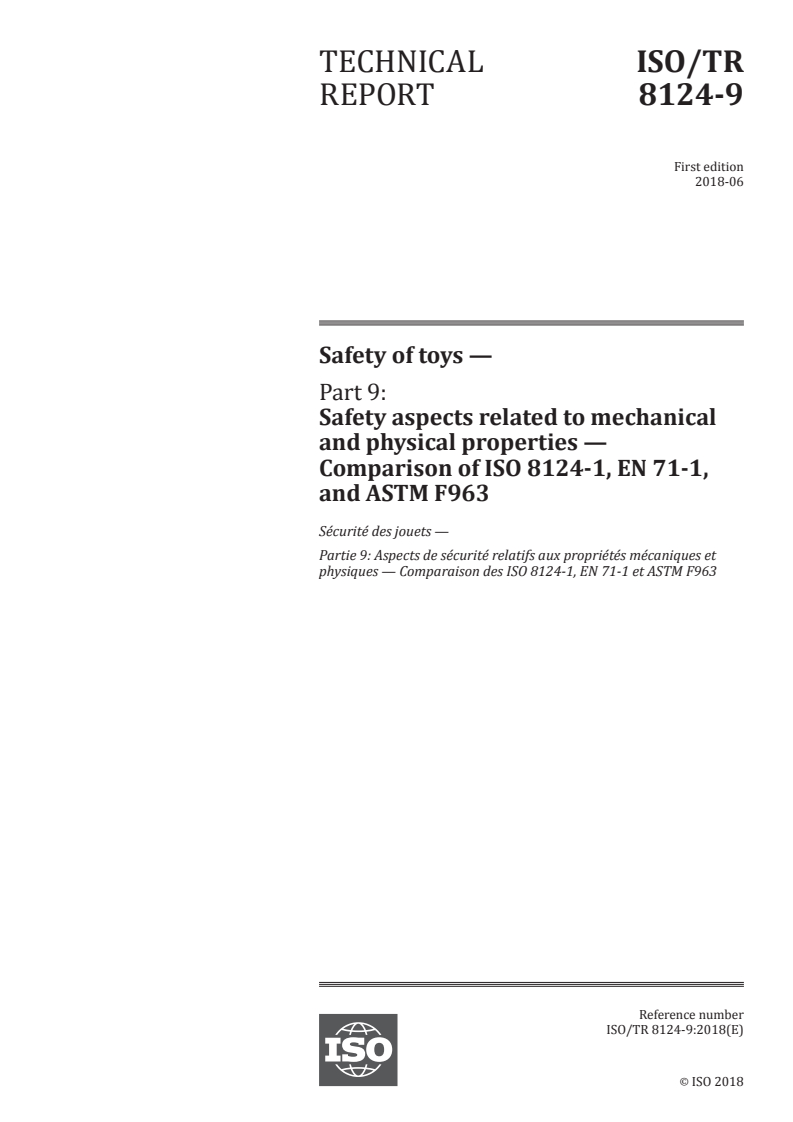
TECHNICAL ISO/TR
REPORT 8124-9
First edition
2018-06
Safety of toys —
Part 9:
Safety aspects related to mechanical
and physical properties —
Comparison of ISO 8124-1, EN 71-1,
and ASTM F963
Sécurité des jouets —
Partie 9: Aspects de sécurité relatifs aux propriétés mécaniques et
physiques — Comparaison des ISO 8124-1, EN 71-1 et ASTM F963
Reference number
©
ISO 2018
© ISO 2018
All rights reserved. Unless otherwise specified, or required in the context of its implementation, no part of this publication may
be reproduced or utilized otherwise in any form or by any means, electronic or mechanical, including photocopying, or posting
on the internet or an intranet, without prior written permission. Permission can be requested from either ISO at the address
below or ISO’s member body in the country of the requester.
ISO copyright office
CP 401 • Ch. de Blandonnet 8
CH-1214 Vernier, Geneva
Phone: +41 22 749 01 11
Fax: +41 22 749 09 47
Email: copyright@iso.org
Website: www.iso.org
Published in Switzerland
ii © ISO 2018 – All rights reserved
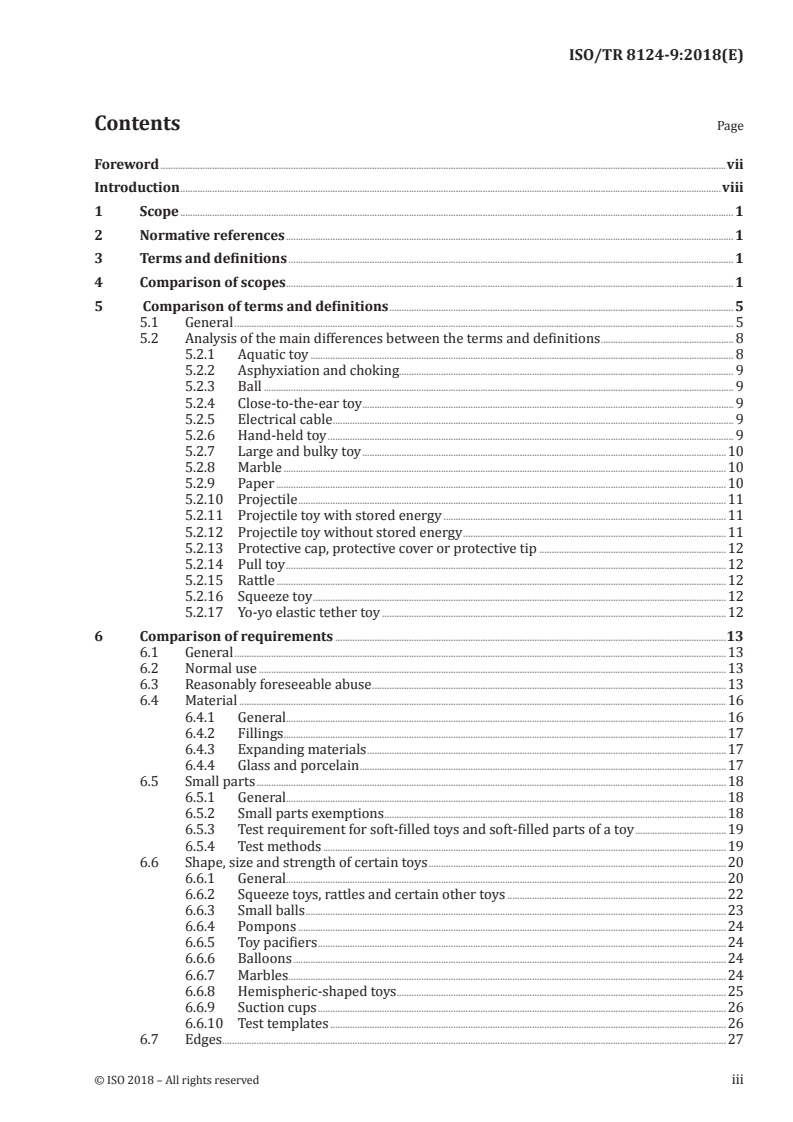
Contents Page
Foreword .vii
Introduction .viii
1 Scope . 1
2 Normative references . 1
3 Terms and definitions . 1
4 Comparison of scopes . 1
5 Comparison of terms and definitions . 5
5.1 General . 5
5.2 Analysis of the main differences between the terms and definitions . 8
5.2.1 Aquatic toy . 8
5.2.2 Asphyxiation and choking. 9
5.2.3 Ball . 9
5.2.4 Close-to-the-ear toy . 9
5.2.5 Electrical cable . 9
5.2.6 Hand-held toy . 9
5.2.7 Large and bulky toy .10
5.2.8 Marble .10
5.2.9 Paper .10
5.2.10 Projectile .11
5.2.11 Projectile toy with stored energy .11
5.2.12 Projectile toy without stored energy .11
5.2.13 Protective cap, protective cover or protective tip .12
5.2.14 Pull toy .12
5.2.15 Rattle .12
5.2.16 Squeeze toy .12
5.2.17 Yo-yo elastic tether toy .12
6 Comparison of requirements .13
6.1 General .13
6.2 Normal use .13
6.3 Reasonably foreseeable abuse .13
6.4 Material .16
6.4.1 General.16
6.4.2 Fillings .17
6.4.3 Expanding materials .17
6.4.4 Glass and porcelain .17
6.5 Small parts .18
6.5.1 General.18
6.5.2 Small parts exemptions .18
6.5.3 Test requirement for soft-filled toys and soft-filled parts of a toy .19
6.5.4 Test methods .19
6.6 Shape, size and strength of certain toys .20
6.6.1 General.20
6.6.2 Squeeze toys, rattles and certain other toys .22
6.6.3 Small balls .23
6.6.4 Pompons .24
6.6.5 Toy pacifiers .24
6.6.6 Balloons .24
6.6.7 Marbles .24
6.6.8 Hemispheric-shaped toys .25
6.6.9 Suction cups .26
6.6.10 Test templates .26
6.7 Edges .27
6.7.1 General.27
6.7.2 Age range for application of the functional sharp edge exemption .28
6.7.3 Toys assembled by adults .28
6.7.4 Test method .28
6.8 Points .29
6.8.1 General.29
6.8.2 Age range for application of the functional sharp point exemption .30
6.8.3 Electrical conductors.30
6.8.4 Accessible, potentially hazardous sharp point in ASTM F963 .30
6.8.5 Test method .30
6.9 Projections .30
6.9.1 General.30
6.9.2 Ends of rigid handlebars .31
6.9.3 Age grade .31
6.9.4 Bath toy projections .31
6.9.5 Protective components .31
6.10 Metal wires and rods .31
6.10.1 General.31
6.10.2 Scope of the metal wires and rods .32
6.10.3 Metal wire flexure test methods .32
6.11 Plastic film or plastic bags in packaging and in toys .33
6.11.1 General.33
6.11.2 Scope of plastic film or plastic bags in packaging and in toys .33
6.11.3 Minimum sheet thickness .33
6.11.4 Thickness of plastic balloons .34
6.11.5 Detached plastic sheeting .34
6.11.6 Perforated plastic film .34
6.11.7 Determination of plastic sheet area .34
6.12 Cords and elastics .35
6.12.1 General.35
6.12.2 Cord thickness .36
6.12.3 Fixed loops of cords or chains .36
6.12.4 Self-retracting cords .36
6.12.5 Toys with cords intended to be strung across a cradle, cot or perambulator .37
6.12.6 Free length of cords .38
6.12.7 Cords and chains on pull-along toys .38
6.12.8 Cords on toy bags .38
6.12.9 Comparison of cords, strings and lines for flying toys .39
6.12.10 Toys with electrical cables .39
6.12.11 Straps intended to be worn fully or partially around the neck .39
6.12.12 Cord warning.39
6.12.13 Test methods .40
6.13 Folding mechanisms .41
6.13.1 General.41
6.13.2 Hinge line clearance .42
6.13.3 Toy pushchairs, perambulators and similar toys .42
6.13.4 Requirement for folding devices having a scissor-like action .43
6.14 Holes, clearances and accessibility of mechanisms .44
6.14.1 General.44
6.14.2 Holes, clearances and accessibility of mechanisms .45
6.14.3 Accessible clearances for moveable segments .45
6.14.4 Chains or belts in ride-on toys .46
6.14.5 Other driving mechanisms .46
6.14.6 Winding keys .46
6.15 Springs .46
6.16 Stability and overload requirements .47
6.16.1 Stability requirements for ride-on toys and seats .47
6.16.2 Overload requirements for ride-on toys and seats .52
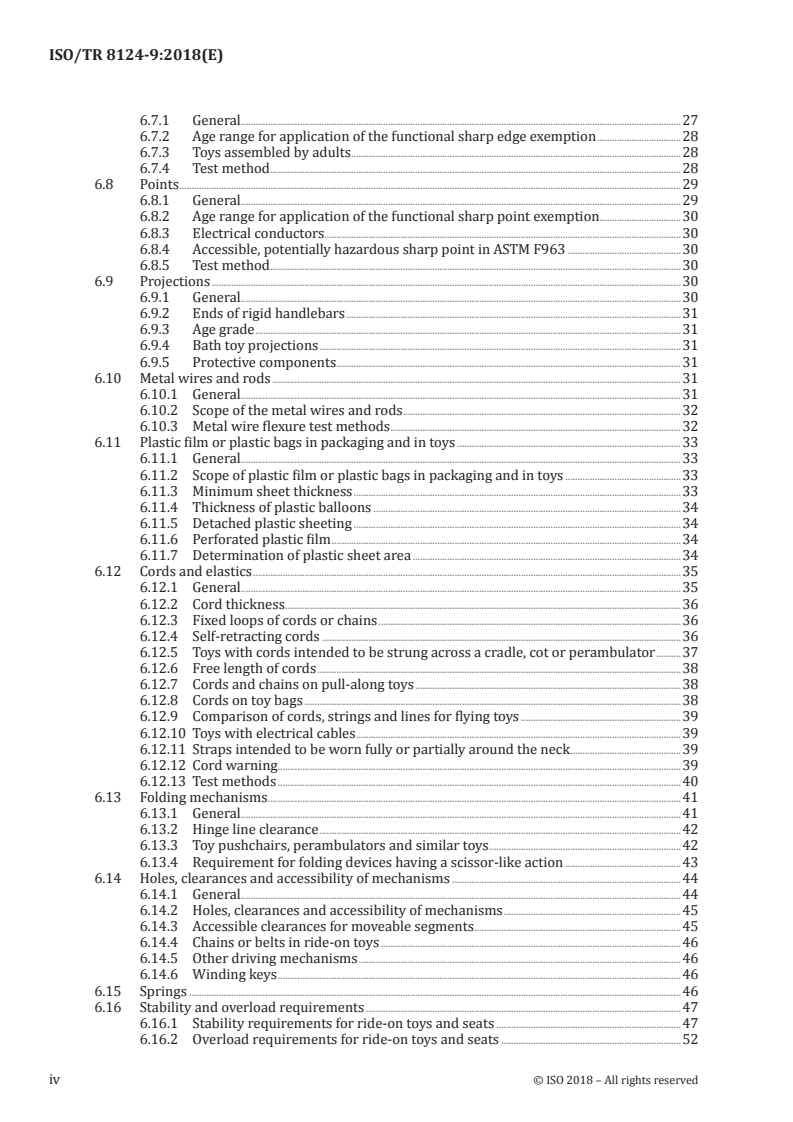
iv © ISO 2018 – All rights reserved
6.16.3 Stability of stationary floor toys .54
6.17 Enclosures .55
6.17.1 General.55
6.17.2 Impermeable material .55
6.17.3 Ventilation .55
6.17.4 Closures .56
6.18 Simulated protective equipment, such as helmets, hats and goggles .56
6.19 Projectile toys .57
6.19.1 General.57
6.19.2 General requirements of projectiles .58
6.19.3 Projectile range .58
6.19.4 Impact surface .59
6.19.5 Discharge mechanism .59
6.19.6 Kinetic energy .59
6.19.7 Arrow .63
6.19.8 Mouth-actuated projectile toys .64
6.19.9 Test method .64
6.20 Rotors and propellers .64
6.21 Aquatic toys .65
6.22 Braking .66
6.22.1 General.66
6.22.2 Braking device . . .66
6.22.3 Free-wheeling facility .67
6.22.4 Brake performance test .67
6.23 Toy bicycles .67
6.23.1 General.67
6.23.2 Braking system .68
6.23.3 Warning .68
6.24 Speed limitation of electrically driven ride-on toys .68
6.24.1 General.68
6.24.2 Seat requirements.69
6.24.3 Determination of maximum design speed of electrically-driven ride-on toys .69
6.25 Toys containing a heat source .70
6.25.1 General.70
6.25.2 Exemption for toys containing a heat source .70
6.25.3 The perspective of toys containing a heat source .71
6.25.4 Temperature rise of heat source .71
6.25.5 Test environment for toys containing a heat source .71
6.26 Liquid-filled toys .71
6.27 Mouth-actuated toys .72
6.28 Toy roller skates, toy inline skates and toy skateboards .72
6.29 Percussion caps .72
6.30 Acoustic requirements .73
6.30.1 General.73
6.30.2 Scope for the acoustic .73
6.30.3 Category .74
6.30.4 Rattle .74
6.30.5 Comparison of the acoustic requirements .74
6.30.6 Test method .74
6.31 Toy scooters .76
6.32 Magnets and magnetic components .77
6.33 Toy-gun marking .79
6.34 Yo-yo elastic tether toys (no reference in ISO 8124-1) .80
6.35 Toys attached to food .80
6.36 Jaw entrapment in handles and steering wheels .80
6.37 Toys comprising monofilament fibres which will cause long hair hazards .81
6.38 Packaging and packaging components (Spherical, egg-shaped or ellipsoidal, and
hemispheric-shaped containers) .81
Annex A (informative) Index of requirements in EN 71-1 .82
Annex B (informative) Index of requirements in ASTM F963 .92
Bibliography .100
vi © ISO 2018 – All rights reserved
Foreword
ISO (the International Organization for Standardization) is a worldwide federation of national standards
bodies (ISO member bodies). The work of preparing International Standards is normally carried out
through ISO technical committees. Each member body interested in a subject for which a technical
committee has been established has the right to be represented on that committee. International
organizations, governmental and non-governmental, in liaison with ISO, also take part in the work.
ISO collaborates closely with the International Electrotechnical Commission (IEC) on all matters of
electrotechnical standardization.
The procedures used to develop this document and those intended for its further maintenance are
described in the ISO/IEC Directives, Part 1. In particular the different approval criteria needed for the
different types of ISO documents should be noted. This document was drafted in accordance with the
editorial rules of the ISO/IEC Directives, Part 2 (see www .iso .org/directives).
Attention is drawn to the possibility that some of the elements of this document may be the subject of
patent rights. ISO shall not be held responsible for identifying any or all such patent rights. Details of
any patent rights identified during the development of the document will be in the Introduction and/or
on the ISO list of patent declarations received (see www .iso .org/patents).
Any trade name used in this document is information given for the convenience of users and does not
constitute an endorsement.
For an explanation of the voluntary nature of standards, the meaning of ISO specific terms and
expressions related to conformity assessment, as well as information about ISO's adherence to the
World Trade Organization (WTO) principles in the Technical Barriers to Trade (TBT) see the following
URL: www .iso .org/iso/foreword .html.
This document was prepared by Technical Committee ISO/TC 181, Safety of toys.
A list of all parts in the ISO 8124 series can be found on the ISO website.
Any feedback or questions on this document should be directed to the user’s national standards body. A
complete listing of these bodies can be found at www .iso .org/members .html.
Introduction
The purpose of this document is to compare and contrast the identified versions of ASTM F963: 2011,
EN 71-1:2014 and ISO 8124-1:2014. This document focuses on the contents of these three referenced
standards as they relate to mechanical and physical properties including scope, definitions, general
requirements, warnings and test methods.
For ease of use and readability, ISO 8124-1:2014, Clause 4 is listed in Clause 6 of this document. For
example, ISO 8124-1:2014, 4.3 relates to 6.4 of this document.
This document is an overview and, therefore, do not cover the entirety of all the differences among
ISO 8124-1, ASTM F963 and EN 71-1. In addition, this document is not to be relied on to fully understand
conformance with any of the referenced standards or the requirements within them. In the case of
any discrepancies in the comparisons presented, please refer to the relevant clauses of the referenced
standards.
The index of requirements in EN 71-1 is given in Annex A.
The index of requirements in ASTM F963 is given in Annex B.
viii © ISO 2018 – All rights reserved
TECHNICAL REPORT ISO/TR 8124-9:2018(E)
Safety of toys —
Part 9:
Safety aspects related to mechanical and physical
properties — Comparison of ISO 8124-1, EN 71-1, and
ASTM F963
1 Scope
This document consists of a comparison of the mechanical and physical requirements covered by the
following toy safety standards:
a) ISO: ISO 8124-1:2014;
b) Europe (CEN): EN 71-1:2014;
c) USA: ASTM F963: 2011.
2 Normative references
There are no normative references in this document.
3 Terms and definitions
No terms and definitions are listed in this document.
ISO and IEC maintain terminological databases for use in standardization at the following addresses:
— ISO Online browsing platform: available at https: //www .iso .org/obp
— IEC Electropedia: available at http: //www .electropedia .org/
4 Comparison of scopes
The scope of applicable toy products covered by the referenced standards is generally similar, as shown
in Table 1.
Table 1 — Scope
ISO 8124-1:2014 EN 71-1:2014 A S T M F 9 6 3: 2011
The requirements in this part of This European Standard applies This specification covers require-
ISO 8124-1 apply to all toys, i.e. any to toys for children, toys being any ments and contains test methods
product or material designed or product or material designed or for toys intended for use by children
clearly intended for use in play by intended, whether or not exclusive- under 14 years of age.
children under 14 years of age. ly, for use in play by children of less
than 14 years.
NOTE “The words “whether or not
exclusively” have been added to the
definition to indicate that the prod-
uct does not have to be exclusively in-
tended for playing purposes in order
for it to be considered as a toy, but it
can have other functions as well. For
example, a key-ring with a teddy bear
attached to it is considered as a toy,
or a sleeping bag in the shape of a
soft filled toy.”
Table 2 illustrates the differences in the product types which are exempted from the scope of each
standard.
Table 2 — Exemptions
ISO 8124-1:2014 EN 71-1:2014 A S T M F 9 6 3: 2011
Bicycles, except for those consid- Bicycles with a maximum saddle Bicycles
ered to be toys, i.e. those having a height of more than 435 mm, meas-
maximum saddle height of 435 mm. ured as the vertical distance from
the ground to the top of the seat
surface, with the seat in a horizon-
tal position and with the seat pillar
set to the minimum insertion mark
(see NOTE 1)
Slingshots Slings and catapults Sling shots
Items that are propelled into free
flight by a child releasing an elas-
tic band (e.g. Aeroplanes and rock-
ets) are considered as catapults
(see NOTE 2)
Darts with metal points; Products and games using Sharp-pointed darts
sharp-pointed missiles, such as
sets of darts with metallic points
(see NOTE 1)
Home and public playground Playground equipment intended for Playground equipment
equipment public use (seeNOTE 2)
Compressed air- and gas-operated Guns and pistols using compressed Non-powder guns
guns and pistols gas, with the exception of water
guns and water pistols (see NOTE 1)
Kites (except for the electric re- — Kites (except for electric resistance
sistance of their strings, which is of kite strings and hand-held lines
included) over 6 ft (1,8 m) long, attached to
flying devices intended for use as
playthings)
NOTE 1 For the purpose of EN 71-1, these product types are not considered as toys. There are guidance documents issued
by CEN to assist in the classification of toys.
NOTE 2 EN 71-1 does not apply to these toys.
2 © ISO 2018 – All rights reserved
Table 2 (continued)
ISO 8124-1:2014 EN 71-1:2014 A S T M F 9 6 3: 2011
Model kits, hobby and craft items, — Hobby and craft items in which the
in which the finished item is not finished item is not primarily of
primarily of play value. play value
Model kits in which the finished
item is not primarily of play value
Sporting goods and equipment, — Sporting goods, camping goods,
camping goods, athletic equipment, athletic equipment, musical in-
musical instruments and furniture; struments, juvenile products, and
however, toys which are their coun- furniture.
terparts are included.
However, toys that are their coun-
terparts are covered.
Models of aircraft, rockets, boats Toy vehicles equipped with combus- Powered models of aircraft, rockets,
and land vehicles powered by tion engines (see NOTE 2) boats, and land vehicles; however,
combustion engines; however, toys toys that are their counterparts are
which are their counterparts are covered.
included.
Collectible products not intended Products for collectors, provided —
for children under 14 years of age. that the product or its packaging
bears a visible and legible indication
that it is intended for collectors of
14 years of age and above. Examples
of this category are:
— detailed and faithful scale mod-
els;
— kits for the assembly of detailed;
— Scale models;
— folk dolls and decorative dolls
and other similar articles;
— historical replicas of toys.
Holiday decorations that are pri- Decorative objects for festivities —
marily intended for ornamental and celebrations (see NOTE 1)
purposes.
Aquatic equipment intended to Aquatic equipment intended to be —
be used in deep water, swim- used in deep water, and swimming
ming-learning devices and flotation learning devices for children, such
aids for children such as swim-seats as swim seats and swimming aids
and swim-aids. (see NOTE 1)
Toys installed in public places (e.g. Automatic playing machines, —
Arcades and shopping centres) whether coin operated or not, in-
tended for public use (see NOTE 2)
Puzzles having more than 500 Puzzles with more than 500 pieces —
pieces or without a picture, for (see NOTE 1)
specialists
Fireworks including percussion Fireworks, including percussion —
caps, except percussion caps specif- caps which are not specifically de-
ically designed for toy signed for toys (see NOTE 1)
NOTE 1 For the purpose of EN 71-1, these product types are not considered as toys. There are guidance documents issued
by CEN to assist in the classification of toys.
NOTE 2 EN 71-1 does not apply to these toys.
Table 2 (continued)
ISO 8124-1:2014 EN 71-1:2014 A S T M F 9 6 3: 2011
Products containing heating ele- Products intended for use for educa- —
ments intended for use under the tional purposes in schools and other
supervision of an adult in a teach- pedagogical contexts under the sur-
ing context veillance of an adult instructor, such
as science equipment (see NOTE 1)
Steam engines Toy steam engines (see NOTE 2) —
Video toys that can be connected — —
to a video screen and operated at a
nominal voltage greater than 24 V
Babies’ pacifiers (dummies) Babies' soothers (see NOTE 1) —
Faithful reproduction of firearm Reproductions of real fire arms —
(see NOTE 1)
Electric ovens, irons or other Functional educational products, —
functional products operated at a such as electric ovens, irons or
nominal voltage greater than 24 V other functional products, as de-
fined in 2009/48/EC, operated at
a nominal voltage exceeding 24 V
which are sold exclusively for teach-
ing purposes under adult supervi-
sion (see NOTE 1)
Bows for archery with an overall Bows for archery over 120 cm long —
relaxed length exceeding 120 cm (see NOTE 1)
Fashion jewellery for children Fashion accessories for children —
which are not for use in play (see
NOTE 1)
— Sports equipment including roller —
skates, inline skates, and skate-
boards intended for children with
a body mass of more than 20 kg
(see NOTE 1)
— Scooters and other means of trans- —
port designed for sport or which are
intended to be used for travel on
public roads or public pathways
— Electrically driven vehicles which —
are intended to be used for travel
on public roads, public pathways, or
the pavement thereof (see NOTE 1)
— Electronic equipment, such as per- —
sonal computers and game consoles,
used to access interactive software
and their associated peripherals,
unless the electronic equipment or
the associated peripherals are spe-
cifically designed for and targeted
at children and have a play value
on their own, such as specially
designed personal computers,
key boards, joy sticks or steering
wheels (see NOTE 1)
NOTE 1 For the purpose of EN 71-1, these product types are not considered as toys. There are guidance documents issued
by CEN to assist in the classification of toys.
NOTE 2 EN 71-1 does not apply to these toys.
4 © ISO 2018 – All rights reserved
Table 2 (continued)
ISO 8124-1:2014 EN 71-1:2014 A S T M F 9 6 3: 2011
— Interactive software, intended for —
leisure and entertainment, such as
computer games, and their storage
media, such as cds (see NOTE 1)
— Child-appealing luminaires (see —
NOTE 1)
— Electrical transformers for toys —
(see NOTE 1)
— Personal protective equipment, —
including flotation aids such as arm
bands and swim seats; and swim-
ming goggles, sunglasses
...
Questions, Comments and Discussion
Ask us and Technical Secretary will try to provide an answer. You can facilitate discussion about the standard in here.
Loading comments...