

ISO 384:2015
(Main)Laboratory glass and plastics ware — Principles of design and construction of volumetric instruments
General Information
- Abstract
ISO 384:2015 sets out principles for the design of volumetric instruments manufactured from glass or from plastics in order to facilitate the most reliable and convenient use to the intended degree of accuracy.
- Status
- Published
- Publication Date
- 06-Dec-2015
- Technical Committee
- ISO/TC 48 - Laboratory equipment
- Drafting Committee
- ISO/TC 48 - Laboratory equipment
- Current Stage
- 9060 - Close of review
- Completion Date
- 02-Sep-2031
Buy Documents

ISO 384:2015 - Laboratory glass and plastics ware -- Principles of design and construction of volumetric instruments

ISO 384:2015 - Laboratory glass and plastics ware — Principles of design and construction of volumetric instruments/7/2015

ISO 384:2015 - Matériel de laboratoire en verre ou en plastique -- Principes de conception et de construction d'instruments volumétriques

ISO 384:2015 - Matériel de laboratoire en verre ou en plastique — Principes de conception et de construction d'instruments volumétriques/7/2015
Overview
ISO 384:2015 - Laboratory glass and plastics ware - Principles of design and construction of volumetric instruments defines the design principles that make volumetric instruments (glass or plastic) reliable, convenient and accurate for laboratory use. The standard sets out requirements for material selection, dimensional design, graduation and marking, accuracy classes, calibration reference conditions and construction details to ensure consistent performance of pipettes, burettes, volumetric flasks and similar volumetric instruments.
Key topics and technical requirements
- Scope and materials: Applies to volumetric instruments manufactured from glass or suitable plastics; instruments should be free from visible defects and internal stress and be chemically and thermally appropriate for intended use.
- Reference conditions: The unit of volume is the millilitre (ml = cm3). The standard reference temperature is 20 °C (27 °C permitted where nationally adopted); temperature influences capacity and must be considered at calibration.
- Accuracy classes: Defines accuracy classes A (and AS) for higher-grade instruments and B for lower-grade instruments. Maximum permissible error (MPE) must be specified per instrument, class and application.
- Permissible error and sizing: MPE values are linked to instrument geometry - notably the internal diameter at the graduation line (D) - and are set from preferred numerical series to ensure reasonable progression with capacity. For scaled instruments, the MPE must not exceed the volume equivalent of the smallest scale division.
- Calibration and testing: Calibration and use methods reference ISO 4787; the standard promotes gravimetric volume determination (mass of water corrected for buoyancy and density). Plastic instruments typically require more frequent recalibration due to lower long‑term stability.
- Construction and features: Guidance on wall thickness, preferred circular cross‑section, stability (flat bases), delivery jets (smooth taper, finishes), stoppers and stopcocks (materials, tapers, interchangeability) and limits on inner diameter to control accuracy.
- Graduation, scales and marking: Specifies spacing, line figure sizing, visibility and marking conventions to ensure readable and reproducible volumetric readings.
Applications and users
ISO 384:2015 is essential for:
- Laboratories (analytical, clinical, educational) selecting or specifying pipettes, burettes, volumetric flasks and dispensers
- Manufacturers designing and producing laboratory glassware and plastic volumetric instruments
- Quality and calibration laboratories performing acceptance testing and routine calibration
- Procurement and regulatory professionals who need standardized specifications for traceability and compliance
Using ISO 384 helps ensure accurate liquid measurement, repeatability, safer lab practices and interoperability across suppliers.
Related standards
- ISO 4787 - Volumetric instruments: methods for testing of capacity and for use (calibration)
- ISO 383 - Interchangeable conical ground joints
- ISO/IEC Guide 99 (VIM) - Metrology vocabulary
- Related product standards referenced in the ISO 384 development: ISO 1042, ISO 648, ISO 835, ISO 385, ISO 4788
Keywords: ISO 384:2015, volumetric instruments, laboratory glassware, plastic volumetric instruments, calibration, volumetric accuracy, reference temperature, graduation lines.
Relations
- Effective Date
- 12-Feb-2026
- Effective Date
- 06-Jun-2022
- Revises
ISO 384:1978 - Laboratory glassware — Principles of design and construction of volumetric glassware - Effective Date
- 04-May-2013
Buy Documents
ISO 384:2015 - Laboratory glass and plastics ware -- Principles of design and construction of volumetric instruments
ISO 384:2015 - Laboratory glass and plastics ware — Principles of design and construction of volumetric instruments/7/2015
ISO 384:2015 - Matériel de laboratoire en verre ou en plastique -- Principes de conception et de construction d'instruments volumétriques
ISO 384:2015 - Matériel de laboratoire en verre ou en plastique — Principes de conception et de construction d'instruments volumétriques/7/2015
Get Certified
Connect with accredited certification bodies for this standard

BSMI (Bureau of Standards, Metrology and Inspection)
Taiwan's standards and inspection authority.
Sponsored listings
Frequently Asked Questions
ISO 384:2015 is a standard published by the International Organization for Standardization (ISO). Its full title is "Laboratory glass and plastics ware — Principles of design and construction of volumetric instruments". This standard covers: ISO 384:2015 sets out principles for the design of volumetric instruments manufactured from glass or from plastics in order to facilitate the most reliable and convenient use to the intended degree of accuracy.
ISO 384:2015 sets out principles for the design of volumetric instruments manufactured from glass or from plastics in order to facilitate the most reliable and convenient use to the intended degree of accuracy.
ISO 384:2015 is classified under the following ICS (International Classification for Standards) categories: 17.060 - Measurement of volume, mass, density, viscosity. The ICS classification helps identify the subject area and facilitates finding related standards.
ISO 384:2015 has the following relationships with other standards: It is inter standard links to EN ISO 384:2015, ISO 17356-4:2005, ISO 384:1978. Understanding these relationships helps ensure you are using the most current and applicable version of the standard.
ISO 384:2015 is available in PDF format for immediate download after purchase. The document can be added to your cart and obtained through the secure checkout process. Digital delivery ensures instant access to the complete standard document.
Standards Content (Sample)
INTERNATIONAL ISO
STANDARD 384
Second edition
2015-12-15
Laboratory glass and plastics ware —
Principles of design and construction
of volumetric instruments
Matériel de laboratoire en verre ou en plastique — Principes de
conception et de construction d’instruments volumétriques
Reference number
©
ISO 2015
© ISO 2015, Published in Switzerland
All rights reserved. Unless otherwise specified, no part of this publication may be reproduced or utilized otherwise in any form
or by any means, electronic or mechanical, including photocopying, or posting on the internet or an intranet, without prior
written permission. Permission can be requested from either ISO at the address below or ISO’s member body in the country of
the requester.
ISO copyright office
Ch. de Blandonnet 8 • CP 401
CH-1214 Vernier, Geneva, Switzerland
Tel. +41 22 749 01 11
Fax +41 22 749 09 47
copyright@iso.org
www.iso.org
ii © ISO 2015 – All rights reserved
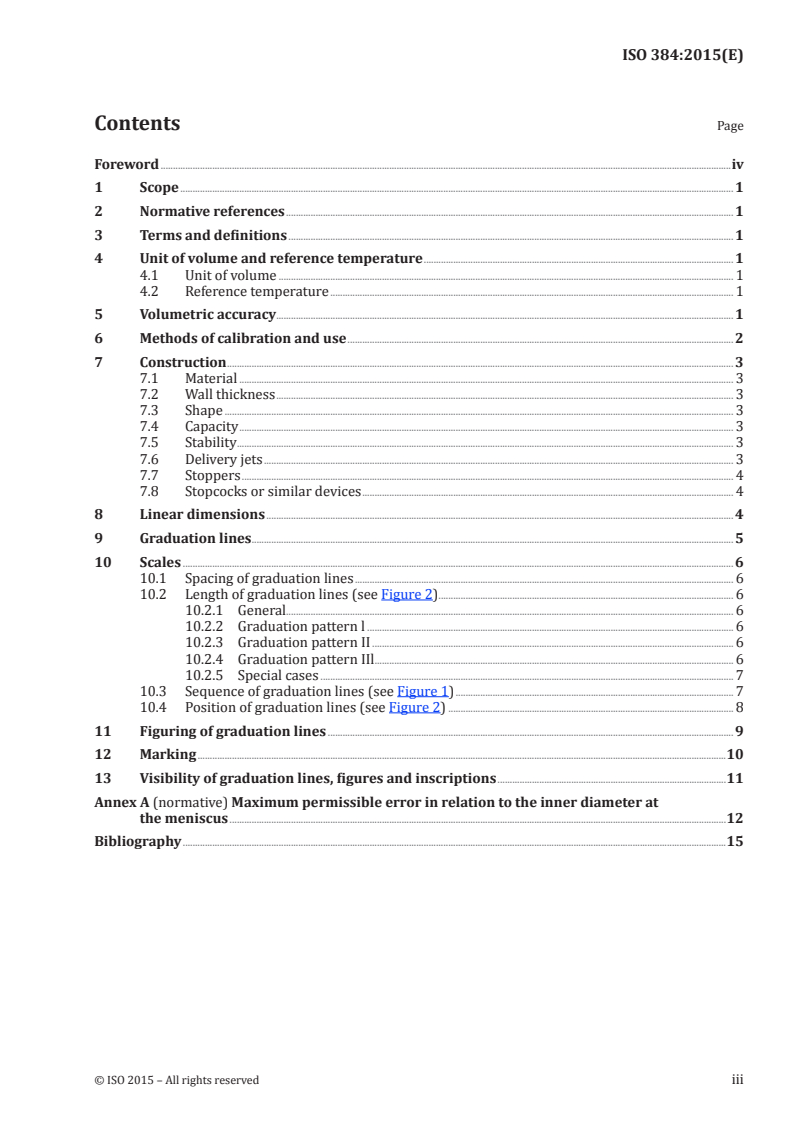
Contents Page
Foreword .iv
1 Scope . 1
2 Normative references . 1
3 Terms and definitions . 1
4 Unit of volume and reference temperature . 1
4.1 Unit of volume . 1
4.2 Reference temperature . 1
5 Volumetric accuracy. 1
6 Methods of calibration and use . 2
7 Construction . 3
7.1 Material . 3
7.2 Wall thickness . 3
7.3 Shape . 3
7.4 Capacity . 3
7.5 Stability . 3
7.6 Delivery jets . 3
7.7 Stoppers . 4
7.8 Stopcocks or similar devices . 4
8 Linear dimensions . 4
9 Graduation lines . 5
10 Scales . 6
10.1 Spacing of graduation lines . 6
10.2 Length of graduation lines (see Figure 2) . 6
10.2.1 General. 6
10.2.2 Graduation pattern l . 6
10.2.3 Graduation pattern II . 6
10.2.4 Graduation pattern IIl . . 6
10.2.5 Special cases . 7
10.3 Sequence of graduation lines (see Figure 1) . 7
10.4 Position of graduation lines (see Figure 2) . 8
11 Figuring of graduation lines . 9
12 Marking .10
13 Visibility of graduation lines, figures and inscriptions .11
Annex A (normative) Maximum permissible error in relation to the inner diameter at
the meniscus .12
Bibliography .15
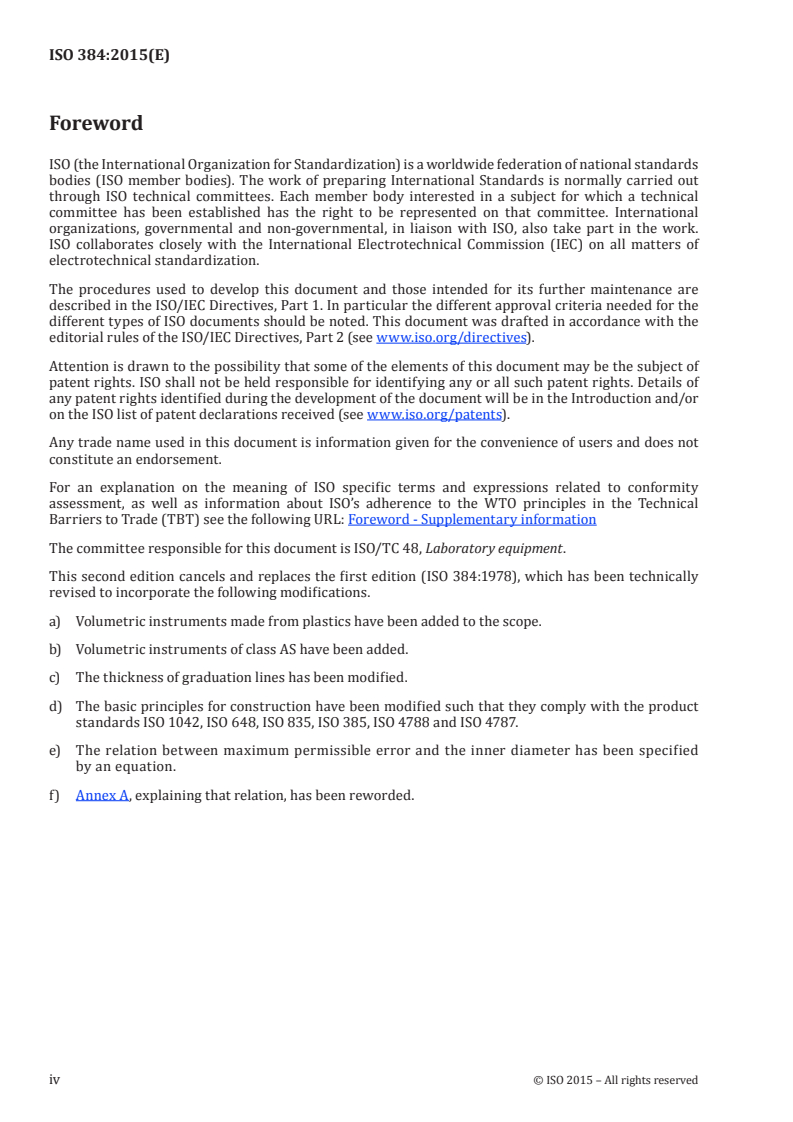
Foreword
ISO (the International Organization for Standardization) is a worldwide federation of national standards
bodies (ISO member bodies). The work of preparing International Standards is normally carried out
through ISO technical committees. Each member body interested in a subject for which a technical
committee has been established has the right to be represented on that committee. International
organizations, governmental and non-governmental, in liaison with ISO, also take part in the work.
ISO collaborates closely with the International Electrotechnical Commission (IEC) on all matters of
electrotechnical standardization.
The procedures used to develop this document and those intended for its further maintenance are
described in the ISO/IEC Directives, Part 1. In particular the different approval criteria needed for the
different types of ISO documents should be noted. This document was drafted in accordance with the
editorial rules of the ISO/IEC Directives, Part 2 (see www.iso.org/directives).
Attention is drawn to the possibility that some of the elements of this document may be the subject of
patent rights. ISO shall not be held responsible for identifying any or all such patent rights. Details of
any patent rights identified during the development of the document will be in the Introduction and/or
on the ISO list of patent declarations received (see www.iso.org/patents).
Any trade name used in this document is information given for the convenience of users and does not
constitute an endorsement.
For an explanation on the meaning of ISO specific terms and expressions related to conformity
assessment, as well as information about ISO’s adherence to the WTO principles in the Technical
Barriers to Trade (TBT) see the following URL: Foreword - Supplementary information
The committee responsible for this document is ISO/TC 48, Laboratory equipment.
This second edition cancels and replaces the first edition (ISO 384:1978), which has been technically
revised to incorporate the following modifications.
a) Volumetric instruments made from plastics have been added to the scope.
b) Volumetric instruments of class AS have been added.
c) The thickness of graduation lines has been modified.
d) The basic principles for construction have been modified such that they comply with the product
standards ISO 1042, ISO 648, ISO 835, ISO 385, ISO 4788 and ISO 4787.
e) The relation between maximum permissible error and the inner diameter has been specified
by an equation.
f) Annex A, explaining that relation, has been reworded.
iv © ISO 2015 – All rights reserved
INTERNATIONAL STANDARD ISO 384:2015(E)
Laboratory glass and plastics ware — Principles of design
and construction of volumetric instruments
1 Scope
This International Standard sets out principles for the design of volumetric instruments manufactured
from glass or from plastics in order to facilitate the most reliable and convenient use to the intended
degree of accuracy.
2 Normative references
The following documents, in whole or in part, are normatively referenced in this document and are
indispensable for its application. For dated references, only the edition cited applies. For undated
references, the latest edition of the referenced document (including any amendments) applies.
ISO 383, Laboratory glassware — Interchangeable conical ground joints
ISO 4787, Laboratory glassware — Volumetric instruments — Methods for testing of capacity and for use
ISO/IEC Guide 99, International vocabulary of metrology — Basic and general concepts and associated
terms (VIM)
3 Terms and definitions
For the purposes of this document, the terms and definitions given in ISO/IEC Guide 99 apply.
4 Unit of volume and reference temperature
4.1 Unit of volume
The unit of volume shall be the millilitre (ml), which is equivalent to one cubic centimetre (cm ).
4.2 Reference temperature
The standard reference temperature, i.e. the temperature at which the volumetric instrument is
intended to contain or deliver its volume (capacity), shall be 20 °C.
When the volumetric instrument is required for use in a country which has adopted a standard
reference temperature of 27 °C, this figure shall be substituted for 20 °C.
NOTE The capacity of volumetric instruments varies with change of temperature. A volumetric instrument
which was adjusted at 20 °C, but used at 27 °C or vice versa, would show an extra error of only 0,007 % if it is
−6 −1
made of borosilicate glass having a coefficient of cubic thermal expansion of 9,9 × 10 °C and of 0,02 % if it is
−6 −1
made of soda-lime glass having a coefficient of cubic thermal expansion of 27 × 10 °C . These errors are smaller
than the limits of error for most volumetric instruments. It follows, therefore, that the reference temperature is
of minor importance in practical use when dealing with glassware. However, when performing calibrations, it is
important to refer to the reference temperature, especially when considering volumetric plastic ware.
5 Volumetric accuracy
5.1 There are two classes of accuracy:
— the higher grade shall be designated “class A” or “class AS”;
— the lower grade shall be designated “class B”.
5.2 The maximum permissible error shall be specified for each type of volumetric instrument in regard
to the method and purpose of use and the class of accuracy.
5.3 The numerical values of maximum permissible error for volumetric instruments for general
purposes shall be preferably chosen from the series 10 – 12 – 15 – 20 –25 – 30 – 40 – 50 – 60 – 80, or a
suitable decimal multiple thereof.
NOTE This series of preferred numbers has been adopted because decimal sub-multiples of some of the
unrounded numbers, for example 31,5, would appear to imply a degree of precision which is not intended and
which could not be measured in practice.
5.4 The maximum permissible error specified for a series of sizes of a volumetric instrument should
provide a reasonably uniform progression in relation to capacity.
5.5 The maximum permissible error permitted for class B should, in general, be approximately twice
as permitted for class A or AS.
5.6 For volumetric instruments having a scale, the maximum permissible error for either class of
accuracy shall not exceed the volume equivalent (see Annex A) of the smallest scale division.
5.7 The maximum permissible error MPE for class A or AS depends on the internal diameter D (in
millimetres) at the related graduation line and shall not be smaller than derived by Formula (1):
π
MPE≥+DD(,04 00,)1 (1)
The corresponding class B limit shall be derived in accordance with 5.5.
NOTE The above formula applies for the most common volumetric instruments which have a circular cross-
section, but may be transferred to non-circular cross-sections as well. See Annex A.
5.8 In addition to 5.7, the maximum permissible error specified for any volumetric instrument designed
to deliver shall also be not less than four times the standard deviation determined experimentally by an
experienced operator from a series of at least 10 consecutive determinations of delivered capacity on
the same volumetric instrument, carried out strictly in accordance with the method specified for this
volumetric instrument in ISO 4787.
6 Methods of calibration and use
The method of calibration and use for each type of volumetric instrument is extensively described in
ISO 4787.
The general procedure is based upon a gravimetric determination of the volume of water, either
contained in or delivered by the volumetric instrument under test. This volume of water is calculated
from its mass under consideration of air buoyancy and water density.
Volumetric instruments manufactured from plastics should be considered to be calibrated more often
than glass instruments, because of the lower long-term stability of plastic instruments.
2 © ISO 2015 – All rights reserved
7 Construction
7.1 Material
Volumetric instruments shall be constructed of glass or plastic of suitable chemical and thermal
properties. They shall be as free as possible from visible defects and shall be reasonably free from
internal stress.
7.2 Wall thickness
The volumetric instruments shall be sufficiently robust in construction to withstand usual laboratory
usage and the wall thickness shall show no gross departure from uniformity.
7.3 Shape
All volumetric instruments shall be of a shape which will facilitate the intended use, and should
preferably be of circular cross-section.
7.4 Capacity
7.4.1 The numerical values of capacity of volumetric instruments for general purposes should
preferably be chosen from the series 10 – 20 – 25 – 50, or a decimal multiple or sub-multiple thereof.
The capacity of volumetric instruments for special applications may have differing values; there are e.g.
pipettes with capacities of 3 ml to 9 ml.
7.4.2 The numerical value of the volume equivalents of the smallest division on volumetric instruments
having a scale shall be chosen from the series 1 – 2 – 5, or a decimal multiple or sub-multiple thereof.
7.4.3 In the case of a special purpose volumetric instrument which is to be graduated for direct reading
of capacity when used with a specific liquid other than water, the specification should preferably indicate
the corresponding capacity when used with pure water, so that the latter can be used for calibration.
7.5 Stability
Volumetric instruments provided with a flat base shall stand vertically without rocking or spinning
when placed on a level surface and, unless specified otherwise, the axis of the graduated portion of the
vessel should be vertical.
7.6 Delivery jets
7.6.1 Delivery jets at the lower end of volumetric instruments should be strongly constructed either
with a smooth and gradual taper or a capillary end, both without sudden constriction at the orifice which
could give rise to turbulent outflow.
7.6.2 The end of the jet shall be finished by one of the methods listed below in order of preference:
a) hot finished square with the axis, slightly bevelled on the outside and polished;
b) smoothly ground square with the axis and optionally fire-polished;
c) cut square with the axis and polished.
A fire-polished finish of glass jets reduces the danger of chipping in use, but should not result in sudden
constriction or in undue stress.
7.6.3 The jet shall be made either from glass tubing or from suitable plastics material. It shall preferably
form an integral part of the volumetric instrument. Otherwise, the jet shall be clearly identified to link it
to the related volumetric instrument or, if sufficient, to the nominal size of the volumetric instrument.
7.7 Stoppers
7.7.1 Glass stoppers should preferably be ground so as to be interchangeable, in which case the ground
portions shall comply with ISO
...
INTERNATIONAL ISO
STANDARD 384
Second edition
2015-12-15
Laboratory glass and plastics ware —
Principles of design and construction
of volumetric instruments
Matériel de laboratoire en verre ou en plastique — Principes de
conception et de construction d’instruments volumétriques
Reference number
©
ISO 2015
© ISO 2015, Published in Switzerland
All rights reserved. Unless otherwise specified, no part of this publication may be reproduced or utilized otherwise in any form
or by any means, electronic or mechanical, including photocopying, or posting on the internet or an intranet, without prior
written permission. Permission can be requested from either ISO at the address below or ISO’s member body in the country of
the requester.
ISO copyright office
Ch. de Blandonnet 8 • CP 401
CH-1214 Vernier, Geneva, Switzerland
Tel. +41 22 749 01 11
Fax +41 22 749 09 47
copyright@iso.org
www.iso.org
ii © ISO 2015 – All rights reserved
Contents Page
Foreword .iv
1 Scope . 1
2 Normative references . 1
3 Terms and definitions . 1
4 Unit of volume and reference temperature . 1
4.1 Unit of volume . 1
4.2 Reference temperature . 1
5 Volumetric accuracy. 1
6 Methods of calibration and use . 2
7 Construction . 3
7.1 Material . 3
7.2 Wall thickness . 3
7.3 Shape . 3
7.4 Capacity . 3
7.5 Stability . 3
7.6 Delivery jets . 3
7.7 Stoppers . 4
7.8 Stopcocks or similar devices . 4
8 Linear dimensions . 4
9 Graduation lines . 5
10 Scales . 6
10.1 Spacing of graduation lines . 6
10.2 Length of graduation lines (see Figure 2) . 6
10.2.1 General. 6
10.2.2 Graduation pattern l . 6
10.2.3 Graduation pattern II . 6
10.2.4 Graduation pattern IIl . . 6
10.2.5 Special cases . 7
10.3 Sequence of graduation lines (see Figure 1) . 7
10.4 Position of graduation lines (see Figure 2) . 8
11 Figuring of graduation lines . 9
12 Marking .10
13 Visibility of graduation lines, figures and inscriptions .11
Annex A (normative) Maximum permissible error in relation to the inner diameter at
the meniscus .12
Bibliography .15
Foreword
ISO (the International Organization for Standardization) is a worldwide federation of national standards
bodies (ISO member bodies). The work of preparing International Standards is normally carried out
through ISO technical committees. Each member body interested in a subject for which a technical
committee has been established has the right to be represented on that committee. International
organizations, governmental and non-governmental, in liaison with ISO, also take part in the work.
ISO collaborates closely with the International Electrotechnical Commission (IEC) on all matters of
electrotechnical standardization.
The procedures used to develop this document and those intended for its further maintenance are
described in the ISO/IEC Directives, Part 1. In particular the different approval criteria needed for the
different types of ISO documents should be noted. This document was drafted in accordance with the
editorial rules of the ISO/IEC Directives, Part 2 (see www.iso.org/directives).
Attention is drawn to the possibility that some of the elements of this document may be the subject of
patent rights. ISO shall not be held responsible for identifying any or all such patent rights. Details of
any patent rights identified during the development of the document will be in the Introduction and/or
on the ISO list of patent declarations received (see www.iso.org/patents).
Any trade name used in this document is information given for the convenience of users and does not
constitute an endorsement.
For an explanation on the meaning of ISO specific terms and expressions related to conformity
assessment, as well as information about ISO’s adherence to the WTO principles in the Technical
Barriers to Trade (TBT) see the following URL: Foreword - Supplementary information
The committee responsible for this document is ISO/TC 48, Laboratory equipment.
This second edition cancels and replaces the first edition (ISO 384:1978), which has been technically
revised to incorporate the following modifications.
a) Volumetric instruments made from plastics have been added to the scope.
b) Volumetric instruments of class AS have been added.
c) The thickness of graduation lines has been modified.
d) The basic principles for construction have been modified such that they comply with the product
standards ISO 1042, ISO 648, ISO 835, ISO 385, ISO 4788 and ISO 4787.
e) The relation between maximum permissible error and the inner diameter has been specified
by an equation.
f) Annex A, explaining that relation, has been reworded.
iv © ISO 2015 – All rights reserved
INTERNATIONAL STANDARD ISO 384:2015(E)
Laboratory glass and plastics ware — Principles of design
and construction of volumetric instruments
1 Scope
This International Standard sets out principles for the design of volumetric instruments manufactured
from glass or from plastics in order to facilitate the most reliable and convenient use to the intended
degree of accuracy.
2 Normative references
The following documents, in whole or in part, are normatively referenced in this document and are
indispensable for its application. For dated references, only the edition cited applies. For undated
references, the latest edition of the referenced document (including any amendments) applies.
ISO 383, Laboratory glassware — Interchangeable conical ground joints
ISO 4787, Laboratory glassware — Volumetric instruments — Methods for testing of capacity and for use
ISO/IEC Guide 99, International vocabulary of metrology — Basic and general concepts and associated
terms (VIM)
3 Terms and definitions
For the purposes of this document, the terms and definitions given in ISO/IEC Guide 99 apply.
4 Unit of volume and reference temperature
4.1 Unit of volume
The unit of volume shall be the millilitre (ml), which is equivalent to one cubic centimetre (cm ).
4.2 Reference temperature
The standard reference temperature, i.e. the temperature at which the volumetric instrument is
intended to contain or deliver its volume (capacity), shall be 20 °C.
When the volumetric instrument is required for use in a country which has adopted a standard
reference temperature of 27 °C, this figure shall be substituted for 20 °C.
NOTE The capacity of volumetric instruments varies with change of temperature. A volumetric instrument
which was adjusted at 20 °C, but used at 27 °C or vice versa, would show an extra error of only 0,007 % if it is
−6 −1
made of borosilicate glass having a coefficient of cubic thermal expansion of 9,9 × 10 °C and of 0,02 % if it is
−6 −1
made of soda-lime glass having a coefficient of cubic thermal expansion of 27 × 10 °C . These errors are smaller
than the limits of error for most volumetric instruments. It follows, therefore, that the reference temperature is
of minor importance in practical use when dealing with glassware. However, when performing calibrations, it is
important to refer to the reference temperature, especially when considering volumetric plastic ware.
5 Volumetric accuracy
5.1 There are two classes of accuracy:
— the higher grade shall be designated “class A” or “class AS”;
— the lower grade shall be designated “class B”.
5.2 The maximum permissible error shall be specified for each type of volumetric instrument in regard
to the method and purpose of use and the class of accuracy.
5.3 The numerical values of maximum permissible error for volumetric instruments for general
purposes shall be preferably chosen from the series 10 – 12 – 15 – 20 –25 – 30 – 40 – 50 – 60 – 80, or a
suitable decimal multiple thereof.
NOTE This series of preferred numbers has been adopted because decimal sub-multiples of some of the
unrounded numbers, for example 31,5, would appear to imply a degree of precision which is not intended and
which could not be measured in practice.
5.4 The maximum permissible error specified for a series of sizes of a volumetric instrument should
provide a reasonably uniform progression in relation to capacity.
5.5 The maximum permissible error permitted for class B should, in general, be approximately twice
as permitted for class A or AS.
5.6 For volumetric instruments having a scale, the maximum permissible error for either class of
accuracy shall not exceed the volume equivalent (see Annex A) of the smallest scale division.
5.7 The maximum permissible error MPE for class A or AS depends on the internal diameter D (in
millimetres) at the related graduation line and shall not be smaller than derived by Formula (1):
π
MPE≥+DD(,04 00,)1 (1)
The corresponding class B limit shall be derived in accordance with 5.5.
NOTE The above formula applies for the most common volumetric instruments which have a circular cross-
section, but may be transferred to non-circular cross-sections as well. See Annex A.
5.8 In addition to 5.7, the maximum permissible error specified for any volumetric instrument designed
to deliver shall also be not less than four times the standard deviation determined experimentally by an
experienced operator from a series of at least 10 consecutive determinations of delivered capacity on
the same volumetric instrument, carried out strictly in accordance with the method specified for this
volumetric instrument in ISO 4787.
6 Methods of calibration and use
The method of calibration and use for each type of volumetric instrument is extensively described in
ISO 4787.
The general procedure is based upon a gravimetric determination of the volume of water, either
contained in or delivered by the volumetric instrument under test. This volume of water is calculated
from its mass under consideration of air buoyancy and water density.
Volumetric instruments manufactured from plastics should be considered to be calibrated more often
than glass instruments, because of the lower long-term stability of plastic instruments.
2 © ISO 2015 – All rights reserved
7 Construction
7.1 Material
Volumetric instruments shall be constructed of glass or plastic of suitable chemical and thermal
properties. They shall be as free as possible from visible defects and shall be reasonably free from
internal stress.
7.2 Wall thickness
The volumetric instruments shall be sufficiently robust in construction to withstand usual laboratory
usage and the wall thickness shall show no gross departure from uniformity.
7.3 Shape
All volumetric instruments shall be of a shape which will facilitate the intended use, and should
preferably be of circular cross-section.
7.4 Capacity
7.4.1 The numerical values of capacity of volumetric instruments for general purposes should
preferably be chosen from the series 10 – 20 – 25 – 50, or a decimal multiple or sub-multiple thereof.
The capacity of volumetric instruments for special applications may have differing values; there are e.g.
pipettes with capacities of 3 ml to 9 ml.
7.4.2 The numerical value of the volume equivalents of the smallest division on volumetric instruments
having a scale shall be chosen from the series 1 – 2 – 5, or a decimal multiple or sub-multiple thereof.
7.4.3 In the case of a special purpose volumetric instrument which is to be graduated for direct reading
of capacity when used with a specific liquid other than water, the specification should preferably indicate
the corresponding capacity when used with pure water, so that the latter can be used for calibration.
7.5 Stability
Volumetric instruments provided with a flat base shall stand vertically without rocking or spinning
when placed on a level surface and, unless specified otherwise, the axis of the graduated portion of the
vessel should be vertical.
7.6 Delivery jets
7.6.1 Delivery jets at the lower end of volumetric instruments should be strongly constructed either
with a smooth and gradual taper or a capillary end, both without sudden constriction at the orifice which
could give rise to turbulent outflow.
7.6.2 The end of the jet shall be finished by one of the methods listed below in order of preference:
a) hot finished square with the axis, slightly bevelled on the outside and polished;
b) smoothly ground square with the axis and optionally fire-polished;
c) cut square with the axis and polished.
A fire-polished finish of glass jets reduces the danger of chipping in use, but should not result in sudden
constriction or in undue stress.
7.6.3 The jet shall be made either from glass tubing or from suitable plastics material. It shall preferably
form an integral part of the volumetric instrument. Otherwise, the jet shall be clearly identified to link it
to the related volumetric instrument or, if sufficient, to the nominal size of the volumetric instrument.
7.7 Stoppers
7.7.1 Glass stoppers should preferably be ground so as to be interchangeable, in which case the ground
portions shall comply with ISO
...
NORME ISO
INTERNATIONALE 384
Deuxième édition
2015-12-15
Matériel de laboratoire en verre ou en
plastique — Principes de conception
et de construction d’instruments
volumétriques
Laboratory glass and plastics ware — Principles of design and
construction of volumetric instruments
Numéro de référence
©
ISO 2015
DOCUMENT PROTÉGÉ PAR COPYRIGHT
© ISO 2015, Publié en Suisse
Droits de reproduction réservés. Sauf indication contraire, aucune partie de cette publication ne peut être reproduite ni utilisée
sous quelque forme que ce soit et par aucun procédé, électronique ou mécanique, y compris la photocopie, l’affichage sur
l’internet ou sur un Intranet, sans autorisation écrite préalable. Les demandes d’autorisation peuvent être adressées à l’ISO à
l’adresse ci-après ou au comité membre de l’ISO dans le pays du demandeur.
ISO copyright office
Ch. de Blandonnet 8 • CP 401
CH-1214 Vernier, Geneva, Switzerland
Tel. +41 22 749 01 11
Fax +41 22 749 09 47
copyright@iso.org
www.iso.org
ii © ISO 2015 – Tous droits réservés
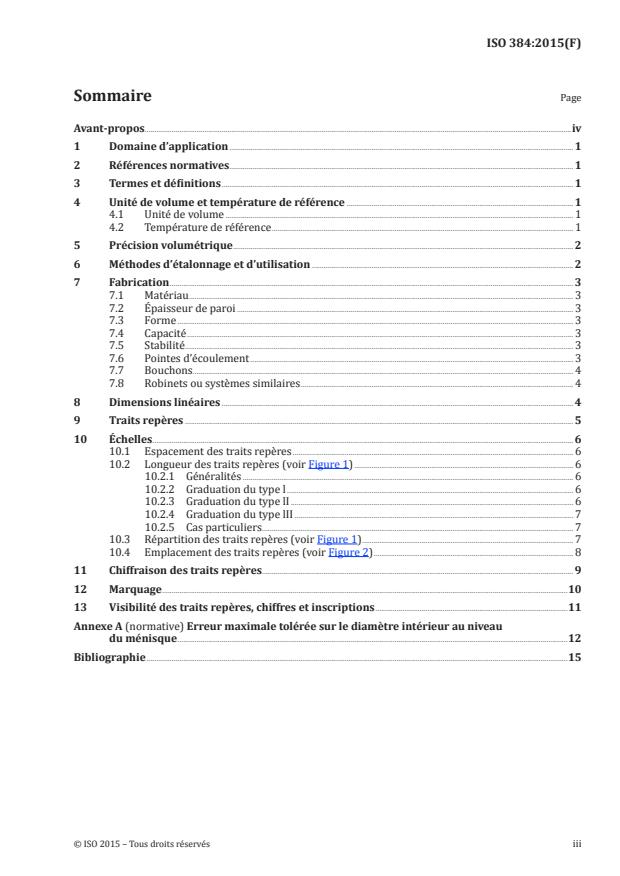
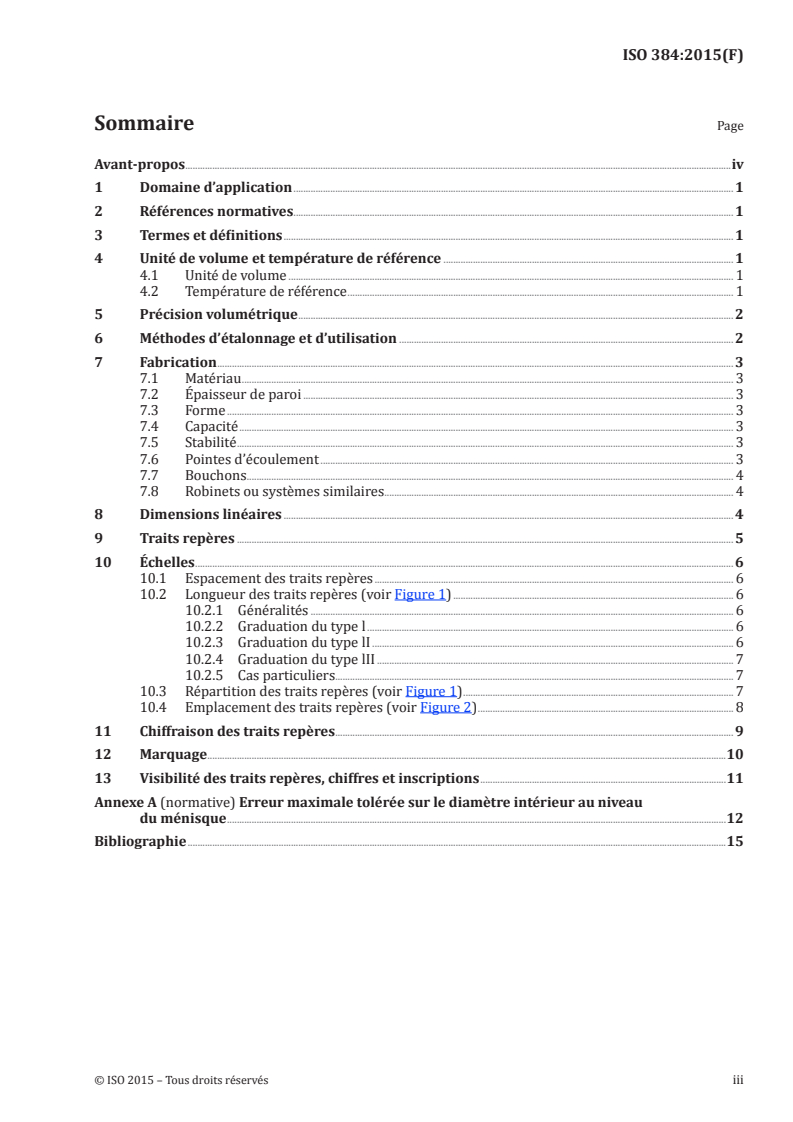
Sommaire Page
Avant-propos .iv
1 Domaine d’application . 1
2 Références normatives . 1
3 Termes et définitions . 1
4 Unité de volume et température de référence . 1
4.1 Unité de volume . 1
4.2 Température de référence . 1
5 Précision volumétrique . 2
6 Méthodes d’étalonnage et d’utilisation . 2
7 Fabrication . 3
7.1 Matériau . 3
7.2 Épaisseur de paroi . 3
7.3 Forme . 3
7.4 Capacité . 3
7.5 Stabilité . 3
7.6 Pointes d’écoulement . 3
7.7 Bouchons . 4
7.8 Robinets ou systèmes similaires . 4
8 Dimensions linéaires . 4
9 Traits repères . 5
10 Échelles . 6
10.1 Espacement des traits repères . 6
10.2 Longueur des traits repères (voir Figure 1) . 6
10.2.1 Généralités . 6
10.2.2 Graduation du type l . 6
10.2.3 Graduation du type lI . 6
10.2.4 Graduation du type lII . 7
10.2.5 Cas particuliers . . 7
10.3 Répartition des traits repères (voir Figure 1) . 7
10.4 Emplacement des traits repères (voir Figure 2) . 8
11 Chiffraison des traits repères . 9
12 Marquage .10
13 Visibilité des traits repères, chiffres et inscriptions .11
Annexe A (normative) Erreur maximale tolérée sur le diamètre intérieur au niveau
du ménisque .12
Bibliographie .15
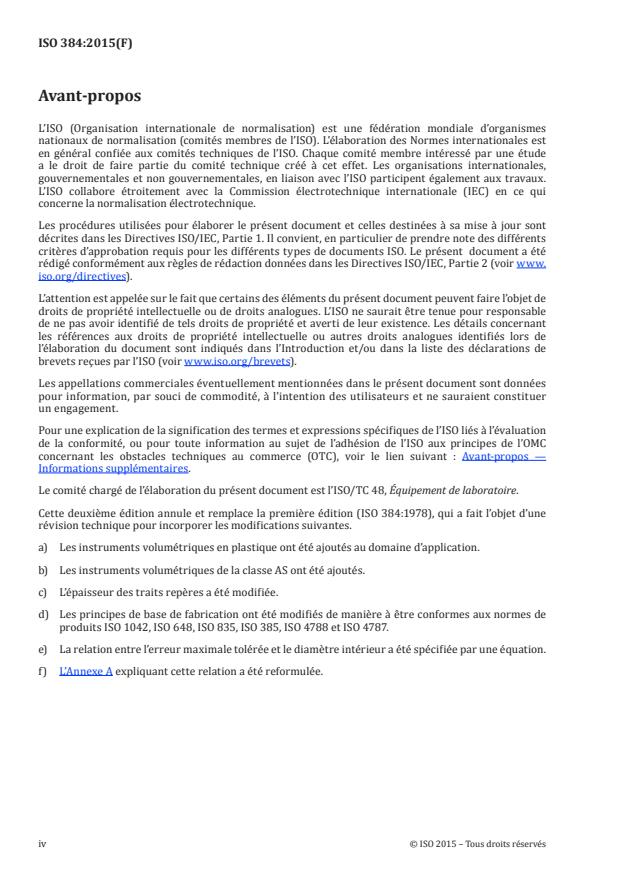
Avant-propos
L’ISO (Organisation internationale de normalisation) est une fédération mondiale d’organismes
nationaux de normalisation (comités membres de l’ISO). L’élaboration des Normes internationales est
en général confiée aux comités techniques de l’ISO. Chaque comité membre intéressé par une étude
a le droit de faire partie du comité technique créé à cet effet. Les organisations internationales,
gouvernementales et non gouvernementales, en liaison avec l’ISO participent également aux travaux.
L’ISO collabore étroitement avec la Commission électrotechnique internationale (IEC) en ce qui
concerne la normalisation électrotechnique.
Les procédures utilisées pour élaborer le présent document et celles destinées à sa mise à jour sont
décrites dans les Directives ISO/IEC, Partie 1. Il convient, en particulier de prendre note des différents
critères d’approbation requis pour les différents types de documents ISO. Le présent document a été
rédigé conformément aux règles de rédaction données dans les Directives ISO/IEC, Partie 2 (voir www.
iso.org/directives).
L’attention est appelée sur le fait que certains des éléments du présent document peuvent faire l’objet de
droits de propriété intellectuelle ou de droits analogues. L’ISO ne saurait être tenue pour responsable
de ne pas avoir identifié de tels droits de propriété et averti de leur existence. Les détails concernant
les références aux droits de propriété intellectuelle ou autres droits analogues identifiés lors de
l’élaboration du document sont indiqués dans l’Introduction et/ou dans la liste des déclarations de
brevets reçues par l’ISO (voir www.iso.org/brevets).
Les appellations commerciales éventuellement mentionnées dans le présent document sont données
pour information, par souci de commodité, à l’intention des utilisateurs et ne sauraient constituer
un engagement.
Pour une explication de la signification des termes et expressions spécifiques de l’ISO liés à l’évaluation
de la conformité, ou pour toute information au sujet de l’adhésion de l’ISO aux principes de l’OMC
concernant les obstacles techniques au commerce (OTC), voir le lien suivant : Avant-propos —
Informations supplémentaires.
Le comité chargé de l’élaboration du présent document est l’ISO/TC 48, Équipement de laboratoire.
Cette deuxième édition annule et remplace la première édition (ISO 384:1978), qui a fait l’objet d’une
révision technique pour incorporer les modifications suivantes.
a) Les instruments volumétriques en plastique ont été ajoutés au domaine d’application.
b) Les instruments volumétriques de la classe AS ont été ajoutés.
c) L’épaisseur des traits repères a été modifiée.
d) Les principes de base de fabrication ont été modifiés de manière à être conformes aux normes de
produits ISO 1042, ISO 648, ISO 835, ISO 385, ISO 4788 et ISO 4787.
e) La relation entre l’erreur maximale tolérée et le diamètre intérieur a été spécifiée par une équation.
f) L’Annexe A expliquant cette relation a été reformulée.
iv © ISO 2015 – Tous droits réservés
NORME INTERNATIONALE ISO 384:2015(F)
Matériel de laboratoire en verre ou en plastique —
Principes de conception et de construction d’instruments
volumétriques
1 Domaine d’application
La présente Norme internationale établit les principes pour la conception des instruments
volumétriques fabriqués en verre ou en plastique afin de faciliter l’utilisation la plus sûre et la plus
commode avec le degré de précision souhaité.
2 Références normatives
Les documents ci-après, dans leur intégralité ou non, sont des références normatives indispensables
à l’application du présent document. Pour les références datées, seule l’édition citée s’applique. Pour
les références non datées, la dernière édition du document de référence (y compris les éventuels
amendements) s’applique.
ISO 383, Verrerie de laboratoire — Assemblages coniques rodés interchangeables
ISO 4787, Verrerie de laboratoire — Instruments volumétriques — Méthodes de vérification de la capacité
et d’utilisation
Guide ISO/IEC 99, Vocabulaire international de métrologie — Concepts fondamentaux et généraux et
termes associés (VIM)
3 Termes et définitions
Pour les besoins du présent document, les termes et définitions donnés dans l’Guide ISO/IEC 99
s’appliquent.
4 Unité de volume et température de référence
4.1 Unité de volume
L’unité de volume doit être le millilitre (ml), qui équivaut à un centimètre cube (cm ).
4.2 Température de référence
La température normale de référence, c’est-à-dire la température à laquelle l’instrument volumétrique
est destiné à contenir ou à délivrer son volume (sa capacité), doit être de 20 °C.
Lorsque l’instrument volumétrique est destiné à être utilisé dans un pays ayant adopté une température
normale de référence de 27 °C, cette valeur doit se substituer à celle de 20 °C.
NOTE La capacité des instruments volumétriques varie avec la température. Un instrument volumétrique
qui a été étalonné à 20 °C mais utilisé à 27 °C, ou vice versa, est susceptible de présenter un pourcentage d’erreur
supplémentaire de seulement 0,007 % dans le cas où il est fabriqué en verre borosilicaté ayant un coefficient de
−6 −1
dilatation volumique de 9,9 × 10 °C , et de 0,02 % dans le cas où il est fabriqué en verre sodocalcique ayant
−6 −1
un coefficient de dilatation volumique de 27 × 10 °C . Ces erreurs sont inférieures aux limites d’erreur de la
plupart des instruments volumétriques. On en déduit que la température de référence est de moindre importance
lors de l’utilisation pratique de la verrerie. Toutefois, lors de la réalisation des étalonnages, il est important de se
référer à la température de référence, notamment lorsqu’il s’agit de matériel volumétrique en plastique.
5 Précision volumétrique
5.1 Il existe deux classes de précision :
— la catégorie supérieure doit être nommée « classe A » ou « classe AS » ;
— la catégorie inférieure doit être nommée « classe B ».
5.2 L’erreur maximale tolérée doit être spécifiée pour chaque type d’instrument volumétrique en
tenant compte de la méthode d’utilisation, de l’usage prévu et de la classe de précision.
5.3 Les valeurs numériques de l’erreur maximale tolérée pour les instruments volumétriques d’usages
généraux doivent être de préférence choisies dans la série 10 – 12 – 15 – 20 – 25 – 30 – 40 – 50 – 60 – 80,
ou un multiple décimal approprié de ces valeurs.
NOTE Cette série de nombres normaux a été adoptée parce que les sous-multiples décimaux de certains des
nombres non entiers, par exemple 31,5, sembleraient impliquer un degré de précision qui n’est pas recherché et
qui ne pourrait être mesuré en réalité.
5.4 Il convient que l’erreur maximale tolérée spécifiée pour une série de tailles d’un instrument
volumétrique suive une progression relativement régulière en fonction de la capacité.
5.5 Il convient que l’erreur maximale tolérée admise pour la classe B soit, en général, approximativement
deux fois celle admise pour la classe A ou AS.
5.6 Pour les instruments volumétriques pourvus d’une échelle, l’erreur maximale tolérée admise pour
l’une ou l’autre des classes de précision ne doit pas dépasser le volume correspondant à la valeur de
l’échelon (voir l’Annexe A).
5.7 L’erreur maximale tolérée, EMT, pour la classe A ou AS, dépend du diamètre intérieur D (en
millimètres) au niveau du trait repère concerné et ne doit pas être inférieure à la valeur obtenue avec
l’Équation (1) :
π
EMT≥+DD(,04 00,)1 (1)
La limite correspondante pour la classe B doit être obtenue conformément à 5.5.
NOTE L’équation ci-dessus s’applique aux instruments volumétriques les plus courants qui ont une section
circulaire, mais elle peut s’appliquer également à des sections non circulaires. Voir l’Annexe A.
5.8 En plus de 5.7, l’erreur maximale tolérée spécifiée pour n’importe quel instrument volumétrique
conçu pour délivrer ne doit, de même, pas être inférieure à quatre fois l’écart-type, ce dernier étant
déterminé expérimentalement à partir d’une série d’au moins dix déterminations consécutives de la
capacité délivrée ; ces déterminations doivent être réalisées par un utilisateur expérimenté, sur le
même instrument volumétrique et en observant strictement la méthode spécifiée pour cet instrument
dans l’ISO 4787.
6 Méthodes d’étalonnage et d’utilisation
La méthode d’étalonnage et d’utilisation pour chaque type d’instrument volumétrique est décrite de
manière détaillée dans l’ISO 4787.
Le mode opératoire général est basé sur la détermination gravimétrique du volume d’eau contenu dans
l’instrument volumétrique soumis à essai ou délivré par celui-ci. Ce volume d’eau est calculé à partir de
sa masse en tenant compte de la poussée de l’air et de la densité de l’eau.
2 © ISO 2015 – Tous droits réservés
Il convient que l’on envisage d’étalonner les instruments volumétriques en plastique plus fréquemment
que ceux en verre, en raison de la moins grande stabilité à long terme des instruments en plastique.
7 Fabrication
7.1 Matériau
Les instruments volumétriques doivent être fabriqués en verre ou en plastique présentant des
propriétés chimiques et thermiques appropriées. Ils doivent être exempts, dans la mesure du possible,
de défauts visibles et raisonnablement exempts de contraintes internes.
7.2 Épaisseur de paroi
Les instruments volumétriques doivent être de fabrication suffisamment robuste pour résister
à une utilisation courante en laboratoire et l’épaisseur de paroi ne doit pas présenter d’écart
d’uniformité manifeste.
7.3 Forme
Tous les instruments volumétriques doivent avoir une forme qui facilite l’utilisation prévue et il convient
de préférence qu’ils présentent une section circulaire.
7.4 Capacité
7.4.1 Il convient que les valeurs numériques de la capacité des instruments volumétrique d’usages
généraux soient de préférence choisies dans la série 10 – 20 – 25 – 50, ou soient un multiple ou sous-
multiple décimal de ces valeurs.
La capacité des instruments volumétriques destinés à des applications particulières peut présenter
différentes valeurs ; il existe par exemple des pipettes de capacité comprise entre 3 ml et 9 ml.
7.4.2 Les valeurs numériques des volumes correspondant à la valeur de l’échelon d’un instrument
volumétrique pourvu d’une échelle doivent être choisies dans la série 1 – 2 – 5, ou être un multiple ou
sous-multiple décimal de ces valeurs.
7.4.3 Dans le cas d’un instrument volumétrique à usage particulier devant être gradué pour une
lecture directe de capacité lorsqu’il est utilisé avec un liquide spécifique autre que l’eau, il convient de
préférence d’indiquer la capacité correspondante pour l’eau pure, de façon que cette dernière puisse être
utilisée pour l’étalonnage.
7.5 Stabilité
Les instruments volumétriques à fond plat doivent tenir debout sans bouger ni osciller lorsqu’ils sont
posés sur une surface plane et, sauf indication contraire, il convient que l’axe de la partie graduée du
récipient soit vertical.
7.6 Pointes d’écoulement
7.6.1 Il convient que les pointes d’écoulement à l’extrémité inférieure des instruments volumétriques
soient de fabrication robuste, présentent une conicité régulière et uniforme ou une extrémité capillaire
et que, dans un cas comme dans l’autre, l’orifice ne présente aucune constriction brutale susceptible de
provoquer une turbulence à l’écoulement.
7.6.2 L’extrémité de la pointe doit être finie selon l’une des méthodes ci-après et dans l’ordre de
préférence suivant :
a) finie à chaud perpendiculairement à l’axe, légèrement biseautée à l’extérieur et polie ;
b) finement rodée perpendiculairement à l’axe et, facultativement, polie à la flamme ;
c) coupée perpendiculairement à l’axe et polie.
Le fait de polir à la flamme les pointes en verre réduit le risque d’ébrèchement lors de l’utilisation, mais
il convient que cette finition ne provoque pas de constriction brutale ou de contrainte inutile.
7.6.3 La pointe doit être formée soit d’un tube en verre, soit d’une matière plastique appropriée. Elle
doit de préférence faire partie intégrante de l’instrument volumétrique. Dans le cas contraire, la pointe
doit être clairement identifiée pour être associée à l’instrument volumétrique correspondant ou, si cela
suffit, à la dimension nominale de l’instrument volumétrique.
7.7 Bouchons
7.7.1 Il convient que les bouchons en verre soient de préférence rodés, de façon à être interchangeables
et, dans ce cas, les parties rodées doivent être conformes à l’ISO 383. S’ils sont ajustés individuellement,
ils doivent être convenablement rodés, afin d’éviter les fuites, et doivent présenter une conicité de
préférence proche de 1:10.
7.7.2 L’emploi de bouchons en matière plastique suffisamment inerte peut être toléré pour remplacer
les bouchons en verre. Dans ce cas, il c
...
NORME ISO
INTERNATIONALE 384
Deuxième édition
2015-12-15
Matériel de laboratoire en verre ou en
plastique — Principes de conception
et de construction d’instruments
volumétriques
Laboratory glass and plastics ware — Principles of design and
construction of volumetric instruments
Numéro de référence
©
ISO 2015
DOCUMENT PROTÉGÉ PAR COPYRIGHT
© ISO 2015, Publié en Suisse
Droits de reproduction réservés. Sauf indication contraire, aucune partie de cette publication ne peut être reproduite ni utilisée
sous quelque forme que ce soit et par aucun procédé, électronique ou mécanique, y compris la photocopie, l’affichage sur
l’internet ou sur un Intranet, sans autorisation écrite préalable. Les demandes d’autorisation peuvent être adressées à l’ISO à
l’adresse ci-après ou au comité membre de l’ISO dans le pays du demandeur.
ISO copyright office
Ch. de Blandonnet 8 • CP 401
CH-1214 Vernier, Geneva, Switzerland
Tel. +41 22 749 01 11
Fax +41 22 749 09 47
copyright@iso.org
www.iso.org
ii © ISO 2015 – Tous droits réservés
Sommaire Page
Avant-propos .iv
1 Domaine d’application . 1
2 Références normatives . 1
3 Termes et définitions . 1
4 Unité de volume et température de référence . 1
4.1 Unité de volume . 1
4.2 Température de référence . 1
5 Précision volumétrique . 2
6 Méthodes d’étalonnage et d’utilisation . 2
7 Fabrication . 3
7.1 Matériau . 3
7.2 Épaisseur de paroi . 3
7.3 Forme . 3
7.4 Capacité . 3
7.5 Stabilité . 3
7.6 Pointes d’écoulement . 3
7.7 Bouchons . 4
7.8 Robinets ou systèmes similaires . 4
8 Dimensions linéaires . 4
9 Traits repères . 5
10 Échelles . 6
10.1 Espacement des traits repères . 6
10.2 Longueur des traits repères (voir Figure 1) . 6
10.2.1 Généralités . 6
10.2.2 Graduation du type l . 6
10.2.3 Graduation du type lI . 6
10.2.4 Graduation du type lII . 7
10.2.5 Cas particuliers . . 7
10.3 Répartition des traits repères (voir Figure 1) . 7
10.4 Emplacement des traits repères (voir Figure 2) . 8
11 Chiffraison des traits repères . 9
12 Marquage .10
13 Visibilité des traits repères, chiffres et inscriptions .11
Annexe A (normative) Erreur maximale tolérée sur le diamètre intérieur au niveau
du ménisque .12
Bibliographie .15
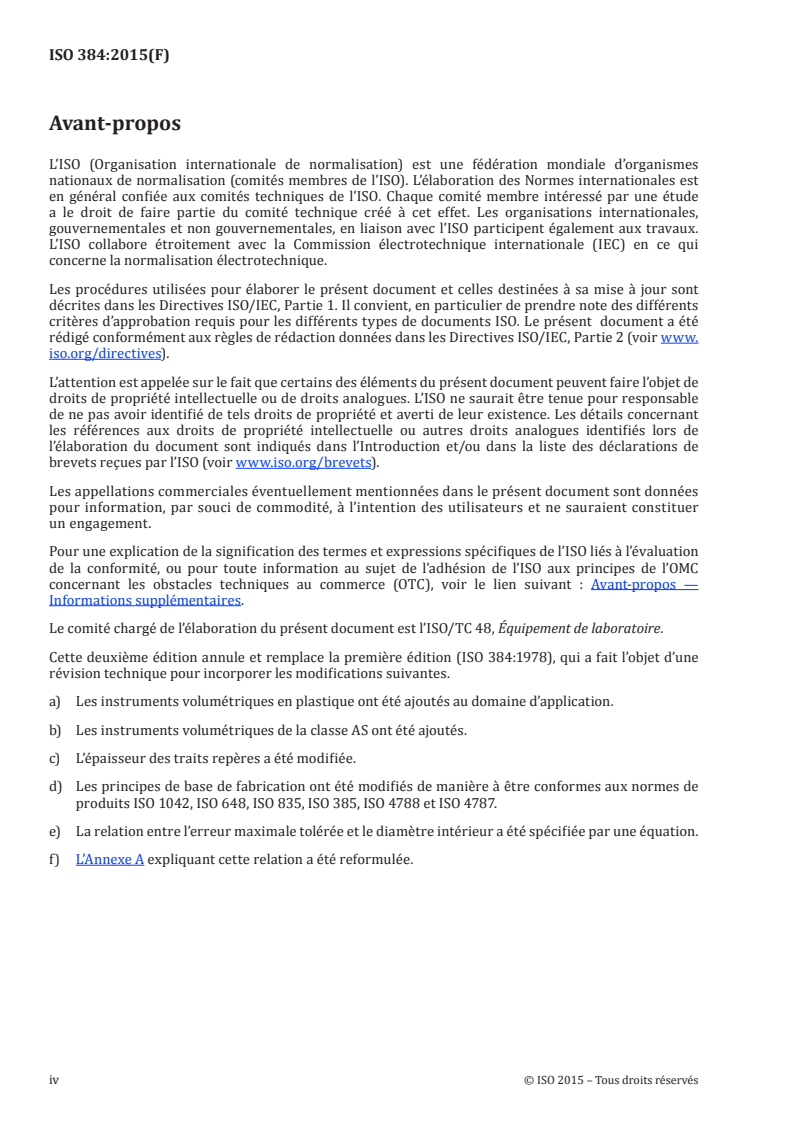
Avant-propos
L’ISO (Organisation internationale de normalisation) est une fédération mondiale d’organismes
nationaux de normalisation (comités membres de l’ISO). L’élaboration des Normes internationales est
en général confiée aux comités techniques de l’ISO. Chaque comité membre intéressé par une étude
a le droit de faire partie du comité technique créé à cet effet. Les organisations internationales,
gouvernementales et non gouvernementales, en liaison avec l’ISO participent également aux travaux.
L’ISO collabore étroitement avec la Commission électrotechnique internationale (IEC) en ce qui
concerne la normalisation électrotechnique.
Les procédures utilisées pour élaborer le présent document et celles destinées à sa mise à jour sont
décrites dans les Directives ISO/IEC, Partie 1. Il convient, en particulier de prendre note des différents
critères d’approbation requis pour les différents types de documents ISO. Le présent document a été
rédigé conformément aux règles de rédaction données dans les Directives ISO/IEC, Partie 2 (voir www.
iso.org/directives).
L’attention est appelée sur le fait que certains des éléments du présent document peuvent faire l’objet de
droits de propriété intellectuelle ou de droits analogues. L’ISO ne saurait être tenue pour responsable
de ne pas avoir identifié de tels droits de propriété et averti de leur existence. Les détails concernant
les références aux droits de propriété intellectuelle ou autres droits analogues identifiés lors de
l’élaboration du document sont indiqués dans l’Introduction et/ou dans la liste des déclarations de
brevets reçues par l’ISO (voir www.iso.org/brevets).
Les appellations commerciales éventuellement mentionnées dans le présent document sont données
pour information, par souci de commodité, à l’intention des utilisateurs et ne sauraient constituer
un engagement.
Pour une explication de la signification des termes et expressions spécifiques de l’ISO liés à l’évaluation
de la conformité, ou pour toute information au sujet de l’adhésion de l’ISO aux principes de l’OMC
concernant les obstacles techniques au commerce (OTC), voir le lien suivant : Avant-propos —
Informations supplémentaires.
Le comité chargé de l’élaboration du présent document est l’ISO/TC 48, Équipement de laboratoire.
Cette deuxième édition annule et remplace la première édition (ISO 384:1978), qui a fait l’objet d’une
révision technique pour incorporer les modifications suivantes.
a) Les instruments volumétriques en plastique ont été ajoutés au domaine d’application.
b) Les instruments volumétriques de la classe AS ont été ajoutés.
c) L’épaisseur des traits repères a été modifiée.
d) Les principes de base de fabrication ont été modifiés de manière à être conformes aux normes de
produits ISO 1042, ISO 648, ISO 835, ISO 385, ISO 4788 et ISO 4787.
e) La relation entre l’erreur maximale tolérée et le diamètre intérieur a été spécifiée par une équation.
f) L’Annexe A expliquant cette relation a été reformulée.
iv © ISO 2015 – Tous droits réservés
NORME INTERNATIONALE ISO 384:2015(F)
Matériel de laboratoire en verre ou en plastique —
Principes de conception et de construction d’instruments
volumétriques
1 Domaine d’application
La présente Norme internationale établit les principes pour la conception des instruments
volumétriques fabriqués en verre ou en plastique afin de faciliter l’utilisation la plus sûre et la plus
commode avec le degré de précision souhaité.
2 Références normatives
Les documents ci-après, dans leur intégralité ou non, sont des références normatives indispensables
à l’application du présent document. Pour les références datées, seule l’édition citée s’applique. Pour
les références non datées, la dernière édition du document de référence (y compris les éventuels
amendements) s’applique.
ISO 383, Verrerie de laboratoire — Assemblages coniques rodés interchangeables
ISO 4787, Verrerie de laboratoire — Instruments volumétriques — Méthodes de vérification de la capacité
et d’utilisation
Guide ISO/IEC 99, Vocabulaire international de métrologie — Concepts fondamentaux et généraux et
termes associés (VIM)
3 Termes et définitions
Pour les besoins du présent document, les termes et définitions donnés dans l’Guide ISO/IEC 99
s’appliquent.
4 Unité de volume et température de référence
4.1 Unité de volume
L’unité de volume doit être le millilitre (ml), qui équivaut à un centimètre cube (cm ).
4.2 Température de référence
La température normale de référence, c’est-à-dire la température à laquelle l’instrument volumétrique
est destiné à contenir ou à délivrer son volume (sa capacité), doit être de 20 °C.
Lorsque l’instrument volumétrique est destiné à être utilisé dans un pays ayant adopté une température
normale de référence de 27 °C, cette valeur doit se substituer à celle de 20 °C.
NOTE La capacité des instruments volumétriques varie avec la température. Un instrument volumétrique
qui a été étalonné à 20 °C mais utilisé à 27 °C, ou vice versa, est susceptible de présenter un pourcentage d’erreur
supplémentaire de seulement 0,007 % dans le cas où il est fabriqué en verre borosilicaté ayant un coefficient de
−6 −1
dilatation volumique de 9,9 × 10 °C , et de 0,02 % dans le cas où il est fabriqué en verre sodocalcique ayant
−6 −1
un coefficient de dilatation volumique de 27 × 10 °C . Ces erreurs sont inférieures aux limites d’erreur de la
plupart des instruments volumétriques. On en déduit que la température de référence est de moindre importance
lors de l’utilisation pratique de la verrerie. Toutefois, lors de la réalisation des étalonnages, il est important de se
référer à la température de référence, notamment lorsqu’il s’agit de matériel volumétrique en plastique.
5 Précision volumétrique
5.1 Il existe deux classes de précision :
— la catégorie supérieure doit être nommée « classe A » ou « classe AS » ;
— la catégorie inférieure doit être nommée « classe B ».
5.2 L’erreur maximale tolérée doit être spécifiée pour chaque type d’instrument volumétrique en
tenant compte de la méthode d’utilisation, de l’usage prévu et de la classe de précision.
5.3 Les valeurs numériques de l’erreur maximale tolérée pour les instruments volumétriques d’usages
généraux doivent être de préférence choisies dans la série 10 – 12 – 15 – 20 – 25 – 30 – 40 – 50 – 60 – 80,
ou un multiple décimal approprié de ces valeurs.
NOTE Cette série de nombres normaux a été adoptée parce que les sous-multiples décimaux de certains des
nombres non entiers, par exemple 31,5, sembleraient impliquer un degré de précision qui n’est pas recherché et
qui ne pourrait être mesuré en réalité.
5.4 Il convient que l’erreur maximale tolérée spécifiée pour une série de tailles d’un instrument
volumétrique suive une progression relativement régulière en fonction de la capacité.
5.5 Il convient que l’erreur maximale tolérée admise pour la classe B soit, en général, approximativement
deux fois celle admise pour la classe A ou AS.
5.6 Pour les instruments volumétriques pourvus d’une échelle, l’erreur maximale tolérée admise pour
l’une ou l’autre des classes de précision ne doit pas dépasser le volume correspondant à la valeur de
l’échelon (voir l’Annexe A).
5.7 L’erreur maximale tolérée, EMT, pour la classe A ou AS, dépend du diamètre intérieur D (en
millimètres) au niveau du trait repère concerné et ne doit pas être inférieure à la valeur obtenue avec
l’Équation (1) :
π
EMT≥+DD(,04 00,)1 (1)
La limite correspondante pour la classe B doit être obtenue conformément à 5.5.
NOTE L’équation ci-dessus s’applique aux instruments volumétriques les plus courants qui ont une section
circulaire, mais elle peut s’appliquer également à des sections non circulaires. Voir l’Annexe A.
5.8 En plus de 5.7, l’erreur maximale tolérée spécifiée pour n’importe quel instrument volumétrique
conçu pour délivrer ne doit, de même, pas être inférieure à quatre fois l’écart-type, ce dernier étant
déterminé expérimentalement à partir d’une série d’au moins dix déterminations consécutives de la
capacité délivrée ; ces déterminations doivent être réalisées par un utilisateur expérimenté, sur le
même instrument volumétrique et en observant strictement la méthode spécifiée pour cet instrument
dans l’ISO 4787.
6 Méthodes d’étalonnage et d’utilisation
La méthode d’étalonnage et d’utilisation pour chaque type d’instrument volumétrique est décrite de
manière détaillée dans l’ISO 4787.
Le mode opératoire général est basé sur la détermination gravimétrique du volume d’eau contenu dans
l’instrument volumétrique soumis à essai ou délivré par celui-ci. Ce volume d’eau est calculé à partir de
sa masse en tenant compte de la poussée de l’air et de la densité de l’eau.
2 © ISO 2015 – Tous droits réservés
Il convient que l’on envisage d’étalonner les instruments volumétriques en plastique plus fréquemment
que ceux en verre, en raison de la moins grande stabilité à long terme des instruments en plastique.
7 Fabrication
7.1 Matériau
Les instruments volumétriques doivent être fabriqués en verre ou en plastique présentant des
propriétés chimiques et thermiques appropriées. Ils doivent être exempts, dans la mesure du possible,
de défauts visibles et raisonnablement exempts de contraintes internes.
7.2 Épaisseur de paroi
Les instruments volumétriques doivent être de fabrication suffisamment robuste pour résister
à une utilisation courante en laboratoire et l’épaisseur de paroi ne doit pas présenter d’écart
d’uniformité manifeste.
7.3 Forme
Tous les instruments volumétriques doivent avoir une forme qui facilite l’utilisation prévue et il convient
de préférence qu’ils présentent une section circulaire.
7.4 Capacité
7.4.1 Il convient que les valeurs numériques de la capacité des instruments volumétrique d’usages
généraux soient de préférence choisies dans la série 10 – 20 – 25 – 50, ou soient un multiple ou sous-
multiple décimal de ces valeurs.
La capacité des instruments volumétriques destinés à des applications particulières peut présenter
différentes valeurs ; il existe par exemple des pipettes de capacité comprise entre 3 ml et 9 ml.
7.4.2 Les valeurs numériques des volumes correspondant à la valeur de l’échelon d’un instrument
volumétrique pourvu d’une échelle doivent être choisies dans la série 1 – 2 – 5, ou être un multiple ou
sous-multiple décimal de ces valeurs.
7.4.3 Dans le cas d’un instrument volumétrique à usage particulier devant être gradué pour une
lecture directe de capacité lorsqu’il est utilisé avec un liquide spécifique autre que l’eau, il convient de
préférence d’indiquer la capacité correspondante pour l’eau pure, de façon que cette dernière puisse être
utilisée pour l’étalonnage.
7.5 Stabilité
Les instruments volumétriques à fond plat doivent tenir debout sans bouger ni osciller lorsqu’ils sont
posés sur une surface plane et, sauf indication contraire, il convient que l’axe de la partie graduée du
récipient soit vertical.
7.6 Pointes d’écoulement
7.6.1 Il convient que les pointes d’écoulement à l’extrémité inférieure des instruments volumétriques
soient de fabrication robuste, présentent une conicité régulière et uniforme ou une extrémité capillaire
et que, dans un cas comme dans l’autre, l’orifice ne présente aucune constriction brutale susceptible de
provoquer une turbulence à l’écoulement.
7.6.2 L’extrémité de la pointe doit être finie selon l’une des méthodes ci-après et dans l’ordre de
préférence suivant :
a) finie à chaud perpendiculairement à l’axe, légèrement biseautée à l’extérieur et polie ;
b) finement rodée perpendiculairement à l’axe et, facultativement, polie à la flamme ;
c) coupée perpendiculairement à l’axe et polie.
Le fait de polir à la flamme les pointes en verre réduit le risque d’ébrèchement lors de l’utilisation, mais
il convient que cette finition ne provoque pas de constriction brutale ou de contrainte inutile.
7.6.3 La pointe doit être formée soit d’un tube en verre, soit d’une matière plastique appropriée. Elle
doit de préférence faire partie intégrante de l’instrument volumétrique. Dans le cas contraire, la pointe
doit être clairement identifiée pour être associée à l’instrument volumétrique correspondant ou, si cela
suffit, à la dimension nominale de l’instrument volumétrique.
7.7 Bouchons
7.7.1 Il convient que les bouchons en verre soient de préférence rodés, de façon à être interchangeables
et, dans ce cas, les parties rodées doivent être conformes à l’ISO 383. S’ils sont ajustés individuellement,
ils doivent être convenablement rodés, afin d’éviter les fuites, et doivent présenter une conicité de
préférence proche de 1:10.
7.7.2 L’emploi de bouchons en matière plastique suffisamment inerte peut être toléré pour remplacer
les bouchons en verre. Dans ce cas, il c
...