

ISO 17740-1:2015
(Main)Building construction machinery and equipment — Concrete placing systems for stationary equipment — Part 1: Terminology and commercial specifications
General Information
- Abstract
ISO 17740-1:2015 defines terminology and commercial specifications for concrete placing systems which are stationary. ISO 17740-1:2015 is not applicable to concrete placing systems which are part of a mobile or trailer-mounted concrete pumping system (see ISO 21573‑1).
- Status
- Published
- Publication Date
- 16-Jul-2015
- Technical Committee
- ISO/TC 195/SC 1 - Machinery and equipment for concrete work
- Drafting Committee
- ISO/TC 195/SC 1 - Machinery and equipment for concrete work
- Current Stage
- 9093 - International Standard confirmed
- Start Date
- 17-Jun-2026
- Completion Date
- 29-Aug-2026
Overview
ISO 17740-1:2015 defines terminology and commercial specifications for stationary concrete placing systems used in building construction. It covers concrete placing systems mounted on a slewing pedestal and base structure (placing booms, boom pedestal, base, control station, climbing systems, etc.). The standard applies to stationary units only and explicitly excludes placing systems that are part of mobile or trailer‑mounted concrete pumping systems (see ISO 21573‑1). ISO 17740‑1 is the first part of a series; additional parts addressing safety are under preparation.
Key topics
This part standardizes the vocabulary and the information that manufacturers and suppliers should publish as commercial specifications. Major technical topics include:
- Terminology - Clear definitions for terms such as concrete placing system, placing boom, boom pedestal, counter‑jib and ballast, control station, base structure, climbing system and self‑climbing system.
- Classification - Types of stationary systems: free‑standing, ballasted free‑standing, free‑standing with support, inside (self) climbing, and wall‑mounted systems.
- Dimensional characteristics - Key geometric data to be specified: horizontal reach, vertical reach, boom depth reach (including end hose), boom arm lengths, articulation angles for each arm, slewing angle, and working‑range diagrams.
- Commercial specifications - Information required on product datasheets:
- General characteristics: manufacturer contact, prime mover details (combustion engine or electric) including engine/power ratings, fuel/electrical specs.
- Dimensional characteristics: reach, arm lengths, angles, delivery line diameter, end hose length.
- System characteristics: model, number of boom sections, mass for crane lifting, operating ambient temperature range, slewing speed, hydraulic system pressure, oil tank capacity.
Applications and users
ISO 17740‑1 is intended to support:
- Manufacturers and OEMs preparing product datasheets and commercial specifications for placing booms and stationary concrete distribution equipment.
- Procurement and specifiers (contractors, builders, consultants) evaluating and comparing placing systems by consistent, standardized data.
- Engineers and planners responsible for equipment selection, installation, lifting/erection planning, and integration with building structures (base plates, floor frames, climbing systems).
- Maintenance and service teams using standardized terminology for parts, service manuals, and spare‑parts ordering.
- Standards committees and technical writers creating subsequent safety and performance standards for stationary placing equipment.
Related standards
- ISO 21573‑1 - Concrete pumps: terminology and commercial specifications for mobile/trailer‑mounted systems (complements the exclusion in ISO 17740‑1).
- ISO 11375 - Building construction machinery and equipment - terms and definitions (general vocabulary used across equipment standards).
Keywords: ISO 17740-1, concrete placing systems, stationary placing boom, commercial specifications, terminology, placing boom dimensions, base structure, self-climbing system.
Get Certified
Connect with accredited certification bodies for this standard

DIBt (Deutsches Institut für Bautechnik)
German Institute for Building Technology.
DIN CERTCO
DIN Group product certification.

Aboma Certification B.V.
Specialized in construction, metal, and transport sectors.
Sponsored listings
Frequently Asked Questions
ISO 17740-1:2015 is a standard published by the International Organization for Standardization (ISO). Its full title is "Building construction machinery and equipment — Concrete placing systems for stationary equipment — Part 1: Terminology and commercial specifications". This standard covers: ISO 17740-1:2015 defines terminology and commercial specifications for concrete placing systems which are stationary. ISO 17740-1:2015 is not applicable to concrete placing systems which are part of a mobile or trailer-mounted concrete pumping system (see ISO 21573‑1).
ISO 17740-1:2015 defines terminology and commercial specifications for concrete placing systems which are stationary. ISO 17740-1:2015 is not applicable to concrete placing systems which are part of a mobile or trailer-mounted concrete pumping system (see ISO 21573‑1).
ISO 17740-1:2015 is classified under the following ICS (International Classification for Standards) categories: 01.040.91 - Construction materials and building (Vocabularies); 91.220 - Construction equipment. The ICS classification helps identify the subject area and facilitates finding related standards.
ISO 17740-1:2015 is available in PDF format for immediate download after purchase. The document can be added to your cart and obtained through the secure checkout process. Digital delivery ensures instant access to the complete standard document.
Standards Content (Sample)
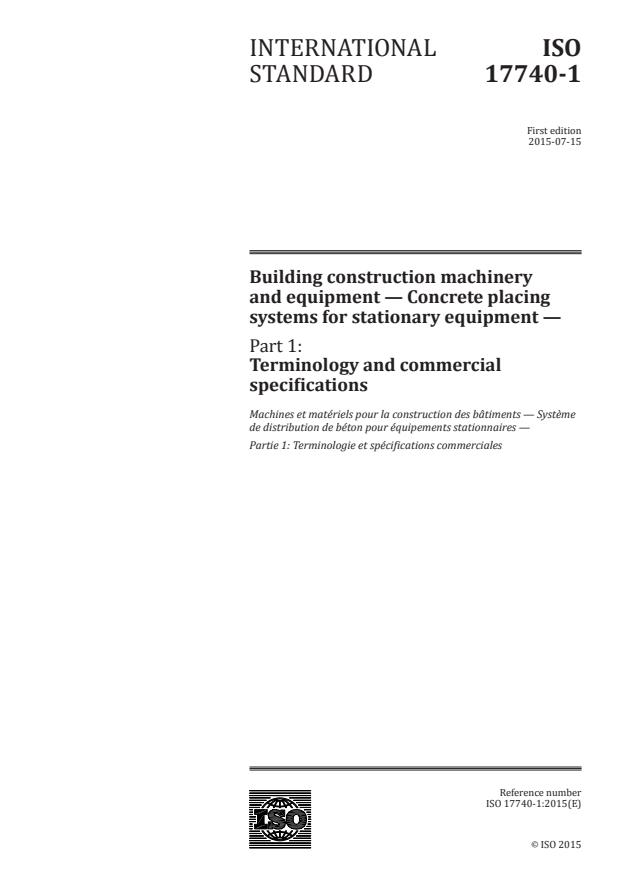
INTERNATIONAL ISO
STANDARD 17740-1
First edition
2015-07-15
Building construction machinery
and equipment — Concrete placing
systems for stationary equipment —
Part 1:
Terminology and commercial
specifications
Machines et matériels pour la construction des bâtiments — Système
de distribution de béton pour équipements stationnaires —
Partie 1: Terminologie et spécifications commerciales
Reference number
©
ISO 2015
© ISO 2015, Published in Switzerland
All rights reserved. Unless otherwise specified, no part of this publication may be reproduced or utilized otherwise in any form
or by any means, electronic or mechanical, including photocopying, or posting on the internet or an intranet, without prior
written permission. Permission can be requested from either ISO at the address below or ISO’s member body in the country of
the requester.
ISO copyright office
Ch. de Blandonnet 8 • CP 401
CH-1214 Vernier, Geneva, Switzerland
Tel. +41 22 749 01 11
Fax +41 22 749 09 47
copyright@iso.org
www.iso.org
ii © ISO 2015 – All rights reserved
Contents Page
Foreword .iv
Introduction .v
1 Scope . 1
2 Terms and definitions . 1
3 Classification . 2
4 Dimensions . 6
5 Commercial specifications . 7
5.1 General characteristics . 7
5.2 Dimensional characteristics . 8
5.3 System characteristics . 9
Bibliography .10
Foreword
ISO (the International Organization for Standardization) is a worldwide federation of national standards
bodies (ISO member bodies). The work of preparing International Standards is normally carried out
through ISO technical committees. Each member body interested in a subject for which a technical
committee has been established has the right to be represented on that committee. International
organizations, governmental and non-governmental, in liaison with ISO, also take part in the work.
ISO collaborates closely with the International Electrotechnical Commission (IEC) on all matters of
electrotechnical standardization.
The procedures used to develop this document and those intended for its further maintenance are
described in the ISO/IEC Directives, Part 1. In particular the different approval criteria needed for the
different types of ISO documents should be noted. This document was drafted in accordance with the
editorial rules of the ISO/IEC Directives, Part 2 (see www.iso.org/directives).
Attention is drawn to the possibility that some of the elements of this document may be the subject of
patent rights. ISO shall not be held responsible for identifying any or all such patent rights. Details of
any patent rights identified during the development of the document will be in the Introduction and/or
on the ISO list of patent declarations received (see www.iso.org/patents).
Any trade name used in this document is information given for the convenience of users and does not
constitute an endorsement.
For an explanation on the meaning of ISO specific terms and expressions related to conformity
assessment, as well as information about ISO’s adherence to the WTO principles in the Technical Barriers
to Trade (TBT) see the following URL: Foreword - Supplementary information
The committee responsible for this document is ISO/TC 195, Building construction machinery and
equipment, Subcommittee SC 1, Machinery and equipment for concrete work.
ISO 17740 consists of the following parts, under the general title Building construction machinery and
equipment — Concrete placing systems for stationary equipment:
— Part 1: Terminology and commercial specifications
Additional parts, dealing with safety requirements, are under preparation.
iv © ISO 2015 – All rights reserved
Introduction
This International Standard is part of a series of standards for concrete placing systems which are
mounted on a slewing pedestal at the top of a base structure.
INTERNATIONAL STANDARD ISO 17740-1:2015(E)
Building construction machinery and equipment —
Concrete placing systems for stationary equipment —
Part 1:
Terminology and commercial specifications
1 Scope
This part of ISO 17740 defines terminology and commercial specifications for concrete placing systems
which are stationary.
This part of ISO 17740 is not applicable to concrete placing systems which are part of a mobile or trailer-
mounted concrete pumping system (see ISO 21573-1).
2 Terms and definitions
For the purposes of this document, the following terms and definitions apply.
2.1
concrete placing system
power-driven devices consisting of an extensible placing boom, a boom pedestal and base structure to
deposit concrete
2.2
placing boom
extensible boom with a fixed concrete co
...