

ISO 21760-1:2019
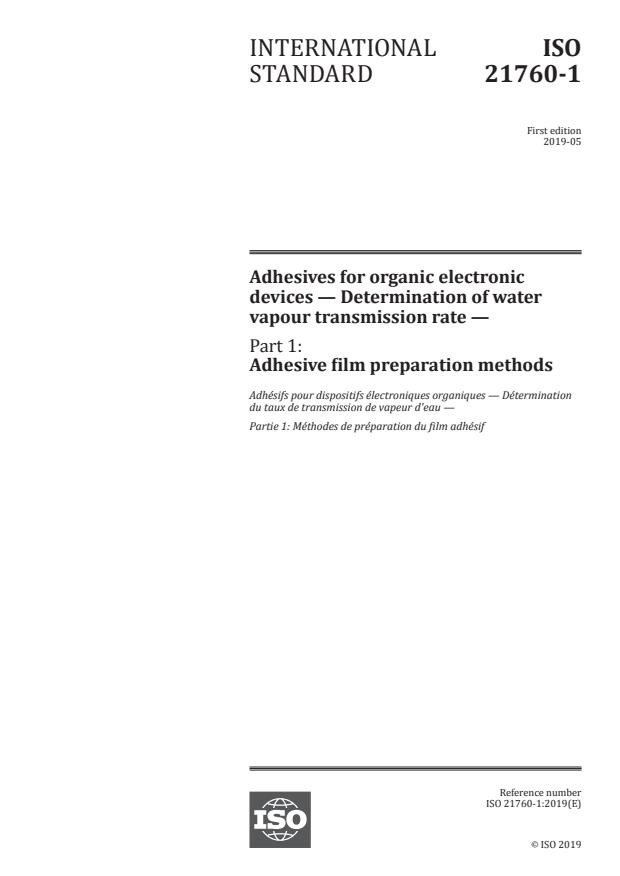
(Main)Adhesives for organic electronic devices — Determination of water vapour transmission rate — Part 1: Adhesive film preparation methods
General Information
- Abstract
This document specifies six methods for determining the water vapour transmission rate of adhesive films coated on a plastic substrate. The adhesive is used in organic electronic devices such as organic light-emitting diodes. The methods provide rapid measurement over a wide range of water vapour transmission rates.
- Status
- Published
- Publication Date
- 21-May-2019
- Technical Committee
- ISO/TC 61/SC 11 - Products
- Drafting Committee
- ISO/TC 61/SC 11/WG 5 - Polymeric adhesives
- Current Stage
- 9093 - International Standard confirmed
- Start Date
- 21-Oct-2024
- Completion Date
- 29-Aug-2026
Buy Documents
ISO 21760-1:2019 - Adhesives for organic electronic devices -- Determination of water vapour transmission rate
ISO 21760-1:2019 - Adhesives for organic electronic devices — Determination of water vapour transmission rate — Part 1: Adhesive film preparation methods/22/2019
Overview
ISO 21760-1:2019 specifies adhesive film preparation methods for determining the water vapour transmission rate (WVTR) of adhesives used in organic electronic devices (for example, organic light‑emitting diodes, OLEDs). The standard defines how to prepare non‑self‑supporting adhesive films coated on plastic substrates and describes the experimental approach needed to obtain rapid WVTR measurements across a wide range of permeation rates.
Key topics and technical requirements
- Scope: Six measurement methods for WVTR of adhesive films coated on plastic substrates; aimed at adhesives/seal materials for organic electronic devices.
- Specimens: Non‑self‑supporting adhesive films are applied to plastic substrates (e.g., PET). Substrate thickness options specified: 12, 25, 50 or 100 µm.
- Adhesive thickness: Total dry film thickness range 3 µm to 60 µm (recommended values: 5, 10, 20, 50 µm).
- Coating methods described: Annex A (spin coating), Annex B (blade coating), Annex C (spray coating).
- Conditioning: Specimens conditioned at 23 ± 2 °C and 50 ± 5 % RH unless otherwise agreed.
- Number of specimens: Typically three specimens per test.
- Thickness determination: Adhesive thickness may be determined by calculation (from application rate and non‑volatile content per ISO 3233‑1) or by optical/mechanical methods (ISO 4593, ISO 2808).
- Test principle: WVTR of the adhesive cannot be measured directly for non‑self‑supporting films; measure WVTR of substrate+adhesive and substrate alone, then calculate the adhesive WVTR by accounting for the substrate contribution (reciprocal subtraction approach).
- Measurement methods (ISO 15106 series): Six detection techniques are referenced - humidity sensor, infrared, electrolytic, gas chromatography, pressure sensor, and atmospheric pressure ionization mass spectrometry - with guidance on method selection by sensitivity, WVTR magnitude, and specimen fragility.
Applications and users
- Primary users: Adhesive manufacturers, coating/process engineers, quality control and test laboratories, and device integrators in the organic electronics and flexible electronics industries.
- Practical applications:
- Verifying barrier/sealant performance for OLEDs and other water‑sensitive organic electronic devices.
- Comparing coating methods (spin, blade, spray) and formulation choices (resins, multi‑layer films, desiccant‑loaded layers).
- Supporting materials selection, process optimization, reliability testing, and supplier qualification for low‑WVTR sealing solutions.
Related standards
- ISO 15106 (all parts) - WVTR measurement methods (1 to 6)
- ISO 4593, ISO 2808 - thickness determination of films/sheets
- ISO 3233‑1 - determination of non‑volatile content (for dry film thickness calculation)
Keywords: ISO 21760-1:2019, WVTR, water vapour transmission rate, adhesives for organic electronic devices, adhesive film preparation, spin coating, blade coating, spray coating, PET substrate, OLED barrier testing.
Buy Documents
ISO 21760-1:2019 - Adhesives for organic electronic devices -- Determination of water vapour transmission rate
ISO 21760-1:2019 - Adhesives for organic electronic devices — Determination of water vapour transmission rate — Part 1: Adhesive film preparation methods/22/2019
Get Certified
Connect with accredited certification bodies for this standard

DIN CERTCO
DIN Group product certification.

Smithers Quality Assessments
US management systems and product certification.
Sponsored listings
Frequently Asked Questions
ISO 21760-1:2019 is a standard published by the International Organization for Standardization (ISO). Its full title is "Adhesives for organic electronic devices — Determination of water vapour transmission rate — Part 1: Adhesive film preparation methods". This standard covers: This document specifies six methods for determining the water vapour transmission rate of adhesive films coated on a plastic substrate. The adhesive is used in organic electronic devices such as organic light-emitting diodes. The methods provide rapid measurement over a wide range of water vapour transmission rates.
This document specifies six methods for determining the water vapour transmission rate of adhesive films coated on a plastic substrate. The adhesive is used in organic electronic devices such as organic light-emitting diodes. The methods provide rapid measurement over a wide range of water vapour transmission rates.
ISO 21760-1:2019 is classified under the following ICS (International Classification for Standards) categories: 83.180 - Adhesives. The ICS classification helps identify the subject area and facilitates finding related standards.
ISO 21760-1:2019 is available in PDF format for immediate download after purchase. The document can be added to your cart and obtained through the secure checkout process. Digital delivery ensures instant access to the complete standard document.
Standards Content (Sample)
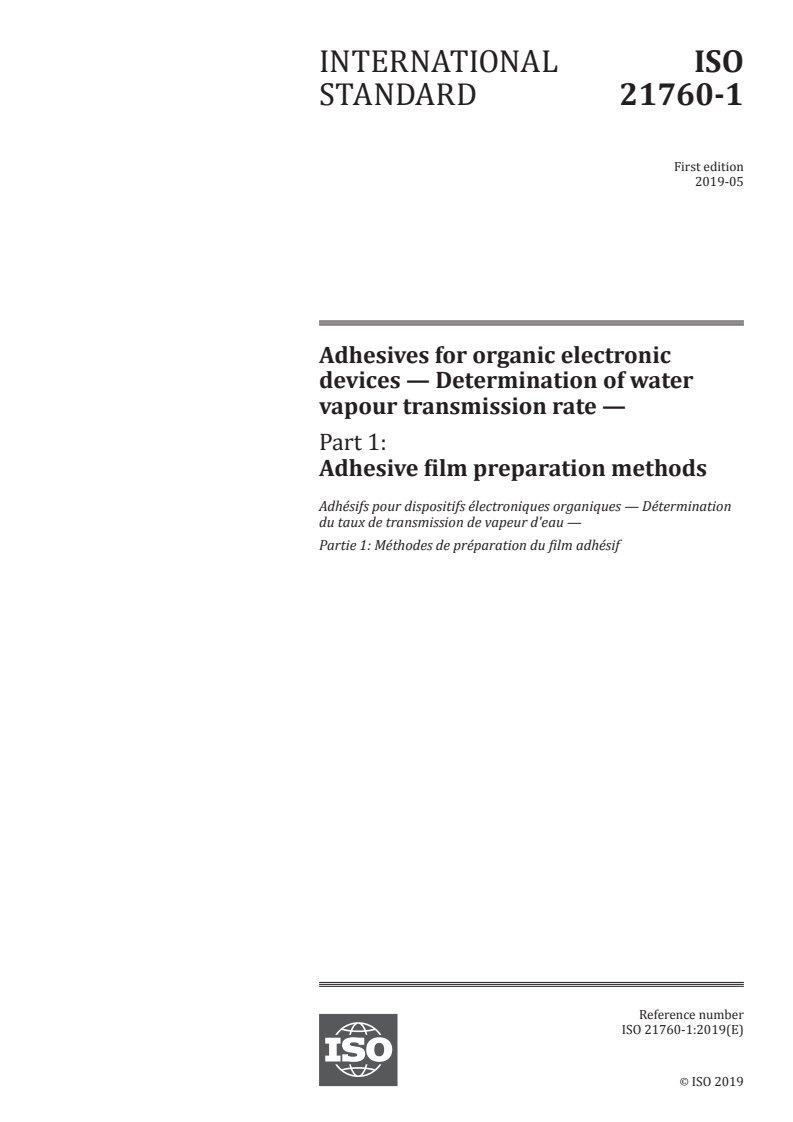
INTERNATIONAL ISO
STANDARD 21760-1
First edition
2019-05
Adhesives for organic electronic
devices — Determination of water
vapour transmission rate —
Part 1:
Adhesive film preparation methods
Adhésifs pour dispositifs électroniques organiques — Détermination
du taux de transmission de vapeur d'eau —
Partie 1: Méthodes de préparation du film adhésif
Reference number
©
ISO 2019
© ISO 2019
All rights reserved. Unless otherwise specified, or required in the context of its implementation, no part of this publication may
be reproduced or utilized otherwise in any form or by any means, electronic or mechanical, including photocopying, or posting
on the internet or an intranet, without prior written permission. Permission can be requested from either ISO at the address
below or ISO’s member body in the country of the requester.
ISO copyright office
CP 401 • Ch. de Blandonnet 8
CH-1214 Vernier, Geneva
Phone: +41 22 749 01 11
Fax: +41 22 749 09 47
Email: copyright@iso.org
Website: www.iso.org
Published in Switzerland
ii © ISO 2019 – All rights reserved
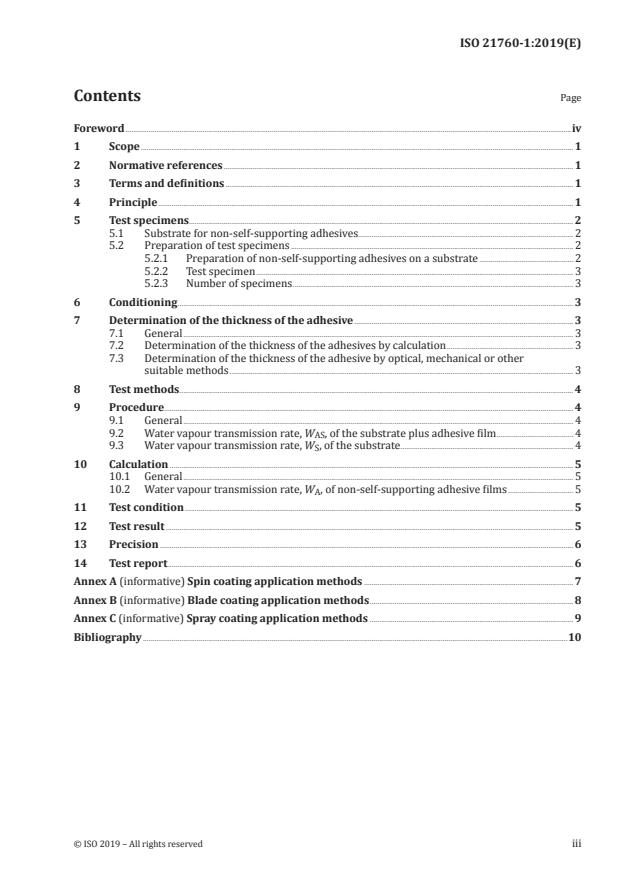
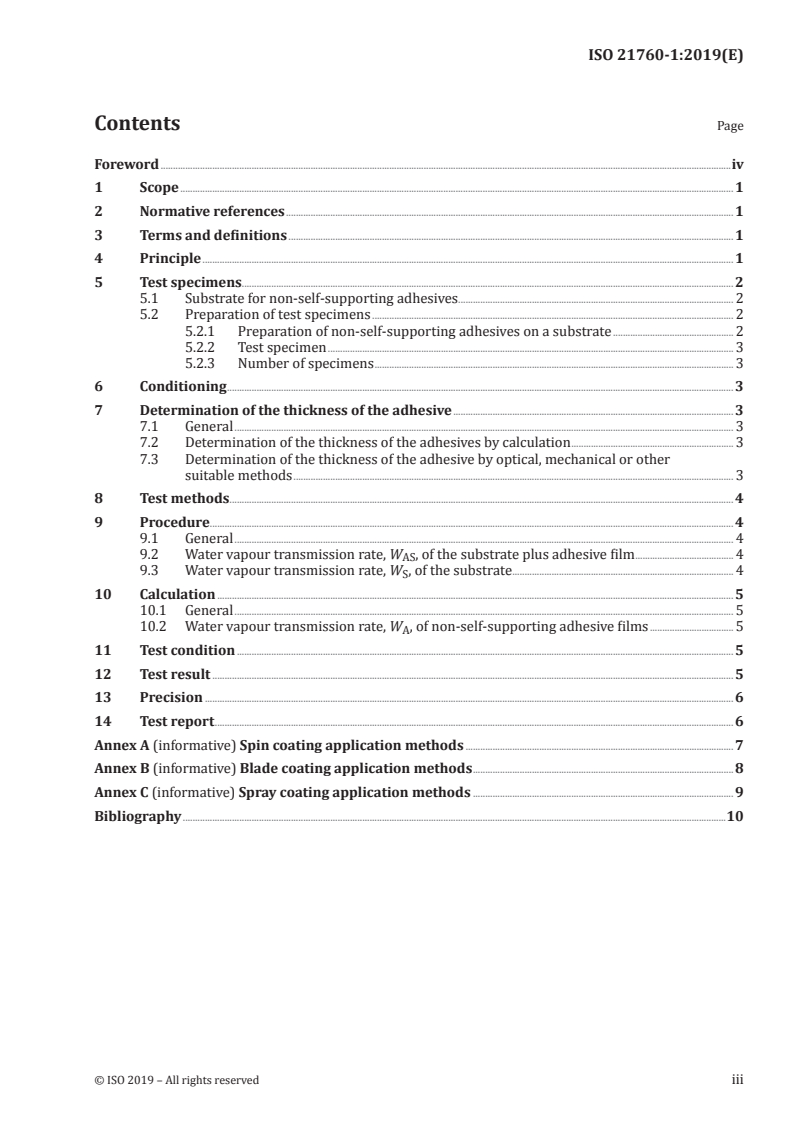
Contents Page
Foreword .iv
1 Scope . 1
2 Normative references . 1
3 Terms and definitions . 1
4 Principle . 1
5 Test specimens. 2
5.1 Substrate for non-self-supporting adhesives . 2
5.2 Preparation of test specimens . 2
5.2.1 Preparation of non-self-supporting adhesives on a substrate . 2
5.2.2 Test specimen . 3
5.2.3 Number of specimens . 3
6 Conditioning . 3
7 Determination of the thickness of the adhesive . 3
7.1 General . 3
7.2 Determination of the thickness of the adhesives by calculation . 3
7.3 Determination of the thickness of the adhesive by optical, mechanical or other
suitable methods . 3
8 Test methods . 4
9 Procedure. 4
9.1 General . 4
9.2 Water vapour transmission rate, W , of the substrate plus adhesive film . 4
AS
9.3 Water vapour transmission rate, W , of the substrate . 4
S
10 Calculation . 5
10.1 General . 5
10.2 Water vapour transmission rate, W , of non-self-supporting adhesive films . 5
A
11 Test condition . 5
12 Test result . 5
13 Precision . 6
14 Test report . 6
Annex A (informative) Spin coating application methods . 7
Annex B (informative) Blade coating application methods . 8
Annex C (informative) Spray coating application methods . 9
Bibliography .10
Foreword
ISO (the International Organization for Standardization) is a worldwide federation of national standards
bodies (ISO member bodies). The work of preparing International Standards is normally carried out
through ISO technical committees. Each member body interested in a subject for which a technical
committee has been established has the right to be represented on that committee. International
organizations, governmental and non-governmental, in liaison with ISO, also take part in the work.
ISO collaborates closely with the International Electrotechnical Commission (IEC) on all matters of
electrotechnical standardization.
The procedures used to develop this document and those intended for its further maintenance are
described in the ISO/IEC Directives, Part 1. In particular, the different approval criteria needed for the
different types of ISO documents should be noted. This document was drafted in accordance with the
editorial rules of the ISO/IEC Directives, Part 2 (see www .iso .org/directives).
Attention is drawn to the possibility that some of the elements of this document may be the subject of
patent rights. ISO shall not be held responsible for identifying any or all such patent rights. Details of
any patent rights identified during the development of the document will be in the Introduction and/or
on the ISO list of patent declarations received (see www .iso .org/patents).
Any trade name used in this document is information given for the convenience of users and does not
constitute an endorsement.
For an explanation of the voluntary nature of standards, the meaning of ISO specific terms and
expressions related to conformity assessment, as well as information about ISO's adherence to the
World Trade Organization (WTO) principles in the Technical Barriers to Trade (TBT) see www .iso
.org/iso/foreword .html.
The committee responsible for this document is ISO/TC 61, Plastics, Subcommittee SC 11, Products.
A list of all parts in the ISO 21760 series can be found on the ISO website.
Any feedback or questions on this document should be directed to the user’s national standards body. A
complete listing of these bodies can be found at www .iso .org/members .html.
iv © ISO 2019 – All rights reserved
INTERNATIONAL STANDARD ISO 21760-1:2019(E)
Adhesives for organic electronic devices — Determination
of water vapour transmission rate —
Part 1:
Adhesive film preparation methods
1 Scope
This document specifies six methods for determining the water vapour transmission rate of adhesive
films coated on a plastic substrate.
The adhesive is used in organic electronic devices such as organic light-emitting diodes.
The methods provide rapid measurement over a wide range of water vapour transmission rates.
2 Normative references
The following documents are referred to in the text in such a way that some or all of their content
constitutes requirements of this document. For dated references, only the edition cited applies. For
undated references, the latest edition of the referenced document (including any amendments) applies.
ISO 2808, Paints and varnishes — Determination of film thickness
ISO 4593, Plastics — Film and sheeting — Determination of thickness by mechanical scanning
ISO 15106 (all parts), Plastics — Film and sheeting — Determination of water vapour transmission rate
3 Terms and definitions
For the purposes of this document, the following terms and definitions apply.
ISO and IEC maintain terminological databases for use in standardization at the following addresses:
— ISO Online browsing platform: available at https: //www .iso .org/obp
— IEC Electropedia: available at http: //www .electropedia .org/
3.1
water vapour transmission rate
amount of water vapour transmitted per unit area of test specimen (3.2) per unit time under specified
conditions
Note 1 to entry: It is expressed in grams per square metre per 24 h [g/(m × 24 h)].
3.2
test specimen
supporting substrate with coating of adhesives applied to it
4 Principle
A test specimen consists of a non-self-supporting adhesive film on a plastic substrate. The test specimen
is mounted in a transmission cell forming a sealed barrier between two chambers.
The upstream chamber is usually the wet side and the downstream chamber is usually the dry side.
The amount of water vapour transmitted through the specimen is detected by a sensor capable of
providing an electrical output signal.
Since the water vapour transmission rate of a non-self-supporting adhesive cannot be measured
directly, it is necessary to measure the water vapour transmission rate of the adhesive plus substrate
and the substrate alone.
When calculating the water vapour transmission rate of a non-self-supporting adhesive, the water
vapour transmission rate of the substrate shall be taken into account. The reciprocal number of the
water vapour transmission rate of the adhesive is obtained by subtracting that of the substrate alone
from that of the substrate plus adhesive.
Materials such as a light-emitting layer in the flexible organic electronic device are degraded by the
penetration of a very small amount of water vapour. Both the plastic substrate and adhesive film (seal
material) are required to have high barrier properties. The method for determining the water vapour
transmission rate of plastic substrates is specified in accordance with one of ISO 15106-1, ISO 15106-2,
ISO 15106-3, ISO 15106-4, ISO 15106-5, or ISO 15106-6.
The water vapour transmission rate of self-supporting adhesive film shall be determined in accordance
with ISO 15106 (all parts).
5 Test specimens
5.1 Substrate for non-self-supporting adhesives
Any homogeneous material which has a water-vapour transmission rate larger than 1 g/(m · 24 h)
is suitable for use as the substrate for non-self-supporting adhesives
...
INTERNATIONAL ISO
STANDARD 21760-1
First edition
2019-05
Adhesives for organic electronic
devices — Determination of water
vapour transmission rate —
Part 1:
Adhesive film preparation methods
Adhésifs pour dispositifs électroniques organiques — Détermination
du taux de transmission de vapeur d'eau —
Partie 1: Méthodes de préparation du film adhésif
Reference number
©
ISO 2019
© ISO 2019
All rights reserved. Unless otherwise specified, or required in the context of its implementation, no part of this publication may
be reproduced or utilized otherwise in any form or by any means, electronic or mechanical, including photocopying, or posting
on the internet or an intranet, without prior written permission. Permission can be requested from either ISO at the address
below or ISO’s member body in the country of the requester.
ISO copyright office
CP 401 • Ch. de Blandonnet 8
CH-1214 Vernier, Geneva
Phone: +41 22 749 01 11
Fax: +41 22 749 09 47
Email: copyright@iso.org
Website: www.iso.org
Published in Switzerland
ii © ISO 2019 – All rights reserved
Contents Page
Foreword .iv
1 Scope . 1
2 Normative references . 1
3 Terms and definitions . 1
4 Principle . 1
5 Test specimens. 2
5.1 Substrate for non-self-supporting adhesives . 2
5.2 Preparation of test specimens . 2
5.2.1 Preparation of non-self-supporting adhesives on a substrate . 2
5.2.2 Test specimen . 3
5.2.3 Number of specimens . 3
6 Conditioning . 3
7 Determination of the thickness of the adhesive . 3
7.1 General . 3
7.2 Determination of the thickness of the adhesives by calculation . 3
7.3 Determination of the thickness of the adhesive by optical, mechanical or other
suitable methods . 3
8 Test methods . 4
9 Procedure. 4
9.1 General . 4
9.2 Water vapour transmission rate, W , of the substrate plus adhesive film . 4
AS
9.3 Water vapour transmission rate, W , of the substrate . 4
S
10 Calculation . 5
10.1 General . 5
10.2 Water vapour transmission rate, W , of non-self-supporting adhesive films . 5
A
11 Test condition . 5
12 Test result . 5
13 Precision . 6
14 Test report . 6
Annex A (informative) Spin coating application methods . 7
Annex B (informative) Blade coating application methods . 8
Annex C (informative) Spray coating application methods . 9
Bibliography .10
Foreword
ISO (the International Organization for Standardization) is a worldwide federation of national standards
bodies (ISO member bodies). The work of preparing International Standards is normally carried out
through ISO technical committees. Each member body interested in a subject for which a technical
committee has been established has the right to be represented on that committee. International
organizations, governmental and non-governmental, in liaison with ISO, also take part in the work.
ISO collaborates closely with the International Electrotechnical Commission (IEC) on all matters of
electrotechnical standardization.
The procedures used to develop this document and those intended for its further maintenance are
described in the ISO/IEC Directives, Part 1. In particular, the different approval criteria needed for the
different types of ISO documents should be noted. This document was drafted in accordance with the
editorial rules of the ISO/IEC Directives, Part 2 (see www .iso .org/directives).
Attention is drawn to the possibility that some of the elements of this document may be the subject of
patent rights. ISO shall not be held responsible for identifying any or all such patent rights. Details of
any patent rights identified during the development of the document will be in the Introduction and/or
on the ISO list of patent declarations received (see www .iso .org/patents).
Any trade name used in this document is information given for the convenience of users and does not
constitute an endorsement.
For an explanation of the voluntary nature of standards, the meaning of ISO specific terms and
expressions related to conformity assessment, as well as information about ISO's adherence to the
World Trade Organization (WTO) principles in the Technical Barriers to Trade (TBT) see www .iso
.org/iso/foreword .html.
The committee responsible for this document is ISO/TC 61, Plastics, Subcommittee SC 11, Products.
A list of all parts in the ISO 21760 series can be found on the ISO website.
Any feedback or questions on this document should be directed to the user’s national standards body. A
complete listing of these bodies can be found at www .iso .org/members .html.
iv © ISO 2019 – All rights reserved
INTERNATIONAL STANDARD ISO 21760-1:2019(E)
Adhesives for organic electronic devices — Determination
of water vapour transmission rate —
Part 1:
Adhesive film preparation methods
1 Scope
This document specifies six methods for determining the water vapour transmission rate of adhesive
films coated on a plastic substrate.
The adhesive is used in organic electronic devices such as organic light-emitting diodes.
The methods provide rapid measurement over a wide range of water vapour transmission rates.
2 Normative references
The following documents are referred to in the text in such a way that some or all of their content
constitutes requirements of this document. For dated references, only the edition cited applies. For
undated references, the latest edition of the referenced document (including any amendments) applies.
ISO 2808, Paints and varnishes — Determination of film thickness
ISO 4593, Plastics — Film and sheeting — Determination of thickness by mechanical scanning
ISO 15106 (all parts), Plastics — Film and sheeting — Determination of water vapour transmission rate
3 Terms and definitions
For the purposes of this document, the following terms and definitions apply.
ISO and IEC maintain terminological databases for use in standardization at the following addresses:
— ISO Online browsing platform: available at https: //www .iso .org/obp
— IEC Electropedia: available at http: //www .electropedia .org/
3.1
water vapour transmission rate
amount of water vapour transmitted per unit area of test specimen (3.2) per unit time under specified
conditions
Note 1 to entry: It is expressed in grams per square metre per 24 h [g/(m × 24 h)].
3.2
test specimen
supporting substrate with coating of adhesives applied to it
4 Principle
A test specimen consists of a non-self-supporting adhesive film on a plastic substrate. The test specimen
is mounted in a transmission cell forming a sealed barrier between two chambers.
The upstream chamber is usually the wet side and the downstream chamber is usually the dry side.
The amount of water vapour transmitted through the specimen is detected by a sensor capable of
providing an electrical output signal.
Since the water vapour transmission rate of a non-self-supporting adhesive cannot be measured
directly, it is necessary to measure the water vapour transmission rate of the adhesive plus substrate
and the substrate alone.
When calculating the water vapour transmission rate of a non-self-supporting adhesive, the water
vapour transmission rate of the substrate shall be taken into account. The reciprocal number of the
water vapour transmission rate of the adhesive is obtained by subtracting that of the substrate alone
from that of the substrate plus adhesive.
Materials such as a light-emitting layer in the flexible organic electronic device are degraded by the
penetration of a very small amount of water vapour. Both the plastic substrate and adhesive film (seal
material) are required to have high barrier properties. The method for determining the water vapour
transmission rate of plastic substrates is specified in accordance with one of ISO 15106-1, ISO 15106-2,
ISO 15106-3, ISO 15106-4, ISO 15106-5, or ISO 15106-6.
The water vapour transmission rate of self-supporting adhesive film shall be determined in accordance
with ISO 15106 (all parts).
5 Test specimens
5.1 Substrate for non-self-supporting adhesives
Any homogeneous material which has a water-vapour transmission rate larger than 1 g/(m · 24 h)
is suitable for use as the substrate for non-self-supporting adhesives
...