


ISO/TR 14799-1:2015
(Main)Comparison of worldwide escalator and moving walk safety standards — Part 1: Rule by rule comparison
Comparison of worldwide escalator and moving walk safety standards — Part 1: Rule by rule comparison
ISO/TR 14799-1:2015 consists of a comparison of the requirements of selected topics as covered by the following worldwide safety standards (excluding local deviations): a) Europe (CEN) ? EN 115‑1, Safety of escalators and moving walks ? Part 1: Construction and installation (Edition 2010, including Amendment 1); b) North America - ASME A17.1/CSA B44-2010, Safety Code for Elevators and Escalators; c) Japan ? Safety requirements mainly comprised of Building Standard Law Enforcement Order (BSLJ-EO), Notifications of Ministry of Construction (MOC-N), Japan Industrial Standard (JIS), and Japan Elevator Association Standard (JEAS). NOTE The original Japanese codes were written in Japanese and no official English versions had been released. Listed Japanese codes were carefully translated, but the original is corresponding to the translation sentence is not guaranteed. It is to be noted that in addition to the above listed standards and other regulations, escalators and moving walks may be required to conform to the requirements of other standards, as appropriate. Where ISO/TC 178 was aware of these standards, they are mentioned in Annex C.
Comparaison des normes mondiales de sécurité des escaliers mécaniques et trottoirs roulants — Partie 1: Comparaison paragraphe par paragraphe
General Information
- Status
- Withdrawn
- Publication Date
- 30-Nov-2015
- Technical Committee
- ISO/TC 178 - Lifts, escalators and moving walks
- Drafting Committee
- ISO/TC 178 - Lifts, escalators and moving walks
- Current Stage
- 9599 - Withdrawal of International Standard
- Start Date
- 20-Apr-2022
- Completion Date
- 12-Feb-2026
Relations
- Effective Date
- 06-Jun-2022
- Effective Date
- 09-May-2020
- Effective Date
- 28-Jul-2012
Get Certified
Connect with accredited certification bodies for this standard

ICC Evaluation Service
Building products evaluation and certification.

QAI Laboratories
Building and construction product testing and certification.

Aboma Certification B.V.
Specialized in construction, metal, and transport sectors.
Sponsored listings
Frequently Asked Questions
ISO/TR 14799-1:2015 is a technical report published by the International Organization for Standardization (ISO). Its full title is "Comparison of worldwide escalator and moving walk safety standards — Part 1: Rule by rule comparison". This standard covers: ISO/TR 14799-1:2015 consists of a comparison of the requirements of selected topics as covered by the following worldwide safety standards (excluding local deviations): a) Europe (CEN) ? EN 115‑1, Safety of escalators and moving walks ? Part 1: Construction and installation (Edition 2010, including Amendment 1); b) North America - ASME A17.1/CSA B44-2010, Safety Code for Elevators and Escalators; c) Japan ? Safety requirements mainly comprised of Building Standard Law Enforcement Order (BSLJ-EO), Notifications of Ministry of Construction (MOC-N), Japan Industrial Standard (JIS), and Japan Elevator Association Standard (JEAS). NOTE The original Japanese codes were written in Japanese and no official English versions had been released. Listed Japanese codes were carefully translated, but the original is corresponding to the translation sentence is not guaranteed. It is to be noted that in addition to the above listed standards and other regulations, escalators and moving walks may be required to conform to the requirements of other standards, as appropriate. Where ISO/TC 178 was aware of these standards, they are mentioned in Annex C.
ISO/TR 14799-1:2015 consists of a comparison of the requirements of selected topics as covered by the following worldwide safety standards (excluding local deviations): a) Europe (CEN) ? EN 115‑1, Safety of escalators and moving walks ? Part 1: Construction and installation (Edition 2010, including Amendment 1); b) North America - ASME A17.1/CSA B44-2010, Safety Code for Elevators and Escalators; c) Japan ? Safety requirements mainly comprised of Building Standard Law Enforcement Order (BSLJ-EO), Notifications of Ministry of Construction (MOC-N), Japan Industrial Standard (JIS), and Japan Elevator Association Standard (JEAS). NOTE The original Japanese codes were written in Japanese and no official English versions had been released. Listed Japanese codes were carefully translated, but the original is corresponding to the translation sentence is not guaranteed. It is to be noted that in addition to the above listed standards and other regulations, escalators and moving walks may be required to conform to the requirements of other standards, as appropriate. Where ISO/TC 178 was aware of these standards, they are mentioned in Annex C.
ISO/TR 14799-1:2015 is classified under the following ICS (International Classification for Standards) categories: 91.140.90 - Lifts. Escalators. The ICS classification helps identify the subject area and facilitates finding related standards.
ISO/TR 14799-1:2015 has the following relationships with other standards: It is inter standard links to ISO 20976-1:2019, ISO/TR 14799-1:2022, ISO/TR 14799-1:2005. Understanding these relationships helps ensure you are using the most current and applicable version of the standard.
ISO/TR 14799-1:2015 is available in PDF format for immediate download after purchase. The document can be added to your cart and obtained through the secure checkout process. Digital delivery ensures instant access to the complete standard document.
Standards Content (Sample)
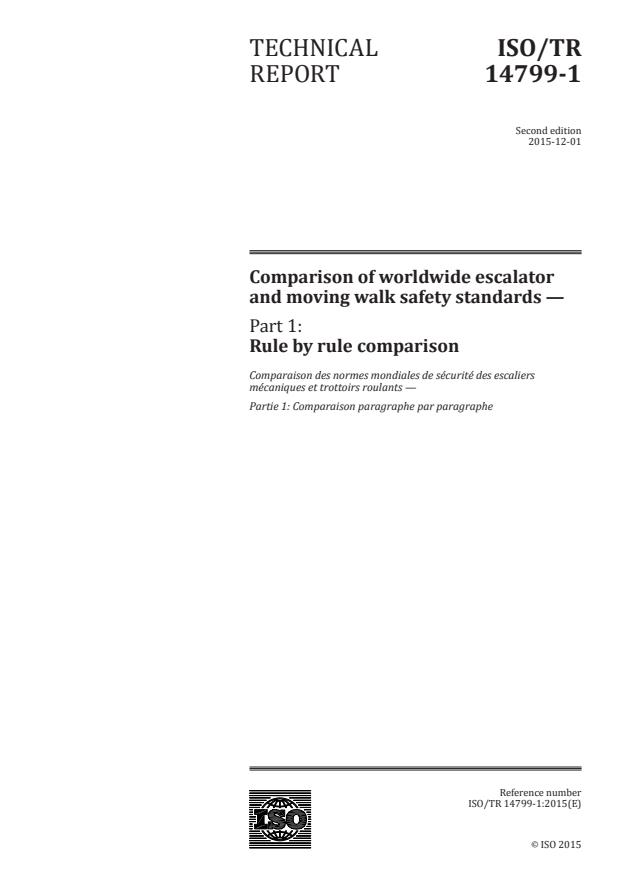
TECHNICAL ISO/TR
REPORT 14799-1
Second edition
2015-12-01
Comparison of worldwide escalator
and moving walk safety standards —
Part 1:
Rule by rule comparison
Comparaison des normes mondiales de sécurité des escaliers
mécaniques et trottoirs roulants —
Partie 1: Comparaison paragraphe par paragraphe
Reference number
©
ISO 2015
© ISO 2015, Published in Switzerland
All rights reserved. Unless otherwise specified, no part of this publication may be reproduced or utilized otherwise in any form
or by any means, electronic or mechanical, including photocopying, or posting on the internet or an intranet, without prior
written permission. Permission can be requested from either ISO at the address below or ISO’s member body in the country of
the requester.
ISO copyright office
Ch. de Blandonnet 8 • CP 401
CH-1214 Vernier, Geneva, Switzerland
Tel. +41 22 749 01 11
Fax +41 22 749 09 47
copyright@iso.org
www.iso.org
ii © ISO 2015 – All rights reserved
Contents Page
Foreword .iv
Introduction .v
1 Scope . 1
2 Rule by rule comparison . 1
2.1 General . 1
Annex A (informative) Figures of EN 115-1 .154
Annex B (informative) Tables mentioned in the column for Japanese codes .160
Annex C (informative) References in the compared codes .162
Annex D (informative) Addresses of standardization bodies occupied with the
compared codes .166
Foreword
ISO (the International Organization for Standardization) is a worldwide federation of national standards
bodies (ISO member bodies). The work of preparing International Standards is normally carried out
through ISO technical committees. Each member body interested in a subject for which a technical
committee has been established has the right to be represented on that committee. International
organizations, governmental and non-governmental, in liaison with ISO, also take part in the work.
ISO collaborates closely with the International Electrotechnical Commission (IEC) on all matters of
electrotechnical standardization.
The procedures used to develop this document and those intended for its further maintenance are
described in the ISO/IEC Directives, Part 1. In particular the different approval criteria needed for the
different types of ISO documents should be noted. This document was drafted in accordance with the
editorial rules of the ISO/IEC Directives, Part 2 (see www.iso.org/directives).
Attention is drawn to the possibility that some of the elements of this document may be the subject of
patent rights. ISO shall not be held responsible for identifying any or all such patent rights. Details of
any patent rights identified during the development of the document will be in the Introduction and/or
on the ISO list of patent declarations received (see www.iso.org/patents).
Any trade name used in this document is information given for the convenience of users and does not
constitute an endorsement.
For an explanation on the meaning of ISO specific terms and expressions related to conformity
assessment, as well as information about ISO’s adherence to the WTO principles in the Technical
Barriers to Trade (TBT) see the following URL: Foreword - Supplementary information
The committee responsible for this document is ISO/TC 178, Lifts, escalators and moving walks.
This second edition cancels and replaces the first edition (ISO/TR 14799-1:2005), which has been
technically revised.
ISO/TR 14799 consists of the following parts, under the general title Comparison of worldwide escalator
and moving walk safety standards:
— Part 1: Rule by rule comparison
— Part 2: Abbreviated comparison and comments
Annexes A to C form an integral part of this part of ISO/TR 14799.
iv © ISO 2015 – All rights reserved
Introduction
At the 1995 plenary meeting of ISO/TC 178, the work on a comparison of worldwide standards which
includes the American, Australian, European, Russian, and Japanese escalator and moving walk safety
code was passed to ISO/TC 178 (Resolution Singapore 1995/114). In October 1995, working group 5
was officially formed to carry out the task of preparing a cross reference between the relevant sections
of these standards and to analyse the differences on selected subjects. The goal at that time was to
prepare a Technical Report which would provide reference information to assist national committees
when reviewing and revising individual standards which may initiate a gradual convergence of the
technical requirements. In 1996, the study was expanded to include the Korean safety standard.
The content of this Technical Report is based on the information provided by the WG 5 members acting
in personal capacity.
This Technical Report is intended to aid standards writers in developing their safety requirements and to
help standards users understand the basis for the requirements as they are applied throughout the world.
This Technical Report is not intended to replace existing safety standards which may have been
updated. Conclusions are arrived at in some cases, but only where there is unanimity amongst the
various experts. In other cases, the reasons for the divergent views are expressed.
This Technical Report is to be read in conjunction with the various safety standards. Unless approved by
the relevant standard writing organizations, the information contained in this Technical Report does not
necessarily represent the opinions of these standards writing organizations (see Annex C for references).
This Technical Report was done with EN 115-1:2008 and its Amendment A1:2010 as a reference
document shown as the only one in its normal sequence. All other codes are not in their normal sequence
and logical order. They are structured differently to EN 115-1. The resultant incorrectly leaves the
impression of incompleteness of these standards. These standards in their original structure inclusive
of their references to other standards and requirements are however complete.
This comparison does no longer include the Australian, Korean, and Russian safety codes as there are
intentions on national level to bring theses codes in line with one of the remaining four codes.
TECHNICAL REPORT ISO/TR 14799-1:2015(E)
Comparison of worldwide escalator and moving walk
safety standards —
Part 1:
Rule by rule comparison
1 Scope
This part of ISO/TR 14799 consists of a comparison of the requirements of selected topics as covered by
the following worldwide safety standards (excluding local deviations):
a) Europe (CEN) – EN 115-1, Safety of escalators and moving walks — Part 1: Construction and
installation (Edition 2010, including Amendment 1);
b) North America - ASME A17.1/CSA B44-2010, Safety Code for Elevators and Escalators;
c) Japan – Safety requirements mainly comprised of Building Standard Law Enforcement Order (BSLJ-
EO), Notifications of Ministry of Construction (MOC-N), Japan Industrial Standard (JIS), and Japan
Elevator Association Standard (JEAS).
NOTE The original Japanese codes were written in Japanese and no official English versions had been
released. Listed Japanese codes were carefully translated, but the original is corresponding to the translation
sentence is not guaranteed.
It is to be noted that in addition to the above listed standards and other regulations, escalators and
moving walks may be required to conform to the requirements of other standards, as appropriate.
Where ISO/TC 178 was aware of these standards, they are mentioned in Annex C.
2 Rule by rule comparison
2.1 General
This comparison is between EN 115-1, the rules in A17.1/B44, and the Japanese codes. There are other
standards in the countries concerned that have requirements not shown in the escalator/moving walk
standards compared, but address some of the same requirements as EN 115-1 (see list in Clause 1).
The principal dimensions (e.g. L , b , h , etc.) of EN 115-1 can be seen in the figures shown in Annex A.
1 8 6
NOTE 1 EN 115–1 clause numbers in brackets serve only as a reference point. They do not exist in the
published EN 115–1.
NOTE 2 Where the Australian Standard requirements are given in italics, they only apply to moving walks.
NOTE 3 Where a clause number in parentheses is used, this serves only as a reference point to EN 115–1.
EN 115–1 (Europe) A17.1/B44 (North America) Japanese codes
Introduction No equivalent statement —
This standard is a type C standard
as stated in ISO 12100–1.
The machinery concerned and the
extent to which hazards, hazardous
situations, and events are covered
are indicated in the scope of this
standard.
When the provisions of this C
standard are different from those
which are stated in type A or B
standards, the provisions of this
type C standard take precedence
over the provisions of the other
standards for machines that have
been designed and built
according to the provisions of
this type C standard.
The purpose of this standard is to GENERAL
define safety rules for escalators
This code is one of the numerous
and moving walks in order to
codes and standards developed and
safeguard people and objects
published by the American Society of
against risks of accidents during
Mechanical Engineers (ASME) under
operation, maintenance, and
the general auspices of the American
inspection work
National Standards Institute, Inc.
(ANSI).
The code is intended to serve as the
basis for state, municipal, and other
jurisdictional authorities in drafting
regulations governing the
installation, testing, inspection,
maintenance, alteration, and repair
of elevators, dumbwaiters,
escalators, moving walks, material
lifts with automatic transfer
devices, wheelchair lifts, and
stairway chairlifts. It is also
intended as a standard reference
of safety requirements for the
guidance of architects, engineers,
insurance companies,
manufacturers, and contractors,
and as a standard of safety
practices for owners and
management of structures where
equipment covered in the scope of
the code is used.
Safety codes and standards are
intended to enhance public health
and safety. Revisions result from
committee consideration of factors
such as technological advances, new
data, and changing environmental
and industry needs. Revisions do not
imply that previous editions were
inadequate.
2 © ISO 2015 – All rights reserved
EN 115–1 (Europe) A17.1/B44 (North America) Japanese codes
The contents of this standard are No equivalent statement —
based on the assumption that
persons using escalators and
moving walks are able to do so
unaided. However, physical and
sensory abilities in a population
can vary over a wide range.
Escalators and moving walks are
also likely to be used by persons
with a range of other disabilities.
Some individuals, in particular,
older people, might have more than
one impairment. Some individuals
are not able to use an escalator
or moving walk independently
and rely on assistance/support
being provided by a companion.
Furthermore, some individuals
can be encumbered by objects or
be responsible for other persons
which can affect their mobility. The
extent to which an individual is
incapacitated by impairments and
encumbrances often depends on the
usability of products, facilities, and
the environment.
The use of wheelchairs on
escalators and moving walks can
lead to dangerous situations
which cannot be mitigated by
machine designs and therefore,
should not be permitted.
The use of lifts is the preferred
method of vertical travel for most
people with disabilities and in
particular, wheelchair users and
persons with guide dogs.
Additional signs should be provid-
ed to indicate the location of other
facilities. These facilities should be
in close proximity to the escalators
and moving walks and easy to find.
EN 115–1 (Europe) A17.1/B44 (North America) Japanese codes
— — BSLJ-EO
(Fundamental Principles of
Structural Design)
Article 36–2
In planning the structural design of
buildings, columns, beams, floors,
walls, etc., shall be arranged
effectively according to use,
scale, and structural features
of the building concerned, as
well as the conditions of the land
concerned, so that the said
building, as a whole, will be of
structure safe from dead load,
live load, snow load, wind
pressure, ground pressure, and
water pressure, as well as
earthquakes or other vibration
or shock acting upon the said
building.
2. Principal parts necessary for
structural strength shall be ar-
ranged in balance so as to resist
any horizontal forces acting upon
the building concerned.
3 Principal parts of a building
necessary for structural strength
shall be designed to have rigidity
enough to prevent distortion or
vibration adversely affecting the
use of the said building and
toughness enough to prevent
sudden destruction.
— — BSLJ (Maintenance) Article 8–1
The owner, custodian, or occupant
of a building shall endeavour to
maintain the site, structure, and
building equipment of the building
in a state complying with legal
requirements.
4 © ISO 2015 – All rights reserved
EN 115–1 (Europe) A17.1/B44 (North America) Japanese codes
BSLJ (Reports, Inspection, etc.)
Article 12–2
The owners of elevatory equipment
and those of building equipment
other than elevatory equipment
(including building equipment
installed in buildings of the State,
a prefecture, or a city, town, or
village having building officals) of a
building as mentioned in article 6,
paragraph 1, item (1), or any other
building specified by cabinet order
as mentioned in the
preceding paragraph and
designated by the special
administrative agency, shall, in
accordance with Ministry of
Construction Order, have a
1st-class licensed
architect/building engineer,
2nd-class licensed
architect/building engineer,
or a qualified person as
designated by the Ministry of
Construction periodically
inspect the said building
equipment, and report the
inspection results to the special
administrative agency.
— PREFACE APPLICATION OF RULES —
TO NEW TECHNOLOGY
Where present rules are not
applicable or do not describe the
product or system, the enforcing
authority should recognize the
need for exercising latitude and
granting exceptions where the
product or system is equivalent in
quality, strength or stability, fire
resistance, effectiveness, durability,
and safety to that intended by the
present code rules.
EN 115–1 (Europe) A17.1/B44 (North America) Japanese codes
— 1.1 Equipment covered by this —
code
The provisions of this code are not
intended to prevent the use of
systems, methods, or devices of
equivalent or superior quality,
strength, fire resistance,
effectiveness, durability, and safety
to those prescribed by this code
provided that there is technical
documentation to demonstrate the
equivalency of the system, method,
or device.
The specific requirements of this
code may be modified by the author-
ity having jurisdiction based upon
technical documentation or physical
performance verification to allow al-
ternative arrangements that will en-
sure safety equivalent to that which
would be provided by conformance
to the corresponding requirements
of this code.
Definitions:
enforcing authority - see authority
having jurisdiction.
approved - acceptable to the
authority having jurisdiction.
authority having jurisdiction - the
organization, office, or individual
responsible for approving
equipment. Where compliance
with this code has been mandated
by law, the “authority having
jurisdiction” is the federal, state,
or local department or individual
so designated in the enacting
legislation or administrative
regulation.
It is assumed that negotiations Outdoor escalators JEAS 520 Installation for outdoor
have been made for each contract condition
6.1.8.1/6.2.8.1 Weatherproofing.
between the customer and the
Escalators/moving walks shall be 2 Description
supplier/installer (see also
so constructed that exposure to the
Annex A) about the following: 2.1 Classification of the outdoor
weather will not interfere with
type and the semi-outdoor type
a) intended use of the escalator or normal operation.
escalator
moving walk;
6.1.8.1.1/6.2.8.1.1 The escalator/
The escalator without overhead
b) environmental conditions; moving walk equipment and its
roof or whose line connecting the
supports shall be protected from
c) civil engineering problems; roof edge and the escalator forms
corrosion.
an angle of less than 30° to the ver-
d) other aspects related to the place
6.1.8.1.2/6.2.8.1.2 Electrical tical line is classified as the
of installation.
equipment shall be provided with a outdoor type (refer to Figure 1)
If escalators or moving walks are degree of protection of at least type and the escalator with above
intended to be operated under 4 construction as specified in NEMA angle of not less than 30° and not
special conditions such as directly 250 and wiring shall be identified for more than 70° is classified as the
exposed to the weather or explosive use in wet locations in accordance semi-outdoor type (refer to
Figure 2).
6 © ISO 2015 – All rights reserved
EN 115–1 (Europe) A17.1/B44 (North America) Japanese codes
atmosphere, or in exceptional cases with NFPA 70 or CSA C22.1, as 2.2 Considerations in
serve as emergency exits, applicable (see Part 9). construction
appropriate design criteria,
6.1.8.2/6.2.8.2 Precipitation. A As to the outdoor type and the
components, materials, and
cover directly over the horizontal semi-outdoor type escalators, the
instructions for use should be
projection of the escalator/moving following considerations by the
used that satisfy the particular
walk shall be provided. The cover building side are required. It is also
conditions.
shall extend outward from the recommended that a roof be
centerline of the handrail so that a furnished especially in case of
line extended from the edge of the rainfall or snowfall where the
cover to the centerline of the treads are slippery and the
handrail forms an angle of not less passengers may lose their
than 15° from the vertical. balances when getting on and
off with the use of umbrellas.
6.1.8.2.1/6.2.8.2.1 When the
escalator/moving walk is subjected (1) The landings of the escalator
to blowing snow or freezing rain, should be installed higher than
heating systems shall be operated to the surrounding floors so that
prevent accumulation of snow or ice rainwater or snow may not flow
on the steps/treradway, into the inside of the escalator and
landings, and skirt deflector the drainage slope, as well as the
devices. The heating systems drainage should be provided (refer
operation shall be thermostatically to Figure 3).
controlled and independent of the
(2) An equipment for releasing
escalator/moving walk operation.
water accumulated inside of the
6.1.8.2.2/6.2.8.2.2 Drains suitable lower pit of the escalator should
for all weather conditions shall be be furnished. Further, as drained
provided to prevent the water is mixed with oil, dust, or
accumulation of water. pebbles, a proper filtering device at
the external drain is required and
6.1.8.3/6.2.8.3 Slip resistance.
measures to prevent any adverse
Landing plates and combplates shall
flow are recommended (refer to
be designed to provide a secure
Figure 4)
foothold when wet.
(3) In consideration of the use
during night time etc., lighting
fixtures are necessary to be
equipped for the passengers to
be able to see where they are
stepping well.
(4) At the pull-in end of the power
source for the escalator, necessary
protection measures are required.
(5) The supervisory panel for
supervision, TV camera, or the like
are preferable to be furnished.
(6) Depending on the installation
circumstances, measures by
heating devices or the like are
recommended to be equipped to
prevent freezing etc.
EN 115–1 (Europe) A17.1/B44 (North America) Japanese codes
2.3 Considerations on
supervision
Concerning the outdoor type or the
semi-outdoor type escalator, the
following considerations on super-
vision in operation are
recommendable.
(1) In case of snowfall or freezing
in winter, operation of the
escalator should be suspended
to prevent the passengers from
sliding and the equipment from
being damaged.
(2) When operation of escalator is
suspended, necessary measures
should be taken not to be used as a
stairway.
(3) The lifetime of the equipment of
the escalator which was installed
under outdoor or semi-outdoor is
generally shorter than that of in-
door and therefore, regular mainte-
nance and inspection in accordance
with the installation circumstanc-
es are indispensable.
2.4 Considerations on equipment
Concerning the outdoor type or
the semi-outdoor type escalator,
the following considerations are
required.
(1) Adequate rustproof
measures for the main
structures are required.
(2) Necessary protection
measures for the electric
apparatus are required.
An Interpretation Committee has Requesting Interpretations. There is no Interpretation
been established to clarify, if Committee.
On request, the A17 committee will
necessary, the spirit in which the
render an interpretation of any re-
clauses of the standard have been
quirement of the code.
drafted and to specify the
Interpretations can only be
requirements appropriate to
rendered in response to a written
particular cases. Interpretation
request sent to the secretary of the
requests can be sent to the
main committee.
National Standard Bodies which
will contact the responsible
The request for interpretation
Technical Committee (CEN/TC 10).
should be clear and unambiguous.
The formats of an interpretation
It is further recommended that the
request and the interpretation are
inquirer submit his request utilizing
given in Annex L.
the following format:
8 © ISO 2015 – All rights reserved
EN 115–1 (Europe) A17.1/B44 (North America) Japanese codes
Subject: Cite the applicable rule
number(s) and a concise description.
Edition: Cite the applicable edition
and supplement of the code for which
the interpretation is being request-
ed.
Question: Phrase the question as
a request for an interpretation of
a specific requirement suitable for
general understanding and use, not
as a request for an approval of a
proprietary design or situation. The
inquirer may also include any plans
or drawings which are necessary
to explain the question, however,
they should not contain proprietary
names or information.
Requests which are not in this
format will be rewritten in this
format by the committee prior to
being answered which may
inadvertently change the intent of
the original request.
ASME procedures provide for
reconsideration of any
interpretation when or if
additional information which
might affect an interpretation is
available. Further, persons
aggrieved by an interpretation
may appeal to the cognizant ASME
committee or subcommittee. ASME
does not “approve,” “certify,” “rate,”
or “endorse” any item, construction,
proprietary device, or activity.
EN 115–1 (Europe) A17.1/B44 (North America) Japanese codes
1 Scope Scope equipment covered by this BSLJ (scope of application)
code
1.1 This standard is applicable for Article 3
all new escalators and moving This code of safety standards covers
The provisions of this section shall
walks (pallet or belt type) as the design, construction, operation,
apply to the elevatory
defined in Clause 3. inspection, testing, maintenance,
equipment installed in buildings
alteration, and repair of the
and described in each of the
following equipment, its associated
following items.
parts, and its hoistways, where
located, in or adjacent to a building (2) Escalator
or structure (except as modified by
Not withstanding the provision of
paragraph 1.2):
the preceding paragraph, the
a) hoisting and lowering mechanisms provisions of each said item shall
equipped with a car or platform not apply to the elevatory
which move between two or more equipment described in following
landings. This equipment includes, each item.
but is not limited, to the following
(2) The escalators of special
(see Section 3, definitions):
construction and special use
(1) elevators;
form of which structural method
(2) wheelchair and stairway
designated by the minister of land,
chairlifts;
infrastructure, and transport;
the provisions of Article 129–12,
b) power-driven stairways and
paragraph 1.
walkways for carrying persons
between landings. This equipment
includes, but is not limited, to the
following (see Section 3, definitions):
(1) escalators;
(2) moving walks;
c) hoisting and lowering
mechanisms equipped with a car
which serves two or more landings
and is restricted to the carrying of
material by its limited size or
limited access to the car. This
equipment includes, but is not
limited to, the following (see
Section 3, definitions):
(1) dumbwaiters;
(2) material lifts and dumbwaiters
with automatic transfer devices.
10 © ISO 2015 – All rights reserved
EN 115–1 (Europe) A17.1/B44 (North America) Japanese codes
1.2 This standard does not deal SECTION 8.5: ESCALATOR AND MOC-N (No. 541–2009)
with hazards arising from seismic MOVING WALK SAFETY
The step roller shall not be
activities. REQUIREMENTS FOR SEISMIC
dropped off from track rail by
RISK ZONE 2 OR GREATER
earthquakes and other vibrations.
Requirement 8.5 applies to all
escalators and moving walks
installed in buildings that are
designed and built to the
requirements of, and located in,
seismic risk zone 2, or greater, as
defined by the building code
(see 1.3).
Where the applicable building code
does not make reference to
seismic risk zones, the ground
motion parameters shown in
8.4.13 shall be used.
The escalator and moving walk
safety requirements contained in 8.5
shall be in addition to the
requirements in the other parts of
the code, unless otherwise specified.
….
1.3 This document is not applicable 1.3 Application of parts (of A17.1/ BSLJ; Art. 3, 3(3)
to escalators and moving walks B44)
which were manufactured before
This code applies to new
the date of its publication as EN.
installations only, except Parts
It is, however, recommended that
X, XII, and XIX which apply to both
existing installations be adapted to
new and existing installations.
this standard.
Definitions:
- installation, new - any installation
not classified as an existing
installation by definition, or an
existing elevator, dumbwaiter,
escalator, material lift, inclined lift,
or moving walk moved to a new
location subsequent to the effective
date of this code.
- installation, existing - an
installation that has been
completed or is under construction
prior to the effective date of this
code.
- installation placed out of service
- an installation whose power feed
lines have been disconnected from
the mainline disconnect switch and
an escalator or moving walks whose
entrances have been permanently
barricaded.
EN 115–1 (Europe) A17.1/B44 (North America) Japanese codes
(1.4) 6.1.3.14/6.2.3.17 Non-escalator/ —
moving walk-related equipment.
Components not used directly in
connection with the
escalator/moving walk are
prohibited to be installed on,
in, or through the escalator/
moving walk.
2 Normative references SECTION 4: REFERENCE CODES, JIS
STANDARDS, AND
The following documents, in whole The following standards are cited
SPECIFICATIONS
or in part, are normatively in JIS A 4302 - 1992.
referenced in this document and This section covers the codes,
are indispensable for its standards, and specifications
application. For dated references, incorporated in this code by
only the edition cited applies. For reference, the specific editions
undated references, the latest which are applicable, and the
edition of the referenced document rules of this code which reference
(including any amendments) each document [see Table 4(a)].
applies. This section also lists the names
and addresses of the organizations
from which these documents may
be procured [see Table 4(b)].
Only that portion of the code,
standard, or specification as
specified by the rule in this code
is applicable.
3 Definitions — —
3.1 Terms and definitions
For the purposes of this document,
the terms and definitions given in
ISO 12100–1:2003 and the following
apply.
3.1.1 angle of inclination:
maximum angle to the horizontal
in which the steps, the pallets, or
the belt move.
3.1.2 balustrade: part of the — —
escalator/moving walk which
ensures the user’s safety by
providing stability, protecting
from moving parts, and
supporting the handrail
3.1.3 balustrade decking: — —
transverse member of the
balustrade which meets the
handrail guidance profile and
which forms the top cover of
the balustrade
3.1.4 brake load: load on the — —
step/pallet/belt which the brake
system is designed to stop the
escalator/moving walk
3.1.5 a comb: pronged section — —
at each landing that meshes with
the grooves
12 © ISO 2015 – All rights reserved
EN 115–1 (Europe) A17.1/B44 (North America) Japanese codes
3.1.5 b comb plate: platform at — —
each landing to which the combs
are attached
3.1.6 electrical safety system: — —
safety related part of the electrical
control system as an arrangement
of safety circuits and monitoring
devices
3.1.7 electrical safety devices: — —
part of a safety circuit consisting
of safety switches and/or fail
safe circuits
3.1.8 escalator: power-driven, SECTION 3: DEFINITIONS BSLJ-EO; Article 129–3,EXP. 1(2)
inclined, continuous moving
This section defines various terms The escalator means “power
stairway used for raising or
used in this code. In addition, a driven, continuous stairway or
lowering persons in which the
number of other terms are defined walkway for the transport of
user carrying surface (e.g. steps)
for the standardization of passengers”.
remains horizontal
3)
nomenclature and terminology
NOTE Escalators are machines
3)
There are many more definitions in
even when they are out of
A 17.1 than is shown here. The ones
operation and cannot be
shown here correspond to the defini-
considered as fixed staircases.
tions in EN 115.
escalator - power-driven, inclined,
continuous stairway used for raising
or lowering passengers
- escalator, conventional - an
escalator on which the running
gear is driven by a single drive
shaft at a terminal
- escalator, modular - an escalator
on which the running gear along the
incline is driven by one or more drive
units
3.1.9 exterior panel: part of the — —
exterior side of the enclosure of
an escalator or moving walk
3.1.10 fail safe circuit: safety — —
related electrical and/or
electronic system with defined
failure mode behaviour
3.1.11 handrail: power-driven — —
moving rail for persons to grip
while using the escalator or
moving walk
3.1.12 interior panel: panel — —
located between the skirting or
lower inner decking and the
handrail guidance profile or
balustrade decking
3.1.13 a lower inner decking: — —
profile that connects the skirting
with the interior panel when they
do not meet at a common point
EN 115–1 (Europe) A17.1/B44 (North America) Japanese codes
3.1.13 b lower outer decking: — —
profile that connects the exterior
panels with the interior panel
3.1.14 machinery: escalator or — —
moving walk machine(s)
mechanisms and associated
equipment
3.1.15 machinery spaces: — —
space(s) inside or outside of the
truss where the machinery as a
whole, or in parts, is placed
3.1.16 maximum capacity: — —
maximum flow of persons that
can be achieved under operational
conditions
3.1.17 moving walk: power- moving walk - a type of BSLJ-EO; Article 129–3, EXP.1(2)
driven installation for the passenger-carrying device on
The walkway (called passenger
conveyance of persons in which which passengers stand or walk
conveyor) means that the angle of
the user carrying surface remains and in which the passenger-
inclination is equal to or less than
parallel to its direction of motion carrying surface remains parallel
15° and the tread surface of pallets
and is uninterrupted (e.g. pallets, to its direction of motion and is
or belts, which the height
belt) uninterrupted
difference between pallets is
NOTE Moving walks are - moving walk, belt pallet type - a equal to or less than 4 mm, is
machines even when they are moving walk with a series of horizontal or inclined.
out of operation and should not connected and power-driven
be used as a fixed access. pallets to which a continuous belt
treadway is fastened
- moving walk, belt type - a moving
walk with a power-driven
continuous belt treadway
- moving walk, edge supported belt
type - a
moving walk with the treadway
supported near its edges by
succession of rollers
- moving walk, pallet type - a mov-
ing walk with a series of connected
and power-driven pallets which
together constitute the treadway
- moving walk, roller bed type - a
moving walk with the treadway
supported throughout its width by a
succession of rollers
- moving walk, slider-bed type - a
moving walk with the treadway
sliding upon a supporting surface
3.1.18 newel: end of the — —
balustrade
3.1.19 nominal speed: speed — —
in the direction of the moving
steps, pallets, or the belt when
operating the equipment under
no load condition (i.e. without
persons) stated by the
manufacturer as that for which
the escalator or moving walk
has been designed
14 © ISO 2015 – All rights reserved
EN 115–1 (Europe) A17.1/B44 (North America) Japanese codes
3.1.20 programmable — —
electronic system in safety
related applications for
escalators and moving walks
(PESSRAE): system for control,
protection, or monitoring based
on one or more programmable
electronic devices including all
elements of the system such as
power supplies, sensors, and other
input devices, data highways, and
other communication paths and
actuators and other output
devices used in safety related
applications as listed in Table 6.
3.1.21 rated load: load which rated load —
the equipment is designed to
- elevator, dumbwaiter, escalator,
move
or inclined lift - the load which the
NOTE For maximum capacity, equipment is designed and installed
see Annex H. to lift at the rated speed;
- moving walk - the load which the
moving walk is designed and in-
stalled to move, horizontally or at an
incline at the rated speed
3.1.22 rise: vertical distance — —
between the upper and lower
finished floor levels
3.1.23 safety circuit: part of — —
the electric safety system
consisting of electrical safety
devices
3.1.24 safety integrity level — —
(SIL): discrete level for specifying
the safety integrity requirements
of the safety functions to be
allocated to the PESSRAE
NOTE In this European Standard,
SIL 1 is representing the lowest
level and SIL 3 the highest, even
when it does not make use of SIL 3.
3.1.25 skirting: vertical part of — —
the balustrade interfacing with
the steps, pallets, or belt
3.1.26 skirt deflector: device to — —
minimize the risk of trapping
between the step and the skirting
3.1.27 stand-by operation: — —
mode in which an escalator/
moving walk can be stopped or
operated under no load condition
with any speed below the nominal
speed
EN 115–1 (Europe) A17.1/B44 (North America) Japanese codes
3.1.28 system reaction time: — —
sum of the following two values:
a) time period between the
occurrence of a fault in the
PESSRAE and the initiation of
the corresponding action on the
escalator/moving walk;
b) time period for the escalator/
moving walk to respond to the ac-
tion maintaining a safe state
(3.1.29) rated speed - the speed at which the BSLJ-EO Article 129–12, EXP.1(5)
elevator, dumbwaiter, Rated speed: Speed in the up di-
escalator, moving walk, material rection of the moving steps,
lift, or inclined lift is designed to pallets, or the belt when
operate under the following condi- operating the equipment under
tions: no load condition.
- elevator, dumbwaiter, or material
lift - the speed in the up direction
with rated load in the car (also see
operating speed in the down
direction)
- escalator or inclined lift - the rate
of travel of the steps or carriage
measured along the angle of
inclination with rated load on the
steps or carriage. In the case of a
reversible escalator, the rated
speed shall be the rate of travel of
the steps in the up direction
measured along the angle of
inclination with rated load on the
steps.
- moving walk - the rate of travel of
the treadway horizontally or at an
incline with rated load on the
treadway. In the case of reversible
inclined moving walks, the rated
speed is the rate of travel of the
treadway in the up direction
measured along the angle of
inclination, with rated load on the
treadway.
(3.1.30) The A 17.1 is a safety code which ap- —
plies equally to all escalators regard-
less of their use. The loading patterns
and useful life of the
equipment is a commercial issue
and not one of safety.
(3.31) controller - a device or group of —
devices which serves to control in a
predetermined manner the
apparatus to which it is connected.
16 © ISO 2015 – All rights reserved
EN 115–1 (Europe) A17.1/B44 (North America) Japanese codes
(3.32) driving machine - the power unit —
which applies the energy
necessary to raise and lower an
elevator, material lift, or
dumbwaiter car, or to drive an
escalator, an inclined lift, or a
moving walk.
(3.33) flat steps – the distance, expressed —
in step length, that the leading edge
of the escalator step travels after
emerging from the comb before
moving vertically
(3.34) landing – the stationary area at the —
entrance to or exit from an
escalator/moving walk
(3.35) pallet, moving walk - one of a series —
of rigid platforms which together
form an articulated treadway or the
support for a continuous treadway
(3.36) slope, moving walk - the angle —
which the treadway makes with the
horizontal
(3.37) travel (rise) - the vertical distance —
between the bottom terminal
landing and the top terminal
landing of an elevator, dumbwaiter,
escalator, material lift, or inclined
lift.
(3.38) treadway, moving walk - the —
passenger-carrying member of a
moving walk.
(3.39) width, moving walk - the exposed —
width of the treadway.
6.1.3.2/6.2.3.2 Geometry
6.1.3.2.1/6.2.3.2.1 The width
of the escalator/moving walk shall
be the width of step tread/exposed
tread (see 6.1.3.5.2, for step width
requirements, see 6.2.3.7)
3.2 Symbols and abbreviations — —
See Table 1.
4 List of significant hazards — —
This clause contains all the
significant hazards, hazardous
situations, and events, as far as
they are dealt with in this standard,
identified by risk assessment as
significant for escalators and
moving walks and which require
action to eliminate or reduce the
risk. These significant hazards are
based upon ISO 14121–1.
….
EN 115–1 (Europe) A17.1/B44 (North America) Japanese codes
5 Safety requirements and/or — —
protective measures
5.1 General
Escalators and moving walks shall
comply with the safety
requirements and/or protective
measures of this clause. In
addition, escalators and moving
walks shall be designed according
to the principles of ISO 12100–2
for relevant, but not significant
hazards which are not dealt with
by this standard.
Certain escalators and
moving walks are subject to
special operational and
environmental conditions.
For these cases, some additional
recommendations are defined
(see H.2).
5.2 Supporting structure(truss) 6.1.2.1/6.2.2.1 Protection re- —
and enclosure quired
5.2.1 General The sides and undersides of an
escalator/moving walk truss or
5.2.1.1 All mechanically moving
group of adjacent trusses in a
parts of the escalator or moving
single wellway shall be enclosed
walk shall be completely enclosed
in materials defined as either non-
within imperforate panels or walls.
combustible or limited-combustible
Exempt from this are the
by the building code or ANSI/NFPA
accessible steps, the accessible
1)
101 . Means provided for adequate
pallets, the accessible belt, and
ventilation of the driving machine
that part of the handrail available
and control spaces when included
for the user. Apertures for
in the truss enclosure area shall be
ventilation are permitted (see
permitted.
also 5.2.1.5).
18 © ISO 2015 – All rights reserved
EN 115–1 (Europe) A17.1/B44 (North America) Japanese codes
1)
The term “fire resis
...
Questions, Comments and Discussion
Ask us and Technical Secretary will try to provide an answer. You can facilitate discussion about the standard in here.
Loading comments...