


ISO 19959:2020
(Main)Steels, nickel alloys and cobalt alloys investment castings - Visual testing of surface quality
Steels, nickel alloys and cobalt alloys investment castings - Visual testing of surface quality
This document specifies the acceptance criteria for the surface examination of steel, nickel alloy and cobalt alloy investment castings by visual testing.
Pièces moulées par le procédé dit «à la cire perdue» en acier, alliages de nickel et alliages de cobalt — Examen visuel de la qualité de surface
General Information
- Status
- Published
- Publication Date
- 14-Mar-2020
- Technical Committee
- ISO/TC 17/SC 11 - Steel castings
- Drafting Committee
- ISO/TC 17/SC 11 - Steel castings
- Current Stage
- 9093 - International Standard confirmed
- Start Date
- 22-Sep-2025
- Completion Date
- 13-Dec-2025
Relations
- Effective Date
- 14-Jan-2017
Overview
ISO 19959:2020 - "Steels, nickel alloys and cobalt alloys investment castings - Visual testing of surface quality" defines acceptance criteria and inspection practices for the surface examination of investment castings made from steel, nickel and cobalt alloys. The standard specifies how to perform visual testing (VT) of surface features, magnification limits, acceptance levels, ordering information and required inspection documentation.
Key topics and requirements
- Scope: Visual surface inspection of steel, nickel‑alloy and cobalt‑alloy investment castings (lost‑wax process).
- Acceptance levels: Four levels (I–IV). If no level is specified by purchaser, Level IV applies by default.
- Inspection conditions:
- Maximum magnification: 3×.
- Surface features smaller than 0.25 mm are considered non‑relevant.
- Linear discontinuities are not permitted.
- Typical acceptance criteria (examples from Table 1):
- Surface pits, positive metal, gate‑stub and parting‑line heights are defined per level (e.g., gate stub heights for Levels I–IV include 0.25 mm, 0.40 mm, 0.75 mm, 1.15 mm respectively).
- Apparent surface roughness Ra values are specified by level (e.g., 1.6 µm, 2.5 µm, 3.2 µm, 6.3 µm).
- Maximum pit and protrusion diameters and depths are listed per level.
- Ordering information: Purchaser and supplier should agree on the area(s) to be examined, number of castings, required acceptance level(s) and any explicitly unacceptable surface conditions.
- Personnel qualification: Inspectors must be qualified per ISO 9712 (NDT personnel certification).
- Documentation: Manufacturer should retain inspection records (if requested), including casting identification, inspector name and qualification, comparator reference, and designated area/level checked.
Applications and users
ISO 19959:2020 is used by:
- Foundries producing investment castings in steel, nickel and cobalt alloys
- Quality/inspection engineers and NDT technicians performing visual acceptance tests
- Purchasers and supply chain quality managers in aerospace, power generation, medical, oil & gas and precision engineering sectors where surface integrity of cast components affects performance and fit
- Contract manufacturers and suppliers who must document compliance with contractual acceptance levels
Practical benefits include standardized pass/fail criteria for surface defects, consistent supplier–buyer agreements on surface quality, and clear requirements for inspector qualification and traceable inspection records.
Related standards
- ISO 9712 - Qualification and certification of NDT personnel (normative reference).
- Comparator references cited in the standard: BNIF 359 and GAR sample plates for visual/tactile surface comparison.
Keywords: ISO 19959:2020, visual testing, surface quality, investment castings, acceptance criteria, NDT, ISO 9712, surface pits, linear discontinuities.

Frequently Asked Questions
ISO 19959:2020 is a standard published by the International Organization for Standardization (ISO). Its full title is "Steels, nickel alloys and cobalt alloys investment castings - Visual testing of surface quality". This standard covers: This document specifies the acceptance criteria for the surface examination of steel, nickel alloy and cobalt alloy investment castings by visual testing.
This document specifies the acceptance criteria for the surface examination of steel, nickel alloy and cobalt alloy investment castings by visual testing.
ISO 19959:2020 is classified under the following ICS (International Classification for Standards) categories: 77.140.80 - Iron and steel castings. The ICS classification helps identify the subject area and facilitates finding related standards.
ISO 19959:2020 has the following relationships with other standards: It is inter standard links to ISO 19959:2005. Understanding these relationships helps ensure you are using the most current and applicable version of the standard.
ISO 19959:2020 is available in PDF format for immediate download after purchase. The document can be added to your cart and obtained through the secure checkout process. Digital delivery ensures instant access to the complete standard document.
Standards Content (Sample)
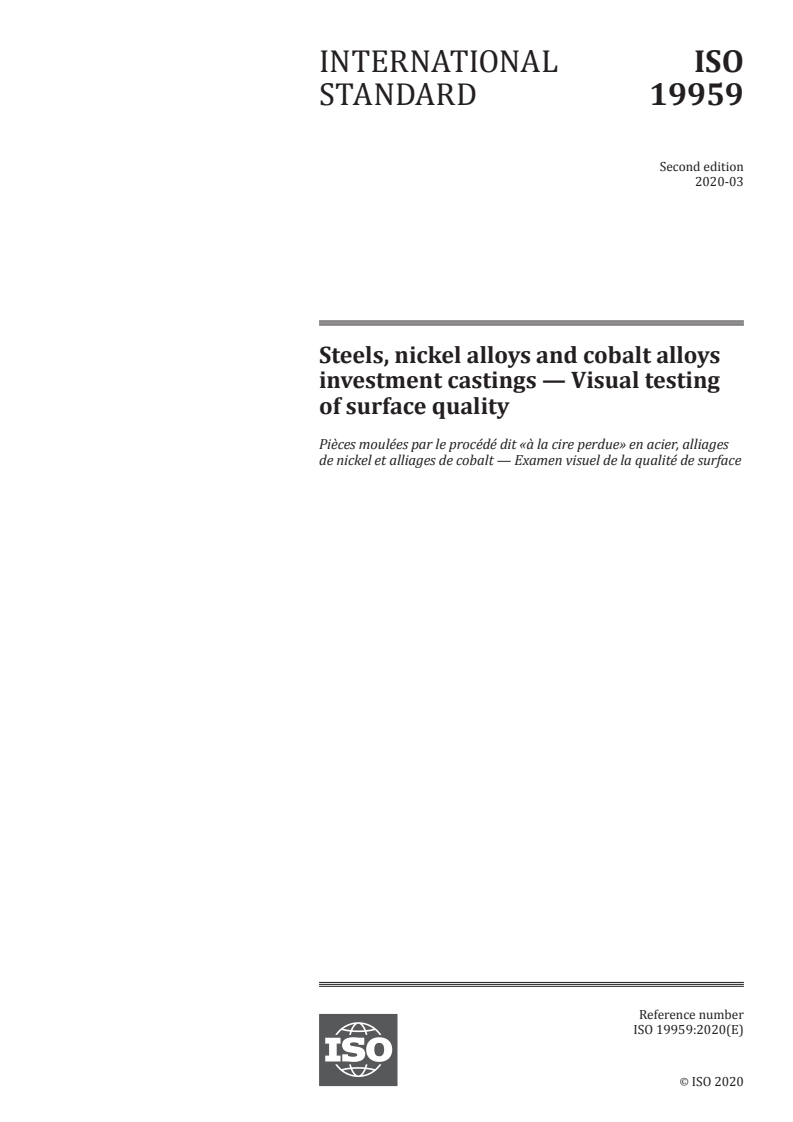
INTERNATIONAL ISO
STANDARD 19959
Second edition
2020-03
Steels, nickel alloys and cobalt alloys
investment castings — Visual testing
of surface quality
Pièces moulées par le procédé dit «à la cire perdue» en acier, alliages
de nickel et alliages de cobalt — Examen visuel de la qualité de surface
Reference number
©
ISO 2020
© ISO 2020
All rights reserved. Unless otherwise specified, or required in the context of its implementation, no part of this publication may
be reproduced or utilized otherwise in any form or by any means, electronic or mechanical, including photocopying, or posting
on the internet or an intranet, without prior written permission. Permission can be requested from either ISO at the address
below or ISO’s member body in the country of the requester.
ISO copyright office
CP 401 • Ch. de Blandonnet 8
CH-1214 Vernier, Geneva
Phone: +41 22 749 01 11
Fax: +41 22 749 09 47
Email: copyright@iso.org
Website: www.iso.org
Published in Switzerland
ii © ISO 2020 – All rights reserved
Contents Page
Foreword .iv
1 Scope . 1
2 Normative references . 1
3 Terms and definitions . 1
4 Ordering information . 2
5 Testing . 2
5.1 Qualification of personnel . 2
5.2 Conditions of testing . 2
6 Acceptance criteria . 2
7 Testing documentation . 2
Bibliography . 4
Foreword
ISO (the International Organization for Standardization) is a worldwide federation of national standards
bodies (ISO member bodies). The work of preparing International Standards is normally carried out
through ISO technical committees. Each member body interested in a subject for which a technical
committee has been established has the right to be represented on that committee. International
organizations, governmental and non-governmental, in liaison with ISO, also take part in the work.
ISO collaborates closely with the International Electrotechnical Commission (IEC) on all matters of
electrotechnical standardization.
The procedures used to develop this document and those intended for its further maintenance are
described in the ISO/IEC Directives, Part 1. In particular, the different approval criteria needed for the
different types of ISO documents should be noted. This document was drafted in accordance with the
editorial rules of the ISO/IEC Directives, Part 2 (see www .iso .org/ directives).
Attention is drawn to the possibility that some of the elements of this document may be the subject of
patent rights. ISO shall not be held responsible for identifying any or all such patent rights. Details of
any patent rights identified during the development of the document will be in the Introduction and/or
on the ISO list of patent declarations received (see www .iso .org/ patents).
Any trade name used in this document is information given for the convenience of users and does not
constitute an endorsement.
For an explanation of the voluntary nature of standards, the meaning of ISO specific terms and
expressions related to conformity assessment, as well as information about ISO's adherence to the
World Trade Organization (WTO) principles in the Technical Barriers to Trade (TBT) see www .iso .org/
iso/ foreword .html.
This document was prepared by Technical Committee ISO/TC 17, Steel, Subcommittee SC 11, Steel
castings.
This second edition cancels and replaces the first edition (ISO 19959:2005), which has been technically
revised. The main changes compared to the previous edition are as follows:
— “Terms and Definition” renumbered as Clause 3;
— “Ordering Information” renumbered as Clause 4;
— new Clause 7 for “Testing documentation”.
Any feedback or questions on this document should be directed to the user’s national standards body. A
complete listing of these bodies can be found at www .iso
...
Questions, Comments and Discussion
Ask us and Technical Secretary will try to provide an answer. You can facilitate discussion about the standard in here.
Loading comments...