

ISO 16468:2025
(Main)Investment castings (steel, nickel alloys and cobalt alloys) — General technical requirements
General Information
- Abstract
This document specifies technical requirements for castings (steel, nickel alloys, and cobalt alloys) produced by the investment casting process. NOTE The International Standards specifying metallurgical material requirements for steel, nickel alloy, and cobalt alloy casting grades are listed in the Bibliography. The requirements stated in this document form an integral part of the material specification. In cases of conflict, the requirements of this specification take precedence over the individual material specification requirements.
- Status
- Published
- Publication Date
- 25-May-2025
- Technical Committee
- ISO/TC 17/SC 11 - Steel castings
- Drafting Committee
- ISO/TC 17/SC 11 - Steel castings
- Current Stage
- 6060 - International Standard published
- Start Date
- 26-May-2025
- Due Date
- 01-Apr-2025
- Completion Date
- 26-May-2025
Overview
ISO 16468:2025 - Investment castings (steel, nickel alloys and cobalt alloys) - General technical requirements - defines the technical and inspection requirements for parts produced by the investment (lost‑wax) casting process in steel, nickel and cobalt alloy families. The third edition updates the 2015 version and sets requirements that become an integral part of any material specification; where conflicts occur, ISO 16468:2025 takes precedence.
Keywords: ISO 16468:2025, investment castings, steel castings, nickel alloy castings, cobalt alloy castings, general technical requirements.
Key topics and technical requirements
- Materials and manufacture
- Primary heats are to be produced by electric furnace routes, with optional refining (e.g., AOD, VOD, VIM) unless otherwise agreed.
- Sub‑heats (remelts) are made by induction furnaces, with or without atmosphere protection; limitations on re‑melting of revert material are specified.
- Inspection and testing
- General inspection follows ISO 4990; sampling rules specify how chemical and mechanical test samples relate to primary heats and sub‑heats.
- Test‑block options and specimen locations are illustrated (Figure 1) and guidance is provided for mechanical test sampling.
- Non‑destructive examination (NDE) and supplementary requirements
- A suite of supplementary options can be specified in orders: magnetic particle, liquid penetrant, radiographic, ultrasonic inspection, weld preparation inspection, impact testing, hardness testing (Brinell, Rockwell, Vickers), ferrite determination in duplex/austenitic steels, and more.
- Quality, cleaning and finishing
- Cleaning/dressing requirements ensure surface conditions are sufficient for acceptance checks; visual acceptance standards are to be agreed (ISO 11971 may be used).
- Production welding must comply with ISO 11970.
- Additional provisions
- Rules for retests, marking, decarburization concerns, metallurgical cleanliness, sampling frequencies and documentation are included or referenced.
Practical applications and users
ISO 16468:2025 is used by:
- Foundries and investment‑casting manufacturers specifying process, melting and remelt practices.
- Quality, inspection and metallurgy engineers setting acceptance criteria and sampling plans.
- Purchasers and procurement teams who include casting technical requirements in contracts.
- NDE technicians and welding engineers applying inspection, welding and repair requirements.
- Industries that rely on high‑integrity precision cast components - e.g., aerospace, power generation, oil & gas, medical devices and specialist engineering - where controlled metallurgical and inspection practices are critical.
Related standards
Normative and referenced standards commonly used with ISO 16468:2025 include:
- ISO 4990 (general technical delivery requirements for steel castings)
- ISO 4992‑1 / 4992‑2 (ultrasonic testing)
- ISO 4993 (radiographic testing)
- ISO 4986 / ISO 4987 (magnetic particle / liquid penetrant testing)
- ISO 6506‑1, ISO 6507‑1, ISO 6508‑1 (hardness tests)
- ISO 10474 (inspection documents) and ISO 11970 (welding procedure specification)
- ISO 13520 (ferrite determination in austenitic stainless steel castings)
Use ISO 16468:2025 when specifying investment‑casting technical requirements to ensure consistent metallurgical practice, sampling, inspection and acceptance criteria for steel, nickel and cobalt alloy parts.
Relations
- Effective Date
- 06-Jun-2022
Get Certified
Connect with accredited certification bodies for this standard

Element Materials Technology
Materials testing and product certification.

Inštitut za kovinske materiale in tehnologije
Institute of Metals and Technology. Materials testing, metallurgical analysis, NDT.
Sponsored listings
Frequently Asked Questions
ISO 16468:2025 is a standard published by the International Organization for Standardization (ISO). Its full title is "Investment castings (steel, nickel alloys and cobalt alloys) — General technical requirements". This standard covers: This document specifies technical requirements for castings (steel, nickel alloys, and cobalt alloys) produced by the investment casting process. NOTE The International Standards specifying metallurgical material requirements for steel, nickel alloy, and cobalt alloy casting grades are listed in the Bibliography. The requirements stated in this document form an integral part of the material specification. In cases of conflict, the requirements of this specification take precedence over the individual material specification requirements.
This document specifies technical requirements for castings (steel, nickel alloys, and cobalt alloys) produced by the investment casting process. NOTE The International Standards specifying metallurgical material requirements for steel, nickel alloy, and cobalt alloy casting grades are listed in the Bibliography. The requirements stated in this document form an integral part of the material specification. In cases of conflict, the requirements of this specification take precedence over the individual material specification requirements.
ISO 16468:2025 is classified under the following ICS (International Classification for Standards) categories: 77.140.80 - Iron and steel castings. The ICS classification helps identify the subject area and facilitates finding related standards.
ISO 16468:2025 has the following relationships with other standards: It is inter standard links to ISO 16468:2015. Understanding these relationships helps ensure you are using the most current and applicable version of the standard.
ISO 16468:2025 is available in PDF format for immediate download after purchase. The document can be added to your cart and obtained through the secure checkout process. Digital delivery ensures instant access to the complete standard document.
Standards Content (Sample)
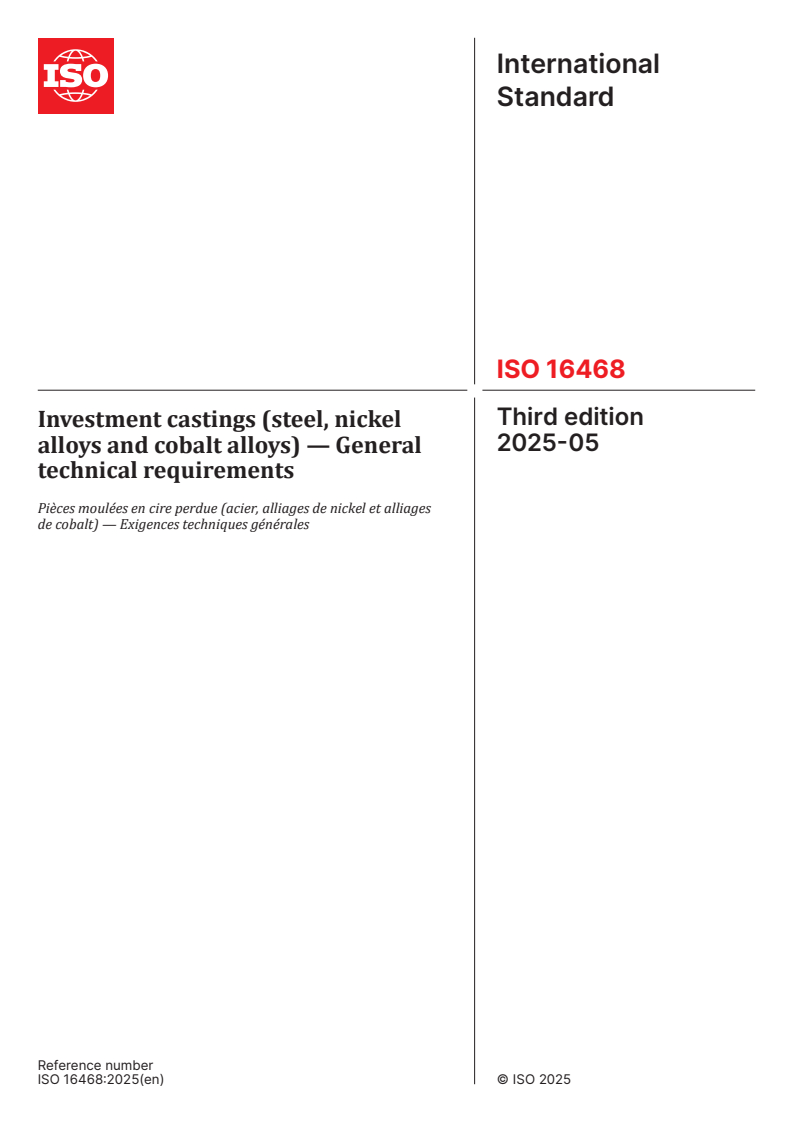
International
Standard
ISO 16468
Third edition
Investment castings (steel, nickel
2025-05
alloys and cobalt alloys) — General
technical requirements
Pièces moulées en cire perdue (acier, alliages de nickel et alliages
de cobalt) — Exigences techniques générales
Reference number
© ISO 2025
All rights reserved. Unless otherwise specified, or required in the context of its implementation, no part of this publication may
be reproduced or utilized otherwise in any form or by any means, electronic or mechanical, including photocopying, or posting on
the internet or an intranet, without prior written permission. Permission can be requested from either ISO at the address below
or ISO’s member body in the country of the requester.
ISO copyright office
CP 401 • Ch. de Blandonnet 8
CH-1214 Vernier, Geneva
Phone: +41 22 749 01 11
Email: copyright@iso.org
Website: www.iso.org
Published in Switzerland
ii
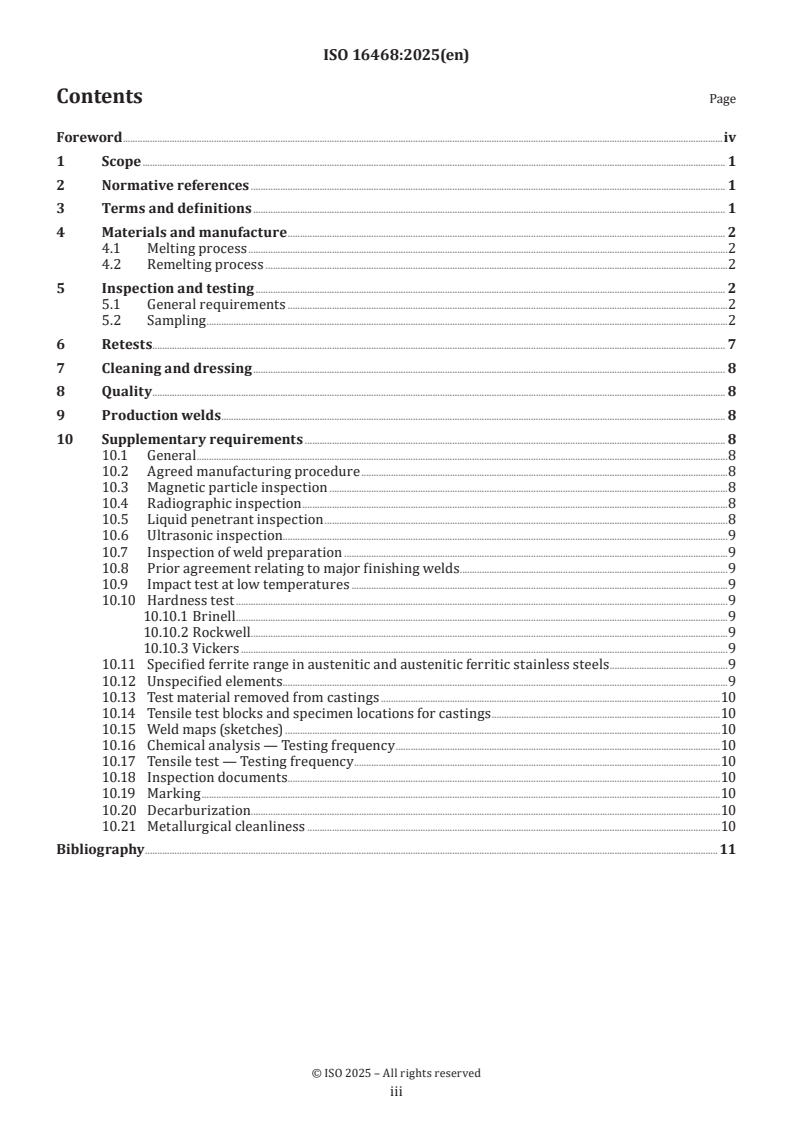
Contents Page
Foreword .iv
1 Scope . 1
2 Normative references . 1
3 Terms and definitions . 1
4 Materials and manufacture . 2
4.1 Melting process .2
4.2 Remelting process .2
5 Inspection and testing . 2
5.1 General requirements .2
5.2 Sampling .2
6 Retests . 7
7 Cleaning and dressing . 8
8 Quality . 8
9 Production welds . 8
10 Supplementary requirements . 8
10.1 General .8
10.2 Agreed manufacturing procedure .8
10.3 Magnetic particle inspection .8
10.4 Radiographic inspection .8
10.5 Liquid penetrant inspection .8
10.6 Ultrasonic inspection.9
10.7 Inspection of weld preparation .9
10.8 Prior agreement relating to major finishing welds .9
10.9 Impact test at low temperatures .9
10.10 Hardness test .9
10.10.1 Brinell .9
10.10.2 Rockwell.9
10.10.3 Vickers .9
10.11 Specified ferrite range in austenitic and austenitic ferritic stainless steels .9
10.12 Unspecified elements .9
10.13 Test material removed from castings .10
10.14 Tensile test blocks and specimen locations for castings .10
10.15 Weld maps (sketches) .10
10.16 Chemical analysis — Testing frequency .10
10.17 Tensile test — Testing frequency . .10
10.18 Inspection documents.10
10.19 Marking .10
10.20 Decarburization . .10
10.21 Metallurgical cleanliness .10
Bibliography .11
iii
Foreword
ISO (the International Organization for Standardization) is a worldwide federation of national standards
bodies (ISO member bodies). The work of preparing International Standards is normally carried out through
ISO technical committees. Each member body interested in a subject for which a technical committee
has been established has the right to be represented on that committee. International organizations,
governmental and non-governmental, in liaison with ISO, also take part in the work. ISO collaborates closely
with the International Electrotechnical Commission (IEC) on all matters of electrotechnical standardization.
The procedures used to develop this document and those intended for its further maintenance are described
in the ISO/IEC Directives, Part 1. In particular, the different approval criteria needed for the different types
of ISO document should be noted. This document was drafted in accordance with the editorial rules of the
ISO/IEC Directives, Part 2 (see www.iso.org/directives).
ISO draws attention to the possibility that the implementation of this document may involve the use of (a)
patent(s). ISO takes no position concerning the evidence, validity or applicability of any claimed patent
rights in respect thereof. As of the date of publication of this document, ISO had not received notice of (a)
patent(s) which may be required to implement this document. However, implementers are cautioned that
this may not represent the latest information, which may be obtained from the patent database available at
www.iso.org/patents. ISO shall not be held responsible for identifying any or all such patent rights.
Any trade name used in this document is information given for the convenience of users and does not
constitute an endorsement.
For an explanation of the voluntary nature of standards, the meaning of ISO specific terms and expressions
related to conformity assessment, as well as information about ISO's adherence to the World Trade
Organization (WTO) principles in the Technical Barriers to Trade (TBT), see www.iso.org/iso/foreword.html.
This document was prepared by Technical Committee ISO/TC 17, Steel, Subcommittee SC 11, Steel castings.
This third edition cancels and replaces the second edition (ISO 16468:2015), which has been technically
revised.
The main changes are as follows:
— former subclauses 5.2.1 to 5.2.4 have been relabelled a to d, with revised wording to c.
Any feedback or questions on this document should be directed to the user’s national standards body. A
complete listing of these bodies can be found at www.iso.org/members.html.
iv
International Standard ISO 16468:2025(en)
Investment castings (steel, nickel alloys and cobalt alloys) —
General technical requirements
1 Scope
This document specifies technical requirements for castings (steel, nickel alloys, and cobalt alloys) produced
by the investment casting process.
NOTE The International Standards specifying metallurgical material requirements for steel, nickel alloy, and
cobalt alloy casting grades are listed in the Bibliography.
The requirements stated in this document form an integral part of the material specification. In cases of
conflict, the requirements of this specification take precedence over the individual material specification
requirements.
2 Normative references
The following documents are referred to in the text in such a way that some or all of their content constitutes
requirements of this document. For dated references, only the edition cited applies. For undated references,
the latest edition of the referenced document (including any amendments) applies.
ISO 4986, Steel and iron castings — Magnetic particle testing
ISO 4987, Steel and iro
...