

ISO 15222:2025
(Main)Truck and bus tyres — Method for measuring relative wet grip performance — Loaded new tyres
General Information
- Abstract
This document specifies the method for measuring the relative wet grip braking performance index to a reference under loaded conditions for new tyres for use on commercial vehicles on a wet-paved surface. NOTE The methods developed in this document are intended to reduce variability. A reference tyre is used to limit the variability of the testing method procedures. This document applies to all commercial vehicle, truck and bus tyres. This document does not apply to: — tyres fitted with additional devices to improve traction properties (e.g. studded tyres); — professional off-road tyres.
- Status
- Published
- Publication Date
- 30-Nov-2025
- Technical Committee
- ISO/TC 31 - Tyres, rims and valves
- Drafting Committee
- ISO/TC 31 - Tyres, rims and valves
- Current Stage
- 6060 - International Standard published
- Start Date
- 01-Dec-2025
- Due Date
- 21-Jun-2026
- Completion Date
- 01-Dec-2025
Overview
ISO 15222:2025 - Truck and bus tyres - Method for measuring relative wet grip performance - Loaded new tyres defines a standardized test procedure for measuring the relative wet grip braking performance of new commercial vehicle tyres on a wet‑paved surface. The standard specifies methods to reduce test variability by using a reference tyre and applies to truck and bus tyres used on commercial vehicles. It excludes tyres with traction devices (e.g., studded tyres) and professional off‑road tyres. This is the third edition and replaces ISO 15222:2021 with updated reference tyres and revised track characterisation.
Key topics and technical requirements
- Test scope and definitions: Key terms such as candidate tyre, reference tyre, control tyre, braking force, braking force coefficient (BFC), dynamic tyre braking force coefficient and peak braking force coefficient are defined.
- Measurement approaches:
- Standard vehicle method - measuring braking‑related deceleration and calculating BFC.
- Trailer / tyre test vehicle method - real‑time measurement of vertical and longitudinal forces to derive dynamic and peak coefficients.
- Test environment and instrumentation:
- Track characteristics and macrotexture measurement requirements.
- Wetting and atmospheric condition controls to ensure repeatability.
- Precise instrumentation and data acquisition requirements for longitudinal and vertical force measurements.
- Tyre preparation:
- Tyre mounting, rim specifications, break‑in procedures, specified tyre load and inflation pressure for “loaded new tyres.”
- Data processing and validation:
- Calculation of braking force coefficients, adjusted reference tyre coefficients, and the relative wet grip index.
- Validation rules, result processing and example test report templates (Annex A).
- Control tyre concept: Use of control tyre sets when direct comparison on the same vehicle is not possible; storage, replacement and preservation rules.
Practical applications and users
ISO 15222:2025 is intended for:
- Tyre manufacturers conducting wet‑grip development and quality control.
- Independent test laboratories and homologation bodies performing performance verification.
- Vehicle manufacturers (OEMs) validating tyre choices for commercial fleets.
- Regulatory agencies and standards committees defining tyre performance labeling or procurement specifications.
- Fleet operators and procurement teams comparing wet‑braking performance for safety decisions.
Benefits include improved comparability of wet‑grip results, better repeatability across test facilities, and a clear basis for performance claims.
Related standards
- ISO 23671 - Passenger car tyres - Method for measuring relative wet grip performance (related methodology).
- ISO 4223-1, ISO 4209-1 - Terminology and tyre/rim specifications referenced.
- ASTM E965 - Pavement macrotexture measurement referenced for track characterisation.
Keywords: ISO 15222:2025, truck and bus tyres, wet grip, relative wet grip index, loaded new tyres, reference tyre, braking force coefficient, tyre test vehicle.
Relations
- Effective Date
- 24-Jun-2023
Get Certified
Connect with accredited certification bodies for this standard

DIN CERTCO
DIN Group product certification.

Smithers Quality Assessments
US management systems and product certification.
Sponsored listings
Frequently Asked Questions
ISO 15222:2025 is a standard published by the International Organization for Standardization (ISO). Its full title is "Truck and bus tyres — Method for measuring relative wet grip performance — Loaded new tyres". This standard covers: This document specifies the method for measuring the relative wet grip braking performance index to a reference under loaded conditions for new tyres for use on commercial vehicles on a wet-paved surface. NOTE The methods developed in this document are intended to reduce variability. A reference tyre is used to limit the variability of the testing method procedures. This document applies to all commercial vehicle, truck and bus tyres. This document does not apply to: — tyres fitted with additional devices to improve traction properties (e.g. studded tyres); — professional off-road tyres.
This document specifies the method for measuring the relative wet grip braking performance index to a reference under loaded conditions for new tyres for use on commercial vehicles on a wet-paved surface. NOTE The methods developed in this document are intended to reduce variability. A reference tyre is used to limit the variability of the testing method procedures. This document applies to all commercial vehicle, truck and bus tyres. This document does not apply to: — tyres fitted with additional devices to improve traction properties (e.g. studded tyres); — professional off-road tyres.
ISO 15222:2025 is classified under the following ICS (International Classification for Standards) categories: 83.160.10 - Road vehicle tyres. The ICS classification helps identify the subject area and facilitates finding related standards.
ISO 15222:2025 has the following relationships with other standards: It is inter standard links to ISO 15222:2021. Understanding these relationships helps ensure you are using the most current and applicable version of the standard.
ISO 15222:2025 is available in PDF format for immediate download after purchase. The document can be added to your cart and obtained through the secure checkout process. Digital delivery ensures instant access to the complete standard document.
Standards Content (Sample)
International
Standard
ISO 15222
Third edition
Truck and bus tyres — Method
2025-12
for measuring relative wet grip
performance — Loaded new tyres
Pneumatiques pour camions et autobus — Méthode de mesure
de l'adhérence relative sur revêtement mouillé — Pneumatiques
neufs en charge
Reference number
© ISO 2025
All rights reserved. Unless otherwise specified, or required in the context of its implementation, no part of this publication may
be reproduced or utilized otherwise in any form or by any means, electronic or mechanical, including photocopying, or posting on
the internet or an intranet, without prior written permission. Permission can be requested from either ISO at the address below
or ISO’s member body in the country of the requester.
ISO copyright office
CP 401 • Ch. de Blandonnet 8
CH-1214 Vernier, Geneva
Phone: +41 22 749 01 11
Email: copyright@iso.org
Website: www.iso.org
Published in Switzerland
ii
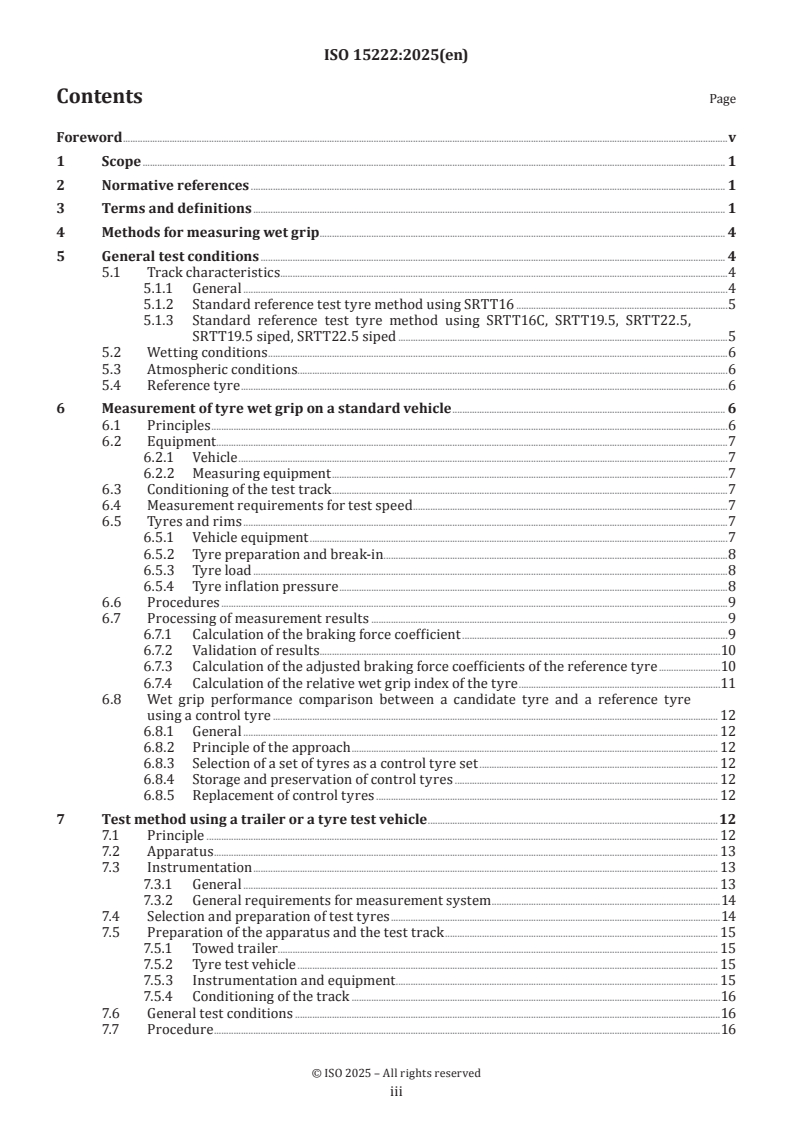
Contents Page
Foreword .v
1 Scope . 1
2 Normative references . 1
3 Terms and definitions . 1
4 Methods for measuring wet grip . 4
5 General test conditions . 4
5.1 Track characteristics . .4
5.1.1 General .4
5.1.2 Standard reference test tyre method using SRTT16 .5
5.1.3 Standard reference test tyre method using SRTT16C, SRTT19.5, SRTT22.5,
SRTT19.5 siped, SRTT22.5 siped .5
5.2 Wetting conditions .6
5.3 Atmospheric conditions.6
5.4 Reference tyre .6
6 Measurement of tyre wet grip on a standard vehicle . 6
6.1 Principles .6
6.2 Equipment .7
6.2.1 Vehicle .7
6.2.2 Measuring equipment .7
6.3 Conditioning of the test track .7
6.4 Measurement requirements for test speed .7
6.5 Tyres and rims .7
6.5.1 Vehicle equipment .7
6.5.2 Tyre preparation and break-in .8
6.5.3 Tyre load .8
6.5.4 Tyre inflation pressure .8
6.6 Procedures .9
6.7 Processing of measurement results .9
6.7.1 Calculation of the braking force coefficient .9
6.7.2 Validation of results.10
6.7.3 Calculation of the adjusted braking force coefficients of the reference tyre .10
6.7.4 Calculation of the relative wet grip index of the tyre .11
6.8 Wet grip performance comparison between a candidate tyre and a reference tyre
using a control tyre . 12
6.8.1 General . 12
6.8.2 Principle of the approach . 12
6.8.3 Selection of a set of tyres as a control tyre set . 12
6.8.4 Storage and preservation of control tyres . 12
6.8.5 Replacement of control tyres . 12
7 Test method using a trailer or a tyre test vehicle .12
7.1 Principle . 12
7.2 Apparatus . 13
7.3 Instrumentation . 13
7.3.1 General . 13
7.3.2 General requirements for measurement system .14
7.4 Selection and preparation of test tyres .14
7.5 Preparation of the apparatus and the test track . 15
7.5.1 Towed trailer. 15
7.5.2 Tyre test vehicle . 15
7.5.3 Instrumentation and equipment . 15
7.5.4 Conditioning of the track .16
7.6 General test conditions .16
7.7 Procedure .16
iii
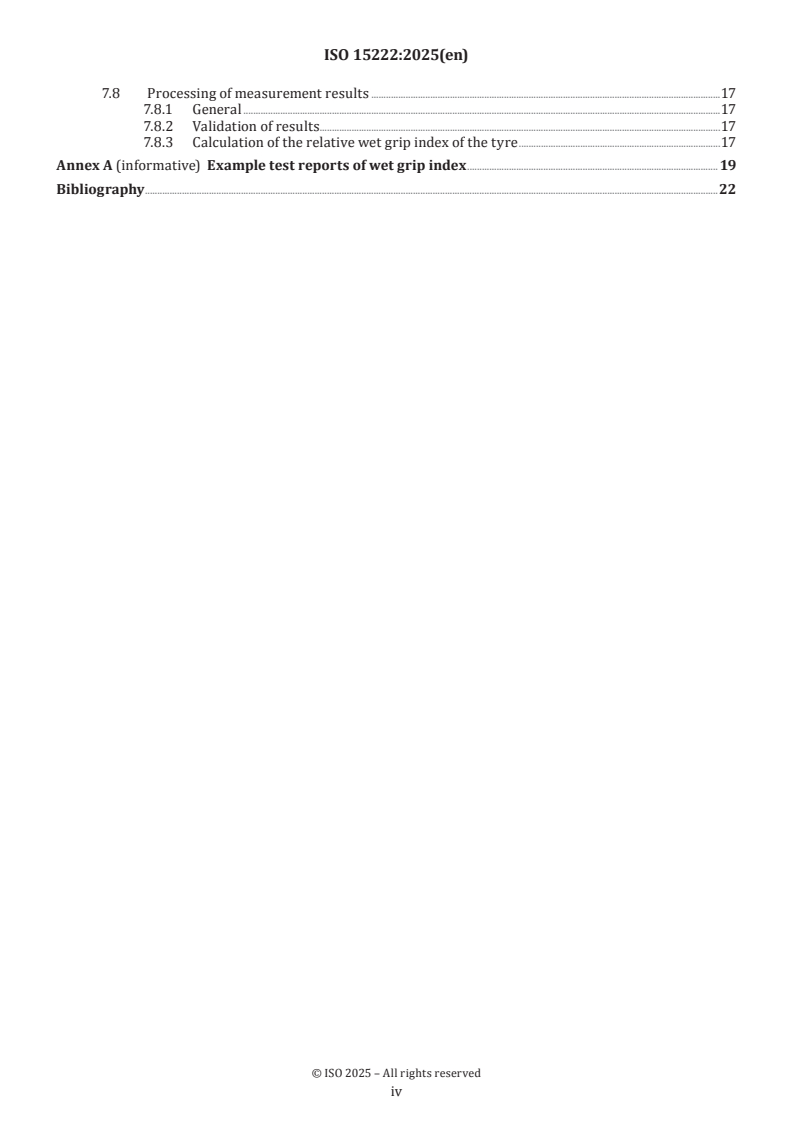
7.8 Processing of measurement results .17
7.8.1 General .17
7.8.2 Validation of results.17
7.8.3 Calculation of the relative wet grip index of the tyre .17
Annex A (informative) Example test reports of wet grip index . 19
Bibliography .22
iv
Foreword
ISO (the International Organization for Standardization) is a worldwide federation of national standards
bodies (ISO member bodies). The work of preparing International Standards is normally carried out through
ISO technical committees. Each member body interested in a subject for which a technical committee
has been established has the right to be represented on that committee. International organizations,
governmental and non-governmental, in liaison with ISO, also take part in the work. ISO collaborates closely
with the International Electrotechnical Commission (IEC) on all matters of electrotechnical standardization.
The procedures used to develop this document and those intended for its further maintenance are described
in the ISO/IEC Directives, Part 1. In particular, the different approval criteria needed for the different types
of ISO document should be noted. This document was drafted in accordance with the editorial rules of the
ISO/IEC Directives, Part 2 (see www.iso.org/directives).
ISO draws attention to the possibility that the implementation of this document may involve the use of (a)
patent(s). ISO takes no position concerning the evidence, validity or applicability of any claimed patent rights
in respect thereof. As of the date of publication of this document, ISO had not received notice of (a) patent(s)
which may be required to implement this document. However, implementers are cautioned that this may not
represent the latest information, which may be obtained from the patent database available at www.iso.org/
patents. ISO shall not be held responsible for identifying any or all such patent rights.
Any trade name used in this document is information given for the convenience of users and does not
constitute an endorsement.
For an explanation of the voluntary nature of standards, the meaning of ISO specific terms and expressions
related to conformity assessment, as well as information about ISO's adherence to the World Trade
Organization (WTO) principles in the Technical Barriers to Trade (TBT), see www.iso.org/iso/foreword.
html.
This document was prepared by Technical Committee ISO/TC 31, Tyres, rims and valves.
This third edition cancels and replaces the second edition (ISO 15222:2021), which has been technically
revised.
The main changes are as follows:
— addition of new reference tyres in Clauses 5.4, 6.7.4, 7.8.3, and Annex A;
— revision of the track characterization method in Clause 5.1.
Any feedback or questions on this document should be directed to the user’s national standards body. A
complete listing of these bodies can be found at www.iso.org/members.html.
v
International Standard ISO 15222:2025(en)
Truck and bus tyres — Method for measuring relative wet
grip performance — Loaded new tyres
1 Scope
This document specifies the method for measuring the relative wet grip braking performance index to a
reference under loaded conditions for new tyres for use on commercial vehicles on a wet-paved surface.
NOTE The methods developed in this document are intended to reduce variability. A reference tyre is used to
limit the variability of the testing method procedures.
This document applies to all commercial vehicle, truck and bus tyres.
This document does not apply to:
— tyres fitted with additional devices to improve traction properties (e.g. studded tyres);
— professional off-road tyres.
2 Normative references
The following documents are referred to in the text in such a way that some or all of their content constitutes
requirements of this document. For dated references, only the edition cited applies. For undated references,
the latest edition of the referenced document (including any amendments) applies.
ASTM E965-15, Standard Test Method for Measuring Pavement Macrotexture Depth Using a Volumetric
Technique
ISO 4209-1, Truck and bus tyres and rims (metric series) — Part 1: Tyres
ISO 4223-1, Definitions of some terms used in the tyre industry — Part 1: Pneumatic tyres
ISO 23671, Passenger car tyres — Method for measuring relative wet grip performance — Loaded new tyres
3 Terms and definitions
For the purposes of this document, the terms and definitions given in ISO 4223-1 and the following apply.
ISO and IEC maintain terminology databases for use in standardization at the following addresses:
— ISO Online browsing platform: available at https:// www .iso .org/ obp
— IEC Electropedia: available at https:// www .electropedia .org/
3.1
test run
single pass of a loaded tyre over a given test surface
3.2
candidate tyre
T
test tyre that is part of an evaluation programme
3.3
reference tyre
R
standard reference test tyre (3.19) that is used as a benchmark in an evaluation programme
Note 1 to entry: These tyres usually have carefully controlled design features to minimize variation.
3.4
control tyre
C
intermediate tyre that is used when the candidate tyre (3.2) and the reference tyre (3.3) cannot be directly
compared on the same vehicle
3.5
braking force
longitudinal force between a tyre and the road resulting from braking torque application
Note 1 to entry: It is expressed in newtons.
3.6
braking force coefficient
BFC
ratio between the average deceleration in a test run (3.1) and the acceleration gravity
−2
(9,81 m∙s )
3.7
dynamic tyre braking force coefficient
µ(t)
ratio between the braking force (3.5) and the vertical load (3.10)
acquired in real time
3.8
peak braking force coefficient
µ
peak
maximum value of the dynamic tyre braking force coefficient (3.7) that
occurs prior to the lockup of a wheel (3.9) as the braking torque is progressively increased
3.9
lockup of a wheel
condition of a wheel in which its rotational velocity about the wheel spin axis is zero and it is prevented from
rotating in the presence of applied wheel torque
3.10
vertical load
normal force (Z-direction) of a tyre exerted on the road resulting from the mass supported by the tyre
Note 1 to entry: It is expressed in newtons.
3.11
trailer
tyre test vehicle
special purpose tyre evaluation vehicle which has instruments to measure the vertical and longitudinal
forces on one tyre during braking
3.12
hitch height
coupling height
height when measured perpendicularly from the centre of the articulation point of the trailer towing
coupling or hitch to the ground, when the towing vehicle and trailer are coupled together
Note 1 to entry: The vehicle and trailer shall be standing on level pavement surface in their test mode complete with
the appropriate tyre(s) to be used in the particular test.
3.13
braking test
series of a specified number of test runs (3.1) of the same tyre repeated within a short time frame
3.14
braking test cycle
series of braking test (3.13) that consist of an initial braking test of the reference tyre (3.3) set, of up to three
braking tests of either candidate tyre (3.2) sets or control tyre (3.4) sets, or both, and a final braking test of
the same reference tyre set (3.17) or tyre set (3.18)
3.15
vehicle method
method for testing a tyre mounted on a commercially available vehicle
3.16
trailer or tyre test vehicle method
method for testing a tyre mounted on a trailer towed by a vehicle, or mounted on a special tyre test vehicle
3.17
tyre set
four or six tyres depending on the test vehicle
3.18
tyre set
one or two tyres
3.19
SRTT
standard reference test tyre
tyre that is produced, controlled and stored under specific conditions, in order to be used as a reference tyre
for testing
Note 1 to entry: These tyres usually have carefully controlled design features to minimize variation. The requirements
for SRTTs are given in ASTM international standards as indicated in SRTT16C (3.19.1) to SRTT22.5 siped (3.19.6) .
3.19.1
SRTT16C
[1]
standard reference test tyre (3.19) as defined in ASTM F2872
Note 1 to entry: It has the designation 225/75R16C 116/114S.
3.19.2
SRTT19.5
[2]
standard reference test tyre (3.19) as defined in ASTM F2871
Note 1 to entry: It has the designation 245/70R19.5 136/134M.
3.19.3
SRTT22.5
[3]
standard reference test tyre (3.19) as defined in ASTM F2870
Note 1 to entry: It has the designation 315/70R22.5 154/150L.
3.19.4
SRTT16
[4]
standard reference test tyre (3.19) as defined in ASTM F2493
Note 1 to entry: It has the designation P225/60R16 97S.
3.19.5
SRTT19.5 siped
[5]
standard reference test tyre (3.19) as defined in ASTM F3678
Note 1 to entry: It has the designation 245/70R19.5 136/134M SW.
3.19.6
SRTT22.5 siped
[6]
standard reference test tyre (3.19) as defined in ASTM F3677
Note 1 to entry: It has the designation 315/70R22.5 154/150L SW.
3.20
class of tyre
type of tyres intended to be used on similar vehicles
[7]
[SOURCE: ISO 20908 , 3.1]
3.20.1
class C2 tyre
commercial vehicle tyres with the load index (LI) in single formation lower than or equal to 121 and speed
category symbol greater than or equal to "N"
[8]
Note 1 to entry: Speed symbol “N” is defined in ISO 4209-1 .
3.20.2
class C3 tyre
commercial vehicle tyres with the load index (LI) in single formation less than or equal to 121 and speed
symbol "M" and below, or such tyres with the LI in single formation 122 and higher
[8]
Note 1 to entry: Speed symbol “M” is defined in the ISO 4209-1 .
4 Methods for measuring wet grip
The relative wet grip braking performance of a loaded new tyre for commercial vehicles travelling straight
ahead on a wet, paved surface can be measured by one of the following methods:
— a vehicle method consisting of testing a tyre set mounted on a standard vehicle;
— a test method using a trailer or a tyre test vehicle equipped with a test tyre set.
5 General test conditions
5.1 Track characteristics
5.1.1 General
The surface shall be a dense asphalt surface with a uniform gradient of not more than 2 %. The surface shall
not deviate by more than 6 mm when tested with a 3 m straight edge.
The test surface shall have a pavement of uniform age, composition and wear. The test surface shall be free
of loose material or foreign deposits.
The maximum chipping size shall be from 8 mm to 13 mm.
The macro texture depth (MTD) of the area of the track to be used for the wet grip test shall be measured as
specified in ASTM E965-15, and shall be (0,7 ± 0,3) mm.
The surface friction value for the wetted track shall be established by either of the following methods:
a) method specified in 5.1.2;
b) method specified in 5.1.3, according to the class of candidate tyre and the method, i.e. trailer (5.1.3.1) or
vehicle (5.1.3.2);
The determined wetted surface friction value shall be within the range indicated in Table 1.
Table 1 — Frictional properties of the surface
Trailer method Vehicle method
Class of candidate tyre SRTT
μ range BFC range
peak
C2, C3 SRTT16 0,65 - 0,90 N/A
C2 SRTT16C 0,44 - 0,77 0,36 - 0,69
C3 SRTT19.5 0,51 - 0,67 0,35 - 0,61
SRTT22.5
C3 SRTT19.5 siped 0,52 - 0,68 0,36 - 0,62
SRTT22.5 siped
5.1.2 Standard reference test tyre method using SRTT16
[4]
This method uses the SRTT P225/60R16 97S, defined in ASTM F2493 (see SRTT16).
Perform at least six valid measurements of the peak braking force coefficients (μ ) with SRTT16 using a
peak
trailer or special purpose tyre evaluation vehicle test procedure as specified in Clause 7 or in ISO 23671 at
65 km/h and 180 kPa.
If the coefficient of variation CV(μ ) exceeds 4 %, dismiss the results and repeat the braking test.
peak
The average of the measured peak braking force coefficients (μ ) shall be corrected for the effects of
peak,ave
temperature as shown in Formula (1):
(1)
where
μ is the temperature corrected average peak braking force coefficient;
peak,corr
μ is the average of the measured peak braking force coefficients;
peak,ave
−1
a is equal to 0,002 °C ;
is the wetted surface temperature in degree Celsius;
is equal to 20 °C.
μ shall be not less than 0,65 and not greater than 0,90.
peak,corr
The test shall be conducted using the lanes and length of the track to be used for the wet grip test.
For the trailer method, testing is run in such a way that braking occurs within a 10 m distance in length of
where the surface was characterized.
5.1.3 Standard reference test tyre method using SRTT16C, SRTT19.5, SRTT22.5, SRTT19.5 siped,
SRTT22.5 siped
5.1.3.1 Trailer or special purpose tyre evaluation vehicle test procedure
Using a trailer or special purpose tyre evaluation vehicle test procedure as specified in Clause 7, perform at
least eight valid measurements of the peak braking force coefficients, μ .
peak
Evaluate the braking test as described in Clause 7.8.2. If the coefficient of variation CV(µpeak) exceeds 5 %,
dismiss the results and repeat the braking test.
No temperature correction is applied.
The average peak braking force coefficient, μ , shall be within the range reported in Table 1.
peak,ave
The test shall be conducted using the lanes and length of the track to be used for the wet adhesion
measurement and in the same area where the MTD was evaluated.
5.1.3.2 Vehicle test procedure
Using a vehicle test procedure as specified in Clause 6, perform at least six valid measurements of the
braking force coefficient.
Evaluate the braking test as described in Clause 6.7.2. If the coefficient of variation CV(BFC) exceeds 3 %,
dismiss the results and repeat the braking test.
No temperature correction is applied.
The braking force coefficient (BFC ) shall be within the range specified in Table 1.
ave
The test shall be conducted using the lanes and length of the track to be used for the wet adhesion
measurement and in the same area where the MTD was evaluated.
5.2 Wetting conditions
The surface may be wetted from the track-side or by a wetting system incorporated into the test vehicle or
the trailer.
If external watering is used, water the test surface at least half an hour prior to testing in order to equalize
the surface temperature and water temperature. External watering should be supplied continuously
throughout testing.
For both external watering and self-watering systems, the water depth shall be not less than 0,5 mm and not
greater than 2,0 mm measured from the peaks of the pavement for the braking lanes used.
5.3 Atmospheric conditions
The wind conditions shall not interfere with wetting of the surface (windshields are allowed).
The ambient and the wetted surface temperatures shall be between 5 °C and 35 °C and shall not vary during
the test by more than 10 °C.
5.4 Reference tyre
In order to cover the range of tyre sizes fitting the commercial vehicles, the standard reference test tyres
SRTT16C, SRTT19.5, SRTT22.5, SRTT19.5 siped or SRTT22.5 siped shall be used to measure the relative wet
grip index according to Table 2.
Table 2 — Measurement of the relative wet grip index — Reference tyre
Class of tyre SRTT designation
For Class C3 tyres SRTT19.5, SRTT22.5, SRTT19.5 siped or SRTT22.5 siped
For Class C2 tyres SRTT16C
6 Measurement of tyre wet grip on a standard vehicle
6.1 Principles
The test method covers a procedure for measuring the deceleration performance of commercial vehicle
tyres during braking, using a commercial vehicle having an antilock braking system (ABS).
Starting with a defined initial speed, the brakes are applied hard enough on the two axles at the same time
to activate the ABS. The braking force coefficient (BFC) is calculated between the initial speed of 60 km/h
and the final speed 20 km/h.
6.2 Equipment
6.2.1 Vehicle
The standard equipment is a two-axle standard-model commercial vehicle equipped with four-disc brakes
and an ABS. If tyre fitting is not possible, for example, multi-purpose tyres (MPT) or free rolling tyres (FRT),
a vehicle model with drum-brakes and ABS is permitted.
The permitted modifications are:
— those allowing the number of tyre sizes that can be mounted on the vehicle to be increased;
— those permitting automatic activation of the braking device to be installed.
Any other modification of the braking system is prohibited.
6.2.2 Measuring equipment
Measuring device(s) suitable for measuring speed on wet surface and distance covered between two speeds
shall be used.
To measure vehicle speed, a fifth wheel or non-contact precision (including, for example, radar, GPS) speed-
measuring system shall be used.
The following tolerances shall be respected:
— for speed measurements: ±1 % or ±0,5 km/h, whichever is greater;
−1
— for distance: ±1 × 10 m.
The measured speed or the difference between the measured speed and the reference speed for the test
should be displayed inside the vehicle, so that the driver can adjust the speed of the vehicle.
A data acquisition system can be used for storing the measurements.
6.3 Conditioning of the test track
Condition the pavement by conducting at least 10 test runs with tyres not involved in the test programme at
an initial speed higher or equal to 65 km/h to guarantee that a sufficient length of track is conditioned.
6.4 Measurement requirements for test speed
The speed at the start of braking shall be (65 ± 2) km/h.
The average deceleration shall be calculated between 60 km/h and 20 km/h.
6.5 Tyres and rims
6.5.1 Vehicle equipment
The rear axle may be fitted with 2 tyres or 4 tyres.
For the reference tyre testing, both axles are fitted with reference tyres (a total of 4 reference tyres or 6
reference tyres depending on the choice mentioned above).
For the candidate tyre testing, three fitting configurations are possible:
— configuration 1: candidate tyres on front and rear axles (standard configuration that should be used
whenever possible);
— configuration 2: candidate tyres on front axle and reference tyre or control tyre on rear axle (permitted
where fitting the candidate tyre on the rear position is not possible);
— configuration 3: candidate tyres o
...