


ISO 16293-1:2008
(Main)Glass in building — Basic soda lime silicate glass products — Part 1: Definitions and general physical and mechanical properties
Glass in building — Basic soda lime silicate glass products — Part 1: Definitions and general physical and mechanical properties
ISO 16293-1:2008 defines and classifies basic soda-lime silicate glass products, indicates their chemical composition, their main physical and mechanical characteristics and defines their general quality criteria. Specific dimensions and dimensional tolerances, description of faults, quality limits and designation for the product types are not included in this part of ISO 16293-1:2008.
Verre dans la construction — Produits de base à partir de verre de silicate sodo-calcique — Partie 1: Définitions et propriétés physiques et mécaniques générales
General Information
- Status
- Published
- Publication Date
- 24-Jun-2008
- Technical Committee
- ISO/TC 160/SC 1 - Product considerations
- Drafting Committee
- ISO/TC 160/SC 1/WG 1 - Basic glass products
- Current Stage
- 9093 - International Standard confirmed
- Start Date
- 16-May-2025
- Completion Date
- 12-Feb-2026
Overview
ISO 16293-1:2008 - "Glass in building - Basic soda lime silicate glass products - Part 1" defines and classifies basic soda‑lime silicate glass used in building. The standard sets out chemical composition ranges, general physical and mechanical properties, and broad quality criteria for clear and body‑tinted glass. It does not include specific dimensions, dimensional tolerances, detailed fault descriptions or product designation limits (these are to be addressed in future Part 2 for float glass). ISO 9050 (light transmittance measurement) is a normative reference for optical testing.
Key topics and requirements
- Scope and classification
- Applies to basic soda‑lime silicate glass products commonly used in construction (including float glass definitions).
- Chemical composition
- Typical mass fraction ranges: SiO2 69–74 %, Na2O 10–16 %, CaO 5–14 %, MgO 0–6 %, Al2O3 0–3 %, others 0–5 %.
- Physical and mechanical characteristics
- Representative (conventional) values for normal annealed glass used for calculations where very high precision is not required:
- Density ≈ 2 500 kg/m3
- Mohs hardness ≈ 6
- Young’s modulus ≈ 7 × 10^10 Pa
- Poisson’s ratio ≈ 0.2
- Specific heat ≈ 0.85 × 10^3 J/(kg·K) at 50 °C
- Coefficient of linear expansion ≈ 9 × 10^-6 K^-1 (20–300 °C)
- Thermal conductivity ≈ 1 W/(m·K)
- Mean refractive index ≈ 1.5 (visible)
- Representative (conventional) values for normal annealed glass used for calculations where very high precision is not required:
- Optical designation (clear glass)
- Defines criteria for designating a product as clear transparent glass based on light transmittance measured per ISO 9050. Minimum transmittance values depend on nominal thickness (e.g., ~0.89 for 2 mm, decreasing to ~0.67 for 25 mm).
- Quality criteria
- General guidance for evaluating optical quality (distortion, homogeneity), appearance (spot and linear faults) and stability of properties over time.
Applications and users
ISO 16293-1:2008 is practically useful for:
- Architects, façade and glazing engineers specifying glass performance and optical designation.
- Glass manufacturers and product developers establishing material composition and baseline physical properties.
- Building product certifiers, inspectors and specifiers assessing basic quality and optical criteria.
- Designers performing preliminary structural/thermal calculations where conventional glass property values are needed.
Keywords: ISO 16293-1:2008, soda‑lime silicate glass, glass in building, float glass, light transmittance, glass properties, clear glass designation.
Related standards
- ISO 9050 - Determination of light transmittance and related glazing factors (normative reference).
- ISO 16293-2 - Planned part addressing specific dimensions, tolerances and fault descriptions for float glass.

Frequently Asked Questions
ISO 16293-1:2008 is a standard published by the International Organization for Standardization (ISO). Its full title is "Glass in building — Basic soda lime silicate glass products — Part 1: Definitions and general physical and mechanical properties". This standard covers: ISO 16293-1:2008 defines and classifies basic soda-lime silicate glass products, indicates their chemical composition, their main physical and mechanical characteristics and defines their general quality criteria. Specific dimensions and dimensional tolerances, description of faults, quality limits and designation for the product types are not included in this part of ISO 16293-1:2008.
ISO 16293-1:2008 defines and classifies basic soda-lime silicate glass products, indicates their chemical composition, their main physical and mechanical characteristics and defines their general quality criteria. Specific dimensions and dimensional tolerances, description of faults, quality limits and designation for the product types are not included in this part of ISO 16293-1:2008.
ISO 16293-1:2008 is classified under the following ICS (International Classification for Standards) categories: 81.040.20 - Glass in building. The ICS classification helps identify the subject area and facilitates finding related standards.
ISO 16293-1:2008 is available in PDF format for immediate download after purchase. The document can be added to your cart and obtained through the secure checkout process. Digital delivery ensures instant access to the complete standard document.
Standards Content (Sample)
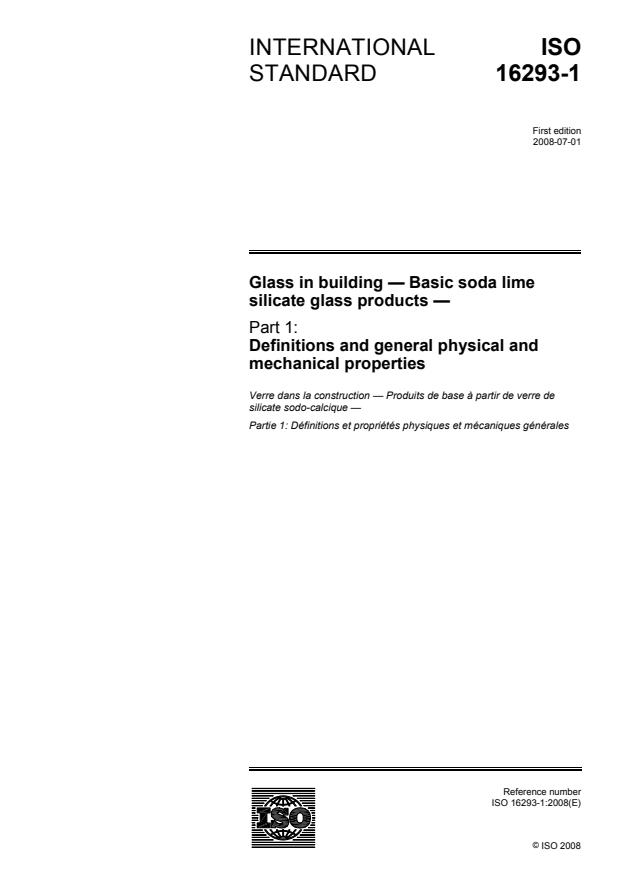
INTERNATIONAL ISO
STANDARD 16293-1
First edition
2008-07-01
Glass in building — Basic soda lime
silicate glass products —
Part 1:
Definitions and general physical and
mechanical properties
Verre dans la construction — Produits de base à partir de verre de
silicate sodo-calcique —
Partie 1: Définitions et propriétés physiques et mécaniques générales
Reference number
©
ISO 2008
PDF disclaimer
This PDF file may contain embedded typefaces. In accordance with Adobe's licensing policy, this file may be printed or viewed but
shall not be edited unless the typefaces which are embedded are licensed to and installed on the computer performing the editing. In
downloading this file, parties accept therein the responsibility of not infringing Adobe's licensing policy. The ISO Central Secretariat
accepts no liability in this area.
Adobe is a trademark of Adobe Systems Incorporated.
Details of the software products used to create this PDF file can be found in the General Info relative to the file; the PDF-creation
parameters were optimized for printing. Every care has been taken to ensure that the file is suitable for use by ISO member bodies. In
the unlikely event that a problem relating to it is found, please inform the Central Secretariat at the address given below.
© ISO 2008
All rights reserved. Unless otherwise specified, no part of this publication may be reproduced or utilized in any form or by any means,
electronic or mechanical, including photocopying and microfilm, without permission in writing from either ISO at the address below or
ISO's member body in the country of the requester.
ISO copyright office
Case postale 56 • CH-1211 Geneva 20
Tel. + 41 22 749 01 11
Fax + 41 22 749 09 47
E-mail copyright@iso.org
Web www.iso.org
Published in Switzerland
ii © ISO 2008 – All rights reserved
Foreword
ISO (the International Organization for Standardization) is a worldwide federation of national standards bodies
(ISO member bodies). The work of preparing International Standards is normally carried out through ISO
technical committees. Each member body interested in a subject for which a technical committee has been
established has the right to be represented on that committee. International organizations, governmental and
non-governmental, in liaison with ISO, also take part in the work. ISO collaborates closely with the
International Electrotechnical Commission (IEC) on all matters of electrotechnical standardization.
International Standards are drafted in accordance with the rules given in the ISO/IEC Directives, Part 2.
The main task of technical committees is to prepare International Standards. Draft International Standards
adopted by the technical committees are circulated to the member bodies for voting. Publication as an
International Standard requires approval by at least 75 % of the member bodies casting a vote.
Attention is drawn to the possibility that some of the elements of this document may be the subject of patent
rights. ISO shall not be held responsible for identifying any or all such patent rights.
ISO 16293-1 was prepared by Technical Committee ISO/TC 160, Glass in building, Subcommittee SC 1,
Product considerations.
ISO 16293 consists of the following parts, under the general title Glass in building — Basic soda lime silicate
glass products:
⎯ Part 1: Definitions and general physical and mechanical properties
A part 2 dealing with float glass is under preparation.
INTERNATIONAL STANDARD ISO 16293-1:2008(E)
Glass in building — Basic soda lime silicate glass products —
Part 1:
Definitions and general physical and mechanical properties
1 Scope
This part of ISO 16293 defines and classifies basic soda-lime silicate glass products, indicates their chemical
composition, their main physical and mechanical characteristics and defines their general quality criteria.
Specific dimensions and dimensional tolerances, description of faults, quality limits and designation for the
product types are not included in this part of ISO 16293.
NOTE It is intended to include the specific dimensions and dimensional tolerances, description of faults, quality limits
and designation for the product types in the future ISO 16293-2, which is specific to float glass.
2 Normative references
The following referenced documents are indispensable for the application of this document. For dated
references, only the edition cited applies. For undated references, the latest edition of the referenced
document (including any amendments) applies.
ISO 9050, Glass in building — Determination of light transmittance, solar direct transmittance, total solar
energy transmittance, ultraviolet transmittance and related glazing factors
3 Terms and definitions
For the purposes of this document, the following terms and definitions apply.
3.1
float glass
flat, transparent, clear or tinted soda-lime silicate glass having parallel and polished faces obtained
...
Questions, Comments and Discussion
Ask us and Technical Secretary will try to provide an answer. You can facilitate discussion about the standard in here.
Loading comments...