

ISO 21690:2021
(Main)Glass in building — Glass blocks — Specification and test methods
General Information
- Abstract
This document specifies requirements for the properties of glass blocks used for the construction of non-load-bearing walls and horizontally spanning panels. This document also specifies test methods used to verify these properties for square, rectangular and circular glass blocks.
- Status
- Published
- Publication Date
- 15-Nov-2021
- Technical Committee
- ISO/TC 160/SC 1 - Product considerations
- Drafting Committee
- ISO/TC 160/SC 1/WG 7 - Glass blocks and glass paver units
- Current Stage
- 6060 - International Standard published
- Start Date
- 16-Nov-2021
- Due Date
- 09-Jan-2022
- Completion Date
- 16-Nov-2021
Buy Documents

ISO 21690:2021 - Glass in building -- Glass blocks -- Specification and test methods
ISO 21690:2021 - Glass in building — Glass blocks — Specification and test methods/16/2021
Overview
ISO 21690:2021 - Glass in building - Glass blocks - Specification and test methods provides standardized requirements and test methods for glass blocks used in building elements. It covers square, rectangular and circular glass blocks in three categories (hollow, dished and solid) for use in non‑load‑bearing walls and horizontally spanning panels (e.g., floors, vaults, domes). The document specifies dimensional tolerances, appearance criteria, mechanical requirements and test procedures to verify conformity.
Key topics and technical requirements
- Types and shapes: Hollow, dished and solid glass blocks; square, rectangular and circular shapes are covered.
- Dimensional tolerances: External dimensions (length, width, thickness) shall not exceed ±1.5 mm. Face thickness for hollow blocks shall be not less than 3.0 mm.
- Production irregularities: Limits for inherent irregularities - twisting or misalignment ≤ 1.5 mm, bulge ≤ 2.0 mm, depression ≤ 1.0 mm, and welded seams must be tightly sealed without protrusion beyond the edge profile.
- Appearance requirements: Visual inspection is performed at 0.8–1.0 m with backlighting (diffused source 430–540 lm/m²). Permissible blemishes are defined (e.g., bubble size thresholds, limits for opaque inclusions, scratches and pits).
- Mechanical properties:
- Compressive strength for hollow blocks: minimum 4.4 N/mm² (test procedures in Annex A).
- Applied load test for glass pavers (hollow, dished, solid): minimum average compressive strength 15.0 kN.
- Thermal shock resistance: For special purposes, a thermal shock test with a 40 °C temperature fall is specified; no cracks or damage permitted.
- Test methods and instrumentation: Measurement methods include sliding calipers, steel straight edges, feeler gauges; mechanical testing references include calibration and mortar capping procedures (mortar per EN 998‑2, capped layer ~10 ±2 mm).
Applications and users
ISO 21690:2021 is used to ensure consistent quality, safety and performance of glass blocks in architectural and structural installations. Typical users:
- Architects and façade designers specifying light‑transmitting partitions, non‑load‑bearing walls and glass pavements.
- Manufacturers of glass blocks for production control and product certification.
- Test laboratories and quality inspectors performing dimensional, appearance, mechanical and thermal tests.
- Building engineers and contractors verifying conformance for installation and procurement.
Related standards
Normative references cited include EN 998‑2 (masonry mortar), ISO 7500‑1 (calibration of test machines) and ISO 48‑2 (hardness testing), which are relevant for test preparation and equipment calibration.
Keywords: ISO 21690:2021, glass blocks, glass in building, specification and test methods, dimensional tolerances, compressive strength, thermal shock resistance, appearance requirements.
Relations
- Effective Date
- 15-Dec-2017
Buy Documents
ISO 21690:2021 - Glass in building -- Glass blocks -- Specification and test methods
ISO 21690:2021 - Glass in building — Glass blocks — Specification and test methods/16/2021
Frequently Asked Questions
ISO 21690:2021 is a standard published by the International Organization for Standardization (ISO). Its full title is "Glass in building — Glass blocks — Specification and test methods". This standard covers: This document specifies requirements for the properties of glass blocks used for the construction of non-load-bearing walls and horizontally spanning panels. This document also specifies test methods used to verify these properties for square, rectangular and circular glass blocks.
This document specifies requirements for the properties of glass blocks used for the construction of non-load-bearing walls and horizontally spanning panels. This document also specifies test methods used to verify these properties for square, rectangular and circular glass blocks.
ISO 21690:2021 is classified under the following ICS (International Classification for Standards) categories: 81.040.20 - Glass in building. The ICS classification helps identify the subject area and facilitates finding related standards.
ISO 21690:2021 has the following relationships with other standards: It is inter standard links to ISO 21690:2006. Understanding these relationships helps ensure you are using the most current and applicable version of the standard.
ISO 21690:2021 is available in PDF format for immediate download after purchase. The document can be added to your cart and obtained through the secure checkout process. Digital delivery ensures instant access to the complete standard document.
Standards Content (Sample)
INTERNATIONAL ISO
STANDARD 21690
Second edition
2021-11
Glass in building — Glass blocks —
Specification and test methods
Verre dans la construction — Briques de verre — Spécification et
méthodes d'essai
Reference number
© ISO 2021
All rights reserved. Unless otherwise specified, or required in the context of its implementation, no part of this publication may
be reproduced or utilized otherwise in any form or by any means, electronic or mechanical, including photocopying, or posting on
the internet or an intranet, without prior written permission. Permission can be requested from either ISO at the address below
or ISO’s member body in the country of the requester.
ISO copyright office
CP 401 • Ch. de Blandonnet 8
CH-1214 Vernier, Geneva
Phone: +41 22 749 01 11
Email: copyright@iso.org
Website: www.iso.org
Published in Switzerland
ii
Contents Page
Foreword .iv
Introduction .v
1 Scope . 1
2 Normative references . 1
3 Terms and definitions . 1
4 Symbols . 2
5 Types of glass block . .2
5.1 Categories. 2
5.2 Shapes of glass block . 3
5.3 Surface aspect and treatment . 3
6 Dimensional tolerances . 4
6.1 Methods . 4
6.2 Hollow glass block face thickness . 4
6.3 External dimensions . 4
7 Irregularities inherent to the production of hollow glass block .4
7.1 Dimensional irregularities measurement method . 4
7.1.1 Welded seam protrusion . 4
7.1.2 Twisting or misalignment . 5
7.1.3 Face depressions or bulge . 5
7.2 Dimensional irregularities limitation . 5
8 Appearance for hollow glass blocks .6
8.1 Method . 6
8.2 Appearance requirements . 6
9 Mechanical properties .7
9.1 Compressive strength of hollow glass blocks . 7
9.2 Applied load test . 7
10 Thermal shock resistance for hollow glass blocks . 7
Annex A (normative) Mechanical resistance test procedures . 8
Annex B (informative) Mechanical resistance test procedures — Thermal shock test
procedures .11
Bibliography .12
iii
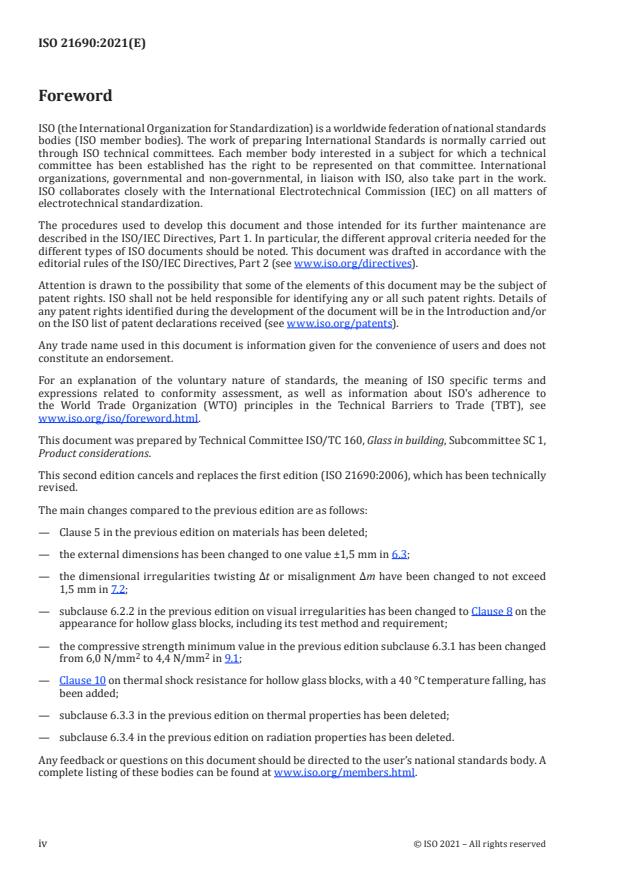
Foreword
ISO (the International Organization for Standardization) is a worldwide federation of national standards
bodies (ISO member bodies). The work of preparing International Standards is normally carried out
through ISO technical committees. Each member body interested in a subject for which a technical
committee has been established has the right to be represented on that committee. International
organizations, governmental and non-governmental, in liaison with ISO, also take part in the work.
ISO collaborates closely with the International Electrotechnical Commission (IEC) on all matters of
electrotechnical standardization.
The procedures used to develop this document and those intended for its further maintenance are
described in the ISO/IEC Directives, Part 1. In particular, the different approval criteria needed for the
different types of ISO documents should be noted. This document was drafted in accordance with the
editorial rules of the ISO/IEC Directives, Part 2 (see www.iso.org/directives).
Attention is drawn to the possibility that some of the elements of this document may be the subject of
patent rights. ISO shall not be held responsible for identifying any or all such patent rights. Details of
any patent rights identified during the development of the document will be in the Introduction and/or
on the ISO list of patent declarations received (see www.iso.org/patents).
Any trade name used in this document is information given for the convenience of users and does not
constitute an endorsement.
For an explanation of the voluntary nature of standards, the meaning of ISO specific terms and
expressions related to conformity assessment, as well as information about ISO's adherence to
the World Trade Organization (WTO) principles in the Technical Barriers to Trade (TBT), see
www.iso.org/iso/foreword.html.
This document was prepared by Technical Committee ISO/TC 160, Glass in building, Subcommittee SC 1,
Product considerations.
This second edition cancels and replaces the first edition (ISO 21690:2006), which has been technically
revised.
The main changes compared to the previous edition are as follows:
— Clause 5 in the previous edition on materials has been deleted;
— the external dimensions has been changed to one value ±1,5 mm in 6.3;
— the dimensional irregularities twisting Δt or misalignment Δm have been changed to not exceed
1,5 mm in 7.2;
— subclause 6.2.2 in the previous edition on visual irregularities has been changed to Clause 8 on the
appearance for hollow glass blocks, including its test method and requirement;
— the compressive strength minimum value in the previous edition subclause 6.3.1 has been changed
2 2
from 6,0 N/mm to 4,4 N/mm in 9.1;
— Clause 10 on thermal shock resistance for hollow glass blocks, with a 40 °C temperature falling, has
been added;
— subclause 6.3.3 in the previous edition on thermal properties has been deleted;
— subclause 6.3.4 in the previous edition on radiation properties has been deleted.
Any feedback or questions on this document should be directed to the user’s national standards body. A
complete listing of these bodies can be found at www.iso.org/members.html.
iv
Introduction
Light transmitting glass blocks are used for the construction of building elements both in non-load
bearing walls and load bearing horizontally spanning panels.
Glass blocks for non-load bearing walls carry only their own weight and withstand horizontal forces
such as those generated by the wind. Glass block walls and horizontally spanning panels do not carry
any forces generated by the building.
Glass blocks used for the construction of horizontally spanning panels (e.g. floors, vaults and domes)
carry their own weight and any other imposed loads (e.g. pedestrian or vehicular traffic).
v
INTERNATIONAL STANDARD ISO 21690:2021(E)
Glass in building — Glass blocks — Specification and test
methods
1 Scope
This document specifies requirements for the properties of glass blocks used for the construction of
non-load-bearing walls and horizontally spanning panels. This document also specifies test methods
used to verify these properties for square, rectangular and circular glass blocks.
2 Normative references
The following documents are referred to in the text in such a way that some or all of their content
constitutes requirements of this document. For dated references, only the edition cited applies. For
undated references, the latest edition
...
INTERNATIONAL ISO
STANDARD 21690
Second edition
2021-11
Glass in building — Glass blocks —
Specification and test methods
Verre dans la construction — Briques de verre — Spécification et
méthodes d'essai
Reference number
© ISO 2021
All rights reserved. Unless otherwise specified, or required in the context of its implementation, no part of this publication may
be reproduced or utilized otherwise in any form or by any means, electronic or mechanical, including photocopying, or posting on
the internet or an intranet, without prior written permission. Permission can be requested from either ISO at the address below
or ISO’s member body in the country of the requester.
ISO copyright office
CP 401 • Ch. de Blandonnet 8
CH-1214 Vernier, Geneva
Phone: +41 22 749 01 11
Email: copyright@iso.org
Website: www.iso.org
Published in Switzerland
ii
Contents Page
Foreword .iv
Introduction .v
1 Scope . 1
2 Normative references . 1
3 Terms and definitions . 1
4 Symbols . 2
5 Types of glass block . .2
5.1 Categories. 2
5.2 Shapes of glass block . 3
5.3 Surface aspect and treatment . 3
6 Dimensional tolerances . 4
6.1 Methods . 4
6.2 Hollow glass block face thickness . 4
6.3 External dimensions . 4
7 Irregularities inherent to the production of hollow glass block .4
7.1 Dimensional irregularities measurement method . 4
7.1.1 Welded seam protrusion . 4
7.1.2 Twisting or misalignment . 5
7.1.3 Face depressions or bulge . 5
7.2 Dimensional irregularities limitation . 5
8 Appearance for hollow glass blocks .6
8.1 Method . 6
8.2 Appearance requirements . 6
9 Mechanical properties .7
9.1 Compressive strength of hollow glass blocks . 7
9.2 Applied load test . 7
10 Thermal shock resistance for hollow glass blocks . 7
Annex A (normative) Mechanical resistance test procedures . 8
Annex B (informative) Mechanical resistance test procedures — Thermal shock test
procedures .11
Bibliography .12
iii
Foreword
ISO (the International Organization for Standardization) is a worldwide federation of national standards
bodies (ISO member bodies). The work of preparing International Standards is normally carried out
through ISO technical committees. Each member body interested in a subject for which a technical
committee has been established has the right to be represented on that committee. International
organizations, governmental and non-governmental, in liaison with ISO, also take part in the work.
ISO collaborates closely with the International Electrotechnical Commission (IEC) on all matters of
electrotechnical standardization.
The procedures used to develop this document and those intended for its further maintenance are
described in the ISO/IEC Directives, Part 1. In particular, the different approval criteria needed for the
different types of ISO documents should be noted. This document was drafted in accordance with the
editorial rules of the ISO/IEC Directives, Part 2 (see www.iso.org/directives).
Attention is drawn to the possibility that some of the elements of this document may be the subject of
patent rights. ISO shall not be held responsible for identifying any or all such patent rights. Details of
any patent rights identified during the development of the document will be in the Introduction and/or
on the ISO list of patent declarations received (see www.iso.org/patents).
Any trade name used in this document is information given for the convenience of users and does not
constitute an endorsement.
For an explanation of the voluntary nature of standards, the meaning of ISO specific terms and
expressions related to conformity assessment, as well as information about ISO's adherence to
the World Trade Organization (WTO) principles in the Technical Barriers to Trade (TBT), see
www.iso.org/iso/foreword.html.
This document was prepared by Technical Committee ISO/TC 160, Glass in building, Subcommittee SC 1,
Product considerations.
This second edition cancels and replaces the first edition (ISO 21690:2006), which has been technically
revised.
The main changes compared to the previous edition are as follows:
— Clause 5 in the previous edition on materials has been deleted;
— the external dimensions has been changed to one value ±1,5 mm in 6.3;
— the dimensional irregularities twisting Δt or misalignment Δm have been changed to not exceed
1,5 mm in 7.2;
— subclause 6.2.2 in the previous edition on visual irregularities has been changed to Clause 8 on the
appearance for hollow glass blocks, including its test method and requirement;
— the compressive strength minimum value in the previous edition subclause 6.3.1 has been changed
2 2
from 6,0 N/mm to 4,4 N/mm in 9.1;
— Clause 10 on thermal shock resistance for hollow glass blocks, with a 40 °C temperature falling, has
been added;
— subclause 6.3.3 in the previous edition on thermal properties has been deleted;
— subclause 6.3.4 in the previous edition on radiation properties has been deleted.
Any feedback or questions on this document should be directed to the user’s national standards body. A
complete listing of these bodies can be found at www.iso.org/members.html.
iv
Introduction
Light transmitting glass blocks are used for the construction of building elements both in non-load
bearing walls and load bearing horizontally spanning panels.
Glass blocks for non-load bearing walls carry only their own weight and withstand horizontal forces
such as those generated by the wind. Glass block walls and horizontally spanning panels do not carry
any forces generated by the building.
Glass blocks used for the construction of horizontally spanning panels (e.g. floors, vaults and domes)
carry their own weight and any other imposed loads (e.g. pedestrian or vehicular traffic).
v
INTERNATIONAL STANDARD ISO 21690:2021(E)
Glass in building — Glass blocks — Specification and test
methods
1 Scope
This document specifies requirements for the properties of glass blocks used for the construction of
non-load-bearing walls and horizontally spanning panels. This document also specifies test methods
used to verify these properties for square, rectangular and circular glass blocks.
2 Normative references
The following documents are referred to in the text in such a way that some or all of their content
constitutes requirements of this document. For dated references, only the edition cited applies. For
undated references, the latest edition
...