


ISO 16132:2016
(Main)Ductile iron pipes and fittings — Seal coats for cement mortar linings
Ductile iron pipes and fittings — Seal coats for cement mortar linings
ISO 16132:2016 specifies the requirements for seal coatings for factory application to the surfaces of cement mortar linings, which are factory applied to the interior of ductile iron pipes and fittings. It provides the performance requirements for short-term sealing efficiency, long-term durability and cyclic pressure, as well as the routine testing requirements for visual appearance, coating thickness and adhesion. ISO 16132:2016 is applicable to products for potable and other water applications.
Tuyaux et raccords en fonte ductile — Seal coats pour les revêtements de mortier de ciment
General Information
- Status
- Withdrawn
- Publication Date
- 20-Apr-2016
- Technical Committee
- ISO/TC 5/SC 2 - Cast iron pipes, fittings and their joints
- Drafting Committee
- ISO/TC 5/SC 2 - Cast iron pipes, fittings and their joints
- Current Stage
- 9599 - Withdrawal of International Standard
- Start Date
- 08-Mar-2024
- Completion Date
- 12-Feb-2026
Relations
- Effective Date
- 06-Aug-2022
- Effective Date
- 07-Dec-2013
Get Certified
Connect with accredited certification bodies for this standard

Element Materials Technology
Materials testing and product certification.

Inštitut za kovinske materiale in tehnologije
Institute of Metals and Technology. Materials testing, metallurgical analysis, NDT.
Institut za varilstvo d.o.o. (Welding Institute)
Slovenia's leading welding institute since 1952. ISO 3834, EN 1090, pressure equipment certification, NDT personnel, welder qualification. Only IIW Au
Sponsored listings
Frequently Asked Questions
ISO 16132:2016 is a standard published by the International Organization for Standardization (ISO). Its full title is "Ductile iron pipes and fittings — Seal coats for cement mortar linings". This standard covers: ISO 16132:2016 specifies the requirements for seal coatings for factory application to the surfaces of cement mortar linings, which are factory applied to the interior of ductile iron pipes and fittings. It provides the performance requirements for short-term sealing efficiency, long-term durability and cyclic pressure, as well as the routine testing requirements for visual appearance, coating thickness and adhesion. ISO 16132:2016 is applicable to products for potable and other water applications.
ISO 16132:2016 specifies the requirements for seal coatings for factory application to the surfaces of cement mortar linings, which are factory applied to the interior of ductile iron pipes and fittings. It provides the performance requirements for short-term sealing efficiency, long-term durability and cyclic pressure, as well as the routine testing requirements for visual appearance, coating thickness and adhesion. ISO 16132:2016 is applicable to products for potable and other water applications.
ISO 16132:2016 is classified under the following ICS (International Classification for Standards) categories: 23.040.10 - Iron and steel pipes; 77.140.75 - Steel pipes and tubes for specific use. The ICS classification helps identify the subject area and facilitates finding related standards.
ISO 16132:2016 has the following relationships with other standards: It is inter standard links to ISO 16132:2024, ISO 16132:2004. Understanding these relationships helps ensure you are using the most current and applicable version of the standard.
ISO 16132:2016 is available in PDF format for immediate download after purchase. The document can be added to your cart and obtained through the secure checkout process. Digital delivery ensures instant access to the complete standard document.
Standards Content (Sample)
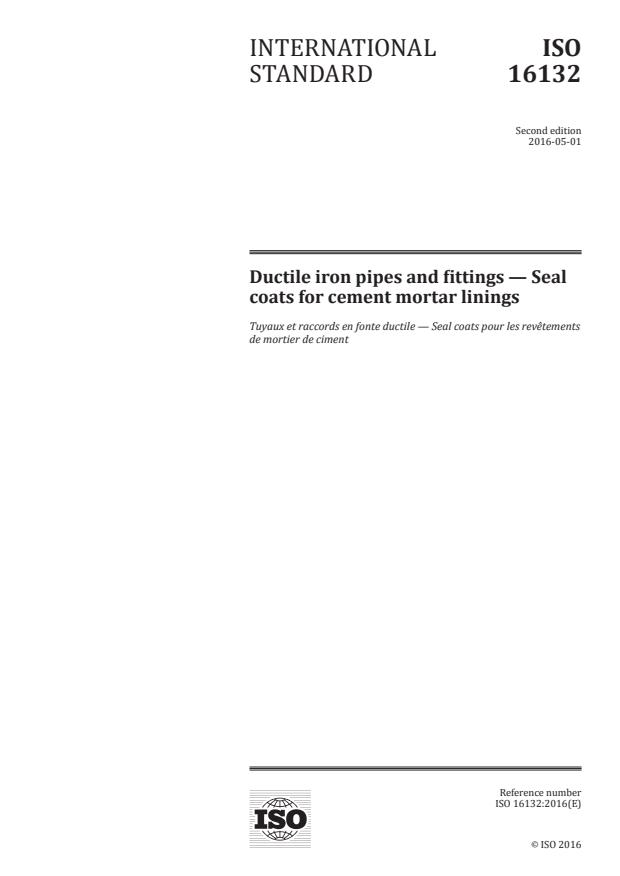
INTERNATIONAL ISO
STANDARD 16132
Second edition
2016-05-01
Ductile iron pipes and fittings — Seal
coats for cement mortar linings
Tuyaux et raccords en fonte ductile — Seal coats pour les revêtements
de mortier de ciment
Reference number
©
ISO 2016
© ISO 2016, Published in Switzerland
All rights reserved. Unless otherwise specified, no part of this publication may be reproduced or utilized otherwise in any form
or by any means, electronic or mechanical, including photocopying, or posting on the internet or an intranet, without prior
written permission. Permission can be requested from either ISO at the address below or ISO’s member body in the country of
the requester.
ISO copyright office
Ch. de Blandonnet 8 • CP 401
CH-1214 Vernier, Geneva, Switzerland
Tel. +41 22 749 01 11
Fax +41 22 749 09 47
copyright@iso.org
www.iso.org
ii © ISO 2016 – All rights reserved
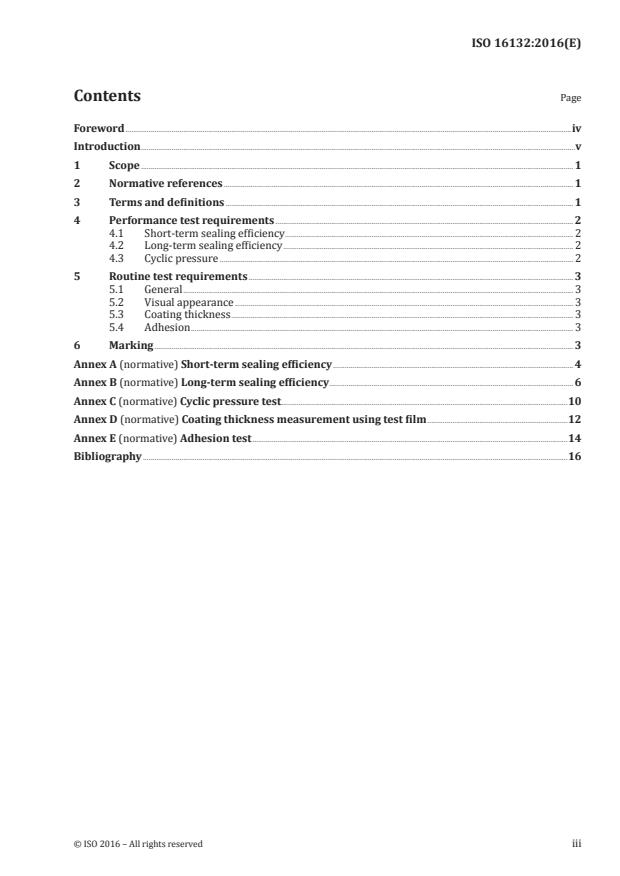
Contents Page
Foreword .iv
Introduction .v
1 Scope . 1
2 Normative references . 1
3 Terms and definitions . 1
4 Performance test requirements . 2
4.1 Short-term sealing efficiency . 2
4.2 Long-term sealing efficiency . 2
4.3 Cyclic pressure . 2
5 Routine test requirements . 3
5.1 General . 3
5.2 Visual appearance . 3
5.3 Coating thickness . 3
5.4 Adhesion . 3
6 Marking . 3
Annex A (normative) Short-term sealing efficiency . 4
Annex B (normative) Long-term sealing efficiency . 6
Annex C (normative) Cyclic pressure test .10
Annex D (normative) Coating thickness measurement using test film .12
Annex E (normative) Adhesion test .14
Bibliography .16
Foreword
ISO (the International Organization for Standardization) is a worldwide federation of national standards
bodies (ISO member bodies). The work of preparing International Standards is normally carried out
through ISO technical committees. Each member body interested in a subject for which a technical
committee has been established has the right to be represented on that committee. International
organizations, governmental and non-governmental, in liaison with ISO, also take part in the work.
ISO collaborates closely with the International Electrotechnical Commission (IEC) on all matters of
electrotechnical standardization.
The procedures used to develop this document and those intended for its further maintenance are
described in the ISO/IEC Directives, Part 1. In particular the different approval criteria needed for the
different types of ISO documents should be noted. This document was drafted in accordance with the
editorial rules of the ISO/IEC Directives, Part 2 (see www.iso.org/directives).
Attention is drawn to the possibility that some of the elements of this document may be the subject of
patent rights. ISO shall not be held responsible for identifying any or all such patent rights. Details of
any patent rights identified during the development of the document will be in the Introduction and/or
on the ISO list of patent declarations received (see www.iso.org/patents).
Any trade name used in this document is information given for the convenience of users and does not
constitute an endorsement.
For an explanation on the meaning of ISO specific terms and expressions related to conformity
assessment, as well as information about ISO’s adherence to the WTO principles in the Technical
Barriers to Trade (TBT) see the following URL: Foreword - Supplementary information
The committee responsible for this document is ISO/TC 5, Ferrous metal pipes and metallic fittings,
Subcommittee SC 2, Cast iron pipes, fittings and their joints.
This second edition cancels and replaces the first edition (ISO 16132:2004), of which it constitutes a
minor revision.
iv © ISO 2016 – All rights reserved
Introduction
The intended purpose of a seal coat is to reduce the contact between a cement mortar lining and the
contents of a water main, thereby restricting the leaching of inorganic materials into the water supply.
Seal coats are usually specified where the pipeline is to convey soft waters and/or where residence
times are very long. Supply water quality data for such pipelines should be discussed between the
prospective client and the seal coated pipe supplier to ensure the suitability of the product for use.
Attention is drawn to the fact that seal coated cement mortar lined surfaces in contact with, or likely to
come into contact with, potable water need to conform to the requirements of national or international
water supply or water quality regulations. Approval may be required for the individual components
of the system, or for the combined system, depending upon the requirements of those national or
international water supply or water quality regulations when used
— in accordance with the product manufacturer’s instructions for use, and
— under any other appropriate conditions defined for that product within any published list of
substances, products and processes approved to those water supply or water quality regulations.
INTERNATIONAL STANDARD ISO 16132:2016(E)
Ductile iron pipes and fittings — Seal coats for cement
mortar linings
1 Scope
This International Standard specifies the requirements for seal coatings for factory application to the
surfaces of cement mortar linings, which are factory applied to the interior of ductile iron pipes and
fittings.
It provides the performance requirements for short-term sealing efficiency, long-term durability and
cyclic pressure, as well as the routine testing requirements for visual appearance, coating thickness
and adhesion.
This International Standard is applicable to products for potable and other water applications.
2 Normative references
The following documents, in whole or in part, are normatively referenced in this document and are
indispensable for its application. For dated references, only the edition cited applies. For undated
references, the latest edition of the referenced document (including any amendments) applies.
ISO 2439, Flexible cellular polymeric materials — Determination of hardness (indentation technique)
ISO 2808, Paints and varnishes — Determination of film thickness
ISO 10523, Water quality — Determination of pH
ASTM D 3330, Standard Test Method for Peel Adhesion of Pressure-Sensitive Tape
3 Terms and definitions
For the purposes of this document, the following terms and definitions apply.
3.1
ductile iron
type of cast iron used for pipes, fittings and accessories in which graphite is present primarily in
spheroidal form
3.2
fitting
casting other than a pipe, which allows pipeline deviation or change of direction or bore
Note 1 to entry: Flanged sockets, flanged spigots and collars are also classified as fittings.
3.3
test film
film of consistent thickness and density, morphologically stable at the temperature of the substrate
during seal coat application, used as a surrogate surface for the measurement of coating thicknesses
3.4
pipe
casting of uniform bore, with straight axis, having either socket, spigot or flanged ends
Note 1 to entry: This does not apply to flanged sockets or flanged spigots and collars, which are classified as
fittings.
3.5
product
seal coated, cement mortar lined iron pipe or fitting
3.6
seal coat
coating applied over a cement mortar lining to control the interactions between the lining and the
contents of the conduit
3.7
performance test
proof of design test, done once and repeated only after a relevant change of material or supplier of the
seal coat or lining, or relevant change in process design
4 Performance test requirements
4.1 Short-term sealing efficiency
When tested in accordance with Annex A, the pH of the test water shall not exceed 9,5.
By agreement between the manufacturer of the product and the customer, other performance tests
with other exposure periods, test waters and/or limits of pH value may be undertaken to suit particular
national or customer requirements.
4.2 Long-term sealing efficiency
When tested in accordance with Annex B, the pH of the test water shall not exceed 9,5 for each of the
test samples.
By agreement between the manufacturer of the product and the customer, other performance tests
with other exposure periods, test waters and/or limits of pH value may be undertaken to suit particular
national or customer requirements.
Note that if the seal coat has been documented by the manufacturer to a National Standard and
successfully used for a minimum of 5 years, the performance of the type test in accordance with
Annex B is only required for significant changes in the coating material, type or formulation which
could adversely affect the performance of the seal coat.
4.3 Cyclic pressure
When tested in accordance with Annex C, visual inspection shall display no peeling of the seal coat or
cracking with a width in excess of 0,8 mm. It is permissible to have some precipitation of white alkaline
deposit.
At the conclusion of the visual inspection, the pipe samples shall immediately be tested for sealing
efficiency in accordance with Annex A. When tested in accordance with Annex A, the pH of the test
water shall not exceed 9,5 in either of the pipe samples.
Note that if the seal coat has been tested and successfully used for a minimum of 10 years, the
performance of the type test in accordance with Annex C is only required for significant changes in the
coating material, type, or formulation which could adversely affect the performance of the seal coat.
2 © ISO 2016 – All rights reserved
5 Routine test requirements
5.1 General
Coating and re-work procedures (e.g. drying regimes for solvent-based coatings and mixing and
curing regimes for multi-component materials) shall be defined by the manufacturer of the product
in agreement with the seal coat supplier, if necessary, so as to enable the product to conform to the
requirements of this International Standard.
The tests specified in 5.2 to 5.4 shall be carried out on factory seal coated pipes or fittings as opposed
to separately prepared samples.
Sampling plans for the tests specified in 5.2 to 5.4, specific to the seal coating material used, the size
of the batch and the storage conditions, shall be specified by the manufacturer of the product for each
batch of product.
Where a non-conforming product is identified, the product shall either be re-worked, so that it meets
the requirements of this International Standard, or be rejected.
5.2 Visual appearance
When examined visually, the seal coat shall be free from any coating irregularities likely to be
detrimental to the performance of the seal coat (as required by the performance tests in this
International Standard). The manufacturer shall define those coating irregularities (e.g. hairline cracks
or pinholes) which are considered not to be detrimental to the performance of the seal coat (as required
by the performance tests in this International Standard), taking into account the nature of the seal coat
material.
5.3 Coating thickness
When tested in accordance with Annex D or any appropriate method defined in ISO 2808, the wet or dry
coating thickness shall be within the limits specified by the manufacturer of the product in conjunction
with the seal coat supplier, if necessary.
5.4 Adhesion
When tested in accordance with Annex E, one of the following requirements shall be met:
— where a cross cut is made in the seal coat, the adhesive strength shall fall within the range of 1 to 3;
— where no cross cut is used, the area of disbonded coating shall be less than 10 % of the test area.
Any area damaged during testing shall be repaired in accordance with a procedure defined by the
manufacturer of the product in agreement with the seal coat supplier.
6 Marking
Each seal coated pipe or fitting shall be identified with the pipe manufacturer’s name or mark.
In addition, seal coated pipes shall be indelibly and legibly marked on the external surface with the
number and year of this International Standard.
Where pipes are bundled, the required markings may be applied to the bundle rather than to
individual pipes.
Annex A
(normative)
Short-term sealing efficiency
A.1 Principle
The initial or short-term sealing efficiency of a seal coat applied to a cement mortar lined surface that
is exposed to a given test water is determined by measuring the pH of test water after three successive
24 h periods of exposure within a seal coated pipe sample.
A.2 Materials and apparatus
A.2.1 Paraffin wax, solventless epoxy, silicone resin, or othe
...
Questions, Comments and Discussion
Ask us and Technical Secretary will try to provide an answer. You can facilitate discussion about the standard in here.
Loading comments...