

ISO 13954:1997
(Main)Plastics pipes and fittings — Peel decohesion test for polyethylene (PE) electrofusion assemblies of nominal outside diameter greater than or equal to 90 mm
General Information
- Abstract
- Status
- Withdrawn
- Publication Date
- 24-Dec-1997
- Current Stage
- 9599 - Withdrawal of International Standard
- Start Date
- 19-Nov-2025
- Completion Date
- 29-Aug-2026
Buy Documents
ISO 13954:1997 - Plastics pipes and fittings — Peel decohesion test for polyethylene (PE) electrofusion assemblies of nominal outside diameter greater than or equal to 90 mm Released:12/25/1997
ISO 13954:1997 - Tubes et raccords en matieres plastiques — Essai de décohésion par pelage des assemblages électrosoudables en polyéthylene (PE) de diametres extérieurs nominaux supérieurs ou égaux a 90 mm Released:12/25/1997
Overview
ISO 13954:1997 specifies a laboratory method - the peel decohesion test - for assessing the cohesion of polyethylene (PE) electrofusion pipe-and-fitting assemblies with a nominal outside diameter ≥ 90 mm. The test evaluates how the electrofusion joint fails under axial peeling stress at controlled conditions and provides quantitative and qualitative indicators of joint integrity for distribution pipelines and fluid systems.
Key topics and technical requirements
- Test principle: Apply axial tensile load to a machined specimen to cause progressive peeling of the electrofusion weld; examine the nature and extent of decohesion at the welded interface.
- Test conditions: Performed at (23 ± 2) °C with controlled test speeds in the range 20–50 mm/min (in dispute cases use 25 mm/min ±10%).
- Specimen preparation: Assemblies must be made following ISO 11413 (electrofusion tube–fitting assembly). Specimens are machined from assemblies after conditioning; dimensions and machining tolerances are defined so cut faces are parallel and specimen width matches tube wall thickness or a specified width (see the standard).
- Conditioning: The standard sets specific waiting and conditioning intervals between welding, machining and testing (including minimum ageing at test temperature).
- Equipment: Tensile testing machine capable of the specified speed and force and a steel loading yoke (lifting/shackle fixture) to apply the peel load.
- Measurements and outputs:
- Record maximum force at rupture.
- Record rupture location/type (e.g., brittle fracture in weld plane, ductile failure in tube, failure between coil turns).
- Measure length of brittle fracture along the weld and calculate percentage decohesion relative to the welded coil length (ISO 13954 defines the calculation).
- Reporting: The test report must identify sample details, materials, dimensions, welding conditions, test speed, force at rupture, percentage decohesion, rupture type, observations, date and laboratory identity.
Applications and users
ISO 13954 is used for:
- Quality control and production testing of large-diameter PE electrofusion joints in water, gas and other fluid distribution systems.
- Type approval and compliance testing by manufacturers, testing laboratories and certification bodies.
- Design validation and R&D to compare jointing procedures, fittings or fusion equipment.
- Specification and procurement, helping engineers and asset owners set acceptance criteria for electrofusion assemblies.
Typical users: pipe and fitting manufacturers, independent testing laboratories, pipeline contractors, material engineers, certification bodies and regulatory authorities.
Related standards
- ISO 11413:1996 - Preparation of specimens by electrofusion assembly (referenced in ISO 13954).
Keywords: ISO 13954, peel decohesion test, electrofusion assemblies, polyethylene (PE) pipes, large-diameter PE fittings, joint integrity testing, pipe quality control.
Relations
- Effective Date
- 25-Aug-2026
- Effective Date
- 25-Aug-2026
- Effective Date
- 25-Aug-2026
- Effective Date
- 25-Aug-2026
- Effective Date
- 25-Aug-2026
- Effective Date
- 25-Aug-2026
- Effective Date
- 25-Aug-2026
- Effective Date
- 25-Aug-2026
- Effective Date
- 25-Aug-2026
- Effective Date
- 25-Aug-2026
- Effective Date
- 25-Aug-2026
- Effective Date
- 25-Aug-2026
- Effective Date
- 08-Apr-2026
- Effective Date
- 08-Apr-2026
- Effective Date
- 08-Apr-2026
Buy Documents
ISO 13954:1997 - Plastics pipes and fittings — Peel decohesion test for polyethylene (PE) electrofusion assemblies of nominal outside diameter greater than or equal to 90 mm Released:12/25/1997
ISO 13954:1997 - Tubes et raccords en matieres plastiques — Essai de décohésion par pelage des assemblages électrosoudables en polyéthylene (PE) de diametres extérieurs nominaux supérieurs ou égaux a 90 mm Released:12/25/1997
Get Certified
Connect with accredited certification bodies for this standard

Institut za varilstvo d.o.o. (Welding Institute)
Slovenia's leading welding institute since 1952. ISO 3834, EN 1090, pressure equipment certification, NDT personnel, welder qualification. Only IIW Au
Sponsored listings
Frequently Asked Questions
ISO 13954:1997 is a standard published by the International Organization for Standardization (ISO). Its full title is "Plastics pipes and fittings — Peel decohesion test for polyethylene (PE) electrofusion assemblies of nominal outside diameter greater than or equal to 90 mm". This standard covers: Plastics pipes and fittings — Peel decohesion test for polyethylene (PE) electrofusion assemblies of nominal outside diameter greater than or equal to 90 mm
Plastics pipes and fittings — Peel decohesion test for polyethylene (PE) electrofusion assemblies of nominal outside diameter greater than or equal to 90 mm
ISO 13954:1997 is classified under the following ICS (International Classification for Standards) categories: 23.040.60 - Flanges, couplings and joints. The ICS classification helps identify the subject area and facilitates finding related standards.
ISO 13954:1997 has the following relationships with other standards: It is inter standard links to EN 12814-4:2001, EN 1555-1:2010, CEN/TS 1555-7:2003, EN ISO 16486-3:2025, EN ISO 16486-1:2020, EN ISO 16486-1:2023, CEN/TS 12201-7:2003, EN 1555-3:2010+A1:2012, EN ISO 16486-3:2020, EN 1555-5:2010, EN ISO 16486-5:2021, CEN/TS 13244-7:2003, EN 1555-3:2025, EN 12201-1:2011, EN 1555-1:2025. Understanding these relationships helps ensure you are using the most current and applicable version of the standard.
ISO 13954:1997 is available in PDF format for immediate download after purchase. The document can be added to your cart and obtained through the secure checkout process. Digital delivery ensures instant access to the complete standard document.
Standards Content (Sample)
INTERNATIONAL ISO
STANDARD 13954
First edition
1997-12-15
Plastics pipes and fittings — Peel
decohesion test for polyethylene (PE)
electrofusion assemblies of nominal
outside diameter greater than or equal
to 90 mm
Tubes et raccords en matières plastiques — Essai de décohésion
par pelage des assemblages électrosoudables en polyéthylène (PE)
de diamètres extérieurs nominaux supérieurs ou égaux à 90 mm
A
Reference number
Foreword
ISO (the International Organization for Standardization) is a worldwide
federation of national standards bodies (ISO member bodies). The work of
preparing International Standards is normally carried out through ISO
technical committees. Each member body interested in a subject for which
a technical committee has been established has the right to be represented
on that committee. International organizations, governmental and non-
governmental, in liaison with ISO, also take part in the work. ISO
collaborates closely with the International Electrotechnical Commission
(IEC) on all matters of electrotechnical standardization.
Draft International Standards adopted by the technical committees are
circulated to the member bodies for voting. Publication as an International
Standard requires approval by at least 75 % of the member bodies casting
a vote.
International Standard ISO 13954 was prepared by Technical Committee
ISO/TC 138, Plastics pipes, fittings and valves for the transport of fluids,
Subcommittee SC 5, General properties of pipes, fittings and valves
of plastic materials and their accessories — Test methods and basic
specifications.
© ISO 1997
All rights reserved. Unless otherwise specified, no part of this publication may be reproduced
or utilized in any form or by any means, electronic or mechanical, including photocopying and
microfilm, without permission in writing from the publisher.
International Organization for Standardization
Case postale 56 • CH-1211 Genève 20 • Switzerland
Internet central@iso.ch
X.400 c=ch; a=400net; p=iso; o=isocs; s=central
Printed in Switzerland
ii
©
INTERNATIONAL STANDARD ISO ISO 13954:1997(E)
Plastics pipes and fittings — Peel decohesion test for polyethylene
(PE) electrofusion assemblies of nominal outside diameter greater
than or equal to 90 mm
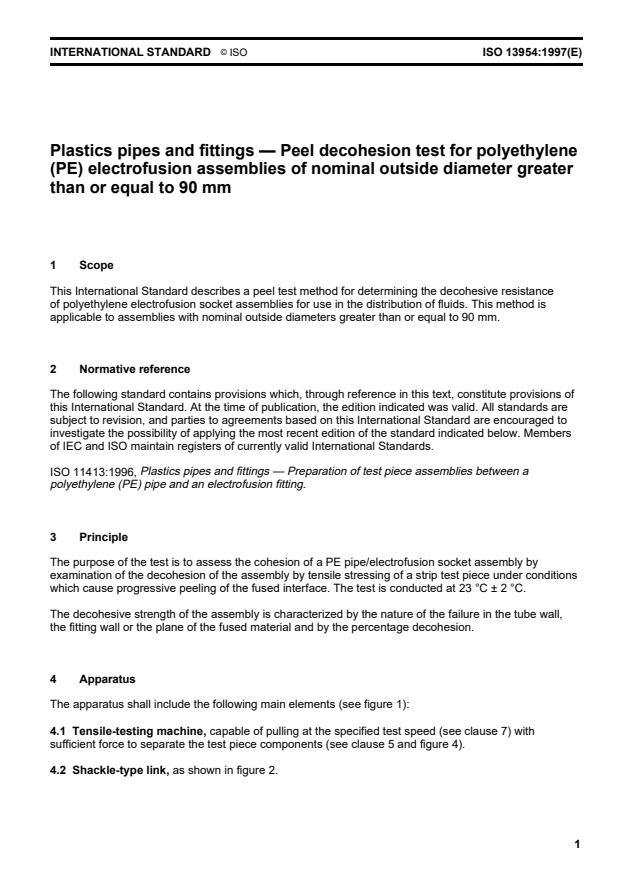
1 Scope
This International Standard describes a peel test method for determining the decohesive resistance
of polyethylene electrofusion socket assemblies for use in the distribution of fluids. This method is
applicable to assemblies with nominal outside diameters greater than or equal to 90 mm.
2 Normative reference
The following standard contains provisions which, through reference in this text, constitute provisions of
this International Standard. At the time of publication, the edition indicated was valid. All standards are
subject to revision, and parties to agreements based on this International Standard are encouraged to
investigate the possibility of applying the most recent edition of the standard indicated below. Members
of IEC and ISO maintain registers of currently valid International Standards.
ISO 11413:1996, Plastics pipes and fittings — Preparation of test piece assemblies between a
polyethylene (PE) pipe and an electrofusion fitting.
3 Principle
The purpose of the test is to assess the cohesion of a PE pipe/electrofusion socket assembly by
examination of the decohesion of the assembly by tensile stressing of a strip test piece under conditions
which cause progressive peeling of the fused interface. The test is conducted at 23 °C ± 2 °C.
The decohesive strength of the assembly is characterized by the nature of the failure in the tube wall,
the fitting wall or the plane of the fused material and by the percentage decohesion.
4 Apparatus
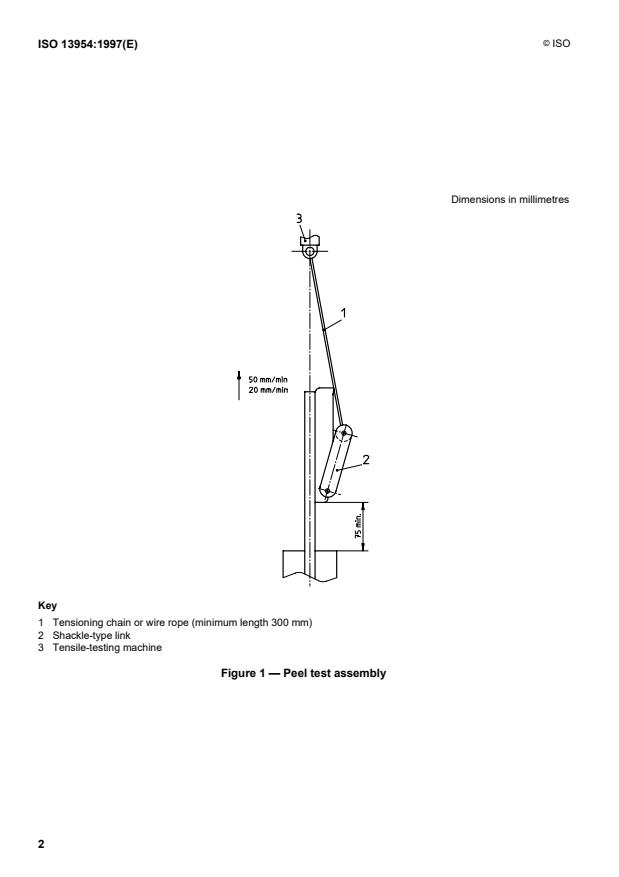
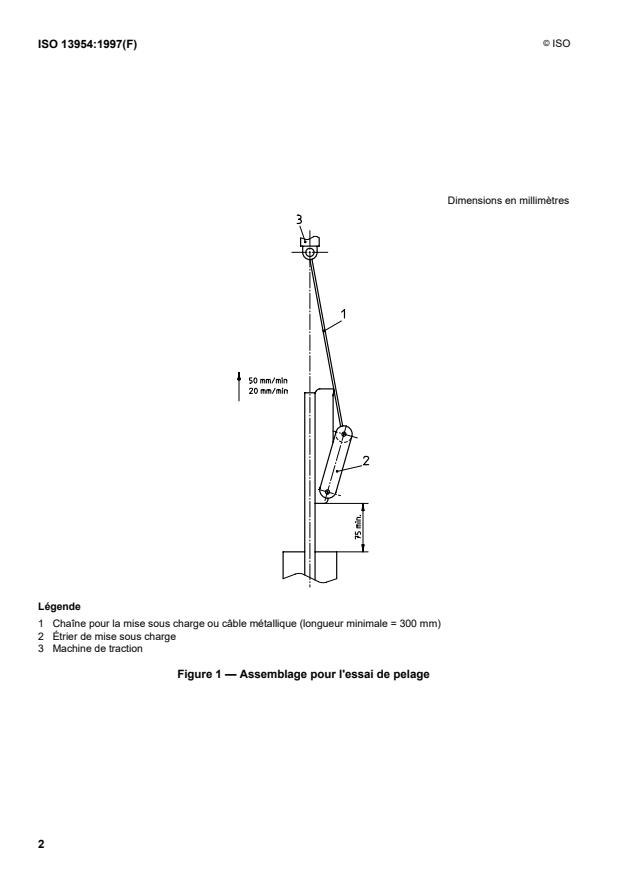
The apparatus shall include the following main elements (see figure 1):
4.1 Tensile-testing machine, capable of pulling at the specified test speed (see clause 7) with
sufficient force to separate the test piece components (see clause 5 and figure 4).
4.2 Shackle-type link, as shown in figure 2.
©
ISO
Dimensions in millimetres
Key
1 Tensioning chain or wire rope (minimum length 300 mm)
2 Shackle-type link
3 Tensile-testing machine
Figure 1 — Peel test assembly
©
ISO
Dimensions in millimetres
Key
1 Spacer
2 Bolt, designed to fit the hole in the test piece (see figures 1 and 3)
1) Gap sized to accommodate tensioning chain/rope
Figure 2 — Shackle-type link
5 Test pieces
5.1 Preparation of assembly
Samples of electrofusion socket fittings and of pipe obtained by sampling as specified by the product
standard shall be assembled in accordance with ISO 11413 and so that the end of each pipe projects at
least 125 mm from each electrofusion socket.
5.2 Preparatio
...
NORME ISO
INTERNATIONALE 13954
Première édition
1997-12-15
Tubes et raccords en matières
plastiques — Essai de décohésion par
pelage des assemblages électrosoudables
en polyéthylène (PE) de diamètres
extérieurs nominaux supérieurs ou égaux
à 90 mm
Plastics pipes and fittings — Peel decohesion test for polyethylene (PE)
electrofusion assemblies of nominal outside diameter greater than or equal
to 90 mm
A
Numéro de référence
Avant-propos
L'ISO (Organisation internationale de normalisation) est une fédération
mondiale d'organismes nationaux de normalisation (comités membres de
l'ISO). L'élaboration des Normes internationales est en général confiée aux
comités techniques de l'ISO. Chaque comité membre intéressé par une
étude a le droit de faire partie du comité technique créé à cet effet. Les
organisations internationales, gouvernementales et non gouvernementales,
en liaison avec l'ISO, participent également aux travaux. L'ISO collabore
étroitement avec la Commission électrotechnique internationale (CEI) en
ce qui concerne la normalisation électrotechnique.
Les projets de Normes internationales adoptés par les comités techniques
sont soumis aux comités membres pour vote. Leur publication comme
Normes internationales requiert l'approbation de 75 % au moins des
comités membres votants.
La Norme internationale ISO 13954 a été élaborée par le comité technique
ISO/TC 138, Tubes, raccords et robinetterie en matières plastiques pour le
transport des fluides, sous-comité SC 5, Propriétés générales des tubes,
raccords et robinetteries en matières plastiques et leurs accessoires —
Méthodes d'essais et spécifications de base.
© ISO 1997
Droits de reproduction réservés. Sauf prescription différente, aucune partie de cette publi-
cation ne peut être reproduite ni utilisée sous quelque forme que ce soit et par aucun pro-
cédé, électronique ou mécanique, y compris la photocopie et les microfilms, sans l'accord
écrit de l'éditeur.
Organisation internationale de normalisation
Case postale 56 • CH-1211 Genève 20 • Suisse
Internet central@iso.ch
X.400 c=ch; a=400net; p=iso; o=isocs; s=central
Imprimé en Suisse
ii
©
NORME INTERNATIONALE ISO ISO 13954:1997(F)
Tubes et raccords en matières plastiques — Essai de décohésion
par pelage des assemblages électrosoudables en polyéthylène
(PE) de diamètres extérieurs nominaux supérieurs ou égaux
à 90 mm
1 Domaine d'application
La présente Norme internationale prescrit une méthode d'essai pour déterminer la résistance à la
décohésion par pelage des assemblages de tubes et d'emboîtures électrosoudables en polyéthylène
(PE) destinés à la distribution de fluides.
Elle est applicable aux assemblages avec des tubes de diamètres extérieur nominaux supérieurs ou
égaux à 90 mm.
2 Référence normative
La norme suivante contient des dispositions qui, par suite de la référence qui en est faite, constituent
des dispositions valables pour la présente Norme internationale. Au moment de la publication, les
éditions indiquées étaient en vigueur. Toute norme est sujette à révision, et les parties prenantes des
accords fondés sur la présente Norme internationale sont invitées à rechercher la possibilité d'appliquer
l'édition la plus récente de la norme indiquée ci-après. Les membres de la CEI et de l'ISO possèdent le
registre des Normes internationales en vigueur à un moment donné.
Tubes et raccords en matières plastiques — Préparation d'éprouvettes par assemblage
ISO 11413:1996,
tube-raccord électrosoudable en polyéthylène (PE).
3 Principe
Estimation de la cohésion d'un assemblage tube/emboîture électrosoudable en polyéthylène (PE) par
l'examen de la décohésion de l'assemblage, résultant de la mise sous une contrainte de traction d'une
éprouvette dans des conditions qui provoquent le pelage progressif de l'interface soudée. L'essai est
effectué à la température de 23 �C – 2 �C.
La résistance à la décohésion de l'assemblage est caractérisée par la nature de la rupture dans
l’épaisseur du tube, du raccord ou dans le plan de soudure et par le pourcentage de décohésion.
4 Appareillage
L'appareillage doit comporter les éléments principaux suivants (voir la figure 1):
4.1 Machine de traction, capable d'appliquer à la vitesse d'essai spécifiée (voir l'article 7) une force
suffisante pour séparer les éléments de l'éprouvette (voir l'article 5 et la figure 4);
4.2 Étrier de mise sous charge, en acier, comme représenté à la figure 2.
©
ISO
Dimensions en millimètres
Légende
1 Chaîne pour la mise sous charge ou câble métallique (longueur minimale = 300 mm)
2 Étrier de mise sous charge
3 Machine de traction
Figure 1 — Assemblage pour l'essai de pelage
©
ISO
Dimensions en millimètres
Légende
1 Entretoises
2 Boulon destiné au trou de l'éprouvette en vue de la mise sous charge (voir figures 1 et 3)
1) Emplacement destiné à la chaîne de mise sous charge
Figure 2 — Étrier de mise sous charge
5 Éprouvettes
5.1 Préparation de l'assemblage
Les échantillons de raccords à emboîtures électrosoudables et de tubes, obtenus suivant la méthode
d'échantillonnage spécifiée par la norme de produit, doivent être assemblés conformément
...