


ISO/IEC 10021-6:1990
(Main)Information Technology — Text communication — Message-Oriented Text Interchange Systems (MOTIS) — Part 6: Protocol Specifications
Information Technology — Text communication — Message-Oriented Text Interchange Systems (MOTIS) — Part 6: Protocol Specifications
Technologies de l'information — Communication de texte — Systèmes d'échange de texte en mode message — Partie 6: Spécification de protocole
General Information
- Status
- Withdrawn
- Publication Date
- 12-Dec-1990
- Withdrawal Date
- 12-Dec-1990
- Current Stage
- 9599 - Withdrawal of International Standard
- Start Date
- 08-Dec-2003
- Completion Date
- 12-Feb-2026
Relations
- Consolidated By
ISO 3098-0:1997 - Technical product documentation — Lettering — Part 0: General requirements - Effective Date
- 06-Jun-2022
- Effective Date
- 06-Jun-2022
- Effective Date
- 06-Jun-2022
- Effective Date
- 06-Jun-2022
- Effective Date
- 06-Jun-2022
- Effective Date
- 06-Jun-2022
- Effective Date
- 06-Jun-2022
- Effective Date
- 06-Jun-2022
- Effective Date
- 15-Apr-2008
- Effective Date
- 15-Apr-2008
- Effective Date
- 15-Apr-2008
- Effective Date
- 15-Apr-2008
- Effective Date
- 15-Apr-2008
- Effective Date
- 15-Apr-2008
- Effective Date
- 15-Apr-2008
Get Certified
Connect with accredited certification bodies for this standard

BSI Group
BSI (British Standards Institution) is the business standards company that helps organizations make excellence a habit.

NYCE
Mexican standards and certification body.
Sponsored listings
Frequently Asked Questions
ISO/IEC 10021-6:1990 is a standard published by the International Organization for Standardization (ISO). Its full title is "Information Technology — Text communication — Message-Oriented Text Interchange Systems (MOTIS) — Part 6: Protocol Specifications". This standard covers: Information Technology — Text communication — Message-Oriented Text Interchange Systems (MOTIS) — Part 6: Protocol Specifications
Information Technology — Text communication — Message-Oriented Text Interchange Systems (MOTIS) — Part 6: Protocol Specifications
ISO/IEC 10021-6:1990 is classified under the following ICS (International Classification for Standards) categories: 35.240.20 - IT applications in office work. The ICS classification helps identify the subject area and facilitates finding related standards.
ISO/IEC 10021-6:1990 has the following relationships with other standards: It is inter standard links to ISO 3098-0:1997, ISO/IEC 10021-6:1990/Amd 1:1994, ISO/IEC 10021-6:1990/Cor 6:1993, ISO/IEC 10021-6:1990/Cor 7:1994, ISO/IEC 10021-6:1990/Cor 4:1992, ISO/IEC 10021-6:1990/Cor 2:1991, ISO/IEC 10021-6:1990/Cor 5:1992, ISO/IEC 10021-6:1990/Cor 3:1992, ISO/IEC 10021-6:1996; is excused to ISO/IEC 10021-6:1990/Cor 7:1994, ISO/IEC 10021-6:1990/Cor 4:1992, ISO/IEC 10021-6:1990/Cor 5:1992, ISO/IEC 10021-6:1990/Cor 6:1993, ISO/IEC 10021-6:1990/Cor 2:1991, ISO/IEC 10021-6:1990/Cor 3:1992. Understanding these relationships helps ensure you are using the most current and applicable version of the standard.
ISO/IEC 10021-6:1990 is available in PDF format for immediate download after purchase. The document can be added to your cart and obtained through the secure checkout process. Digital delivery ensures instant access to the complete standard document.
Standards Content (Sample)
I
I N TE R NAT I O NA L ISOIIEC
10021-6
STANDARD
First edition
1990-1 2-01
Information technology - Text Communication
- Message-Oriented Text Interchange Systems
(MOTIS) -
Part 6:
Protocol Specifications
Technologies de I'in formation - Communication de texte - S ysthes d'&change
de texte en mode message -
Partie 6: Specification de protocole
Reference number
ISO/IEC 10021-6 : 1990 (E)
ISO/IEC 10021-6 : 1990 (E)
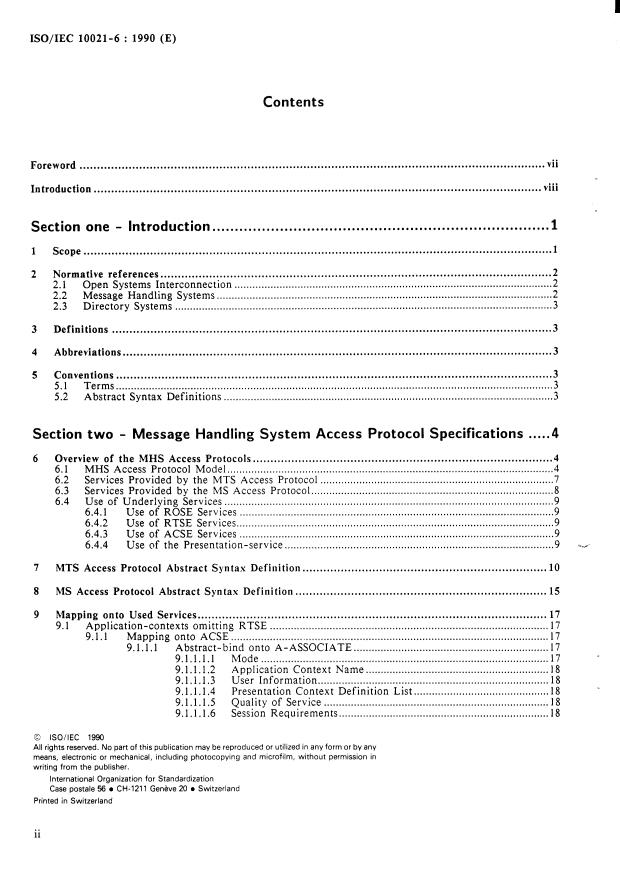
Contents
..
Foreword . VII
e.
Introduction . vi11
Section one . Introduction . 1
1 Scope . 1
2 Normative references . 2
2.1 Open Systems Interconnection . 2
2.2 Message Handling Systems . 2
2.3 Directory Systems . 3
3 Definitions . 3
4 Abbreviations . 3
5 Conventions . 3
5.1 Terms . 3
5.2 Abstract Syntax Definitions . 3
Section two . Message Handling System Access Protocol Specifications . 4
6 Overview of the MHS Access Protocols . 4
6.1 MHS Access Protocol Model . 4
6.2 Services Provided by the MTS Access Protocol . 7
6.3 Services Provided by the MS Access Protocol . 8
6.4 Use of Underlying Services . 9
6.4.1 Use of ROSE Services . 9
6.4.2 Use of RTSE Services . 9
6.4.3 Use of ACSE Services . 9
6.4.4 Use of the Presentation-service . 9 . .- .
MTS Access Protocol Abstract Syntax Definition . 10
8 MS Access Protocol Abstract Syntax Definition . 15
9 Mapping onto Used Services . 17
9.1 Application-contexts omitting RTSE . 17
9.1.1 Mapping onto ACSE . 17
9.1.1.1 Abstract-bind onto A-ASSOCIATE . 17
9.1.1.1.1 Mode . 17
9.1.1.1.2 Application Context Name . 18
9.1.1.1.3 User Information . 18
9.1.1.1.4 Presentation Context Definition List . 18
9.1.1.1.5 Quality of Service . 18
9.1.1.1.6 Session Requirements . 18
O ISO/IEC 1990
All rights reserved . No part of this publication may be reproduced or utilized in any form or by any
means. electronic or mechanical. including photocopying and microfilm. without permission in
writing from the publisher .
International Organization for Standardization
Case postale 56 CH-121 1 Genève 20 Switzerland
Printed in Switzerland
..
I
ISO/IEC 10021-6 : 1990 (E)
Abstract-unbind onto A-RELEASE . 18
9.1.1.2
9.1.1.2.1 Result . 18
Use of A-ABORT and A-P-ABORT Services . 18
9.1.1.3
Mapping onto ROSE . 19
9.1.2
Application-contexts including RTSE . 19
Mapping onto RT-OPEN and RT-CLOSE . 19
9.2.1
Abstract-bind onto RT-OPEN . 19
9.2.1.1
................................................................................................ 19
9.2.1.1.1 Mode
9.2.1.1.2 Application Context Name . 19
9.2.1.1.3 User-data . 19
9.2.1.1.4 Presentation Context Definition List . 19
Abstract-unbind onto RT-CLOSE . 20
9.2.1.2
9.2.2 Mapping onto ROSE . 20
Managing the Turn . 20
9.2.2.1
10 Conformance . 21
10.1 Statement Requirements . 21
10.2 Static Requirements . 22
10.3 Dynamic Requirements . 22
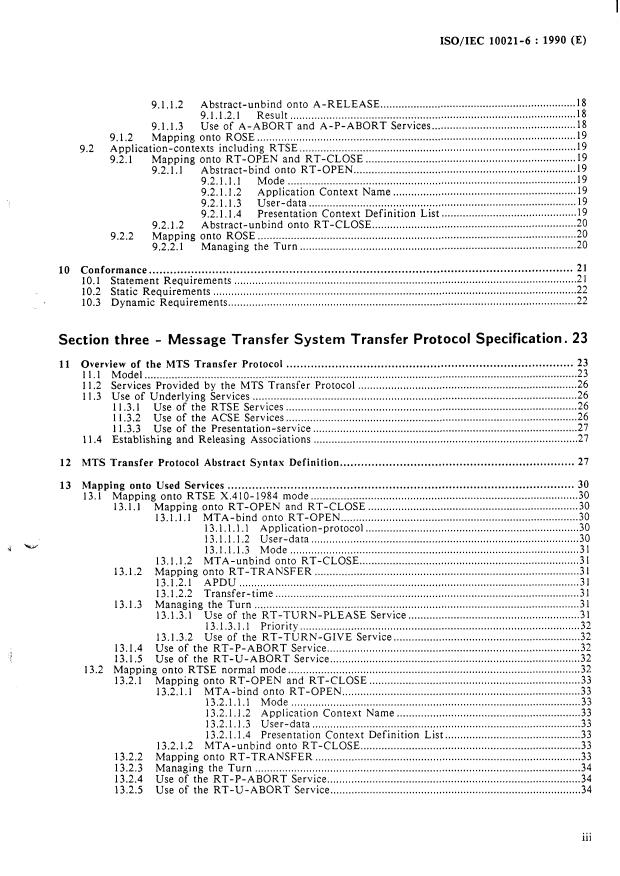
Section three . Message Transfer System Transfer Protocol Specification . 23
11 Overview of the MTS Transfer Protocol . 23
11.1 Model . 23
......................................................................... 26
11.2 Services Provided by the MTS Transfer Protocol
1 1.3 Use of Underlying Services . 26
Use of the RTSE Services . 26
11.3.1
Use of the ACSE Services . 26
1 1.3.2
11.3.3 Use of the Presentation-service . 27
Establishing and Releasing Associations . 27
1 1.4
12 MTS Transfer Protocol Abstract Syntax Definition . 27
Mapping onto Used Services . 30
13.1 Mapping onto RTSE X.410- 1984 mode . 30
13.1.1 Mapping onto RT-OPEN and RT-CLOSE . 30
13.1 . 1 . 1 MTA-bind onto RT-OPEN . 30
13.1.1.1.1 Application-protocol . 30
13.1.1.1.2 User-data . 30
13.1.1.1.3 Mode . 31
13.1 . 1 . 2 MTA-unbind onto RT-CLOSE . 31
Mapping onto RT-TRANSFER . 31
13.1.2
13.1.2.1 APDU . 31
13.1.2.2 Transfer-time . 31
13.1.3 Managing the Turn . 31
......................................................... 31
13.1.3.1 Use of the RT-TURN-PLEASE Service
13.1.3.1.1 Priority . 32
13.1.3.2 Use of the RT-TURN-GIVE Service . 32
13.1.4 Use of the RT-P-ABORT Service . 32
13.1.5 Use of the RT-U-ABORT Service . 32
13.2 Mapping onto RTSE normal mode . 3~
13.2.1 Mapping onto RT-OPEN and RT-CLOSE . 33
13.2.1.1 MTA-bind onto RT-OPEN . 33
13.2.1.1.1 Mode . 33
13.2.1.1.2 Application Context Name . 33
13.2.1.1.3 User-data . 33
13.2.1.1.4 Presentation Context Definition List . 33
13.2.1.2 MTA-unbind onto RT-CLOSE . 33
13.2.2 Mapping onto RT-TRANSFER . 33
13.2.3 Managing the Turn . 34
.................................................................................... 34
13.2.4 Use of the RT-P-ABORT Service
13.2.5 Use of the RT-U-ABORT Service . 34
...
I
ISO/IEC 10021-6 : 1990 (E)
14 Conformance . 34
14.1 Statement Requirements . 34
14.2 Static Requirements . 35
14.3 Dynamic Requirements . 35
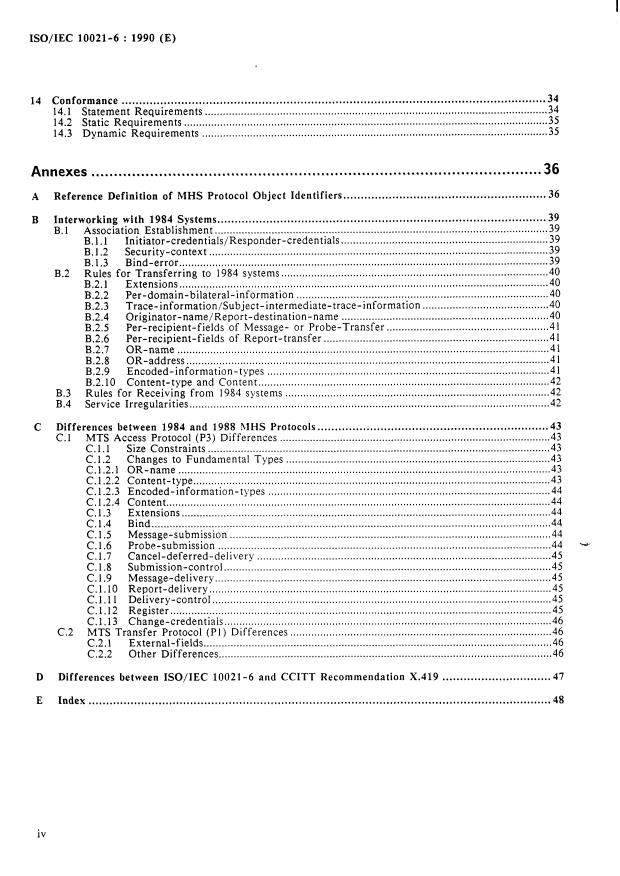
Annexes . 36
Reference Definition of MHS Protocol Object Identifiers . 36
A
Interworking with 1984 Systems . 39
B
B.l Association Establishment . 39
B . 1.1 Initiator-credentials/Responder-credentials . 39
B.1.2 Security-context . 39
B.1.3 Bind-error . 39
Rules for Transferring to 1984 systems . 40
B.2
B.2.1 Extensions . 40
B.2.2 Per-domain-bilateral-information . 40
B.2.3 Trace-information/Subject-intermediate-trace-information . 40
B.2.4 Originator-name/Report-destination-name . 40
B.2.5 Per-recipient-fields of Message- or Probe-Transfer . 41
B.2.6 Per-recipient-fields of Report-transfer . 41
B.2.7 OR-name . 41
B.2.8 OR-address . 41
B.2.9 Encoded-information-types . 41
B.2.10 Content-type and Content . 42
B.3 Rules for Receiving from 1984 systems . 42
B.4 Service Irregularities . 42
Differences between 1984 and 1988 hlHS Protocols . 43
C
C.l MTS Access Protocol (P3) Differences . 43
C . 1.1 Size Constraints . 43
C.1.2 Changes to Fundamental Types . 43
C.1.2.1 OR-name . 43
C.1.2.2 Content-type . 43
C.1.2.3 Encoded-information-types . 44
C.1.2.4 Content . 44
C . 1.3 Extensions . 44
C.1.4 Bind . 44
C.1.5 Message-submission . 44
C.1.6 Probe-submission . 44
Cancel-deferred-delivery . 45
C.1.7
C . 1.8 Submission-control . 45
C.1.9 Message-delivery . 45
C.l. 10 Report-delivery . 45
C . 1.1 1 Delivery-control . 45
C.1.12 Register . 45
C . 1.1 3 Change-credentials . 46
MTS Transfer Protocol (PI) Differences . 46
C.2
C.2.1 External-fields . 46
(2.2.2 Other Differences . 46
D Differences between ISO/IEC 10021 -6 and CCITT Recommendation X.419 . 47
E Index . 48
iv
ISO/IEC 10021-6 : 1990 (E)
List of Figures
MTS Access Protocol Model . 6
2 An MS Access Protocol Model . 6
Abstract Syntax Definition of the MTS Access Protocol (P3) . 11-14
4 Abstract Syntax Definition of the MS Access Protocol (P7) . 15-17
5 MTS Transfer Protocol Model . 25
Abstract Syntax Definition of the MTS Transfer Protocol (Pl) . 29
A.1 Abstract Syntax Definition of MHS Protocol Object Identifiers . 37-38
V
ISO/IEC 10021-6 : 1990 (E)
List of Tables
MHS Access Protocol Application Contexts . 5
Remote Operation Priorities . 21
MTS Access Protocol Conformance Requirements . 22
MS Access Protocol Conformance Requirements . 22
MTS Transfer Protocol Application Contexts . 24
Interworking between ISO/IEC MOTIS and CCITT X.400 . 25
MTS Transfer Protocol Conformance Requirements . 35
.....
vi
I
ISO/IEC 10021-6 : 1990 (E)
Foreword
IS0 (the International Organization for Standardization) and IEC (the International
Electrotechnical Commission) form the specialized system for worldwide standardiz-
ation. National bodies that are members of IS0 or IEC participate in the development
of International Standards through technical committees established by the respective
to deal with particular fields of technical activity. IS0 and IEC technical
organization
committees collaborate in fields of mutual interest. Other international organizations,
governmental and non-governmental, in liaison with IS0 and IEC, also take part in the
work.
In the field of information technology, IS0 and IEC have established a joint technical
committee, ISO/IEC JTC 1. Draft International Standards adopted by the joint
technical committee are circulated to national bodies for voting. Publication as an
International Standard requires approval by at least 75 070 of the national bodies casting
a vote.
International Standard ISO/IEC 10021-6 was prepared by Joint Technical Committee
ISO/IEC JTC I, Information technology.
ISO/IEC 10021-6 consists of the following parts, under the general title: Information
technology - Text Communication - Message-Oriented Text Interchange Systems
(MOTIS) -
- Part I : System and Service Overview
- Part 2: Overall Architecture
- Part 3: Abstract Service Definition Conventions
- Part 4: Message Transfer System: Abstract Service Definition and Procedures
- Part 5: Message Store: Abstract Service Definition
- Part 6: Protocol Specifications
- Part 7: Interpersonal Messaging System
Annexes A and B form an integral part of this part of ISO/IEC 10021. Annexes C, D
and E are for information only.
vii
ISO/IEC 10021-6 : 1990 (E)
Introduction
This part of ISO/IEC 10021 is one of a number of parts of ISO/IEC 10021 (the International Standards
for Message-Oriented Text Interchange Systems (MOTIS)).
MOTIS provides for the exchange of messages between users on a store-and-forward basis. A message
submitted by one user (the origiizator) is transferred through the Message Transfer System (MTS) and
delivered to one or more other users (the recipieizfs). A user may interact directly with the MTS, or
indirectly via a message store (MS).
The MTS comprises a number of message-transfer-agents (MTAs), which transfer messages and deliver
them to their intended recipients.
This International Standard was developed jointly by CCITT and ISO/IEC. The equivalent CCITT
document is CCITT Recommendation X.419.
'. i '
...
Vlll
I
ISO/IEC 10021-6 : 1990 (E)
INTERNATIONAL STANDARD
Information technology - Text Communication -
Message-Oriented Text Interchange Systems (MOTIS) -
Part 6 : Protocol Specifications
Section one - Introduction
1 Scope
This part of IS0 10021 specifies the MTS Access Protocol (P3) used between a remote user-agent and
the MTS to provide access to the MTS Abstract Service defined in ISO/IEC 10021-4.
This part of ISO/IEC 10021 also specifies the MS Access Protocol (P7) used between a remote user-
agent and a message-store (MS) to provide access to the MS Abstract Service defined in
ISO/IEC 10021-5.
This part of ISO/IEC 10021 also specifies the MTS Transfer Protocol (Pl) used between MTAs to
provide the distributed operation of the MTS as defined in ISO/IEC 10021-4.
ISO/IEC 1002 1-2 identifies the other International Standards which define other aspects of Message
Handling Systems.
Section two of this part of ISO/IEC 10021 specifies the MHS Access Protocols (P3 and P7). Clause 6
provides an overview of the MHS Access Protocols. Clause 7 defines the abstract-syntax of the MTS
Access Protocol (P3). Clause 8 defines the abstract-syntax of the MS Access Protocol (P7). Clause 9
defines the mapping of the MHS Access Protocols onto used services. Clause 10 specifies conformance
requirements for systems implementing the MHS Access Protocols.
Section three of this part of ISO/IEC 10021 specifies the MTS Transfer Protocol (Pl). Clause 11
provides an overview of the MTS Transfer Protocol (Pl). Clause 12 defines the abstract-syntax of the
MTS Transfer Protocol (Pl). Clause 13 defines the mapping of the MTS Transfer Protocol (Pl) onto
used services. Clause 14 specifies conformance requirements for systems implementing the MTS
ir Transfer Protocol (Pl).
Annex A provides a reference definition of the MHS protocol object identifiers cited in the ASN.1
modules in the body of this part of ISO/IEC 10021,
Annex B describes protocol rules for interworking with implementations of the CCITT Recommendation
X.411 (1984) using the MTS Transfer Protocol (Pl).
Annex C identifies the differences between the CCITT Recommendation X.411 (1984) and this part of
ISO/IEC 1002 1.
Annex D identifies the technical differences between the ISO/IEC and CCITT versions of CCITT
Recommendations X.419 and ISO/IEC 10021 -6.
Annex E provides an index to this part of ISO/IEC 10021, categorised into: Abbreviations; Terms;
1 modules; ASN. 1 macros; ASN. 1 types; and ASN. 1 values.
Information Items; ASN.
2 Normative references
The following standards contain provisions which, through reference in this text, constitute provisions
of this part of ISO/IEC 10021. At the time of publication, the editions indicated were valid. All
standards are subject to revision, and parties to agreements based on this part of ISO/IEC 10021 are
ISO/IEC 10021-6 : 1990 (E)
encouraged to investigate the possibility of applying the most recent editions of the standards listed
below. Members of IS0 and IEC maintain registers of currently valid International Standards.
2.1 Open Systems Interconnection
This part of ISO/IEC 10021 cites the following OS1 specifications:
IS0 8649: 988, Itiformation processing systems - Operi Systenis Interconnection - Service
definition for the Associatiori Control Service Element.
IS0 8822: 988, Information processing systems - Open Systems Interconnection - Connection
oriented presentation service definition.
IS0 8824: 990, Information processing systems - Open Systems Intercoririectioir - Specification o f
Abstract Syritas Notation One (ASN.1).
ISO/IEC 9066: 1989, - Text communication - Reliable Traits fer -
Informatioit processing systems
Part 1: Model and service definition.
Part 2: Protocol specification.
ISO/IEC 9072: 1989, Information processiiig systems - Text communication - Remote operations -
Part 1: Model. notatiori and service definition.
Part 2: Protocol specification.
2.2 Message Handling Systems
This part of ISO/IEC 1002 1 cites the following Message Handling System specifications:
ISO/IEC 1002 1: 1990, In formatioii techwlogy - Text coniniutiicatioii - Message-Oriented Text
Interchange Systenis (MOTIS) -
Part 1: Service and system overview.
Part 2: Overall architecture.
Part 3: Abstract service defiriitiori consentions.
Part 4: Message tram fer system : Abstract service de finition and procedures.
Part 5: Message store : Abstract service de finition.
Part 7: Iiiterpersonal niessaging system.
2.3 Directory Systems
This part of ISO/IEC 10021 cites the following Directory System specification:
ISO/IEC 9594-2: 1990, In formation techtrology - Open Systems Interconnection - The Directory
Part 2: Models.
3 Definitions
For the purposes of this part of ISO/IEC 10021 the definitions given in ISO/IEC 10021-2 apply.
ISO/IEC 10021-6 : 1990 (E)
4 Ab brevia tions
For the purposes of this part of ISO/IEC 10021 the abbreviations given in ISO/IEC 10021-2 apply
5 Conventions
This International Standard uses the descriptive conventions described below.
5.1 Terms
Throughout this part of ISO/IEC 10021 the words of defined terms, and the names and values of service
parameters and protocol fields, unless they are proper names, begin with a lower-case letter and are
linked by a hyphen thus: defined-term. Proper names begin with an upper-case letter and are not
linked by a hyphen thus: Proper Name.
5.2 Abstract Syntax Definitions
This part of ISO/IEC 10021 defines the abstract-syntax of the MHS protocols using the abstract syntax
notation (ASN.l) defined in IS0 8824 and the remote operations notation defined in ISO/IEC 9072-1.
ISO/IEC 10021-6 : 1990 (E)
Section two - Message Handling System Access Protocol Specifications
Overview of the MHS Access Protocols
6.1 MHS Access Protocol Model
Clause 6 of ISO/IEC 10021-4 describes an abstract model of the Message Transfer System (MTS), and
the MTS Abstract Service which it provides to its MTS-users.
Clause 6 of ISO/IEC 10021-5 describes an abstract model of a Message Store (MS), and the MS Abstract
Service which it provides to its MS-user.
This clause describes how the MTS Abstract Service and the MS Abstract Service are supported by
instances of OS1 communication when an abstract-service user and an abstract-service provider are
realised as application-processes located in different open systems.
In the OS1 environment, communication between application-processes is represented in terms of
communication between a pair of application-entities (AEs) using the presentation-service. The
functionality of an application-entity is factored into a set of one or more application-service-elements
(ASEs). The interaction between AEs is described in terms of their use of the services provided by the
ASEs.
Access to the MTS Abstract Service is supported by three application-service-elements, each supporting
a type of port paired between an MTS-user and the MTS in the abstract model. The Message
Submission Service Element (MSSE) supports the services of the submission-port; the Message Delivery
Service Element (MDSE) supports the services of the delivery-port; and the Message Administration
Service Element (MASE) supports the services of the administration-port. The MSSE, MDSE and
MASE are asymmetric-ASES; that is, the MTS-user ASEs act as the consumer, and the MTS ASEs act as
the supplier, of the MTS Abstract Service.
Similarly, access to the MS Abstract Service is supported by three application-service-elements: the
Message Submission Service Element (MSSE) supports the indirect-submission-port; the Message
Retrieval Service Element (MRSE) supports the services of the retrieval-port; and the Message
Administration Service Element (MASE) supports the services of the administration-port. The MS-user
ASEs act as the consumer, and the MS ASEs act as the supplier, of the MS Abstract Service.
These application-service-elements are in turn supported by other application-service-elements.
id,,’
The Remote Operations Service Element (ROSE) supports the request/reply paradigm of the abstract
operations that occur at the ports in the abstract model. The MSSE, MDSE, MRSE and MASE provide
the mapping function of the abstract-syntax notation of an abstract-service onto the services provided
by the ROSE.
Optionally, the Reliable Transfer Service Element (RTSE) may be used to reliably transfer the
application-protocol-data-units (APDUs) that contain the parameters of the operations between AEs.
The Association Control Service Element (ACSE) supports the establishment and release of an
application-association between a pair of AEs. Associations between an MTS-user and the MTS may be
established by either the MTS-user or the MTS. Associations between an MS-user and an MS may be
established only by the MS-user. Only the initiator of an established association can release it.
The combination of one or more of the MSSE, MDSE, MRSE and MASE, together with their supporting
ASEs, defines the application-context of an application-association. Note that a single application-
association may be used to support one or more port types paired between two objects in the abstract
model.
Table 1 identifies the application-contexts defined in this part of ISO/IEC 10021 for the MTS Access
Protocol and MS Access Protocol.
ISO/IEC 10021-6 : 1990 (E)
Table 1
MHS Access Protocol Application Contexts
..........................................................................
I I Message Handling ASES I Supporting ASES I
I. .+.
I
I
I Application Context I MSSE MDSE MRSE MASE I ROSE RTSE ACSE 1
1. .+.+.
I
I MTS Access Protocol I I I
I mts-access IC c - ClX
XI
I mts-forced-access 1s
s - SIX XI
I mts-reliable-access IC c - Clx X XI
I mts-forced-reliable-access 1 S S - S I x XXI
I. .+.+.
I
I MS Access Protocol I
I I
I ms-access
IC - c C(X
XI
I ms-retiable-access IC - c ClX x XI
...........................................................................
. ~~~~~d .
I x present C present with initiator the consumer I
I - absent S present with initiator the supplier I
....................................................
If the MTS Access Protocol (P3) is supported, then support for the mts-access and mts-forced-access
application-contexts is mandatory for an MTA. If an MTA supports the mts-reliable-access
application-context, it shall also support the mts-forced-reliable-access, and vice versa. Support for
each of the MTS Access Protocol (P3) application-contexts is optional for an MTS-user.
If the MS Access Protocol (P7) is supported, then support for the ms-access application-context is
mandatory for an MS, and support for the ms-reliable-access application-context is optional. Support
for each of the MS Access Protocol (P7) application-contexts is optional for an MS-user.
Figure models an application-context between an MTS-user and the MTS. The consumer role of the
\CJ MTS-user ASEs, and the supplier role of the MTS ASEs, is indicated by a subscript 'c', or 's',
respectively.
Similarly, Figure 2 models an application-context between an MS-user and the MS.
ISO/IEC 10021-6 : 1990 (E)
MTS-user
MTS
IMSSEc I
Application
IMDSEc 1 IMDSE, I
Layer
-
IMASE, I
IROSE 1
1 ACSE 1
1 ACSE I
....................... ............................................................................
....
presentat ion-connection
Presentat ion
Layer
Figure 1
MTS Access Protocol Model
MS
I MS-user I
Appt icat ion
Layer
......................................................................................................
I
I presentation-connection
Presentation
Layer
Figure 2
An MS Access Protocol Model
I
ISO/IEC 10021-6 : 1990 (E)
6.2 Services Provided by the MTS Access Protocol
The MTS Access Protocol (P3) comprises the following operations which provide the services defined in
ISO/IEC 1002 1-4:
MTS-bind arid MTS-uribirid
a) MTS- bind
b) MTS-unbind
Message Submissioii Service Elemeiit (MSSE)
cl Message-submission
d) Probe-submission
e) Cancel-deferred-delivery
f) Submission-control
Message Delivery Service Element (MDSE)
g) Message-delivery
h) Report-delivery
i) Delivery-control
Message Admiriistration Service Elenterit (MASE)
j) Register
k) Change-credentials.
ISO/IEC 10021-6 : 1990 (E)
6.3 Services Provided by the MS Access Protocol
The MS Access Protocol (P7) comprises the following operations which provide the services defined in
ISO/IEC 10021 -5:
MS-bind and MS-unbind
a) MS-bind
b) MS-unbind
Message Submission Service Element (MSSE)
cl Message-submission
d) Probe-submission
e) Cancel-deferred-delivery
f) Submission-control
Message Retrieval Service Elenictit (MRSE)
g) Summarize
h) List
il Fetch
j) Delete
k) Register-MS
1) Alert
Message Administratioti Service Elemetit (MASE)
m) Register
n) Change-credentials.
ISO/IEC 10021-6 : 1990 (E)
6.4 Use of Underlying Services
The MHS Access Protocols make use of underlying services as described below.
6.4.1 Use of ROSE Services
The Remote Operations Service Element (ROSE) is defined in ISO/IEC 9072-1
The ROSE supports the request/reply paradigm of remote operations.
The MSSE, MDSE, MRSE and MASE are the sole users of the RO-INVOKE, RO-RESULT, RO-
ERROR, RO-REJECT-U and RO-REJECT-P services of the ROSE.
The remote operations of the MTS Access Protocol (P3) and the MS Access Protocol (P7) are Class 2
(asynchronous) operations.
6.4.2 Use of RTSE Services
The Reliable Transfer Service Element (RTSE) is defined in ISO/IEC 9066-1.
transfer of application-protocol-data-units (APDUs). The RTSE
The RTSE provides for the reliable
ensures that each APDU is completely transferred exactly once, or that the sender is warned of an
exception. The RTSE recovers from communication and end-system failure and minimises the amount
of retransmission needed for recovery.
Alternative application-contexts with and without RTSE are defined to support the MHS Access
Protocols.
The RTSE is used in the normal mode. The use of the normal mode of the RTSE implies the use of the
normal mode of the ACSE and the normal mode of the presentation-service.
If the RTSE is included in an application-context, the MHS Access Protocol MTS-bind and MTS-
unbind (or MS-bind and MS-unbind) are the sole users of the RT-OPEN and RT-CLOSE services of
the RTSE. The ROSE is the sole user of the RT-TRANSFER, RT-TURN-PLEASE, RT-TURN-GIVE,
RT-P-ABORT and RT-U-ABORT services of the RTSE.
6.4.3 Use of ACSE Services
The Association Control Service Element (ACSE) is defined in IS0 8649.
The ACSE provides for the control (establishment, release, abort) of application-associations between
AEs.
If the RTSE is not included in an application-context, the MHS Access Protocol MTS-bind and MTS-
unbind (or MS-bind and MS-unbind) are the sole users of the A-ASSOCIATE and A-RELEASE
services of the ACSE in normal mode. The ROSE is the user of the A-ABORT and A-P-ABORT
services of the ACSE.
If the RTSE is included in the application-context, the RTSE is the sole user of the A-ASSOCIATE, A-
RELEASE, A-ABORT and A-P-ABORT services of the ACSE. The use of the normal mode of the
RTSE implies the use of the normal mode of the ACSE and the normal mode of the presentation-
service.
6.4.4 Use of the Presentation-service
The presentation-service is defined in IS0 8822.
ISO/IEC 10021-6 1990 (E)
The Presentation Layer co-ordinates the representation (syntax) of the Application Layer semantics that
are to be exchanged.
In normal mode, a different presentation-context is used for each abstract-syntax included in the
application-context.
The ACSE is the sole user of the P-CONNECT, P-RELEASE, P-U-ABORT and P-P-ABORT services
of the presentation-service.
If the RTSE is not included in the application-context, the ROSE is the sole user of the P-DATA
service of the presentation-service.
If the RTSE is included in the application-context, the RTSE is the sole user of the P-ACTIVITY-
START, P-DATA, P-MINOR-SYNCHRONIZE, P-ACTIVITY-END, P-ACTIVITY-INTERRUPT, P-
ACTIVITY-DISCARD, P-U-EXCEPTION-REPORT, P-ACTIVITY-RESUME, P-P-EXCEPTION-
REPORT, P-TOKEN-PLEASE and P-CONTROL-GIVE services of the presentation-service. The use
of the normal mode of the RTSE implies the use of the normal mode of the ACSE and the normal mode
of the presentation-service.
7 MTS Access Protocol Abstract Syntax Definition
The abstract-syntax of the MTS Access Protocol (P3) is defined in Figure 3.
The abstract-syntax of the MTS Access Protocol (P3) is defined using the abstract syntax notation
(ASN.1) defined in IS0 8824, and the remote operations notation defined in ISO/IEC 9072-1.
The abstract-syntax definition of the MTS Access Protocol (P3) has the following major parts:
Prologue: declarations of the exports from, and imports to, the MTS Access Protocol (P3) module
(Figure 3 Part 1).
Applicatioit Contexts: definitions of application-contexts that may be used between an MTS-user
MTS (Figure 3 Parts 1 and 2).
and the
Message Submissiori Service Elentent: definitions of the Message Submission Service Element
(MSSE) and its remote operations and errors (Figure 3 Part 3).
Message Delivery Service Elentetit: definitions of the Message Delivery Service Element (MDSE)
..,. *
and its remote operations and errors (Figure 3 Part 4).
Message Administration Service Elenterit: definitions of the Message Administration Service
Element (MASE) and its remote operations and errors (Figure 3 Part 4).
I
ISO/IEC 10021-6 : 1990 (E)
MTSAccessProtocol c joint- iso-ccitt mhs-motis(6) protocols(0) moduLes(0) mts-access-protocol(1) 1
DEFINITIONS IMPLICIT TAGS ::=
BEGIN
-- Prologue
EXPORTS
-- Applicatioit Service Elenierits
rnSSE, mDSE, m4SE;
IMPORTS
-- Application Service Elenierits aiid Application Coritexts
aCSE, APPLICATION-CONTEXT, APPLICATION-SERVICE-ELEMENT
FROM Remot e- Opera t i ons - Nota t i on- ex tens i on C j oi nt - i so- cc i t t remote- opera t i ons(4)
not at i on- ex tens i on( 2) >
rTSE
FROM Reliable-Transfer-APDUs C joint-iso-ccitt reliablemtransfer(3) apdus(0) 1
-- MTS Abstract Service Parameters
CancelDeferredDelivery, ChangeCredentials, ControlViolatesRegistration, DeferredDeliveryCancellationRejected,
DeliveryControl, DeliveryControlViolated, ElernentOfServiceNotSubscribed, InconsistentRequest,
MessageDelivery, MessageSubmission, MessageSubmissionIdentifierInvalid, MTSBind, MTSUnbind,
NewCredentialsUnacceptable, OldCredentialsIncorrectlySpecified, Originatorlnvalid, ProbeSubmission,
RecipientImproperLySpecified, Register, RegisterRejected, RemoteBindError, ReportDelivery, SecurityError,
SubmissionControl, Submissioncontrolviolated, UnsupportedCriticalFunction
FROM MTSAbstractService C joint- iso-ccitt mhs-motis(6) mts(3) mcdules(0)
mts-abstract-service(1) 1
-- Object identifiers
id-ac-mts-access, id-ac-mts-forced-access, id-ac-mts-forced-reliable-access, id-ac-mts-reliable-access,
id-as-acse, id-as-mase, id-as-&se, id-as-msse, id-as-mts, id-as-mts-rtse, id-ase-mase, id-ase-&se,
id-ase-msse
FROM MHSProtocolObjectIdentif iers C joint-iso-cci tt mhs-motis(6) protocols(0)
modules(0) object- identif iers(0) >;
-- Applicatioii Colttexts oniittiug RTSE
-- MTS-user itiitiated
mts-access APPLICATION-CONTEXT
cj "c, APPLICATION SERVICE ELEMENTS C aCSE >
BIND MTSBind
UNBIND MTSUnbind
REMOTE OPERATIONS C rOSE 1
INITIATOR CONSUMER OF C rnSSE, mDSE, m4SE >
ABSTRACT SYNTAXES C
id-as-acse, -- of ACSE
id-as-msse, -- of MSSE, including ROSE
id-as-&se, -- of MDSE, including ROSE
id-as-mase, -- of MASE, including ROSE
id- as-mts -- of MTSBind and MTSUnbind -- >
::= id-ac-mts-access
Figure 3
Abstract Syntax Definition of the hlTS Access Protocol (P3) (Part 1 of 4)
ISO/IEC 10021-6 : 1990 (E)
-- MTS initiated
mts-forced-access APPLICATION-CONTEXT
APPLICATION SERVICE ELEMENTS C aCSE 1
BIND MTSBind
UNBIND MTSUnbind
REMOTE OPERATIONS C rOSE 1
RESPONDER CONSUMER OF C mSSE, mDSE, mASE 1
ABSTRACT SYNTAXES C
id-as-acse, -- of ACSE
id-as-msse, -- of MSSE, including ROSE
-- of MDSE, includ
...
Questions, Comments and Discussion
Ask us and Technical Secretary will try to provide an answer. You can facilitate discussion about the standard in here.
Loading comments...