

ISO/IEC 29500-4
(Main)Document description and processing languages — Office Open XML File Formats — Part 4: Transitional migration features
- Abstract
ISO/IEC 29500-4:2016 defines a set of XML vocabularies for representing word-processing documents, spreadsheets and presentations. On the one hand, the goal of ISO/IEC 29500 is to represent faithfully the existing corpus of word-processing documents, spreadsheets and presentations that have been produced by Microsoft Office applications (from Microsoft Office 97 to Microsoft Office 2008, inclusive). It also specifies requirements for Office Open XML consumers and producers. On the other hand, the goal is to facilitate extensibility and interoperability by enabling implementations by multiple vendors and on multiple platforms. ISO/IEC 29500-4:2016 defines features for backward-compatibility and that are useful for high-quality migration of existing binary documents to ISO/IEC 29500. These features are used only by documents of conformance class WML Transitional (§2.1), SML Transitional (§2.1), or PML Transitional (§2.1). These features are sometimes needed for high-quality migration of existing binary documents to ISO/IEC 29500.
- Status
- Not Published
- Technical Committee
- ISO/IEC JTC 1/SC 34 - Document description and processing languages
- Drafting Committee
- ISO/IEC JTC 1/SC 34/WG 4 - Office Open XML
- Current Stage
- 6000 - International Standard under publication - 60 Publication
- Start Date
- 13-Oct-2026
ISO/IEC 29500-4 is an ISO/IEC International Standard for Office Open XML File Formats, published for implementers of word-processing, spreadsheet, and presentation software. It specifies transitional migration features that help preserve the fidelity of existing Microsoft Office documents while they are moved into ISO/IEC 29500 formats, and it sets requirements for both consumers and producers of those documents.
What does ISO/IEC 29500-4 specify?
ISO/IEC 29500-4 specifies additions to and modifications of ISO/IEC 29500-1 for Office Open XML documents that use the Transitional conformance path. In practice, it is the part you use when you need legacy features for migration or compatibility, not for creating new documents that should avoid those features.
The scope says the standard is aimed at faithful representation of documents produced by Microsoft Office applications from Microsoft Office 97 through Microsoft Office 2008, and at interoperability across vendors and platforms. Clause 1 also ties the document to Office Open XML consumers and producers, so it matters both for software that reads documents and software that writes them.
The document is organized into:
- Clauses 1-7 for scope, references, terms, conventions, external data files, and conformance
- Clauses 8-13 for additional shared parts and the Transitional treatment of WordprocessingML, SpreadsheetML, PresentationML, DrawingML, and Shared MLs
- Clauses 14-20 for reference material on those same areas
- Annexes A-C for schema files and accessibility guidance
| Annex | What it covers |
|---|---|
| Annex A | Schemas - W3C XML Schema |
| Annex B | Schemas - RELAX NG |
| Annex C | Accessibility best practices |
Clause 4 states that, unless otherwise noted, the functionality from ISO/IEC 29500-1 applies here as well, but the namespaces used in this part are different. That matters when you validate or generate XML, because examples and element names must be read in the right namespace context.
What are the key requirements of ISO/IEC 29500-4?
ISO/IEC 29500-4 defines the rules that make a document or application Transitional conformant. The most important practical requirement is that Transitional features are controlled and limited: they exist to support faithful migration and legacy interoperability, not to change the basic Office Open XML model.
Conformance and packaging
Clause 7 requires a document conformance class Office Open XML Transitional to be an OPC package that satisfies this part's constraints and belongs to one of the three document categories: Wordprocessing, Spreadsheet, or Presentation. For a buyer or integrator, that means the file is not just XML content - it must be a valid package with the right parts, relationships, and category.
Clause 7.1 also says VML Drawing Parts must contain markup in the Markup Compatibility namespace as specified in ISO/IEC 29500-3, and their child elements must be valid against the VML schema after removing extensions. In practice, this is the rule that keeps legacy drawing content compatible while still being checkable.
Application behavior
Clause 7.2 defines application conformance in terms of both syntax and semantics. A conforming consumer must not reject conforming documents of at least one Transitional class, and a conforming producer must be able to produce them. Just as important, any feature an application does process must be handled in a way that matches the semantics of ISO/IEC 29500.
That matters for viewers, editors, and back-end processors alike. If your software supports a Transitional feature, it must interpret that feature consistently, even if it does not process every feature in the file.
Legacy and migration features
The introduction says ISO/IEC 29500-4 augments ISO/IEC 29500-1 and is intended for a transitional period while existing binary documents are migrated. This means the standard is explicitly about compatibility preservation, especially for documents that rely on older behaviors.
Clause 6 says the normative requirements are in the document itself and in the electronic data files noted in the annexes. For implementation work, this means the schemas are not optional background material - they are part of full implementation.
Additional shared parts
Clause 8 adds support for a VML Drawing Part. It is used to provide an alternative image representation in SpreadsheetML or PresentationML documents, but it shall not appear in a WordprocessingML document. Clause 8.2 also limits its relationships: it is internal to the package and may relate only to an Image part.
This is important when importing older files, because a tool has to preserve or interpret legacy drawing content without placing it in the wrong document family.
WordprocessingML, SpreadsheetML, PresentationML, DrawingML, and Shared MLs
Clauses 9-13 list the Transitional parts that differ from ISO/IEC 29500-1. The practical pattern is the same across all of them: the standard allows legacy parts, legacy attributes, and compatibility behavior that help older documents round-trip more faithfully.
Examples that matter in practice include:
- WordprocessingML support for template, frameset, master/subdocument, mail merge, and XSL transformation relationships
- SpreadsheetML support for calculation chains, chartsheets, external workbooks, pivot tables, and legacy drawing references
- PresentationML support for notes, slide synchronization, HTML publish location, and legacy embedded objects
- DrawingML support for legacy compatibility features, charts, themes, diagram parts, and percentage-related simple types
- Shared MLs support for additional characteristics, custom XML, embedded objects, media, file properties, and hyperlinks
Reference material and compatibility details
Clauses 14-20 are dense reference material. They cover paragraphs, tables, fonts, numbering, annotations, settings, fields, hyperlinks, simple types, changed attributes, workbook and presentation behaviors, DrawingML charts and legacy compatibility, VML elements and types, and shared markup language content.
For implementation teams, these clauses are where you look up the exact Transitional XML vocabulary, attribute behavior, and legacy-compatible structures that a validator, importer, exporter, or migration tool must handle.
What terms does ISO/IEC 29500-4 define?
ISO/IEC 29500-4 defines a small set of terms directly and uses several Transitional abbreviations throughout the document.
- DOS file path - An identifier for the name and possibly the location of a file in a legacy file system.
- Office Open XML Transitional - The Transitional document conformance class used for Office Open XML documents that need legacy compatibility features.
- WML Transitional - The Transitional conformance class for Wordprocessing documents.
- SML Transitional - The Transitional conformance class for Spreadsheet documents.
- PML Transitional - The Transitional conformance class for Presentation documents.
- OPC - The package conformance class required for Transitional documents.
- MCE - The markup compatibility processing used to remove extensions before validating parts such as VML Drawing Parts.
- VML - Vector Markup Language, the legacy markup used in VML Drawing Parts and related compatibility content.
Who uses ISO/IEC 29500-4?
ISO/IEC 29500-4 is used by software vendors, document-conversion tool developers, and office suite engineers who need to read or write Transitional Office Open XML files. It is also relevant to testing teams and quality managers who validate compatibility behavior, package structure, and legacy content handling.
In practice, the standard is used in office productivity applications, line-of-business systems, migration tools, archival systems, and document preservation workflows. It matters when a system must preserve the appearance or behavior of older Microsoft Office documents while moving them into Office Open XML.
What changed in ISO/IEC 29500-4 from the previous edition?
ISO/IEC 29500-4:2026 is the fifth edition and it cancels and replaces ISO/IEC 29500-4:2016. The foreword says the standard was technically revised, but no new functionality was added.
The stated changes are:
- Corrections and clarifications throughout the text
- Hanging paragraphs moved into introductory subclauses, which renumbered some subclauses
- Normative and bibliographical references updated, added, or removed where appropriate
- BNF and EBNF replaced by ABNF
- Clarifications and corrections to the separation between Strict and Transitional, with some content moved from ISO/IEC 29500-1 into this part
- Clause 2 and the Bibliography no longer repeat references listed in ISO/IEC 29500-1
- Printed schemas removed from Annexes A and B, with schemas kept in digital form only
- The annex on Namespace Prefix Mapping in Examples removed
- Annex C, Accessibility best practices, added
Which standards are used with ISO/IEC 29500-4?
Clause 2 names ISO/IEC 29500-1:2026 as a normative reference. That part provides the Fundamentals and Markup Language Reference that ISO/IEC 29500-4 augments, so implementers use it together with this part.
Clause 2 also names the United States Postal Service Domestic Mail Manual. In addition, Clause 7 relies on ISO/IEC 29500-2 for OPC and on ISO/IEC 29500-3 for MCE processing, so those companion parts are part of the practical conformance picture even when they are not listed in Clause 2.
What does the ISO/IEC 29500-4 document contain?
ISO/IEC 29500-4 contains a large amount of reference material for Transitional Office Open XML implementation. It includes clause-level lists of parts, relationship types, simple types, changed attributes, and compatibility settings for WordprocessingML, SpreadsheetML, PresentationML, DrawingML, VML, and Shared MLs.
It also contains:
- Schema-based definitions in Annex A and RELAX NG schemas in Annex B
- WordprocessingML and SpreadsheetML legacy features such as mail merge, external workbooks, fields, numbering, and web settings
- PresentationML and DrawingML compatibility material for legacy drawings, web publishing, charts, and linked content
- VML element and type definitions used for older drawing behavior
- Accessibility best practices in Annex C for implementers and users of Office Open XML systems
If you need to build, validate, or migrate Transitional Office Open XML documents, this part is the one that gives the legacy XML structures and compatibility rules needed for that work.
Relations
- Effective Date
- 17-Sep-2022
Get Certified
Connect with accredited certification bodies for this standard

BSI Group
BSI (British Standards Institution) is the business standards company that helps organizations make excellence a habit.

NYCE
Mexican standards and certification body.
Sponsored listings
Frequently Asked Questions
ISO/IEC 29500-4 is a draft published by the International Organization for Standardization (ISO). Its full title is "Document description and processing languages — Office Open XML File Formats — Part 4: Transitional migration features". This standard covers: ISO/IEC 29500-4:2016 defines a set of XML vocabularies for representing word-processing documents, spreadsheets and presentations. On the one hand, the goal of ISO/IEC 29500 is to represent faithfully the existing corpus of word-processing documents, spreadsheets and presentations that have been produced by Microsoft Office applications (from Microsoft Office 97 to Microsoft Office 2008, inclusive). It also specifies requirements for Office Open XML consumers and producers. On the other hand, the goal is to facilitate extensibility and interoperability by enabling implementations by multiple vendors and on multiple platforms. ISO/IEC 29500-4:2016 defines features for backward-compatibility and that are useful for high-quality migration of existing binary documents to ISO/IEC 29500. These features are used only by documents of conformance class WML Transitional (§2.1), SML Transitional (§2.1), or PML Transitional (§2.1). These features are sometimes needed for high-quality migration of existing binary documents to ISO/IEC 29500.
ISO/IEC 29500-4:2016 defines a set of XML vocabularies for representing word-processing documents, spreadsheets and presentations. On the one hand, the goal of ISO/IEC 29500 is to represent faithfully the existing corpus of word-processing documents, spreadsheets and presentations that have been produced by Microsoft Office applications (from Microsoft Office 97 to Microsoft Office 2008, inclusive). It also specifies requirements for Office Open XML consumers and producers. On the other hand, the goal is to facilitate extensibility and interoperability by enabling implementations by multiple vendors and on multiple platforms. ISO/IEC 29500-4:2016 defines features for backward-compatibility and that are useful for high-quality migration of existing binary documents to ISO/IEC 29500. These features are used only by documents of conformance class WML Transitional (§2.1), SML Transitional (§2.1), or PML Transitional (§2.1). These features are sometimes needed for high-quality migration of existing binary documents to ISO/IEC 29500.
ISO/IEC 29500-4 is classified under the following ICS (International Classification for Standards) categories: 35.060 - Languages used in information technology; 35.240.30 - IT applications in information, documentation and publishing. The ICS classification helps identify the subject area and facilitates finding related standards.
ISO/IEC 29500-4 has the following relationships with other standards: It is inter standard links to ISO/IEC 29500-4:2016. Understanding these relationships helps ensure you are using the most current and applicable version of the standard.
ISO/IEC 29500-4 is available in PDF format for immediate download after purchase. The document can be added to your cart and obtained through the secure checkout process. Digital delivery ensures instant access to the complete standard document.
Standards Content (Sample)
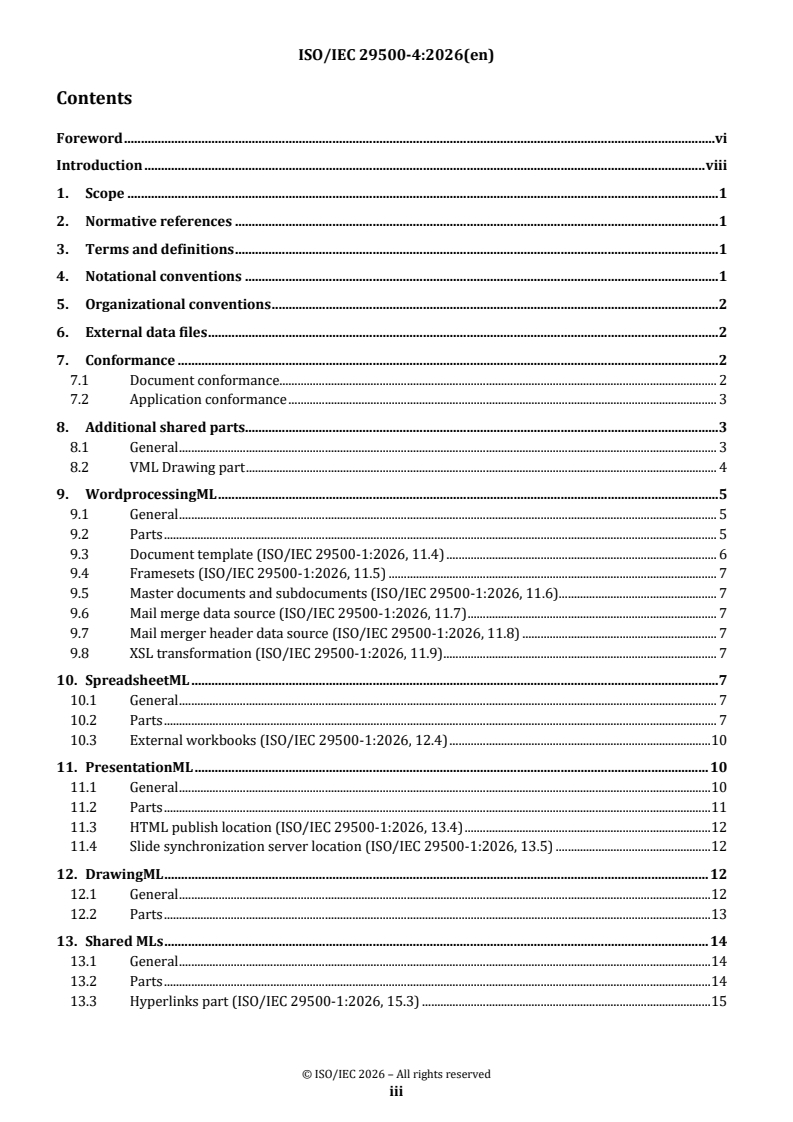
Contents
- Introduction
- 1. Scope
- 2. Normative references
- 3. Terms and definitions
- 3.1 DOS file path
- 4. Notational conventions
- 5. Organizational conventions
- 6. External data files
- 7. Conformance
- 7.1 Document conformance
- 7.2 Application conformance
- 8. Additional shared parts
- 8.1 General
- 8.2 VML Drawing part
- 9. WordprocessingML
- 9.1 General
- 9.2 Parts
- 9.3 Document template (ISO/IEC 29500-1:2026, 11.4)
- 9.4 Framesets (ISO/IEC 29500-1:2026, 11.5)
- 9.5 Master documents and subdocuments (ISO/IEC 29500-1:2026, 11.6)
- 9.6 Mail merge data source (ISO/IEC 29500-1:2026, 11.7)
- 9.7 Mail merger header data source (ISO/IEC 29500-1:2026, 11.8)
- 9.8 XSL transformation (ISO/IEC 29500-1:2026, 11.9)
- 10. SpreadsheetML
- 10.1 General
- 10.2 Parts
- 10.3 External workbooks (ISO/IEC 29500-1:2026, 12.4)
- 11. PresentationML
- 11.1 General
- 11.2 Parts
- 11.3 HTML publish location (ISO/IEC 29500-1:2026, 13.4)
- 11.4 Slide synchronization server location (ISO/IEC 29500-1:2026, 13.5)
- 12. DrawingML
- 12.1 General
- 12.2 Parts
- 13. Shared MLs
- 13.1 General
- 13.2 Parts
- 13.3 Hyperlinks part (ISO/IEC 29500-1:2026, 15.3)
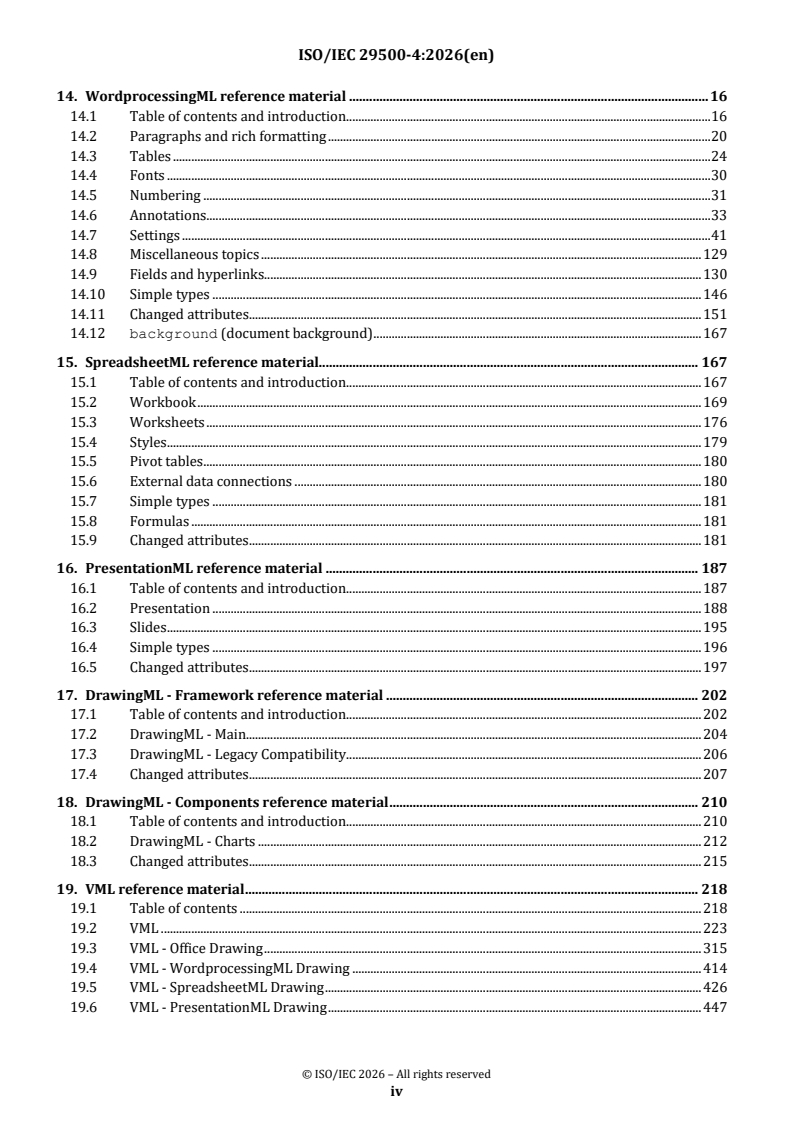
- 14. WordprocessingML reference material
- 14.1 Table of contents and introduction
- 14.2 Paragraphs and rich formatting
- 14.3 Tables
- 14.4 Fonts
- 14.5 Numbering
- 14.6 Annotations
- 12 Aiueo
- 13 Iroha
- 14.7 Settings
- 14.8 Miscellaneous topics
- 14.9 Fields and hyperlinks
- 14.10 Simple types
- 1. Divide the value by 10 and write the symbol
- 2. Divide the quotient of the previous division by
- 3. Repeat step 2 until the remaining value is equal
- 14.11 Changed attributes
- 15. SpreadsheetML reference material
- 15.1 Table of contents and introduction
- 15.2 Workbook
- 15.3 Worksheets
- 15.4 Styles
- 15.5 Pivot tables
- 15.6 External data connections
- 15.7 Simple types
- 15.8 Formulas
- 15.9 Changed attributes
- 16. PresentationML reference material
- 16.1 Table of contents and introduction
- 16.2 Presentation
- 16.3 Slides
- 16.4 Simple types
- 16.5 Changed attributes
- 17. DrawingML - Framework reference material
- 17.1 Table of contents and introduction
- 17.2 DrawingML - Main
- 17.3 DrawingML - Legacy Compatibility
- 17.4 Changed attributes
- 18. DrawingML - Components reference material
- 18.1 Table of contents and introduction
- 18.2 DrawingML - Charts
Introduction
The ISO/IEC 29500 series specifies a family of XML schemas, collectively called Office Open XML, which define the XML vocabularies for word-processing, spreadsheet, and presentation documents, as well as the packaging of documents that conform to these schemas.
The goal is to enable the implementation of the Office Open XML formats by the widest set of tools and platforms, fostering interoperability across office productivity applications and line-of-business systems, as well as to support and strengthen document archival and preservation, all in a way that is fully compatible
with the existing corpus of Microsoft® Office documents.
The intent of this document is to enable a transitional period during which existing binary documents being migrated to ISO/IEC 29500 can make use of legacy features to preserve their fidelity, while noting that new documents should not use them.
This document is normative but is not guaranteed to be included in future revisions of the ISO/IEC 29500 series.
In general, this document augments ISO/IEC 29500-1 and inherits the provisions of that document. Exceptions to this are indicated explicitly.
Microsoft Office is the trademark of a product supplied by Microsoft Corporation. This information is given for the convenience of users of this document and does not constitute an endorsement by ISO or IEC of the product named. Equivalent products may be used if they can be shown to lead to the same results.
ISO/IEC 29500-4:2026(en) Document description and processing languages — Office Open XML File Formats — Part 4:
Transitional migration features
1. Scope
The goals of ISO/IEC 29500 are to represent faithfully the existing corpus of word-processing documents, spreadsheets and presentations that have been produced by Microsoft Office applications, from Microsoft Office 97 to Microsoft Office 2008, inclusive, and to facilitate extensibility and interoperability by enabling implementations by multiple vendors and on multiple platforms. This document specifies additions to and modifications to ISO/IEC 29500-1 for Office Open XML documents that, in their semantics, syntax, and packaging, satisfy the requirements of conformance class Office Open XML Transitional, as specified in Clause 7. This document also specifies requirements for Office Open XML consumers and producers.
2. Normative references
The following documents are referred to in the text in such a way that some or all of their content constitutes requirements of this document. For dated references, only the edition cited applies. For undated references, the latest edition of the referenced document (including any amendments) applies. ISO/IEC 29500-1:2026, Document description and processing languages — Office Open XML File Formats, Part 1: Fundamentals and Markup Language Reference UNITED STATES POSTAL SERVICE. Mailing Standards of the United States Postal Service, Domestic Mail Manual. Online. Available from:
http://pe.usps.com/cpim/ftp/manuals/dmm300/Full/MailingStandards.pdf.
3. Terms and definitions
For the purposes of this document, the following terms and definitions apply. ISO and IEC maintain terminology databases for use in standardization at the following addresses:
- ISO Online browsing platform: available at https://www.iso.org/obp
- IEC Electropedia: available at https://www.electropedia.org
3.1 DOS file path
identifier for the name and possibly location of a file in a legacy file system
4. Notational conventions
The following typographical conventions are used in this document:
- The first occurrence of a new term is written in italics. For example: "The text in this document is divided into normative and informative categories."
ISO/IEC 29500-4:2026(en) - The tag name of an XML element is written using a distinct style and typeface. For example: "The bookmarkStart and bookmarkEnd elements specify …" - The name of an XML attribute is written using a distinct style and typeface. For example: "The dropCap attribute specifies …" - The value of an XML attribute is written using a constant-width style. For example: "The attribute value of auto specifies …" - The qualified or unqualified name of a simple type, complex type, or base datatype is written using a distinct style and typeface. For example: "The possible values for this attribute are defined by the ST_HexColor simple type." Tag names in code fragments are generally expressed as prefixed names. The main exception is that tag names in SpreadsheetML examples are prefixless (see Clause 15). Attribute names in code fragments are prefixless unless the name is declared to be in a specific namespace that is different to that of the parent element’s tag name, except in WordprocessingML examples in which all attribute names are prefixed. References to an attribute of an element are given in XPath style notation. For example: "The value of w:pgMar/@w:left is …" Unless stated otherwise in this document, the functionality defined in ISO/IEC 29500-1 is applicable to this document. However, this document uses namespaces that are different from those used by ISO/IEC 29500-1. As such, when examples in ISO/IEC 29500-1 are read in the context of this document, they should be understood in the context of the corresponding namespaces in this document.
5. Organizational conventions
The primary table of contents does not list the full set of all subclauses in this document. Clauses and subclauses with many further subclauses have their own tables of contents which list all subordinate items. Examples, which are informative and do not contain requirements, are shown using the lead-in “EXAMPLE” when separated from surrounding paragraphs and "For example, …" when inline with regular text. The definitions of lists of items—such as attributes within elements, enumerated values within simple types, and other information whose inline presentation is improved by a grid layout—are presented in a format with the visual appearance of tables but are not designated as tables. Sets of information referenced from other locations in this document are labeled as tables.
6. External data files
Normative requirements are prescribed in this document and the data files provided in electronic form, as noted in the Annexes, and all are required to fully implement ISO/IEC 29500. For example, default values of attributes and permissible contents of elements are specified in schemas only.
7. Conformance
7.1 Document conformance
A document of conformance class Office Open XML Transitional shall be a package of conformance class OPC, as specified in ISO/IEC 29500-2, for which all the following shall hold:
- The document obeys all constraints specified in this document. As in ISO/IEC 29500-1, both normative W3C XML Schema schemas and informative RELAX NG schemas are provided in Annex A and Error! R eference source not found., respectively.
- The document is of category Wordprocessing, Spreadsheet, or Presentation. These categories are defined in ISO/IEC 29500-1:2026, Clause 7.
ISO/IEC 29500-4:2026(en) - VML Drawing Parts (see 8.1) contain markup in the Markup Compatibility namespace as specified in ISO/IEC 29500-3. Any child elements of the root element of VMLDrawing Parts are valid against the VML schema in the file specified in Annex A, after the removal of any extensions specified using the mechanisms in ISO/IEC 29500-3. VML Drawing Parts obey all constraints specified in this document. - The OPC Parts of the document listed in ISO/IEC 29500-1, 10.2 shall be valid after MCE processing as specified in that subclause.
This document uses the following further terms to refer to documents of conformance class Office Open XML Transitional:
- WML Transitional, if the document is of category Wordprocessing
- SML Transitional, if the document is of category Spreadsheet
- PML Transitional, if the document is of category Presentation
7.2 Application conformance
Application conformance incorporates both syntax and semantics. - A conforming consumer shall not reject any conforming documents of at least one document conformance class.
- A conforming producer shall be able to produce conforming documents of at least one document conformance class.
- A conforming application shall treat the information in Office Open XML documents in a manner consistent with the semantic definitions given in ISO/IEC 29500. An application's intended behavior need not require that application to process all of the information in an Office Open XML document. However, the information that it does process shall be processed in a manner that is consistent with the semantic definitions given in ISO/IEC 29500.
This note illustrates the third bullet above. Conforming applications include a viewer, an editor, and a backend processor. Here is an illustration of how the third bullet applies to each of those examples:
- If a conforming viewer supports a given feature, then when it displays information using that feature, it respects the semantics of that feature as described in the Standard.
- If a conforming editor supports a given feature, then when it provides its user with an interface for manipulating information using that feature, it respects the semantics of that feature as described in the Standard.
- If a conforming back-end processor supports a given feature, then when that processor transforms or assembles information involving that feature, that processor respects the semantics of that feature as described in the Standard.
This document defines the following application conformance classes:
- WML Transitional, if the application is a conforming application that is a consumer or producer of documents having conformance class WML Transitional.
- SML Transitional, if the application is a conforming application that is a consumer or producer of documents having conformance class SML Transitional.
- PML Transitional, if the application is a conforming application that is a consumer or producer of documents having conformance class PML Transitional.
8. Additional shared parts
8.1 General
A transitional implementation can provide support for a VML Drawing Part, which is discussed below.
ISO/IEC 29500-4:2026(en)
8.2 VML Drawing part
Content application/vnd.openxmlformats-officedocument.vmlDrawing Type:
Root not applicable Namespace:
Source http://schemas.openxmlformats.org/officeDocument/2006/relationships/vmlDrawi Relationship: ng
An instance of this part type contains markup in the Vector Markup Language (VML) syntax, which is used to provide an alternative image representation of objects stored in a SpreadsheetML or PresentationML document. An instance of this part type shall not appear within a WordprocessingML document. A package is permitted to contain zero or more VML Drawing parts, each of which shall be the target of an explicit relationship in a Handout Master part (ISO/IEC 29500-1:2026, 13.3.3), Notes Slide part (ISO/IEC 29500-1:2026, 13.3.5), Notes Master part (ISO/IEC 29500-1:2026, 13.3.4), Slide part (ISO/IEC 29500- 1:2026, 13.3.8), Slide Layout part (ISO/IEC 29500-1:2026, 13.3.9), or Slide Master part (ISO/IEC 29500- 1:2026, 13.3.10) in a PresentationML document; or a Dialogsheet part (ISO/IEC 29500-1:2026, 12.3.7) or Worksheet part (ISO/IEC 29500-1:2026, 12.3.24) in a SpreadsheetML document. For example, the following SpreadsheetML package-relationship item contains one relationship, for the VML Drawing part stored in the ZIP item ../drawings/drawing1.vml:
<Relationships xmlns="…"> <Relationship Id="rId8" Type="http://…/vmlDrawing" Target="../drawings/drawing1.vml"/> </Relationships> The root element for a part of this content type shall be xml in the null namespace, encapsulating an arbitrary amount of VML markup as defined by this document.
For example, consider the following VML Drawing part:
<xml> <v:shape ...>
</v:shape>
</xml> A VML Drawing part shall be located within the package containing the Relationships part (expressed syntactically, the TargetMode attribute of the Relationship element shall be Internal). A VML Drawing part is permitted to have explicit relationships to the following parts defined by this document:
- Image (ISO/IEC 29500-1:2026, 15.2.14) A VML Drawing part shall not have implicit or explicit relationships to any other part defined by this document.
A VML Drawing part shall be valid against vml-main.xsd (Annex A). No MCE processing shall be applied before this validation.
ISO/IEC 29500-4:2026(en)
9. WordprocessingML
9.1 General
The following parts, which are defined in subclauses within ISO/IEC 29500-1:2026, Clause 11, have different source relationships and/or root namespaces when used in documents of the Transitional conformance class:
9.2 Parts
9.2.1 Alternative Format Import part (ISO/IEC 29500-1:2026, 11.3.1)
Source http://schemas.openxmlformats.org/officeDocument/2006/relationships/aFChunk Relationship:
9.2.2 Comments part (ISO/IEC 29500-1:2026, 11.3.2)
Root http://schemas.openxmlformats.org/wordprocessingml/2006/main Namespace:
Source http://schemas.openxmlformats.org/officeDocument/2006/relationships/comment Relationship: s
9.2.3 Document Settings part (ISO/IEC 29500-1:2026, 11.3.3)
Root http://schemas.openxmlformats.org/wordprocessingml/2006/main Namespace:
Source http://schemas.openxmlformats.org/officeDocument/2006/relationships/settings Relationship:
9.2.4 Endnotes part (ISO/IEC 29500-1:2026, 11.3.4)
Root http://schemas.openxmlformats.org/wordprocessingml/2006/main Namespace:
Source http://schemas.openxmlformats.org/officeDocument/2006/relationships/endnotes Relationship:
9.2.5 Font Table part (ISO/IEC 29500-1:2026, 11.3.5)
Root http://schemas.openxmlformats.org/wordprocessingml/2006/main Namespace:
Source http://schemas.openxmlformats.org/officeDocument/2006/relationships/fontTable Relationship:
9.2.6 Footer part (ISO/IEC 29500-1:2026, 11.3.6)
Root http://schemas.openxmlformats.org/wordprocessingml/2006/main Namespace:
Source http://schemas.openxmlformats.org/officeDocument/2006/relationships/footer Relationship:
9.2.7 Footnotes part (ISO/IEC 29500-1:2026, 11.3.7)
Root http://schemas.openxmlformats.org/wordprocessingml/2006/main Namespace:
Source http://schemas.openxmlformats.org/officeDocument/2006/relationships/footnotes Relationship:
ISO/IEC 29500-4:2026(en)
9.2.8 Glossary Document part (ISO/IEC 29500-1:2026, 11.3.8)
Root http://schemas.openxmlformats.org/wordprocessingml/2006/main Namespace:
Source http://schemas.openxmlformats.org/officeDocument/2006/relationships/glossaryD Relationship: ocument
9.2.9 Header part (ISO/IEC 29500-1:2026, 11.3.9)
Root http://schemas.openxmlformats.org/wordprocessingml/2006/main Namespace:
Source http://schemas.openxmlformats.org/officeDocument/2006/relationships/header Relationship:
9.2.10 Main Document part (ISO/IEC 29500-1:2026, 11.3.10)
Root http://schemas.openxmlformats.org/wordprocessingml/2006/main Namespace:
Source http://schemas.openxmlformats.org/officeDocument/2006/relationships/officeDoc Relationship: ument
9.2.11 Numbering Definitions part (ISO/IEC 29500-1:2026, 11.3.11)
Root http://schemas.openxmlformats.org/wordprocessingml/2006/main Namespace:
Source http://schemas.openxmlformats.org/officeDocument/2006/relationships/numberin Relationship: g
9.2.12 Style Definitions part (ISO/IEC 29500-1:2026, 11.3.12)
Root http://schemas.openxmlformats.org/wordprocessingml/2006/main Namespace:
Source http://schemas.openxmlformats.org/officeDocument/2006/relationships/styles Relationship:
9.2.13 Web Settings part (ISO/IEC 29500-1:2026, 11.3.13)
Root http://schemas.openxmlformats.org/wordprocessingml/2006/main Namespace:
Source http://schemas.openxmlformats.org/officeDocument/2006/relationships/webSettin Relationship: gs
9.2.14 Mail Merge Recipient Data part (ISO/IEC 29500-1:2026, 11.3.14)
Root http://schemas.openxmlformats.org/wordprocessingml/2006/main Namespace:
Source http://schemas.openxmlformats.org/officeDocument/2006/relationships/recipient Relationship: Data
9.3 Document template (ISO/IEC 29500-1:2026, 11.4)
Source http://schemas.openxmlformats.org/officeDocument/2006/relationships/attachedT Relationship: emplate
ISO/IEC 29500-4:2026(en)
9.4 Framesets (ISO/IEC 29500-1:2026, 11.5)
Source http://schemas.openxmlformats.org/officeDocument/2006/relationships/frame Relationship:
9.5 Master documents and subdocuments (ISO/IEC 29500-1:2026, 11.6)
Source http://schemas.openxmlformats.org/officeDocument/2006/relationships/subDocu Relationship: ment
9.6 Mail merge data source (ISO/IEC 29500-1:2026, 11.7)
Source http://schemas.openxmlformats.org/officeDocument/2006/relationships/mailMerg Relationship: eSource
9.7 Mail merger header data source (ISO/IEC 29500-1:2026, 11.8)
Source http://schemas.openxmlformats.org/officeDocument/2006/relationships/mailMerg Relationship: eHeaderSource
9.8 XSL transformation (ISO/IEC 29500-1:2026, 11.9)
Source http://schemas.openxmlformats.org/officeDocument/2006/relationships/transform Relationship:
10. SpreadsheetML
10.1 General
The following parts, which are defined in subclauses within ISO/IEC 29500-1:2026, Clause 12, have different source relationships and/or root namespaces when used in documents of the Transitional conformance class:
10.2 Parts
10.2.1 Calculation Chain part (ISO/IEC 29500-1:2026, 12.3.1)
Root http://schemas.openxmlformats.org/spreadsheetml/2006/main Namespace:
Source http://schemas.openxmlformats.org/officeDocument/2006/relationships/calcChain Relationship:
10.2.2 Chartsheet part (ISO/IEC 29500-1:2026, 12.3.2)
Root http://schemas.openxmlformats.org/spreadsheetml/2006/main Namespace:
Source http://schemas.openxmlformats.org/officeDocument/2006/relationships/chartshee Relationship: t
10.2.3 Comments part (ISO/IEC 29500-1:2026, 12.3.3)
Root http://schemas.openxmlformats.org/spreadsheetml/2006/main Namespace:
Source http://schemas.openxmlformats.org/officeDocument/2006/relationships/comment Relationship: s
ISO/IEC 29500-4:2026(en)
10.2.4 Connections part (ISO/IEC 29500-1:2026, 12.3.4)
Root http://schemas.openxmlformats.org/spreadsheetml/2006/main Namespace:
Source http://schemas.openxmlformats.org/officeDocument/2006/relationships/connectio Relationship: ns
10.2.5 Custom Property part (ISO/IEC 29500-1:2026, 12.3.5)
Root Not applicable Namespace:
Source http://schemas.openxmlformats.org/officeDocument/2006/relationships/customPr Relationship: operty
10.2.6 Custom XML Mappings part (ISO/IEC 29500-1:2026, 12.3.6)
Root http://schemas.openxmlformats.org/spreadsheetml/2006/main Namespace:
Source http://schemas.openxmlformats.org/officeDocument/2006/relationships/xmlMaps Relationship:
10.2.7 Dialogsheet part (ISO/IEC 29500-1:2026, 12.3.7)
Root http://schemas.openxmlformats.org/spreadsheetml/2006/main Namespace:
Source http://schemas.openxmlformats.org/officeDocument/2006/relationships/dialogshe Relationship: et
10.2.8 Drawing part (ISO/IEC 29500-1:2026, 12.3.8)
Root http://schemas.openxmlformats.org/drawingml/2006/spreadsheetDrawing Namespace:
Source http://schemas.openxmlformats.org/officeDocument/2006/relationships/drawing Relationship:
10.2.9 External Workbook References part (ISO/IEC 29500-1:2026, 12.3.9)
Root http://schemas.openxmlformats.org/spreadsheetml/2006/main Namespace:
Source http://schemas.openxmlformats.org/officeDocument/2006/relationships/externalLi Relationship: nk
10.2.10 Metadata part (ISO/IEC 29500-1:2026, 12.3.10)
Root http://schemas.openxmlformats.org/spreadsheetml/2006/main Namespace:
Source http://schemas.openxmlformats.org/officeDocument/2006/relationships/sheetMet Relationship: adata
10.2.11 Pivot Table part (ISO/IEC 29500-1:2026, 12.3.11)
Root http://schemas.openxmlformats.org/spreadsheetml/2006/main Namespace:
...