

ISO/IEC 29500-1
(Main)Document description and processing languages — Office Open XML File Formats — Part 1: Fundamentals and markup language reference
- Abstract
ISO/IEC 29500-1:2016 defines a set of XML vocabularies for representing word-processing documents, spreadsheets and presentations. On the one hand, the goal of ISO/IEC 29500 is to be capable of faithfully representing the pre-existing corpus of word-processing documents, spreadsheets and presentations that had been produced by the Microsoft Office applications (from Microsoft Office 97 to Microsoft Office 2008, inclusive) at the date of the creation of ISO/IEC 29500. It also specifies requirements for Office Open XML consumers and producers. On the other hand, the goal is to facilitate extensibility and interoperability by enabling implementations by multiple vendors and on multiple platforms. ISO/IEC 29500-1:2016 specifies concepts for documents and applications of both strict and transitional conformance.
- Status
- Not Published
- Technical Committee
- ISO/IEC JTC 1/SC 34 - Document description and processing languages
- Drafting Committee
- ISO/IEC JTC 1/SC 34/WG 4 - Office Open XML
- Current Stage
- 6000 - International Standard under publication - 60 Publication
- Start Date
- 13-Oct-2026
ISO/IEC 29500-1 is an ISO/IEC standard in the Office Open XML File Formats series. It defines XML vocabularies for word-processing documents, spreadsheets and presentations, and it sets requirements for Office Open XML consumers and producers. In practice, it is the part to read when you need the document model, package structure and conformance rules for Office Open XML Strict and Transitional use cases.
What does ISO/IEC 29500-1 specify?
ISO/IEC 29500-1 specifies the fundamentals and markup language reference for Office Open XML documents. It covers the document concepts, the package model, markup compatibility, the main XML vocabularies, and the detailed reference material for the markup used in word-processing, spreadsheet, presentation and drawing content.
The document is organized so that the early clauses define the framework and the later clauses give the detailed reference material used by implementations.
| Annex | What it covers |
|---|---|
| A | Schemas - W3C XML Schema |
| B | Schemas - RELAX NG |
| C | WordprocessingML page borders |
| D | Predefined SpreadsheetML style definitions |
| E | Example predefined DrawingML shape and text geometries |
| F | Bidirectional support |
| G | Accessibility best practices |
| H | WordprocessingML page layout concepts |
| I | DrawingML coordinate systems and transformations |
What are the key requirements of ISO/IEC 29500-1?
ISO/IEC 29500-1 sets out how an Office Open XML document is represented, how applications are expected to handle it, and which XML vocabularies and package structures are valid for the standard. The practical focus is on reliable interchange: a producer has to write packages that fit the model, and a consumer has to read them in a way that preserves the document meaning.
Conformance and application roles
Clause 7 defines document conformance, application conformance, application descriptions and interoperability guidelines. ISO/IEC 29500-1 distinguishes what a document must contain from what an application must do, so implementers can state whether they are producing, consuming or both.
Packages, parts and relationships
Clauses 8 and 9 describe the Office Open XML package model and its use of Open Packaging Conventions (OPC). The standard treats an Office Open XML document as a package made of parts linked by relationships, with rules for addressing, fragments, unknown parts, invalid parts and interleaving. In practice, this is the structure software must preserve when saving, copying or inspecting files.
Markup compatibility and extensibility
Clause 10 covers Markup Compatibility and Extensibility (MCE). This is the mechanism that lets implementations handle extension markup and unknown content without breaking the document, which matters for interoperability across vendors and product versions.
WordprocessingML, SpreadsheetML and PresentationML package structure
Clauses 11, 12 and 13 define the package structure and parts for WordprocessingML, SpreadsheetML and PresentationML. They identify the core parts such as the main document, workbook or presentation, plus supporting parts like styles, settings, comments, headers and footers, sheets, slides, layouts, masters, notes and synchronization data. In practice, these clauses tell a writer where each content type belongs and tell a reader where to look for each feature.
DrawingML and shared markup languages
Clauses 14 and 15 define DrawingML and shared markup languages such as Math, extended properties, custom properties, variant types, custom XML data properties, bibliography and office document relationships. These clauses matter because images, charts, diagrams, themes, hyperlinks and metadata often live outside the main document body and still have to round-trip correctly.
Detailed reference material
Clauses 17 to 23 provide the detailed reference material for the individual vocabularies. This is where implementers find the element and attribute-level guidance for paragraph layout, tables, styles, numbering, workbook structures, slide structures, charts, diagrams, shared types and custom XML schema references.
What terms does ISO/IEC 29500-1 define?
ISO/IEC 29500-1 defines the core roles and document types used throughout the standard. These terms are the basis for understanding who reads or writes the package and what kind of Office Open XML content is being described.
- package - A ZIP archive conforming to the Open Packaging Conventions defined in ISO/IEC 29500-2.
- application - A consumer or producer.
- consumer - Software or a device that reads packages through a package implementer.
- producer - Software or a device that writes packages through a package implementer.
- Office Open XML document - A rendition of a data stream formatted using WordprocessingML, SpreadsheetML or PresentationML and its related MLs.
- WordprocessingML - The set of conventions for representing an Office Open XML document of category Wordprocessing.
- SpreadsheetML - The set of conventions for representing an Office Open XML document of category Spreadsheet.
- PresentationML - The set of conventions for representing an Office Open XML document of category Presentation.
Who uses ISO/IEC 29500-1?
ISO/IEC 29500-1 is used by software vendors, document format engineers and interoperability teams that build Office Open XML consumers and producers. It is also relevant to organizations that need office productivity applications and line-of-business systems to exchange documents reliably across multiple platforms and vendors.
In practice, it is used for file-format implementation, validation, round-trip testing, import/export design, interoperability checks and long-term document handling. It also matters to teams working on archival or preservation workflows that need the XML structure and packaging rules to remain readable over time.
What changed in ISO/IEC 29500-1 from the previous edition?
ISO/IEC 29500-1 is the fifth edition and it cancels and replaces the fourth edition, ISO/IEC 29500-1:2016. The foreword states that the document was technically revised.
The main changes stated in the document are:
- Corrections and clarifications throughout the text, with no new functionality added.
- Hanging paragraphs moved into introductory subclauses, which caused some renumbering.
- Normative and bibliographical references added, removed or updated where appropriate.
- BNF and EBNF replaced by ABNF.
- Clarifications to the separation between Strict and Transitional, with some content moved to ISO/IEC 29500-4.
- Clause 3 reorganized, with ML-specific glossaries integrated into the terms and definitions clause.
- Clause 10 expanded and revised.
- Printed schemas removed from Annexes A and B, with schemas available in digital form only.
- Annexes removed: Additional syntax constraints, Namespace prefix mapping in examples, WordprocessingML custom XML data extraction, Root element locations, Primer, and Differences between ISO/IEC 29500 and ECMA-376:2006.
- Annexes added: WordprocessingML page layout concepts and DrawingML coordinate systems and transformations.
Which standards are used with ISO/IEC 29500-1?
ISO/IEC 29500-1 uses several companion standards to define the XML, packaging, character and date-time foundations it builds on. The most direct companion parts are ISO/IEC 29500-2 for Open Packaging Conventions and ISO/IEC 29500-3 for Markup Compatibility and Extensibility.
Other key references include:
- ISO 8601-1 and RFC 3339 for date and time representations.
- XML 1.0 and Namespaces in XML 1.0 for the XML syntax and naming model.
- XML Schema Part 1, XPath 1.0 and XSLT 1.0 for schema and transformation processing.
- UTF-16, Unicode and Unicode Bidirectional Algorithm references for text handling.
- MIME, URI, IRIs, ABNF and case-sensitive ABNF support for content types and syntax.
- IEC 61966-2-1 for the default sRGB color space.
- ISO/IEC 14496-22 for the Open Font Format.
- ISO/IEC 10118-3 and the referenced RFC hash algorithms for hashing support.
- IANA registries and BCP 47 for media types, character sets and language tags.
What does the ISO/IEC 29500-1 document contain?
ISO/IEC 29500-1 contains a full clause-by-clause reference for Office Open XML fundamentals and markup languages. Clauses 17 to 23 are especially detailed, covering WordprocessingML, SpreadsheetML, PresentationML, DrawingML, shared markup languages and custom XML schema references.
The reference material is organized around the things implementers actually read and write: elements, attributes, simple types, package parts and the rules that connect them. It includes tables of properties, package structures, formula and field-related content, relationship types, style definitions, numbering, comments, revisions, charts, diagrams and other document features.
The annexes add practical support material. Some annexes give normative schema content, while others provide examples, layout concepts, bidirectional text guidance, accessibility guidance and coordinate-system explanations for rendering and authoring tools.
Relations
- Effective Date
- 17-Sep-2022
Get Certified
Connect with accredited certification bodies for this standard

BSI Group
BSI (British Standards Institution) is the business standards company that helps organizations make excellence a habit.

NYCE
Mexican standards and certification body.
Sponsored listings
Frequently Asked Questions
ISO/IEC 29500-1 is a draft published by the International Organization for Standardization (ISO). Its full title is "Document description and processing languages — Office Open XML File Formats — Part 1: Fundamentals and markup language reference". This standard covers: ISO/IEC 29500-1:2016 defines a set of XML vocabularies for representing word-processing documents, spreadsheets and presentations. On the one hand, the goal of ISO/IEC 29500 is to be capable of faithfully representing the pre-existing corpus of word-processing documents, spreadsheets and presentations that had been produced by the Microsoft Office applications (from Microsoft Office 97 to Microsoft Office 2008, inclusive) at the date of the creation of ISO/IEC 29500. It also specifies requirements for Office Open XML consumers and producers. On the other hand, the goal is to facilitate extensibility and interoperability by enabling implementations by multiple vendors and on multiple platforms. ISO/IEC 29500-1:2016 specifies concepts for documents and applications of both strict and transitional conformance.
ISO/IEC 29500-1:2016 defines a set of XML vocabularies for representing word-processing documents, spreadsheets and presentations. On the one hand, the goal of ISO/IEC 29500 is to be capable of faithfully representing the pre-existing corpus of word-processing documents, spreadsheets and presentations that had been produced by the Microsoft Office applications (from Microsoft Office 97 to Microsoft Office 2008, inclusive) at the date of the creation of ISO/IEC 29500. It also specifies requirements for Office Open XML consumers and producers. On the other hand, the goal is to facilitate extensibility and interoperability by enabling implementations by multiple vendors and on multiple platforms. ISO/IEC 29500-1:2016 specifies concepts for documents and applications of both strict and transitional conformance.
ISO/IEC 29500-1 is classified under the following ICS (International Classification for Standards) categories: 35.060 - Languages used in information technology; 35.240.30 - IT applications in information, documentation and publishing. The ICS classification helps identify the subject area and facilitates finding related standards.
ISO/IEC 29500-1 has the following relationships with other standards: It is inter standard links to ISO/IEC 29500-1:2016. Understanding these relationships helps ensure you are using the most current and applicable version of the standard.
ISO/IEC 29500-1 is available in PDF format for immediate download after purchase. The document can be added to your cart and obtained through the secure checkout process. Digital delivery ensures instant access to the complete standard document.
Standards Content (Sample)
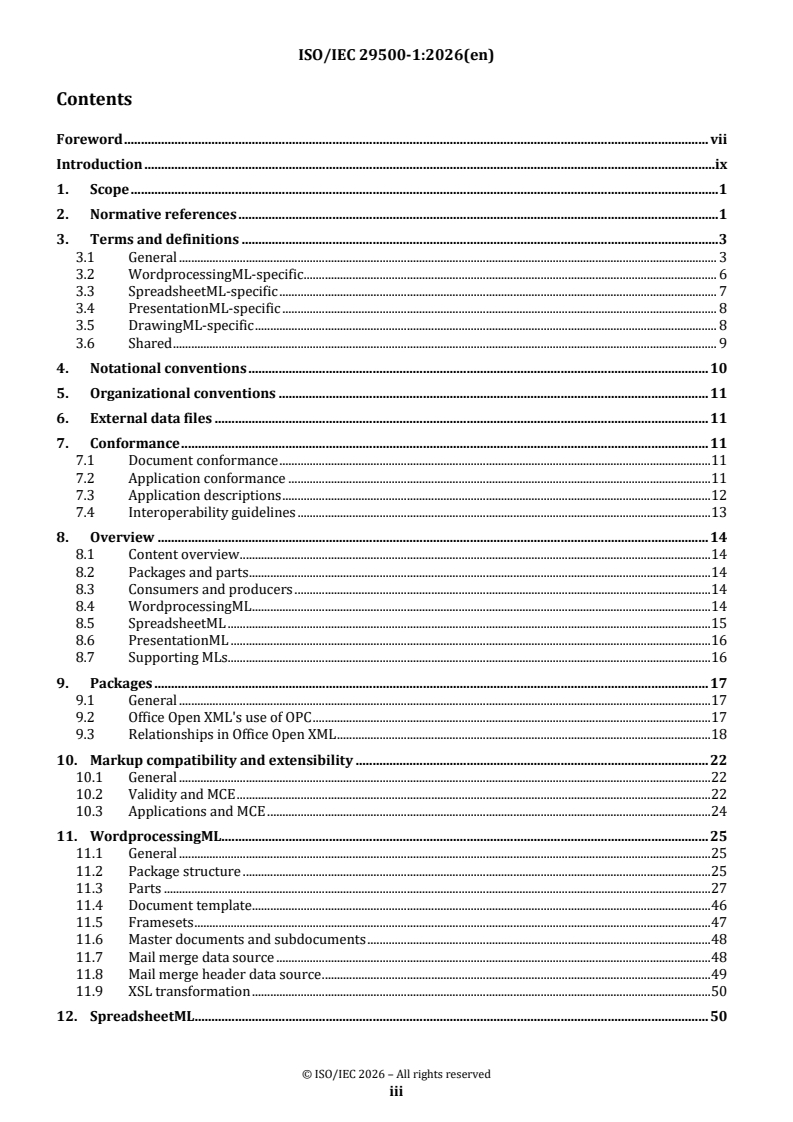
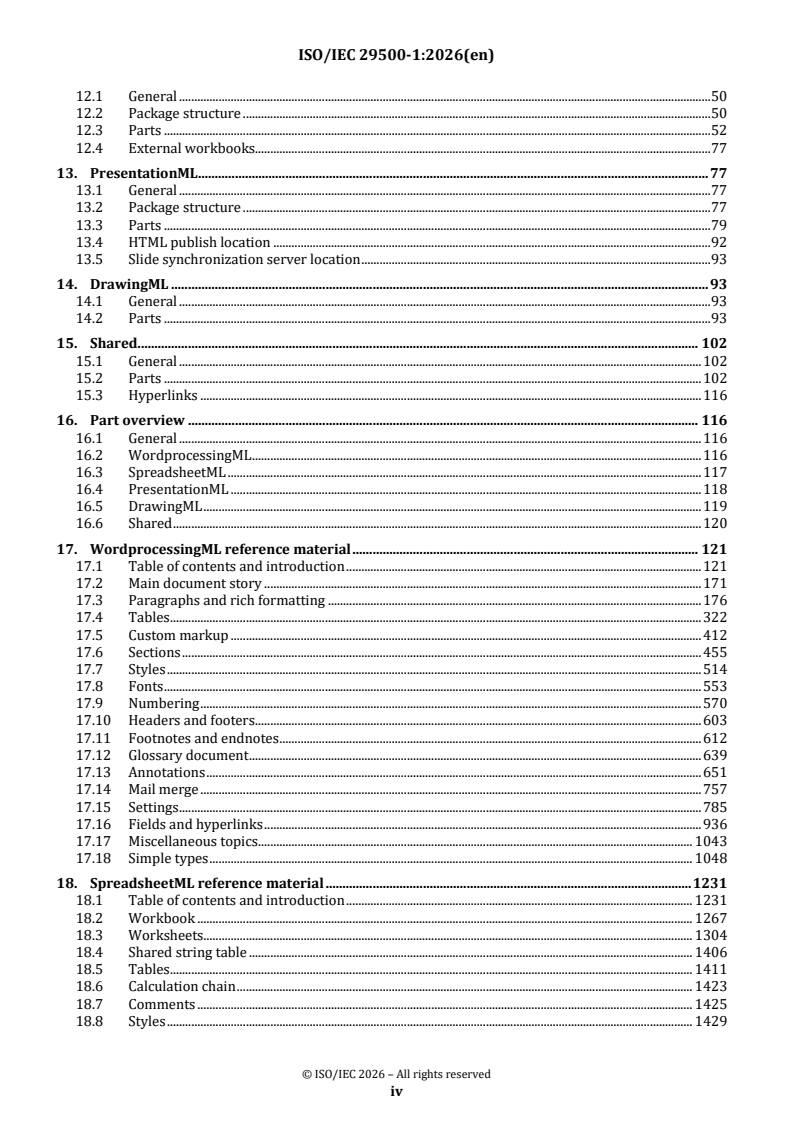
Contents
- Introduction
- 1. Scope
- 2. Normative references
- 3. Terms and definitions
- 3.1 General
- 3.1.1 package
- 3.1.2 application
- 3.1.3 consumer
- 3.1.4 producer
- 3.1.5 Office Open XML document
- 3.1.6 WordprocessingML
- 3.1.7 SpreadsheetML
- 3.1.8 PresentationML
- 3.1.9 DrawingML
- 3.1.10 document category
- 3.1.11 embedded package
- 3.1.12 relationship
- 3.1.13 relationships part
- 3.1.14 explicit relationship
- 3.1.15 implicit relationship
- 3.1.16 behavior
- 3.1.17 implementation-defined
- 3.1.18 unspecified
- 3.1.19 byte
- 3.1.20 comment
- 3.1.21 content type
- 3.1.22 extension
- 3.1.23 locale-specific
- 3.1.24 ODBC
- 3.1.25 OLE
- 3.1.26 unique identifier
- 3.2 WordprocessingML-specific
- 3.2.1 document setting
- 3.2.2 section
- 3.2.3 document building block
- 3.2.4 template
- 3.2.5 master document
- 3.2.6 subdocument
- 3.2.7 glossary document
- 3.2.8 supplementary document storage location
- 3.3 SpreadsheetML-specific
- 3.3.1 workbook
- 3.3.2 worksheet
- 3.3.3 cell
- 3.3.4 row
- 3.3.5 column
- 3.3.6 cell reference
- 3.3.7 formula
- 3.3.8 function
- 3.3.9 table
- 3.3.10 pivot table
- 3.3.11 AutoFilter
- 3.3.12 chart
- 3.3.13 connection
- 3.3.14 MDX
- 3.3.15 OLAP
- 3.4 PresentationML-specific
- 3.4.1 presentation
- 3.4.2 handout
- 3.4.3 slide
- 3.4.4 slide layout
- 3.4.5 note
- 3.5 DrawingML-specific
- 3.5.1 DiagramML
- 3.5.2 diagram
- 3.6 Shared
- 3.6.1 control
- 3.6.2 math zone
- 3.6.3 mathematical text
- 3.6.4 OMML
- 3.6.5 instance of mathematical text
- 3.6.6 math paragraph
- 3.6.7 display mode
- 3.6.8 oMath container
- 3.6.9 display equation
- 3.6.10 inline equation
- 3.6.11 math alphanumerics
- 3.6.12 math accent
- 3.6.13 linear format
- 3.6.14 built-down form
Introduction
The ISO/IEC 29500 series specifies a family of XML schemas, collectively called Office Open XML, which define the XML vocabularies for word-processing, spreadsheet, and presentation documents, as well as the packaging of documents that conform to these schemas.
The goal is to enable the implementation of the Office Open XML formats by the widest set of tools and platforms, fostering interoperability across office productivity applications and line-of-business systems, as well as to support and strengthen document archival and preservation, all in a way that is fully compatible
with the existing corpus of Microsoft® Office documents.
Microsoft Office is the trademark of a product supplied by Microsoft Corporation. This information is given for the convenience of users of this document and does not constitute an endorsement by ISO or IEC of the product named. Equivalent products may be used if they can be shown to lead to the same results.
ISO/IEC 29500-1:2026(en) Document description and processing languages — Office Open XML File Formats — Part 1:
Fundamentals and markup language reference
1. Scope
The goals of ISO/IEC 29500 are to be capable of faithfully representing the pre-existing corpus of wordprocessing documents, spreadsheets and presentations that had been produced by the Microsoft Office applications, from Microsoft Office 97 to Microsoft Office 2008, inclusive, at the date of creation of ISO/IEC 29500 and to facilitate extensibility and interoperability by enabling implementations by multiple vendors and on multiple platforms.
This document specifies the features of Office Open XML documents that, in their semantics, syntax, and packaging, satisfy the requirements of conformance class Office Open XML Strict, as specified in Clause 7. This document also specifies requirements for Office Open XML consumers and producers.
2. Normative references
The following documents are referred to in the text in such a way that some or all of their content constitutes requirements of this document. For dated references, only the edition cited applies. For undated references, the latest edition of the referenced document (including any amendments) applies. ISO 8601-1, Date and time — Representations for information interchange — Part 1: Basic rules ISO/IEC 8859-1, Information technology — 8-bit single-byte coded graphic character sets — Part 1: Latin alphabet No. 1 ISO/IEC 9075-1, Information technology — Database languages — SQL — Part 1: Framework (SQL/Framework) ISO/IEC 9075-3:2023, Information technology — Database languages — SQL — Part 3: Call-Level Interface (SQL/CLI) ISO/IEC 10118-3, IT Security techniques — Hash-functions — Part 3: Dedicated hash-functions ISO/IEC 14496-22, Information technology — Coding of audio-visual objects — Part 22: Open Font Format ISO/IEC 29500-2:2021, Document description and processing languages — Office Open XML file formats – Part 2: Open packaging conventions ISO/IEC 29500-3:2015, Information technology — Document description and processing languages — Office Open XML File Formats – Part 3: Markup Compatibility and Extensibility ISO/IEC 60559:2020, Information technology — Microprocessor Systems — Floating-Point arithmetic IEC 61966-2-1, Multimedia systems and equipment — Colour measurement and management — Part 2-1:
Colour management — Default RGB colour space — sRGB IANA (INTERNET ASSIGNED NAMES AUTHORITY). Media Types. Online. Edited by A. Melnikov, D. Miller, M. Kucherawy. Available from: https://www.iana.org/assignments/media-types/media-types.xhtml. IANA. Character Set Registrations. Online. Edited by M. Dürst. Available from:
https://www.iana.org/assignments/charset-reg/charset-reg.xhtml.
ISO/IEC 29500-1:2026(en) IANA. Character Sets. Online. Edited by M. Dürst. Available from:
https://www.iana.org/assignments/character-sets/character-sets.xhtml. IETF. BCP 47. Online. Available from: https://datatracker.ietf.org/doc/bcp47/. IETF. RFC 1319: The MD2 Message-Digest Algorithm. Online. Edited by B. Kaliski. April 1992. Available from:
https://datatracker.ietf.org/doc/rfc1319/.
IETF. RFC 1320: The MD4 Message-Digest Algorithm. Online. Edited by R. Rivest. April 1992. Available from:
https://datatracker.ietf.org/doc/rfc1320/https://www.rfc-editor.org/rfc/rfc1320. IETF. RFC 1321: The MD5 Message-Digest Algorithm. Online. Edited by R. Rivest. April 1992. Available from:
https://datatracker.ietf.org/doc/rfc1321/.
IETF. RFC 2046: Multipurpose Internet Mail Extensions (MIME) Part Two: Media Types. Online. Edited by N. Freed, N. Borenstein. November 1996. Available from: https://datatracker.ietf.org/doc/rfc2046/. IETF. RFC 2781: UTF-16, an encoding of ISO 10646. Online. Edited by P. Hoffman, F. Yergeau. February 2000. Available from: https://datatracker.ietf.org/doc/rfc2781/.
IETF. RFC 3339: Date and Time on the Internet: Timestamps. Online. Edited by G. Klyne, C. Newman. July 2002. Available from: https://datatracker.ietf.org/doc/rfc3339/. IETF. RFC 3986 (STD 66): Uniform Resource Identifier (URI): Generic Syntax. Online. Edited by T. Berners-Lee, R. Fielding, L. Masinter. January 2005. Available from: https://datatracker.ietf.org/doc/rfc3986/. IETF. RFC 3987: Internationalized Resource Identifiers (IRIs). Edited by M. Duerst and M. Suignard. IETF, January 2005. Available from: https://datatracker.ietf.org/doc/rfc3987/. IETF. RFC 5234 (STD 68): Augmented BNF for Syntax Specifications: ABNF. Online. Edited by D. Crocker, P. Overell. January 2008. Available from: https://datatracker.ietf.org/doc/rfc5234/. IETF. RFC 7405: Case-Sensitive String Support in ABNF. Online. Edited by P. Kyzivat. December 2014. Available from: https://datatracker.ietf.org/doc/rfc7405/.
THE UNICODE CONSORTIUM. The Unicode Standard. Online. Available from:
https://www.unicode.org/standard/standard.html.
THE UNICODE CONSORTIUM. Unicode Standard Annex #9: Unicode Bidirectional Algorithm. Online. Edited by M. Goregaokar, R. Leroy. Available from: https://www.unicode.org/reports/tr9/. W3C. Cascading Style Sheets Level 2 Revision 1 (CSS 2.1). Online. Edited by B. Bos, T. Çelik, I. Hickson, H. W. Lie. 7 June 2011. Available from: https://www.w3.org/TR/CSS2/. W3C. Extensible Markup Language (XML) 1.0 (Fourth Edition). Online. Edited by T. Bray, J. Paoli, C. M. Sperberg-McQueen, E. Maler, F. Yergeau. 16 August 2006. Available from:
https://www.w3.org/TR/2006/REC-xml-20060816/.
W3C. Namespaces in XML 1.0 (Third Edition). Online. Edited by T. Bray, D. Hollander, A. Layman, R. Tobin, H. S. Thompson. 8 December 2009. Available from: https://www.w3.org/TR/2009/REC-xml-names- 20091208/.
W3C. Scalable Vector Graphics (SVG) 1.1 (Second Edition). Online. Edited by E. Dahlström, P. Dengler, A. Grasso, C. Lilley, C. McCormack, D. Schepers, J. Watt. 16 August 2011. Available from:
https://www.w3.org/TR/SVG11/.
W3C. SOAP Version 1.2 Part 1: Messaging Framework (Second Edition). Online. Edited by M. Gudgin, M. Hadley, N. Mendelsohn, J. Moreau, H. F. Nielsen, A. Karmarkar, Y. Lafon. 27 April 2007. Available from:
https://www.w3.org/TR/soap12/.
W3C. XML Path Language (XPath) Version 1.0. Online. Edited by J. Clark, S., DeRose. 16 November 1999. Available from: https://www.w3.org/TR/xpath-10/.
W3C. XML Schema Part 1: Structures (Second Edition). Online. Edited by H. Thompson, D. Beech, M. Maloney, N. Mendelsohn. 28 October 2004. Available at: https://www.w3.org/TR/xmlschema-1/.
ISO/IEC 29500-1:2026(en) W3C. XSL Transformations (XSLT) Version 1.0. Online. Edited by J. Clark. 16 November 1999. Available from:
https://www.w3.org/TR/xslt-10/.
CNS 7648: Data Elements and Interchange Formats — Information Interchange — Representation of Dates and Times. Ministry of Economic Affairs [Taiwan]: Bureau of Standards, Metrology and Inspection, 2015. Available from: https://www.cnsonline.com.tw/?node=detail&generalno=7648&locale=en_US. INCITS 4-1986 (R2022) [formerly: ANSI X3.4-1986], Information Systems - Coded Character Sets - 7- Bit Standard Code for Information Interchange (7-Bit ASCII). InterNational Committee for Information Technology Standards, 2022. Available from: https://webstore.ansi.org/standards/incits/incits1986r2022. JIS X 0301: Data elements and interchange formats —Information interchange — Representation of dates and times. Japanese Standards Association Group, 2019. Available from:
https://webdesk.jsa.or.jp/books/W11M0090/index/?bunsyo_id=JIS+X+0301%3A2002%2FAMENDMENT+ 1%3A2019.
HAR'EL, Zvi. Gauss Formula for the Julian Date of Passover. Online. Haifa: Technion – Israel Institute of Technology, 2005. Available from: http://harel.org.il/zvi/docs/gauss.pdf. MAIMON, Rabbi Moshe ben. Complete Restatement of the Oral Law (Mishneh Torah). MINISTRY OF EARTH SCIENCES [India]: Positional Astronomy Centre. Indian Astronomical Ephemeris for the Year 2025. Kolkata: Positional Astronomy Centre, 2024. Available from: https://packolkata.gov.in/iae.php. See also: https://packolkata.gov.in/indian-astronomical-ephemeris.php. MINISTRY OF ISLAMIC AFFAIRS, ENDOWMENTS, DA‘WAH AND GUIDANCE [Saudi Arabia]. REPUBLIC OF KOREA. Korean Law Enactment No. 4, 1961.
SARGENT, Murray. Unicode Technical Note #28: UnicodeMath, A Nearly Plain-Text Encoding of Mathematics. Available from: https://www.unicode.org/notes/tn28/.
UNIVERSAL POSTAL UNION. POST*CODE: Postal addressing systems. Berne: UPU Publications, 2006, ISSN 1020-6019.
3. Terms and definitions
For the purposes of this document, the following terms and definitions apply. ISO and IEC maintain terminology databases for use in standardization at the following addresses:
- ISO Online browsing platform: available at https://www.iso.org/obp
- IEC Electropedia: available at https://www.electropedia.org
3.1 General
3.1.1 package
ZIP archive conforming to the Open Packaging Conventions defined in ISO/IEC 29500-2
3.1.2 application
consumer or producer
3.1.3 consumer
piece of software or device that reads packages through a package implementer Note 1 to entry: A consumer is often designed to consume packages only for a specific physical package format.
3.1.4 producer
piece of software or device that writes packages through a package implementer
ISO/IEC 29500-1:2026(en) Note 1 to entry: A producer is often designed to produce packages according to a particular physical package format specification.
3.1.5 Office Open XML document
rendition of a data stream formatted using WordprocessingML, SpreadsheetML, or PresentationML and its related MLs Note 1 to entry: Such a document is represented as a package, as described in ISO/IEC 29500-2.
3.1.6 WordprocessingML
set of conventions for representing an Office Open XML document of category Wordprocessing
3.1.7 SpreadsheetML
set of conventions for representing an Office Open XML document of category Spreadsheet
3.1.8 PresentationML
set of conventions for representing an Office Open XML document of category Presentation
3.1.9 DrawingML
set of conventions for specifying the location and appearance of drawing elements in an Office Open XML document
3.1.10 document category
one of the three categories of Office Open XML documents (Wordprocessing, Spreadsheet, and Presentation) Note 1 to entry: A document whose package-relationship item contains a relationship to…:
- …a Main Document part (see 11.3.10) is a document of category Wordprocessing.
- …a Workbook part (see 12.3.23) is a document of category Spreadsheet.
- …a Presentation part (see 13.3.6) is a document of category Presentation. Note 2 to entry: An Office Open XML document can contain one or more embedded Office Open XML packages (see 15.2.11) with each embedded package having any of the three document categories. However, the presence of these embedded packages does not change the category of the document.
3.1.11 embedded package
package stored as the target of an Embedded Package relationship (see 15.2.11) in an Office Open XML document
3.1.12 relationship
kind of connection between a source part and a target part in a package Note 1 to entry: Relationships make the connections between parts directly discoverable without examining the content in the parts and without altering the parts themselves.
3.1.13 relationships part
part containing an XML representation of relationships
3.1.14 explicit relationship
relationship in which a resource is referenced from a source part’s XML using the Id attribute of a Relationship tag
ISO/IEC 29500-1:2026(en)
3.1.15 implicit relationship
relationship that is not explicit
3.1.16 behavior
external appearance or action
3.1.17 implementation-defined
unspecified behavior where each implementation is expected to document that behavior Note 1 to entry: Documentation is intended to promote predictability and reproducibility within any given implementation.
3.1.18 unspecified
application-dependent specific to an implementation with no recommendation made by ISO/IEC 29500 Note 1 to entry: Extensions are properly added using the extensibility mechanisms described by ISO/IEC 29500, not by giving meaning to otherwise unspecified behavior.
3.1.19 byte
sequence of 8 bits treated as a unit
3.1.20 comment
note attached to content in a document Note 1 to entry: Although a consumer might choose to display comments, they are not considered part of the body of the document. A comment might include the text of the note, the comment author's name and initials, and date of creation, among other things.
3.1.21 content type
media type, subtype, and an optional set of parameters Note 1 to entry: All instances of the term “content type” in this document are identical in meaning to the term “media type,” as defined in RFC 2046, that is preferred and used in other information technology standards.
3.1.22 extension
XML element, XML attribute, relationship, or part not explicitly included in ISO/IEC 29500, but that uses the extensibility mechanisms described by ISO/IEC 29500
3.1.23 locale-specific
dependent on local conventions of nationality, culture, and language
3.1.24 ODBC
implementation of ISO/IEC 9075-3 or an SQL/CLI-based database connectivity API EXAMPLE One broadly used SQL/CLI-based database connectivity API is the Open Database Connectivity (ODBC) API.
3.1.25 OLE
generalized abstraction of embedding and linking objects within a document
ISO/IEC 29500-1:2026(en) Note 1 to entry: OLE in the context of this document does not refer to any specific technology.
3.1.26 unique identifier
id exclusive descriptor using one of a variety of different identification schemes Note 1 to entry: In this document, the term does not imply use of the xsd:ID data type.
3.2 WordprocessingML-specific
3.2.1 document setting
document-level property that affects the handling of a given document and influences the appearance and behavior of the current document as well as the stored document-level state
3.2.2 section
portion of a document in which certain page formatting options can be set Note 1 to entry: A new section is created to change such properties as line numbering, number of columns, or headers and footers.
3.2.3 document building block
reusable element in a template Note 1 to entry: Such elements include boilerplate text, cover pages, equations, footers, headers, tables, text boxes, and watermarks.
3.2.4 template
document that is a pattern for creating other documents Note 1 to entry: A template can contain text, formatting, and graphics, among other things, such that documents based on it automatically have access to these elements.
3.2.5 master document
document that is the parent of one or more subdocuments Note 1 to entry: A master document can be used to manage a multipart document, such as a book having several chapters. In such a case, the master document might contain the cover page, front matter, table of contents, and cross-reference index, while each chapter and appendix resides in its own subdocument.
3.2.6 subdocument
piece of a master document Note 1 to entry: A chapter or appendix might be a subdocument in a book.
3.2.7 glossary document
additional WordprocessingML document story used to store reusable fragments of rich WordprocessingML content Note 1 to entry: It is called the glossary document as this story contains one or more fragments that can be indexed and extracted by name, like items in a glossary.
3.2.8 supplementary document storage location
part within a WordprocessingML document in which fragments of WordprocessingML content can be stored separate from the printed page
ISO/IEC 29500-1:2026(en)
3.3 SpreadsheetML-specific
3.3.1 workbook
collection of worksheets
3.3.2 worksheet
two-dimensional grid of cells organized into rows and columns
3.3.3 cell
location at the intersection of a row and column, in which numeric or textual data or a formula is stored Note 1 to entry: A cell can have a number of characteristics, such as numeric or text formatting, alignment, font, color, and border.
3.3.4 row
horizontal set of cells in a worksheet Note 1 to entry: Each row has a numeric heading. Rows are numbered sequentially, starting at 1.
3.3.5 column
vertical set of cells in a worksheet Note 1 to entry: Each column has an alphabetic heading. Columns are named sequentially, going from A–Z, then AA–AZ, BA–BZ, and so on.
3.3.6 cell reference
individual cell's designation using a combination of its column and row headings EXAMPLE Cell references include A13, H19, and BX1200.
Note 1 to entry: A relative cell reference in a formula automatically changes when the formula is copied down a column or across a row. An absolute cell reference is fixed and does not change when a formula is copied from one cell to another. A mixed cell reference has either an absolute column and a relative row or an absolute row and a relative column.
3.3.7 formula
recipe for calculating a value Note 1 to entry: Some formulas are predefined; others are user-defined.
3.3.8 function
predefined formula Note 1 to entry: A function, such as AVERAGE, MAX, MIN, or SUM, takes one or more arguments on which it operates, producing a result. In the formula =SUM(B1:B4), there is one argument, B1:B4, which is the range of cells B1–B4, inclusive.
3.3.9 table
rectangular-shaped set of related rows and columns that can be sorted, filtered, and totaled as a group Note 1 to entry: Rows in a table can be hidden by applying AutoFilters to one or more columns.
3.3.10 pivot table
kind of table used to manage and analyze related data that is stored elsewhere
ISO/IEC 29500-1:2026(en)
3.3.11 AutoFilter
SpreadsheetML document state in which only certain rows are displayed, determined via filter criteria applied to the columns
3.3.12 chart
graphical representation of data EXAMPLE Chart types include bar, column, line, and pie.
3.3.13 connection
means by which external data can be imported into a worksheet Note 1 to entry: External data is data stored outside of a workbook, such as in a database or on a Web server.
3.3.14 MDX
multi-dimensional expression language Note 1 to entry: MDX is passed to an OLAP provider. The method of interpreting this is defined by the serverside OLAP provider implementation.
3.3.15 OLAP
online analytical processing database which uses a multi-dimensional data model
3.4 PresentationML-specific
3.4.1 presentation
collection of slides intended to be viewed by an audience
3.4.2 handout
printed set of slides Note 1 to entry: This is so named because the printed set is designed to be handed out to an audience for future reference.
3.4.3 slide
frame containing one or more pieces of text and/or images
3.4.4 slide layout
organization of elements on a slide
...