

ISO/IEC 8613-6:1994/Cor 1:1998
(Corrigendum)Information technology — Open Document Architecture (ODA) and Interchange Format: Character content architectures — Technical Corrigendum 1
General Information
- Abstract
- Status
- Published
- Publication Date
- 19-Dec-1998
- Technical Committee
- ISO/IEC JTC 1 - Information technology
- Drafting Committee
- ISO/IEC JTC 1 - Information technology
- Current Stage
- 6060 - International Standard published
- Start Date
- 20-Dec-1998
- Completion Date
- 29-Aug-2026
Overview
ISO/IEC 8613-6:1994/Cor 1:1998 is a Technical Corrigendum to ISO/IEC 8613-6:1994, the part of the Open Document Architecture (ODA) and Interchange Format that defines character content architectures. Published in 1998, this corrigendum makes editorial and technical clarifications to terminology, control-function definitions, presentation attributes and the interchange semantics used for character-level content in ODA documents. It also adds a new clause describing implementation-dependent features and how recipients may handle presentation attributes.
Key Topics and Requirements
- Terminology corrections: Multiple term replacements to align names (for example, various “Relative”/“Backward”/“Forward” label changes) and consistent quoting/formatting of alignment values.
- Control-function clarifications: Revised definitions for control functions that govern text layout and imaging, including:
- Character position adjustments (HPB/Character Position Backward, HPR/Character Position Forward)
- Tabulation and selective tabulation references (STAB)
- Line break semantics (SPACE as potential line-break point, NBH/No Break Here)
- Superscript/subscript start/end, inverse imaging, and parallel presentation markers
- No Justify (JFY) insertion rules for the last line of a sequence
- Presentation attributes and formatting: Stipulation that formatting indicators cannot be altered inside a basic component; notes removed or renumbered for clarity; rules for pairwise kerning, first-line offset and itemization that may result in insertion of positioning control functions.
- Implementation-dependent features: New explicit note that rendering of presentation attributes is implementation dependent. Originators can request attributes but recipients may substitute or fall back (examples provided):
- font selection for emphasis (weight/posture)
- alternate rendition for blinking in print
- replacing underlining when writing direction requires it
- substitution of fonts when specified ones are unavailable
- Interchange behavior: Emphasis that document application profiles may impose additional constraints or requirements on character presentation.
Applications and Who Uses It
- Software developers and implementers of ODA document processors, converters and renderers.
- Vendors creating document interchange and archival systems that must preserve character-level semantics.
- Standards authors and profile writers who define document application profiles or interoperability rules for ODA.
- Preservation and interoperability specialists who require precise rules for character spacing, kerning, line breaking and font substitution during interchange.
Related Standards
- ITU‑T Rec. T.416 (1993)/Cor.1 (1997) - related interchange recommendations cited in the corrigendum
- ISO/IEC 6937 - graphic character repertoire referenced for selective parameters
- ISO/IEC 6429 and ISO/IEC 2022 - character set designation and invocation mechanisms
- ITU‑T Rec. T.410-series / ISO/IEC 8613 - higher-level presentation/layout context
Keywords: ISO/IEC 8613-6, ODA, Open Document Architecture, character content architectures, technical corrigendum, character positioning, kerning, tabulation, line breaking, presentation attributes, document interchange.
Relations
- Effective Date
- 06-Jun-2022
- Effective Date
- 15-Apr-2008
Get Certified
Connect with accredited certification bodies for this standard

BSI Group
BSI (British Standards Institution) is the business standards company that helps organizations make excellence a habit.

NYCE
Mexican standards and certification body.
Sponsored listings
Frequently Asked Questions
ISO/IEC 8613-6:1994/Cor 1:1998 is a standard published by the International Organization for Standardization (ISO). Its full title is "Information technology — Open Document Architecture (ODA) and Interchange Format: Character content architectures — Technical Corrigendum 1". This standard covers: Information technology — Open Document Architecture (ODA) and Interchange Format: Character content architectures — Technical Corrigendum 1
Information technology — Open Document Architecture (ODA) and Interchange Format: Character content architectures — Technical Corrigendum 1
ISO/IEC 8613-6:1994/Cor 1:1998 is classified under the following ICS (International Classification for Standards) categories: 35.240.20 - IT applications in office work. The ICS classification helps identify the subject area and facilitates finding related standards.
ISO/IEC 8613-6:1994/Cor 1:1998 has the following relationships with other standards: It is inter standard links to ISO/IEC 8613-6:1994; is excused to ISO/IEC 8613-6:1994. Understanding these relationships helps ensure you are using the most current and applicable version of the standard.
ISO/IEC 8613-6:1994/Cor 1:1998 is available in PDF format for immediate download after purchase. The document can be added to your cart and obtained through the secure checkout process. Digital delivery ensures instant access to the complete standard document.
Standards Content (Sample)
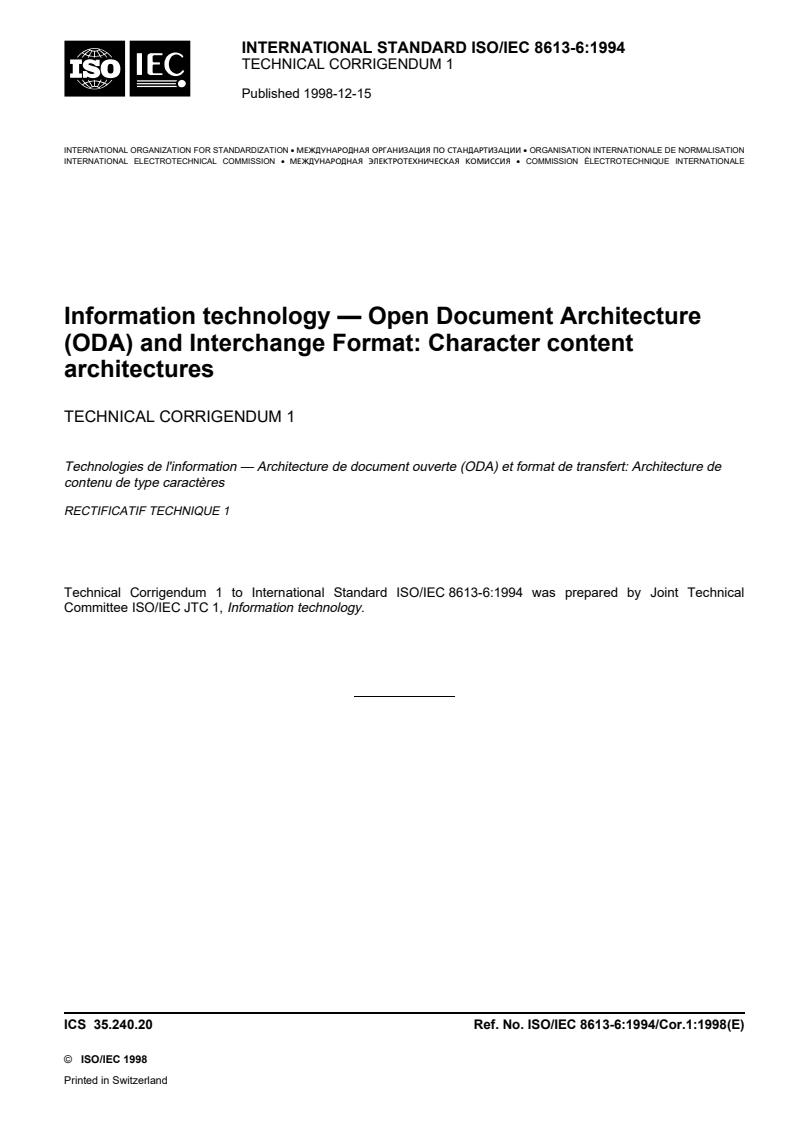
INTERNATIONAL STANDARD ISO/IEC 8613-6:1994
TECHNICAL CORRIGENDUM 1
bc
Published 1998-12-15
INTERNATIONAL ORGANIZATION FOR STANDARDIZATION ORGANISATION INTERNATIONALE DE NORMALISATION
• �¯˘˜�˝�—˛˜˝�� ˛—ˆ�˝¨˙��¨� ˇ˛ ���˝˜�—�¨˙��¨¨ •
INTERNATIONAL ELECTROTECHNICAL COMMISSION COMMISSION ÉLECTROTECHNIQUE INTERNATIONALE
• �¯˘˜�˝�—˛˜˝�� �¸¯˚�—˛�¯�˝¨�¯�˚�� ˚˛�¨��¨� •
Information technology — Open Document Architecture
(ODA) and Interchange Format: Character content
architectures
TECHNICAL CORRIGENDUM 1
Technologies de l'information — Architecture de document ouverte (ODA) et format de transfert: Architecture de
contenu de type caractères
RECTIFICATIF TECHNIQUE 1
Technical Corrigendum 1 to International Standard ISO/IEC 8613-6:1994 was prepared by Joint Technical
Committee ISO/IEC JTC 1, Information technology.
ICS 35.240.20 Ref. No. ISO/IEC 8613-6:1994/Cor.1:1998(E)
©
ISO/IEC 1998
Printed in Switzerland
)3/�)%#���������������#OR�����������%�
).4%2.!4)/.!,��34!.$!2$
ISO/IEC 8613-6 : 1994/Cor.1 : 1998 (E)
ITU-T Rec. T.416 (1993)/Cor.1 (1997 E)
)45�4��2%#/--%.$!4)/.
).&/2-!4)/.��4%#(./,/’9��
/0%.��$/#5-%.4��!2#()4%#452%���/$!���!.$��).4%2#(!.’%��&/2-!4�
#(!2!#4%2��#/.4%.4��!2#()4%#452%3
4%#(.)#!,��#/22)’%.$5-���
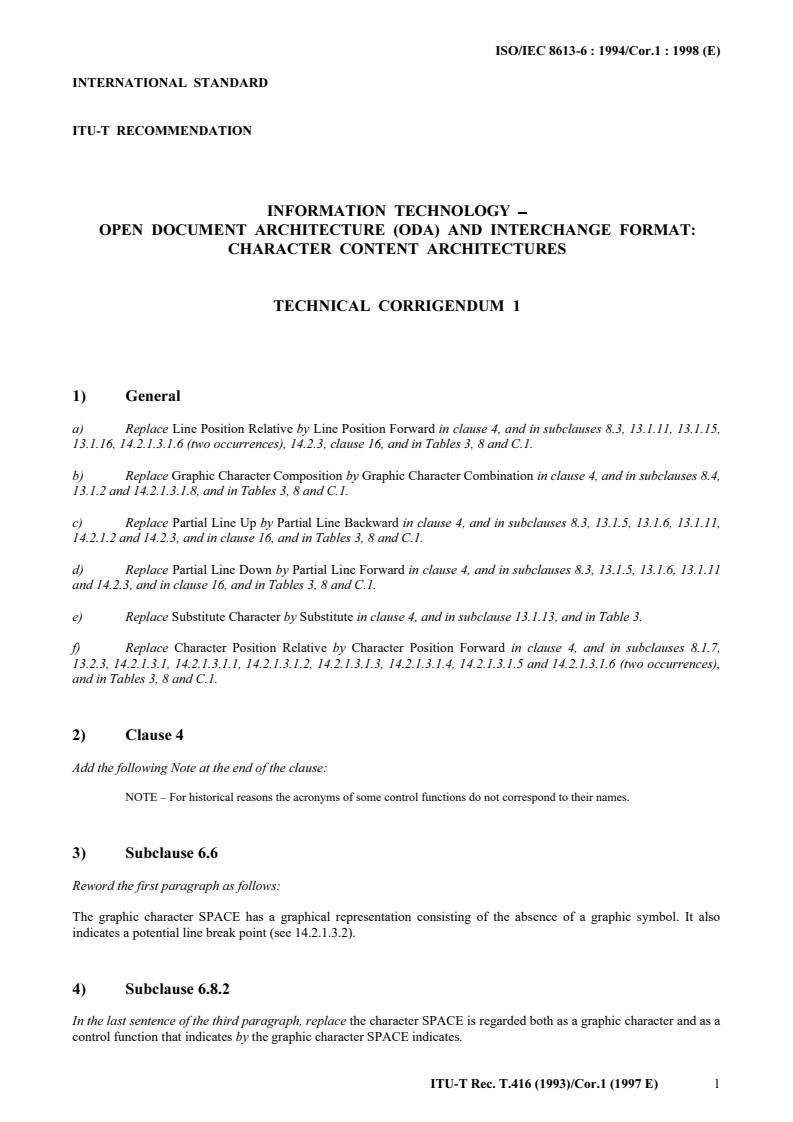
�� ’ENERAL
A� 2EPLACE�Line Position Relative�BY�Line Position Forward�IN�CLAUSE����AND�IN�SUBCLAUSES�����������������������
�����������������������TWO�OCCURRENCES�����������CLAUSE�����AND�IN�4ABLES������AND�#���
B� 2EPLACE�Graphic Character Composition�BY�Graphic Character Combination�IN�CLAUSE����AND�IN�SUBCLAUSES�����
�������AND���������������AND�IN�4ABLES������AND�#���
C� 2EPLACE�Partial Line Up�BY�Partial Line Backward�IN�CLAUSE����AND�IN�SUBCLAUSES������������������������������
���������AND���������AND�IN�CLAUSE�����AND�IN�4ABLES������AND�#���
D� 2EPLACE�Partial Line Down�BY�Partial Line Forward�IN�CLAUSE����AND�IN�SUBCLAUSES�����������������������������
AND���������AND�IN�CLAUSE�����AND�IN�4ABLES������AND�#���
E� 2EPLACE�Substitute Character�BY�Substitute�IN�CLAUSE����AND�IN�SUBCLAUSE����������AND�IN�4ABLE���
F� 2EPLACE�Character Position Relative�BY�Character Position Forward�IN�CLAUSE����AND�IN�SUBCLAUSES�������
�����������������������������������������������������������������������������������������AND���������������TWO�OCCURRENCES��
AND�IN�4ABLES������AND�#���
�� #LAUSE��
!DD�THE�FOLLOWING�.OTE�AT�THE�END�OF�THE�CLAUSE�
NOTE – For historical reasons the acronyms of some control functions do not correspond to their names.
�� 3UBCLAUSE����
2EWORD�THE�FIRST�PARAGRAPH�AS�FOLLOWS�
The graphic character SPACE has a graphical representation consisting of the absence of a graphic symbol. It also
indicates a potential line break point (see 14.2.1.3.2).
�� 3UBCLAUSE������
)N�THE�LAST�SENTENCE�OF�THE�THIRD�PARAGRAPH��REPLACE�the character SPACE is regarded both as a graphic character and as a
control function that indicates�BY�the graphic character SPACE indicates�
)45�4�2EC��4������������#OR���������%� 1
)3/�)%#���������������#OR�����������%�
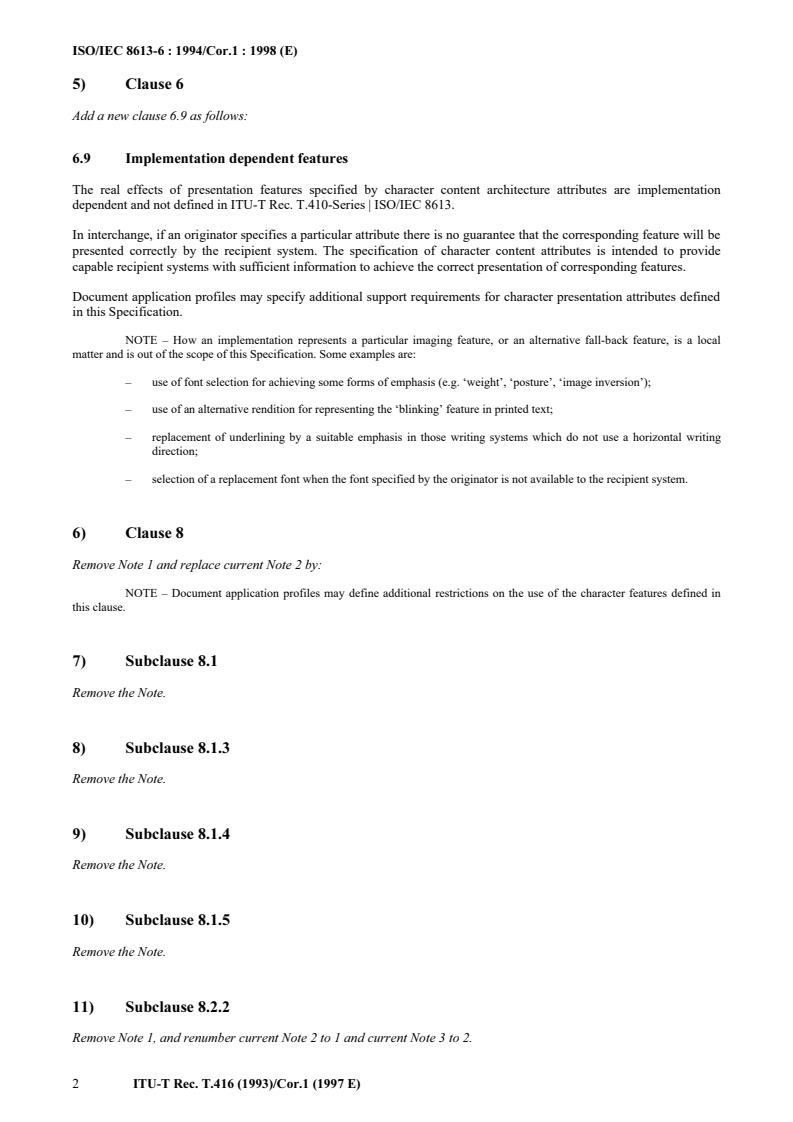
�� #LAUSE��
!DD�A�NEW�CLAUSE�����AS�FOLLOWS�
��� )MPLEMENTATION�DEPENDENT�FEATURES
The real effects of presentation features specified by character content architecture attributes are implementation
dependent and not defined in ITU-T Rec. T.410-Series | ISO/IEC 8613.
In interchange, if an originator specifies a particular attribute there is no guarantee that the corresponding feature will be
presented correctly by the recipient system. The specification of character content attributes is intended to provide
capable recipient systems with sufficient information to achieve the correct presentation of corresponding features.
Document application profiles may specify additional support requirements for character presentation attributes defined
in this Specification.
NOTE – How an implementation represents a particular imaging feature, or an alternative fall-back feature, is a local
matter and is out of the scope of this Specification. Some examples are:
– use of font selection for achieving some forms of emphasis (e.g. ‘weight’, ‘posture’, ‘image inversion’);
– use of an alternative rendition for representing the ‘blinking’ feature in printed text;
– replacement of underlining by a suitable emphasis in those writing systems which do not use a horizontal writing
direction;
– selection of a replacement font when the font specified by the originator is not available to the recipient system.
�� #LAUSE��
2EMOVE�.OTE���AND�REPLACE�CURRENT�.OTE���BY�
NOTE – Document application profiles may define additional restrictions on the use of the character features defined in
this clause.
�� 3UBCLAUSE����
2EMOVE�THE�.OTE�
�� 3UBCLAUSE������
2EMOVE�THE�.OTE�
�� 3UBCLAUSE������
2EMOVE�THE�.OTE�
��� 3UBCLAUSE������
2EMOVE�THE�.OTE�
��� 3UBCLAUSE������
2EMOVE�.OTE����AND�RENUMBER�CURRENT�.OTE���TO���AND�CURRENT�.OTE���TO���
2 )45�4�2EC��4������������#OR���������%�
)3/�)%#���������������#OR�����������%�
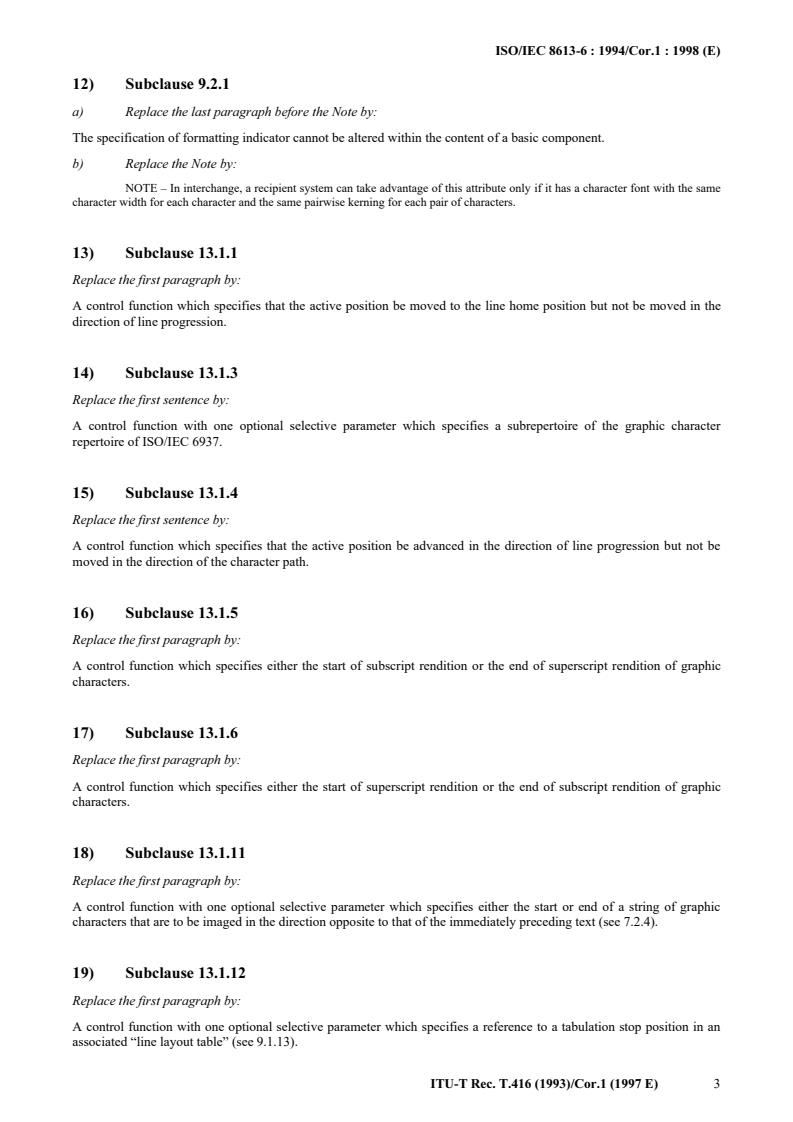
��� 3UBCLAUSE������
A� 2EPLACE�THE�LAST�PARAGRAPH�BEFORE�THE�.OTE�BY�
The specification of formatting indicator cannot be altered within the content of a basic component.
B� 2EPLACE�THE�.OTE�BY�
NOTE – In interchange, a recipient system can take advantage of this attribute only if it has a character font with the same
character width for each character and the same pairwise kerning for each pair of characters.
��� 3UBCLAUSE�������
2EPLACE�THE�FIRST�PARAGRAPH�BY�
A control function which specifies that the active position be moved to the line home position but not be moved in the
direction of line progression.
��� 3UBCLAUSE�������
2EPLACE�THE�FIRST�SENTENCE�BY�
A control function with one optional selective parameter which specifies a subrepertoire of the graphic character
repertoire of ISO/IEC 6937.
��� 3UBCLAUSE�������
2EPLACE�THE�FIRST�SENTENCE�BY�
A control function which specifies that the active position be advanced in the direction of line progression but not be
moved in the direction of the character path.
��� 3UBCLAUSE�������
2EPLACE�THE�FIRST�PARAGRAPH�BY�
A control function which specifies either the start of subscript rendition or the end of superscript rendition of graphic
characters.
��� 3UBCLAUSE�������
2EPLACE�THE�FIRST�PARAGRAPH�BY�
A control function which specifies either the start of superscript rendition or the end of subscript rendition of graphic
characters.
��� 3UBCLAUSE��������
2EPLACE�THE�FIRST�PARAGRAPH�BY�
A control function with one optional selective parameter which specifies either the start or end of a string of graphic
characters that are to be imaged in the di
...