

ISO/IEC 13712-1:1995/Amd 1:1996
(Amendment)Information technology — Remote Operations: Concepts, model and notation — Amendment 1: Built-in operations
General Information
- Abstract
Provides the definition of three built-in operations -Probe, Acknowledge and Cancel - which are of general utility to designers of ROSE-based applications.
- Status
- Published
- Publication Date
- 31-Jul-1996
- Technical Committee
- ISO/IEC JTC 1 - Information technology
- Drafting Committee
- ISO/IEC JTC 1 - Information technology
- Current Stage
- 6060 - International Standard published
- Start Date
- 01-Aug-1996
- Completion Date
- 29-Aug-2026
Buy Documents

ISO/IEC 13712-1:1995/Amd 1:1996 - Information technology — Remote Operations: Concepts, model and notation — Amendment 1: Built-in operations Released:8/1/1996

ISO/IEC 13712-1:1995/Amd 1:1996 - Technologies de l'information — Opérations distantes: Concepts, modele et notation — Amendement 1: Opérations intégrées Released:11/7/1996

ISO/IEC 13712-1:1995/Amd 1:1996 - Technologies de l'information — Opérations distantes: Concepts, modele et notation — Amendement 1: Opérations intégrées Released:11/7/1996
ISO/IEC 13712-1:1995/Amd 1:1996 Overview
ISO/IEC 13712-1:1995/Amd 1:1996 is an important international standard in information technology that addresses remote operations - specifically, it extends the original ISO/IEC 13712-1:1995 standard with Amendment 1, focusing on built-in operations utilized in ROSE-based applications. ROSE (Remote Operations Service Element) is a key component in distributed systems enabling remote invocation of operations.
This amendment introduces three built-in operations - Probe, Acknowledge, and Cancel - designed to provide general utility functions central to improving the robustness and management of remote operation interactions. The inclusion of these operations enhances the capabilities of ROSE implementations, supporting error handling, operation tracking, and termination requests.
Key Topics
Built-in Operations Definition:
The amendment clearly defines the three key built-in operations:- Probe: Queries the status of a previously invoked operation, returning whether it is running, finished, or unknown.
- Acknowledge: Confirms receipt of a return message from a non-idempotent operation invocation.
- Cancel: Requests premature termination of an ongoing operation, only applicable to operations marked as cancellable.
Idempotency Concept:
A critical addition is the definition of idempotent operations - operations that can be invoked multiple times without causing state changes beyond the first invocation. This property is integral to Probe, Acknowledge, and Cancel operations to ensure consistency in distributed environments.Operation Class Extensions:
The OPERATION information object class is extended with new fields such asidemPotent,alwaysReturns, andinvokePriority, supporting finer control and definition of operations in remote services.Error Handling:
Specific error types likecancelFailedandcancelledare introduced to manage cancellation-related failures and to signal successful cancellation events clearly.Protocol Synchronization:
The amendment specifies synchronous and asynchronous behavior defaults for operations, supporting correspondence between request and response messages reliably.
Applications
This amendment is highly relevant for developers, system architects, and designers working on distributed and networked applications, particularly those using ROSE-based protocols for remote method invocation. Practical applications include:
Distributed Systems Management:
Enhance monitoring of remote operation statuses to handle retries, acknowledgments, and cancellations gracefully.Network Protocol Development:
Provide a standardized approach for managing operation lifecycles in protocol negotiation and execution.Telecommunication Systems:
Support improved interaction and control flows within open distributed processing, especially in systems requiring fault tolerance and operation tracking.Middleware and API Design:
Offer built-in operations that can be implemented in middleware layers facilitating reliable operation execution and error management.
Related Standards
- ISO/IEC 13712-1:1995 - The base standard detailing the concepts, models, and notations for remote operations.
- ITU-T Recommendation X.880 - The equivalent ITU-T recommendation aligned with ISO/IEC 13712-1, ensuring interoperability and international consensus.
- ISO/IEC JTC 1 Standards - Broader family of standards related to Open Systems Interconnection (OSI), data management, and distributed processing by the ISO/IEC Joint Technical Committee 1.
Summary
ISO/IEC 13712-1:1995/Amd 1:1996 provides essential extensions to the remote operation framework by defining built-in, idempotent operations - Probe, Acknowledge, and Cancel - that are critical for reliable remote service interoperability. These enhancements streamline the monitoring, acknowledgment, and cancellation of remote method invocations in distributed information technology systems, making this amendment invaluable for ROSE-based application designers seeking robust and standardized remote operation management.
Keywords: ISO/IEC 13712-1 amendment, remote operations, ROSE, built-in operations, probe operation, acknowledge operation, cancel operation, idempotent operations, distributed systems, remote invocation, international IT standards.
Relations
- Amends
ISO/IEC 13712-1:1995 - Information technology — Remote Operations: Concepts, model and notation - Effective Date
- 06-Jun-2022
- Child
ISO/IEC 13712-1:1995 - Information technology — Remote Operations: Concepts, model and notation - Effective Date
- 15-Apr-2008
Buy Documents
ISO/IEC 13712-1:1995/Amd 1:1996 - Information technology — Remote Operations: Concepts, model and notation — Amendment 1: Built-in operations Released:8/1/1996
ISO/IEC 13712-1:1995/Amd 1:1996 - Technologies de l'information — Opérations distantes: Concepts, modele et notation — Amendement 1: Opérations intégrées Released:11/7/1996
ISO/IEC 13712-1:1995/Amd 1:1996 - Technologies de l'information — Opérations distantes: Concepts, modele et notation — Amendement 1: Opérations intégrées Released:11/7/1996
Get Certified
Connect with accredited certification bodies for this standard

BSI Group
BSI (British Standards Institution) is the business standards company that helps organizations make excellence a habit.

NYCE
Mexican standards and certification body.
Sponsored listings
Frequently Asked Questions
ISO/IEC 13712-1:1995/Amd 1:1996 is a standard published by the International Organization for Standardization (ISO). Its full title is "Information technology — Remote Operations: Concepts, model and notation — Amendment 1: Built-in operations". This standard covers: Provides the definition of three built-in operations -Probe, Acknowledge and Cancel - which are of general utility to designers of ROSE-based applications.
Provides the definition of three built-in operations -Probe, Acknowledge and Cancel - which are of general utility to designers of ROSE-based applications.
ISO/IEC 13712-1:1995/Amd 1:1996 is classified under the following ICS (International Classification for Standards) categories: 35.240.20 - IT applications in office work. The ICS classification helps identify the subject area and facilitates finding related standards.
ISO/IEC 13712-1:1995/Amd 1:1996 has the following relationships with other standards: It is inter standard links to ISO/IEC 13712-1:1995; is excused to ISO/IEC 13712-1:1995. Understanding these relationships helps ensure you are using the most current and applicable version of the standard.
ISO/IEC 13712-1:1995/Amd 1:1996 is available in PDF format for immediate download after purchase. The document can be added to your cart and obtained through the secure checkout process. Digital delivery ensures instant access to the complete standard document.
Standards Content (Sample)
ISO/IEC
INTERNATIONAL
13712-I
STANDARD
First edition
1995-09-I 5
AMENDMENT 1
1996-08-I 5
Information technology - Remote
Operations: Concepts, model and notation
AMENDMENT 1: Built-in operations
Opbrations 2 distance: Concepts, mod&/e
Technologies de /‘information -
et notation
AMENDEMENT 7: Opkrations intbgrkes
Reference number
GO/I EC 13712-I : 1995/Amd. 1: 1996(E)
ISO/IEC 137124: 199WAmd.l: 1996(E)
Contents
Page
Subclause 3.3 .
1)
...............................................................................................................................................
Subclause 8.2.1
2)
Subclause 8.2 .
3)
Subclause 10.1 .
4)
.............................................................................................................................................
Subclause 10.5.1
5)
Subclause 10.5.2 .
6)
.......................................................................................................................
Subclauses 10.6 through 10.16
7)
.......................................................................................................................
Subclauses 10.6 through 10.11
8)
Annex A .
10)
Annex D .
10)
0 ISO/IEC 1996
All rights reserved. Unless otherwise specified, no part of this publication may be
reproduced or utilized in any form or by any means, electronic or mechanical, including
photocopying and microfilm, without permission in writing from the publisher.
ISO/IEC Copyright Office l Case postale 56 l CH-1211 Geneve 20 l Switzerland
Printed in Switzerland
ii
0 ISO/IEC ISO/IEC 137124: 199UAmd.l: 1996(E)
Foreword
IS0 (the International Organization for Standardization) and IEC (the Inter-
national Electrotechnical Commission) form the specialized system for worldwide
standardization. National bodies that are members of IS0 or IEC participate in the
development of International Standards through technical committees established
by the respective organization to deal with particular fields of technical activity.
IS0 and IEC technical committees collaborate in fields of mutual interest. Other
international organizations, governmental and non-governmental, in liaison with
IS0 and IEC, also take part in the work.
In the field of information technology, IS0 and IEC have established a joint
technical committee, ISO/IEC JTC 1. Draft International Standards adopted by the
joint technical committee are circulated to national bodies for voting. Publication
as an International Standard requires approval by at least 75 % of the national
bodies casting a vote.
Amendment 1 to International Standard ISO/IEC 137 12- 1: 1995 was prepared by
Joint Technical Committee ISO/IEC JTC 1, Information technology, Sub-
committee SC 21, Open systems interconnection, data management and open
distributed processing, in collaboration with ITU-T. The identical text is
published as ITU-T Rec. X88O/Amd. 1.
0 ISO/IEC
ISO/IEC 13712~1:1995/Amd.l: 1996(E)
Introduction
This amendment to Rec. X.880 I ISO/IEC 13712-1 provides the definition of three built-in operations - Probe,
Acknowledge and Cancel - which are of general utility to designers of ROSE-based applications.
ISO/IEC 13712-1: 199SlAmd.l: 1996 (E)
INTERNATIONAL STANDARD
ITU-T RECOMMENDATION
INFORMATION TECHNOLOGY - REMOTE OPERATIONS:
CONCEPTS, MODEL AND NOTATION
AMENDMENT 1
Built-in operations
Subclause 3.3
1)
Add the following new definition immediately after 3.3.7:
“3.3.8 idempotent: A characteristic of an operation that it can be invoked repeatedly without changing the state of
the performer.”
The definitions which follow definition 3.3.8, should be renumbered accordingly.
Subclause 8.2.1
2)
Add the followingfield underlined to the OPERATION information object class:
OPERATION ::= CLASS
i
&ArgumentType OPTIONAL,
&argumentTypeOptional BOOLEAN OPTIONAL,
8zreturnResult BOOLEAN DEFAULT TRUE,
OPTIONAL,
&ResultType
&resultTypeOptional BOOLEAN OPTIONAL,
&Errors ERROR OPTIONAL,
&Linked OPERATION OPTIONAL,
&synchronous BOOLEAN DEFAULT FALSE,
BOOLEAN DEFAULT FALSE,
&idemnotent
&alwaysReturns BOOLEAN DEFAULT TRUE,
&InvokePriority Priority OPTIONAL,
Priority OPTIONAL,
&ResultPriority
&operationCode Code UNIQUE OPTIONAL
WITH SYNTAX
[ARGUMENT &ArgumentType [OPTIONAL &argumentTypeOptional]]
&returnResult]
[RETURN RESULT
[RESULT &ResultType [OPTIONAL &resultTypeOptional]]
&Errors]
[ERRORS
[LINKED &Linked]
[SYNCHRONOUS &synchronous]
&idemnotent]
JIDEMPOTENT
[ALWAYS RESPONDS &alwaysReturns]
[INVOKE PRIORITY &InvokePriority]
[RESULT-PRIORITY &ResultPriority]
[CODE &operationCode]
ITU-T Rec. X.880 (1994)/Amd.l(1995 1
ISO/IEC 13712-l : 199YAmd.l : 1996 (E)
Subclause 8.2
3)
Add a new subclause as follows:
“8.2.14 The Ldempotent field specifies whether or not the operation is idempotent, taking the value TRUE if it is,
and FALSE otherwise.”
Subclause 10.1
4)
Rewrite item a) as follows (with the new text underlined):
“a) generally useful operations, (emptyBind, emptyunbind, no-op, probe, acknowledge,
cancel), and their associated errors;”
Subclause 10.51
5)
Rewrite the no-op OPERATION definition by adding an additionalfield (underlined) as follows:
no-op OPERATION ::=
TRUE
ALWAYS RESPONDS FALSE
CODE local:-1
Subclause 10.52
6)
Rewrite IO.52 as follows (with the new text underlined}:
The operation is idemPotent and does not return.”
“10.52
Subclauses 10.6 through 10.16
7)
Renumber IO.6 through IO. 16 as 10.12 through IO.22 respectively.
Subclauses 10.6 through 10.11
8)
Add the following new subclauses numbered 10.6 through 10.11:
10.6 Probe
10.6.1 The probe operation enquires about the outcome of a previously invoked operation. It is specified as follows:
probe OPERATION ::=
ARGUMENT SEQUENCE
invokeId [0] InvokeId
RESULT ENUMERATED{running(O), finished(l), unknown(2), . .}
IDEMPOTENT TRUE
CODE local:-2
...
NORME ISO/CEI
INTERNATIONALE 137124
Première édition
1995-09-I 5
AMENDEMENT 1
1996-08-l 5
Technologies de l’information -
Opérations distantes: Concepts, modèle et
notation
AMENDEMENT 1: Opérations intégrées
Remo te Opera tions: Concepts, mode/ and
Information technology -
notation
AMENDMENT 1: Built-in operations
Numéro de référence
ISO/CEI 13712-I :1995/Amd.l :1996(F)
ISOKEI 13712~1:1995/Amd.l:1996(F)
Sommaire
Page
Paragraphe 3.3 .
1)
Paragraphe 8.2.1 .
2)
Paragraphe 8.2 .
3)
Paragraphe 10.1 .
4)
Paragraphe 10.5.1 .
5)
Paragraphe 10.52 .
6)
Paragraphes 10.6 a 10.16 .
7)
Paragraphes 10.6 & 10.11 . 2
8)
Annexe A . 4
9)
Annexe D . 6
10)
0 ISOKEI 1996
Droits de reproduction réservés. Sauf prescription différente, aucune partie de cette
publication ne peut être reproduite ni utilisée sous quelque forme que ce soit et par aucun
procédé, électronique ou mécanique, y compris la photocopie et les microfilms, sans
l’accord écrit de l’éditeur.
ISOKEI Copyright Office l Case postale 56 l CH-l 211 Genève 20 l Suisse
Imprimé en Suisse
ii
0 ISO/CEI ISOKEI 13712~1:1995/Amd.l:1996(F)
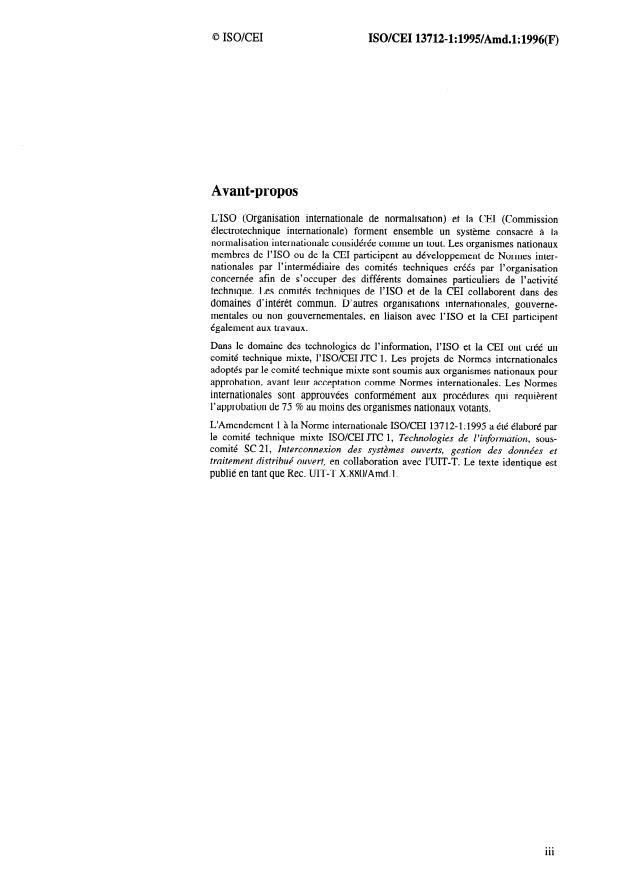
Avant-propos
LIS0 (Organisation internationale de normalisation) et la CE1 (Commission
électrotechnique internationale) forment ensemble un système consacré à la
normalisation internationale considérée comme un tout. Les organismes nationaux
membres de 1’ISO ou de la CE1 participent au développement de Normes inter-
nationales par l’intermédiaire des comités techniques créés par l’organisation
concernée afin de s’occuper des différents domaines particuliers de l’activité
technique. Les comités techniques de 1’ISO et de la CE1 collaborent dans des
domaines d’intérêt commun. D’autres organisations internationales, gouverne-
mentales ou non gouvernementales, en liaison avec I’ISO et la CE1 participent
également aux travaux.
Dans le domaine des technologies de l’information, 1’ISO et la CE1 ont créé un
comité technique mixte, l’ISO/CEI JTC 1. Les projets de Normes internationales
adoptés par le comité technique mixte sont soumis aux organismes nationaux pour
approbation, avant leur acceptation comme Normes internationales. Les Normes
internationales sont approuvées conformément aux procédures qui requièrent
l’approbation de 75 % au moins des organismes nationaux votants.
L’Amendement 1 à la Norme internationale ISOKEI 137 12- 1: 1995 a été élaboré par
le comité technique mixte ISOKEI JTC 1, TechnoZogies de Z’infomultion, sous-
comité SC 21, Interconnexion des systèmes ouverts, gestion des données et
traitement distribué ouvert, en collaboration avec I’UIT-T. Le texte identique est
publié en tant que Rec. UIT-T X.88O/Amd.l.
. . .
NO/CE1 13712-l: 199YAmd.l: 1996(F)
0 ISO/CEI
Introduction
Le présent amendement à la Rec. X.880 I ISOKEI 13712-1 définit trois opérations intégrées - sondage, acquittement et
annulation - d’interêt général pour les concepteurs d’applications basées sur Mément de service d’ophations distantes
(ROSE) (remote operations service element).
iv
ISOKEI 137124 : 1995lAmd.l: 1996 (F)
NORME INTERNATIONALE
RECOMMANDATION UIT-T
TECHNOLOGIES DE L’INFORMATION - OPÉRATIONS DISTANTES:
CONCEPTS, MODÈLE ET NOTATION
AMENDEMENT 1
Opérations intégrées
Paragraphe 3.3
1)
Ajouter la nouvelle définition suivante après 3.3.7:
«3*3.8 idempotent: caractéristique d’une opération qui peut être invoquée à plusieurs reprises sans modifier Mat de
l’exécutant.»
Renuméroter en conséquence les définitions qui viennent à la suite du point 3.3.8.
Paragraphe 8.2.1
2)
Ajouter le champ souligné suivant à la classe d’objets informutionnels OPERATION:
OPERATION ::= CLASS
&ArgumentType OPTIONAL,
&argumentTypeOptional BOOLEAN OPTIONAL,
&returnResult BOOLEAN DEFAULT TRUE,
&ResultType OPTIONAL,
BOOLEAN OPTIONAL,
&resultTypeOptional
&Errors ERROR OPTIONAL,
&Linked OPERATION OPTIONAL,
bynchronous BOOLEAN DEFAULT FALSE,
&alwaysReturns BOOLEAN DEFAULT TRUE,
MnvokePriority Priority OPTIONAL,
&ResultPriority Priority OPTIONAL,
&operationCode Code UNIQUE OPTIONAL
WITH SYNTAX
[ARGUMENT &ArgumentType [OPTIONAL &argumentTypeOptional]]
[RETURN RESULT &returnResult]
[RESULT &ResultType [OPTIONAL &resultTypeOptional] J
[ERRORS &Errors]
[LINKED &Linked]
[SYNCHRONOUS bynchronous]
te&J
[ALWAYS RESPONDS &alwaysReturns]
[INVOKE PRIORITY &InvokePriority]
[RESULT-PRIORITY &ResultPriority]
[CODE
&operationCode]
Rec. UIT-T X.880 (1994)/Amd.l(1995 F)
ISOKEI 13712-1: 199YAmd.l : 1996 (F)
Paragraphe 8.2
3)
Ajouter le nouveau paragraphe qui suit:
a8.2.14 Le champ Cdempotent (idempotent) spécifie si l’operation est idempotente, il prend la valeur TRUE (vrai)
si c’est le cas et la valeur FALSE (faux) dans le cas contraire.»
Paragraphe 10.1
4)
Le point a) devient le suivant (les adjonctions sont soulignées):
d’intérêt général (emptyBind, emptyunbind, no-op, probe,
«a) des opérations
acknowledae, cancel) avec leurs erreurs associées;»
Paragraphe 10.51
5)
Ajouter le champ souligné comme suit à la définition de l’opération no-op:
no-op OPERATION ::=
{
ALWAYS RESPONDS FALSE
CODE local:-1
Paragraphe 10.52
6)
Le paragraphe 10.52 devient le suivant (les adjonctions étant soulignées):
«10.5.2 L’opération est idemnotente et ne renvoie aucune notification en retour.»
Paragraphes 10.6 à 10.16
7)
Renuméroter les paragraphes 10.6 à 10.16 en 10.12 à I0.22.
Paragraphes 10.6 à 10.11
8)
Ajouter les nouveaux paragraphes suivants numérotés de 10.6 à 10. II:
10.6 Opération probe
10.6.1 L’opération probe (sondage) recherche le résultat d’une opération précédemment invoquée. Elle est spécifiée
comme suit:
probe OPERATION ::=
ARGUMENT SEQUENCE
invokeId [0] InvokeId
RESULT ENUMERATED{running(O), finished(l), unknown(2), . .}
IDEMPOTENT TRUE
CODE local:-2
10.6.2 Un seul argument, de type Inv
...
NORME ISO/CEI
INTERNATIONALE 137124
Première édition
1995-09-I 5
AMENDEMENT 1
1996-08-l 5
Technologies de l’information -
Opérations distantes: Concepts, modèle et
notation
AMENDEMENT 1: Opérations intégrées
Remo te Opera tions: Concepts, mode/ and
Information technology -
notation
AMENDMENT 1: Built-in operations
Numéro de référence
ISO/CEI 13712-I :1995/Amd.l :1996(F)
ISOKEI 13712~1:1995/Amd.l:1996(F)
Sommaire
Page
Paragraphe 3.3 .
1)
Paragraphe 8.2.1 .
2)
Paragraphe 8.2 .
3)
Paragraphe 10.1 .
4)
Paragraphe 10.5.1 .
5)
Paragraphe 10.52 .
6)
Paragraphes 10.6 a 10.16 .
7)
Paragraphes 10.6 & 10.11 . 2
8)
Annexe A . 4
9)
Annexe D . 6
10)
0 ISOKEI 1996
Droits de reproduction réservés. Sauf prescription différente, aucune partie de cette
publication ne peut être reproduite ni utilisée sous quelque forme que ce soit et par aucun
procédé, électronique ou mécanique, y compris la photocopie et les microfilms, sans
l’accord écrit de l’éditeur.
ISOKEI Copyright Office l Case postale 56 l CH-l 211 Genève 20 l Suisse
Imprimé en Suisse
ii
0 ISO/CEI ISOKEI 13712~1:1995/Amd.l:1996(F)
Avant-propos
LIS0 (Organisation internationale de normalisation) et la CE1 (Commission
électrotechnique internationale) forment ensemble un système consacré à la
normalisation internationale considérée comme un tout. Les organismes nationaux
membres de 1’ISO ou de la CE1 participent au développement de Normes inter-
nationales par l’intermédiaire des comités techniques créés par l’organisation
concernée afin de s’occuper des différents domaines particuliers de l’activité
technique. Les comités techniques de 1’ISO et de la CE1 collaborent dans des
domaines d’intérêt commun. D’autres organisations internationales, gouverne-
mentales ou non gouvernementales, en liaison avec I’ISO et la CE1 participent
également aux travaux.
Dans le domaine des technologies de l’information, 1’ISO et la CE1 ont créé un
comité technique mixte, l’ISO/CEI JTC 1. Les projets de Normes internationales
adoptés par le comité technique mixte sont soumis aux organismes nationaux pour
approbation, avant leur acceptation comme Normes internationales. Les Normes
internationales sont approuvées conformément aux procédures qui requièrent
l’approbation de 75 % au moins des organismes nationaux votants.
L’Amendement 1 à la Norme internationale ISOKEI 137 12- 1: 1995 a été élaboré par
le comité technique mixte ISOKEI JTC 1, TechnoZogies de Z’infomultion, sous-
comité SC 21, Interconnexion des systèmes ouverts, gestion des données et
traitement distribué ouvert, en collaboration avec I’UIT-T. Le texte identique est
publié en tant que Rec. UIT-T X.88O/Amd.l.
. . .
NO/CE1 13712-l: 199YAmd.l: 1996(F)
0 ISO/CEI
Introduction
Le présent amendement à la Rec. X.880 I ISOKEI 13712-1 définit trois opérations intégrées - sondage, acquittement et
annulation - d’interêt général pour les concepteurs d’applications basées sur Mément de service d’ophations distantes
(ROSE) (remote operations service element).
iv
ISOKEI 137124 : 1995lAmd.l: 1996 (F)
NORME INTERNATIONALE
RECOMMANDATION UIT-T
TECHNOLOGIES DE L’INFORMATION - OPÉRATIONS DISTANTES:
CONCEPTS, MODÈLE ET NOTATION
AMENDEMENT 1
Opérations intégrées
Paragraphe 3.3
1)
Ajouter la nouvelle définition suivante après 3.3.7:
«3*3.8 idempotent: caractéristique d’une opération qui peut être invoquée à plusieurs reprises sans modifier Mat de
l’exécutant.»
Renuméroter en conséquence les définitions qui viennent à la suite du point 3.3.8.
Paragraphe 8.2.1
2)
Ajouter le champ souligné suivant à la classe d’objets informutionnels OPERATION:
OPERATION ::= CLASS
&ArgumentType OPTIONAL,
&argumentTypeOptional BOOLEAN OPTIONAL,
&returnResult BOOLEAN DEFAULT TRUE,
&ResultType OPTIONAL,
BOOLEAN OPTIONAL,
&resultTypeOptional
&Errors ERROR OPTIONAL,
&Linked OPERATION OPTIONAL,
bynchronous BOOLEAN DEFAULT FALSE,
&alwaysReturns BOOLEAN DEFAULT TRUE,
MnvokePriority Priority OPTIONAL,
&ResultPriority Priority OPTIONAL,
&operationCode Code UNIQUE OPTIONAL
WITH SYNTAX
[ARGUMENT &ArgumentType [OPTIONAL &argumentTypeOptional]]
[RETURN RESULT &returnResult]
[RESULT &ResultType [OPTIONAL &resultTypeOptional] J
[ERRORS &Errors]
[LINKED &Linked]
[SYNCHRONOUS bynchronous]
te&J
[ALWAYS RESPONDS &alwaysReturns]
[INVOKE PRIORITY &InvokePriority]
[RESULT-PRIORITY &ResultPriority]
[CODE
&operationCode]
Rec. UIT-T X.880 (1994)/Amd.l(1995 F)
ISOKEI 13712-1: 199YAmd.l : 1996 (F)
Paragraphe 8.2
3)
Ajouter le nouveau paragraphe qui suit:
a8.2.14 Le champ Cdempotent (idempotent) spécifie si l’operation est idempotente, il prend la valeur TRUE (vrai)
si c’est le cas et la valeur FALSE (faux) dans le cas contraire.»
Paragraphe 10.1
4)
Le point a) devient le suivant (les adjonctions sont soulignées):
d’intérêt général (emptyBind, emptyunbind, no-op, probe,
«a) des opérations
acknowledae, cancel) avec leurs erreurs associées;»
Paragraphe 10.51
5)
Ajouter le champ souligné comme suit à la définition de l’opération no-op:
no-op OPERATION ::=
{
ALWAYS RESPONDS FALSE
CODE local:-1
Paragraphe 10.52
6)
Le paragraphe 10.52 devient le suivant (les adjonctions étant soulignées):
«10.5.2 L’opération est idemnotente et ne renvoie aucune notification en retour.»
Paragraphes 10.6 à 10.16
7)
Renuméroter les paragraphes 10.6 à 10.16 en 10.12 à I0.22.
Paragraphes 10.6 à 10.11
8)
Ajouter les nouveaux paragraphes suivants numérotés de 10.6 à 10. II:
10.6 Opération probe
10.6.1 L’opération probe (sondage) recherche le résultat d’une opération précédemment invoquée. Elle est spécifiée
comme suit:
probe OPERATION ::=
ARGUMENT SEQUENCE
invokeId [0] InvokeId
RESULT ENUMERATED{running(O), finished(l), unknown(2), . .}
IDEMPOTENT TRUE
CODE local:-2
10.6.2 Un seul argument, de type Inv
...