

ISO/IEC 13712-2:1995/Amd 1:1996
(Amendment)Information technology — Remote Operations: OSI realizations — Remote Operations Service Element (ROSE) service definition — Amendment 1: Mapping to A-UNIT-DATA and built-in operations
General Information
- Abstract
Provides the mapping of ROSE APDUs onto the A-UNIT-DATA service, and the inclusion of three built-in operations -Probe, Acknowledge and Cancel - which are of general utility to designers of ROSE-based applications.
- Status
- Published
- Publication Date
- 31-Jul-1996
- Technical Committee
- ISO/IEC JTC 1 - Information technology
- Drafting Committee
- ISO/IEC JTC 1 - Information technology
- Current Stage
- 6060 - International Standard published
- Start Date
- 01-Aug-1996
- Completion Date
- 29-Aug-2026
Buy Documents

ISO/IEC 13712-2:1995/Amd 1:1996 - Information technology — Remote Operations: OSI realizations — Remote Operations Service Element (ROSE) service definition — Amendment 1: Mapping to A-UNIT-DATA and built-in operations Released:8/1/1996
ISO/IEC 13712-2:1995/Amd 1:1996 - Technologies de l'information — Opérations distantes: Réalisations OSI — Définition du service de l'élément de service d'opérations distantes (ROSE) — Amendement 1: Mappage sur A-UNIT-DATA et opérations intégrées Released:11/7/1996
ISO/IEC 13712-2:1995/Amd 1:1996 - Technologies de l'information — Opérations distantes: Réalisations OSI — Définition du service de l'élément de service d'opérations distantes (ROSE) — Amendement 1: Mappage sur A-UNIT-DATA et opérations intégrées Released:11/7/1996
Overview
ISO/IEC 13712-2:1995/Amd 1:1996 is an important international standard in the field of information technology, specifically addressing remote operations via Open Systems Interconnection (OSI). This amendment enhances the Remote Operations Service Element (ROSE) service definition by detailing how ROSE Application Protocol Data Units (APDUs) are mapped to the A-UNIT-DATA service. Additionally, it introduces three powerful built-in operations - Probe, Acknowledge, and Cancel - which offer significant value to the design and implementation of ROSE-based applications.
This amendment, developed jointly by ISO/IEC and ITU-T, supports systems that require efficient, reliable, and flexible remote operations in distributed computing and network environments.
Key Topics
Mapping ROSE to A-UNIT-DATA:
Provides mechanisms for translating ROSE APDUs to the A-UNIT-DATA service. This is crucial for supporting connectionless operation and interoperability across diverse network services.Built-in ROSE Operations:
The amendment standardizes three core operations:- Probe: Enables applications to query the status of previously invoked remote operations, improving resource management and operational transparency.
- Acknowledge: Facilitates explicit confirmation of non-idempotent operations, bolstering reliability in distributed environments.
- Cancel: Supports termination of outstanding operations, essential for error handling and responsive systems.
Application Context Field Extensions:
The amendment extends the ROSE application context information object class with new fields (&probe,&acknowledge) that control the inclusion of these built-in operations, offering flexibility to application designers.Compatibility with OSI Services:
Integrates with key OSI elements such as the Association Control Service Element (ACSE) and optionally the Reliable Transfer Service Element (RTSE), ensuring robust service contracts and broad interoperability.
Applications
Distributed Systems Design:
Frameworks and platforms leveraging OSI protocols can utilize the standard to enable robust, remote operation invocation and management, especially in heterogeneous networked systems.Open Systems Development:
Software developers building open, standards-compliant applications benefit from a clear method to implement ROSE in both connection-oriented and connectionless environments.Teleprocessing and Network Management:
The standardized mapping enhances support for network interconnection and data processing applications that demand flexible information exchange and reliable operation lifecycle management.Interoperability Solutions:
Organizations needing to ensure their applications or middleware operate seamlessly across global networks can apply this standard to achieve conformity with international protocols.
Related Standards
- ISO/IEC 13712-2:1995 - The main ROSE service definition standard
- ITU-T Rec. X.881 / ISO/IEC 13712-2 - Identical baseline standard
- ITU-T Rec. X.882 / ISO/IEC 13712-3 - ROSE protocol specification
- ISO/IEC 8649 / ITU-T Rec. X.217 - ACSE services
- ISO/IEC 8650-1 / ITU-T Rec. X.227 - ACSE protocol
- ISO/IEC 10035-1 / ITU-T Rec. X.237 - Connectionless protocol for ACSE
- ISO/IEC 13712-1 - ROSE concepts, model, notation (with built-in operations covered by Amendment 1)
By adopting ISO/IEC 13712-2:1995/Amd 1:1996, organizations and developers can ensure their remote operations infrastructure is aligned with global best practices for interoperability, flexibility, and operational efficiency in OSI-based information systems.
Relations
- Effective Date
- 06-Jun-2022
- Effective Date
- 15-Apr-2008
Buy Documents
ISO/IEC 13712-2:1995/Amd 1:1996 - Information technology — Remote Operations: OSI realizations — Remote Operations Service Element (ROSE) service definition — Amendment 1: Mapping to A-UNIT-DATA and built-in operations Released:8/1/1996
ISO/IEC 13712-2:1995/Amd 1:1996 - Technologies de l'information — Opérations distantes: Réalisations OSI — Définition du service de l'élément de service d'opérations distantes (ROSE) — Amendement 1: Mappage sur A-UNIT-DATA et opérations intégrées Released:11/7/1996
ISO/IEC 13712-2:1995/Amd 1:1996 - Technologies de l'information — Opérations distantes: Réalisations OSI — Définition du service de l'élément de service d'opérations distantes (ROSE) — Amendement 1: Mappage sur A-UNIT-DATA et opérations intégrées Released:11/7/1996
Get Certified
Connect with accredited certification bodies for this standard

BSI Group
BSI (British Standards Institution) is the business standards company that helps organizations make excellence a habit.

NYCE
Mexican standards and certification body.
Sponsored listings
Frequently Asked Questions
ISO/IEC 13712-2:1995/Amd 1:1996 is a standard published by the International Organization for Standardization (ISO). Its full title is "Information technology — Remote Operations: OSI realizations — Remote Operations Service Element (ROSE) service definition — Amendment 1: Mapping to A-UNIT-DATA and built-in operations". This standard covers: Provides the mapping of ROSE APDUs onto the A-UNIT-DATA service, and the inclusion of three built-in operations -Probe, Acknowledge and Cancel - which are of general utility to designers of ROSE-based applications.
Provides the mapping of ROSE APDUs onto the A-UNIT-DATA service, and the inclusion of three built-in operations -Probe, Acknowledge and Cancel - which are of general utility to designers of ROSE-based applications.
ISO/IEC 13712-2:1995/Amd 1:1996 is classified under the following ICS (International Classification for Standards) categories: 35.240.20 - IT applications in office work. The ICS classification helps identify the subject area and facilitates finding related standards.
ISO/IEC 13712-2:1995/Amd 1:1996 has the following relationships with other standards: It is inter standard links to ISO/IEC 13712-2:1995; is excused to ISO/IEC 13712-2:1995. Understanding these relationships helps ensure you are using the most current and applicable version of the standard.
ISO/IEC 13712-2:1995/Amd 1:1996 is available in PDF format for immediate download after purchase. The document can be added to your cart and obtained through the secure checkout process. Digital delivery ensures instant access to the complete standard document.
Standards Content (Sample)
INTERNATIONAL ISO/IEC
13712-2
STANDARD
First edition
1995-04-I 5
AMENDMENT 1
1996-08-I 5
Information technology - Remote
Operations: OSI realizations - Remote
Operations Service Element (ROSE) service
definition
AMENDMENT 1: Mapping to A-UNIT-DATA
and built-in operations
Technologies de /‘information - Op&ations 2 distance: R6alisa tions
OSI - Ddfinition du service pour I’Gl6ment de service des op&-ations d
distance (ROSE)
AMENDEMENT 7: Cartographie pour une don&e unitaire et op&ations
in tdgrbes
Reference number
lSO/IEC 1371 Z-21 995/Amd.l :I 996(E)
ISO/IEC 13712-2: 1995/Amd.l: 1996(E)
Contents
Page
Clause 1 . . . . . . . . . . . . . . . . . . . . . . . . . . . . . . . . . . . . . . . . . . . . . . . . . . . . . . . . . . . . . . . . . . . . . . . . . . . . . . . . . . . . . . . . . . . . . . . . . . . . . . . . . . . . . . . . . . . . . . . . . 1
1)
Subclause 2.1 . . . . . . . . . . . . . . . . . . . .*.*.=.~. 1
2)
Clause 6 . . . . . . . . . . . . . . . . . . . . . . . . . . . . . . . . . . . . . . . . . . . . . . . . . . . . . . . . . . . .*~=*.*. 1
3)
Clauses 8 to 11 . . . . . . . . . . . . . . . . . . . . . . . . . . . . . . . . . . . . . . . . . . . . . . . . . . . . . . . . . . . . . . . . . . . . . . . . . . . . . . . . . . . . .*. 2
4)
Subclause 7.2.1 . . . . . . . . . . . . . . . . . . . . . . . . . . . . . . . . . . . . . . . . . . . . . . . . . . . . . . . . . . . . . . . . . . . . . . . . . . . . . . . . . . . . . . . . . . . . . . . . . . . . . . . . . . . . . . . . . . . . . . . . . 2
5)
. . . . . . . . . . . . . . . . . . . . . . . . . . . . . . . . . . . . . . . . . . . . . . . . . . . . . . . . . . . . . . . . . . . . . . . . . . . . . . . . . . . . . . . . . . . . . . . . . . . . . . . . . . . . . . . . . . . . . . . . .*. 2
Subclause 7.2
6)
Subclause 7.3.2 . . . . . . . . . . . . . . . . . . . . . . . . . . . . . . . . . . . . . . . . . . . . . . . . . . . . . . . . . . . . . . . . . . . . . . . . . . . . . . . . . . . . . . . . . . . . . . . . . . . . . . . . . . . . . . . . . . . . . . . . .
7)
. . . . . . . . . . . . . . . . . . . . . . . . . . . . . . . . . . . . . . . . . . . . . . . . . . . . . . . . . . . . . . . . . . . . . . . . . . . . . . . . . . . . . . . . . . . . . . . . . . . . . . . . . . . . . . . . . . . . . . . . . 3
Subclause 9.3
8)
Clause 10 . . . . . . . . . . . . . . . . . . . . . . . . . . . . . . . . . . . . . . . . . . . . . . . . . . . . . . . . . . . . . . . . . . . . . . . . . . . . . . . . . . . . . . . . . . . . . . . . . . . . . . . . . . . . . . . . . . . . . . . . . 3
9)
Clause 11 . . . . . . . . . . . . . . . . . . . . . . . . . . . . . . . . . . . . . . . . . . . . . . . . . . . . . . . . . . . . . . . . . . . . . . . . . . . . . . . . . . . . . . . . . . . . . . . . . . . . . . . . . . . . . . . . . . . . . . . . . 3
10)
Clause 10 . . . . . . . . . . . . . . . . . . . . . . . . . . . . . . . . . . . . . . . . . . . . . . . . . . . . . . . . . . . . . . . . . . . . . . . . . . . . . . . . . . . . . . . . . . . . . . . . . . . . . . . . . . . . . . . . . . . . . . . . . 4
11)
Annex A . . . . . . . . . . . . . . . . . . . . . . . . . . . . . . . . . . . . . . . . . . . . . . . . . . . . . . . . . . . . . . . . . . . . . . . . . . . . . . . . . . . . . . . . . . . . . . . . . . . . . . . . . . . . . . . . . . . . . . . . . 4
12)
Annex C . . . . . . . . . . . . . . . . . . . . . . . . . . . . . . . . . . . . . . . . . . . . . . . . . . . . . . . . . . . . . . . . . . . . . . . . . . . . . . . . . . . . . . . . . . . . . . . . . . . . . . . . . . . . . . . . . . . . . . . .*. 5
0 ISO/IEC 1996
All rights reserved. Unless otherwise specified, no part of this publication may be
reproduced or utilized in any form or by any means, electronic or mechanical, including
photocopying and microfilm, without permission in writing from the publisher.
ISO/IEC Copyright Office l Case postale 56 l CI-I-1211 Geneve 20 l Switzerland
Printed in Switzerland
ii
@ ISO/IEC ISO/IEC 13712-2: 1995/Amd.l: 1996(E)
Foreword
IS0 (the International Organization for Standardization) and IEC (the Inter-
national Electrotechnical Commission) form the specialized system for worldwide
standardization. National bodies that are members of IS0 or IEC participate in the
development of International Standards through technical committees established
by the respective organization to deal with particular fields of technical activity.
IS0 and IEC technical committees collaborate in fields of mutual interest. Other
international organizations, governmental and non-governmental, in liaison with
IS0 and IEC, also take part in the work.
In the field of information technology, IS0 and IEC have established a joint
technical committee, ISO/IEC JTC 1. Draft International Standards adopted by the
joint technical committee are circulated to national bodies for voting. Publication
as an International Standard requires approval by at least 75 % of the national
bodies casting a vote.
Amendment 1 to International Standard ISO/IEC 137 12-2: 1995 was prepared by
Joint Technical Committee ISO/IEC JTC 1, Znformation technology, Sub-
committee SC 21, Open systems interconnection, data management and open
distributed processing, in collaboration with ITU-T. The identical text is
published as ITU-T Rec. X.88 l/Amd. 1.
s . .
ISO/IEC 13712-2: 1995/Amd.l: 1996(E)
0 ISO/IEC
Introduction
This amendment to Rec. X.881 I ISO/IEC 13712-2 provides the mapping of ROSE APDUs onto the A-UNIT-DATA
service, and the inclusion of three built-in operations - Probe, Acknowledge and Cancel - which are of general utility to
designers of ROSE-based applications.
ISOAEC 13712-2 : 1995lAmd.l: 1996 (E)
INTERNATIONAL STANDARD
IT&T RECOMMENDATION
REMOTE OPERATIONS: OS1 REALIZATIONS -
INFORMATION TECHNOLOGY -
REMOTE OPERATIONS SERVICE ELEMENT (ROSE) SERVICE DEFINITION
AMENDMENT 1
Mapping to A-UNIT-DATA and built-in operations
Clause 1
1)
Rewrite the third sentence of the second paragraph as follows (with the changes underlined):
The ROSE services are provided by the use of the ROSE protocol (specified in a companion Recommendation I
International Standard, ITU-T Rec. X.882 I ISO/IEC 13712-3), in conjuction with the Association Control Service
Element (ACSE) services (ITU-T Rec. X.217 I ISO/IEC 8649) and the ACSE protocol (ITU-T Rec. X.227 I
ISO/IEC 8650-l and ITU-T Rec. X.237 I ISOLIEC 10035-l), and, optionally, the Reliable Transfer Service Element
(RTSE) services (ITU-T Rec. X.218 I ISOLIEC 9066-l) and the RTSE protocol (ITU-T Rec. X.228 I ISO/IEC 9066-2),
and the Presentation service (ITU-T Rec. X.216 I ISO/IEC 8822).
Subclause 2.1
2)
Add the following references:
-
ITU-T Recommendation X.237 (1995) I ISOIIEC 100351: 1995, Information technology - Open Systems
Connectionless protocol for the Association Control Service Element: Protocol
Interconnection -
specification.
-
ITU-T Recommendation X.880 (1994)/Amd. 1 (1995) I ISOLIEC 13712-1: 1995/Amd. 1: 1996, Information
technology - Remote Operations: Concepts, model and notation
-Amendment 1 : Built-in operations.
-
ITU-T Recommendation X.882 (1994)/Amd. 1 (1995) I ISOLIEC 13712-3: 1995/Amd. 1: 1996, Information
technology - Remote Operations: OSI realizations - Remote Operations Service Element (ROSE)
protocol specification - Amendment 1: Mapping to A-UNIT-DATA and built-in operations.
Clause 6
3)
Add the fol
...
NORME
ISO/CEI
INTERNATIONALE
13712-2
Première édition
1995-04-I 5
AMENDEMENT 1
1996-08-I 5
Technologies de l’information -
Opérations distantes: Réalisations OSI -
Définition du service de l’élément de
service d’opérations distantes
AMENDEMENT 1: Mappage sur A-UNIT-DATA
et opérations intégrées
Information technology - Remo te Opera tions: OSI realiza tions - Remote
Opera tions Service Elemen t (ROSE) service de finition
AMENDMENT 1: Mapping to A-UNIT-DATA and built-in operations
Numéro de référence
ISO/CEI 1371 Z-21 995/Amd.l :1996(F)
ISOKEI 13712-2: 199YAmd.l: 1996(F)
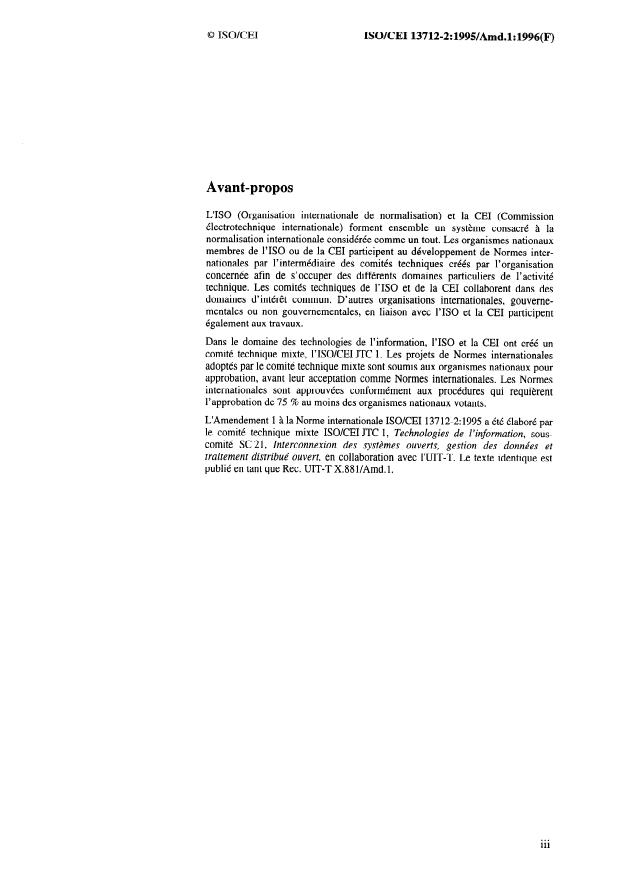
Sommaire
Page
Article 1 . 1
1)
................................................................................................................................................
Paragraphe 2.1 1
2)
..........................................................................................................................................................
Article 6 1
3)
Articles 8 à 11 . 2
4)
Paragraphe 7.2.1 . 2
5)
Paragraphe 7.2 . 2
6)
Paragraphe 7.3.2 . 3
7)
Paragraphe 9.3 . 3
8)
Article 10 . 3
9)
Article 11 . 3
10)
Article 10 . 4
11)
Anneex A . 4
12)
Annexe C . 5
1%
0 ISOKEI 1996
Droits de reproduction réservés. Sauf prescription différente, aucune partie de cette
publication ne peut être reproduite ni utilisée sous quelque forme que ce soit et par aucun
procédé, électronique ou mécanique, y compris la photocopie et les microfilms, sans
l’accord écrit de l’éditeur.
ISOKEI Copyright Office l Case postale 56 l CH-l 211 Genève 20 l Suisse
Imprimé en Suisse
ii
0 ISOKEI ISOKEI 13712-2: 199YAmd.l: 1996(F)
Avant-propos
LIS0 (Organisation internationale de normalisation) et la CE1 (Commission
électrotechnique internationale) forment ensemble un système consacré à la
normalisation internationale considérée comme un tout. Les organismes nationaux
membres de I’ISO ou de la CE1 participent au développement de Normes inter-
nationales par l’intermédiaire des comités techniques créés par l’organisation
concernée afin de s’occuper des différents domaines particuliers de l’activité
technique. Les comités techniques de 1’ISO et de la CE1 collaborent dans des
domaines d’intérêt commun. D’autres organisations internationales, gouverne-
mentales ou non gouvernementales, en liaison avec I’ISO et la CE1 participent
également aux travaux.
Dans le domaine des technologies de l’information, I’ISO et la CE1 ont créé un
comité technique mixte, I’ISOKEI JTC 1. Les projets de Normes internationales
adoptés par le comité technique mixte sont soumis aux organismes nationaux pour
approbation, avant leur acceptation comme Normes internationales. Les Normes
internationales sont approuvées conformément aux procédures qui requièrent
l’approbation de 75 % au moins des organismes nationaux votants.
L’Amendement 1 à la Norme internationale ISOKEI 137 12-2: 1995 a été élaboré par
le comité technique mixte ISO/CEI JTC 1, Technologies de l’information, sous-
comité SC 21, Interconnexion des systèmes ouverts, gestion des données et
traitement distribué ouvert, en collaboration avec I’UIT-T. Le texte identique est
publié en tant que Rec. UIT-T X.8WAmd.l.
. . .
0 ISOKEI
ISO/CEI 13712-2: 1995/Amd.l: 1996(F)
Introduction
Le présent amendement à la Rec. X.881 I ISOKEI 13712-2 traite de la projection d’unités de données protocolaires
d’application (APDU) (application protocol data unit) de Mément de service d’opérations distantes (ROSE) (remote
operations service element) sur le service A-UNIT-DATA. Dans le présent amendement figurent aussi trois opérations
sondage, acquittement et annulation - d’intérêt général pour les concepteurs d’applications basées sur
intégrées -
l’élément de service ROSE.
1v
ISOKEI 13712-2 : 1995lAmd.l: 1996 (F)
NORME INTERNATIONALE
RECOMMANDATION UIT-T
TECHNOLOGIES DE L’INFORMATION - OPÉRATIONS DISTANTES:
RÉALISATIONS OS1 - DÉFINITION DU SERVICE DE L’ÉLÉMENT
DE SERVICE D’OPÉRATIONS DISTANTES
AMENDEMENT 1
Mappage sur A-UNIT-DATA et opérations intégrées
Article 1
1)
Réécrire comme suit la troisième phrase du deuxième paragraphe (le texte ajouté est souligné):
Les services ROSE sont assur& par la mise en œuvre du protocole ROSE (spécifié dans la Rec. UIT-T X.882
ISOKEI 137 12-3) conjointement avec les services de l’élément de service de contrôle d’association (ACSE
(Rec. UIT-T X.217 I ISOKEI 8649), du protocole ACSE (Rec. UIT-T X.227 I ISOKEI 8650-l et Rec. UIT-T X.237 I
ISOKEI 10035-l) et, facultativement, avec les services de l%lément du service de transfert fiable (RTSE)
(Rec. UIT-T X.21 8 I ISOKEI 9066-l), du protocole RTSE (Rec. UIT-T X.228 I ISOKEI 9066-2) et avec le service de
Présentation (Rec. UIT-T X.216 I ISOKEI 8822).
Paragraphe 2.1
2)
Ajouter les références suivantes:
‘1
- Recommandation UIT-T X.237 (1995) I ISOKEI 1003%1:1995, Technologies de l’information -
Interconnexion des systèmes ouverts - Protocole en mode sans connexion pour l’élément de service de
contrôle d’association: Spécifïcation du protocole.
- Recommandation UIT-T X.880 (1994)/Amd. 1 (1995) I ISOKEI 13712-1:1995 /Amd. 1:1996,
Technologies de l’information - Opérations distantes: Concepts, modèle et notation - Amendement 1:
Opérations intégrées.
- Recommandation UIT-T X.882 (1994)/Amd. 1 (1995) I ISOKEI 13712-3:1995 /Amd. 1:1996,
Technologies de l’information - Opérations distantes: Réalisations OSI - Spécification du protocole de
l’élément de service d’opérations distantes - Amendement 1: Mappage sur A-UNIT-DATA et opérations
in tégrées. ”
Article 6
3)
Ajouter lafigure et le texte suivants à lafin de l’article:
“La structure interne de l’élément de service ROSE est représentée à la Figure 3.
L’élément de service ROSE de base permet d’envoyer et de recevoir les invocations et les retours des opérations. Les
services ROSE de base sont définis à l’article 8. De plus, l’élément ROSE peut comporter un certain nombre d’opérations
int&rees qui assurent les services ROSE étendus définis à l’article 10. Les opérations intégrees ne seront activées que si
elles sont requises par le contrat d’association pris e
...
NORME
ISO/CEI
INTERNATIONALE
13712-2
Première édition
1995-04-I 5
AMENDEMENT 1
1996-08-I 5
Technologies de l’information -
Opérations distantes: Réalisations OSI -
Définition du service de l’élément de
service d’opérations distantes
AMENDEMENT 1: Mappage sur A-UNIT-DATA
et opérations intégrées
Information technology - Remo te Opera tions: OSI realiza tions - Remote
Opera tions Service Elemen t (ROSE) service de finition
AMENDMENT 1: Mapping to A-UNIT-DATA and built-in operations
Numéro de référence
ISO/CEI 1371 Z-21 995/Amd.l :1996(F)
ISOKEI 13712-2: 199YAmd.l: 1996(F)
Sommaire
Page
Article 1 . 1
1)
................................................................................................................................................
Paragraphe 2.1 1
2)
..........................................................................................................................................................
Article 6 1
3)
Articles 8 à 11 . 2
4)
Paragraphe 7.2.1 . 2
5)
Paragraphe 7.2 . 2
6)
Paragraphe 7.3.2 . 3
7)
Paragraphe 9.3 . 3
8)
Article 10 . 3
9)
Article 11 . 3
10)
Article 10 . 4
11)
Anneex A . 4
12)
Annexe C . 5
1%
0 ISOKEI 1996
Droits de reproduction réservés. Sauf prescription différente, aucune partie de cette
publication ne peut être reproduite ni utilisée sous quelque forme que ce soit et par aucun
procédé, électronique ou mécanique, y compris la photocopie et les microfilms, sans
l’accord écrit de l’éditeur.
ISOKEI Copyright Office l Case postale 56 l CH-l 211 Genève 20 l Suisse
Imprimé en Suisse
ii
0 ISOKEI ISOKEI 13712-2: 199YAmd.l: 1996(F)
Avant-propos
LIS0 (Organisation internationale de normalisation) et la CE1 (Commission
électrotechnique internationale) forment ensemble un système consacré à la
normalisation internationale considérée comme un tout. Les organismes nationaux
membres de I’ISO ou de la CE1 participent au développement de Normes inter-
nationales par l’intermédiaire des comités techniques créés par l’organisation
concernée afin de s’occuper des différents domaines particuliers de l’activité
technique. Les comités techniques de 1’ISO et de la CE1 collaborent dans des
domaines d’intérêt commun. D’autres organisations internationales, gouverne-
mentales ou non gouvernementales, en liaison avec I’ISO et la CE1 participent
également aux travaux.
Dans le domaine des technologies de l’information, I’ISO et la CE1 ont créé un
comité technique mixte, I’ISOKEI JTC 1. Les projets de Normes internationales
adoptés par le comité technique mixte sont soumis aux organismes nationaux pour
approbation, avant leur acceptation comme Normes internationales. Les Normes
internationales sont approuvées conformément aux procédures qui requièrent
l’approbation de 75 % au moins des organismes nationaux votants.
L’Amendement 1 à la Norme internationale ISOKEI 137 12-2: 1995 a été élaboré par
le comité technique mixte ISO/CEI JTC 1, Technologies de l’information, sous-
comité SC 21, Interconnexion des systèmes ouverts, gestion des données et
traitement distribué ouvert, en collaboration avec I’UIT-T. Le texte identique est
publié en tant que Rec. UIT-T X.8WAmd.l.
. . .
0 ISOKEI
ISO/CEI 13712-2: 1995/Amd.l: 1996(F)
Introduction
Le présent amendement à la Rec. X.881 I ISOKEI 13712-2 traite de la projection d’unités de données protocolaires
d’application (APDU) (application protocol data unit) de Mément de service d’opérations distantes (ROSE) (remote
operations service element) sur le service A-UNIT-DATA. Dans le présent amendement figurent aussi trois opérations
sondage, acquittement et annulation - d’intérêt général pour les concepteurs d’applications basées sur
intégrées -
l’élément de service ROSE.
1v
ISOKEI 13712-2 : 1995lAmd.l: 1996 (F)
NORME INTERNATIONALE
RECOMMANDATION UIT-T
TECHNOLOGIES DE L’INFORMATION - OPÉRATIONS DISTANTES:
RÉALISATIONS OS1 - DÉFINITION DU SERVICE DE L’ÉLÉMENT
DE SERVICE D’OPÉRATIONS DISTANTES
AMENDEMENT 1
Mappage sur A-UNIT-DATA et opérations intégrées
Article 1
1)
Réécrire comme suit la troisième phrase du deuxième paragraphe (le texte ajouté est souligné):
Les services ROSE sont assur& par la mise en œuvre du protocole ROSE (spécifié dans la Rec. UIT-T X.882
ISOKEI 137 12-3) conjointement avec les services de l’élément de service de contrôle d’association (ACSE
(Rec. UIT-T X.217 I ISOKEI 8649), du protocole ACSE (Rec. UIT-T X.227 I ISOKEI 8650-l et Rec. UIT-T X.237 I
ISOKEI 10035-l) et, facultativement, avec les services de l%lément du service de transfert fiable (RTSE)
(Rec. UIT-T X.21 8 I ISOKEI 9066-l), du protocole RTSE (Rec. UIT-T X.228 I ISOKEI 9066-2) et avec le service de
Présentation (Rec. UIT-T X.216 I ISOKEI 8822).
Paragraphe 2.1
2)
Ajouter les références suivantes:
‘1
- Recommandation UIT-T X.237 (1995) I ISOKEI 1003%1:1995, Technologies de l’information -
Interconnexion des systèmes ouverts - Protocole en mode sans connexion pour l’élément de service de
contrôle d’association: Spécifïcation du protocole.
- Recommandation UIT-T X.880 (1994)/Amd. 1 (1995) I ISOKEI 13712-1:1995 /Amd. 1:1996,
Technologies de l’information - Opérations distantes: Concepts, modèle et notation - Amendement 1:
Opérations intégrées.
- Recommandation UIT-T X.882 (1994)/Amd. 1 (1995) I ISOKEI 13712-3:1995 /Amd. 1:1996,
Technologies de l’information - Opérations distantes: Réalisations OSI - Spécification du protocole de
l’élément de service d’opérations distantes - Amendement 1: Mappage sur A-UNIT-DATA et opérations
in tégrées. ”
Article 6
3)
Ajouter lafigure et le texte suivants à lafin de l’article:
“La structure interne de l’élément de service ROSE est représentée à la Figure 3.
L’élément de service ROSE de base permet d’envoyer et de recevoir les invocations et les retours des opérations. Les
services ROSE de base sont définis à l’article 8. De plus, l’élément ROSE peut comporter un certain nombre d’opérations
int&rees qui assurent les services ROSE étendus définis à l’article 10. Les opérations intégrees ne seront activées que si
elles sont requises par le contrat d’association pris e
...