


ISO 19152-3:2024
(Main)Geographic information — Land Administration Domain Model (LADM) — Part 3: Marine georegulation
Geographic information — Land Administration Domain Model (LADM) — Part 3: Marine georegulation
This document specifies the concepts and structure for standardization for georegulation in the marine space. This document addresses the information structures related to management of legal spaces (such as the international maritime limits and boundaries, marine living and non-living resources management areas, marine conservation areas, etc.) and their related rights and obligations. This document establishes the common elements and basic schema to structure marine georegulation information system. It builds upon the common components defined in ISO 19152-1.
Information géographique — Modèle du domaine de l'administration des terres (LADM) — Partie 3: Géoréglementation marine
Le présent document spécifie les concepts et la structure de normalisation pour la géoréglementation dans l'espace marin. Le présent document traite des structures d'information liées à la gestion des espaces juridiques, telles que les limites et frontières maritimes internationales, les zones de gestion des ressources marines vivantes et non vivantes, les zones de conservation marine, etc., ainsi que les droits et obligations associés. Le présent document établit les éléments communs et le schéma de base pour structurer le système d'information de la géoréglementation marine. Il s'appuie sur les composants communs définis dans l'ISO 19152-1.
General Information
- Status
- Published
- Publication Date
- 07-Jul-2024
- Technical Committee
- ISO/TC 211 - Geographic information/Geomatics
- Drafting Committee
- ISO/TC 211 - Geographic information/Geomatics
- Current Stage
- 6060 - International Standard published
- Start Date
- 08-Jul-2024
- Due Date
- 02-May-2024
- Completion Date
- 08-Jul-2024
Relations
- Effective Date
- 12-Feb-2026
- Consolidates
ISO 2810:2020 - Paints and varnishes — Natural weathering of coatings — Exposure and assessment - Effective Date
- 06-Jun-2022
- Effective Date
- 06-Jun-2022
Overview
ISO 19152-3:2024 - Geographic information - Land Administration Domain Model (LADM) - Part 3: Marine georegulation specifies a standardized conceptual model and schema for describing legal, administrative and spatial information in the marine domain. Building on the common components of ISO 19152-1, this international standard defines the information structures needed to manage marine legal spaces (for example international maritime limits and boundaries, resource-management areas, conservation zones) and their associated rights, restrictions and responsibilities.
Keywords: ISO 19152-3, LADM, marine georegulation, maritime boundaries, marine spatial planning, geospatial interoperability.
Key topics and technical requirements
- Scope and purpose: standardize concepts and structure for georegulation in marine space, enabling consistent representation of legal spaces and their legal relations.
- Core schema elements: packages and classes for Party, Administrative (BAUnit, RRR, rights/responsibilities/restrictions), Spatial unit (limits, zones, surfaces, spaces, volumes), Source, and MRN-related elements.
- Geometry and topology: a defined geometry structure for point, curve, surface and volume representations to model marine limits and zones.
- Feature and attribute structure: defined feature types, attributes and relationships for marine governance, spatial units and parties.
- Conformance and testing: conformance requirements and conformance classes, including:
- Class 1 - Marine limits and boundaries in support of UNCLOS
- Class 2 - General marine georegulation implementations
- Notation, context and inheritance: aligned with ISO 19152-1 common components and includes rules for notation and contextual metadata.
Practical applications
- Mapping and managing international maritime limits and boundaries in support of UNCLOS submissions and maritime claims.
- Designing and operating marine protected areas (MPAs), fisheries management zones and resource extraction concessions with explicit legal rights and restrictions.
- Enabling interoperable marine spatial planning, permitting, enforcement and compliance systems across agencies and jurisdictions.
- Integrating marine georegulation data into national cadastre and geographic information systems for planning, environmental assessment and offshore industry management.
Who should use this standard
- National hydrographic and cadastral authorities
- Marine and environmental regulators, maritime boundary commissions
- Coastal and marine spatial planners, conservation agencies
- GIS and software vendors, system integrators building marine governance platforms
- Offshore energy, fisheries and maritime industry stakeholders requiring standardized legal-space data exchange
Related standards
- ISO 19152-1 (common components for the LADM), which ISO 19152-3 builds upon.
- References and compliance guidance are provided within ISO 19152-3 for conformance testing and implementation.
This standard supports interoperable, legally-aware marine geospatial information systems for better governance, planning and resource management.
ISO 19152-3:2024 - Geographic information — Land Administration Domain Model (LADM) — Part 3: Marine georegulation Released:7/8/2024
ISO 19152-3:2024 - Information géographique — Modele du domaine de l'administration des terres (LADM) — Partie 3: Géoréglementation marine Released:7/8/2024
Get Certified
Connect with accredited certification bodies for this standard

BSI Group
BSI (British Standards Institution) is the business standards company that helps organizations make excellence a habit.

NYCE
Mexican standards and certification body.
Sponsored listings
Frequently Asked Questions
ISO 19152-3:2024 is a standard published by the International Organization for Standardization (ISO). Its full title is "Geographic information — Land Administration Domain Model (LADM) — Part 3: Marine georegulation". This standard covers: This document specifies the concepts and structure for standardization for georegulation in the marine space. This document addresses the information structures related to management of legal spaces (such as the international maritime limits and boundaries, marine living and non-living resources management areas, marine conservation areas, etc.) and their related rights and obligations. This document establishes the common elements and basic schema to structure marine georegulation information system. It builds upon the common components defined in ISO 19152-1.
This document specifies the concepts and structure for standardization for georegulation in the marine space. This document addresses the information structures related to management of legal spaces (such as the international maritime limits and boundaries, marine living and non-living resources management areas, marine conservation areas, etc.) and their related rights and obligations. This document establishes the common elements and basic schema to structure marine georegulation information system. It builds upon the common components defined in ISO 19152-1.
ISO 19152-3:2024 is classified under the following ICS (International Classification for Standards) categories: 35.240.70 - IT applications in science. The ICS classification helps identify the subject area and facilitates finding related standards.
ISO 19152-3:2024 has the following relationships with other standards: It is inter standard links to EN ISO 19152-3:2024, ISO 2810:2020, ISO 19152:2012. Understanding these relationships helps ensure you are using the most current and applicable version of the standard.
ISO 19152-3:2024 is available in PDF format for immediate download after purchase. The document can be added to your cart and obtained through the secure checkout process. Digital delivery ensures instant access to the complete standard document.
Standards Content (Sample)
International
Standard
ISO 19152-3
First edition
Geographic information — Land
2024-07
Administration Domain Model
(LADM) —
Part 3:
Marine georegulation
Information géographique — Modèle du domaine de
l'administration des terres (LADM) —
Partie 3: Géoréglementation marine
Reference number
© ISO 2024
All rights reserved. Unless otherwise specified, or required in the context of its implementation, no part of this publication may
be reproduced or utilized otherwise in any form or by any means, electronic or mechanical, including photocopying, or posting on
the internet or an intranet, without prior written permission. Permission can be requested from either ISO at the address below
or ISO’s member body in the country of the requester.
ISO copyright office
CP 401 • Ch. de Blandonnet 8
CH-1214 Vernier, Geneva
Phone: +41 22 749 01 11
Email: copyright@iso.org
Website: www.iso.org
Published in Switzerland
ii
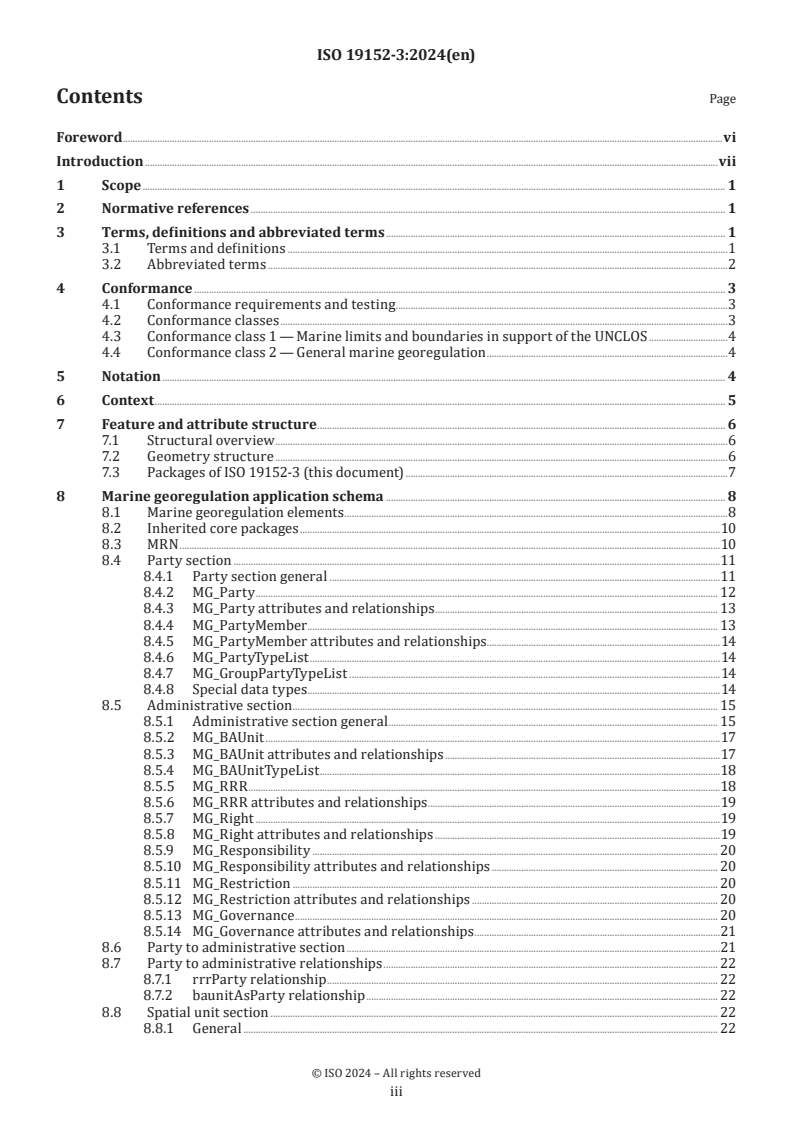
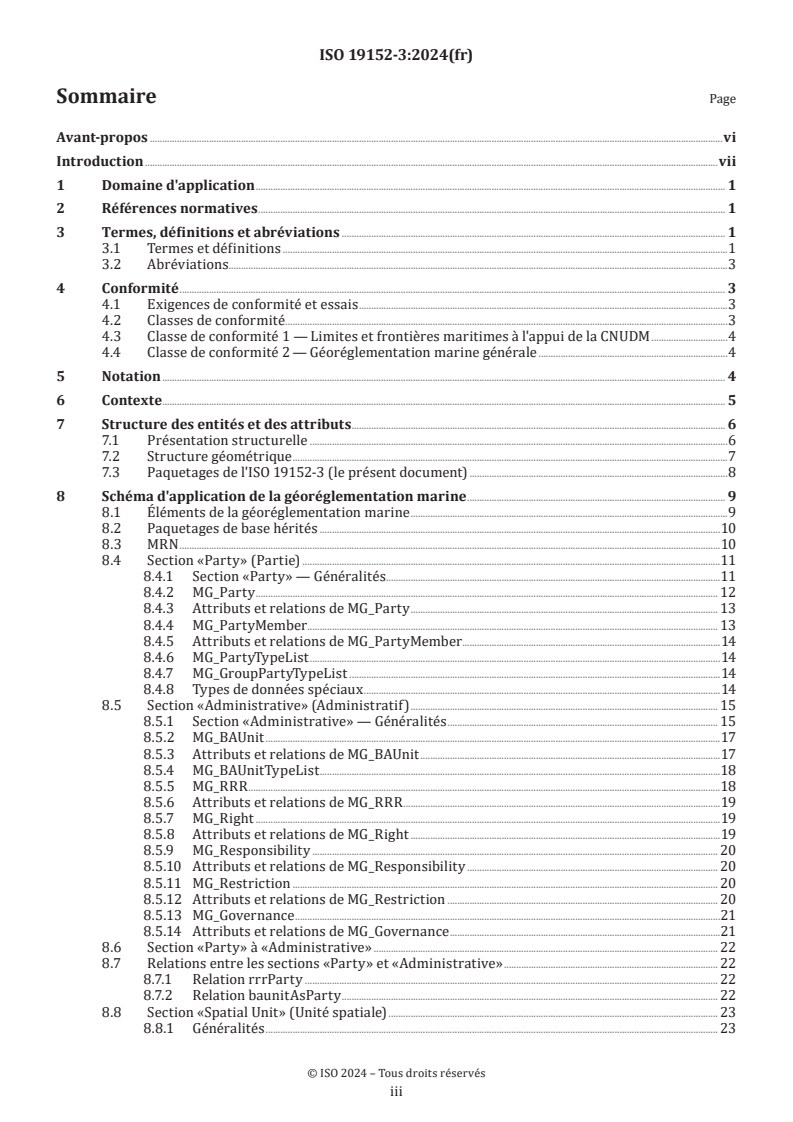
Contents Page
Foreword .vi
Introduction .vii
1 Scope . 1
2 Normative references . 1
3 Terms, definitions and abbreviated terms . 1
3.1 Terms and definitions .1
3.2 Abbreviated terms .2
4 Conformance . 3
4.1 Conformance requirements and testing .3
4.2 Conformance classes .3
4.3 Conformance class 1 — Marine limits and boundaries in support of the UNCLOS .4
4.4 Conformance class 2 — General marine georegulation .4
5 Notation . 4
6 Context . 5
7 Feature and attribute structure . 6
7.1 Structural overview .6
7.2 Geometry structure .6
7.3 Packages of ISO 19152-3 (this document) .7
8 Marine georegulation application schema . 8
8.1 Marine georegulation elements .8
8.2 Inherited core packages .10
8.3 MRN .10
8.4 Party section .11
8.4.1 Party section general .11
8.4.2 MG_Party . 12
8.4.3 MG_Party attributes and relationships . 13
8.4.4 MG_PartyMember . . 13
8.4.5 MG_PartyMember attributes and relationships .14
8.4.6 MG_PartyTypeList .14
8.4.7 MG_GroupPartyTypeList .14
8.4.8 Special data types.14
8.5 Administrative section . . 15
8.5.1 Administrative section general . 15
8.5.2 MG_BAUnit .17
8.5.3 MG_BAUnit attributes and relationships .17
8.5.4 MG_BAUnitTypeList .18
8.5.5 MG_RRR .18
8.5.6 MG_RRR attributes and relationships .19
8.5.7 MG_Right .19
8.5.8 MG_Right attributes and relationships .19
8.5.9 MG_Responsibility . 20
8.5.10 MG_Responsibility attributes and relationships . 20
8.5.11 MG_Restriction . 20
8.5.12 MG_Restriction attributes and relationships . 20
8.5.13 MG_Governance . 20
8.5.14 MG_Governance attributes and relationships .21
8.6 Party to administrative section .21
8.7 Party to administrative relationships . 22
8.7.1 rrrParty relationship . 22
8.7.2 baunitAsParty relationship . 22
8.8 Spatial unit section . 22
8.8.1 General . 22
iii
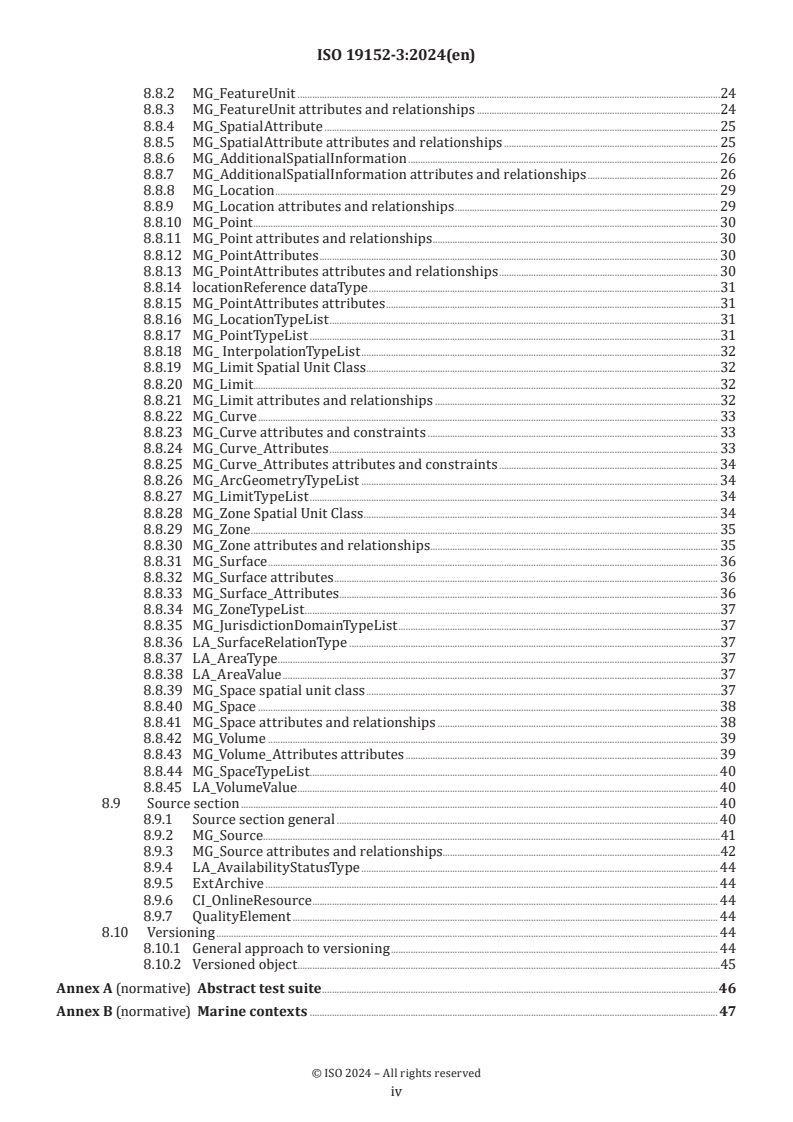
8.8.2 MG_FeatureUnit .24
8.8.3 MG_FeatureUnit attributes and relationships .24
8.8.4 MG_SpatialAttribute . 25
8.8.5 MG_SpatialAttribute attributes and relationships . 25
8.8.6 MG_AdditionalSpatialInformation . 26
8.8.7 MG_AdditionalSpatialInformation attributes and relationships . 26
8.8.8 MG_Location . 29
8.8.9 MG_Location attributes and relationships . 29
8.8.10 MG_Point . 30
8.8.11 MG_Point attributes and relationships . 30
8.8.12 MG_PointAttributes . 30
8.8.13 MG_PointAttributes attributes and relationships . 30
8.8.14 locationReference dataType .31
8.8.15 MG_PointAttributes attributes .31
8.8.16 MG_LocationTypeList .31
8.8.17 MG_PointTypeList .31
8.8.18 MG_ InterpolationTypeList .32
8.8.19 MG_Limit Spatial Unit Class .32
8.8.20 MG_Limit.32
8.8.21 MG_Limit attributes and relationships .32
8.8.22 MG_Curve . 33
8.8.23 MG_Curve attributes and constraints . 33
8.8.24 MG_Curve_Attributes . 33
8.8.25 MG_Curve_Attributes attributes and constraints . 34
8.8.26 MG_ArcGeometryTypeList . 34
8.8.27 MG_LimitTypeList . 34
8.8.28 MG_Zone Spatial Unit Class . 34
8.8.29 MG_Zone . . 35
8.8.30 MG_Zone attributes and relationships . . 35
8.8.31 MG_Surface . 36
8.8.32 MG_Surface attributes . 36
8.8.33 MG_Surface_Attributes . . 36
8.8.34 MG_ZoneTypeList .37
8.8.35 MG_JurisdictionDomainTypeList .37
8.8.36 LA_SurfaceRelationType .37
8.8.37 LA_AreaType . .37
8.8.38 LA_AreaValue .37
8.8.39 MG_Space spatial unit class .37
8.8.40 MG_Space . 38
8.8.41 MG_Space attributes and relationships . 38
8.8.42 MG_Volume . 39
8.8.43 MG_Volume_Attributes attributes . 39
8.8.44 MG_SpaceTypeList . 40
8.8.45 LA_VolumeValue . 40
8.9 Source section . 40
8.9.1 Source section general . 40
8.9.2 MG_Source.41
8.9.3 MG_Source attributes and relationships.42
8.9.4 LA_AvailabilityStatusType . 44
8.9.5 ExtArchive . 44
8.9.6 CI_OnlineResource . 44
8.9.7 QualityElement . 44
8.10 Versioning . 44
8.10.1 General approach to versioning . 44
8.10.2 Versioned object .45
Annex A (normative) Abstract test suite .46
Annex B (normative) Marine contexts . 47
iv
Bibliography .53
v
Foreword
ISO (the International Organization for Standardization) is a worldwide federation of national standards
bodies (ISO member bodies). The work of preparing International Standards is normally carried out through
ISO technical committees. Each member body interested in a subject for which a technical committee
has been established has the right to be represented on that committee. International organizations,
governmental and non-governmental, in liaison with ISO, also take part in the work. ISO collaborates closely
with the International Electrotechnical Commission (IEC) on all matters of electrotechnical standardization.
The procedures used to develop this document and those intended for its further maintenance are described
in the ISO/IEC Directives, Part 1. In particular, the different approval criteria needed for the different types
of ISO document should be noted. This document was drafted in accordance with the editorial rules of the
ISO/IEC Directives, Part 2 (see www.iso.org/directives).
ISO draws attention to the possibility that the implementation of this document may involve the use of (a)
patent(s). ISO takes no position concerning the evidence, validity or applicability of any claimed patent
rights in respect thereof. As of the date of publication of this document, ISO had not received notice of (a)
patent(s) which may be required to implement this document. However, implementers are cautioned that
this may not represent the latest information, which may be obtained from the patent database available at
www.iso.org/patents. ISO shall not be held responsible for identifying any or all such patent rights.
Any trade name used in this document is information given for the convenience of users and does not
constitute an endorsement.
For an explanation of the voluntary nature of standards, the meaning of ISO specific terms and expressions
related to conformity assessment, as well as information about ISO's adherence to the World Trade
Organization (WTO) principles in the Technical Barriers to Trade (TBT), see www.iso.org/iso/foreword.html.
This document was prepared by Technical Committee ISO/TC 211, Geographic information/Geomatics, in
collaboration with the European Committee for Standardization (CEN) Technical Committee CEN/TC 287,
Geographic Information, in accordance with the Agreement on technical cooperation between ISO and CEN
(Vienna Agreement), and in collaboration with the International Hydrographic Organization (IHO).
This edition of ISO 19152-3, together with all other parts in the ISO 19152 series, cancels and replaces the
first edition (ISO 19152:2012), which has been technically revised. This document is a new part to the
ISO 19152 series and makes no changes to the original ISO 19152:2007.
A list of all parts in the ISO 19152 series can be found on the ISO website.
Any feedback or questions on this document should be directed to the user’s national standards body. A
complete listing of these bodies can be found at www.iso.org/members.html.
vi
Introduction
ISO 19152:2012 specifically addressed the land registration aspects of land administration. This document
(ISO 19152-3:2023) introduces the broader term "georegulation", which addresses any area of geographic
information in which rights, restrictions or responsibilities (RRR) can be applied. Georegulation is the
activity of delimiting and asserting control over geographical spaces through regulations. This document
allows the objects of georegulation to be documented in a systematic and consistent manner. Although
the broader term "georegulation" is used throughout the document, the main element of the title of the
document remains “Land Administration Domain Model” to retain compatibility with the previous edition
of the document.
This document addresses georegulation in the marine environment. Rights and obligations created by
georegulation share a basic structure, as described in ISO 19152-1. Marine activity, including transportation,
resource extraction and food production (fishing and marine aquaculture), is of great importance. Different
rights and obligations can exist on the surface, in the water column and on the seabed. The model defined
in this document can be used for marine cadastres as well as other use cases (such as conservation areas,
living resources and fishery management areas, non-living resources management areas, seabed tenure,
[27]
etc.), and to describe data in support of the United Nations Convention on the Law of the Sea (UNCLOS) or
other conventions, e.g. administrative areas described in support of safe navigation under the International
[28]
Convention for the Safety of Life At Sea (SOLAS).
The oceans are of importance to all humankind, and specific areas along coastlines are under the jurisdiction
of nation states. The jurisdiction of coastal states extends to certain maritime zones. Users and states have
rights, restrictions and responsibilities in specific zones. The area beyond coastal states’ zones is without
[27]
exercise or claim of sovereignty and the rights regarding the resources are vested in mankind. In
specific cases there are private rights, such as the rights associated with fishing or resource extraction.
Some individuals can have property rights on land adjacent to water potentially extending into the area
covered by water. This can be described in a marine cadastre, described using the structures available in
this document.
International marine rights are addressed in international treaties globally through UN conventions and
[27]
between nations; in particular, the United Nations Convention on the Law of the Sea (UNCLOS). Marine
safety and navigation are addressed by the International Maritime Organization (IMO) international
[28]
convention on Safety Of Life At Sea (SOLAS) 1974. Other international conventions, treaties and national
laws establish rights and obligations.
The International Hydrographic Organization is an international standards development organization that
specializes in the marine space. It develops standards for safe navigation, marine jurisdictions, oceanography
and other aspects of the marine space in close cooperation with other international organizations such as
[29] [27]
the UN DOALOS and ISO. In particular it supports several UN conventions such as the UNCLOS and the
[28] [30]
SOLAS conventions in cooperation with the UN IMO. Alignment between ISO International Standards
for the marine space and the IHO is important.
United Nations’ Sustainable Development Goal 14C and United Nations’ General Assembly Resolution
A/RES/59/24 directed the IHO to provide technical standards for maritime zones. The IHO supports
standards development for oceanography, marine science and the UN SOLAS and the UNCLOS conventions.
[31] [18]
In particular, as part of the S-100 Universal Hydrographic Data Model, IHO has developed a series of
[32] [20]
standards and specifications that address the marine space. These include IHO S-121 on maritime
[33]
limits and boundaries and IHO S-122 on marine protected areas.
A characteristic of georegulation objects in the marine space is that their geometry structure can need
[18]
to be aligned with IHO S-100 and ISO 19107. As such, there can be different “feature” types. This is in
alignment with the way "feature" is defined in the general feature model from ISO 19109 and the approach
to feature cataloguing defined in ISO 19110. For their geographic information aspects, the IHO suite of
hydrographic standards is based on many of the ISO/TC 211 suite of Geographic Information documents,
[20] [27]
through S-100. S-121 on maritime limits and boundaries directly supports the UNCLOS and is built
[20]
upon the ISO 19152 series. Due to the close links between S-121 and the ISO 19152 series, this document
makes direct reference to S-100 and S-121.
vii
Since many of the rights and restrictions in the marine space come either from international or bi-national
treaties, or national proclamations or laws, within the context of georegulation, it can be necessary to express
the text or preamble of a treaty or law. A “governance” object has therefore been added to the administrative
structure in this document to allow legal text to be associated with an administrative unit. In many cases
the parties involved in rights, restrictions and responsibilities (RRR) relationships in the marine space are
nations. This means that the code lists of types of parties and administrative units defined in other parts of
the ISO 19152 series will not necessarily apply. Unique code lists have been defined to address the marine
space. Further, treaties are often the reference source for both the administrative and spatial aspects, so the
distinction between types of sources has been eliminated.
The ISO 19152 series is a general abstract model for Land Administrative Domain Model (LADM) systems. It
provides a uniform way of describing national or other systems. The ISO 19152 series is implemented through
[20]
profiles, such as country profiles, in accordance with ISO 19106. S-121 is a profile for the description
[28] [27]
of marine limits and boundaries (MLB) in the context of support for the SOLAS and the UNCLOS
conventions supported by the IHO series of standards. This document has two conformance classes, one
that directly supports the S-121 profile, and the other more general conformance class that supports other
aspects of marine georegulation. The profile for MLB is defined in S-121. The support of other aspects of
marine georegulation will require the development of specific profiles to address these other areas.
[20]
This document is a derived work, developed under a cooperative agreement with the IHO, based on S-121
and used with permission.
In accordance with the ISO/IEC Directives, Part 2, 2018, Rules for the structure and drafting of International
Standards, in International Standards the decimal sign is a comma on the line. However, the General
Conference on Weights and Measures (Conférence Générale des Poids et Mesures) at its meeting in 2003
passed unanimously the following resolution:
“The decimal marker shall be either a point on the line or a comma on the line.”
In practice, the choice between these alternatives depends on customary use in the language concerned. In
the technical areas of geodesy and geographic information it is customary for the decimal point always to be
used, for all languages. That practice is used throughout this document.
NOTE The direction of positive rotation used in this document is positive in a counter clockwise direction in
alignment with ISO 19109 and ISO 19107. The IHO S-100 series of standards makes use of “Heading Orientation” which
is positive in a clockwise direction. The user needs to be aware of this difference.
viii
International Standard ISO 19152-3:2024(en)
Geographic information — Land Administration Domain
Model (LADM) —
Part 3:
Marine georegulation
1 Scope
This document specifies the concepts and structure for standardization for georegulation in the marine space.
This document addresses the information structures related to management of legal spaces (such as the
international maritime limits and boundaries, marine living and non-living resources management areas,
marine conservation areas, etc.) and their related rights and obligations.
This document establishes the common elements and basic schema to structure marine georegulation
information system. It builds upon the common components defined in ISO 19152-1.
2 Normative references
The following documents are referred to in the text in such a way that some or all of their content constitutes
requirements of this document. For dated references, only the edition cited applies. For undated references,
the latest edition of the referenced document (including any amendments) applies.
ISO 19152-1, Geographic information — Land Administration Domain Model (LADM) — Part 1: Generic
conceptual model
3 Terms, definitions and abbreviated terms
3.1 Terms and definitions
For the purposes of this document, the terms and definitions given in ISO 19152-1 and the following apply.
ISO and IEC maintain terminology databases for use in standardization at the following addresses:
— ISO Online browsing platform: available at https:// www .iso .org/ obp
— IEC Electropedia: available at https:// www .electropedia .org/
3.1.1
boundary
delimitation between two or more zones
Note 1 to entry: A boundary involves two or more parties.
Note 2 to entry: Adapted from Reference [20].
3.1.2
curve
1-dimensional geometric primitive, representing the continuous image of a line
Note 1 to entry: The boundary of a curve is the set of points at either end of the curve. If the curve is a cycle, the two
ends are identical, and the curve (if topologically closed) is considered to not have a boundary. The first point is called
the start point, and the last is the end point. Connectivity of the curve is guaranteed by the "continuous image of a line"
clause. A topological theorem states that a continuous image of a connected set is connected.
[SOURCE: ISO 19136-1:2020, 3.1.17]
3.1.3
limit
curve that defines a boundary or extent of a zone
Note 1 to entry: A limit involves one party.
Note 2 to entry: Adapted from Reference [20].
3.1.4
marine
relating to navigation or shipping or relating to or connected with the sea or used, or adopted for use at sea
Note 1 to entry: Sometimes called "maritime", but maritime is more frequently applied to that which borders on the sea.
[SOURCE: Reference [22]]
3.1.5
marine cadastre
management tool which spatially describes, visualizes and realizes formally and informally defined
boundaries and associated rights, restrictions and responsibilities in the marine environment
Note 1 to entry: In addition to boundaries, a marine cadastre can also address locations, limits, baselines, zones and spaces.
Note 2 to entry: A marine cadastre is a type of georegulation related to property registration as addressed in
ISO 19152-2 where the concept of “land” is extended to include “over water”.
Note 3 to entry: Adapted from Reference [17].
3.1.6
marine georegulation
expression of a right, restriction or responsibility for one or more parties or group parties for a spatial
location, boundary, zone or space in the marine domain
3.1.7
maritime
bordering on, or concerned with, or related to the sea
[SOURCE: Reference [22]]
3.2 Abbreviated terms
BAUnit basic administrative unit
CRS coordinate reference system
DOALOS Division of Ocean Affairs and the Law of the Sea, office of legal affairs, United Nations
ENC Electronic Nautical Chart
GIS geographic information system
guid globally unique identifier
IALA International Association of marine aids to navigation and Lighthouse Authorities
IETF Internet Engineering Task Force
IHO International Hydrographic Organization
IMO International Maritime Organization of the United Nations
LADM Land Administration Domain Model
MLB marine limits and boundaries
MRN Maritime Resource Name
Oid object ID
RRR right, restriction, responsibility
SOLAS International Convention on Safety of Life at Sea
UML Unified Modelling Language
UNCLOS United Nations Convention on the Law Of the Sea
uom units of measure
URI Uniform Resource Identifier
URN Uniform Resource Name
4 Conformance
4.1 Conformance requirements and testing
Conformance to this document consists of alignment with the requirements established in 4.3 and 4.4. The
abstract test suite given in Annex A describes a methodology which shall be used for testing conformance to
these requirements.
4.2 Conformance classes
Two conformance classes are identified in this document:
— one for the description of a LADM marine georegulation system in support of maritime limits and
boundaries for the UNCLOS
— one in support of other marine georegulation domain areas as outlined in Annex B.
The conformance class for a marine georegulation system in support of maritime limits and boundaries
[27] [20]
for the UNCLOS provides a general model that is used by S-121. This includes code lists and other
structures, such as the governance class MG_Governance and the attribute type Marine Resource
[18] [19]
Name (MRN) as defined in S-100, and geometry constraints to align with S-101. The more general
conformance class for other types of marine georegulation permits but does not require the use of the
code lists and other structures specific to maritime limits and boundaries for the UNCLOS. These code lists
and structures can be extended, or other code lists and structures can be included. Where compatibility is
desirable between data products that conform with conformance class 1 and extensions that conform with
conformance class 2, it is desirable that extensions be used. These two conformance classes are not mutually
exclusive, but rather by making use of extensions it is possible to support both conformance criteria. Support
for the geometric constraints described in 7.2 is required for any marine georegulation data product that
supports compatibility with the S-100-based suite of Electronic Nautical Chart (ENC) navigation standards.
4.3 Conformance class 1 — Marine limits and boundaries in support of the UNCLOS
Requirement 1: The description of a LADM marine georegulation schema in support of maritime limits
and boundaries for the UNCLOS using this document (ISO 19152-3) shall consist of a set of UML classes with
associated attributes that make use of or subtype the classes defined in Clause 8 including the code lists
defined in 8.4.6, 8.4.7, 8.5.4, 8.5.14.7, 8.8.16, 8.8.27, 8.8.34, and 8.8.35, the attribute Marine Resource Name
defined in 8.3 and the geometry constraints defined in 7.2 which are enumerated in Annex B.
[19]
NOTE The IHO standard S-121 conforms to conformance class 1 of this document.
4.4 Conformance class 2 — General marine georegulation
Requirement 2: The description of a LADM marine georegulation schema for general application, such
as for marine cadastre or any of the other marine contexts described in Annex B using this document
(ISO 19152-3) shall consist of a set of UML classes with associated attributes that make use of or subtype
the classes defined in Clause 8. This allows for other marine georegulation application areas to be addressed
[20] [27]
that are not covered in S-121 or in the UNCLOS. For example, seabed resource extraction would be
an area that can be addressed by this conformance class. However, to do this, all of the code list values that
pertain to this other application area would need to be defined as part of the specification of that application.
The code lists, the attribute Marine Resource Name and the geometry constraints identified in conformance
class 2 are optional and can be replaced with other code lists and geometric constraints.
5 Notation
The conceptual schema specified in this document is described using the Unified Modelling Language
(UML), following the guidance of ISO 19103. The description of the types of relationships, such as subtyping,
inheritance, and realization are described in ISO 19103, not in this document.
Several model elements used in this schema are defined in other ISO geographic information International
Standards. By convention within some ISO/TC 211 documents, names of UML classes, with the exception of
basic data type classes, include a two-letter prefix that identifies the document and the UML package in which
the class is defined. This provides a global unique name for the class. UML classes defined in this document
have the two-letter prefix of MG. The two-letter prefix of LA is used for ISO 19152-1 and ISO 19152-2 to
support backward compatibility. Table 1 lists the other International Standards and packages in which UML
classes used in this document have been defined.
Table 1 — Sources of externally defined UML classes
Prefix Document Part
CI ISO 19115-1 Metadata — Fundamentals
DQ ISO 19157-1 Data quality — General requirements
GM ISO 19107 Spatial schema
LA ISO 19152-1 Generic conceptual model
a
LA ISO 19152-2 Land registration
MG ISO 19152-3 Marine georegulation
a
Under preparation. Stage at the time of publication ISO/DIS 19152-2:2024.
NOTE ISO 19157-1 and ISO 19107 have dropped the prefixes GM and DQ, relying on context for the uniqueness of
class names. However, the prefixes are still used in the older versions of these documents, which are still referenced by
[18]
some external standards, such as versions of S-100. Retaining the prefixes in Table 1 provides an understanding of
the meaning of these prefixes when they are encountered. They are required for backward compatibility.
The following stereotypes are used to identify attributes that apply to specific conformance classes.
<> — This stereotype applies to attributes that are specific to conformance class 1 relating to
[20]
maritime limits and boundaries in accordance with S-121.
<> — This stereotype applies to attributes used to carry the Maritime Resource Name, which is a
[20]
specific identifier managed by the IHO and defined for the S-100 suite of standards, including S-121.
6 Context
The purpose of this document is to establish a structure for the description of georegulation in the marine space.
Jurisdictions in the marine space can be different from those on land and can be covered by international
[27]
conventions such as the UN Convention on the Law of the Sea (UNCLOS). The UNCLOS defines the marine
zones and the rights and duties of a country regarding those zon
...
Norme
internationale
ISO 19152-3
Première édition
Information géographique —
2024-07
Modèle du domaine de
l'administration des terres
(LADM) —
Partie 3:
Géoréglementation marine
Geographic information — Land Administration Domain Model
(LADM) —
Part 3: Marine georegulation
Numéro de référence
DOCUMENT PROTÉGÉ PAR COPYRIGHT
© ISO 2024
Tous droits réservés. Sauf prescription différente ou nécessité dans le contexte de sa mise en œuvre, aucune partie de cette
publication ne peut être reproduite ni utilisée sous quelque forme que ce soit et par aucun procédé, électronique ou mécanique,
y compris la photocopie, ou la diffusion sur l’internet ou sur un intranet, sans autorisation écrite préalable. Une autorisation peut
être demandée à l’ISO à l’adresse ci-après ou au comité membre de l’ISO dans le pays du demandeur.
ISO copyright office
Case postale 401 • Ch. de Blandonnet 8
CH-1214 Vernier, Genève
Tél.: +41 22 749 01 11
E-mail: copyright@iso.org
Web: www.iso.org
Publié en Suisse
ii
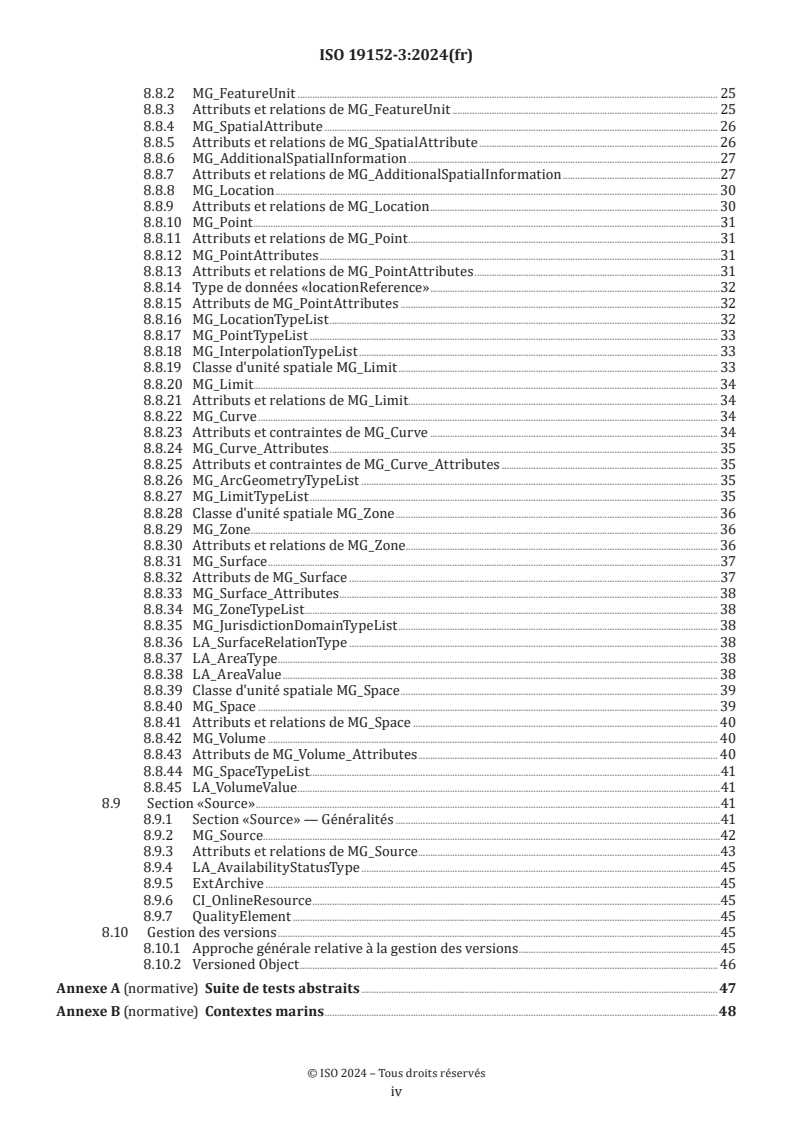
Sommaire Page
Avant-propos .vi
Introduction .vii
1 Domaine d'application . 1
2 Références normatives . 1
3 Termes, définitions et abréviations . 1
3.1 Termes et définitions .1
3.2 Abréviations.3
4 Conformité . 3
4.1 Exigences de conformité et essais .3
4.2 Classes de conformité . .3
4.3 Classe de conformité 1 — Limites et frontières maritimes à l'appui de la CNUDM .4
4.4 Classe de conformité 2 — Géoréglementation marine générale .4
5 Notation . 4
6 Contexte . . 5
7 Structure des entités et des attributs . . 6
7.1 Présentation structurelle .6
7.2 Structure géométrique .7
7.3 Paquetages de l'ISO 19152-3 (le présent document) .8
8 Schéma d'application de la géoréglementation marine . 9
8.1 Éléments de la géoréglementation marine .9
8.2 Paquetages de base hérités .10
8.3 MRN .10
8.4 Section «Party» (Partie) .11
8.4.1 Section «Party» — Généralités .11
8.4.2 MG_Party . 12
8.4.3 Attributs et relations de MG_Party . 13
8.4.4 MG_PartyMember . . 13
8.4.5 Attributs et relations de MG_PartyMember .14
8.4.6 MG_PartyTypeList .14
8.4.7 MG_GroupPartyTypeList .14
8.4.8 Types de données spéciaux .14
8.5 Section «Administrative» (Administratif) . 15
8.5.1 Section «Administrative» — Généralités . 15
8.5.2 MG_BAUnit .17
8.5.3 Attributs et relations de MG_BAUnit .17
8.5.4 MG_BAUnitTypeList .18
8.5.5 MG_RRR .18
8.5.6 Attributs et relations de MG_RRR .19
8.5.7 MG_Right .19
8.5.8 Attributs et relations de MG_Right .19
8.5.9 MG_Responsibility . 20
8.5.10 Attributs et relations de MG_Responsibility . 20
8.5.11 MG_Restriction . 20
8.5.12 Attributs et relations de MG_Restriction . 20
8.5.13 MG_Governance .21
8.5.14 Attributs et relations de MG_Governance .21
8.6 Section «Party» à «Administrative» . 22
8.7 Relations entre les sections «Party» et «Administrative» . 22
8.7.1 Relation rrrParty . 22
8.7.2 Relation baunitAsParty . 22
8.8 Section «Spatial Unit» (Unité spatiale) . 23
8.8.1 Généralités . 23
iii
8.8.2 MG_FeatureUnit . 25
8.8.3 Attributs et relations de MG_FeatureUnit . 25
8.8.4 MG_SpatialAttribute . 26
8.8.5 Attributs et relations de MG_SpatialAttribute . 26
8.8.6 MG_AdditionalSpatialInformation .27
8.8.7 Attributs et relations de MG_AdditionalSpatialInformation .27
8.8.8 MG_Location . 30
8.8.9 Attributs et relations de MG_Location . 30
8.8.10 MG_Point .31
8.8.11 Attributs et relations de MG_Point .31
8.8.12 MG_PointAttributes .31
8.8.13 Attributs et relations de MG_PointAttributes .31
8.8.14 Type de données «locationReference» .32
8.8.15 Attributs de MG_PointAttributes .32
8.8.16 MG_LocationTypeList .32
8.8.17 MG_PointTypeList . 33
8.8.18 MG_InterpolationTypeList . 33
8.8.19 Classe d'unité spatiale MG_Limit . 33
8.8.20 MG_Limit. 34
8.8.21 Attributs et relations de MG_Limit. 34
8.8.22 MG_Curve . 34
8.8.23 Attributs et contraintes de MG_Curve . 34
8.8.24 MG_Curve_Attributes . 35
8.8.25 Attributs et contraintes de MG_Curve_Attributes . 35
8.8.26 MG_ArcGeometryTypeList . 35
8.8.27 MG_LimitTypeList . 35
8.8.28 Classe d'unité spatiale MG_Zone . 36
8.8.29 MG_Zone . . 36
8.8.30 Attributs et relations de MG_Zone . 36
8.8.31 MG_Surface .37
8.8.32 Attributs de MG_Surface .37
8.8.33 MG_Surface_Attributes . . 38
8.8.34 MG_ZoneTypeList . 38
8.8.35 MG_JurisdictionDomainTypeList . 38
8.8.36 LA_SurfaceRelationType . 38
8.8.37 LA_AreaType . . 38
8.8.38 LA_AreaValue . 38
8.8.39 Classe d'unité spatiale MG_Space . 39
8.8.40 MG_Space . 39
8.8.41 Attributs et relations de MG_Space . 40
8.8.42 MG_Volume . 40
8.8.43 Attributs de MG_Volume_Attributes . 40
8.8.44 MG_SpaceTypeList .41
8.8.45 LA_VolumeValue .41
8.9 Section «Source» .41
8.9.1 Section «Source» — Généralités .41
8.9.2 MG_Source.42
8.9.3 Attributs et relations de MG_Source.43
8.9.4 LA_AvailabilityStatusType .45
8.9.5 ExtArchive .45
8.9.6 CI_OnlineResource .45
8.9.7 QualityElement .45
8.10 Gestion des versions .45
8.10.1 Approche générale relative à la gestion des versions .45
8.10.2 Versioned Object . 46
Annexe A (normative) Suite de tests abstraits . 47
Annexe B (normative) Contextes marins .48
iv
Bibliographie .55
v
Avant-propos
L'ISO (Organisation internationale de normalisation) est une fédération mondiale d'organismes nationaux
de normalisation (comités membres de l'ISO). L'élaboration des Normes internationales est en général
confiée aux comités techniques de l'ISO. Chaque comité membre intéressé par une étude a le droit de faire
partie du comité technique créé à cet effet. Les organisations internationales, gouvernementales et non
gouvernementales, en liaison avec l'ISO participent également aux travaux. L'ISO collabore étroitement avec
la Commission électrotechnique internationale (IEC) en ce qui concerne la normalisation électrotechnique.
Les procédures utilisées pour élaborer le présent document et celles destinées à sa mise à jour sont
décrites dans les Directives ISO/IEC, Partie 1. Il convient, en particulier, de prendre note des différents
critères d'approbation requis pour les différents types de documents ISO. Le présent document a
été rédigé conformément aux règles de rédaction données dans les Directives ISO/IEC, Partie 2 (voir
www.iso.org/directives).
L’ISO attire l’attention sur le fait que la mise en application du présent document peut entraîner l’utilisation
d’un ou de plusieurs brevets. L’ISO ne prend pas position quant à la preuve, à la validité et à l’applicabilité de
tout droit de brevet revendiqué à cet égard. À la date de publication du présent document, l’ISO n'avait pas
reçu notification qu’un ou plusieurs brevets pouvaient être nécessaires à sa mise en application. Toutefois,
il y a lieu d’avertir les responsables de la mise en application du présent document que des informations
plus récentes sont susceptibles de figurer dans la base de données de brevets, disponible à l'adresse
www.iso.org/brevets. L’ISO ne saurait être tenue pour responsable de ne pas avoir identifié tout ou partie de
tels droits de propriété.
Les appellations commerciales éventuellement mentionnées dans le présent document sont données pour
information, par souci de commodité, à l’intention des utilisateurs et ne sauraient constituer un engagement.
Pour une explication de la nature volontaire des normes, la signification des termes et expressions
spécifiques de l'ISO liés à l'évaluation de la conformité, ou pour toute information au sujet de l'adhésion de
l'ISO aux principes de l’Organisation mondiale du commerce (OMC) concernant les obstacles techniques au
commerce (OTC), voir www.iso.org/avant-propos.
Le présent document a été élaboré par le comité technique ISO/TC 211, Information géographique/
Géomatique, en collaboration avec le comité technique CEN/TC 287, Information géographique, du Comité
européen de normalisation (CEN) conformément à l’Accord de coopération technique entre l’ISO et le CEN
(Accord de Vienne), en collaboration avec l'Organisation hydrographique internationale (l'OHI).
Cette édition de l'ISO 19152-3, ainsi que de toutes les autres parties de la série ISO 19152, annule et remplace
la première édition (ISO 19152:2012), qui a fait l’objet d’une révision technique. Le présent document
est une nouvelle partie de la série ISO 19152 et n'apporte aucune modification à la première édition de
l'ISO 19152:2012.
Une liste de toutes les parties de la série ISO 19152 se trouve sur le site web de l’ISO.
Il convient que l’utilisateur adresse tout retour d’information ou toute question concernant le présent
document à l’organisme national de normalisation de son pays. Une liste exhaustive desdits organismes se
trouve à l’adresse www.iso.org/fr/members.html.
vi
Introduction
L'ISO 19152:2012 traitait spécifiquement des aspects de l'administration des terres relatifs à l'enregistrement
des terres. Le présent document (ISO 19152-3:2023) introduit le terme plus large de «géoréglementation»,
qui désigne tout domaine d'information géographique dans lequel des droits, des restrictions ou des
responsabilités (RRR) peuvent être appliqués. La géoréglementation est l'activité consistant à délimiter
des espaces géographiques et à exercer un contrôle sur ces espaces au travers de réglementations. Le
présent document permet aux objets de géoréglementation d'être documentés de manière systématique et
cohérente. Bien que le terme plus large de «géoréglementation» soit utilisé tout au long du document, le
principal élément du titre du document reste «Modèle du domaine de l'administration des terres (LADM)»
pour maintenir la compatibilité avec l'édition précédente du document.
Le présent document traite de la géoréglementation dans l'environnement marin. Les droits et les
obligations créés par la géoréglementation partagent une structure de base telle qu'elle est décrite dans
l'ISO 19152-1. Les activités marines, notamment le transport, l'extraction de ressources et la production
alimentaire (pêche et aquaculture marine), sont d'une grande importance. Il peut exister différents droits
et obligations relatifs à la surface, à la colonne d'eau et aux fonds marins. Le modèle défini dans le présent
document peut être utilisé pour les cadastres marins ainsi que pour d'autres cas d'utilisation (tels que les
zones de conservation, les zones de gestion des ressources vivantes et halieutiques, les zones de gestion des
ressources non vivantes, le régime foncier des fonds marins, etc.), et pour décrire les données à l'appui de
[27]
la Convention des Nations Unies sur le droit de la mer (CNUDM) ou d'autres conventions, par exemple les
zones administratives décrites à l'appui de la sécurité de la navigation dans la Convention internationale
[28]
pour la sauvegarde de la vie humaine en mer (SOLAS).
Les océans sont importants pour l'ensemble de l'humanité et des zones spécifiques le long des côtes
relèvent de la juridiction des États. La juridiction des États côtiers s'étend à certaines zones maritimes.
Les utilisateurs et les États ont des droits, des restrictions et des responsabilités dans certaines zones
spécifiques. Aucuns droits de souveraineté sur l'aire située au-delà des zones des États côtiers ne sauraient
[27]
être exercés ou revendiqués, et l'humanité est investie de tous les droits sur les ressources de cette zone.
Dans certains cas, il existe des droits privés, tels que les droits liés à la pêche ou à l'extraction des ressources.
Des personnes physiques peuvent détenir des droits de propriété sur des terres littorales pouvant s'étendre
à la partie immergée. Cette situation peut être décrite dans un cadastre marin, à l'aide des structures
disponibles dans le présent document.
Les droits maritimes internationaux sont traités globalement dans des traités internationaux par le biais
des conventions des Nations Unies et entre les nations, particulièrement dans le cadre de la Convention des
[27]
Nations Unies sur le droit de la mer (CNUDM). La sécurité en mer et la navigation sont traitées par la
[28]
convention internationale de 1974 de l'OMI pour la sauvegarde de la vie humaine en mer (SOLAS). D'autres
conventions internationales, traités et législations nationales établissent des droits et des obligations.
L'Organisation hydrographique internationale est un organisme de développement de normes
internationales, spécialisé dans l'espace marin. Elle élabore des normes relatives à la sécurité de la navigation,
aux juridictions maritimes, à l'océanographie et à d'autres aspects de l'espace marin en coopération étroite
[29]
avec d'autres organisations internationales telles que la division DOALOS des Nations Unies et l'ISO. Elle
[27] [28]
vient à l'appui de plusieurs conventions des Nations Unies telles que les conventions CNUDM et SOLAS
[30]
en coopération avec l'OMI des Nations Unies. L'alignement entre les normes ISO relatives à l'espace marin
et l'OHI est important.
L'objectif de développement durable 14C des Nations Unies et la résolution de l'Assemblée générale
des Nations Unies A/RES/59/24 ont chargé l'OHI d'élaborer des normes techniques relatives aux zones
maritimes. L'OHI promeut l'élaboration de normes relatives à l'océanographie, aux sciences de la mer et aux
[31]
conventions SOLAS et CNUDM des Nations Unies. En particulier dans le cadre du modèle universel de
[18]
données hydrographiques S-100, l'OHI a élaboré une série de normes et de spécifications qui traitent de
[32] [20]
l'espace marin. Celles-ci comprennent la norme OHI S-121 sur les limites et frontières maritimes, et la
[33]
norme OHI S-122 sur les aires marines protégées.
Les objets de géoréglementation dans l'espace marin se caractérisent par le fait qu'il peut être nécessaire
[18]
d'aligner leur structure géométrique sur la norme OHI S-100 et l'ISO 19107. Il peut donc y avoir différents
types d'«entités». Cela correspond à la façon dont les entités sont définies dans le modèle général des
vii
entités (General Feature Model - GFM) de l'ISO 19109 et à l'approche de catalogage des entités définie
dans l'ISO 19110. Pour les aspects d'information géographique qui la concernent, la suite de normes
hydrographiques de l'OHI est basée sur un grand nombre des documents de la série ISO/TC 211, Information
[20]
géographique, en passant par la norme S-100. La norme S-121 sur les limites et frontières maritimes vient
[27]
directement à l'appui de la CNUDM et est fondée sur la série ISO 19152. En raison des liens étroits entre
[20]
la S-121 et la série ISO 19152, le présent document fait directement référence aux normes S-100 et S-121.
Étant donné que de nombreux droits et restrictions de l'espace marin découlent soit de traités internationaux
ou binationaux, soit de lois ou de décrets nationaux, dans le contexte de la géoréglementation, il peut être
nécessaire d'exprimer le texte ou le préambule d'un traité ou d'une loi. Un objet «governance» (Gouvernance)
a donc été ajouté à la structure administrative du présent document pour permettre au texte de loi d'être
associé à une unité administrative. Dans de nombreux cas, les parties impliquées dans les relations en
matière de droits, restrictions et responsabilités (RRR) dans l'espace marin sont des pays. Cela signifie que
les listes de codes des types de parties et d'unités administratives définies dans d'autres parties de la série
ISO 19152 ne s'appliquent pas nécessairement. Des listes de codes uniques ont été définies pour l'espace
marin. En outre, les traités sont souvent la source de référence pour les aspects administratifs et spatiaux,
de sorte que la distinction entre les types de sources a été éliminée.
La série ISO 19152 est un modèle abstrait général pour les systèmes de modèle du domaine de l'administration
des terres (LADM). Elle fournit un moyen uniforme de décrire des systèmes nationaux ou d'autres systèmes.
La série ISO 19152 est mise en œuvre au travers de profils, tels que des profils de pays, conformément à
[20]
l'ISO 19106. La norme S-121 est un profil utilisé pour décrire les limites et frontières maritimes (MLB)
[28] [27]
à l'appui des conventions SOLAS et CNUDM soutenues par la série de normes de l'OHI. Le présent
document contient deux classes de conformité, une qui vient directement à l'appui du profil S-121, et l'autre,
plus générale, qui prend en charge d'autres aspects de la géoréglementation marine. Le profil des MLB est
défini dans la norme S-121. La prise en charge des autres aspects de la géoréglementation marine implique
de développer des profils traitant spécifiquement de ces autres domaines.
Le présent document est une œuvre dérivée, élaborée dans le cadre d'un accord de coopération avec l'OHI,
[20]
basée sur la norme S-121 et utilisée avec son autorisation.
Conformément aux Directives ISO/IEC, Partie 2, 2018, Règles de structure et de rédaction des normes
internationales, le signe décimal est une virgule sur la ligne. Cependant, la Conférence générale des poids et
mesures, réunie en 2003, a adopté à l'unanimité la résolution suivante:
«Le symbole du séparateur décimal doit être le point sur la ligne ou la virgule sur la ligne.»
En pratique, le choix entre ces alternatives dépend de l'usage coutumier dans la langue concernée. Dans les
domaines techniques de la géodésie et de l'information géographique, il est d'usage d'utiliser toujours le
point décimal pour toutes les langues. Cette pratique est utilisée tout au long du présent document.
NOTE Le sens de rotation positive utilisé dans le présent document est positif dans le sens inverse des aiguilles
d'une montre, conformément à l'ISO 19109 et à l'ISO 19107. La série de normes S-100 de l'OHI utilise une « orientation
de cap » qui est positive dans le sens des aiguilles d'une montre. Il est important que l'utilisateur soit informé de cette
différence.
viii
Norme internationale ISO 19152-3:2024(fr)
Information géographique — Modèle du domaine de
l'administration des terres (LADM) —
Partie 3:
Géoréglementation marine
1 Domaine d'application
Le présent document spécifie les concepts et la structure de normalisation pour la géoréglementation dans
l'espace marin.
Le présent document traite des structures d'information liées à la gestion des espaces juridiques, telles que
les limites et frontières maritimes internationales, les zones de gestion des ressources marines vivantes et
non vivantes, les zones de conservation marine, etc., ainsi que les droits et obligations associés.
Le présent document établit les éléments communs et le schéma de base pour structurer le système
d'information de la géoréglementation marine. Il s'appuie sur les composants communs définis dans
l'ISO 19152-1.
2 Références normatives
Les documents suivants sont cités dans le texte de sorte qu'ils constituent, pour tout ou partie de leur
contenu, des exigences du présent document. Pour les références datées, seule l'édition citée s'applique. Pour
les références non datées, la dernière édition du document de référence s'applique (y compris les éventuels
amendements).
ISO 19152-1, Information géographique — Modèle du domaine de l'administration des terres (LADM) — Partie
1: Modèle conceptuel générique
3 Termes, définitions et abréviations
3.1 Termes et définitions
Pour les besoins du présent document, les termes et les définitions de l'ISO 19152-1 ainsi que les suivants
s'appliquent.
L'ISO et l'IEC tiennent à jour des bases de données terminologiques destinées à être utilisées en normalisation,
consultables aux adresses suivantes:
— ISO Online browsing platform: disponible à l'adresse https:// www .iso .org/ obp
— IEC Electropedia: disponible à l'adresse https:// www .electropedia .org/
3.1.1
frontière
délimitation entre deux zones ou plus
Note 1 à l'article: Une frontière implique deux parties ou plus.
Note 2 à l'article: Adapté de la Référence [20].
3.1.2
courbe
primitive géométrique à 1 dimension, représentant l'image continue d'une ligne
Note 1 à l'article: La frontière d'une courbe correspond à l'ensemble de points à chaque extrémité de cette courbe. Si
la courbe est un cycle, les deux extrémités sont identiques, et la courbe (si elle est fermée du point de vue topologique)
est considérée comme dépourvue de frontière. Le premier et le dernier points sont respectivement appelés point
d'origine et point extrémité. La connectivité de la courbe est garantie par l'«image continue d'une ligne». Un théorème
topologique stipule qu'une image continue d'un ensemble connecté est connectée.
[SOURCE: ISO 19136-1:2020, 3.1.17]
3.1.3
limite
courbe qui définit une frontière ou l'étendue d'une zone
Note 1 à l'article: Une limite implique une partie.
Note 2 à l'article: Adapté de la Référence [20].
3.1.4
marin
lié à la navigation ou aux bâtiments et navires, ou qualifie ce qui appartient à la mer, qui est formé par la mer
ou qui est destiné à la mer
Note 1 à l'article: Parfois appelé «maritime», mais «maritime» s'applique plus fréquemment à ce qui touche à la mer.
[SOURCE: Référence [22]]
3.1.5
cadastre marin
outil de gestion qui décrit, visualise et matérialise dans l'espace les frontières définies de manière formelle
et informelle ainsi que les droits, restrictions et responsabilités associés à l'environnement marin
Note 1 à l'article: En plus des frontières, un cadastre marin peut également couvrir des sites, des limites, des lignes de
base, des zones et des espaces.
Note 2 à l'article: Un cadastre marin est un type de géoréglementation lié à l'enregistrement de la propriété traité dans
l'ISO 19152-2 où le concept de «foncier» est élargi pour inclure «au-dessus de l'eau».
Note 3 à l'article: Adapté de la Référence [17].
3.1.6
géoréglementation marine
expression d'un droit, d'une restriction ou d'une responsabilité d'une ou plusieurs parties ou d'un ou
plusieurs groupes de parties sur un site spatial, une frontière, une zone ou un espace dans le domaine marin
3.1.7
maritime
qui est proche de la mer, qui est relatif à la mer ou à la navigation en mer
[SOURCE: Référence [22]]
3.2 Abréviations
AISM Association internationale de signalisation maritime
BAUnit unité administrative de base
CNUDM Convention des Nations Unies sur le droit de la mer
Division of Ocean Affairs and the Law of the Sea [Division des affaires maritimes et du droit de
DOALOS
la mer], Bureau des affaires juridiques, Nations Unies
ENC Electronic Nautical Chart [Carte électronique de navigation]
guid identifiant universel unique [Globally Unique Identifier]
IETF Internet Engineering Task Force
LADM Land Administration Domain Model [Modèle du domaine de l'administration des terres]
MLB Maritime Limits and Boundaries [Limites et frontières maritimes]
MRN Maritime Resource Name [Nom de ressource maritime]
OHI Organisation hydrographique internationale
Oid object ID [ID d'objet]
OMI Organisation maritime internationale des Nations Unies
RRR Right, Restriction, Responsibility [Droit, restriction, responsabilité]
SIG système d'information géographique
International Convention on Safety of Life at Sea [Convention internationale pour la sauvegarde
SOLAS
de la vie humaine en mer]
SRC système de référence de coordonnées
UML Unified Modelling Language [Langage de modélisation unifié]
uom unit of measure [unité de mesure]
URI Uniform Resource Identifier [Identifiant de ressource uniforme]
URN Uniform Resource Name [Nom uniforme de ressource]
4 Conformité
4.1 Exigences de conformité et essais
La conformité au présent document consiste en une mise en adéquation avec les exigences établies aux
paragraphes 4.3 et 4.4. La suite de tests abstraits fournie dans l'Annexe A décrit une méthodologie qui doit
être utilisée pour contrôler la conformité à ces exigences.
4.2 Classes de conformité
Deux classes de conformité sont identifiées dans le présent document:
— une pour la description d'un système de géoréglementation marine du LADM à l'appui des limites et
frontières maritimes de la CNUDM;
— une à l'appui des autres domaines de géoréglementation marine comme énoncé à l'Annexe B.
La classe de conformité du système de géoréglementation marine à l'appui des limites et frontières maritimes
[27] [20]
de la CNUDM prévoit un modèle général qui est utilisé par la norme S-121. Cela comprend des listes
de codes et d'autres structures telles que la classe de gouvernance MG_Governance et le type d'attribut
[18]
Marine Resource Name (MRN) défini dans la norme S-100 et les contraintes géométriques permettant
[19]
de se conformer à la norme S-101. La classe de conformité, plus générale pour d'autres types de
géoréglementation marine, autorise, mais n'exige pas, l'utilisation des listes de codes et d'autres structures
spécifiques aux limites et frontières maritimes de la CNUDM. Ces listes de codes et structures peuvent
être étendues ou d'autres listes de codes et structures peuvent être incluses. Lorsque la compatibilité est
souhaitable entre des produits de données conformes à la classe de conformité 1 et des extensions conformes
à la classe de conformité 2, il est souhaitable d'utiliser des extensions. Ces deux classes de conformité ne
s'excluent pas mutuellement, mais en recourant à des extensions, il est possible de satisfaire aux deux
critères de conformité. La prise en charge des contraintes géométriques décrites au 7.2 est requise pour tout
produit de données de géoréglementation marine compatible avec la suite de normes relatives aux cartes
électroniques de navigation (ENC) basée sur la norme S-100.
4.3 Classe de conformité 1 — Limites et frontières maritimes à l'appui de la CNUDM
Exigence 1: La description d'un schéma de géoréglementation marine du LADM à l'appui des limites et
frontières maritimes de la CNUDM utilisant le présent document (ISO 19152-3) doit être constituée d'un
ensemble de classes UML avec des attributs associés qui utilisent ou sous-typent les classes définies à
l'Article 8, y compris les listes de codes définies aux 8.4.6, 8.4.7, 8.5.4, 8.5.14.7, 8.8.16, 8.8.27, 8.8.34 et 8.8.35,
l'attribut Marine Resource Number défini au 8.3 et les contraintes géométriques définies au 7.2 et énumérées
à l'Annexe B.
[19]
NOTE La norme OHI S-121 est conforme à la classe de conformité 1 du présent document.
4.4 Classe de conformité 2 — Géoréglementation marine générale
Exigence 2: La description d'un schéma de géoréglementation marine du LADM pour une application
générale, telle que le cadastre marin ou tout autre contexte marin décrit à l'Annexe B utilisant le présent
document (ISO 19152-3) doit être constituée d'un ensemble de classes UML avec des attributs associés
qui utilisent ou sous-typent les classes définies à l'Article 8. Cela permet de traiter les autres domaines
[20]
d'application de la géoréglementation marine qui ne sont pas abordés dans la norme S-121 ou la CNUDM.
[27]
Par exemple, l'extraction des ressources des fonds marins est un domaine qui pourrait être traité par
cette classe de conformité. Cependant, pour y parvenir, il serait nécessaire de définir toutes les valeurs de
liste de codes relevant de cet autre domaine d'application dans le cadre de la spécification de l'application
en question. Les listes de
...
Questions, Comments and Discussion
Ask us and Technical Secretary will try to provide an answer. You can facilitate discussion about the standard in here.
Loading comments...