


ISO 23274-2:2012
(Main)Hybrid-electric road vehicles — Exhaust emissions and fuel consumption measurements — Part 2: Externally chargeable vehicles
Hybrid-electric road vehicles — Exhaust emissions and fuel consumption measurements — Part 2: Externally chargeable vehicles
ISO 23274-2:2012 specifies a chassis dynamometer test procedure to determine the end of CD (charge-depleting) state and consumed electric energy during CD state. The identification of the end of CD state is an important step for procedures to determine exhaust emissions and fuel consumption. Final determination of exhaust emissions and fuel consumption is not included in ISO 23274-2:2012. ISO 23274-2:2012 applies to vehicles with the following characteristics. The vehicles are hybrid-electric road vehicles (HEV) with an internal combustion engine (ICE) and the on-board rechargeable energy storage system (RESS) for vehicle propulsion which is supplied by electric energy from the stationary external power source. A CD state, in which the electric energy in RESS from the stationary external power source is consumed, is followed by a CS (charge-sustaining) state in which the fuel energy is consumed sustaining the electric energy of the RESS. Only batteries are assumed as the RESS of a vehicle. The RESS is not charged while driving unless by regenerative braking and/or by generating by ICE. The vehicle is classified as a passenger car or light duty truck, as defined in each regional annex. Only liquid fuels (for example, gasoline and diesel fuel) are used. Trolleybuses and solar powered vehicles are not included in the scope. In the case of vehicles with ICE using other fuel [for example, compressed natural gas (CNG), hydrogen (H2)], ISO 23274-2:2012 can apply except the measurement of consumed fuel; otherwise the measurement method for those using the corresponding fuel can apply.
Véhicules routiers électriques hybrides — Mesurages des émissions à l'échappement et de la consommation de carburant — Partie 2: Véhicules rechargeables par des moyens externes
General Information
- Status
- Withdrawn
- Publication Date
- 25-Jul-2012
- Withdrawal Date
- 25-Jul-2012
- Technical Committee
- ISO/TC 22/SC 37 - Electrically propelled vehicles
- Drafting Committee
- ISO/TC 22/SC 37 - Electrically propelled vehicles
- Current Stage
- 9599 - Withdrawal of International Standard
- Start Date
- 08-Sep-2021
- Completion Date
- 12-Feb-2026
Relations
- Effective Date
- 23-Apr-2020
- Effective Date
- 17-Jul-2010
Get Certified
Connect with accredited certification bodies for this standard

TÜV Rheinland
TÜV Rheinland is a leading international provider of technical services.

TÜV SÜD
TÜV SÜD is a trusted partner of choice for safety, security and sustainability solutions.

AIAG (Automotive Industry Action Group)
American automotive industry standards and training.
Sponsored listings
Frequently Asked Questions
ISO 23274-2:2012 is a standard published by the International Organization for Standardization (ISO). Its full title is "Hybrid-electric road vehicles — Exhaust emissions and fuel consumption measurements — Part 2: Externally chargeable vehicles". This standard covers: ISO 23274-2:2012 specifies a chassis dynamometer test procedure to determine the end of CD (charge-depleting) state and consumed electric energy during CD state. The identification of the end of CD state is an important step for procedures to determine exhaust emissions and fuel consumption. Final determination of exhaust emissions and fuel consumption is not included in ISO 23274-2:2012. ISO 23274-2:2012 applies to vehicles with the following characteristics. The vehicles are hybrid-electric road vehicles (HEV) with an internal combustion engine (ICE) and the on-board rechargeable energy storage system (RESS) for vehicle propulsion which is supplied by electric energy from the stationary external power source. A CD state, in which the electric energy in RESS from the stationary external power source is consumed, is followed by a CS (charge-sustaining) state in which the fuel energy is consumed sustaining the electric energy of the RESS. Only batteries are assumed as the RESS of a vehicle. The RESS is not charged while driving unless by regenerative braking and/or by generating by ICE. The vehicle is classified as a passenger car or light duty truck, as defined in each regional annex. Only liquid fuels (for example, gasoline and diesel fuel) are used. Trolleybuses and solar powered vehicles are not included in the scope. In the case of vehicles with ICE using other fuel [for example, compressed natural gas (CNG), hydrogen (H2)], ISO 23274-2:2012 can apply except the measurement of consumed fuel; otherwise the measurement method for those using the corresponding fuel can apply.
ISO 23274-2:2012 specifies a chassis dynamometer test procedure to determine the end of CD (charge-depleting) state and consumed electric energy during CD state. The identification of the end of CD state is an important step for procedures to determine exhaust emissions and fuel consumption. Final determination of exhaust emissions and fuel consumption is not included in ISO 23274-2:2012. ISO 23274-2:2012 applies to vehicles with the following characteristics. The vehicles are hybrid-electric road vehicles (HEV) with an internal combustion engine (ICE) and the on-board rechargeable energy storage system (RESS) for vehicle propulsion which is supplied by electric energy from the stationary external power source. A CD state, in which the electric energy in RESS from the stationary external power source is consumed, is followed by a CS (charge-sustaining) state in which the fuel energy is consumed sustaining the electric energy of the RESS. Only batteries are assumed as the RESS of a vehicle. The RESS is not charged while driving unless by regenerative braking and/or by generating by ICE. The vehicle is classified as a passenger car or light duty truck, as defined in each regional annex. Only liquid fuels (for example, gasoline and diesel fuel) are used. Trolleybuses and solar powered vehicles are not included in the scope. In the case of vehicles with ICE using other fuel [for example, compressed natural gas (CNG), hydrogen (H2)], ISO 23274-2:2012 can apply except the measurement of consumed fuel; otherwise the measurement method for those using the corresponding fuel can apply.
ISO 23274-2:2012 is classified under the following ICS (International Classification for Standards) categories: 43.120 - Electric road vehicles. The ICS classification helps identify the subject area and facilitates finding related standards.
ISO 23274-2:2012 has the following relationships with other standards: It is inter standard links to ISO 23274-2:2021, ISO 23274:2007. Understanding these relationships helps ensure you are using the most current and applicable version of the standard.
ISO 23274-2:2012 is available in PDF format for immediate download after purchase. The document can be added to your cart and obtained through the secure checkout process. Digital delivery ensures instant access to the complete standard document.
Standards Content (Sample)
INTERNATIONAL ISO
STANDARD 23274-2
First edition
2012-08-01
Hybrid-electric road vehicles —
Exhaust emissions and fuel
consumption measurements —
Part 2:
Externally chargeable vehicles
Véhicules routiers électriques hybrides — Mesurages des émissions à
l’échappement et de la consommation de carburant —
Partie 2: Véhicules rechargeables par des moyens externes
Reference number
©
ISO 2012
© ISO 2012
All rights reserved. Unless otherwise specified, no part of this publication may be reproduced or utilized in any form or by any
means, electronic or mechanical, including photocopying and microfilm, without permission in writing from either ISO at the
address below or ISO’s member body in the country of the requester.
ISO copyright office
Case postale 56 • CH-1211 Geneva 20
Tel. + 41 22 749 01 11
Fax + 41 22 749 09 47
E-mail copyright@iso.org
Web www.iso.org
Published in Switzerland
ii © ISO 2012 – All rights reserved
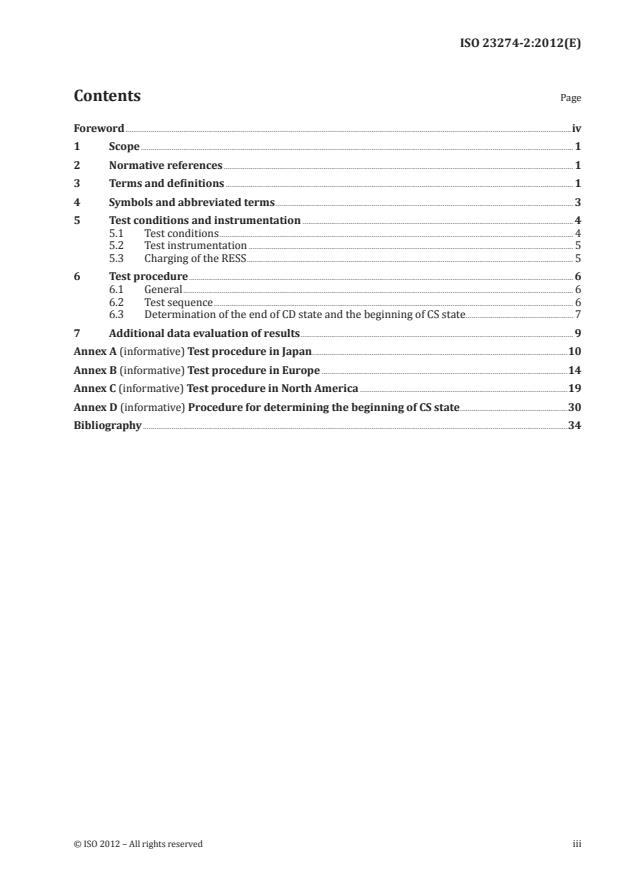
Contents Page
Foreword .iv
1 Scope . 1
2 Normative references . 1
3 Terms and definitions . 1
4 Symbols and abbreviated terms . 3
5 Test conditions and instrumentation . 4
5.1 Test conditions . 4
5.2 Test instrumentation . 5
5.3 Charging of the RESS . 5
6 Test procedure . 6
6.1 General . 6
6.2 Test sequence . 6
6.3 Determination of the end of CD state and the beginning of CS state . 7
7 Additional data evaluation of results . 9
Annex A (informative) Test procedure in Japan.10
Annex B (informative) Test procedure in Europe .14
Annex C (informative) Test procedure in North America .19
Annex D (informative) Procedure for determining the beginning of CS state .30
Bibliography .34
Foreword
ISO (the International Organization for Standardization) is a worldwide federation of national standards
bodies (ISO member bodies). The work of preparing International Standards is normally carried out
through ISO technical committees. Each member body interested in a subject for which a technical
committee has been established has the right to be represented on that committee. International
organizations, governmental and non-governmental, in liaison with ISO, also take part in the work.
ISO collaborates closely with the International Electrotechnical Commission (IEC) on all matters of
electrotechnical standardization.
International Standards are drafted in accordance with the rules given in the ISO/IEC Directives, Part 2.
The main task of technical committees is to prepare International Standards. Draft International
Standards adopted by the technical committees are circulated to the member bodies for voting.
Publication as an International Standard requires approval by at least 75 % of the member bodies
casting a vote.
Attention is drawn to the possibility that some of the elements of this document may be the subject of
patent rights. ISO shall not be held responsible for identifying any or all such patent rights.
ISO 23274-2 was prepared by Technical Committee ISO/TC 22, Road vehicles, Subcommittee SC 21,
Electrically propelled road vehicles.
This first edition of ISO 23274-2, together with ISO 23274-1, cancels and replaces ISO 23274:2007, which
has been technically revised.
ISO 23274 consists of the following parts, under the general title Hybrid-electric road vehicles — Exhaust
emissions and fuel consumption measurements:
— Part 1: Non-externally chargeable vehicles
— Part 2: Externally chargeable vehicles
iv © ISO 2012 – All rights reserved
INTERNATIONAL STANDARD ISO 23274-2:2012(E)
Hybrid-electric road vehicles — Exhaust emissions and
fuel consumption measurements —
Part 2:
Externally chargeable vehicles
1 Scope
This part of ISO 23274 specifies a chassis dynamometer test procedure to determine the end of
CD (charge-depleting) state and consumed electric energy during CD state.
The identification of the end of CD state is an important step for procedures to determine exhaust
emissions and fuel consumption. Final determination of exhaust emissions and fuel consumption is not
included in this part of ISO 23274.
This part of ISO 23274 applies to vehicles with the following characteristics.
— The vehicles are hybrid-electric road vehicles (HEV) with an internal combustion engine (ICE) and
the on-board rechargeable energy storage system (RESS) for vehicle propulsion which is supplied
by electric energy from the stationary external power source.
— A CD state, in which the electric energy in RESS from the stationary external power source is
consumed, is followed by a CS (charge-sustaining) state in which the fuel energy is consumed
sustaining the electric energy of the RESS.
— Only batteries are assumed as the RESS of a vehicle.
— The RESS is not charged while driving unless by regenerative braking and/or by generating by ICE.
NOTE 1 Trolleybuses and solar powered vehicles are not included in the scope.
— The vehicle is classified as a passenger car or light duty truck, as defined in each regional annex.
— Only liquid fuels (for example, gasoline and diesel fuel) are used.
NOTE 2 In the case of vehicles with ICE using other fuel [for example, compressed natural gas (CNG), hydrogen
(H )], this part of ISO 23274 can apply except the measurement of consumed fuel; otherwise the measurement
method for those using the corresponding fuel can apply.
2 Normative references
The following referenced documents are indispensable for the application of this document. For dated
references, only the edition cited applies. For undated references, the latest edition of the referenced
document (including any amendments) applies.
ISO/TR 8713, Electrically propelled road vehicles — Vocabulary
ISO 23274-1, Hybrid-electric road vehicles — Exhaust emissions and fuel consumption measurements —
Part 1: Non-externally chargeable vehicles
3 Terms and definitions
For the purposes of this document, the terms and definitions given in ISO/TR 8713 and the following apply.
3.1
applicable driving test
ADT
single driving test schedule which is specified for each region
EXAMPLE Chassis dynamometer test cycle for light-duty vehicles in Japan (JC08), New European Driving Cycle
(NEDC), Urban Dynamometer Driving Schedule (UDDS)
3.2
charge balance of RESS
change of charge in battery during fuel consumption measurement
NOTE Normally expressed in ampere hours (Ah).
3.3
charge-depleting state
CD state
operating mode of a HEV with ICE in which the vehicle runs by consuming mainly the electric energy
from the stationary external power source or along with the fuel energy simultaneously or sequentially
until CS state
3.4
charge-sustaining state
CS state
operating mode where the HEV runs by consuming the fuel energy while sustaining the electric
energy of the RESS
3.5
energy balance of RESS
ΔE
RESS
change of battery energy state during an applicable driving test
NOTE 1 Normally expressed in watt hours (Wh).
NOTE 2 For practical use, the energy balance of RESS is approximated by multiplying the charge balance of battery
in ampere hours (Ah) by the nominal voltage in volts (V). Nominal voltage is defined in 9.4.2 of ISO 12405-1:2011.
3.6
externally chargeable HEV
HEV with a rechargeable energy storage system (RESS) that is intended to be charged from an external
electric energy source
NOTE 1 External charge for the purpose of conditioning of the RESS is not included.
NOTE 2 Externally chargeable HEVs are widely known as plug-in HEVs (PHEVs).
3.7
hybrid-electric vehicle
HEV
vehicle with both a rechargeable energy storage system (RESS) and a fuelled power source for propulsion
EXAMPLE Internal combustion engine or fuel cell systems are typical types of fuelled power sources.
3.8
non-externally chargeable HEV
HEV with a rechargeable energy storage system (RESS) that is not intended to be charged from an
external electric energy source
2 © ISO 2012 – All rights reserved
3.9
rated capacity
supplier’s specification of the total number of ampere hours that can be withdrawn from a fully charged
battery pack or system for a specified set of test conditions such as discharge rate, temperature,
discharge cut-off voltage, etc.
3.10
rechargeable energy storage system
RESS
system that stores energy for delivery of electric power and which is rechargeable
EXAMPLE batteries or capacitors
3.11
regenerative braking
braking with conversion of kinetic energy into electric energy for charging the RESS
3.12
state of charge
SOC
available capacity in a battery pack or system
NOTE Expressed as a percentage of rated capacity.
4 Symbols and abbreviated terms
A/C air-conditioning
ABS antilock braking system
ADT applicable driving test
BMD bag mini-diluter
CD charge-depleting
CFR Code of Federal Regulations
CLA chemiluminescent assay
CNG compressed natural gas
CO carbon oxide
CS charge-sustaining
CVS constant volume sampler, constant volume sampling
E energy
ECE Economic Commission for Europe
E energy of consumed fuel
CF
EPA Environmental Protection Agency
E energy of RESS
RESS
F consumed fuel
FC fuel consumption
FCT full charge test
FEC full environmental chamber
FID flame ionization detector
FTP Federal Test Procedure
H hydrogen
HC hydrocarbon
HEV hybrid-electric vehicle
HFEDS Highway Fuel Economy Driving Schedule
HFID heated flame ionization detector
ICE internal combustion engine
ISO International Organization for Standardization
JC08 chassis dynamometer test cycle for light-duty vehicles in Japan
NDIR non dispersive infrared
NDUVR non dispersive ultraviolet resonance absorption
NEDC New European Driving Cycle
NOx nitrogen oxide
RESS rechargeable energy storage system
SAE Society of Automotive Engineers, Inc.
SC03 Speed Correction Driving Schedule
SOC state of charge
TCS traction control system
THC total hydrocarbons
UDDS Urban Dynamometer Driving Schedule
UN United Nations
US-06 Supplemental FTP
ρ density
5 Test conditions and instrumentation
5.1 Test conditions
For test conditions, ISO 23274-1 applies.
4 © ISO 2012 – All rights reserved
5.2 Test instrumentation
Test instrumentation shall have accuracy levels shown in Table 1, unless specified differently in
Annex A, B or C.
Table 1 — Accuracy of measured values
Item Unit Accuracy of measurement
Time s ± 0,1 s
Distance m ± 0,1 %
Temperature °C ± 1 °C
Speed km/h ± 1 %
Mass kg ± 0,5 %
Current A ± 0,5 %
Electric energy Wh ± 0,5 %
5.3 Charging of the RESS
5.3.1 Application of a normal charge
5.3.1.1 Normal charging procedure
The charging of the RESS shall be carried out at an ambient temperature of (25 ± 5) °C. The normal charging
procedure shall be in accordance with the vehicle manufacturer’s specification for normal operation.
For the normal charging procedure all types of special charging shall be excluded, for example RESS
service charging.
5.3.1.2 End-of-charge criteria
The end-of-charge criteria shall correspond to a charging time of 12 h except if a clear indication is given
to the driver by the standard instrumentation that the RESS is not yet fully charged. In this case, the
maximum charging time shall be in accordance with the manufacturer’s specification. After charging,
the vehicle shall not be conductively connected to the stationary external power source unless otherwise
specified by the manufacturer.
5.3.1.3 Fully charged RESS
A RESS is fully charged when charged according to the normal charging procedure (see 5.3.1.1) and the
end-of-charge criteria (see 5.3.1.2).
5.3.2 Charging the RESS and measuring energy
The vehicle shall be physically reconnected to the stationary external power source within 2 h
following completion of the appropriate test sequence unless otherwise specified by the regional
standards or regulations.
The RESS shall then be fully charged in accordance with the normal charging procedure (see 5.3.1.1).
The energy, E, in a.c. Wh, delivered from the stationary external power source, as well as the charging
time duration, shall be measured. The energy-measuring equipment shall be placed between the
stationary external a.c. power source and the vehicle power inlet.
6 Test procedure
6.1 General
This clause specifies how to determine the end of CD state and consumed electric energy during CD state. In
this part of ISO 23274, applicable driving tests during CS state are only used to determine the end of CD state.
In general, the results for the CS state in this part of ISO 23274 are not consistent with regulatory
requirements and should not be used for that purpose. See ISO 23274-1 to determine the exhaust
emissions and fuel consumption for the CS state. If only the CS state applies, then only testing in
accordance with ISO 23274-1 is necessary.
The appropriate regional procedure to measure exhaust emission and fuel consumption shall be selected
(see Annexes A, B and C for example). The test sequence and the single test steps of the test procedure to
determine the end of CD state are described below.
6.2 Test sequence
6.2.1 General
This test procedure consists of the following steps.
a) Perform vehicle preconditioning; (see 6.2.2).
b) Perform vehicle soak (see 6.2.3).
c) Perform initial charge of RESS to full (see 5.3.1.1).
d) Move the vehicle to the test room (see 6.2.4).
e) Run an applicable driving test and measure exhaust emissions, charge balance and fuel
consumption (see 6.2.5).
f) Determine if the end of CD state is reached (see 6.3.2 or 6.3.3).
If the end of CD state is identified, then go to g). If not, the procedure from e) shall be repeated.
g) Fully charge the RESS and measure a.c. electric energy (see 5.3.2).
6.2.2 Vehicle preconditioning
Vehicle preconditioning shall be carried out in accordance with the corresponding annex of regional test
procedure, if necessary.
If necessary, SOC may be pre-adjusted by charging or discharging, to obtain suitable energy balance of
RESS between the beginning and the end of test.
6.2.3 Vehicle soak
The vehicle shall be soaked in accordance with the appropriate regional procedure (see Annexes A, B
and C for example).
6.2.4 Vehicle movement to the test room
When the vehicle is brought into the test room, and moved during the test if necessary, it shall be pushed
or towed (neither driven or regeneratively recharged.). The test vehicle shall be set on the chassis
dynamometer after the chassis dynamometer has warmed up just before the test. The vehicle shall not
be activated during soak until right before starting the test.
6 © ISO 2012 – All rights reserved
6.2.5 Measurement in each applicable driving test
Energy balance of RESS, consumed fuel and exhaust emissions shall be measured in each applicable
driving test. The conditions of the vehicle during the applicable driving test shall follow the appropriate
regional test procedure (see Annexes A, B and C for example).
6.2.6 Electric energy measurement
The RESS shall be fully charged in accordance with the procedure described in 5.3.1.
After completing the applicable driving tests (see 6.3), the RESS shall be fully charged as specified by vehicle
manufacturers. The charging shall be started within 2 h after completion of the test in accordance with 5.3.
For the determination of the end of CD state (case 2) according to 6.3.3, the electric energy of the RESS
before charging may be adjusted to the mean value of the electric energy during CS state.
6.3 Determination of the end of CD state and the beginning of CS state
6.3.1 General
The energy balance of the RESS during CS state varies depending on the design of a HEV system and its
operation. Therefore this part of ISO 23274 specifies two cases for the determination of the transition
point between CD and CS state. Case 1 and case 2 depend on the characteristics in the CS state as
described in Figure 1 and Figure 2 and defined in 5.3.2 and 5.3.3. One of these cases shall apply unless
the regional Annexes A through C contain specific direction. Case 1 is applicable to most HEVs. If case 1
is not applicable, case 2 shall apply.
CD state does not exist unless the nominal energy of the RESS is 2 % or more of energy of consumed fuel
in an applicable driving test. See Annexes A, B and C for the measurement of consumed fuel.
6.3.2 Determination of the end of CD state (case 1)
Case 1 applies when the energy balance of the RESS during each applicable driving test in CS state is
varying within a specified small range (see Figure 1). For case 1, one or more applicable driving tests
shall be carried out. The vehicle is in CS state when the energy balance of the RESS during each driving
test is varying within the specified range.
The applicable driving test where CD state ends shall be determined by performing applicable driving
tests as follows.
— The energy balance of RESS (ΔE , Wh) between the start and the end of each applicable driving
RESS
test shall be calculated.
— Applicable driving tests shall continuously be carried out until each ΔE is determined to be
RESS
stable within ±(0,01 × E ) in Wh, E is the energy of consumed fuel of applicable driving test
CF CF
(converted to Wh using lower heating value).
— One or more consecutive applicable driving test(s) are necessary to know whether the vehicle is in
CS state.
— The applicable driving test where CD state ends is the one before the first applicable driving test
where CS state starts.
NOTE See Annex D for the procedure.
Key
1 full charge 8 first test
2 CD state 9 second test
3 CS state N test number
4 ΔE X time sequence
RESS
5 ΔE of Nth test Y1 electric energy of the RESS (Wh)
RESS
6 +0,01 × E of (N+1)th test Y2 ΔE (Wh)
CF RESS
7 −0,01 × E of Nth test
CF
Figure 1 — Determination of transition point of CD and CS state (case 1)
6.3.3 Determination of the end of CD state (case 2)
Case 2 applies when the energy balance of the RESS during a set of applicable driving tests in CS state is
varying within a specified small range(see Figure 2).
The applicable driving test where CD state ends is given by specifying the first set of applicable driving
tests in CS state as follows.
A series of applicable driving tests supposed to be in CS state shall be divided into sets. A set consists of
consecutive applicable driving tests. The number of applicable driving tests in a set should be minimum.
When the energy balance at the start of the first driving test and the end of the last test in the set is
determined to be stable within ± 1 % of the consumed fuel of one(P = 1 in Annex D) or more (P > 1 in
Annex D) consecutive set(s), the vehicle shall be determined as being in CS state. The applicable driving
test where CD state ends is the first applicable driving test of the first set of applicable driving tests in
the series where CS state starts.
NOTE See Annex D for the procedure to determine the minimum number of ADTs in a set.
8 © ISO 2012 – All rights reserved
Key
1 full charge 10 first set
2 CD state 11 second set
3 CS state 12 third set
4 ΔE of a single test 13 fourth set
RESS
5 ΔE of a set 14 first test
RESS
6 +0,01 × E of first set 15 second test
CF
7 +0,01 × E X time sequence
CF
8 −0,01 × E Y1 electric energy of the RESS (Wh)
CF
9 −0,01 × E of second set Y2 ΔE (Wh)
CF RESS
Figure 2 — Determination of transition of CD and CS state (case 2)
7 Additional data evaluation of results
Determination of CD state shall be documented. By determination of CD state in accordance with
Clause 6, the following results can be obtained:
— the number of applicable driving test(s) until CD state ends;
— electric energy consumed in the CD state as measured in accordance with 5.3.2.
NOTE Exhaust emissions and fuel consumption representing CD state depend on regional regulations.
Annex A
(informative)
Test procedure in Japan
A.1 General
This Annex describes the typical procedures and related conditions in Japan to measure the exhaust
emissions and fuel consumption of the passenger cars and light duty trucks defined in Japan regulations.
Japan Regulations are written as Announcement that Prescribes Details of Safety Regulations for Road
Vehicles (MLIT Announcement No. 619, 2002 Attachment 42), TRIAS 5-9-2009 and TRIAS 60-4-2009.
A.2 Test
A.2.1 Test facility
A.2.1.1 Chassis dynamometer
The equivalent inertia mass of the chassis dynamometer shall be set to the standard value of equivalent
inertia mass specified in the right column of Table A.1 according to the relative test vehicle mass (vehicle
curb mass plus 110 kg) specified in the left column of the table. Furthermore, if the standard value of the
equivalent inertia mass in the right column of the table cannot be set, it is permissible to set the equivalent
inertia mass within a range between the said standard value and the said standard value plus10 %.
A.2.2 Applicable driving test (ADT)
The test vehicle shall run the applicable driving test (ADT). In Japan, JC08-mode driving schedule [0 s to
1 204 s] specified in Japan Regulations is applicable (See Figure A.1).
A.2.3 Test vehicle mass
Test vehicle mass at measuring running resistance and at measuring exhaust emissions on the chassis
dynamometer shall be vehicle curb mass plus 110 kg.
A.3 Test procedure
Preconditioning shall be performed by running an ADT on the chassis dynamometer after given road
load setting. Then, the test procedure until electric energy measurement in 5.2.5 shall be carried out
according to the test flow in Figure A.2.
10 © ISO 2012 – All rights reserved
Table A.1 — Test vehicle mass and standard value of equivalent inertia mass
Test vehicle mass Standard value of equivalent inertia mass
kg kg
~480 455
481~540 510
541~595 570
596~650 625
651~710 680
711~765 740
766~850 800
851~965 910
966~1 080 1 020
1 081~1 190 1 130
1 191~1 305 1 250
1 306~1 420 1 360
1 421~1 530 1 470
1 531~1 640 1 590
1 641~1 760 1 700
1 761~1 870 1 810
1 871~1 980 1 930
1 981~2 100 2 040
2 101~2 210 2 150
2 211~2 380 2 270
2 381~2 625 2 500
2 626~2 875 2 750
2 876~3 250 3 000
3 251~3 750 3 500
Continued in increments of 500 kg Continued in increments of 500 kg
Key
X time (s)
Y speed (km/h)
Figure A.1 — JC08-mode driving schedule
A.4 Calculation of exhaust emissions and fuel consumption
A.4.1 Exhaust emissions
Each exhaust emission component in the sample gas shall be calculated by each ADT.
A.4.2 Fuel consumption
By using each exhaust emission component in the sample gas of each ADT, fuel consumption (km/l) shall
be calculated according to the carbon balance method as in the following equations.
A.4.2.1 In case of gasoline
866×ρ
f
FC = (A.1)
()i
0,,429×+mm0 866×+0,273×m
CO THCCO2
where
FC is fuel consumption of i-th ADT km/l
(i)
ρ is fuel density g/cm
f
m is CO emission mass g/km
CO
m is THC emission mass g/km
THC
m is CO emission mass g/km
CO2 2
A.4.2.2 In case of diesel oil
862×ρ
f
FC = (A.2)
()i
0,,429×+mm0 862×+0,273×m
CO THCCO2
12 © ISO 2012 – All rights reserved
A.4.3 Calculation of fuel consumption
Based on the fuel consumption calculated in A.4.2, consumed fuel (l) in each ADT shall be calculated.
8,172
F = (A.3)
()i
FC
()i
where
F is consumed fuel of i-th ADT l
(i)
Figure A.2 — Test flow
Annex B
(informative)
Test procedure in Europe
B.1 Overview
The test procedure prescribed in this Annex is based on UN ECE Regulation R 101 (Emission of carbon
dioxide, fuel and electric energy consumption, range), as amended to be applied to Hybrid Electric
vehicles, and on UN ECE Regulation 83 (Emissions of pollutants).
NOTE The following documents of both Regulations have been considered in this Annex:
— R 101: E/ECE/324 Rev.2/Add.100/Rev.2;
— R 83: E/ECE/324 Rev.1/Add.82/Rev.3.
At further amendments of R 101 and R 83, this part of ISO 23274 and especially Annex B will have
to be reviewed.
The measurements of the exhaust emissions (CO, NOx, HC particulates) and of CO emission and fuel
consumption are performed by applying the Type I Test in R 83.
The description given in the following clauses contain only the essentials to understand the procedure.
For details reference is made to the relevant clauses in both UN ECE Regulations.
B.2 Scope
Based on the legal requirements in Europe this Annex specifies the measurement procedures for the
determination of the exhaust and carbon dioxide emission and the fuel consumption of externally
chargeable HEV of categories M1 and N1 with a maximum permissible total mass (according to ISO 1176)
of 3 500 kg. As fuels for the ICE, only gasoline and diesel fuel are considered.
B.3 Test
B.3.1 Test equipment
B.3.1.1 Chassis dynamometer
Features, accuracy, load and inertia setting, calibration and other steps to prepare the chassis
dynamometer to be used are prescribed in R 83, Annex 4, Clauses 4.1, 5.1 and 5.2 and in Appendices 2
and 3 of Annex 4. The adjustment of the inertia simulators to the vehicle’s translatory inertias shall be
according to Table B.1, given in R 83, Annex 4, Clause 5.1.
B.3.2 Exhaust gas sampling system
The system that shall be used is the constant volume sampler (CVS) system. Details are given in R 83,
Annex 4, Clause 4.2 and 4.4 and in Appendix 5 of Annex 4.
B.3.3 Analytical equipment
Emitted gases shall be analysed with the following instruments:
— non dispersive infrared (NDIR) absorption type analysers for CO and CO determination;
14 © ISO 2012 – All rights reserved
— for HC determination, flame ionization (FID) type analysers for spark ignition engines and heated
flame ionization (HFID) type analysers for compression ignition engines;
— chemiluminescent (CLA) or non-dispersive ultraviolet resonance absorption (NDUVR) analysers for
NOx determination.
Particulates shall be gravimetrically determined of the particulates collected with two series
mounted filters.
Details on applying, calibration, accuracy requirements are prescribed in R 83, Annex 4, Clause 4.3 and
4.5 (for gases used for calibration) and in Appendix 6 of Annex 4.
Table B.1 — Equivalent inertia of dynamometer related to the reference mass of the vehicle
Reference mass of the vehicle, m Equivalent inertia, I
v
kg kg
m ≤ 480 455
v
480 ˂ m ≤ 540 510
v
540 ˂ m ≤ 595 570
v
595 ˂ m ≤ 650 625
v
650 ˂ m ≤ 710 680
v
710 ˂ m ≤ 765 740
v
765 ˂ m ≤ 850 800
v
850 ˂ m ≤ 965 910
v
965 ˂ m ≤ 1 080 1 020
v
1 080 ˂ m ≤ 1 190 1 130
v
1 190 ˂ m ≤ 1 305 1 250
v
1 305 ˂ m ≤ 1 420 1 360
v
1 420 ˂ m ≤ 1 530 1 470
v
1 530 ˂ m ≤ 1 640 1 590
v
1 640 ˂ m ≤ 1 760 1 700
v
1 760 ˂ m ≤ 1 870 1 810
v
1 870 ˂ m ≤ 1 980 1 930
v
1 980 ˂ m ≤ 2 100 2 040
v
2 100 ˂ m ≤ 2 210 2 150
v
2 210 ˂ m ≤ 2 380 2 270
v
2 380 ˂ m ≤ 2 610 2 270
v
2 610 ˂ m 2 270
v
B.4 Test vehicle
B.4.1 General
The test vehicle shall be in running order, as determined by the manufacturer, with all the equipment,
as provided as standard.
B.4.2 Test mass
The mass of the vehicle under test (in R 83 called “reference mass”, see Clause 2.2) shall be the “unladen
mass” plus a uniform figure of 100 kg. The “unladen mass” (see R 83, Clause 2.2.1) is the mass of the
vehicle in running order, without load and persons, but with the fuel tank 90 % full.
B.4.3 Tyres
The tests shall be performed with all tyres in respect to their width provided as standard by the vehicle
manufacturer. Optionally the prescription of R 83 (see Annex 4, Appendix 3, Clause 4.1.2) may be applied,
i.e. only the widest of the standard widths or the widest minus one (in case of more than three standard
widths) shall be chosen.
The tyre pressure shall be according to the vehicle manufacturer’s specification, but may be increased
by up to 50 % when the test is done on a two-roller dynamometer (R 83, Annex 4, 5.3.2).
B.4.4 Test fuels
Details on the test fuels (in R 83 called reference fuels) are given in Annex 10 and Annex 10a of R 83.
B.4.5 Test cycle
The test cycle prescribed for the Type I Test (verifying exhaust emissions, see also B.5.2) is in detail
described in Appendix 1 of Annex 4 of R 83 including allowable tolerances.
The test cycle is made up of one Part One (urban) cycle consisting of four elementary urban cycles, and
one Part Two (extra urban) cycle, as roughly illustrated in Figure B.1 and described in Table 2.
16 © ISO 2012 – All rights reserved
Key
X time, s
Y vehicle speed, km/h
1 Part 1 (urban) cycle
2 Part 2 (extra urban) cycle
3 elementary urban cycle
Figure B.1 — Test cycle
Table B.2 — General information on test cycle
Parameter Urban cycle Extra urban cycle
Average speed 19 km/h 62,6 km/h
Maximum speed 50 km/h 120 km/h
Effective running time 4 × 195 s = 780 s (13 min) 400 s (6 min 40 s)
Theoretical distance 4 × 1 013 km = 4 052 km 6 955 km
B.5 Test procedure
B.5.1 Preconditioning of vehicle
Besides the vehicle stabilization over at least 3 000 km (see 4.1.3.1 of this standard) R 101, Annex 8,
Clause 5.2 requires two consecutive full test cycles (see B.4) as preconditioning. Upon request of the
manufacturer, one Part One and two Part Two cycles may be applied for positive ignition engines.
(In R 83, Annex 4, Clause 5.3.1, three consecutive extra urban cycles are prescribed for the particulate
determination of compression ignition engines.)
B.5.2 Conditioning of the vehicles
After the preconditioning according to B.5.1, the vehicles shall be kept in a room with a relative constant
temperature between 20 °C and 30 °C for at least 6 h, until the engine oil and coolant temperatures are
within ± 2 °C of the room temperature. For details see R 83, Annex 4, Clause 5.3.
B.5.3 Performance of the test
One complete test cycle according to B.4 shall be run with the test equipment as in B.2, the test vehicle as
in B.3 after the preconditioning and conditioning as in B.5.1 and B.5.2. The following requirements shall be
met during the test. General descriptions of the test including the number of tests are given in 5.3 of R 83.
B.5.3.1 Special conditions
Temperature shall be between 20 °C and 30 °C, the absolute humidity between 5.5 g H O/kg dry air and
12.2 g H O/kg dry air. For details, see R 83, Annex 4, Clause 6.1.1.
For details on air blown over the vehicle under test, see Clause 6.1.3 of R 83, Annex 4.
B.5.3.2 Performing the different steps of the test cycle
The test shall be performed according to the prescriptions of the vehicle manufacturer, starting with
the activation of the propulsion system and followed by the procedure to meet the allowed tolerances
of the test cycle.
B.5.3.3 Sampling and analysis
As for ICE vehicles, the CO emission and the fuel consumption shall be determined separately for the
urban and the extra urban cycle (see Clause 5.1.1 of Annex 5 of R 101). Therefore sampling and analysis
has to be performed separately, although this is not required for the determination of the exhaust
emissions (CO. HC, NOx and particulates) according to R 83.
Details on sampling and analysis are given in R 83, Annex 4, Clause 7.1 and 7.2.
B.6 Calculation of the exhaust emission and fuel consumption
B.6.1 Exhaust gas, CO and particulate emission
The mass and volume calculation of the emitted pollutants and their correction to standard conditions
(273,2 K and 101,33 kPa) and the determination of the no-humidity-correction-factor for NOx shall be
performed according to Clause 8 and Appendix 8 of Annex 4 of R 83.
The results shall be expressed in grams per kilometre (g/km).
B.6.2 Fuel consumption
The calculation of the fuel consumption shall be done as prescribed in R 101, Annex 6, Clause 1.4. In case
that the fuels used differ from those (reference fuels) to which the formulas refer, correction factors may
be applied, which is also described in Clause 1.4.
The result shall be expressed in litres per 100 km (l/100 km).
18 © ISO 2012 – All rights reserved
Annex C
(informative)
Test procedure in North America
C.1 General
This Annex describes the test procedure recommended for use in the United States, and other countries
that embrace the use of SAE (Society of Automotive Engineers, Inc.) methods, for measuring fuel
consumption and range of fuel cell and hybrid fuel cell electric vehicles fuelled by compressed gaseous
hydrogen. Specifically, SAE Recommended Practice J1711, issued JUN2010, is the governing document
and citations throughout this Annex are with reference to this issue date.
C.2 Scope
This US Annex of ISO 23274-2 prescribes the uniform chassis dynamometer test procedures for
externally chargeable hybrid electric vehicles designed to be driven on public roads. Low speed vehicles
are not included. Also not included in the scope are vehicles that will always deplete while driving on
the prescribed driving cycles. Instructions are given for measuring and calculating the charge-depleting
fuel consumption and electric energy consumption for five test cycles:
— the “city” fuel consumption test using the Urban Dynamometer Driving Schedule (UDDS);
— the “highway” fuel consumption test using the Highway Fuel Economy Driving Schedule (HFEDS);
— the Supplemental FTP (US-06);
— the Speed Correction drive cycle (SC03);
— the Cold UDDS.
C.3 Test equipment
C.3.1 Chassis dynamometer
Use of an electric 48-inch single roll chassis dynamometer, or equivalent, is required for fuel cell vehicle
and hybrid fuel cell electric vehicle testing. All factors concerning the dynamometer, specifically its
capability requirements, configuration, calibration, warm-up, and settings, are presented in the
sub-paragraphs to paragraph 4.5 of SAE J2572, and which give further reference to other specific
requirements as contained in 40 CFR Part 86.135-90 (i). The determination of the dynamometer load
coefficients shall be as specified in SAE J2264.
C.3.2 Exhaust gas sampling system and analytical equipment
The constant volume sampler and exhaust gas analytical equipment shall conform to that specified in
40 CFR Part 86.
C.4 Test vehicle
C.4.1 Vehicle stabilization
Prior to testing, the test vehicle shall be stabilized as specified in 40 CFR Part 86.098-26, which
includes vehicle mileage accumulation either to a manufacturer-determined distance or to 2 000 miles
(per 40 CFR Part 86.1831-01c) over the Durability Driving Schedule (defined in Appendix IV of Part 86).
Vehicles for which regular, external charging is recommended shall have their RESS recharged to full
charge at least once between each refilling of consumable fuel. However, charging frequency for the
RESS shall not be greater than is anticipated during normal vehicle use.
C.4.2 Vehicle appendages
Vehicles shall be tested with normal appendages (mirrors, bumpers, etc.). Certain items (e.g. hub caps)
may be removed where necessary for safety on the dynamometer. If an off-board fuel source is used for
the test, the test vehicle may include a connector to receive the fuel from that source.
C.4.3 Tyres
Manufacturer’s recommended tyres shall be used.
C.4.4 Tyre pressure
For dynamometer testing, tyre pressures should be set at the beginning of the test according to the
manufacturer’s recommended values. These same tyre pressure values should also be used to establish
the dynamometer road-load coefficients (see Section 4.1.3.7) and shall not exceed levels necessary for
safe operation.
C.4.5 Tyre conditioning
Tyres shall be conditioned as recommended by the vehicle manufacturer. They shall have accumulated
a minimum of 100 km (62 miles) and have at least 50 % of the original usable tread depth remaining.
C.4.6 Lubricants
The vehicle lubricants normally specified by the manufacturer shall be used.
C.4.7 Regenerative braking
If the vehicle has regenerative braking, the regenerative braking system shall be enabled for all
dynamometer testing (with the exception of preparatory testing such as Dynamometer Load Coefficient
Determination as described in Section 4.1.3.6). Depending upon how the regenerative braking is
blended with the foundation (friction) braking system, the most accurate way to account for the effect
of regenerative braking is to test the vehicle on a four-wheel drive electric dynamometer. However, it
has been shown that the contribution of regenerative braking in many modern hybrid vehicle designs
results in nearly the exact outcome on either a two-wheel drive dynamometer or four-wheel drive
dynamometer. Manufacturers must declare if testing the vehicle on a two-wheel drive dynamometer
may significantly change the contributions of regenerative braking on the final results.
C.4.8 Traction control
If the vehicle is equipped with an Antilock Braking System (ABS) or a Traction Control System (TCS)
and is tested on a two-wheel dynamometer, the vehicle’s ABS or TCS may inadvertently interpret the
non-movement of the set of wheels that are off the dynamometer as a malfunctioning system. If so, then
modifications to the ABS or TCS shall be made to achieve normal operation of the remaining vehicle
systems, including the electric motor assist, engine start-stop, and regenerative braking system.
20 © ISO 2012 – All rights reserved
C.4.9 Vehicle preparation
The vehicle shall be prepared for testing as specified in 40 CFR Part 86-131-00. This includes provisions
for the installation of fittings for draining fuel and a throttle position sensing signal to control
dynamometer dynamic inertia weight adjustments when applicable.
C.4.10 RESS stabilization
The RESS shall have been stabilized with the vehicle, as defined in C.4.1 or by equivalent conditioning. In the
event that a stabilization cycle different from the one specified in C.4.1 is used, it is the vehicle manufacturer’s
responsibility to establish that the cycle used is equivalent in its ability to stabilize the RESS.
C.5 Test driving schedules
C.5.1 General
The driving schedules to be used for vehicle testing provided by the United States Environmental
Protection Agency (EPA) are the Urban Dynamometer Driving Schedule (UDDS) and the Highway Fuel
Economy Driving Schedule (HFEDS), the Supplemental FTP Cycle (UD06), and the Speed Correction
Driving Schedule (SC03).
C.5.2 Urban Dynamometer Driving Schedule (UDDS)
The driving cycle used for the city fuel economy test, illustrated in Figure 1, represents US city driving
and consists of a series of non-repetitive idle, acceleration, cruise, and deceleration modes of various
time sequences throughout an interval of 1 372 s, as detailed in the EPA Urban Dynamometer Driving
Schedule (UDDS).
Key
X test time, s
Y vehicle speed, mph
Figure C.1 — EPA Urban Dynamometer Driving Schedule
Duration: 1 369 s; distance: 7,45 miles; average speed: 19,59 mph
C.5.3 Highway Fuel Economy Test Driving Schedule (HFEDS)
The driving cycle used for the highway fuel economy test, illustrated in Figure 2, represents US highway
driving and consists of a series of non-repetitive acceleration, cruise, and deceleration modes of various
time sequences throughout an interval of 765 s, as detailed in the EPA Highway Fuel Economy Driving
Schedule (HFEDS).
Key
X test time, s
Y vehicle speed, mph
Figure C.2 — EPA Highway Fuel Economy Test Driving Schedule
Duration: 765 s; distance: 10,26 miles; average speed: 48,3 mph
C.5.4 Supplemental FTP, or US06 Schedule
The driving cycle used for the US06 test, illustrated in Figure 3, represents more aggressive US city and
highway driving and consists of a series of non-repetitive acceleration, cruise, and deceleration modes
of various time sequences throughout an interval of 596 s.
22 © ISO 2012 – All rights reserved
Key
X test time, s
Y vehicle speed, mph
Figure C.3 — US06 or Supplemental FTP Driving Schedule
Sample period: 596 s; distance: 8,01 miles; average speed: 48,37 mph
C.5.5 Speed Correction Driving Schedule (SC03)
The driving cycle used for the highway fuel economy test, illustrated in Figure 2, represents US city
d
...
Questions, Comments and Discussion
Ask us and Technical Secretary will try to provide an answer. You can facilitate discussion about the standard in here.
Loading comments...