


ISO 2094:1999
(Main)Textile floor coverings — Determination of thickness loss under dynamic loading
Textile floor coverings — Determination of thickness loss under dynamic loading
This International Standard specifies a method for the determination of the thickness loss of textile floor coverings under dynamic loading. It is applicable to all types of textile floor coverings with a surface that is level in height and construction. It does not apply to other textile floor coverings unless the areas of different thickness or construction can be tested separately.
Revêtements de sol textiles — Détermination de la perte d'épaisseur sous charge dynamique
La présente Norme internationale spécifie une méthode de détermination de la perte d'épaisseur des revêtements de sol textiles, sous charge dynamique. Elle est applicable à tous les types de revêtements de sol textiles de surface plane, unie et de construction homogène. Elle n'est pas applicable aux autres revêtements de sol textiles, à moins que les zones d'épaisseur ou de construction différentes puissent être soumises à l'essai séparément.
General Information
- Status
- Published
- Publication Date
- 24-Mar-1999
- Technical Committee
- ISO/TC 219 - Floor coverings
- Drafting Committee
- ISO/TC 219 - Floor coverings
- Current Stage
- 9093 - International Standard confirmed
- Start Date
- 03-Feb-2026
- Completion Date
- 12-Feb-2026
Relations
- Consolidated By
ISO 3656:2011 - Animal and vegetable fats and oils — Determination of ultraviolet absorbance expressed as specific UV extinction - Effective Date
- 06-Jun-2022
- Revises
ISO 2094:1986 - Textile floor coverings — Determination of thickness loss under dynamic loading - Effective Date
- 15-Apr-2008
Overview
ISO 2094:1999 specifies a laboratory method to determine thickness loss of textile floor coverings under dynamic loading. The standard applies to all textile floor coverings with a level surface and construction, and describes a repeatable impact test that simulates compressive and vertical-shearing wear to quantify pile or total-thickness reduction over a stated number of impacts.
Key topics and technical requirements
- Test principle: A guided weight-piece with two steel feet repeatedly drops onto a clamped specimen while the steel base plate is slowly traversed to generate vertical shearing and compression across a defined area.
- Apparatus parameters (as given in the standard): weight-piece mass 1 279 g ± 13 g; drop height 63.5 mm ± 0.5 mm; impact interval 4.3 s ± 0.3 s; two rectangular feet (specified width, length and depth) separated by 38 mm ± 0.5 mm; base plate dimensions and traverse increments to produce ~25 impacts per cycle.
- Specimens and conditioning: Minimum two specimens per sample, cut ≈125 mm × 125 mm (ISO 1957 guidance), conditioned in a standard atmosphere (ISO 139) for at least 24 h. Pile specimens are brushed before testing.
- Measurements: Thickness measured before and after impacts using the method in ISO 1765 under a standard pressure of 2.0 kPa ± 0.2 kPa, to 0.1 mm precision. Typical measurement intervals: after 50, 100, 200 and 1 000 impacts (more impacts permitted). Results expressed as thickness loss (difference) and mean values.
- Reporting and repeatability: Record source/type of sample, atmosphere, procedures used, mean untreated thickness and mean thickness loss to 0.1 mm. If specimen means differ by more than 10%, repeat tests on two additional specimens.
Applications and who uses ISO 2094
- Flooring manufacturers: to quantify product durability and compare constructions (pile height, backing, yarns).
- Test laboratories and QA teams: standard method for routine quality control, acceptance testing and batch verification.
- Specifiers and procurement: objective data for performance-based selection of carpets and textile floor coverings for commercial, residential or institutional projects.
- R&D and product development: to evaluate design changes, materials or backing systems for improved resilience to dynamic wear.
- Standards bodies and certification schemes: as a referenced test in performance classifications or product declarations.
Related standards
- ISO 139 - Standard atmospheres for conditioning and testing (conditioning requirements).
- ISO 1765 - Determination of thickness (measurement procedure referenced).
- ISO 1957 - Sampling and cutting specimens for physical tests (sampling guidance).
Keywords: ISO 2094, textile floor coverings, thickness loss, dynamic loading, carpet testing, durability testing, impact test, flooring quality control.
ISO 2094:1999 - Textile floor coverings -- Determination of thickness loss under dynamic loading
ISO 2094:1999 - Revetements de sol textiles -- Détermination de la perte d'épaisseur sous charge dynamique
Get Certified
Connect with accredited certification bodies for this standard

Control Union Certifications
Global certification for agriculture and sustainability.

Bureau Veritas Bangladesh
Bureau Veritas certification services in Bangladesh.

ECOCERT France
Leader in organic and sustainability certification worldwide.
Sponsored listings
Frequently Asked Questions
ISO 2094:1999 is a standard published by the International Organization for Standardization (ISO). Its full title is "Textile floor coverings — Determination of thickness loss under dynamic loading". This standard covers: This International Standard specifies a method for the determination of the thickness loss of textile floor coverings under dynamic loading. It is applicable to all types of textile floor coverings with a surface that is level in height and construction. It does not apply to other textile floor coverings unless the areas of different thickness or construction can be tested separately.
This International Standard specifies a method for the determination of the thickness loss of textile floor coverings under dynamic loading. It is applicable to all types of textile floor coverings with a surface that is level in height and construction. It does not apply to other textile floor coverings unless the areas of different thickness or construction can be tested separately.
ISO 2094:1999 is classified under the following ICS (International Classification for Standards) categories: 59.080.60 - Textile floor coverings; 97.150 - Floor coverings. The ICS classification helps identify the subject area and facilitates finding related standards.
ISO 2094:1999 has the following relationships with other standards: It is inter standard links to ISO 3656:2011, ISO 2094:1986. Understanding these relationships helps ensure you are using the most current and applicable version of the standard.
ISO 2094:1999 is available in PDF format for immediate download after purchase. The document can be added to your cart and obtained through the secure checkout process. Digital delivery ensures instant access to the complete standard document.
Standards Content (Sample)
INTERNATIONAL ISO
STANDARD 2094
Third edition
1999-03-15
Textile floor coverings — Determination
of thickness loss under dynamic loading
Revêtements de sol textiles — Détermination de la perte d'épaisseur
sous charge dynamique
A
Reference number
Foreword
ISO (the International Organization for Standardization) is a worldwide federation of national standards bodies (ISO
member bodies). The work of preparing International Standards is normally carried out through ISO technical
committees. Each member body interested in a subject for which a technical committee has been established has
the right to be represented on that committee. International organizations, governmental and non-governmental, in
liaison with ISO, also take part in the work. ISO collaborates closely with the International Electrotechnical
Commission (IEC) on all matters of electrotechnical standardization.
International Standards are drafted in accordance with the rules given in the ISO/IEC Directives, Part 3.
Draft International Standards adopted by the technical committees are circulated to the member bodies for voting.
Publication as an International Standard requires approval by at least 75 % of the member bodies casting a vote.
International Standard ISO 2094 was prepared by Technical Committee ISO/TC 38, Textiles, Subcommittee SC 12,
Textile floor coverings.
This third edition cancels and replaces the second edition (ISO 2094:1986) clause 5 of which has been technically
revised.
© ISO 1999
All rights reserved. Unless otherwise specified, no part of this publication may be reproduced or utilized in any form or by any means, electronic
or mechanical, including photocopying and microfilm, without permission in writing from the publisher.
International Organization for Standardization
Case postale 56 • CH-1211 Genève 20 • Switzerland
Internet iso@iso.ch
Printed in Switzerland
ii
INTERNATIONAL STANDARD © ISO ISO 2094:1999(E)
Textile floor coverings — Determination of thickness loss under
dynamic loading
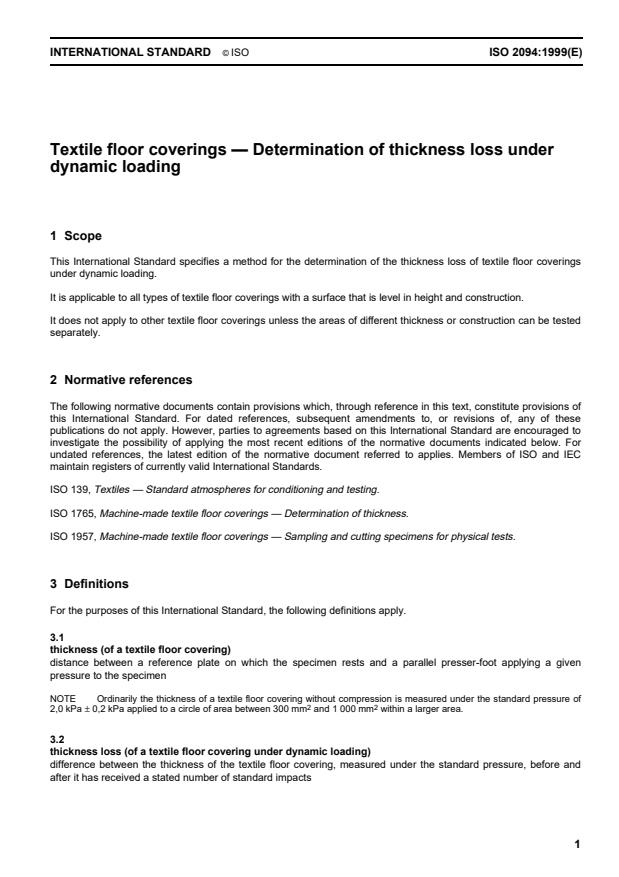
1 Scope
This International Standard specifies a method for the determination of the thickness loss of textile floor coverings
under dynamic loading.
It is applicable to all types of textile floor coverings with a surface that is level in height and construction.
It does not apply to other textile floor coverings unless the areas of different thickness or construction can be tested
separately.
2 Normative references
The following normative documents contain provisions which, through reference in this text, constitute provisions of
this International Standard. For dated references, subsequent amendments to, or revisions of, any of these
publications do not apply. However, parties to agreements based on this International Standard are encouraged to
investigate the possibility of applying the most recent editions of the normative documents indicated below. For
undated references, the latest edition of the normative document referred to applies. Members of ISO and IEC
maintain registers of currently valid International Standards.
ISO 139, Textiles — Standard atmospheres for conditioning and testing.
ISO 1765, Machine-made textile floor coverings — Determination of thickness.
ISO 1957, Machine-made textile floor coverings — Sampling and cutting specimens for physical tests.
3 Definitions
For the purposes of this International Standard, the following definitions apply.
3.1
thickness (of a textile floor covering)
distance between a reference plate on which the specimen rests and a parallel presser-foot applying a given
pressure to the specimen
NOTE Ordinarily the thickness of a textile floor covering without compression is measured under the standard pressure of
2 2
2,0 kPa – 0,2 kPa applied to a circle of area between 300 mm and 1 000 mm within a larger area.
3.2
thickness loss (of a textile floor covering under dynamic loading)
difference between the thickness of the textile floor covering, measured under the standard pressure, before and
after it has received a stated number of standard impacts
© ISO
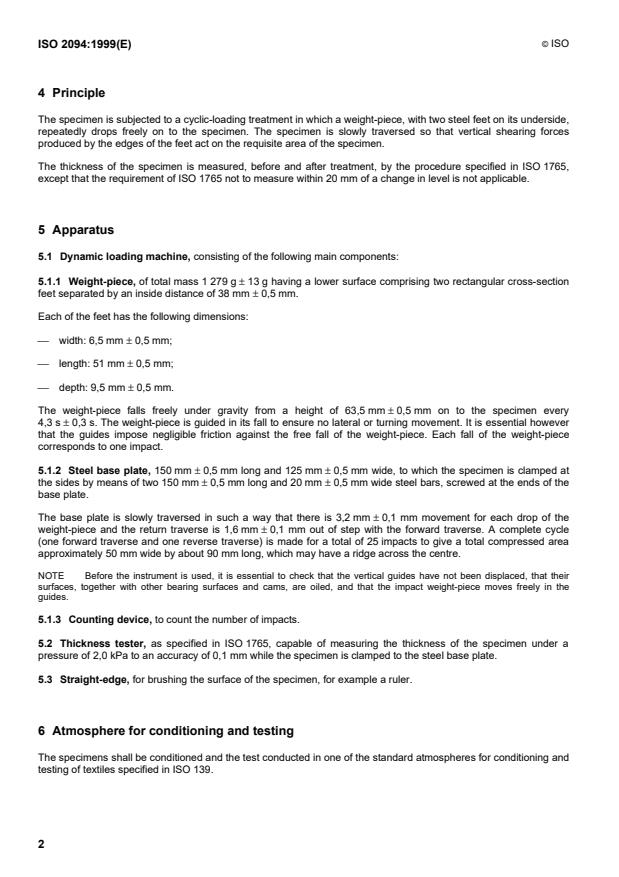
4 Principle
The specimen is subjected to a cyclic-loading treatment in which a weight-piece, with two steel feet on its underside,
repeatedly drops freely on to the specimen. The specimen is slowly traversed so that vertical shearing forces
produced by the edges of the feet act on the requisite area of the specimen.
The thickness of the specimen is measured, before and after treatment, by the procedure specified in ISO 1765,
except that the requirement of ISO 1765 not to measure within 20 mm of a change in level is not applicable.
5 Apparatus
5.1 Dynamic loading machine, consisting of the following main components:
5.1.1 Weight-piece, of total mass 1 279 g – 13 g having a lower surface comprising two rectangular cross-section
feet separated by an inside distance of 38 mm – 0,5 mm.
Each of the feet has the following dimensions:
width: 6,5 mm – 0,5 mm;
length: 51 mm – 0,5 mm;
depth: 9,5 mm – 0,5 mm.
The weight-piece falls freely under gravity from a height of 63,5 mm – 0,5 mm on to the specimen every
4,3 s – 0,3 s. The weight-piece is guided in its fall to ensure no lateral or turning movement. It is essential however
that the guides impose negligible friction against the free fall of the we
...
NORME ISO
INTERNATIONALE 2094
Troisième édition
1999-03-15
Revêtements de sol textiles —
Détermination de la perte d'épaisseur
sous charge dynamique
Textile floor coverings — Determination of thickness loss under dynamic
loading
A
Numéro de référence
Avant-propos
L'ISO (Organisation internationale de normalisation) est une fédération mondiale d'organismes nationaux de
normalisation (comités membres de l'ISO). L'élaboration des Normes internationales est en général confiée aux
comités techniques de l'ISO. Chaque comité membre intéressé par une étude a le droit de faire partie du comité
technique créé à cet effet. Les organisations internationales, gouvernementales et non gouvernementales, en
liaison avec l'ISO participent également aux travaux. L'ISO collabore étroitement avec la Commission
électrotechnique internationale (CEI) en ce qui concerne la normalisation électrotechnique.
Les Normes internationales sont rédigées conformément aux règles données dans les Directives ISO/CEI, Partie 3.
Les projets de Normes internationales adoptés par les comités techniques sont soumis aux comités membres pour
vote. Leur publication comme Normes internationales requiert l'approbation de 75 % au moins des comités
membres votants.
La Norme internationale ISO 2094 a été élaborée par le comité technique ISO/TC 38, Textiles, sous-comité SC 12,
Revêtements de sol textiles.
Cette troisième édition annule et remplace la deuxième édition (ISO 2094:1986), dont l’article 5 a fait l’objet d’une
révision technique.
© ISO 1999
Droits de reproduction réservés. Sauf prescription différente, aucune partie de cette publication ne peut être reproduite ni utilisée sous quelque
forme que ce soit et par aucun procédé, électronique ou mécanique, y compris la photocopie et les microfilms, sans l'accord écrit de l'éditeur.
Organisation internationale de normalisation
Case postale 56 • CH-1211 Genève 20 • Suisse
Internet iso@iso.ch
Imprimé en Suisse
ii
NORME INTERNATIONALE © ISO ISO 2094:1999(F)
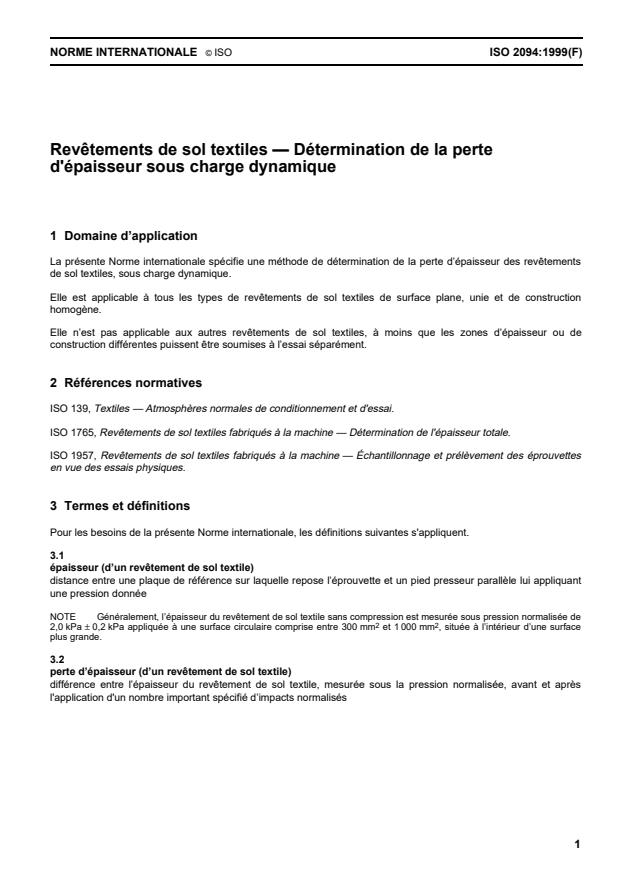
Revêtements de sol textiles — Détermination de la perte
d'épaisseur sous charge dynamique
1 Domaine d’application
La présente Norme internationale spécifie une méthode de détermination de la perte d’épaisseur des revêtements
de sol textiles, sous charge dynamique.
Elle est applicable à tous les types de revêtements de sol textiles de surface plane, unie et de construction
homogène.
Elle n’est pas applicable aux autres revêtements de sol textiles, à moins que les zones d’épaisseur ou de
construction différentes puissent être soumises à l’essai séparément.
2 Références normatives
ISO 139, Textiles — Atmosphères normales de conditionnement et d'essai.
ISO 1765, Revêtements de sol textiles fabriqués à la machine — Détermination de l'épaisseur totale.
ISO 1957, Revêtements de sol textiles fabriqués à la machine — Échantillonnage et prélèvement des éprouvettes
en vue des essais physiques.
3 Termes et définitions
Pour les besoins de la présente Norme internationale, les définitions suivantes s'appliquent.
3.1
épaisseur (d’un revêtement de sol textile)
distance entre une plaque de référence sur laquelle repose l’éprouvette et un pied presseur parallèle lui appliquant
une pression donnée
NOTE Généralement, l’épaisseur du revêtement de sol textile sans compression est mesurée sous pression normalisée de
2 2
2,0 kPa – 0,2 kPa appliquée à une surface circulaire comprise entre 300 mm et 1000 mm , située à l’intérieur d’une surface
plus grande.
3.2
perte d’épaisseur (d’un revêtement de sol textile)
différence entre l’épaisseur du revêtement de sol textile, mesurée sous la pression normalisée, avant et après
l'application d'un nombre important spécifié d’impacts normalisés
© ISO
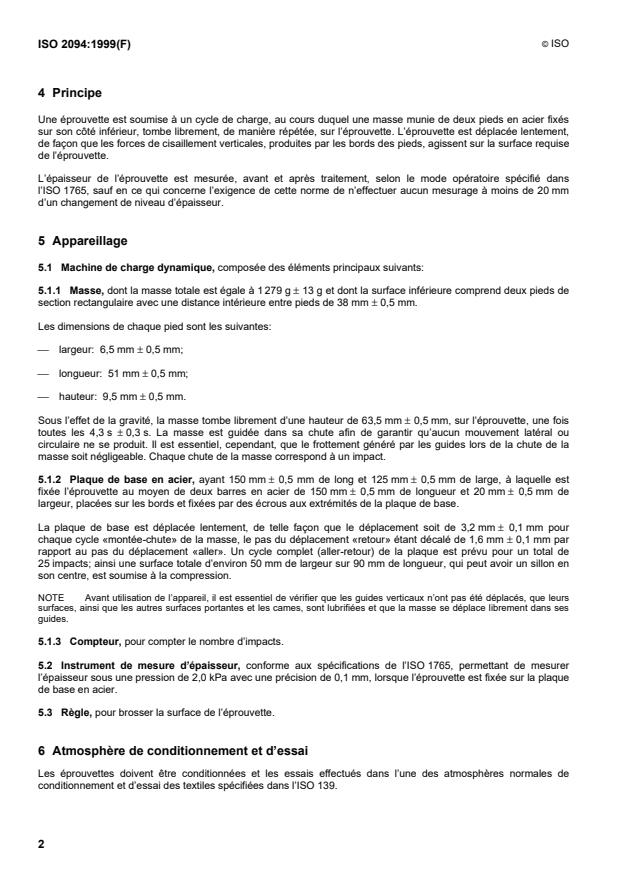
4 Principe
Une éprouvette est soumise à un cycle de charge, au cours duquel une masse munie de deux pieds en acier fixés
sur son côté inférieur, tombe librement, de manière répétée, sur l’éprouvette. L’éprouvette est déplacée lentement,
de façon que les forces de cisaillement verticales, produites par les bords des pieds, agissent sur la surface requise
de l’éprouvette.
L’épaisseur de l’éprouvette est mesurée, avant et après traitement, selon le mode opératoire spécifié dans
l’ISO 1765, sauf en ce qui concerne l’exigence de cette norme de n’effectuer aucun mesurage à moins de 20 mm
d’un changement de niveau d’épaisseur.
5 Appareillage
composée des éléments principaux suivants:
5.1 Machine de charge dynamique,
5.1.1 Masse, dont la masse totale est égale à 1 279 g ± 13 g et dont la surface inférieure comprend deux pieds de
section rectangulaire avec une distance intérieure entre pieds de 38 mm ± 0,5 mm.
Les dimensions de chaque pied sont les suivantes:
largeur: 6,5 mm ± 0,5 mm;
longueur: 51 mm ± 0,5 mm;
hauteur: 9,5 mm ± 0,5 mm.
Sous l’effet de la gravité, la masse tombe librement d’une hauteur de 63,5 mm ± 0,5 mm, sur l’éprouvette, une fois
toutes les 4,3 s ± 0,3 s. La masse est guidée dans sa chute afin de garantir qu’aucun mouvement latéral ou
circulaire ne se produit. Il est essentiel, cependant, que le frottement généré par les guides lors de la chute de la
masse soit négligeable. Chaque chute de la masse correspond à un impact.
ayant 150 mm 0,5 mm de long et 125 mm 0,5 mm de large, à laquelle est
5.1.2 Plaque de base en acier, ± ±
fixée l’éprouvette au moyen de deux barres en acier de 150 mm ± 0,5 mm de longueur et 20 mm ± 0,5 mm de
largeur, placées sur les bords et fixées par des écrous aux extrém
...
Questions, Comments and Discussion
Ask us and Technical Secretary will try to provide an answer. You can facilitate discussion about the standard in here.
Loading comments...