


ISO/IEC 7816-6:2023/FDAmd 1
(Amendment)Identification cards — Integrated circuit cards — Part 6: Interindustry data elements for interchange — Amendment 1: Data elements for quantum safe cryptography
Identification cards — Integrated circuit cards — Part 6: Interindustry data elements for interchange — Amendment 1: Data elements for quantum safe cryptography
Cartes d'identification — Cartes à circuit intégré — Partie 6: Éléments de données intersectoriels pour les échanges — Amendement 1: Éléments de données pour la cryptographie quantique sécurisée
General Information
- Status
- Not Published
- Technical Committee
- ISO/IEC JTC 1/SC 17 - Cards and security devices for personal identification
- Current Stage
- 5020 - FDIS ballot initiated: 2 months. Proof sent to secretariat
- Start Date
- 12-Dec-2025
- Completion Date
- 12-Dec-2025
Relations
- Effective Date
- 28-Oct-2023
Overview
ISO/IEC 7816-6:2023/FDAmd 1 is the latest amendment to the well-established international standard ISO/IEC 7816-6, which specifies interindustry data elements for interchange related to identification cards with integrated circuits. This amendment introduces data elements for quantum safe cryptography (QSC), addressing the evolving security needs in the era of quantum computing. Published by ISO and IEC under the Joint Technical Committee ISO/IEC JTC 1/SC 17, it ensures inclusive global standardization for smart card technology that is future-proof against quantum threats.
This updated specification formally incorporates cryptographic data elements designed to withstand both classical and quantum computer-based attacks, enabling secure interchange of integrated circuit cards in various industries.
Key Topics
Quantum Safe Cryptography (QSC):
Defined as cryptographic systems that resist attacks from both quantum and classical computers, QSC represents the next generation of secure cryptographic algorithms essential for protecting sensitive data in integrated circuit cards.New Data Elements for QSC:
The amendment introduces five new template tags for encoding QSC-related data elements, including:- QSC public or private key templates and their related key components
- Templates for common cryptographic parameters governing QSC algorithms
- Configurations for QSC hybrid signatures
- Parameterized templates for key encapsulation mechanisms (KEM) used in QSC
BER-TLV Extensions:
The amendment adds support for the QSC templates within the existing Basic Encoding Rules - Tag Length Value (BER-TLV) framework, enhancing compatibility and interoperability with current smart card data interchange formats.Cross-References to ISO/IEC 7816-8:
The data elements introduced rely on definitions from ISO/IEC 7816-8 for QSC key and parameter structures, ensuring consistency across parts of the ISO/IEC 7816 series related to cryptographic mechanisms.
Applications
Smart Cards for Personal Identification:
Governments, financial institutions, and healthcare providers can implement quantum safe cryptographic data elements in integrated circuit cards to protect personal identity data against emerging quantum attacks.Secure Payment Systems:
Banking and payment card industries can adopt these data elements to future-proof their cryptographic operations embedded in credit and debit cards, enhancing transaction security.Access Control and Authentication:
Organizations deploying integrated circuit cards for secure access and multi-factor authentication can leverage QSC data elements to safeguard credentials from quantum-enabled cyber threats.Interindustry Interoperability:
This amendment standardizes the representation of quantum safe cryptographic data elements to ensure seamless interoperability across industries using integrated circuit cards for secure data interchange.
Related Standards
ISO/IEC 7816 Series:
This amendment is part of the extensive ISO/IEC 7816 standard series governing integrated circuit cards, particularly related to data elements (Part 6) and cryptographic mechanisms (Part 8).ISO/IEC 7816-8:2021 (Amendment 1:2023):
Provides definitions for QSC keys, parameter templates, and cryptographic algorithm configurations referenced in this amendment.ISO/IEC Directives, Part 1 and Part 2:
Detail the editorial and procedural rules followed in preparing and maintaining this standard.ISO Patent Policy:
Users should be aware of potential patent claims related to quantum safe cryptographic implementations as indicated by ISO and IEC.
By integrating quantum safe cryptography data elements into the universally adopted ISO/IEC 7816-6 standard, this amendment equips the smart card ecosystem with robust defenses against future cryptographic threats–ensuring trust, security, and compliance for identification and secure transaction technologies worldwide.

ISO/IEC 7816-6:2023/FDAmd 1 - Identification cards — Integrated circuit cards — Part 6: Interindustry data elements for interchange — Amendment 1: Data elements for quantum safe cryptography Released:11/28/2025

REDLINE ISO/IEC 7816-6:2023/FDAmd 1 - Identification cards — Integrated circuit cards — Part 6: Interindustry data elements for interchange — Amendment 1: Data elements for quantum safe cryptography Released:11/28/2025
Frequently Asked Questions
ISO/IEC 7816-6:2023/FDAmd 1 is a draft published by the International Organization for Standardization (ISO). Its full title is "Identification cards — Integrated circuit cards — Part 6: Interindustry data elements for interchange — Amendment 1: Data elements for quantum safe cryptography". This standard covers: Identification cards — Integrated circuit cards — Part 6: Interindustry data elements for interchange — Amendment 1: Data elements for quantum safe cryptography
Identification cards — Integrated circuit cards — Part 6: Interindustry data elements for interchange — Amendment 1: Data elements for quantum safe cryptography
ISO/IEC 7816-6:2023/FDAmd 1 is classified under the following ICS (International Classification for Standards) categories: 35.240.15 - Identification cards. Chip cards. Biometrics. The ICS classification helps identify the subject area and facilitates finding related standards.
ISO/IEC 7816-6:2023/FDAmd 1 has the following relationships with other standards: It is inter standard links to ISO/IEC 7816-6:2023. Understanding these relationships helps ensure you are using the most current and applicable version of the standard.
ISO/IEC 7816-6:2023/FDAmd 1 is available in PDF format for immediate download after purchase. The document can be added to your cart and obtained through the secure checkout process. Digital delivery ensures instant access to the complete standard document.
Standards Content (Sample)
FINAL DRAFT
Amendment
ISO/IEC
7816-6:2023/
FDAM 1
ISO/IEC JTC 1/SC 17
Identification cards — Integrated
Secretariat: BSI
circuit cards —
Voting begins on:
2025-12-12
Part 6:
Interindustry data elements for
Voting terminates on:
2026-02-06
interchange
AMENDMENT 1: Data elements for
quantum safe cryptography
RECIPIENTS OF THIS DRAFT ARE INVITED TO SUBMIT,
WITH THEIR COMMENTS, NOTIFICATION OF ANY
RELEVANT PATENT RIGHTS OF WHICH THEY ARE AWARE
AND TO PROVIDE SUPPOR TING DOCUMENTATION.
IN ADDITION TO THEIR EVALUATION AS
BEING ACCEPTABLE FOR INDUSTRIAL, TECHNO
LOGICAL, COMMERCIAL AND USER PURPOSES, DRAFT
INTERNATIONAL STANDARDS MAY ON OCCASION HAVE
TO BE CONSIDERED IN THE LIGHT OF THEIR POTENTIAL
TO BECOME STAN DARDS TO WHICH REFERENCE MAY BE
MADE IN NATIONAL REGULATIONS.
Reference number
ISO/IEC 78166:2023/FDAM 1:2025(en) © ISO/IEC 2025
FINAL DRAFT
ISO/IEC 7816-6:2023/FDAM 1:2025(en)
Amendment
ISO/IEC
7816-6:2023/
FDAM 1
ISO/IEC JTC 1/SC 17
Identification cards — Integrated
Secretariat: BSI
circuit cards —
Voting begins on:
Part 6:
Interindustry data elements for
Voting terminates on:
interchange
AMENDMENT 1: Data elements for
quantum safe cryptography
RECIPIENTS OF THIS DRAFT ARE INVITED TO SUBMIT,
WITH THEIR COMMENTS, NOTIFICATION OF ANY
RELEVANT PATENT RIGHTS OF WHICH THEY ARE AWARE
AND TO PROVIDE SUPPOR TING DOCUMENTATION.
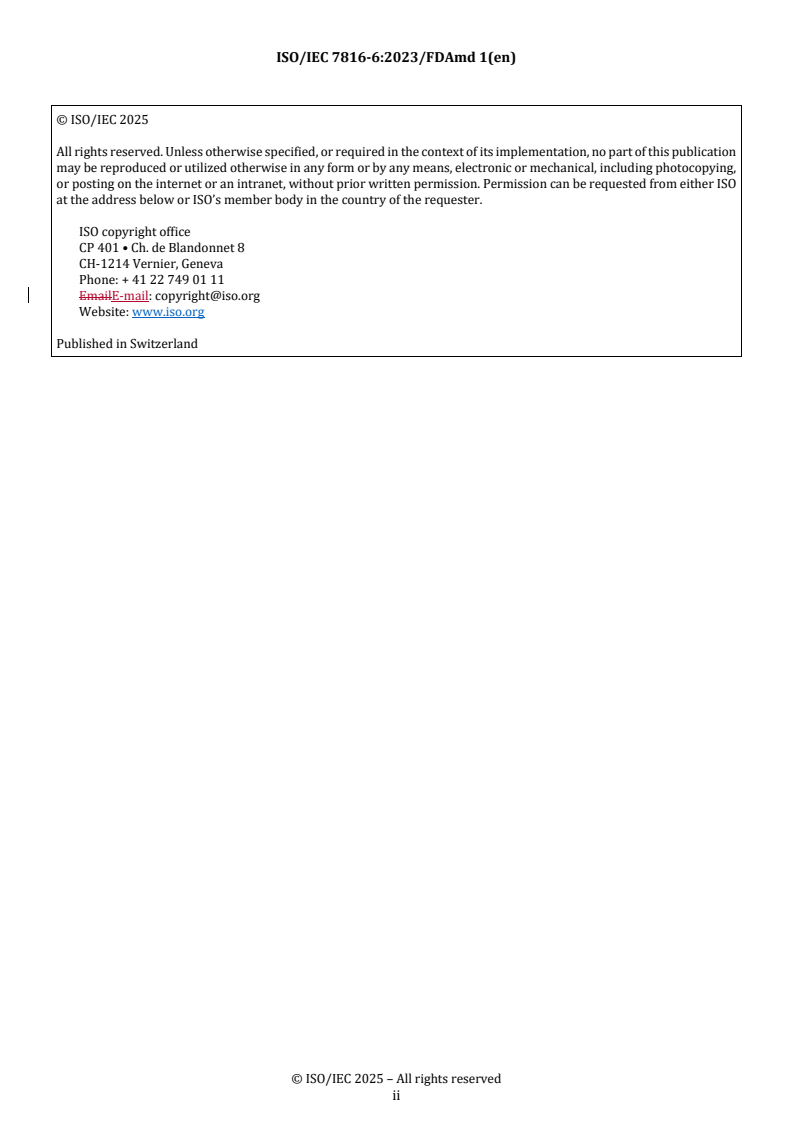
© ISO/IEC 2025
IN ADDITION TO THEIR EVALUATION AS
All rights reserved. Unless otherwise specified, or required in the context of its implementation, no part of this publication may
BEING ACCEPTABLE FOR INDUSTRIAL, TECHNO
LOGICAL, COMMERCIAL AND USER PURPOSES, DRAFT
be reproduced or utilized otherwise in any form or by any means, electronic or mechanical, including photocopying, or posting on
INTERNATIONAL STANDARDS MAY ON OCCASION HAVE
the internet or an intranet, without prior written permission. Permission can be requested from either ISO at the address below
TO BE CONSIDERED IN THE LIGHT OF THEIR POTENTIAL
or ISO’s member body in the country of the requester.
TO BECOME STAN DARDS TO WHICH REFERENCE MAY BE
MADE IN NATIONAL REGULATIONS.
ISO copyright office
CP 401 • Ch. de Blandonnet 8
CH-1214 Vernier, Geneva
Phone: +41 22 749 01 11
Email: copyright@iso.org
Website: www.iso.org
Published in Switzerland Reference number
ISO/IEC 78166:2023/FDAM 1:2025(en) © ISO/IEC 2025
© ISO/IEC 2025 – All rights reserved
ii
ISO/IEC 7816-6:2023/FDAM 1:2025(en)
Foreword
ISO (the International Organization for Standardization) and IEC (the International Electrotechnical
Commission) form the specialized system for worldwide standardization. National bodies that are
members of ISO or IEC participate in the development of International Standards through technical
committees established by the respective organization to deal with particular fields of technical activity.
ISO and IEC technical committees collaborate in fields of mutual interest. Other international organizations,
governmental and non-governmental, in liaison with ISO and IEC, also take part in the work.
The procedures used to develop this document and those intended for its further maintenance are described
in the ISO/IEC Directives, Part 1. In particular, the different approval criteria needed for the different types
of document should be noted. This document was drafted in accordance with the editorial rules of the ISO/
IEC Directives, Part 2 (see www.iso.org/directives or www.iec.ch/members_experts/refdocs).
ISO and IEC draw attention to the possibility that the implementation of this document may involve the
use of (a) patent(s). ISO and IEC take no position concerning the evidence, validity or applicability of any
claimed patent rights in respect thereof. As of the date of publication of this document, ISO and IEC had not
received notice of (a) patent(s) which may be required to implement this document. However, implementers
are cautioned that this may not represent the latest information, which may be obtained from the patent
database available at www.iso.org/patents and https://patents.iec.ch. ISO and IEC shall not be he
...
ISO/IEC 7816-6:2023/DAMFDAmd 1:2025(en)
ISO/IEC JTC 1/SC 17
Secretariat: BSI
Fourth edition
Date: 2025-1011-28
Identification cards — Integrated circuit cards —
Part 6:
Interindustry data elements for interchange
AMENDEMENT AMENDMENT 1: Data elements for quantum safe
cryptography
FDIS stage
© ISO/IEC 2025
All rights reserved. Unless otherwise specified, or required in the context of its implementation, no part of this publication
may be reproduced or utilized otherwise in any form or by any means, electronic or mechanical, including photocopying,
or posting on the internet or an intranet, without prior written permission. Permission can be requested from either ISO
at the address below or ISO’s member body in the country of the requester.
ISO copyright office
CP 401 • Ch. de Blandonnet 8
CH-1214 Vernier, Geneva
Phone: + 41 22 749 01 11
EmailE-mail: copyright@iso.org
Website: www.iso.org
Published in Switzerland
© ISO/IEC 2025 – All rights reserved
ii
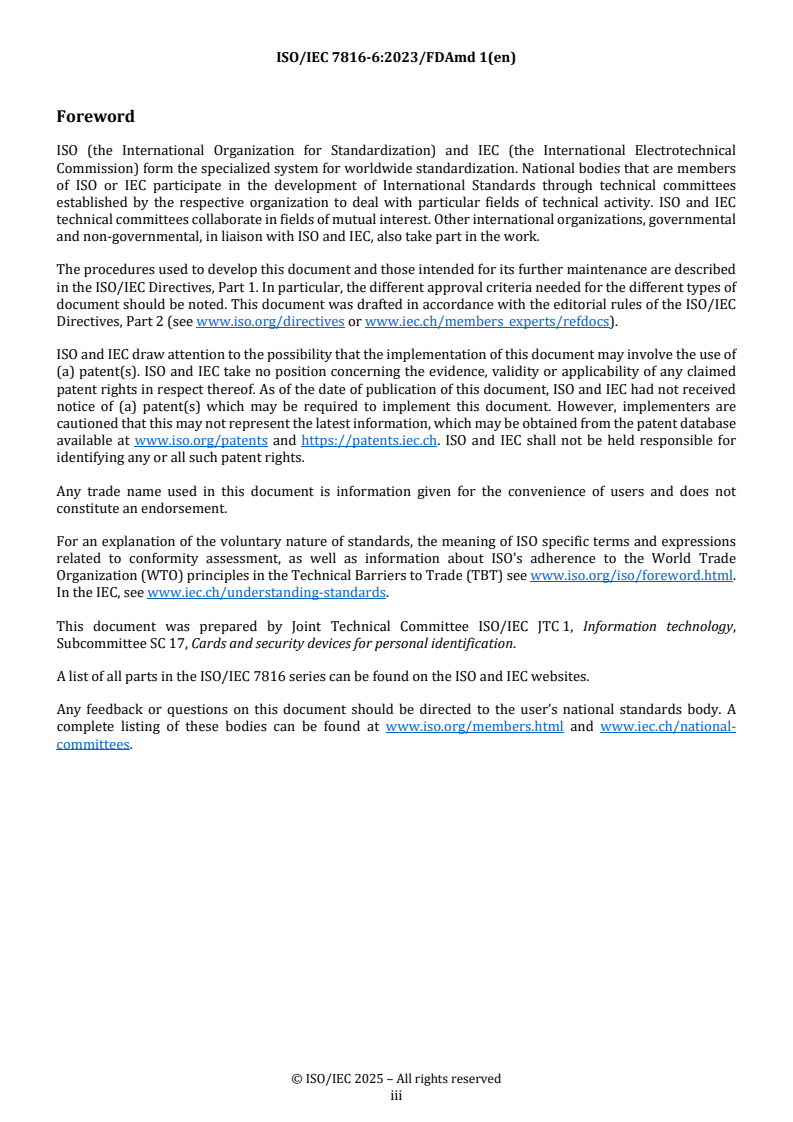
Foreword
ISO (the International Organization for Standardization) and IEC (the International Electrotechnical
Commission) form the specialized system for worldwide standardization. National bodies that are members
of ISO or IEC participate in the development of International Standards through technical committees
established by the respective organization to deal with particular fields of technical activity. ISO and IEC
technical committees collaborate in fields of mutual interest. Other international organizations, governmental
and non-governmental, in liaison with ISO and IEC, also take part in the work.
The procedures used to develop this document and those intended for its further maintenance are described
in the ISO/IEC Directives, Part 1. In particular, the different approval criteria needed for the different types of
document should be noted. This document was drafted in accordance with the editorial rules of the ISO/IEC
Directives, Part 2 (see www.iso.org/directives or www.iec.ch/members_experts/refdocs).
ISO and IEC draw attention to the possibility that the implementation of this document may involve the use of
(a) patent(s). ISO and IEC take no position concerning the evidence, validity or applicability of any claimed
patent rights in respect thereof. As of the date of publication of this document, ISO and IEC had not received
notice of (a) patent(s) which may be required to implement this document. However, implementers are
cautioned that this may not represent the latest information, which may be obtained from the patent database
available at www.iso.org/patents and https://patents.iec.ch. ISO and IEC shall not be held responsible for
identifying any or all such patent rights.
Any trade name used in this document is information given for the convenience of users and does not
constitute an endorsement.
For an explanation of the voluntary nature of standards, the meaning of ISO specific terms and expressions
related to conformity assessment, as well as information about ISO's adherence to the World Trade
Organization (WTO) principles in the Technical Barriers to Trade (TBT) see www.iso.org/iso/foreword.html.
In the IEC, see www.iec.ch/understanding-standards.
This document was prepared by Joint Technical Committee ISO/IEC JTC 1, Information technology,
Subcommittee SC 17,
...
Questions, Comments and Discussion
Ask us and Technical Secretary will try to provide an answer. You can facilitate discussion about the standard in here.
Loading comments...