

ISO/IEC 15693-2:2019
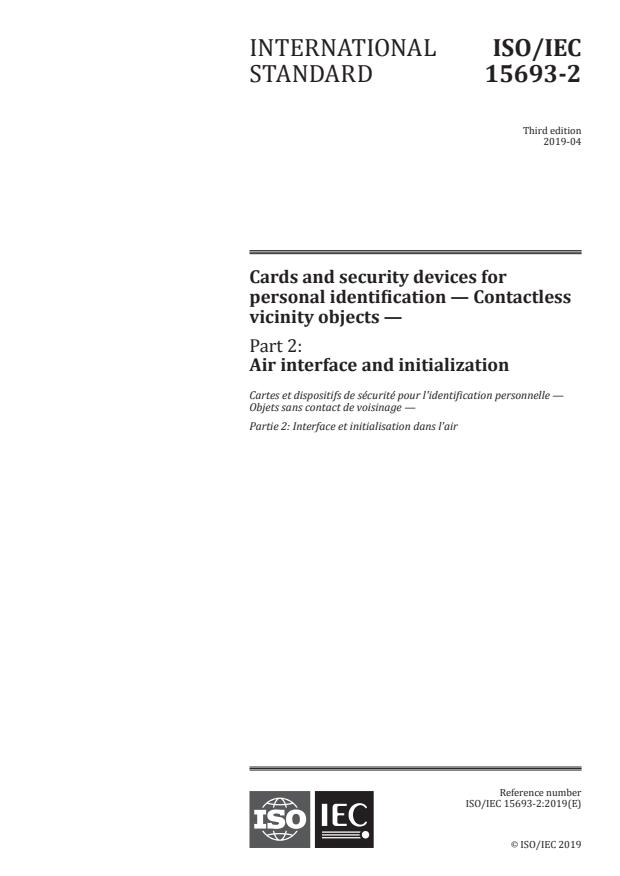
(Main)Cards and security devices for personal identification — Contactless vicinity objects — Part 2: Air interface and initialization
General Information
- Abstract
This document specifies the nature and characteristics of the fields to be provided for power and bi-directional communications between vicinity coupling devices (VCDs) and vicinity cards (VICCs). This document is intended to be used in conjunction with other parts of the ISO/IEC 15693 series. This document does not preclude the incorporation of other standard technologies on the card as described in Annex A.
- Status
- Published
- Publication Date
- 22-Apr-2019
- Technical Committee
- ISO/IEC JTC 1/SC 17 - Cards and security devices for personal identification
- Drafting Committee
- ISO/IEC JTC 1/SC 17/WG 8 - Integrated circuit cards without contacts
- Current Stage
- 9093 - International Standard confirmed
- Start Date
- 22-Oct-2024
- Completion Date
- 29-Aug-2026
Buy Documents

ISO/IEC 15693-2:2019 - Cards and security devices for personal identification -- Contactless vicinity objects

ISO/IEC 15693-2:2019 - Cards and security devices for personal identification — Contactless vicinity objects — Part 2: Air interface and initialization/23/2019
Overview
ISO/IEC 15693-2:2019 - part of the ISO/IEC 15693 series - defines the air interface and initialization for contactless vicinity objects (vicinity cards). It specifies the electrical and signalling characteristics used for power transfer and two‑way communications between a vicinity coupling device (VCD) and a vicinity integrated circuit card (VICC). The standard is intended to be used together with other parts of ISO/IEC 15693 (physical characteristics, anticollision and protocol, test methods) and does not preclude integrating other compatible technologies on the card.
Keywords: ISO/IEC 15693-2:2019, contactless vicinity objects, air interface, vicinity cards, 13.56 MHz, VCD, VICC, RFID standard.
Key Topics and Requirements
- Power transfer: RF power coupling via antenna; operating carrier frequency is 13.56 MHz ± 7 kHz. The VICC must operate between specified minimum and maximum magnetic field strengths (e.g., minimum ~150 mA/m rms and maximum ~5 A/m rms) and the VCD must respect manufacturer operating volumes and limits.
- Initialization and dialogue: Defined sequence for activation and exchange - RF activation, silent waiting, VCD command transmission, VICC response - with protocol behavior governed by ISO/IEC 15693-3.
- Modulation and signalling (VCD → VICC): Uses ASK (Amplitude Shift Keying) with two modulation indexes (10% and 100%). Timing parameters for frame pauses, start/end of frame (SOF/EOF), and modulation depth are specified.
- Data coding and frames: Multiple data coding modes (e.g., 1‑out‑of‑256, 1‑out‑of‑4) and frame formats are defined to meet regulatory and application requirements.
- VICC → VCD communications: Load modulation and subcarrier schemes, multiple data rates including low/high and newly added fast response data rates, bit encoding for single/two subcarrier modes, and frame delimiters.
- Compatibility: Annex A covers standards compatibility; normative references include ISO/IEC 15693-1, 15693-3, and ISO/IEC 10373-7 test methods.
Applications and Who Uses It
ISO/IEC 15693-2:2019 is used by:
- Card and secure device manufacturers designing vicinity (longer-range) contactless smart cards and tokens.
- RFID system integrators and access-control solution providers needing standardized air-interface behavior.
- Payment, ID and credentialing system architects where interoperability and regulatory compliance at 13.56 MHz are required.
- Test laboratories and compliance engineers implementing ISO/IEC 10373-7 test methods.
- RF engineers and firmware developers implementing modulation, bit coding, and initialization sequences.
Practical uses include library cards, asset tracking tags, ID badges, campus and transit credentials, and other applications that benefit from vicinity-range contactless identification.
Related Standards
- ISO/IEC 15693-1 - Physical characteristics (cards)
- ISO/IEC 15693-3 - Anticollision and transmission protocol
- ISO/IEC 10373-7 - Test methods for contactless vicinity objects
- (Context) ISO/IEC 14443, ISO/IEC 10536 - related contactless card families (proximity/close-coupled)
For implementers, ISO/IEC 15693-2:2019 provides the detailed electrical and signalling rules necessary to achieve interoperable, compliant vicinity RFID and contactless card systems.
Relations
- Effective Date
- 25-Aug-2026
- Effective Date
- 17-Jun-2026
- Effective Date
- 03-Jun-2026
- Effective Date
- 10-Feb-2026
- Referred By
EN IEC 63365:2022 - Industrial process measurement, control and automation - Digital nameplate - Effective Date
- 10-Feb-2026
- Effective Date
- 22-Apr-2017
Buy Documents
ISO/IEC 15693-2:2019 - Cards and security devices for personal identification -- Contactless vicinity objects
ISO/IEC 15693-2:2019 - Cards and security devices for personal identification — Contactless vicinity objects — Part 2: Air interface and initialization/23/2019
Get Certified
Connect with accredited certification bodies for this standard

BSI Group
BSI (British Standards Institution) is the business standards company that helps organizations make excellence a habit.

NYCE
Mexican standards and certification body.
Sponsored listings
Frequently Asked Questions
ISO/IEC 15693-2:2019 is a standard published by the International Organization for Standardization (ISO). Its full title is "Cards and security devices for personal identification — Contactless vicinity objects — Part 2: Air interface and initialization". This standard covers: This document specifies the nature and characteristics of the fields to be provided for power and bi-directional communications between vicinity coupling devices (VCDs) and vicinity cards (VICCs). This document is intended to be used in conjunction with other parts of the ISO/IEC 15693 series. This document does not preclude the incorporation of other standard technologies on the card as described in Annex A.
This document specifies the nature and characteristics of the fields to be provided for power and bi-directional communications between vicinity coupling devices (VCDs) and vicinity cards (VICCs). This document is intended to be used in conjunction with other parts of the ISO/IEC 15693 series. This document does not preclude the incorporation of other standard technologies on the card as described in Annex A.
ISO/IEC 15693-2:2019 is classified under the following ICS (International Classification for Standards) categories: 35.240.15 - Identification cards. Chip cards. Biometrics. The ICS classification helps identify the subject area and facilitates finding related standards.
ISO/IEC 15693-2:2019 has the following relationships with other standards: It is inter standard links to CEN ISO/TS 21719-3:2021, EN 18220:2026, CEN/TS 16794-2:2019, EN IEC 61406-1:2022, EN IEC 63365:2022, ISO/IEC 15693-2:2006. Understanding these relationships helps ensure you are using the most current and applicable version of the standard.
ISO/IEC 15693-2:2019 is available in PDF format for immediate download after purchase. The document can be added to your cart and obtained through the secure checkout process. Digital delivery ensures instant access to the complete standard document.
Standards Content (Sample)
INTERNATIONAL ISO/IEC
STANDARD 15693-2
Third edition
2019-04
Cards and security devices for
personal identification — Contactless
vicinity objects —
Part 2:
Air interface and initialization
Cartes et dispositifs de sécurité pour l'identification personnelle —
Objets sans contact de voisinage —
Partie 2: Interface et initialisation dans l'air
Reference number
©
ISO/IEC 2019
© ISO/IEC 2019
All rights reserved. Unless otherwise specified, or required in the context of its implementation, no part of this publication may
be reproduced or utilized otherwise in any form or by any means, electronic or mechanical, including photocopying, or posting
on the internet or an intranet, without prior written permission. Permission can be requested from either ISO at the address
below or ISO’s member body in the country of the requester.
ISO copyright office
CP 401 • Ch. de Blandonnet 8
CH-1214 Vernier, Geneva
Phone: +41 22 749 01 11
Fax: +41 22 749 09 47
Email: copyright@iso.org
Website: www.iso.org
Published in Switzerland
ii © ISO/IEC 2019 – All rights reserved
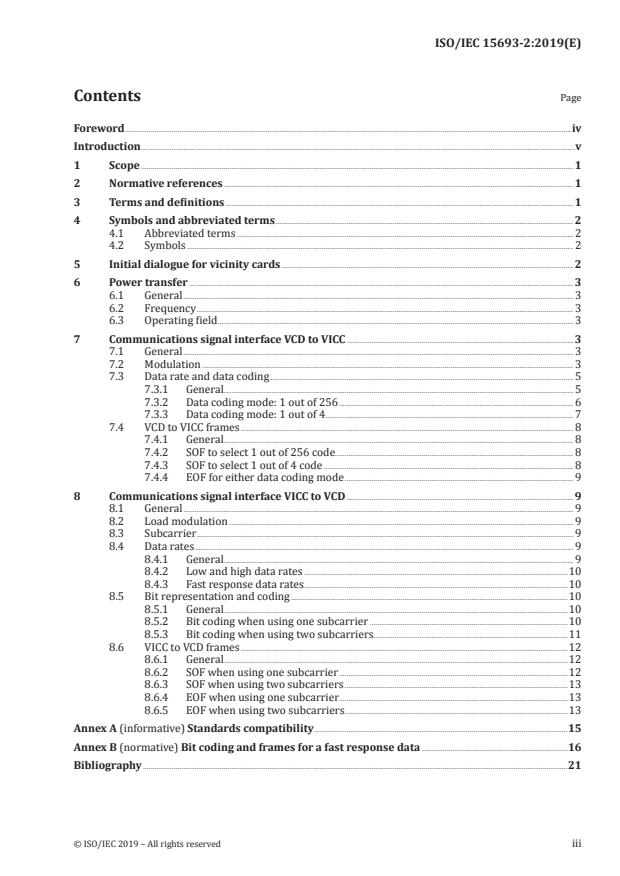
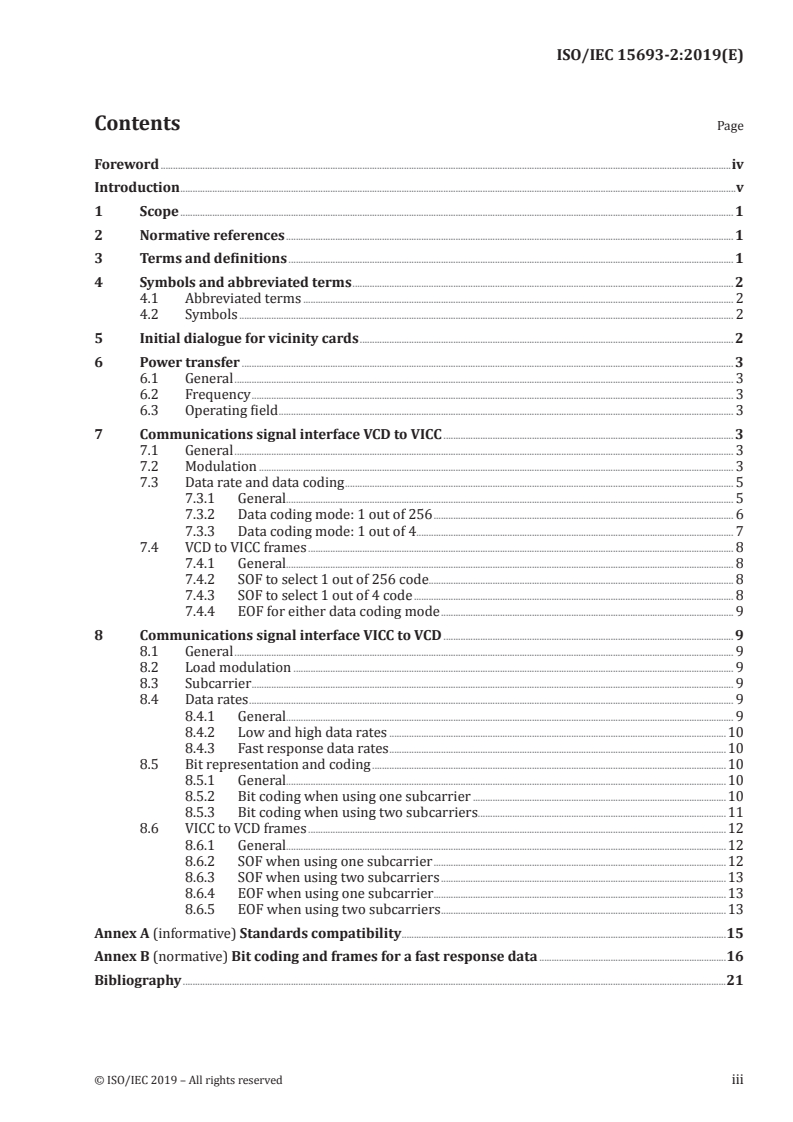
Contents Page
Foreword .iv
Introduction .v
1 Scope . 1
2 Normative references . 1
3 Terms and definitions . 1
4 Symbols and abbreviated terms . 2
4.1 Abbreviated terms . 2
4.2 Symbols . 2
5 Initial dialogue for vicinity cards . 2
6 Power transfer . 3
6.1 General . 3
6.2 Frequency . 3
6.3 Operating field . 3
7 Communications signal interface VCD to VICC . 3
7.1 General . 3
7.2 Modulation . 3
7.3 Data rate and data coding . 5
7.3.1 General. 5
7.3.2 Data coding mode: 1 out of 256 . 6
7.3.3 Data coding mode: 1 out of 4 . 7
7.4 VCD to VICC frames . 8
7.4.1 General. 8
7.4.2 SOF to select 1 out of 256 code. 8
7.4.3 SOF to select 1 out of 4 code . 8
7.4.4 EOF for either data coding mode . 9
8 Communications signal interface VICC to VCD . 9
8.1 General . 9
8.2 Load modulation . 9
8.3 Subcarrier . 9
8.4 Data rates . 9
8.4.1 General. 9
8.4.2 Low and high data rates .10
8.4.3 Fast response data rates .10
8.5 Bit representation and coding .10
8.5.1 General.10
8.5.2 Bit coding when using one subcarrier .10
8.5.3 Bit coding when using two subcarriers.11
8.6 VICC to VCD frames .12
8.6.1 General.12
8.6.2 SOF when using one subcarrier .12
8.6.3 SOF when using two subcarriers .13
8.6.4 EOF when using one subcarrier . .13
8.6.5 EOF when using two subcarriers .13
Annex A (informative) Standards compatibility .15
Annex B (normative) Bit coding and frames for a fast response data .16
Bibliography .21
© ISO/IEC 2019 – All rights reserved iii
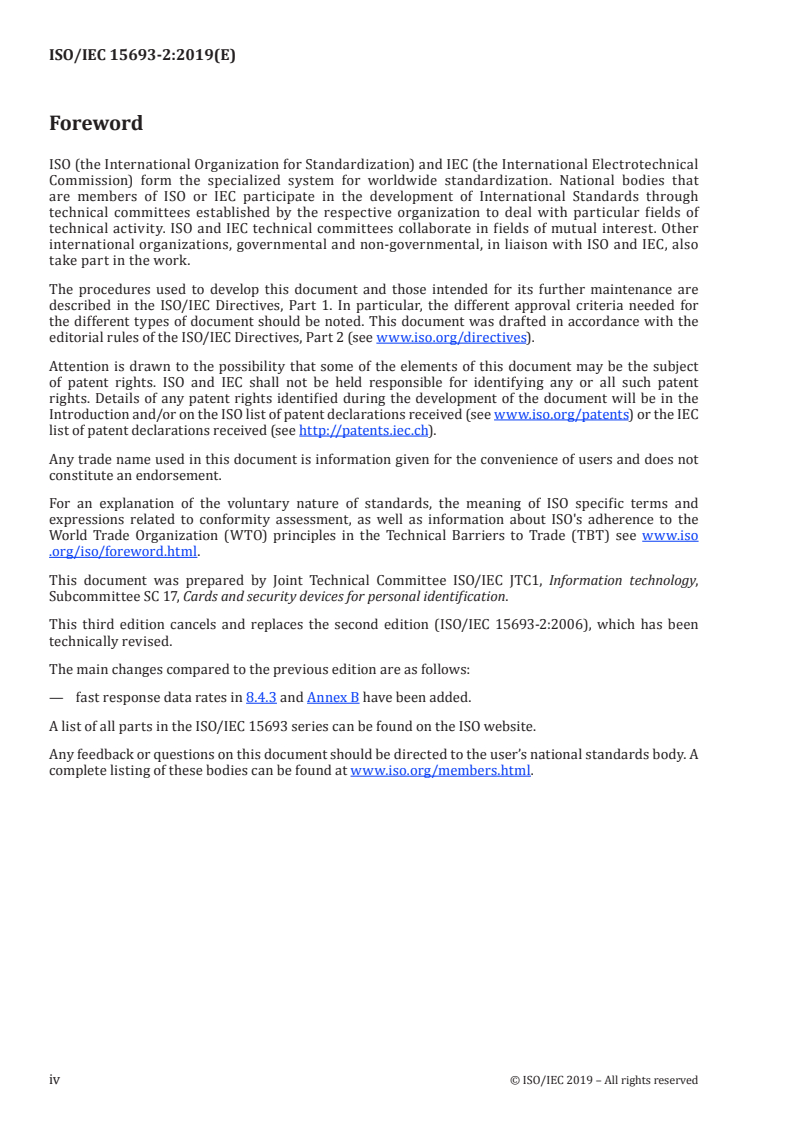
Foreword
ISO (the International Organization for Standardization) and IEC (the International Electrotechnical
Commission) form the specialized system for worldwide standardization. National bodies that
are members of ISO or IEC participate in the development of International Standards through
technical committees established by the respective organization to deal with particular fields of
technical activity. ISO and IEC technical committees collaborate in fields of mutual interest. Other
international organizations, governmental and non-governmental, in liaison with ISO and IEC, also
take part in the work.
The procedures used to develop this document and those intended for its further maintenance are
described in the ISO/IEC Directives, Part 1. In particular, the different approval criteria needed for
the different types of document should be noted. This document was drafted in accordance with the
editorial rules of the ISO/IEC Directives, Part 2 (see www .iso .org/directives).
Attention is drawn to the possibility that some of the elements of this document may be the subject
of patent rights. ISO and IEC shall not be held responsible for identifying any or all such patent
rights. Details of any patent rights identified during the development of the document will be in the
Introduction and/or on the ISO list of patent declarations received (see www .iso .org/patents) or the IEC
list of patent declarations received (see http: //patents .iec .ch).
Any trade name used in this document is information given for the convenience of users and does not
constitute an endorsement.
For an explanation of the voluntary nature of standards, the meaning of ISO specific terms and
expressions related to conformity assessment, as well as information about ISO's adherence to the
World Trade Organization (WTO) principles in the Technical Barriers to Trade (TBT) see www .iso
.org/iso/foreword .html.
This document was prepared by Joint Technical Committee ISO/IEC JTC1, Information technology,
Subcommittee SC 17, Cards and security devices for personal identification.
This third edition cancels and replaces the second edition (ISO/IEC 15693-2:2006), which has been
technically revised.
The main changes compared to the previous edition are as follows:
— fast response data rates in 8.4.3 and Annex B have been added.
A list of all parts in the ISO/IEC 15693 series can be found on the ISO website.
Any feedback or questions on this document should be directed to the user’s national standards body. A
complete listing of these bodies can be found at www .iso .org/members .html.
iv © ISO/IEC 2019 – All rights reserved
Introduction
ISO/IEC 15693 (all parts) is one of a series of International Standards defining the parameters for
identification cards as defined in ISO/IEC 7810 and the use of such cards for international interchange.
This document defines the electrical characteristics of the contactless interface between a vicinity card
and a vicinity coupling device. The interface includes power and bi-directional communications.
Contactless card standards cover a variety of types as embodied in ISO/IEC 10536 (close-coupled cards),
ISO/IEC 14443 (proximity cards) and ISO/IEC 15693 (vicinity cards). These are intended for operation
when very near, nearby and at a longer distance from associated coupling devices, respectively.
© ISO/IEC 2019 – All rights reserved v
INTERNATIONAL STANDARD ISO/IEC 15693-2:2019(E)
Cards and security devices for personal identification —
Contactless vicinity objects —
Part 2:
Air interface and initialization
1 Scope
This document specifies the nature and characteristics of the fields to be provided for power and bi-
directional communications between vicinity coupling devices (VCDs) and vicinity cards (VICCs).
This document is intended to be used in conjunction with other parts of the ISO/IEC 15693 series.
This document does not preclude the incorporation of other standard technologies on the card as
described in Annex A.
2 Normative references
The following documents are referred to in the text in such a way that some or all of their content
constitutes requirements of this document. For dated references, only the edition cited applies. For
undated references, the latest edition of the referenced document (including any amendments) applies.
1)
ISO/IEC 10373-7 , Cards and security devices for personal identification — Test methods — Part 7:
Contactless vicinity objects
ISO/IEC 15693-1, Cards and security devices for personal identification — Contactless vicinity objects —
Part 1: Physical characteristics
ISO/IEC 15693-3, Cards and security devices for personal identification — Contactless vicinity objects —
Part 3: Anticollision and transmission protocol
3 Terms and definitions
For the purposes of this document, the terms and definitions given in ISO/IEC 15693-1 and the
following apply.
ISO and IEC maintain terminological databases for use in standardization at the following addresses:
— ISO Online browsing platform: available at https: //www .iso .org/obp
— IEC Electropedia: available at http: //www .electropedia .org/
3.1
modulation index
index equal to [a-b]/[a+b] where a and b are the peak and minimum signal amplitudes, respectively
Note 1 to entry: The value of the index may be expressed as a percentage.
3.2
subcarrier
signal of frequency f used to modulate the carrier of frequency f
s c
1) Under preparation.
© ISO/IEC 2019 – All rights reserved 1
3.3
byte
string that consists of 8 bits of data designated b1 to b8, from the most significant bit (MSB,b8) to the
least significant bit (LSB,b1)
4 Symbols and abbreviated terms
4.1 Abbreviated terms
ASK amplitude shift keying
EOF end of frame
LSB least significant bit
MSB most significant bit
PPM pulse position modulation
RF radio frequency
SOF start of frame
VCD vicinity coupling device
VICC vicinity integrated circuit card
4.2 Symbols
a carrier amplitude without modulation
b carrier amplitude when modulated
f frequency of the operating field (carrier frequency)
c
f frequency of the subcarrier
s
H maximum operating field
max
H minimum operating field
min
5 Initial dialogue for vicinity cards
The dialogue between the VCD and the VICC (one or more VICCs may be present at the same time) is
conducted through the following consecutive operations:
— activation of the VICC by the RF operating field of the VCD;
— VICC waits silently for a command from the VCD;
— transmission of a command by the VCD;
— transmission of a response by the VICC.
These operations use the RF power transfer and communication signal interface specified in the
following clauses and shall be performed according to the protocol defined in ISO/IEC 15693-3.
2 © ISO/IEC 2019 – All rights reserved
6 Power transfer
6.1 General
Power transfer to the VICC is accomplished by radio frequency via coupling antennas in the VCD and
in the VICC. The RF operating field that supplies power to the VICC from the VCD is modulated for
communication from the VCD to the VICC, as described in Clause 7.
6.2 Frequency
The frequency f of the RF operating field is 13,56 MHz ± 7 kHz.
c
6.3 Operating field
A VICC shall operate as intended continuously between H and H .
min max
The minimum operating field is H and has a value of 150 mA/m rms.
min
The maximum operating field is H and has a value of 5 A/m rms.
max
A VCD shall generate a field of at least H and not exceeding H at the manufacturer’s specified
min max
positions
...
INTERNATIONAL ISO/IEC
STANDARD 15693-2
Third edition
2019-04
Cards and security devices for
personal identification — Contactless
vicinity objects —
Part 2:
Air interface and initialization
Cartes et dispositifs de sécurité pour l'identification personnelle —
Objets sans contact de voisinage —
Partie 2: Interface et initialisation dans l'air
Reference number
©
ISO/IEC 2019
© ISO/IEC 2019
All rights reserved. Unless otherwise specified, or required in the context of its implementation, no part of this publication may
be reproduced or utilized otherwise in any form or by any means, electronic or mechanical, including photocopying, or posting
on the internet or an intranet, without prior written permission. Permission can be requested from either ISO at the address
below or ISO’s member body in the country of the requester.
ISO copyright office
CP 401 • Ch. de Blandonnet 8
CH-1214 Vernier, Geneva
Phone: +41 22 749 01 11
Fax: +41 22 749 09 47
Email: copyright@iso.org
Website: www.iso.org
Published in Switzerland
ii © ISO/IEC 2019 – All rights reserved
Contents Page
Foreword .iv
Introduction .v
1 Scope . 1
2 Normative references . 1
3 Terms and definitions . 1
4 Symbols and abbreviated terms . 2
4.1 Abbreviated terms . 2
4.2 Symbols . 2
5 Initial dialogue for vicinity cards . 2
6 Power transfer . 3
6.1 General . 3
6.2 Frequency . 3
6.3 Operating field . 3
7 Communications signal interface VCD to VICC . 3
7.1 General . 3
7.2 Modulation . 3
7.3 Data rate and data coding . 5
7.3.1 General. 5
7.3.2 Data coding mode: 1 out of 256 . 6
7.3.3 Data coding mode: 1 out of 4 . 7
7.4 VCD to VICC frames . 8
7.4.1 General. 8
7.4.2 SOF to select 1 out of 256 code. 8
7.4.3 SOF to select 1 out of 4 code . 8
7.4.4 EOF for either data coding mode . 9
8 Communications signal interface VICC to VCD . 9
8.1 General . 9
8.2 Load modulation . 9
8.3 Subcarrier . 9
8.4 Data rates . 9
8.4.1 General. 9
8.4.2 Low and high data rates .10
8.4.3 Fast response data rates .10
8.5 Bit representation and coding .10
8.5.1 General.10
8.5.2 Bit coding when using one subcarrier .10
8.5.3 Bit coding when using two subcarriers.11
8.6 VICC to VCD frames .12
8.6.1 General.12
8.6.2 SOF when using one subcarrier .12
8.6.3 SOF when using two subcarriers .13
8.6.4 EOF when using one subcarrier . .13
8.6.5 EOF when using two subcarriers .13
Annex A (informative) Standards compatibility .15
Annex B (normative) Bit coding and frames for a fast response data .16
Bibliography .21
© ISO/IEC 2019 – All rights reserved iii
Foreword
ISO (the International Organization for Standardization) and IEC (the International Electrotechnical
Commission) form the specialized system for worldwide standardization. National bodies that
are members of ISO or IEC participate in the development of International Standards through
technical committees established by the respective organization to deal with particular fields of
technical activity. ISO and IEC technical committees collaborate in fields of mutual interest. Other
international organizations, governmental and non-governmental, in liaison with ISO and IEC, also
take part in the work.
The procedures used to develop this document and those intended for its further maintenance are
described in the ISO/IEC Directives, Part 1. In particular, the different approval criteria needed for
the different types of document should be noted. This document was drafted in accordance with the
editorial rules of the ISO/IEC Directives, Part 2 (see www .iso .org/directives).
Attention is drawn to the possibility that some of the elements of this document may be the subject
of patent rights. ISO and IEC shall not be held responsible for identifying any or all such patent
rights. Details of any patent rights identified during the development of the document will be in the
Introduction and/or on the ISO list of patent declarations received (see www .iso .org/patents) or the IEC
list of patent declarations received (see http: //patents .iec .ch).
Any trade name used in this document is information given for the convenience of users and does not
constitute an endorsement.
For an explanation of the voluntary nature of standards, the meaning of ISO specific terms and
expressions related to conformity assessment, as well as information about ISO's adherence to the
World Trade Organization (WTO) principles in the Technical Barriers to Trade (TBT) see www .iso
.org/iso/foreword .html.
This document was prepared by Joint Technical Committee ISO/IEC JTC1, Information technology,
Subcommittee SC 17, Cards and security devices for personal identification.
This third edition cancels and replaces the second edition (ISO/IEC 15693-2:2006), which has been
technically revised.
The main changes compared to the previous edition are as follows:
— fast response data rates in 8.4.3 and Annex B have been added.
A list of all parts in the ISO/IEC 15693 series can be found on the ISO website.
Any feedback or questions on this document should be directed to the user’s national standards body. A
complete listing of these bodies can be found at www .iso .org/members .html.
iv © ISO/IEC 2019 – All rights reserved
Introduction
ISO/IEC 15693 (all parts) is one of a series of International Standards defining the parameters for
identification cards as defined in ISO/IEC 7810 and the use of such cards for international interchange.
This document defines the electrical characteristics of the contactless interface between a vicinity card
and a vicinity coupling device. The interface includes power and bi-directional communications.
Contactless card standards cover a variety of types as embodied in ISO/IEC 10536 (close-coupled cards),
ISO/IEC 14443 (proximity cards) and ISO/IEC 15693 (vicinity cards). These are intended for operation
when very near, nearby and at a longer distance from associated coupling devices, respectively.
© ISO/IEC 2019 – All rights reserved v
INTERNATIONAL STANDARD ISO/IEC 15693-2:2019(E)
Cards and security devices for personal identification —
Contactless vicinity objects —
Part 2:
Air interface and initialization
1 Scope
This document specifies the nature and characteristics of the fields to be provided for power and bi-
directional communications between vicinity coupling devices (VCDs) and vicinity cards (VICCs).
This document is intended to be used in conjunction with other parts of the ISO/IEC 15693 series.
This document does not preclude the incorporation of other standard technologies on the card as
described in Annex A.
2 Normative references
The following documents are referred to in the text in such a way that some or all of their content
constitutes requirements of this document. For dated references, only the edition cited applies. For
undated references, the latest edition of the referenced document (including any amendments) applies.
1)
ISO/IEC 10373-7 , Cards and security devices for personal identification — Test methods — Part 7:
Contactless vicinity objects
ISO/IEC 15693-1, Cards and security devices for personal identification — Contactless vicinity objects —
Part 1: Physical characteristics
ISO/IEC 15693-3, Cards and security devices for personal identification — Contactless vicinity objects —
Part 3: Anticollision and transmission protocol
3 Terms and definitions
For the purposes of this document, the terms and definitions given in ISO/IEC 15693-1 and the
following apply.
ISO and IEC maintain terminological databases for use in standardization at the following addresses:
— ISO Online browsing platform: available at https: //www .iso .org/obp
— IEC Electropedia: available at http: //www .electropedia .org/
3.1
modulation index
index equal to [a-b]/[a+b] where a and b are the peak and minimum signal amplitudes, respectively
Note 1 to entry: The value of the index may be expressed as a percentage.
3.2
subcarrier
signal of frequency f used to modulate the carrier of frequency f
s c
1) Under preparation.
© ISO/IEC 2019 – All rights reserved 1
3.3
byte
string that consists of 8 bits of data designated b1 to b8, from the most significant bit (MSB,b8) to the
least significant bit (LSB,b1)
4 Symbols and abbreviated terms
4.1 Abbreviated terms
ASK amplitude shift keying
EOF end of frame
LSB least significant bit
MSB most significant bit
PPM pulse position modulation
RF radio frequency
SOF start of frame
VCD vicinity coupling device
VICC vicinity integrated circuit card
4.2 Symbols
a carrier amplitude without modulation
b carrier amplitude when modulated
f frequency of the operating field (carrier frequency)
c
f frequency of the subcarrier
s
H maximum operating field
max
H minimum operating field
min
5 Initial dialogue for vicinity cards
The dialogue between the VCD and the VICC (one or more VICCs may be present at the same time) is
conducted through the following consecutive operations:
— activation of the VICC by the RF operating field of the VCD;
— VICC waits silently for a command from the VCD;
— transmission of a command by the VCD;
— transmission of a response by the VICC.
These operations use the RF power transfer and communication signal interface specified in the
following clauses and shall be performed according to the protocol defined in ISO/IEC 15693-3.
2 © ISO/IEC 2019 – All rights reserved
6 Power transfer
6.1 General
Power transfer to the VICC is accomplished by radio frequency via coupling antennas in the VCD and
in the VICC. The RF operating field that supplies power to the VICC from the VCD is modulated for
communication from the VCD to the VICC, as described in Clause 7.
6.2 Frequency
The frequency f of the RF operating field is 13,56 MHz ± 7 kHz.
c
6.3 Operating field
A VICC shall operate as intended continuously between H and H .
min max
The minimum operating field is H and has a value of 150 mA/m rms.
min
The maximum operating field is H and has a value of 5 A/m rms.
max
A VCD shall generate a field of at least H and not exceeding H at the manufacturer’s specified
min max
positions
...