


ISO/FDIS 22915-8
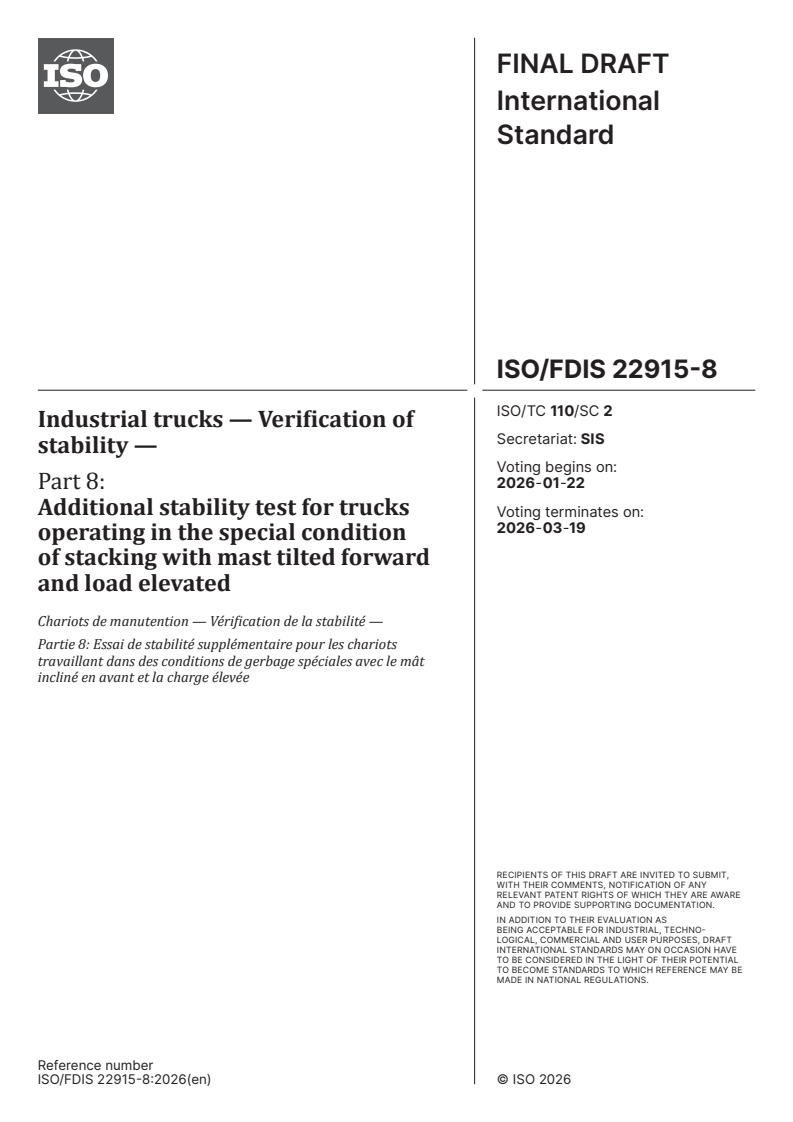
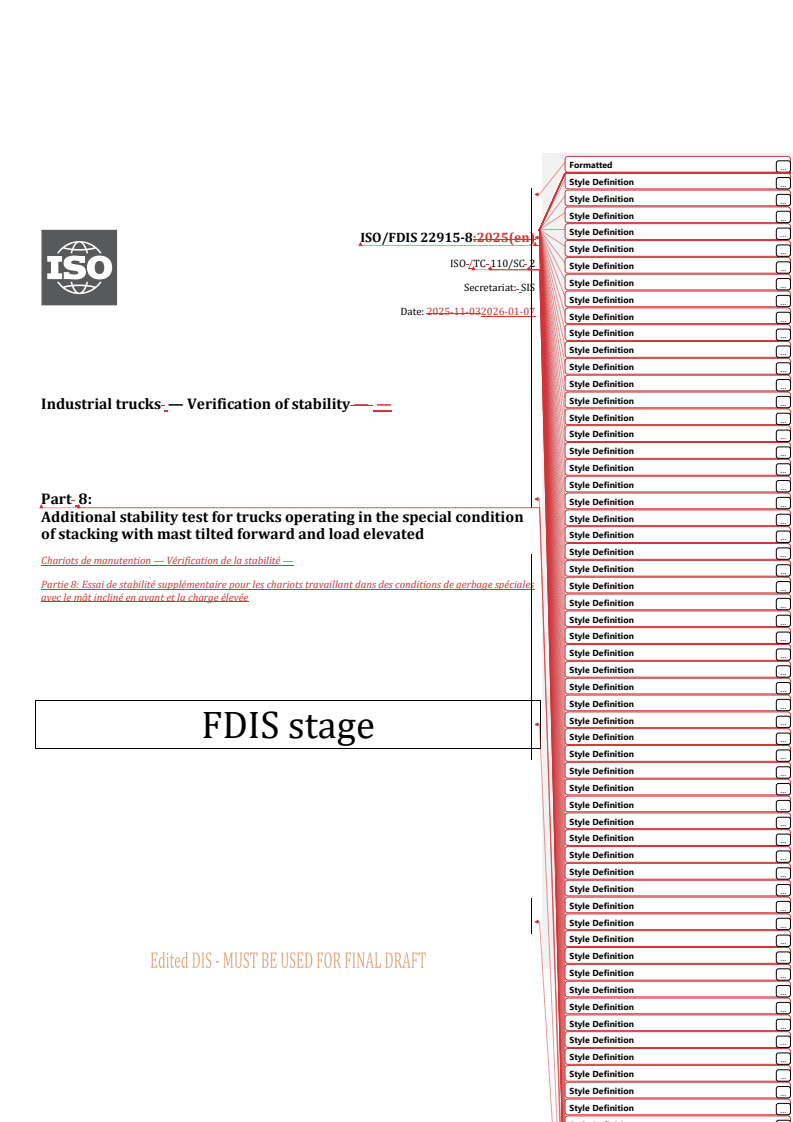
(Main)Industrial trucks — Verification of stability — Part 8: Additional stability test for trucks operating in the special condition of stacking with mast tilted forward and load elevated
Industrial trucks — Verification of stability — Part 8: Additional stability test for trucks operating in the special condition of stacking with mast tilted forward and load elevated
The ISO 22915 series deals with the safety of industrial trucks, as defined in ISO 5053-1, relative to their stability and the verification of that stability. For the purposes of the ISO 22915 series, industrial trucks are wheeled, self‑propelled or pedestrian‑propelled vehicles, excepting those running on rails. They are either operator‑controlled or driverless and designed to carry, tow, push, lift, stack or tier in racks. This document specifies an additional test for verifying the stability of a truck stacking with mast tilted forward and load in the elevated position. It is applicable to the following types of truck: a) counterbalanced trucks with tiltable masts, as specified in ISO 22915?2; b) reach (retractable mast or forks) and straddle trucks with tiltable masts, as specified in ISO 22915?3; c) pallet stackers with tiltable masts, as specified in ISO 22915-4; d) bidirectional and multidirectional (retractable mast or forks) trucks with tiltable masts, as specified in ISO 22915?7; e) rough-terrain trucks with tiltable masts, as specified in ISO 22915-13; f) counterbalanced trucks fitted with articulated steering with tiltable masts, as specified in ISO 22915-15.
Chariots de manutention — Vérification de la stabilité — Partie 8: Essai de stabilité supplémentaire pour les chariots travaillant dans des conditions de gerbage spéciales avec le mât incliné en avant et la charge élevée
La série ISO 22915 traite de la sécurité des chariots de manutention tels que définis dans l'ISO 5053‑1, concernant leur stabilité et la vérification de cette stabilité. Pour les besoins de la série ISO 22915, les chariots de manutention sont des véhicules sur roues, automoteurs ou à propulsion manuelle, à l'exception de ceux se déplaçant sur rail. Ils sont soit avec conducteur, soit sans conducteur et sont conçus pour transporter, tracter, pousser, soulever, gerber ou stocker en rayonnages. Le présent document spécifie un essai supplémentaire pour la vérification de la stabilité d'un chariot gerbant avec le mât incliné vers l'avant et la charge en position élevée. Il est applicable aux types de chariots suivants: a) chariots en porte-à-faux à mâts inclinables, tels que spécifiés dans l'ISO 22915‑2; b) chariots retract (à mât ou à fourches rétractables) et à fourche entre longerons à mats inclinables, tels que spécifiés dans l'ISO 22915‑3; c) chariots à fourche recouvrante à mats inclinables, tels que spécifiés dans l'ISO 22915‑4; d) chariots bidirectionnels et multidirectionnels (à mât ou à fourches rétractables) à mats inclinables, tels que spécifiés dans l'ISO 22915‑7; e) chariots tout terrain à mâts inclinables, tels que spécifiés dans l'ISO 22915‑13; f) chariots en porte-à-faux équipés d'une direction articulée à mâts inclinables, tels que spécifiés dans l'ISO 22915‑15.
General Information
- Status
- Not Published
- Technical Committee
- ISO/TC 110/SC 2 - Safety of powered industrial trucks
- Drafting Committee
- ISO/TC 110/SC 2/WG 11 - Stability
- Current Stage
- 5020 - FDIS ballot initiated: 2 months. Proof sent to secretariat
- Start Date
- 22-Jan-2026
- Completion Date
- 22-Jan-2026
Relations
- Effective Date
- 17-Feb-2024
Overview
ISO/FDIS 22915-8 is an international standard published by ISO that focuses on the verification of stability for industrial trucks operating under specific challenging conditions. This standard addresses an additional stability test tailored for trucks when stacking with the mast tilted forward and the load elevated. Industrial trucks, as defined in this context, are self-propelled or pedestrian-propelled wheeled vehicles designed for various material handling tasks such as lifting, stacking, towing, and pushing.
This part of the ISO 22915 series is essential for ensuring the safe operation of trucks under the special condition where stability risks are increased due to the forward tilt of the mast combined with an elevated load. It is applicable to a range of truck types fitted with tiltable masts, thereby contributing to enhanced safety protocols and compliance in industrial operations.
Key Topics
Scope of Stability Verification
ISO/FDIS 22915-8 specifies an additional test beyond general stability requirements, addressing the unique scenario of stacking with the mast tilted forward and load elevated.Applicable Truck Types
This standard covers various industrial trucks as defined in ISO 5053-1, including but not limited to:- Counterbalanced lift trucks
- Reach and straddle trucks
- Pallet-stacking trucks
- Side-loading trucks
- Multi-directional lift trucks
- Rough-terrain trucks
- Articulated counterbalance lift trucks
Test Conditions and Procedures
Detailed provisions include truck positioning on a tilt table and mast alignment in test setups. The document outlines conditions to replicate real-world challenges faced during stacking operations.Integration with Other ISO Standards
This document references and complements other parts of the ISO 22915 series (e.g., ISO 22915-2, -3, -4, -7, -13, and -15) which specify stability verification for different truck types and configurations.Normative References
The standard incorporates terminology and safety requirements aligned with ISO 5053-1 (vocabulary for industrial trucks) and ISO 3691-1 (safety requirements for self-propelled industrial trucks).
Applications
Workplace Safety Assurance
Organizations operating industrial trucks in warehouses, manufacturing plants, and logistics centers can use ISO/FDIS 22915-8 to verify and enhance the stability of trucks during complex stacking operations, minimizing the risk of accidents.Manufacturing and Design Validation
Truck manufacturers employ these stability tests during design and production to comply with international safety standards, ensuring their products can safely handle loads in elevated stacking scenarios.Regulatory Compliance
Compliance with ISO 22915-8 supports adherence to occupational health and safety regulations by demonstrating that industrial trucks have undergone rigorous stability assessments.Operator Training and Risk Management
The standard provides a basis for developing training materials highlighting special stability considerations when operating trucks with tiltable masts in stacking applications.
Related Standards
ISO 22915 Series
- Part 1: General verification of stability for industrial trucks
- Part 2: Counterbalanced trucks with mast
- Part 3: Reach and straddle trucks
- Part 4: Pallet stackers and order-picking trucks
- Part 5: Single-side-loading trucks
- Part 7: Bidirectional and multidirectional trucks
- Part 13: Rough-terrain trucks
- Part 15: Counterbalanced trucks with articulated steering
ISO 3691-1: Industrial trucks - Safety requirements and verification for self-propelled trucks
ISO 5053-1: Vocabulary related to types of industrial trucks
These related standards collectively form a comprehensive framework for industrial truck safety, including stability verification under various operational conditions.
By implementing ISO/FDIS 22915-8, organizations and manufacturers ensure enhanced industrial truck stability during high-risk stacking conditions, supporting workplace safety, efficient operation, and compliance with recognized international safety standards.
ISO/FDIS 22915-8 - Industrial trucks — Verification of stability — Part 8: Additional stability test for trucks operating in the special condition of stacking with mast tilted forward and load elevated Released:8. 01. 2026
REDLINE ISO/FDIS 22915-8 - Industrial trucks — Verification of stability — Part 8: Additional stability test for trucks operating in the special condition of stacking with mast tilted forward and load elevated Released:8. 01. 2026
Frequently Asked Questions
ISO/FDIS 22915-8 is a draft published by the International Organization for Standardization (ISO). Its full title is "Industrial trucks — Verification of stability — Part 8: Additional stability test for trucks operating in the special condition of stacking with mast tilted forward and load elevated". This standard covers: The ISO 22915 series deals with the safety of industrial trucks, as defined in ISO 5053-1, relative to their stability and the verification of that stability. For the purposes of the ISO 22915 series, industrial trucks are wheeled, self‑propelled or pedestrian‑propelled vehicles, excepting those running on rails. They are either operator‑controlled or driverless and designed to carry, tow, push, lift, stack or tier in racks. This document specifies an additional test for verifying the stability of a truck stacking with mast tilted forward and load in the elevated position. It is applicable to the following types of truck: a) counterbalanced trucks with tiltable masts, as specified in ISO 22915?2; b) reach (retractable mast or forks) and straddle trucks with tiltable masts, as specified in ISO 22915?3; c) pallet stackers with tiltable masts, as specified in ISO 22915-4; d) bidirectional and multidirectional (retractable mast or forks) trucks with tiltable masts, as specified in ISO 22915?7; e) rough-terrain trucks with tiltable masts, as specified in ISO 22915-13; f) counterbalanced trucks fitted with articulated steering with tiltable masts, as specified in ISO 22915-15.
The ISO 22915 series deals with the safety of industrial trucks, as defined in ISO 5053-1, relative to their stability and the verification of that stability. For the purposes of the ISO 22915 series, industrial trucks are wheeled, self‑propelled or pedestrian‑propelled vehicles, excepting those running on rails. They are either operator‑controlled or driverless and designed to carry, tow, push, lift, stack or tier in racks. This document specifies an additional test for verifying the stability of a truck stacking with mast tilted forward and load in the elevated position. It is applicable to the following types of truck: a) counterbalanced trucks with tiltable masts, as specified in ISO 22915?2; b) reach (retractable mast or forks) and straddle trucks with tiltable masts, as specified in ISO 22915?3; c) pallet stackers with tiltable masts, as specified in ISO 22915-4; d) bidirectional and multidirectional (retractable mast or forks) trucks with tiltable masts, as specified in ISO 22915?7; e) rough-terrain trucks with tiltable masts, as specified in ISO 22915-13; f) counterbalanced trucks fitted with articulated steering with tiltable masts, as specified in ISO 22915-15.
ISO/FDIS 22915-8 is classified under the following ICS (International Classification for Standards) categories: 53.060 - Industrial trucks. The ICS classification helps identify the subject area and facilitates finding related standards.
ISO/FDIS 22915-8 has the following relationships with other standards: It is inter standard links to ISO 22915-8:2018. Understanding these relationships helps ensure you are using the most current and applicable version of the standard.
ISO/FDIS 22915-8 is available in PDF format for immediate download after purchase. The document can be added to your cart and obtained through the secure checkout process. Digital delivery ensures instant access to the complete standard document.
Standards Content (Sample)
FINAL DRAFT
International
Standard
ISO/TC 110/SC 2
Industrial trucks — Verification of
Secretariat: SIS
stability —
Voting begins on:
2026-01-22
Part 8:
Additional stability test for trucks
Voting terminates on:
2026-03-19
operating in the special condition
of stacking with mast tilted forward
and load elevated
Chariots de manutention — Vérification de la stabilité —
Partie 8: Essai de stabilité supplémentaire pour les chariots
travaillant dans des conditions de gerbage spéciales avec le mât
incliné en avant et la charge élevée
RECIPIENTS OF THIS DRAFT ARE INVITED TO SUBMIT,
WITH THEIR COMMENTS, NOTIFICATION OF ANY
RELEVANT PATENT RIGHTS OF WHICH THEY ARE AWARE
AND TO PROVIDE SUPPOR TING DOCUMENTATION.
IN ADDITION TO THEIR EVALUATION AS
BEING ACCEPTABLE FOR INDUSTRIAL, TECHNO-
LOGICAL, COMMERCIAL AND USER PURPOSES, DRAFT
INTERNATIONAL STANDARDS MAY ON OCCASION HAVE
TO BE CONSIDERED IN THE LIGHT OF THEIR POTENTIAL
TO BECOME STAN DARDS TO WHICH REFERENCE MAY BE
MADE IN NATIONAL REGULATIONS.
Reference number
FINAL DRAFT
International
Standard
ISO/TC 110/SC 2
Industrial trucks — Verification of
Secretariat: SIS
stability —
Voting begins on:
Part 8:
Additional stability test for trucks
Voting terminates on:
operating in the special condition
of stacking with mast tilted forward
and load elevated
Chariots de manutention — Vérification de la stabilité —
Partie 8: Essai de stabilité supplémentaire pour les chariots
travaillant dans des conditions de gerbage spéciales avec le mât
incliné en avant et la charge élevée
RECIPIENTS OF THIS DRAFT ARE INVITED TO SUBMIT,
WITH THEIR COMMENTS, NOTIFICATION OF ANY
RELEVANT PATENT RIGHTS OF WHICH THEY ARE AWARE
AND TO PROVIDE SUPPOR TING DOCUMENTATION.
© ISO 2026
IN ADDITION TO THEIR EVALUATION AS
All rights reserved. Unless otherwise specified, or required in the context of its implementation, no part of this publication may
BEING ACCEPTABLE FOR INDUSTRIAL, TECHNO-
LOGICAL, COMMERCIAL AND USER PURPOSES, DRAFT
be reproduced or utilized otherwise in any form or by any means, electronic or mechanical, including photocopying, or posting on
INTERNATIONAL STANDARDS MAY ON OCCASION HAVE
the internet or an intranet, without prior written permission. Permission can be requested from either ISO at the address below
TO BE CONSIDERED IN THE LIGHT OF THEIR POTENTIAL
or ISO’s member body in the country of the requester.
TO BECOME STAN DARDS TO WHICH REFERENCE MAY BE
MADE IN NATIONAL REGULATIONS.
ISO copyright office
CP 401 • Ch. de Blandonnet 8
CH-1214 Vernier, Geneva
Phone: +41 22 749 01 11
Email: copyright@iso.org
Website: www.iso.org
Published in Switzerland Reference number
ii
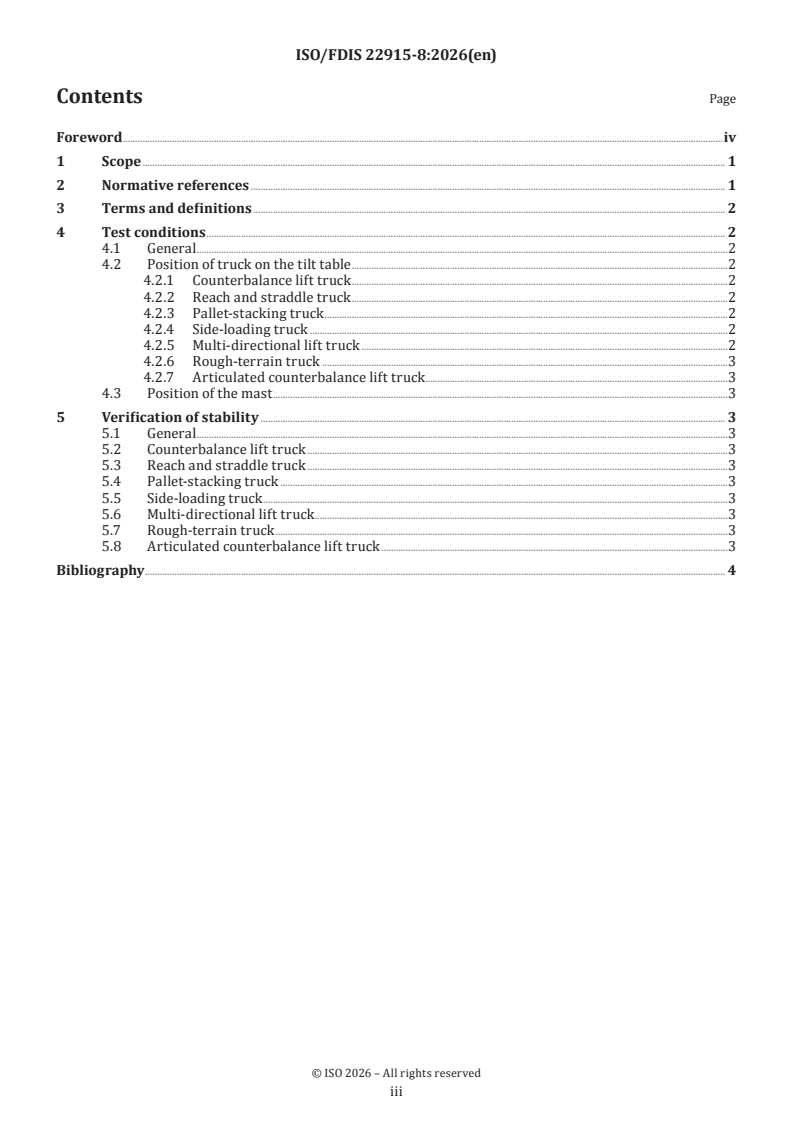
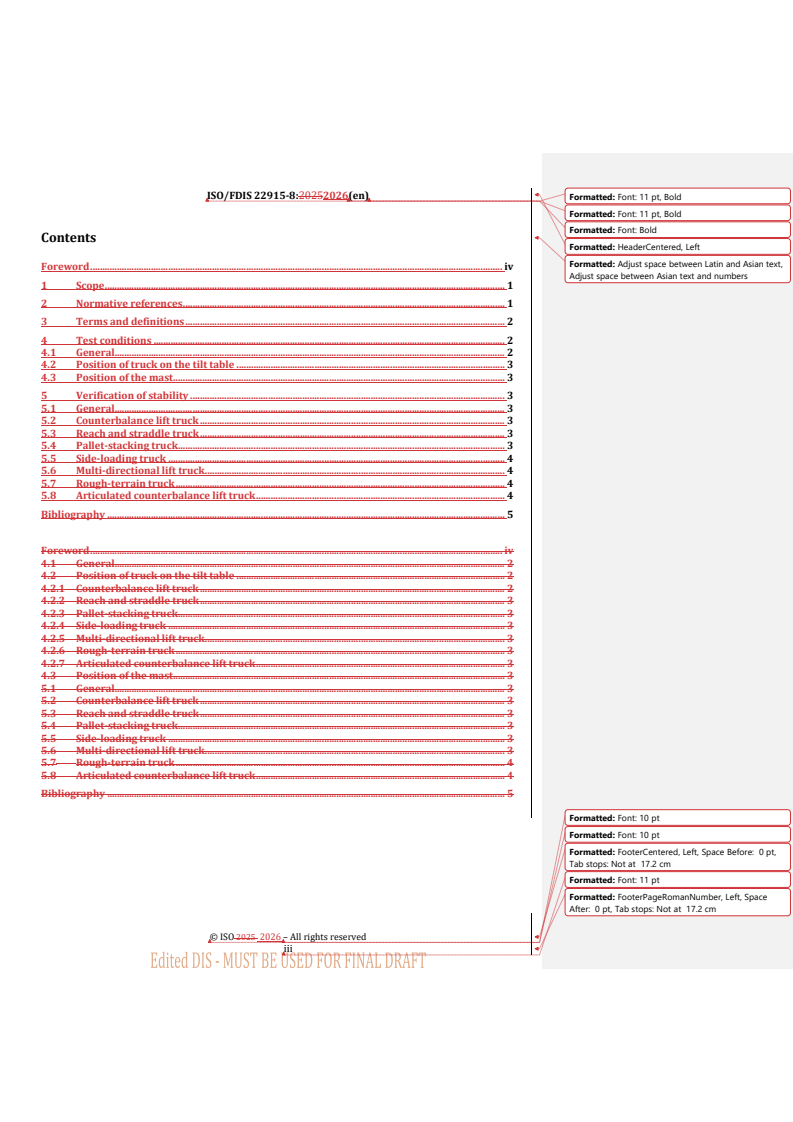
Contents Page
Foreword .iv
1 Scope . 1
2 Normative references . 1
3 Terms and definitions . 2
4 Test conditions . 2
4.1 General .2
4.2 Position of truck on the tilt table .2
4.2.1 Counterbalance lift truck .2
4.2.2 Reach and straddle truck .2
4.2.3 Pallet-stacking truck .2
4.2.4 Side-loading truck .2
4.2.5 Multi-directional lift truck .2
4.2.6 Rough-terrain truck .3
4.2.7 Articulated counterbalance lift truck .3
4.3 Position of the mast .3
5 Verification of stability . 3
5.1 General .3
5.2 Counterbalance lift truck .3
5.3 Reach and straddle truck .3
5.4 Pallet-stacking truck .3
5.5 Side-loading truck .3
5.6 Multi-directional lift truck . .3
5.7 Rough-terrain truck .3
5.8 Articulated counterbalance lift truck .3
Bibliography . 4
iii
Foreword
ISO (the International Organization for Standardization) is a worldwide federation of national standards
bodies (ISO member bodies). The work of preparing International Standards is normally carried out through
ISO technical committees. Each member body interested in a subject for which a technical committee
has been established has the right to be repr
...
Formatted
...
Style Definition
...
Style Definition
...
Style Definition
...
Style Definition
...
Style Definition
...
ISO /TC 110/SC 2
Style Definition
...
Style Definition
...
Secretariat: SIS
Style Definition
...
Date: 2025-11-032026-01-07
Style Definition
...
Style Definition
...
Style Definition
...
Style Definition
...
Style Definition
...
Style Definition
...
Industrial trucks — Verification of stability — —
Style Definition
...
Style Definition
...
Style Definition
...
Style Definition
...
Style Definition
...
Part 8: Style Definition
...
Additional stability test for trucks operating in the special condition Style Definition
...
Style Definition
of stacking with mast tilted forward and load elevated
...
Style Definition
...
Chariots de manutention — Vérification de la stabilité —
Style Definition
...
Partie 8: Essai de stabilité supplémentaire pour les chariots travaillant dans des conditions de gerbage spéciales Style Definition
...
avec le mât incliné en avant et la charge élevée
Style Definition
...
Style Definition
...
Style Definition
...
Style Definition
...
Style Definition
...
Style Definition
...
Style Definition
...
Style Definition
...
FDIS stage
Style Definition
...
Style Definition
...
Style Definition
...
Style Definition
...
Style Definition
...
Style Definition
...
Style Definition
...
Style Definition
...
Style Definition
...
Style Definition
...
Style Definition
...
Style Definition
...
Style Definition
...
Style Definition
...
Style Definition
...
Style Definition
...
Style Definition
...
Style Definition
...
Style Definition
...
Style Definition
...
Style Definition
...
Style Definition
...
Style Definition
...
Style Definition
...
Style Definition
...
Style Definition
...
Style Definition
...
Style Definition
...
Style Definition
...
Style Definition
...
Formatted
...
Formatted
...
Formatted
...
Formatted
...
Formatted
...
Formatted
...
Information classification: Public
Formatted: Font: Bold
Formatted: HeaderCentered
Formatted: Default Paragraph Font
Formatted: No page break before, Adjust space
All rights reserved. Unless otherwise specified, or required in the context of its implementation, no part of this publication
between Latin and Asian text, Adjust space between
may be reproduced or utilized otherwise in any form or by any means, electronic or mechanical, including photocopying,
Asian text and numbers
or posting on the internet or an intranet, without prior written permission. Permission can be requested from either ISO
at the address below or ISO’s member body in the country of the requester.
Formatted: Adjust space between Latin and Asian text,
Adjust space between Asian text and numbers
ISO copyright office
CP 401 • Ch. de Blandonnet 8
CH-1214 Vernier, Geneva
Phone: + 41 22 749 01 11
Fax: +41 22 749 09 47
EmailE-mail: copyright@iso.org
Formatted: zzCopyright address, Adjust space between
Website: www.iso.orgwww.iso.org
Latin and Asian text, Adjust space between Asian text
and numbers
Published in Switzerland
Formatted: Italian (Italy)
Formatted: Italian (Italy)
Formatted: German (Germany)
Formatted: Font: 11 pt
Formatted: FooterPageRomanNumber, Line spacing:
single
iv © ISO 2025 2026 – All rights reserved
ii Information classification: Public
Formatted: Font: 11 pt, Bold
Formatted: Font: Bold
Contents
Formatted: HeaderCentered, Left
Formatted: Adjust space between Latin and Asian text,
Foreword . iv
Adjust space between Asian text and numbers
1 Scope . 1
2 Normative references . 1
3 Terms and definitions . 2
4 Test conditions . 2
4.1 General. 2
4.2 Position of truck on the tilt table . 3
4.3 Position of the mast . 3
5 Verification of stability . 3
5.1 General. 3
5.2 Counterbalance lift truck . 3
5.3 Reach and straddle truck . 3
5.4 Pallet-stacking truck . 3
5.5 Side-loading truck . 4
5.6 Multi-directional lift truck . 4
5.7 Rough-terrain truck . 4
5.8 Articulated counterbalance lift truck . 4
Bibliography . 5
Foreword . iv
4.1 General. 2
4.2 Position of truck on the tilt table . 2
4.2.1 Counterbalance lift truck . 2
4.2.2 Reach and straddle truck . 3
4.2.3 Pallet-stacking truck . 3
4.2.4 Side-loading truck . 3
4.2.5 Multi-directional lift truck . 3
4.2.6 Rough-terrain truck . 3
4.2.7 Articulated counterbalance lift truck . 3
4.3 Position of the mast . 3
5.1 General. 3
5.2 Counterbalance lift truck . 3
5.3 Reach and straddle truck . 3
5.4 Pallet-stacking truck . 3
5.5 Side-loading truck . 3
5.6 Multi-directional lift truck . 3
5.7 Rough-terrain truck . 4
5.8 Articulated counterbalance lift truck . 4
Bibliography . 5
Formatted: Font: 10 pt
Formatted: Font: 10 pt
Formatted: FooterCentered, Left, Space Before: 0 pt,
Tab stops: Not at 17.2 cm
Formatted: Font: 11 pt
Formatted: FooterPageRomanNumber, Left, Space
After: 0 pt, Tab stops: Not at 17.2 cm
iii
Information classification: Public
Formatted: Font: Bold
Formatted: HeaderCentered
Foreword Formatted: Adjust space between Latin and Asian text,
Adjust space between Asian text and numbers
ISO (the International Organization for Standardization) is a worldwide federation of national standards
bodies (ISO member bodies). The work of preparing International Standards is normally carried out through
ISO technical committees. Each member body interested in a subject for which a technical committee has been
established has the right to be represented on that committee. International organizations, governmental and
non-governmental, in liaison with ISO, also take part in the work. ISO collaborates closely with the
International Electrotechnical Commission (IEC) on all matters of electrotechnical standardization.
The procedures used to develop this document and those intended for its further maintenance are described
in the ISO/IEC Directives, Part 1. In particular, the different approval criteria needed for the different types of
ISO document should be noted. This document was drafted in accordance with the editorial rules of the
ISO/IEC Directives, Part 2 (see www.iso.org/directives).
Formatted: English (United Kingdom)
ISO draws attention to the possibility that the implementation of this document may involve the use of (a)
patent(s). ISO takes no position concerning the evidence, validity or applicability of any claimed patent rights
in respect thereof. As of the date of publication of this document, ISO had not received notice of (a) patent(s)
Formatted: English (United Kingdom)
which may be required to implement this document. However, implementers are cautioned that this may not
represent the latest information, which may be obtained from the patent database available at
Formatted: Adjust space between Latin and Asian text,
www.iso.org/patents.www.iso.org/patents. ISO shall not be held responsible for identifying any or all such
Adjust space between Asian text and numbers
patent rights.
Formatted: Default Paragraph Font
Formatted: Default Paragraph Font
Any trade name used in this document is information given for the convenience of users and does not
constitute an endorsement.
Formatted: Default Paragraph Font
Formatted: Default Paragraph Font
For an explanation of the voluntary nature of standards, the meaning of ISO specific terms and expressions
related to conformity assessment, as well as information about ISO's adherence to the World Trade Formatted: Default Paragraph Font
Organization (WTO) principles in the Technical Barriers to Trade (TBT), see
Formatted: Default Paragraph Font
www.iso.org/iso/foreword.htmlwww.iso.org/iso/foreword.html.
Formatted: Adjust space between Latin and Asian text,
Adjust space between Asian text and numbers, Tab
This document was prepared by Technical Committee ISO/TC 110, Industrial trucks, Subcommittee SC 2,
stops: Not at 0.7 cm + 1.4 cm + 2.1 cm + 2.8 cm +
Safety of powered industrial trucks.
3.5 cm + 4.2 cm + 4.9 cm + 5.6 cm + 6.3 cm + 7 cm
This third edition cancels and replaces the second edition (ISO 22915-8:2018), of which it constitutes a minor Formatted: Default Paragraph Font
revision. has been technically revised.
Formatted: Default Paragraph Font
Formatted: Default Paragraph Font
The main changes are as follows:
Formatted: Default Paragraph Font
— — the formatting has been updated to be in line with ISO 22915-10 and ISO 22915-20;
Formatted: Default Paragraph Font
Formatted: Default Paragraph Font
— — references to
...
Questions, Comments and Discussion
Ask us and Technical Secretary will try to provide an answer. You can facilitate discussion about the standard in here.
Loading comments...