

ISO 834-11:2014
(Main)Fire resistance tests — Elements of building construction — Part 11: Specific requirements for the assessment of fire protection to structural steel elements
General Information
- Abstract
The assessment detailed in ISO 834-11:2014 is designed to cover a range of thicknesses of the fire protection material, a range of steel sections characterized by their section factors, a range of design temperatures, and a range of valid fire resistance classification periods. ISO 834-11:2014 covers fire protection systems that include both passive (boards, mats, slabs, and spray materials) and reactive materials as defined in this document. The assessment procedure is used to establish: a) on the basis of the temperature data derived from testing loaded and unloaded specimens, a correction factor and practical constraints on the use of the fire protection system (the physical performance), and b) on the basis of the temperature data derived from testing unloaded short steel specimens, the thermal properties of the fire protection material (the thermal performance). The limits of applicability of the results of the assessment are defined together with permitted direct application of the results to different steel section sizes and strength grades (but not stainless steels) and to the fire protection system tested. The results of the tests obtained according to ISO 834‑10 and the assessment in this part of ISO 834 are directly applicable to steel sections of "I" and "H" cross-sectional shape and hollow sections. Results from analysis of I or H sections are directly applicable to angles, channels, and T-sections for the same section factor, whether used as individual elements or as part of a fabricated steel truss. The results of the assessment are applicable to fabricated sections. ISO 834-11:2014 does not apply to concrete-filled hollow sections, beams, or columns containing holes or openings of any type or solid bar.
- Status
- Published
- Publication Date
- 09-Feb-2014
- Technical Committee
- ISO/TC 92/SC 2 - Fire containment
- Drafting Committee
- ISO/TC 92/SC 2/WG 2 - Calculation methods
- Current Stage
- 9060 - Close of review
- Completion Date
- 04-Jun-2030


Overview
ISO 834-11:2014 - Fire resistance tests - Part 11 - specifies methods for the assessment of fire protection to structural steel elements. It defines how temperature data from fire tests are used to evaluate both the physical and thermal performance of fire protection systems applied to steel members. The standard covers a range of protection thicknesses, steel section factors, design temperatures and fire-resistance classification periods, and applies to both passive (boards, mats, slabs, sprays) and reactive (intumescent/coating) systems.
Key topics and technical requirements
- Scope of applicability
- Direct application to steel sections of I and H shapes and hollow sections; results can be applied to angles, channels and T‑sections with the same section factor.
- Applicable to fabricated sections and to beams, columns and tension members; excludes concrete-filled hollow sections, elements with holes/openings, solid bars and stainless steels.
- Assessment objectives
- Determine a correction factor and practical constraints for the fire protection system (physical performance) using temperature data from loaded and unloaded specimens.
- Derive thermal properties of the protection material (thermal performance) from tests on unloaded short steel specimens.
- Assessment methods
- Accepts multiple validated assessment approaches provided they meet the acceptability criteria (see clause 5.5). Informative annexes present common methods such as the Graphical method, Differential equation analyses (variable and constant λ), Numerical regression and a 3D interpolation method for reactive systems.
- Reporting and limits
- Defines required reporting of assessment results and explicit limits of applicability (permitted thicknesses, section factors, design temperatures and classification periods).
Practical applications and users
ISO 834-11:2014 is intended for:
- Fire protection product manufacturers - to demonstrate performance and develop application tables for product thickness and section ranges.
- Test laboratories and certification bodies - to assess test data (from ISO 834-10) and validate product claims.
- Structural engineers and specifiers - to select and specify appropriate fire protection systems and thicknesses for beams, columns and fabricated members.
- Regulators and code writers - to reference consistent methods for classifying fire resistance of protected steel elements.
Practical uses include product development, performance validation, preparing design tables for protection thickness vs. fire-resistance periods, and supporting compliance documentation for building projects.
Related standards
- ISO 834-1 (General requirements for fire-resistance tests)
- ISO 834-10 (Determination of contribution of applied fire protection materials)
- ISO 8421-2 and ISO 13943 (vocabulary and fire safety terms)
- European guidance: EN 13381 series (similar assessment approaches for passive and reactive products)
Keywords: ISO 834-11:2014, fire resistance tests, structural steel, fire protection, passive protection, reactive protection, section factor, design temperature, assessment methods.
Relations
- Effective Date
- 20-Feb-2026
- Effective Date
- 09-Feb-2026
Get Certified
Connect with accredited certification bodies for this standard

CIS Institut d.o.o.
Personal Protective Equipment (PPE) certification body. Notified Body NB-2890 for EU Regulation 2016/425 PPE.

Kiwa BDA Testing
Building and construction product certification.
Kmetijski inštitut Slovenije
Agricultural Institute of Slovenia. Soil testing, plant health, agricultural product analysis.
Sponsored listings
Frequently Asked Questions
ISO 834-11:2014 is a standard published by the International Organization for Standardization (ISO). Its full title is "Fire resistance tests — Elements of building construction — Part 11: Specific requirements for the assessment of fire protection to structural steel elements". This standard covers: The assessment detailed in ISO 834-11:2014 is designed to cover a range of thicknesses of the fire protection material, a range of steel sections characterized by their section factors, a range of design temperatures, and a range of valid fire resistance classification periods. ISO 834-11:2014 covers fire protection systems that include both passive (boards, mats, slabs, and spray materials) and reactive materials as defined in this document. The assessment procedure is used to establish: a) on the basis of the temperature data derived from testing loaded and unloaded specimens, a correction factor and practical constraints on the use of the fire protection system (the physical performance), and b) on the basis of the temperature data derived from testing unloaded short steel specimens, the thermal properties of the fire protection material (the thermal performance). The limits of applicability of the results of the assessment are defined together with permitted direct application of the results to different steel section sizes and strength grades (but not stainless steels) and to the fire protection system tested. The results of the tests obtained according to ISO 834‑10 and the assessment in this part of ISO 834 are directly applicable to steel sections of "I" and "H" cross-sectional shape and hollow sections. Results from analysis of I or H sections are directly applicable to angles, channels, and T-sections for the same section factor, whether used as individual elements or as part of a fabricated steel truss. The results of the assessment are applicable to fabricated sections. ISO 834-11:2014 does not apply to concrete-filled hollow sections, beams, or columns containing holes or openings of any type or solid bar.
The assessment detailed in ISO 834-11:2014 is designed to cover a range of thicknesses of the fire protection material, a range of steel sections characterized by their section factors, a range of design temperatures, and a range of valid fire resistance classification periods. ISO 834-11:2014 covers fire protection systems that include both passive (boards, mats, slabs, and spray materials) and reactive materials as defined in this document. The assessment procedure is used to establish: a) on the basis of the temperature data derived from testing loaded and unloaded specimens, a correction factor and practical constraints on the use of the fire protection system (the physical performance), and b) on the basis of the temperature data derived from testing unloaded short steel specimens, the thermal properties of the fire protection material (the thermal performance). The limits of applicability of the results of the assessment are defined together with permitted direct application of the results to different steel section sizes and strength grades (but not stainless steels) and to the fire protection system tested. The results of the tests obtained according to ISO 834‑10 and the assessment in this part of ISO 834 are directly applicable to steel sections of "I" and "H" cross-sectional shape and hollow sections. Results from analysis of I or H sections are directly applicable to angles, channels, and T-sections for the same section factor, whether used as individual elements or as part of a fabricated steel truss. The results of the assessment are applicable to fabricated sections. ISO 834-11:2014 does not apply to concrete-filled hollow sections, beams, or columns containing holes or openings of any type or solid bar.
ISO 834-11:2014 is classified under the following ICS (International Classification for Standards) categories: 13.220.50 - Fire-resistance of building materials and elements. The ICS classification helps identify the subject area and facilitates finding related standards.
ISO 834-11:2014 has the following relationships with other standards: It is inter standard links to HD 60364-5-52:2011, EN ISO 20257-1:2020. Understanding these relationships helps ensure you are using the most current and applicable version of the standard.
ISO 834-11:2014 is available in PDF format for immediate download after purchase. The document can be added to your cart and obtained through the secure checkout process. Digital delivery ensures instant access to the complete standard document.
Standards Content (Sample)
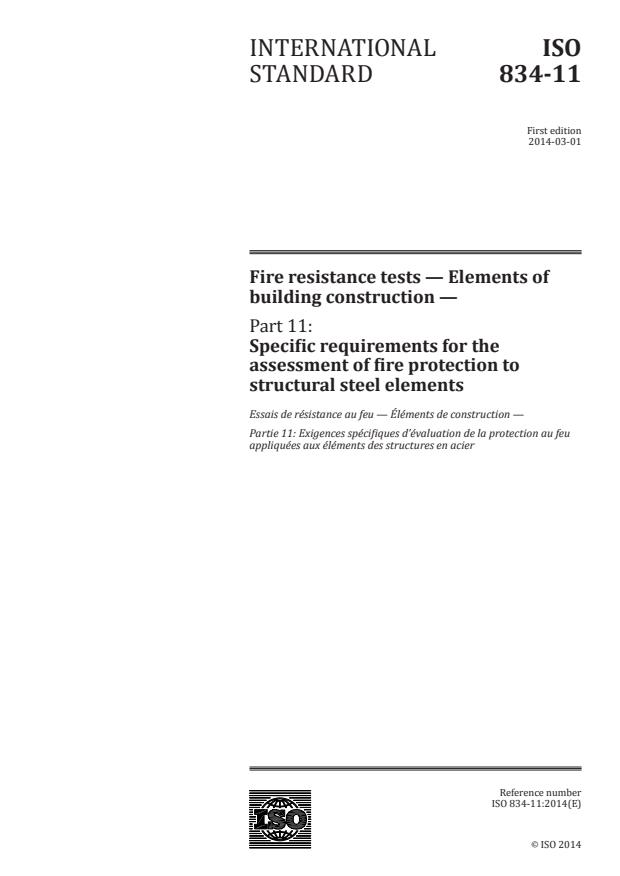
INTERNATIONAL ISO
STANDARD 834-11
First edition
2014-03-01
Fire resistance tests — Elements of
building construction —
Part 11:
Specific requirements for the
assessment of fire protection to
structural steel elements
Essais de résistance au feu — Éléments de construction —
Partie 11: Exigences spécifiques d’évaluation de la protection au feu
appliquées aux éléments des structures en acier
Reference number
©
ISO 2014
© ISO 2014
All rights reserved. Unless otherwise specified, no part of this publication may be reproduced or utilized otherwise in any form
or by any means, electronic or mechanical, including photocopying, or posting on the internet or an intranet, without prior
written permission. Permission can be requested from either ISO at the address below or ISO’s member body in the country of
the requester.
ISO copyright office
Case postale 56 • CH-1211 Geneva 20
Tel. + 41 22 749 01 11
Fax + 41 22 749 09 47
E-mail copyright@iso.org
Web www.iso.org
Published in Switzerland
ii © ISO 2014 – All rights reserved
Contents Page
Foreword .iv
Introduction .v
1 Scope . 1
2 Normative references . 1
3 Terms and definitions . 2
4 Symbols and abbreviated terms . 3
5 Assessment . 6
5.1 General . 6
5.2 Temperature data . 6
5.3 Correction for discrepancy in stickability and insulation performance over the thickness
range tested . 7
5.4 Assessment procedures for thermal performance . 7
5.5 Criteria for acceptability of the assessment method used and the resulting analysis . 7
6 Report of the assessment. 8
7 Limits of the applicability of the results of the assessment. 9
7.1 General . 9
7.2 Permitted protection thickness for beams .10
7.3 Permitted protection thickness for columns .10
7.4 Permitted section factor for beams .10
7.5 Permitted section factor for columns .10
7.6 Specific issues for passive protection .11
Annex A (normative) The applicability of the results of the assessments for passive protection to
sections other than I or H sections .12
Annex B (normative) Correction of data/nominal thickness .14
Annex C (informative) Assessment methodology: Graphical approach .19
Annex D (informative) Assessment methodology: Differential equation analysis (variable
λ approach) .25
Annex E (informative) Assessment methodology: Differential equation analysis (constant
λ approach) .31
Annex F (informative) Assessment methodology: Numerical regression analysis .34
Annex G (informative) Assessment methodology: 3D Interpolation method (reactive systems) .36
Annex H (normative) Selection of test specimens — Reactive materials .41
Annex I (normative) Selection of test specimens — Passive materials .47
Bibliography .53
Foreword
ISO (the International Organization for Standardization) is a worldwide federation of national standards
bodies (ISO member bodies). The work of preparing International Standards is normally carried out
through ISO technical committees. Each member body interested in a subject for which a technical
committee has been established has the right to be represented on that committee. International
organizations, governmental and non-governmental, in liaison with ISO, also take part in the work.
ISO collaborates closely with the International Electrotechnical Commission (IEC) on all matters of
electrotechnical standardization.
The procedures used to develop this document and those intended for its further maintenance are
described in the ISO/IEC Directives, Part 1. In particular the different approval criteria needed for the
different types of ISO documents should be noted. This document was drafted in accordance with the
editorial rules of the ISO/IEC Directives, Part 2 (see www.iso.org/directives).
Attention is drawn to the possibility that some of the elements of this document may be the subject of
patent rights. ISO shall not be held responsible for identifying any or all such patent rights. Details of
any patent rights identified during the development of the document will be in the Introduction and/or
on the ISO list of patent declarations received (see www.iso.org/patents).
Any trade name used in this document is information given for the convenience of users and does not
constitute an endorsement.
For an explanation on the meaning of ISO specific terms and expressions related to conformity
assessment, as well as information about ISO’s adherence to the WTO principles in the Technical Barriers
to Trade (TBT) see the following URL: Foreword - Supplementary information
The committee responsible for this document is ISO/TC 92, Fire safety, Subcommittee SC 2, Fire
containment.
ISO 834 consists of the following parts, under the general title Fire resistance tests — Elements of building
construction:
— Part 1: General requirements
— Part 2: Guidance on measuring uniformity of furnace exposure on test samples [Technical Report]
— Part 3: Commentary on test method and guide to the application of the outputs from the fire-resistance
test [Technical Report]
— Part 4: Specific requirements for loadbearing vertical separating elements
— Part 5: Specific requirements for loadbearing horizontal separating elements
— Part 6: Specific requirements for beams
— Part 7: Specific requirements for columns
— Part 8: Specific requirements for non-loadbearing vertical separating elements
— Part 9: Specific requirements for non-loadbearing ceiling elements
— Part 10: Specific requirements to determine the contribution of applied fire protection materials to
structural steel elements
— Part 11: Specific requirements for the assessment of fire protection to structural steel elements
— Part 12: Specific requirements for separating elements evaluated on less than full scale furnaces
iv © ISO 2014 – All rights reserved
Introduction
Technological advances in the fire protection of structural steelwork have resulted in a range of materials
being developed that are now in widespread use throughout the building construction industry. These
are broadly categorized as intumescent coatings, sprays, renders, and boards and are often referred to
as lightweight systems in comparison to the some of the more traditional materials such as brick, block,
and concrete.
Fire protection materials reduce the rate of temperature rise of steel members when exposed to fire by
a variety of methods. Apart from influencing heat transfer mechanism, such as conduction, convection,
and radiation, they often involve thermo-physical transformations, exothermic chemical reactions,
as well as shape changes that increase the thickness of the material and delay the rate at which the
underlying steel substrate heats up. Relatively simple changes such as the release of free moisture at
around 100 °C, or water of crystallization and sublimation, which all occur within specific temperature
ranges, often result in a plateau of rising temperature versus time of varying magnitude depending
upon the type of material and even the way in which it is applied to the steel substrate.
Understanding the behaviour of fire protection materials is complicated, not least when the physical/
chemical reactions and changes in thermal properties occur at different temperatures and at different
rates, depending on their chemical constitution and reaction temperature. This makes the development
of suitable standards for testing and quantifying their behaviour as insulation materials difficult.
In addition, with recent advances in structural fire engineering in which steel members are no longer
considered to fail at a unique temperature, information on fire protection thicknesses is a requirement
that can be specified over a range of limiting temperatures depending upon the type of loading system
(bending, shear, tension, and compression), the magnitude of the applied loads, and the degree of
exposure of the surface with respect to the fire/furnace.
Therefore, to rationalize the behaviour of fire protection products for protecting structural steelwork
into simple design tables that manufacturers can use to specify their products involves the permutation
of a large number of parameters.
In Europe, the development of testing and assessment protocols for fire protecting structural steel
commenced during the 1990s under a European mandate within CEN TC127 (Fire resistance tests) and
was the beginning of drafting European standards such as DD ENV YYY5. Since then, fire protection
manufacturers in collaboration with the test laboratories throughout Europe have developed a series
of test packages and assessment methods over the past 15 years which have been through a rigorous
appraisal process by the fire protection industry. This work has culminated in the drafting of EN 13381
Parts 4 and 8 which broadly cover passive and reactive products.
Some of the key issues in developing these standards have been identifying the number of specimens
required in a test package to characterize the performance of a fire protection product over the range of
fire resistance times, applicable section factors, type of structural element, and design temperature. In
addition, because of the vagaries in fire resistance testing, it has been necessary to establish a rationale
for applying correction factors to the test results for use in the assessment process partly to maximize
the validity of the data and keep the costs of testing to a minimum.
In Europe, four assessment methods have been developed, referred to as Graphical method, Differential
equation analysis (variable l), Differential equation analysis (constant l), and Numerical regression
analysis. Each method has been through a process of validation and are now included in the standards
EN 13381 Parts 4 and 8.
In this part of ISO 834, the four methods have been directly incorporated into the standard and technically
are identical to the European counterparts. However, it is recognized that other assessment methods
may be suitable and therefore this part of ISO 834 provides a set of criteria for their acceptability. One
such method which has undergone an evaluation process and meets the criteria for acceptability is the
3D method developed in the UK and currently used for reactive materials.
The 3D assessment was formerly presented as a published research paper at the SC2/WG2 meeting in
Kyoto, Japan in November 2006 (N414). Since 2006, it has been published and presented in various forms
in the technical journals and seminars and is now included in the Dutch Standard NEN 7878 (2011) and
the Dutch Fire Safety Handbook (2011).
This part of ISO 834 recognizes that some assessment method/s are more suited to particular types of
fire protection materials, and for this reason, they are presented as Informative Annexes, which enables
freedom of choice in their application. However, only a single method can be used for the assessment
process for a particular data set and cannot be mixed.
This part of ISO 834 specifies methods for assessing fire protection systems applied to structural steel
members, employed in buildings as beams, columns, or tension members. This part of ISO 834 is intended
for use in conjunction with the testing described in ISO 834-10.
vi © ISO 2014 – All rights reserved
INTERNATIONAL STANDARD ISO 834-11:2014(E)
Fire resistance tests — Elements of building
construction —
Part 11:
Specific requirements for the assessment of fire protection
to structural steel elements
1 Scope
The assessment detailed in this part of ISO 834 is designed to cover a range of thicknesses of the fire
protection material, a range of steel sections characterized by their section factors, a range of design
temperatures, and a range of valid fire resistance classification periods.
This part of ISO 834 covers fire protection systems that include both passive (boards, mats, slabs, and
spray materials) and reactive materials as defined in this document.
The assessment procedure is used to establish
a) on the basis of the temperature data derived from testing loaded and unloaded specimens, a
correction factor and practical constraints on the use of the fire protection system (the physical
performance) and
b) on the basis of the temperature data derived from testing unloaded short steel specimens, the
thermal properties of the fire protection material (the thermal performance).
The limits of applicability of the results of the assessment are defined together with permitted direct
application of the results to different steel section sizes and strength grades (but not stainless steels)
and to the fire protection system tested. The results of the tests obtained according to ISO 834-10 and
the assessment in this part of ISO 834 are directly applicable to steel sections of “I” and “H” cross-
sectional shape and hollow sections. Results from analysis of I or H sections are directly applicable to
angles, channels, and T-sections for the same section factor, whether used as individual elements or as
part of a fabricated steel truss.
The results of the assessment are applicable to fabricated sections.
This part of ISO 834 does not apply to concrete-filled hollow sections, beams, or columns containing
holes or openings of any type or solid bar.
Any assessment method is acceptable provided it meets the acceptability criteria given in 5.5. Examples
of assessment methods in common use are given in Annexes C to G.
2 Normative references
The following documents, in whole or in part, are normatively referenced in this document and are
indispensable for its application. For dated references, only the edition cited applies. For undated
references, the latest edition of the referenced document (including any amendments) applies.
ISO 834-1, Fire-resistance tests — Elements of building construction — Part 1: General requirements
ISO 834-10, Fire resistance tests — Elements of building construction — Part 10: Specific requirements to
determine the contribution of applied fire protection materials to structural elements
ISO 8421-2, Fire protection — Vocabulary — Part 2: Structural fire protection
ISO 13943, Fire safety — Vocabulary
3 Terms and definitions
For the purposes of this document, the terms and definitions given in ISO 834-1, ISO 13943, ISO 8421-2,
and the following apply.
3.1
characteristic steel temperature
temperature of the structural steel member which is used for the determination of the correction factor
for stickability which is calculated according to 5.2.2
3.2
design temperature
temperature of the steel member for structural design purposes
3.3
fire protection
protection afforded to the steel member by the fire protection system such that the temperature of the
steel member is limited throughout the period of fire exposure
3.4
fire protection system
fire protection material together with any supporting system including mesh reinforcement as tested
Note 1 to entry: The reactive fire protection materials system includes the primer and top coat if applicable.
3.5
fire protection thickness
dry thickness of a single-layer fire protection system or the combined thickness of all layers of a fire
protection system
Note 1 to entry: The thickness of elements of the supporting system or joint cover strips is not included in the fire
protection thickness.
Note 2 to entry: For reactive fire protection systems, the thickness is the mean dry film thickness of the coating
excluding primer and top coat if applicable.
3.6
H section
steel member with wide flanges compared with the section depth whose main function is to carry axial
loads parallel to its longitudinal axis which can be combined with bending and shear
3.7
I section
steel joist or girder with short flanges shaped like a letter “I” whose main function is to carry loads
transverse to its longitudinal axis
Note 1 to entry: These loads usually cause bending of the beam member. The flanges may be parallel or tapered.
3.8
passive fire protection material
material, which do not change their physical form on heating, providing protection by virtue of their
physical or thermal properties
Note 1 to entry: Passive fire protection materials may include materials containing water or undergo endothermic
reactions which, on heating produce cooling effects. These may take the form of sprayed coatings, renderings, mat
products, boards, or slabs.
2 © ISO 2014 – All rights reserved
3.9
reactive fire protection material
material which are specifically formulated to provide a chemical reaction upon heating such that their
physical form changes and in so doing provide fire protection by thermal insulative and cooling effects
3.10
reference section
steel section which is taken from the same length of steel as its equivalent loaded section
3.11
section factor (unprotected steel)
ratio of the fire exposed perimeter area of the structural steel member, per unit length, A to its cross-
m
sectional volume per unit length, V
3.12
section factor (profiled fire protection system):
ratio of the fire exposed outer perimeter area of the steel structural member excluding the protection
material, per unit length, A to its cross sectional volume per unit length, V
m
3.13
section factor (boxed fire protection system)
ratio of the internal surface area of the smallest possible rectangle or square box encasement which can
be measured around the steel structural member, A , to its volume per unit length, V
m
3.14
steel member
element of building construction, which is load bearing and fabricated from steel
Note 1 to entry: For the purpose of this part of ISO 834, the steel used in the testing must be of the same grade.
3.15
steel temperature
overall mean temperature to be used as input data for the analysis is calculated according to 5.2.1
3.16
stickability
ability of a fire protection system to remain sufficiently coherent and in position for a well-defined
range of deformations, furnace, and steel temperatures, such that the efficacy of the fire protection is
not significantly impaired
3.17
test package
set of steel sections which may include short or long specimens that is tested to evaluate the stickability
of the fire protection system and to provide thermal data over a range of protection thickness, steel
section factor, and steel temperatures
3.18
test specimen
steel section plus the fire protection system under test
Note 1 to entry: The steel test section, representative of a steel member for the purposes of this test, comprises
long and short steel columns or beams.
4 Symbols and abbreviated terms
Symbol Unit Description
A m area
A m exposed perimeter area of the structural steel member, per unit length
m
Symbol Unit Description
for profile protection: exposed outer perimeter area of the structural
steel member excluding the protection material, per unit length
A m
p
for encased protection: the internal surface area of the smallest possi-
ble rectangle or square box encasement which can be measured around
the structural steel member
c J/(kgK) temperature-dependent specific heat capacity
a
temperature-independent specific heat capacity of the fire protection
c J/(kgK)
p
material
c - regression constants in constant λ method of assessment
n,n+1.
d mm thickness
d mm protection thickness of the short section
i
d - regression coefficients
n,n+1.
d mm maximum protection thickness of the loaded section
max
d mm minimum protection thickness of the loaded section
min
d mm thickness of fire protection material
p
d mm maximum thickness of fire protection material
p(max)
d mm minimum thickness of fire protection material
p(min)
thickness of fire protection material on an unloaded short column sec-
d mm
SC
tion
d mm thickness of fire protection material of an unloaded beam section
UB
D mm protection thickness for the loaded section or tall section
D mm protection thickness for the reference section
D min length of the moisture plateau
p
k - correction factor
k - stickability correction factor for the short section at thickness d
i i
k - stickability correction factor at maximum protection thickness
imax
k - stickability correction factor at minimum protection thickness
imin
K - constant applied to λ
δ (p)
K - range factor for thickness
d
K - range factor for section factor
s
n - number of specimens
P m perimeter of the steel section exposed to fire
−1
S m section factor of the loaded or tall section
−1
S m section factor of the reference section
−1
s m section factor at factor K
p s
−1
s m maximum section factor at K factor of 1
max s
−1
s m minimum section factor at K factor of 0
min s
t mm thickness of the wall of the hollow steel section
w
t min time from the commencement of the test
t min time for the reference section to reach the design temperature
t min corrected time for thickness and section factor
c
4 © ISO 2014 – All rights reserved
Symbol Unit Description
t min time required for a short section to reach the design temperature
d
time for an unloaded section to reach an equivalent temperature to the
t min
e
loaded beam at time t
t min time for the loaded section to reach the design temperature
i
t min time at recalculated steel temperature
recal
V m /m volume of the steel section per unit length
Δt min time interval
Δθ °C increase in steel temperature during the time interval Δt
at
θ °C design temperature
θ °C average steel temperature at time t
at
θ °C corrected mean temperature of an unloaded column section
c(SC)
θ °C corrected mean temperature of an unloaded beam section
c(uC)
θ °C characteristic steel temperature of a loaded beam
LB
θ °C characteristic steel temperature of a loaded column
LC
θ °C modified steel temperature of an unloaded section
m(SC)
θ °C average temperature of the furnace at time t
t
θ °C protective material temperature at time t
p
θ °C characteristic steel temperature of a loaded column
LC
θ °C characteristic temperature of a short unloaded reference beam
UB
λ W/(mK) mean value of λ calculated from all the short sections at a temperature
ave(p) p
θ
λ W/(mK) characteristic value of the thermal conductivity of the fire protection
char(p)
material
λ W/(mK) effective thermal conductivity of the fire protection material
p
λ W/(mK) thermal conductivity of the fire protection material at time t and for a
p,t
thickness d of protection material
p
λ standard deviation of λ calculated from all the short sections at a tem-
δ(p) p
W/(mK)
perature θ
ρ Kg/m density
3 3
ρ Kg/m density of steel (normally 7 850 kg/m )
a
ρ Kg/m density of the fire protection on a loaded beam
LB
ρ Kg/m density of the fire protection material
protection
ρ Kg/m density of the fire protection material on the unloaded beam
UB
ρ Kg/m density of the fire protection material on the unloaded column section
UC
LB - loaded beam
LC - loaded column
TC - tall column
LHB - loaded hollow beam
LHC - loaded hollow column
SIB - short I-section beam
SIC - short I-section column
Symbol Unit Description
TCHS - tall circular hollow beam
TRHS - tall rectangular hollow beam
SHB - short hollow beam
SHC - short hollow column
RB - reference beam
5 Assessment
5.1 General
The assessment shall begin with the collection of the data from the fire testing obtained according to
ISO 834-10.
The temperature data obtained from the loaded and unloaded steel sections are used as a basis for
relating the time to reach a specified steel temperature, the thickness of fire protection material, and
section factor. Where the performance at minimum and maximum protection thickness of the loaded
section or tall column is less than that of the equivalent short reference section, the time to reach the
design temperature shall be corrected in accordance with Annex A.
The section factor and applied material thickness of the reference sections shall be within ±10 % of their
equivalent loaded or tall sections. The analysis of the data shall be made on the basis of an assessment of
the test data where the predicted performance satisfies the acceptance criteria given in 5.5 and is fully
described in the assessment report.
The results of the assessment may not be used to extrapolate fire protection thicknesses beyond the
maximum thicknesses evaluated.
Examples of the methods of analysis are given in Annexes C to G. It is incumbent upon the test laboratory
or other approved organization/company, in consultation with the manufacturer, to utilize the most
appropriate method to provide the best fit of the test data.
Only one method shall be utilized to provide the full scope of the assessment of the data from the testing
of the product, i.e. different methods cannot be used to evaliate different portions of the test data.
This part of ISO 834 defines test packages to suit the scope of the assessment for the methodologies
described in this International Standard determined in accordance with the principles given in
ISO 834-10.
I or H sections and hollow sections are treated separately for the purposes of the assessment.
5.2 Temperature data
5.2.1 Steel temperature for calculations
The steel temperature for calculation purposes shall be the overall mean temperature of each section
calculated as follows:
— For I and H section beams, this refers to the mean temperature of the upper flange plus the mean
temperature of the web plus the mean temperature of the lower flange, divided by three.
— For I, H, and hollow section columns, this refers to the sum of the mean temperature of each
measuring station divided by the number of measuring stations.
— For hollow section beams, this refers to the mean temperature of the sides of the section plus the
mean temperature of the bottom face, divided by two.
6 © ISO 2014 – All rights reserved
5.2.2 Characteristic steel temperature
The characteristic temperature is calculated as (mean temperature + maximum temperature)/2.
5.3 Correction for discrepancy in stickability and insulation performance over the
thickness range tested
Correction factors shall be determined for the thickness range tested in accordance with Annex B. Linear
interpolation shall be applied to correct the time to reach the design temperature for the short sections.
The characteristic steel temperature derived in accordance with 5.2.2 will be used to determine the
correction factor assessment procedures for thermal performance
5.4 Assessment procedures for thermal performance
Assessment of thermal performance shall be carried out on the basis of the corrected times to reach
the design temperatures of each short section and they must satisfy the criteria for acceptability and
limitations given in 5.5 and Clause 7 respectively.
A minimum number of short steel sections shall be tested according to ISO 834-10. If further data points
are required, additional specimens shall be tested.
5.5 Criteria for acceptability of the assessment method used and the resulting analysis
The acceptability of the analysis within the range of steel section temperatures (as defined by ISO 834-10
or the sponsor) and duration of the test shall be judged up to the maximum temperature tested on the
following basis:
a) For each short section, the predicted time to reach the design temperature calculated to one decimal
place shall not exceed the corrected time by more than 15 %.
b) The mean value of all percentage differences as calculated in a) shall be less than zero.
c) A maximum of 30 % of individual values of all percentage differences as calculated in a) shall be
more than zero.
d) The results of the analysis which satisfy a) to c) above must comply with the following rules provided
all other parameters remain constant:
1) The thickness of fire protection material increases with fire resistance time.
2) As the section factor increases, the fire resistance time decreases.
3) As the fire resistance time increases, the temperature increases.
4) As the thickness increases, the temperature decreases.
5) As the section factor increases, the temperature increases.
6) As the section factor increases, the thickness increases.
The criteria for acceptability shall be individually applied to all design temperatures included in the
scope of the assessment. This should be carried out in 50 °C steps, starting at 50 °C below the minimum
temperature within the scope or 350 °C, whichever is the higher, up to the maximum temperature within
the scope. There must be at least three temperature steps of 50 °C within the scope of the assessment.
Modification of the analysis should be made until the criteria of acceptability are met.
6 Report of the assessment
The report of the assessment shall include the following:
a) The name/address of the body providing the assessment and the date it was carried out. Reference
to the name/address of the test laboratory, the unique test reference number, and report number(s).
b) The name(s) and address(es) of the sponsor(s). The name of the manufacturer of the product or
products and the manufacturer or manufacturers of the construction.
c) Generic description of the product or products, particularly the fire protection system and any
component parts (where known). If unknown, this shall be stated.
d) General description of the test specimens forming the basis of the assessment including the
measured dimensions of the test specimens.
e) The reason for the omission of any test data.
f) The assessment method used.
g) The mean steel temperatures used in the analysis in accordance with 5.2.1.
h) The corrected times used in the analysis determined as described in Annex A.
i) The values of all thermal data required to be calculated by the chosen assessment method.
j) For all methods of analysis the ability of the method to satisfy the criteria for acceptability as
specified in 5.5.
k) The thermal analysis shall produce a series of tables and graphical presentations relating to fire
resistance classification periods appropriate to the performance of the protection material. Each
table or graphical presentation shall show the minimum thicknesses of fire protection material
required to maintain the design temperature. (An example of the presentation of such tabulated
information is given in Table 1). Any alternative presentation of the data specified by the sponsor
appropriate to local/National needs and different design temperature limits and intervals of section
factor may be used. Whatever the presentation of the data are adopted, interpolation is only allowed
−1
over a maximum range of 50 °C and 10 m .
l) The report shall also include a statement regarding the limits of direct application of the assessment
procedure, especially with regard to the range of section factors, design temperatures, material
thicknesses, fire resistance periods, three- or four-sided protection, etc.
m) The report will include tables of actual and predicted times.
8 © ISO 2014 – All rights reserved
Table 1 — Example of tabulated data
Fire resistance period – 30 minutes
Design temper- 350 400 450 500 550 600 650 700
ature
o
C
Section factor Thickness of fire protection material to maintain steel temperature below design
−1
m temperature
Temperature range for illustration only. Actual range to be determined by the scope of the assessment.
7 Limits of the applicability of the results of the assessment
7.1 General
The results from the assessment procedure are applicable to the fire protection system over the range of
fire protection material thicknesses tested, the values of section factor A /V tested, and the maximum
m
temperatures established during the test.
The results of the analysis for columns can be applied to beams exposed on all four sides up to the
maximum protection thickness predicted from the appropriate loaded beam test. In order for this to
apply, it is necessary for beams to have been tested in accordance with 7.2.1 of ISO 834-10.
For an assessment to be valid for any fire resistance period, the loaded sections protected with the
maximum protection thickness shall achieve a loadbearing capacity performance as defined in 11.3.1
and 11.3.2 of ISO 834-10 within 85 % of this period.
The fire resistance period resulting from the test and assessment is limited to the maximum period of
testing or some shorter period for which the sponsor requires approval.
The results of the assessment are applicable to all other grades of steel to that tested as specified in
ISO 834-10. These shall be hot finished, mild or micro-alloyed steel that have not been heat treated to
improve their mechanical properties.
The maximum web depth will be limited to the web depth of the loaded beam plus 50 %.
The assessment is only applicable to the method of application used in the test specimen preparation.
The results of the assessment are also applicable to fabricated sections.
Nominal extensions only beyond those variables evaluated during the test are permitted. All permitted
extensions must be applied concurrently and are given as follows:
7.2 Permitted protection thickness for beams
a) Maximum permitted thickness: Up to 5 % above the maximum thickness tested on a loaded beam.
b) Minimum permitted thickness: Up to 5 % below the minimum tested on a loaded beam.
7.3 Permitted protection thickness for columns
a) Maximum permitted thickness: Up to 5 % above the maximum thickness tested on a loaded column.
If only loaded beams are tested, the maximum permitted thickness will be that of the loaded beam.
b) Minimum permitted thickness: Up to 5 % below the minimum tested on a loaded column where
such a test has been carried out. Where this is not the case, the permitted minimum will be limited
to that tested on a short unloaded column.
7.4 Permitted section factor for beams
a) Maximum permitted section factor: Up to 10 % above the maximum section factor of any beam
section tested.
b) Minimum permitted section factor: Up to 10 % below the minimum tested on any beam section
tested subject to the minimum permitted beam protection thickness being applied. For section
factors below the extended minimum, the same protection thickness as that applied to the extended
minimum section factor must be applied.
c) Where only columns have been tested, then the minimum permitted extension factors are based on
the minimum section factor of any section tested
7.5 Permitted section factor for columns
a) Maximum permitted section factor: Up to 10 % above the maximum section factor of any column
section tested.
b) Minimum permitted section factor: Up to 10 % below the minimum tested on any column section
subject to the minimum permitted column thickness being applied. For section factors below the
10 © ISO 2014 – All rights reserved
extended minimum, the same protection thickness as that applied to the extended minimum section
factor must be applied.
The above extensions are confined to each section type, i.e. the permitted extensions for beams are not
appropriate for columns and vice versa. Similarly, those extensions applied to I or H sections may not be
applied to hollow sections and vice versa.
7.6 Specific issues for passive protection
The method of fixing boards (or slabs) is confined to the method used for the test specimens since it may
not be suitable for other situations. The suitability of the tested fixing system for different applications
shall be demonstrated by appropriate testing.
For renderings applied to large sections outside the scope of testing, it may be necessary to include
reinforcing mesh.
The testing of passive protection shall take into account various factors including the following:
a) Orientation – fixing methods may vary between columns and beams
b) Shape - fixing methods may vary between different shaped sections, e.g. rectangular and circular
sections, channels, and T’s, etc.
c) Loading – flexural and compression loads may affect the performance of the fixing method in
different ways
d) Numbers of layers – the combination of layers may perform differently compared with a single layer
of the same overall thickness
e) The web depth – for deep web depths, a different support system may be needed
f) The spacing used between the boards and the test specimens in the fire tests shall be as follows:
tested distance −5 mm to +50 mm with no change in fixing
The testing may be limited to any or all of the above but the scope of the assessment will be restricted
accordingly.
Annex A
(normative)
The applicability of the results of the assessments for passive
protection to sections other than I or H sections
A.1 Structural hollow sections
Test data exists on structural hollow sections (SHS) as compression and flexural members which,
together with recent research, have indicated comparability between SHS sections and “I” or “H”
sections in terms of the fire protection thickness related to the section factor. The test information has
been analysed for rectangular, square, and circular sections to establish comparability with respect to
fire protection thickness, section factor, and fire resistance performance and the approaches in A.1.1,
A.1.2, and A.1.3 are recommended for both three- and four-sided protection to both beams and columns.
However, the sponsor may wish to carry out testing on structural hollow sections in accordance with
ISO 834-10 to obtain more suitable data.
A.1.1 Boxed systems
Where thicknesses of the fire protection material have been assessed from “I” or “H” sections with boxed
protection, no change in thickness is required, i.e. the thickness for a SHS of a given A /V value is equal
p
to that for the “I” or “H” section of the same “box” A /V value.
p
A.1.2 Profiled systems
Where thicknesses of the fire protection material have been assessed from “I” or “H” sections with
profiled protection, a correction to the thickness is required based on the A /V value of the section as
m
follows:
a) Establish the A /V value of the structural hollow section.
m
b) Determine the thickness d , in millimetres, of the fire protection material based on the “I” or “H”
p
section data in accordance with Formulae (A.1) or (A.2).
−1
c) For A /V values up to 250 m , increase the thickness as follows:
p
AV
p
Modifiedthicknessd=+1
p
(A.1)
−1
d) For A /V values higher than 250 m , increase the thickness as follows:
p
Modified thickness = 1.25 (A.2)
A.1.3 Alternative fixing methods for boards/slabs
Where the method of fixing boards to hollow sections is not the same as that used for the testing of the
“I” or “H” sections, the suitability of the fixing system shall be demonstrated by appropriate testing. The
testing should take into account the following:
a) orientation – fixing methods may vary between rectangular columns and beams
b) shape - fixing methods may vary between rectangular and circular sections
12 © ISO 2014 – All rights reserved
c) loading – flexural and compression loads may affect the fixing method in different ways
d) numbers of layers – the com
...