


ISO/FDIS 18704
(Main)Molecular in vitro diagnostic examinations - Requirements and recommendations for pre-examination processes for urine and other body fluids - Isolated cell-free DNA
Molecular in vitro diagnostic examinations - Requirements and recommendations for pre-examination processes for urine and other body fluids - Isolated cell-free DNA
This document specifies requirements and provides recommendations for the pre-examination phase of cell free DNA (cfDNA) from body fluid specimens other than blood, including but not limited to the collection, handling, storage, transport, processing and documentation of human body fluids, such as urine, cerebrospinal fluid (CSF), pleural effusions and saliva, intended for cfDNA examination. Processing includes multiple steps, such as centrifugation for specimen cleaning and isolation of cfDNA. This document is applicable to molecular in vitro diagnostic examinations performed by medical laboratories. It is also intended to be used by health institutions including facilities collecting and handling specimen, laboratory customers, in vitro diagnostics developers and manufacturers, biobanks, institutions and commercial organizations performing biomedical research, and regulatory authorities. Dedicated measures that need to be taken for cytohistological analysis of body fluid derived nucleated cells are not described in this document. Neither are measures for preserving and handling of pathogens, and other bacterial or whole microbiome DNA in body fluids described. Different dedicated measures need to be taken for preserving circulating cell free DNA (ccfDNA) from blood. These are not described in this document, but are covered in ISO 20186-3. NOTE International, national or regional regulations or requirements can also apply to specific topics covered in this document.
Analyses de diagnostic moléculaire in vitro — Exigences et recommandations relatives aux processus préanalytiques pour l’urine et d’autres liquides corporels — ADN libre extrait
General Information
- Status
- Not Published
- Current Stage
- 5020 - FDIS ballot initiated: 2 months. Proof sent to secretariat
- Start Date
- 17-Nov-2025
- Completion Date
- 17-Nov-2025
Relations
- Effective Date
- 11-Feb-2023
Overview
ISO/FDIS 18704:2025 specifies requirements and recommendations for the pre‑examination phase of molecular in vitro diagnostic examinations targeting cell‑free DNA (cfDNA) from body fluids other than blood. The standard covers the entire pre‑analytical workflow for specimens such as urine, cerebrospinal fluid (CSF), pleural effusions, saliva and ascites, including collection, transport, handling, storage, processing (e.g., centrifugation and specimen cleaning), isolation, and documentation of cfDNA intended for downstream molecular assays.
This document is aimed at improving the reliability and reproducibility of cfDNA measurements by minimizing post‑collection DNA release, degradation and other pre‑analytical biases that affect assay performance.
Key topics and technical requirements
- Specimen collection and collection devices: guidance for body fluid collection device selection and collection facility practices to preserve native cfDNA profiles.
- Transport and storage requirements: conditions and timelines to limit cfDNA degradation and microbial overgrowth during transport.
- Specimen reception and documentation: procedures for sample acceptance, labeling, chain of custody and record keeping to meet laboratory quality systems (ISO 15189/ISO 13485 alignment).
- Pre‑processing steps: centrifugation and other specimen purification methods to reduce cellular contamination and genomic DNA release prior to cfDNA isolation.
- cfDNA isolation and processing: recommendations for methods and controls used to isolate cfDNA from urine and other non‑blood body fluids.
- Quantity and quality assessment: requirements for assessing cfDNA yield and integrity to ensure suitability for downstream molecular tests.
- Storage of isolated cfDNA: conditions for short‑ and long‑term storage of extracted cfDNA.
- Scope exclusions: cytohistological analysis of nucleated cells, preservation/handling of pathogens or whole microbiome DNA, and circulating cfDNA from blood (covered by ISO 20186‑3).
The standard uses normative language (shall/should/may) to distinguish requirements from recommendations.
Practical applications and users
ISO/FDIS 18704 is intended for:
- Medical laboratories performing molecular in vitro diagnostic examinations on urine and other body fluids.
- Health institutions and collection facilities responsible for specimen collection and transport.
- IVD developers and manufacturers creating cfDNA collection devices, stabilizers and assays.
- Biobanks, research organizations and laboratory customers that store or use cfDNA specimens.
- Regulatory authorities assessing pre‑analytical conformity for diagnostic submissions.
Use cases include assay development and validation, clinical diagnostics (e.g., oncology markers in urine/CSF), biobanking of cfDNA samples, and establishing robust pre‑analytical workflows to improve diagnostic sensitivity and reproducibility.
Related standards
- ISO 20186‑3 (ccfDNA pre‑analytics for blood)
- ISO 15189 (medical laboratory quality and competence)
- ISO 13485 (medical devices quality management)
Keywords: ISO/FDIS 18704, cfDNA, cell‑free DNA, urine cfDNA, pre‑examination, specimen collection, centrifugation, molecular in vitro diagnostic, specimen transport, cfDNA isolation.


ISO/FDIS 18704 - Molecular in vitro diagnostic examinations — Requirements and recommendations for pre-examination processes for urine and other body fluids — Isolated cell-free DNA Released:3. 11. 2025

REDLINE ISO/FDIS 18704 - Molecular in vitro diagnostic examinations — Requirements and recommendations for pre-examination processes for urine and other body fluids — Isolated cell-free DNA Released:3. 11. 2025

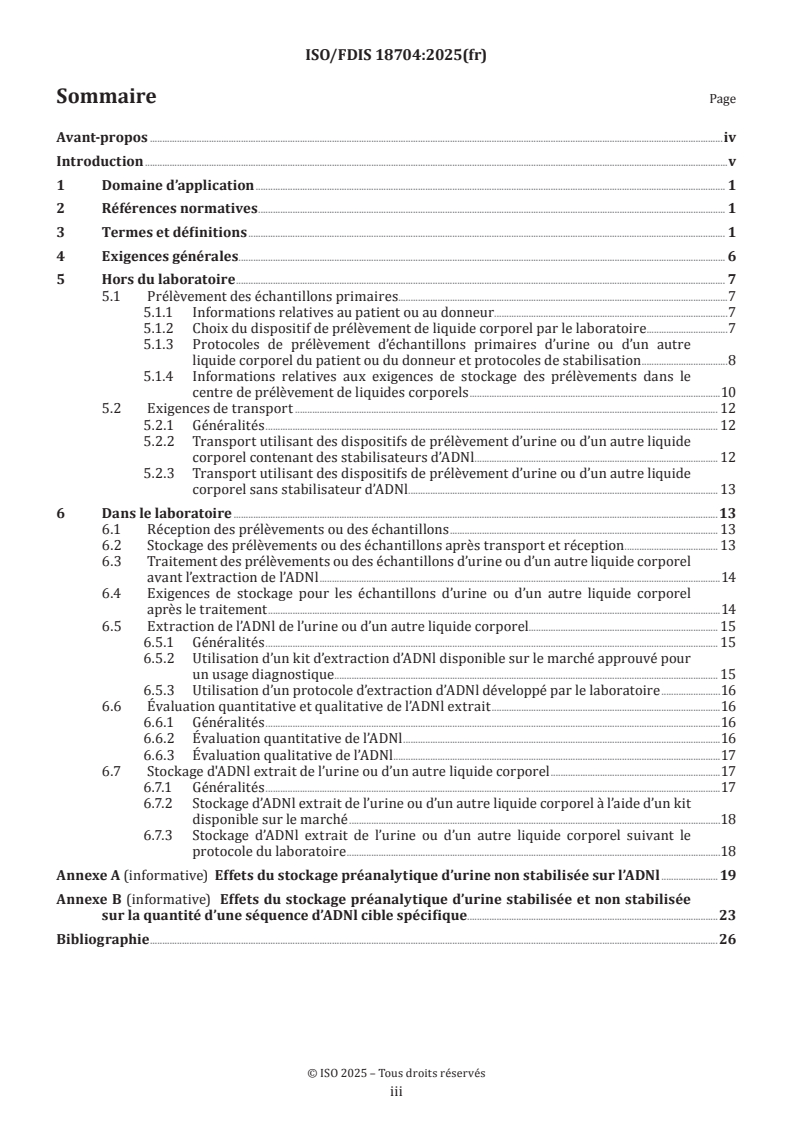
ISO/FDIS 18704 - Analyses de diagnostic moléculaire in vitro — Exigences et recommandations relatives aux processus préanalytiques pour l’urine et d’autres liquides corporels — ADN libre extrait Released:23. 12. 2025
Frequently Asked Questions
ISO/FDIS 18704 is a draft published by the International Organization for Standardization (ISO). Its full title is "Molecular in vitro diagnostic examinations - Requirements and recommendations for pre-examination processes for urine and other body fluids - Isolated cell-free DNA". This standard covers: This document specifies requirements and provides recommendations for the pre-examination phase of cell free DNA (cfDNA) from body fluid specimens other than blood, including but not limited to the collection, handling, storage, transport, processing and documentation of human body fluids, such as urine, cerebrospinal fluid (CSF), pleural effusions and saliva, intended for cfDNA examination. Processing includes multiple steps, such as centrifugation for specimen cleaning and isolation of cfDNA. This document is applicable to molecular in vitro diagnostic examinations performed by medical laboratories. It is also intended to be used by health institutions including facilities collecting and handling specimen, laboratory customers, in vitro diagnostics developers and manufacturers, biobanks, institutions and commercial organizations performing biomedical research, and regulatory authorities. Dedicated measures that need to be taken for cytohistological analysis of body fluid derived nucleated cells are not described in this document. Neither are measures for preserving and handling of pathogens, and other bacterial or whole microbiome DNA in body fluids described. Different dedicated measures need to be taken for preserving circulating cell free DNA (ccfDNA) from blood. These are not described in this document, but are covered in ISO 20186-3. NOTE International, national or regional regulations or requirements can also apply to specific topics covered in this document.
This document specifies requirements and provides recommendations for the pre-examination phase of cell free DNA (cfDNA) from body fluid specimens other than blood, including but not limited to the collection, handling, storage, transport, processing and documentation of human body fluids, such as urine, cerebrospinal fluid (CSF), pleural effusions and saliva, intended for cfDNA examination. Processing includes multiple steps, such as centrifugation for specimen cleaning and isolation of cfDNA. This document is applicable to molecular in vitro diagnostic examinations performed by medical laboratories. It is also intended to be used by health institutions including facilities collecting and handling specimen, laboratory customers, in vitro diagnostics developers and manufacturers, biobanks, institutions and commercial organizations performing biomedical research, and regulatory authorities. Dedicated measures that need to be taken for cytohistological analysis of body fluid derived nucleated cells are not described in this document. Neither are measures for preserving and handling of pathogens, and other bacterial or whole microbiome DNA in body fluids described. Different dedicated measures need to be taken for preserving circulating cell free DNA (ccfDNA) from blood. These are not described in this document, but are covered in ISO 20186-3. NOTE International, national or regional regulations or requirements can also apply to specific topics covered in this document.
ISO/FDIS 18704 is classified under the following ICS (International Classification for Standards) categories: 11.100.10 - In vitro diagnostic test systems. The ICS classification helps identify the subject area and facilitates finding related standards.
ISO/FDIS 18704 has the following relationships with other standards: It is inter standard links to ISO 21368:2022. Understanding these relationships helps ensure you are using the most current and applicable version of the standard.
ISO/FDIS 18704 is available in PDF format for immediate download after purchase. The document can be added to your cart and obtained through the secure checkout process. Digital delivery ensures instant access to the complete standard document.
Standards Content (Sample)
FINAL DRAFT
International
Standard
ISO/TC 212
Molecular in vitro diagnostic
Secretariat: ANSI
examinations — Requirements
Voting begins on:
and recommendations for pre-
2025-11-17
examination processes for urine
Voting terminates on:
and other body fluids — Isolated
2026-01-12
cell-free DNA
RECIPIENTS OF THIS DRAFT ARE INVITED TO SUBMIT,
WITH THEIR COMMENTS, NOTIFICATION OF ANY
RELEVANT PATENT RIGHTS OF WHICH THEY ARE AWARE
AND TO PROVIDE SUPPOR TING DOCUMENTATION.
IN ADDITION TO THEIR EVALUATION AS
BEING ACCEPTABLE FOR INDUSTRIAL, TECHNO
ISO/CEN PARALLEL PROCESSING LOGICAL, COMMERCIAL AND USER PURPOSES, DRAFT
INTERNATIONAL STANDARDS MAY ON OCCASION HAVE
TO BE CONSIDERED IN THE LIGHT OF THEIR POTENTIAL
TO BECOME STAN DARDS TO WHICH REFERENCE MAY BE
MADE IN NATIONAL REGULATIONS.
Reference number
FINAL DRAFT
International
Standard
ISO/TC 212
Molecular in vitro diagnostic
Secretariat: ANSI
examinations — Requirements
Voting begins on:
and recommendations for pre-
examination processes for urine
Voting terminates on:
and other body fluids — Isolated
cell-free DNA
RECIPIENTS OF THIS DRAFT ARE INVITED TO SUBMIT,
WITH THEIR COMMENTS, NOTIFICATION OF ANY
RELEVANT PATENT RIGHTS OF WHICH THEY ARE AWARE
AND TO PROVIDE SUPPOR TING DOCUMENTATION.
© ISO 2025
IN ADDITION TO THEIR EVALUATION AS
All rights reserved. Unless otherwise specified, or required in the context of its implementation, no part of this publication may
BEING ACCEPTABLE FOR INDUSTRIAL, TECHNO
ISO/CEN PARALLEL PROCESSING
LOGICAL, COMMERCIAL AND USER PURPOSES, DRAFT
be reproduced or utilized otherwise in any form or by any means, electronic or mechanical, including photocopying, or posting on
INTERNATIONAL STANDARDS MAY ON OCCASION HAVE
the internet or an intranet, without prior written permission. Permission can be requested from either ISO at the address below
TO BE CONSIDERED IN THE LIGHT OF THEIR POTENTIAL
or ISO’s member body in the country of the requester.
TO BECOME STAN DARDS TO WHICH REFERENCE MAY BE
MADE IN NATIONAL REGULATIONS.
ISO copyright office
CP 401 • Ch. de Blandonnet 8
CH-1214 Vernier, Geneva
Phone: +41 22 749 01 11
Email: copyright@iso.org
Website: www.iso.org
Published in Switzerland Reference number
ii
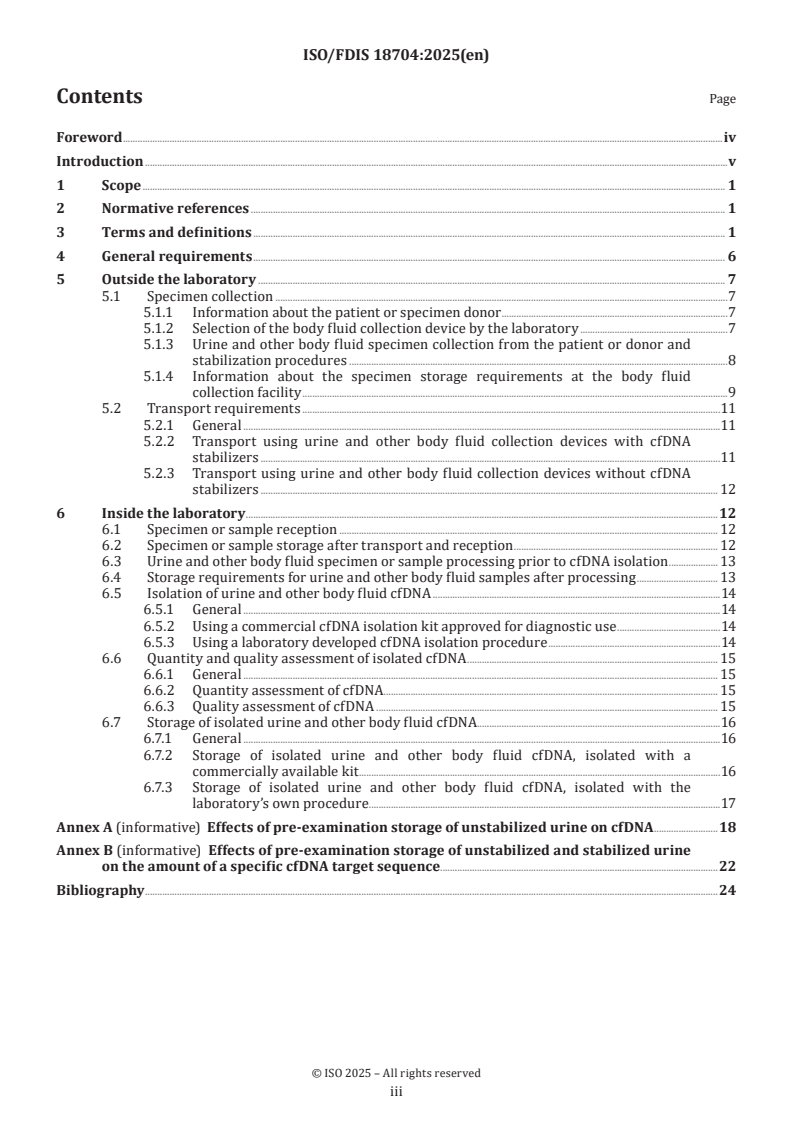
Contents Page
Foreword .iv
Introduction .v
1 Scope . 1
2 Normative references . 1
3 Terms and definitions . 1
4 General requirements . 6
5 Outside the laboratory . 7
5.1 Specimen collection .7
5.1.1 Information about the patient or specimen donor .7
5.1.2 Selection of the body fluid collection device by the laboratory .7
5.1.3 Urine and other body fluid specimen collection from the patient or donor and
stabilization procedures .8
5.1.4 Information about the specimen storage requirements at the body fluid
collection facility .9
5.2 Transport requirements .11
5.2.1 General .11
5.2.2 Transport using urine and other body fluid collection devices with cfDNA
stabilizers .11
5.2.3 Transport using urine and other body fluid collection devices without cfDNA
stabilizers . 12
6 Inside the laboratory .12
6.1 Specimen or sample reception . 12
6.2 Specimen or sample storage after transport and reception . 12
6.3 Urine and other body fluid specimen or sample processing prior to cfDNA isolation . 13
6.4 Storage requirements for urine and other body fluid samples after processing . 13
6.5 Isolation of urine and other body fluid cfDNA .14
6.5.1 General .14
6.5.2 Using a commercial cfDNA isolation kit approved for diagnostic use .14
6.5.3 Using a laboratory developed cfDNA isolation procedure .14
6.6 Quantity and quality assessment of isolated cfDNA . 15
6.6.1 General . 15
6.6.2 Quantity assessment of cfDNA . 15
6.6.3 Quality assessment of cfDNA . 15
6.7 Storage of isolated urine and other body fluid cfDNA.16
6.7.1 General .16
6.7.2 Storage of isolated urine and other body fluid cfDNA, isolated with a
commercially available kit . .16
6.7.3 Storage of isolated urine and other body fluid cfDNA, isolated with the
laboratory’s own procedure.17
Annex A (informative) Effects of pre-examination storage of unstabilized urine on cfDNA .18
Annex B (informative) Effects of pre-examination storage of unstabilized and stabilized urine
on the amount of a specific cfDNA target sequence.22
Bibliography .24
iii
Foreword
ISO (the International Organization for Standardization) is a worldwide federation of national standards
bodies (ISO member bodies). The work of preparing International Standards is normally carried out through
ISO technical committees. Each member body interested in a subject for which a technical committee
has been established has the right to be represented on that committee. International organizations,
governmental and non-governmental, in liaison with ISO, also take part in the work. ISO collaborates closely
with the International Electrotechnical Commission (IEC) on all matters of electrotechnical standardization.
The procedures used to develop this document and those intended for its further maintenance are described
in the ISO/IEC Directives, Part 1. In particular, the different approval criteria needed for the different types
of ISO documents should be noted. This document was drafted in accordance with the editorial rules of the
ISO/IEC Directives, Part 2 (see www.iso.org/directives).
ISO draws attention to the possibility that the implementation of this document may involve the use of (a)
patent(s). ISO takes no position concerning the evidence, validity or applicability of any claimed patent
rights in respect thereof. As of the date of publication of this document, ISO had not received notice of (a)
patent(s) which may be required to implement this document. However, implementers are cautioned that
this may not represent the latest information, which may be obtained from the patent database available at
www.iso.org/patents. ISO shall not be held responsible for identifying any or all such patent rights.
Any trade name used in this document is information given for the convenience of users and does not
constitute an endorsement.
For an explanation of the voluntary nature of standards, the meaning of ISO specific terms and expressions
related to conformity assessment, as well as information about ISO’s adherence to the World Trade
Organization (WTO) principles in the Technical Barriers to Trade (TBT), see www.iso.org/iso/foreword.html.
This document was prepared by Technical Committee ISO/TC 212, Medical laboratories and in vitro diagnostic
systems, in collaboration with the European Committee for Standardization (CEN) Technical Committee
CEN/TC 140, In vitro diagnostic medical devices, in accordance with the Agreement on technical cooperation
between ISO and CEN (Vienna Agreement).
Any feedback or questions on this document should be directed to the user’s national standards body. A
complete listing of these bodies can be found at www.iso.org/members.html.
iv
Introduction
Molecular in vitro diagnostics has enabled significant progress in medicine. Further progress has been
achieved and is still expected by new technologies used to examine profiles of nucleic acids, proteins, and
metabolites in human tissues and body fluids (e.g. genomic, epigenomic, transcriptomic, proteomic and
metabolomic profiling). However, the profiles of these molecules can change drastically during specimen
collection, transport, storage and processing. This can make the outcome from diagnostics or research
unreliable or even result in failure because the subsequent examination will not measure the genuine profile
of nucleic acids, proteins or metabolites as it was in the patient, but a profile altered by the pre-examination
process. Therefore, specifying, developing, verifying and validating preanalytical workflows has become an
[21]
essential part of examination development.
Most of the DNA in the body is located within cells, but small amounts of DNA originating from cells can
also be found outside of cells (extracellular DNA). In case of circulating body fluids such as blood, this DNA
is called circulating cell-free DNA (ccfDNA) and in case of non-circulating body fluids such as urine, saliva,
cerebrospinal fluid, pleural effusion, ascites, and synovial fluid, the DNA is called cell-free DNA (cfDNA).
cfDNA is of specific interest, as for example cfDNA in urine originates from cells from the genitourinary
[22]
tract or from ccfDNA passing through glomerular filtration. cfDNA from cancerous or malignant cells in
[23],[24]
urine have been associated with cancer specific sequences, epigenetic and structural changes. Urine
is currently the most frequently used non-circulating body fluid for cfDNA examination because it is easily
obtained from patients. Although urine is often described as the major specimen type, in this document the
term body fluid is used for urine and other body fluids as defined in Clause 3.
Standardization of the entire workflow from specimen collection to the cfDNA examination is needed to
minimize post-collection release of DNA from cells into the fluid and degradation of cfDNA in the specimen,
which can change the original native cfDNA profile in the body fluid. Post collection microbial growth in
the specimen can further enhance the degradation of the cfDNA, e.g. in urine and saliva. Furthermore, the
isolation of cfDNA can lead to a cfDNA profile bias. Different methods to determine cfDNA yield and quality
can lead to additional variations and impacts.
Studies have been undertaken to determine the pre-examination sources of these and other variables,
as they can impact the cfDNA examination. The variables can compromise the specified examination
performance characteristics, such as sensitivity, specificity, linearity and reproducibility. They can also
impact the examination reliability which could lead to an erroneous examination result and misdiagnosis.
This document draws upon such work to codify and standardize the steps prior to cfDNA examination from
body fluids in what is referred to as the pre-examination process.
In this document, the following verbal forms are used:
— “shall” indicates a requirement;
— “should” indicates a recommendation;
— “may” indicates a permission;
— “can” indicates a possibility or a capability.
v
FINAL DRAFT International Standard ISO/FDIS 18704:2025(en)
Molecular in vitro diagnostic examinations — Requirements
and recommendations for pre-examination processes for
urine and other body fluids — Isolated cell-free DNA
1 Scope
This document specifies requirements and provides recommendations for the pre-examination process
of cell-free DNA (cfDNA) from body fluid specimens other than blood, including but not limited to the
collection, handling, storage, transport, processing and documentation of human body fluids, such as urine,
pleural effusions, ascites, cerebrospinal fluid (CSF), and saliva, intended for cfDNA examination. Processing
includes multiple steps, such as centrifugation for specimen purification and isolation of cfDNA.
This document does not cover dedicated measures for cytohistological analysis of nucleated cells derived
from body fluid, nor measures for preserving and handling of pathogens, and other bacterial or whole
microbiome DNA in body fluids described.
Dedicated measures for preserving circulating cell-free DNA (ccfDNA) from blood are covered in ISO 20186-3.
This document is applicable to medical laboratories, health institutions including facilities collecting and
handling specimens, laboratory customers, in vitro diagnostic examination developers and manufacturers,
biobanks, institutions and organizations performing biomedical research, and regulatory authorities.
NOTE International, national or regional regulations or requirements can also apply to specific topics covered in
this document.
2 Normative references
The following documents are referred to in the text in such a way that some or all of their content constitutes
requirements of this document. For dated references, only the edition cited applies. For undated references,
the latest edition of the referenced document (including any amendments) applies.
ISO 15189, Medical laboratories — Requirements for quality and competence
ISO 13485, Medical devices — Quality management systems — Requirements for regulatory purposes
3 Terms and definitions
For the purposes of this document, the terms and definitions given in ISO 15189, ISO 13485 and the
following apply.
ISO and IEC maintain terminology databases for use in standardization at the following addresses:
— ISO Online browsing platform: available at https:// www .iso .org/ obp
— IEC Electropedia: available at https:// www .electropedia .org/
3.1
aliquot
portion of a larger amount of homogenous material, assumed to be taken with negligible sampling error
Note 1 to entry: The term is usually applied to fluids that are uniform in structure and composition. Tissues are
heterogeneous and therefore cannot be aliquoted.
[SOURCE: ISO 20166-1:2018, 3.1, modified — “that are uniform in structure and composition ” was added in
Note 1 to entry.]
3.2
analyte
component represented in the name of a measurable quantity
[SOURCE: ISO 17511:2020, 3.1, modified — The example was removed.]
3.3
ascites
abnormal buildup of fluid in the abdomen that can cause swelling
Note 1 to entry: In late-stage cancer, tumour cells can be found in the fluid in the abdomen.
Note 2 to entry: Ascites also occurs in patients with liver disease.
Note 3 to entry: This definition was adapted from Reference [28].
3.4
body fluid
natural fluid or secretion that is produced by the body including, but not limited to, urine (3.26), saliva,
semen, mucus, vaginal secretions, breast milk, amniotic fluid, cerebrospinal fluid, synovial fluid, ascites
(3.3), pleural effusions and pericardial fluid
Note 1 to entry: For the purpose of this document blood and faeces are not included.
[SOURCE: ISO/TR 19591:2018, 3.23, modified — Blood and faeces were deleted from the definition, and
saliva, ascites and pleural effusion were added; Note 1 to entry was added.]
3.5
body fluid collection device
tube or other container in which the body fluid (3.4) (e.g. urine (3.26)) specimen (3.23) is collected
3.6
cfDNA
cell-free DNA
extracellular human DNA (3.12) present in body liquids such as urine (3.26)
[29]
Note 1 to entry: cfDNA can include DNA present in vesicles such as exosomes.
3.7
cfDNA profile
cell-free DNA profile
amount of different cell-free DNA (cfDNA) (3.6) molecules, present in a body fluid (3.4) that can be measured
in the absence of any losses, inhibition and interference
3.8
cfDNA stabilizer
cell-free DNA stabilizer
compound, solution or mixture that is designed to minimize degradation and fragmentation of cell-free DNA
(cfDNA) (3.6) as well as release of genomic DNA (3.16) from nucleated cells
3.9
closed system
non-modifiable system provided by the vendor including all necessary components for the analysis (i.e.,
hardware, software, procedures and reagents)
3.10
collection device manufacturer
entity that manufactures in vitro diagnostic or research devices, intended for the collection of specimens (3.23)
3.11
collection facility
area where a human specimen (3.23) is collected, such as physician’s office, patient’s home, hospital and clinic
3.12
DNA
deoxyribonucleic acid
polymer of deoxyribonucleotides occurring in a double-stranded (dsDNA) or single-stranded (ssDNA) form
[SOURCE: ISO 22174:2024, 3.1.6]
3.13
examination
set of operations having the objective of determining the numerical value, text value or characteristics of a
property
Note 1 to entry: An examination may be the total of a number of activities, observations or measurements required to
determine a value or characteristic.
Note 2 to entry: Laboratory examinations that determine a numerical value of a property are called “quantitative
examinations”; those that determine the characteristics of a property are called “qualitative examinations”.
Note 3 to entry: Laboratory examinations are also called “assays” or “tests”.
Note 4 to entry: For the purpose of this document, examination starts with the isolated cell-free DNA (cfDNA) (3.6).
[SOURCE: ISO 15189:2022, 3.8 — Note 4 to entry was added.]
3.14
examination manufacturer
entity that manufactures in vitro diagnostic or research examination devices, including measurement
systems, instruments, reagents, and instructions for use for a specific examination (3.13)
Note 1 to entry: Adapted from ISO 20166-4:2021, 3.16.
3.15
examination performance
analytical test performance
analytical performance
accuracy, precision, specificity, sensitivity and limit of detection of a test to examine the analyte (3.2) of
interest
Note 1 to entry: Other test performance characteristics such as robustness and repeatability may apply as well.
Note 2 to entry: Examination performance is determined from examination performance studies used to assess the
ability of an in vitro diagnostic examination (3.13) procedure to measure or detect a particular analyte.
Note 3 to entry: Examination performance includes such characteristics as analytical sensitivity, detection limit,
analytical specificity (interference and cross-reactivity), trueness, precision and linearity.
Note 4 to entry: Adapted from ISO 20184-1:2018, 3.4.
3.16
genomic DNA
gDNA
DNA (3.12) from the nuclear and mitochondrial genomes containing all coding (exon) and non-coding (intron
and other) sequences
[SOURCE: ISO 20186-2:2019, 3.12, modified — Note 1 to entry was removed.]
3.17
interfering substance
endogenous or exogenous substance that can be present in specimens (3.23) and that can alter an examination
(3.13) result
EXAMPLE Stabilization solution.
3.18
microorganism
entity of microscopic size, encompassing bacteria, fungi, protozoa and viruses
[SOURCE: ISO 11139:2018, 3.176]
3.19
pre-examination process
pre-analytical phase
pre-analytical workflow
pre-examination phase
process that starts, in chronological order, from the user’s request and includes the examination (3.13)
request, preparation and identification of the patient, collection of the specimen(s) (3.23), transportation to
and within the laboratory, ending when the examination begins
Note 1 to entry: For the purpose of this document, pre-examination process ends with the isolated cell-free DNA
(cfDNA) (3.6).
[SOURCE: ISO 15189:2022, 3.24, modified — The preferred terms “pre-analytical phase”, “pre-analytical
workflow” and “pre-examination phase” were added; Note 1 to entry was added.]
3.20
proficiency test
evaluation of participant performance against pre-established criteria by means of interlaboratory
comparisons
[SOURCE: ISO/IEC 17043:2023, 3.7, modified — The term was changed from “proficiency testing” to
“proficiency test”; Note 1 to entry was removed.]
3.21
room temperature
temperature in the range of 18 °C to 25 °C
Note 1 to entry: Local or national regulations can have different definitions.
[SOURCE: ISO 20166-1:2018, 3.22]
3.22
sample
one or more parts taken from a specimen (3.23)
[SOURCE: ISO 15189:2022, 3.28]
3.23
specimen
primary sample
discrete portion of a body fluid (3.4) or tissue or other sample (3.22) associated with the human body taken
for examination (3.13), study or analysis of one or more quantities or characteristics to determine the
character of the whole
[SOURCE: ISO 15189:2022, 3.25, modified — Note 1 to entry was removed.]
3.24
stability
ability of a sample (3.22) material, when stored under specified conditions, to maintain a stated property
value within specified limits for a specified period of time
Note 1 to entry: The measurand constituent for the purpose of this document is isolated DNA (3.12).
[SOURCE: ISO Guide 30:2015, 2.1.15, modified — In the definition, “characteristic” was changed to “ability”;
“specified property value” was changed to “stated property value”; Note 1 to entry was removed and a new
note was added.]
3.25
storage
prolonged interruption of the pre-examination process (3.19) of a sample (3.22) or analyte (3.2) respectively,
or of their derivatives, under appropriate conditions in order to preserve their properties
Note 1 to entry: Long-term storage typically occurs in laboratory archives or in biobanks.
[SOURCE: ISO 20184-1:2018, 3.22, modified — The examples of derivatives “stained sections or tissue
blocks” were removed from the definition.]
3.26
urine
liquid product of the human excretory system produced by the kidneys and expelled through the urethra via
urination
[SOURCE: ISO 30500:2025, 3.1.2.3, modified — Note 1 to entry was removed.]
3.27
validation
confirmation of plausibility for a specific intended use or application through the provision of objective
evidence that specified requirements have been fulfilled
Note 1 to entry: Objective evidence can be obtained through observation, measurement, examination (3.23) or by
other means.
Note 2 to entry: The word “validated” is used to designate the corresponding status.
[SOURCE: ISO 15189:2022, 3.31, modified — Note 3 to entry was removed.]
3.28
verification
confirmation of truthfulness, through the provision of objective evidence, that specified requirements have
been fulfilled
EXAMPLE 1 Confirmation that design input specifications of a measuring system are achieved.
EXAMPLE 2 Confirmation that a target measurement uncertainty can be met.
Note 1 to entry: Verification is the process that intends to confirm that the established performance claims of a
measuring system, e.g. trueness, precision, reportable range, can be replicated in the laboratory before human sample
examination (3.23) is performed.
Note 2 to entry: The objective evidence needed for a verification can be the result of a regulatory authority assessment,
an inspection or other forms of determination, such as performing alternative calculations or reviewing documents.
Note 3 to entry: The word “verified” is used to designate the corresponding status.
[SOURCE: ISO 15189:2022, 3.32, modified — In Example 1 “performance” was changed to “design input”;
Notes 1 and 2 to entry have been revised; Note 3 to entry has been removed.]
3.29
workflow
series of activities necessary to complete a task
[SOURCE: ISO 20166-1:2018, 3.30]
4 General requirements
For general statements on medical laboratory quality management systems and in particular on
specimen collection, reception and handling (including avoidance of cross contaminations) see ISO 15189
and ISO/IEC 17020 or ISO/IEC 17025. ISO 20658 and ISO 20387 (for biobanking) may also apply. The
requirements on laboratory equipment, reagents, and consumables according to ISO 15189 shall be followed;
ISO/IEC 17020 and ISO/IEC 17025 may also apply. For IVD developers and manufacturers ISO 13485 may
apply instead.
All steps of the pre-examination, examination and post-examination processes (i.e. the entire workflow)
can influence the diagnosis or research study results, thus, this entire workflow shall be specified, verified
and validated during the development of the examination, including the development of in vitro diagnostic
(IVD) medical devices. This includes explicitly all pre-examination process steps such as the examination
request, preparation and identification of the patient, collection of the specimen(s), transport to and within
the laboratory, storage and isolation of analytes.
The stability of the cfDNA profile should be investigated throughout the complete pre-examination process.
The verification and validation shall account for the variability of the body fluid specimen’s quality. cfDNA
profiles can change significantly after body fluid collection. The post-collection release of genomic DNA from
cells in the body fluid can change the cfDNA profile (see Reference [31]). In some body fluids, such as urine,
post-collection growth of bacteria can cause additional changes to the cfDNA profile such as contaminating
the human cfDNA with bacterial DNA and causing degradation of target cfDNA. Post-collection conditions
such as large temperature variations and prolonged storage or transportation times, or both, can also result
in cfDNA degradation. Post-collection changes can vary individually in specimens from different donors
or patients, and they can also depend on pathophysiological conditions. This can impact the validity and
reliability of the examination results.
During the design and development of a cfDNA based examination, an appropriate risk assessment shall
be performed (see also ISO 14971, ISO 22367, ISO 35001). Mitigation measures for eliminating or reducing
identified risks shall be established where required for ensuring the performance of the examination. It shall
be investigated and ensured that any change to the cfDNA profile(s) introduced during the pre-examination
process does not lead to a change of the examination result. To ensure the cfDNA profile is not compromised,
it can be necessary to characterize whether or how, or both, the profile intended to be examined changes
during the pre-examination process steps (e.g. degradation of target cfDNA, and the post-collection release
of genomic DNA from present cells). This can be done, for example by applying the intended examination
to specimens or samples that have been subjected to pre-examination steps such as transport and storage
in time course studies (see Annex A). Measures can be implemented to prevent or reduce impacts by the
identified pre-examination variables, e.g. by using body fluid collection devices with cfDNA stabilizers (see
Annex B).
During the whole pre-examination process, precautions shall be taken to avoid cross contamination between
different specimens or samples (e.g. by using single-use material whenever feasible or appropriate cleaning
procedures between processing of different specimens or samples), and to avoid mixing up of specimens or
samples.
Safety instructions for the whole pre-examination process shall be in place and followed. Safety regulations
on specimen or sample transport and handling shall be considered (see ISO 15189, ISO 15190 and ISO 20658).
If transport is required over public areas, corresponding regulations or laws for packaging and transport
apply [e.g. International Air Transport Association (IATA) for air transport].
The manufacturer’s material safety data sheet shall be considered before first use of any potentially
hazardous material (e.g. chemicals in stabilizers).
For all pre-examination steps, the examination manufacturer’s instructions shall be followed, if provided.
Where, for justified reasons (e.g. unmet patient needs), a commercial product is not used in accordance with
the manufacturer’s instructions, responsibility for its verification, validation, use and performance lies with
the laboratory.
5 Outside the laboratory
5.1 Specimen collection
5.1.1 Information about the patient or specimen donor
The documentation shall include the identity of the patient or specimen donor, which may be in the form of
the name or a code.
The documentation should include, but is not limited to:
a) the relevant health status (e.g. healthy, disease type, concomitant disease) and demographics of the
patient or specimen donor (e.g. age and sex);
b) the information about medical treatment and special treatment prior to body fluid collection (e.g.
anaesthetics, medications, fasting status, surgical or diagnostic procedures);
c) the type and the purpose of the examination requested;
d) the appropriate consent from the patient or specimen donor.
NOTE See ISO 15189 for further information. ISO 20658 provides additional general guidance on the entire
collection process.
5.1.2 Selection of the body fluid collection device by the laboratory
The cfDNA profile of body fluids can be influenced by e.g. inadequate collection procedures, inappropriate
storage or transport conditions, separation of contaminating cells as well as by cfDNA isolation procedures.
Specifically, the post-collection degradation can significantly change the cfDNA profile in body fluids, e.g. in
[32],[33]
urine. This can impact the validity of the examination results.
In order to prevent cfDNA degradation, bacterial growth and, where required, release of genomic DNA from
cells and DNA from microorganisms, body fluid collection devices with cfDNA profile stabilizers, or devices
without stabilizers with immediate post-collection addition of stabilizers should be used. These stabilizers
should also allow the separation of nucleated cells from cfDNA in the body fluid, e.g. by centrifugation. Body
fluid collection devices without cfDNA profile stabilizers and workflows without immediate post-collection
addition of cfDNA stabilizers should only be used if the ordered examination specifications allow the non-
use of stabilizers.
The examination manufacturer’s instructions for use for the specimen collection shall be followed. Where
the cfDNA examination manufacturer requires usage of a dedicated body fluid collection device or body
fluid cfDNA stabilizer, these shall be used. This can include a transfer into a secondary container with a
stabilizer. The device’s and stabilizers’ catalogue and lot numbers shall be documented.
For specimens intended for extended storage in a biobank the individual human cfDNA examinations needed
are not always known in advance of extended storage. Therefore, body fluid collection devices with cfDNA
profile stabilizers or workflows with immediate post-collection addition of cfDNA stabilizers should be used
to enable the use of a wider range of examinations.
5.1.3 Urine and other body fluid specimen collection from the patient or donor and stabilization
procedures
5.1.3.1 General
The examination manufacturer shall specify, verify and validate the body fluid collection device for the
examination and shall provide instructions for use for the specimen collection procedure, either with or
where appropriate without stabilizers.
NOTE In some countries it is not a requirement of the examination manufacturer to provide such instructions for
use and to specify, verify and validate the body fluid collection device for the examination.
A cfDNA stabilizer should be used, to prevent any cfDNA profile changes during the pre-examination
process. This may be a collection device prefilled with a stabilizer or an external stabilizer may be added to
the collected urine or body fluid, e.g. from a bulk solution.
Where the specimen collection device is intended for self-collection or home collection, or both, the collection
device manufacturer shall validate this device for these purposes. This shall include mitigating any potential
risks for the patient or donor from the cfDNA stabilizer where appropriate (see Clause 4).
The laboratory shall have written or visual instructions, or both, in place for body fluid collection. These
shall follow the examination manufacturer’s instructions for use where provided.
Where the examination manufacturer’s instructions are not provided (e.g. due to less stringent legal
frameworks), or where, for justified reasons (e.g. unmet patient needs), they require modifications, the
laboratory shall specify, verify and validate the body fluid collection device and collection procedure for
the intended examination and document this according to its quality management system requirements.
This shall include specifications for specimen storage and transport as required for the examination (see
5.1.4 and 5.2). Where the selected body fluid collection device manufacturer provides specified and verified
instructions (see 5.1.3.2 and 5.1.3.3) for the body fluid collection, these can serve as a basis for the laboratory
to verify this device for the examination.
Where the specifications given in the instructions for use of the selected body fluid collection device do not
meet the examination requirements during verification, they shall be modified to be fit for purpose, verified
and documented by the laboratory.
Where specimen self-collection is possible (e.g. saliva, urine), written visual instructions, or both, either
from the body fluid collection device manufacturer or the laboratory shall be supplied to the patient or
donor. Laboratory instructions shall be based on the body fluid collection device manufacturer’s or the
examination manufacturer’s requirements, or both.
The instructions for body fluid specimen collection shall include:
a) Requirements and recommendations to follow before the collection, in particular related to e.g. drinking
or fasting, or both, before collection, or collection time (e.g. first midstream urine of the morning).
b) All requirements for patient identification, collection, storage and transport of the specimen to the
laboratory. For collection this shall include requirements:
1) to collect the specimen within the specified volume range;
2) to mix the specimen with the stabilizer(s) if required by the manufacturer, e.g. by immediate
shaking or inverting.
For self-collection, the patient or donor shall be provided with an appropriate body fluid collection device
(e.g. container, tube), identity tag(s) [(e.g. label, radio frequency identification (RFID)], and in general
anything needed for the specimen collection, preservation, storage and transport procedure for returning
the specimen to laboratory.
The patient or donor shall also be provided with an option to confirm compliance with the supplied
instructions for the body fluid specimen collection, e.g. electronic, paper based.
The patient or donor or person collecting the specimen from the patient or donor shall confirm compliance
with the supplied instructions for the body fluid specimen collection.
The identity of any person other than the patient or donor collecting the specimen shall be documented. The
date and time of body fluid collection shall be documented.
For the labelling (sample or specimen identification) of the body fluid collection device, a routine procedure
(for example ISO 15189 for medical laboratories or ISO 20387 for biobanks) or a procedure with additional
information (e.g. 2D-barcode) shall be used.
Any alterations or additions to the specimen shall be documented.
5.1.3.2 Urine and other body fluid collection with cfDNA stabilizers
The cfDNA stabilizer manufacturer and, where the stabilizer is incorporated into a collection device, the
collection device manufacturer, shall specify, verify and validate the instructions for use for body fluid
collection and stabilization.
The specimen collection device manufacturer shall also specify and verify the specimen collection device
quality parameters, e.g. interference of device materials, stability of stabilizer during product shelf-life and
tightness of closures or caps.
The examination manufacturer shall determine the cfDNA target stability (see Clause 4).
The examination manufacturer’s instructions and thereon built laboratory’s instructions for use may refer
to the instructions of the body fluid collection device or stabilizer, or both, provided by the manufacturer.
The person collecting the specimen from the patient or donor, or the patient or donor self-collecting the
specimen, shall follow the laboratory’s written instructions for use (see 5.1.3.1).
5.1.3.3 Urine and other body fluid collection without cfDNA stabilizers
The cfDNA profile can change rapidly post-collection and can thus impact the intended performance
characteristics of the examination. Therefore such collection devices shall only be used if they have been
specified, verified and validated for the specific examination.
The examination manufacturer’s instructions and thereon built laboratory’s instructions for use may refer
to the instructions of the body fluid collection device without stabilizer provided by the manufacturer.
Where the manufacturer of the body fluid collection device without stabilizer does not provide such
instructions, the laboratory shall specify, verify and validate the instructions for use of the device for body
fluid collection for cfDNA examination. The laboratory shall write instructions for use and follow them.
The instructions may include cooling of the specimen to 2 °C to 8 °C or placing on wet ice, and transportation
to the laboratory without delay within a verified period of time. Otherwise, microbial growth, cfDNA
degradation and contamination with genomic DNA released from cells present in the body fluid can happen
and impact examination test results.
The person collecting the specimen from the patient or donor, or the patient or donor self-collecting the
specimen, shall follow the laboratory’s written instructions for use (see 5.1.3.1).
5.1.4 Information about the specimen storage requirements at the body fluid collection facility
5.1.4.1 General
The examination manufacturer shall specify, verify and validate the storage requirements and shall provide
instructions for specimen storage, either with (see 5.1.4.2) or where appropriate without (see 5.1.4.3)
stabilizers.
NOTE In several countries it is not a requirement to provide such instructions for use.
This can be accomplished with time course studies, e.g. by storing the specimen for different storage
durations and temperatures. As an example, see Annex A.
The laboratory shall have written instructions in place for body fluid storage. These should follow the
examination manufacturer’s instructions for use where provided. Where these are not provided, the
laboratory shall specify, verify and validate the body fluid specimen storage conditions (e.g. temperature,
duration) for the intended examination and document this according to its quality management system
requirements. This can be accomplished by time course studies (see Annex A).
Where provided, the body fluid collection device manufacturer’s instructions may serve as a basis for the
laboratory’s own specification and verification for the intended examination.
The do
...
2025-08-31
ISO/TC 212/ WG 4
Secretariat: ANSI
Date: 2025-10-31
Molecular in vitro diagnostic examinations — Requirements and
recommendations for pre-examination processes for urine and other
body fluids — Isolated cell-free DNA
FDIS stage
All rights reserved. Unless otherwise specified, or required in the context of its implementation, no part of this publication
may be reproduced or utilized otherwise in any form or by any means, electronic or mechanical, including photocopying,
or posting on the internet or an intranet, without prior written permission. Permission can be requested from either ISO
at the address below or ISO’s member body in the country of the requester.
ISO copyright office
CP 401 • Ch. de Blandonnet 8
CH-1214 Vernier, Geneva
Phone: + 41 22 749 01 11
EmailE-mail: copyright@iso.org
Website: www.iso.org
Published in Switzerland
ii
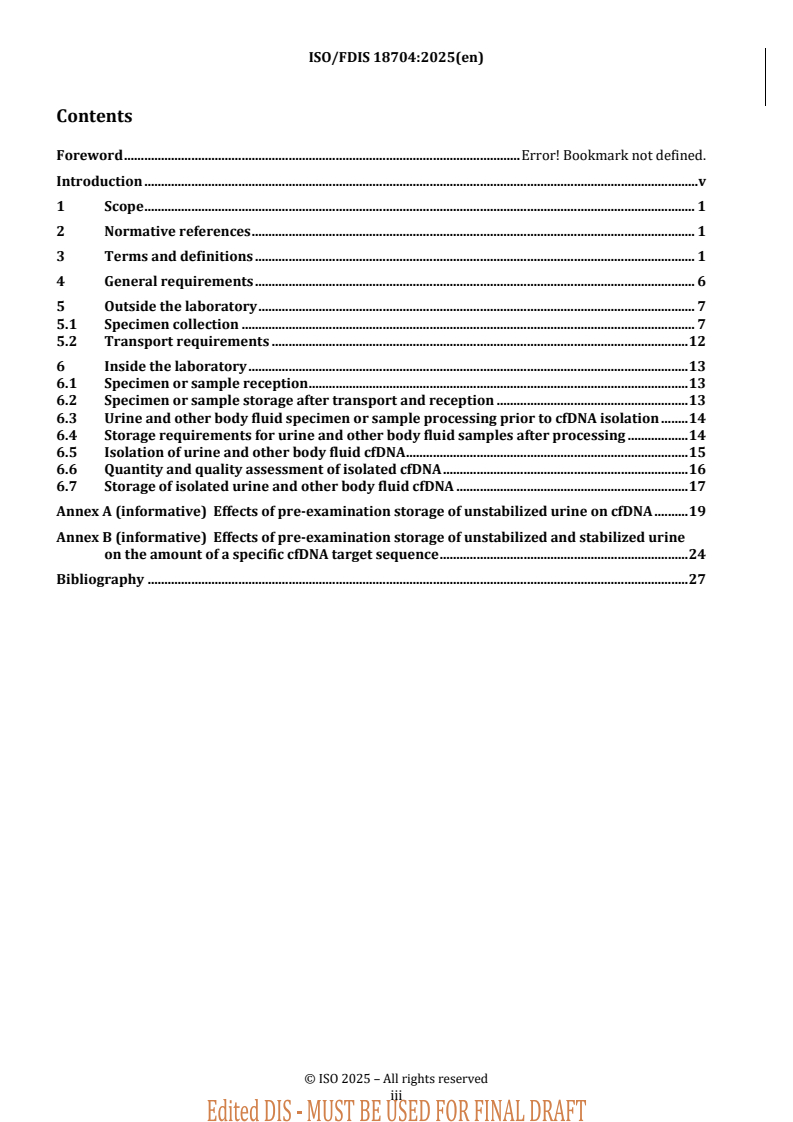
Contents
Foreword . Error! Bookmark not defined.
Introduction . v
1 Scope . 1
2 Normative references . 1
3 Terms and definitions . 1
4 General requirements . 6
5 Outside the laboratory . 7
5.1 Specimen collection . 7
5.2 Transport requirements . 12
6 Inside the laboratory . 13
6.1 Specimen or sample reception . 13
6.2 Specimen or sample storage after transport and reception . 13
6.3 Urine and other body fluid specimen or sample processing prior to cfDNA isolation . 14
6.4 Storage requirements for urine and other body fluid samples after processing . 14
6.5 Isolation of urine and other body fluid cfDNA . 15
6.6 Quantity and quality assessment of isolated cfDNA . 16
6.7 Storage of isolated urine and other body fluid cfDNA . 17
Annex A (informative) Effects of pre-examination storage of unstabilized urine on cfDNA . 19
Annex B (informative) Effects of pre-examination storage of unstabilized and stabilized urine
on the amount of a specific cfDNA target sequence . 24
Bibliography . 27
iii
Foreword
ISO (the International Organization for Standardization) is a worldwide federation of national standards
bodies (ISO member bodies). The work of preparing International Standards is normally carried out through
ISO technical committees. Each member body interested in a subject for which a technical committee has been
established has the right to be represented on that committee. International organizations, governmental and
non-governmental, in liaison with ISO, also take part in the work. ISO collaborates closely with the
International Electrotechnical Commission (IEC) on all matters of electrotechnical standardization.
The procedures used to develop this document and those intended for its further maintenance are described
in the ISO/IEC Directives, Part 1. In particular, the different approval criteria needed for the different types of
ISO documents should be noted. This document was drafted in accordance with the editorial rules of the
ISO/IEC Directives, Part 2 (see www.iso.org/directives).
ISO draws attention to the possibility that the implementation of this document may involve the use of (a)
patent(s). ISO takes no position concerning the evidence, validity or applicability of any claimed patent rights
in respect thereof. As of the date of publication of this document, ISO had not received notice of (a) patent(s)
which may be required to implement this document. However, implementers are cautioned that this may not
represent the latest information, which may be obtained from the patent database available at
www.iso.org/patents. ISO shall not be held responsible for identifying any or all such patent rights.
Any trade name used in this document is information given for the convenience of users and does not
constitute an endorsement.
For an explanation of the voluntary nature of standards, the meaning of ISO specific terms and expressions
related to conformity assessment, as well as information about ISO'sISO’s adherence to the World Trade
Organization (WTO) principles in the Technical Barriers to Trade (TBT), see www.iso.org/iso/foreword.html.
This document was prepared by Technical Committee ISO/TC 212, Medical laboratories and in vitro diagnostic
systems, in collaboration with the European Committee for Standardization (CEN) Technical Committee
CEN/TC 140, In vitro diagnostic medical devices, in accordance with the Agreement on technical cooperation
between ISO and CEN (Vienna Agreement).
Any feedback or questions on this document should be directed to the user’s national standards body. A
complete listing of these bodies can be found at www.iso.org/members.html.
iv
Introduction
Molecular in vitro diagnostics has enabled significant progress in medicine. Further progress has been
achieved and is still expected by new technologies used to examine profiles of nucleic acids, proteins, and
metabolites in human tissues and body fluids (e.g. genomic, epigenomic, transcriptomic, proteomic and
metabolomic profiling). However, the profiles of these molecules can change drastically during specimen
collection, transport, storage and processing. This can make the outcome from diagnostics or research
unreliable or even result in failure because the subsequent examination will not measure the genuine profile
of nucleic acids, proteins or metabolites as it was in the patient, but a profile altered by the pre-examination
process. Therefore, specifying, developing, verifying and validating preanalytical workflows has become an
[21[1] ]
essential part of examination development. .
Most of the DNA in the body is located within cells, but small amounts of DNA originating from cells can also
be found outside of cells (extracellular DNA). In case of circulating body fluids such as blood, this DNA is called
circulating cell-free DNA (ccfDNA) and in case of non-circulating body fluids such as urine, saliva,
cerebrospinal fluid, pleural effusion, ascites, and synovial fluid, the DNA is called cell-free DNA (cfDNA). cfDNA
is of specific interest, as for example cfDNA in urine originates from cells from the genitourinary tract or from
[22[2] ]
ccfDNA passing through glomerular filtration. . cfDNA from cancerous or malignant cells in urine have
[23],[24[3],[4] ]
been associated with cancer specific sequences, epigenetic and structural changes. . Urine is
currently the most frequently used non-circulating body fluid for cfDNA examination because it is easily
obtained from patients. Although urine is often described as the major specimen type, in this document the
term body fluid is used for urine and other body fluids as defined in Clause 3Clause 3.
Standardization of the entire workflow from specimen collection to the cfDNA examination is needed to
minimize post-collection release of DNA from cells into the fluid and degradation of cfDNA in the specimen,
which can change the original native cfDNA profile in the body fluid. Post collection microbial growth in the
specimen can further enhance the degradation of the cfDNA, e.g. in urine and saliva. Furthermore, the isolation
of cfDNA can lead to a cfDNA profile bias. Different methods to determine cfDNA yield and quality can lead to
additional variations and impacts.
Studies have been undertaken to determine the pre-examination sources of these and other variables, as they
can impact the cfDNA examination. The variables can compromise the specified examination performance
characteristics, such as sensitivity, specificity, linearity and reproducibility. ItThey can also impact the
examination reliability which could lead to an erroneous examination result and misdiagnosis.
This document draws upon such work to codify and standardize the steps prior to cfDNA examination from
body fluids in what is referred to as the pre-examination phaseprocess.
In this document, the following verbal forms are used:
— — “shall” indicates a requirement;
— — “should” indicates a recommendation;
— — “may” indicates a permission;
— — “can” indicates a possibility or a capability.
v
Molecular in vitro diagnostic examinations — Requirements and
recommendations for pre-examination processes for urine and other
body fluids — Isolated cell-free DNA
1 Scope
This document specifies requirements and provides recommendations for the pre-examination phaseprocess
of cell-free DNA (cfDNA) from body fluid specimens other than blood, including but not limited to the
collection, handling, storage, transport, processing and documentation of human body fluids, such as urine,
pleural effusions, ascites, cerebrospinal fluid (CSF), and saliva, intended for cfDNA examination. Processing
includes multiple steps, such as centrifugation for specimen purification and isolation of cfDNA.
This document does not cover dedicated measures for cytohistological analysis of nucleated cells derived from
body fluid, nor measures for preserving and handling of pathogens, and other bacterial or whole microbiome
DNA in body fluids described.
Dedicated measures for preserving circulating cell-free DNA (ccfDNA) from blood are covered in ISO 20186-
3.
This document is applicable to medical laboratories, health institutions including facilities collecting and
handling specimens, laboratory customers, in vitro diagnostic examination developers and manufacturers,
biobanks, institutions and organizations performing biomedical research, and regulatory authorities.
NOTE International, national or regional regulations or requirements maycan also apply to specific topics covered
in this document.
2 Normative references
The following documents are referred to in the text in such a way that some or all of their content constitutes
requirements of this document. For dated references, only the edition cited applies. For undated references,
the latest edition of the referenced document (including any amendments) applies.
ISO 15189, Medical laboratories — Requirements for quality and competence
ISO 13485, Medical devices — Quality management systems — Requirements for regulatory purposes
3 Terms and definitions
For the purposes of this document, the terms and definitions given in ISO 15189, ISO 13485 and the following
apply.
ISO and IEC maintain terminology databases for use in standardization at the following addresses:
— — ISO Online browsing platform: available at https://www.iso.org/obp
— — IEC Electropedia: available at https://www.electropedia.org/
3.1 3.1
aliquot
portion of a larger amount of homogenous material, assumed to be taken with negligible sampling error
Note 1 to entry: The term is usually applied to fluids that are uniform in structure and composition. Tissues are
heterogeneous and therefore cannot be aliquoted.
[SOURCE: ISO 20166-1:2018, 3.1 —, modified — “that are uniform in structure and composition-” was added
in Note 1 to entry was modified].]
3.2 3.2
analyte
component represented in the name of a measurable quantity
[SOURCE: ISO 17511:2020, 3.1, modified — The example was removed.]
3.3 3.3
ascites
abnormal buildup of fluid in the abdomen that can cause swelling
Note 1 to entry: In late-stage cancer, tumour cells can be found in the fluid in the abdomen.
Note 2 to entry: Ascites also occurs in patients with liver disease.
[8]
Note 3 to entry: This definition was derivedadapted from Reference [28 .].
3.4 3.4
body fluid
natural fluid or secretion that is produced by the body including, but not limited to, urine (3.26,), saliva, semen,
mucus, vaginal secretions, breast milk, amniotic fluid, cerebrospinal fluid, synovial fluid, ascites (3.3,), pleural
effusions and pericardial fluid
Note 1 to entry: For the purpose of this document blood and faeces are not included.
[SOURCE: ISO/TR 19591:2018, 3.23, modified — Blood and faeces were deleted from the definition, and
saliva, ascites and pleural effusion were added.; Note 1 to entry was added.]
3.5 3.5
body fluid collection device
tube or other container in which the body fluid (3.4) (e.g. urine (3.26))) specimen (3.23) is collected
3.6 3.6
cfDNA
cell-free DNA
extracellular human DNA (3.12) present in body liquids such as urine (3.26)
[ [ ].]
Note 1 to entry: cfDNA can include DNA present in vesicles such as exosomes. 29 9
3.7 3.7
cfDNA profile
cell-free DNA profile
amount of different cell-free DNA (cfDNA) (3.6 (3.6)) molecules, present in a body fluid (3.4) that can be
measured in the absence of any losses, inhibition and interference
3.8 3.8
cfDNA stabilizer
cell-free DNA stabilizer
compound, solution or mixture that is designed to minimize degradation and fragmentation of cell-free DNA
(cfDNA) (3.6 (3.6)) as well as release of genomic DNA (3.16(3.16)) from nucleated cells
3.9 3.9
closed system
non-modifiable system provided by the vendor including all necessary components for the analysis (i.e.,
hardware, software, procedures and reagents)
3.10 3.10
collection device manufacturer
entity that manufactures in vitro diagnostic or research devices, intended for the collection of specimens (3.23)
3.11 3.11
collection facility
area where a human specimen (3.23) is collected, such as physician’s office, patient’s home, hospital and clinic
3.12 3.12
DNA
deoxyribonucleic acid
polymer of deoxyribonucleotides occurring in a double-stranded (dsDNA) or single-stranded (ssDNA) form
[SOURCE: ISO 22174:2024, 3.1.6]
3.13 3.13
examination
set of operations having the objective of determining the numerical value, text value or characteristics of a
property
Note 1 to entry: An examination may be the total of a number of activities, observations or measurements required to
determine a value or characteristic.
Note 2 to entry: Laboratory examinations that determine a numerical value of a property are called "“quantitative
examinations";”; those that determine the characteristics of a property are called "“qualitative examinations".”.
Note 3 to entry: Laboratory examinations are also called "“assays"” or "“tests".”.
Note 4 to entry: For the purpose of this document, examination starts with the isolated cell-free DNA (cfDNA) (3.6 (3.6).).
[SOURCE: ISO 15189:2022, 3.8 — Note 4 to entry was added.]
3.14 3.14
examination manufacturer
entity that manufactures in vitro diagnostic or research examination devices, including measurement systems,
instruments, reagents, and instructions for use for a specific examination (3.13(3.13))
Note 1 to entry: Adapted from ISO 20166-4:2021, 3.16.
3.15 3.15
examination performance
analytical test performance
analytical performance
accuracy, precision, specificity, sensitivity and limit of detection of a test to examine the analyte (3.2(3.2)) of
interest
Note 1 to entry: Other test performance characteristics such as robustness and repeatability may apply as well.
Note 2 to entry: Analytical Examination performance is determined from analyticalexamination performance studies
used to assess the ability of an in vitro diagnostic examination (3.13(3.13)) procedure to measure or detect a particular
analyte (3.2).
Note 3 to entry: Analytical Examination performance includes such characteristics as analytical sensitivity, detection
limit, analytical specificity (interference and cross-reactivity), trueness, precision and linearity. [SOURCE: ISO 20186-
3:2019, 3.11], ISO 7552-1:2024]
[SOURCE: ISO 20184-1:2018, 3.4, modified — The preferred terms “examination performance” and “analytical
performance” were added; “specificity” and “limit of detection” were added to the definition, and “measure”
was changed to “examine”; Note 2 and 3 added.]
3.16
Note 4 to entry: Adapted from ISO 20184-1:2018, 3.4.
3.16
genomic DNA
gDNA
DNA (3.12) from the nuclear and mitochondrial genomes containing all coding (exon) and non-coding (intron
and other) sequences[SOURCE: ISO 20186-2:2019, 3.12 — Note 1 to entry was removed.]
3.17
[SOURCE: ISO 20186-2:2019, 3.12, modified — Note 1 to entry was removed.]
3.17
interfering substance
endogenous or exogenous substance that can be present in specimens (3.23) and that can alter an examination
(3.13(3.13)) result
EXAMPLE Stabilization solution.
3.163.18 3.18
microorganism
entity of microscopic size, encompassing bacteria, fungi, protozoa and viruses
[SOURCE: ISO 11139:2018, 3.176]
3.173.19 3.19
pre-examination process
pre-analytical phase
pre-analytical workflow
pre-examination phase
process that starts, in chronological order, from the user’s request and includes the examination (3.13(3.13))
request, preparation and identification of the patient, collection of the primary samplespecimen(s)
(3.23(3.23),), transportation to and within the laboratory, ending when the examination (3.13) begins
Note 1 to entry: For the purpose of this document, pre-examination process ends with the isolated cell-free DNA (cfDNA)
(3.6 (3.6).).
[SOURCE: ISO 15189:2022, 3.24 —, modified — The preferred terms “pre-analytical phase”, “pre-analytical
workflow” and “pre-examination phase” were added; Note 1 to entry was added.]
3.183.20 3.20
proficiency test
evaluation of participant performance against pre-established criteria by means of interlaboratory
comparisons
[SOURCE: ISO/IEC 17043:2023, 3.7, modified — The term was changed from “proficiency testing” to
“proficiency test”; Note 1 to entry was removed.]
3.193.21 3.21
room temperature
temperature in the range of 18 °C to 25 °C
Note 1 to entry: Local or national regulations can have different definitions.
[SOURCE: ISO 20166--1:2018, 3.22]
3.203.22 3.22
sample
one or more parts taken from a specimen (3.23primary sample (3.23))
[SOURCE: ISO 15189:2022, 3.28]
3.213.23 3.23
specimen
primary sample
discrete portion of a body fluid (3.4) or tissue or other sample (3.22) associated with the human body taken
for examination (3.13(3.13),), study or analysis of one or more quantities or characteristics to determine the
character of the whole
[SOURCE: ISO 15189:2022, 3.25, modified — Note 1 to entry was removed.]
3.223.24 3.24
stability
ability of a sample (3.22) material, when stored under specified conditions, to maintain a stated property value
within specified limits for a specified period of time
Note 1 to entry: The measurand constituent for the purpose of this document is isolated DNA (3.12.).
[SOURCE: ISO Guide 30:2015, 2.1.15, modified — In the definition, “characteristic” was changed to “ability”;
“specified property value” was changed to “stated property value”; Note 1 to entry was removed and a new
note was added.]
3.233.25 3.25
storage
prolonged interruption of the pre-examination process (3.19analytical workflow) of a sample (3.22) or analyte
(3.2) respectively, or of their derivatives, under appropriate conditions in order to preserve their properties
Note 1 to entry: Long-term storage typically occurs in laboratory archives or in biobanks.
[SOURCE: ISO 20184--1:2018, 3.22], modified — The examples of derivatives “stained sections or tissue
blocks” were removed from the definition.]
3.243.26 3.26
urine
liquid product of the human excretory system produced by the kidneys and expelled through the urethra via
urination
[SOURCE: ISO 30500:2025, 3.1.2.3], modified — Note 1 to entry was removed.]
3.253.27 3.27
validation
confirmation of plausibility for a specific intended use or application through the provision of objective
evidence that specified requirements have been fulfilled
Note 1 to entry: Objective evidence can be obtained through observation, measurement, examination (3.23) or by other
means.
Note 2 to entry: The word “validated” is used to designate the corresponding status.
[SOURCE: ISO 15189:2022, 3.31, modified — Note 3 to entry has been deletedwas removed.]
3.263.28 3.28
verification
confirmation of truthfulness, through the provision of objective evidence, that specified requirements have
been fulfilled
EXAMPLE 1 Confirmation that design input specifications of a measuring system are achieved.
EXAMPLE 2 Confirmation that a target measurement uncertainty can be met.
Note 1 to entry: Verification is the process that intends to confirm that the established performance claims of a measuring
system, e.g. trueness, precision, reportable range, can be replicated in the laboratory before human sample examination
(3.23) is performed.
Note 2 to entry: The objective evidence needed for a verification can be the result of a regulatory authority assessment,
an inspection or other forms of determination, such as performing alternative calculations or reviewing documents.
Note 3 to entry: The word “verified” is used to designate the corresponding status.
[SOURCE: ISO 15189:2022, 3.32, modified — EXAMPLE — In Example 1 has been revised.“performance” was
changed to “design input”; Notes 1 and 2 to entry have been revised.; Note 3 to entry has been removed.]
3.273.29 3.29
workflow
series of activities necessary to complete a task
[SOURCE: ISO 20166--1:2018, 3.30]
4 General requirements
For general statements on medical laboratory quality management systems and in particular on specimen
collection, reception and handling (including avoidance of cross contaminations) see ISO 15189 and
ISO/IEC 17020 or ISO/IEC 17025. ISO 20658 and ISO 20387 (for biobanking) may also apply. The
requirements on laboratory equipment, reagents, and consumables according to ISO 15189 shall be followed;
ISO/IEC 17020 and ISO/IEC 17025 may also apply. For IVD developers and manufacturers ISO 13485 may
apply instead.
All steps of the pre-examination, examination and post-examination processes (i.e. the entire workflow) can
influence the diagnosis or research study results, thus, this entire workflow shall be specified, verified and
validated during the development of the examination, including the development of in vitro diagnostic (IVD)
medical devices. This includes explicitly all pre-examination process steps such as the examination request,
preparation and identification of the patient, collection of the specimen(s), transport to and within the
laboratory, storage and isolation of analytes.
The stability of the cfDNA profile should be investigated throughout the complete pre-examination process.
The verification and validation shall account for the variability of the body fluid specimen'sspecimen’s quality.
cfDNA profiles can change significantly after body fluid collection. The post-collection release of genomic DNA
[11]
from cells in the body fluid can change the cfDNA profile (see Reference [31 ).]). In some body fluids, such
as urine, post-collection growth of bacteria can cause additional changes to the cfDNA profile such as
contaminating the human cfDNA with bacterial DNA and causing degradation of target cfDNA. Post-collection
conditions such as large temperature variations and prolonged storage and/or transportation times, or both,
can also result in cfDNA degradation. Post-collection changes can vary individually in specimens from different
donors or patients, and they can also depend on pathophysiological conditions. This can impact the validity
and reliability of the examination results.
During the design and development of a cfDNA based examination, an appropriate risk assessment shall be
performed (see also ISO 14971, ISO 22367, ISO 35001). Mitigation measures for eliminating or reducing
identified risks shall be established where required for ensuring the performance of the examination. It shall
be investigated and ensured that any change to the cfDNA profile(s) introduced during the pre-examination
process does not lead to a change of the examination result. To ensure the cfDNA profile is not compromised,
it can be necessary to characterize whether and/or how, or both, the profile intended to be examined changes
during the pre-examination process steps (e.g. degradation of target cfDNA, and the post-collection release of
genomic DNA from present cells). This can be done, for example by applying the intended examination to
specimens/ or samples that have been subjected to pre-examination steps such as transport and storage in
time course studies (see Annex AAnnex A).). Measures can be implemented to prevent or reduce impacts by
the identified pre-examination variables, e.g. by using body fluid collection devices with cfDNA stabilizers (see
Annex BAnnex B).).
During the whole pre-examination process, precautions shall be taken to avoid cross contamination between
different specimens/ or samples (e.g. by using single-use material whenever feasible or appropriate cleaning
procedures between processing of different specimens/ or samples), and to avoid mixing up of specimens/ or
samples.
Safety instructions for the whole pre-examination process shall be in place and followed. Safety regulations
on specimen/ or sample transport and handling shall be considered (see ISO 15189, ISO 15190 and
ISO 20658). If transport is required over public areas, corresponding regulations or laws for packaging and
transport apply ([e.g. International Air Transport Association (IATA) for air transport).].
The manufacturer'smanufacturer’s material safety data sheet shall be considered before first use of any
potentially hazardous material (e.g. chemicals in stabilizers).
For all pre-examination steps, the examination manufacturer'smanufacturer’s instructions shall be followed,
if provided.
Where, for justified reasons (e.g. unmet patient needs), a commercial product is not used in accordance with
the manufacturer'smanufacturer’s instructions, responsibility for its verification, validation, use and
performance lies with the laboratory.
5 Outside the laboratory
5.1 Specimen collection
5.1.1 Information about the patient or specimen donor
The documentation shall include the identity of the patient or specimen donor, which may be in the form of
the name or a code.
The documentation should include, but is not limited to:
a) a) the relevant health status (e.g. healthy, disease type, concomitant disease) and demographics
of the patient or specimen donor (e.g. age and sex);
b) b) the information about medical treatment and special treatment prior to body fluid collection
(e.g. anaesthetics, medications, fasting status, surgical or diagnostic procedures);
c) c) the type and the purpose of the examination requested;
d) d) the appropriate consent from the patient or specimen donor.
NOTE See ISO 15189 for further information. ISO 20658 provides additional general guidance on the entire
collection process.
5.1.2 Selection of the body fluid collection device by the laboratory
The cfDNA profile of body fluids can be influenced by e.g. inadequate collection procedures, inappropriate
storage/ or transport conditions, separation of contaminating cells as well as by cfDNA isolation procedures.
Specifically, the post-collection degradation can significantly change the cfDNA profile in body fluids, e.g. in
[ ],[ [12],[13] ]
urine. 32 33 . This can impact the validity of the examination results.
In order to prevent cfDNA degradation, bacterial growth and, where required, release of genomic DNA from
cells and DNA from microorganisms, body fluid collection devices with cfDNA profile stabilizers, or devices
without stabilizers with immediate post-collection addition of stabilizers should be used. These stabilizers
should also allow the separation of nucleated cells from cfDNA in the body fluid, e.g. by centrifugation. Body
fluid collection devices without cfDNA profile stabilizers and workflows without immediate post-collection
addition of cfDNA stabilizers should only be used if the ordered examination specifications allow the non-use
of stabilizers.
The examination manufacturer'smanufacturer’s instructions for use for the specimen collection shall be
followed. Where the cfDNA examination manufacturer requires usage of a dedicated body fluid collection
device or body fluid cfDNA stabilizer, these shall be used. This can include a transfer into a secondary container
with a stabilizer. The device'sdevice’s and stabilizers'stabilizers’ catalogue and lot numbers shall be
documented.
For specimens intended for extended storage in a biobank the individual human cfDNA examinations needed
are not always known in advance of extended storage. Therefore, body fluid collection devices with cfDNA
profile stabilizers or workflows with immediate post-collection addition of cfDNA stabilizers should be used
to enable the use of a wider range of examinations.
5.1.3 Urine and other body fluid specimen collection from the patient or donor and stabilization
procedures
5.1.3.1 General
The examination manufacturer shall specify, verify and validate the body fluid collection device for the
examination and shall provide instructions for use for the specimen collection procedure, either with or where
appropriate without stabilizers.
NOTE In some countries it is not a requirement of the examination manufacturer to provide such instructions for
use and to specify, verify and validate the body fluid collection device for the examination.
A cfDNA stabilizer should be used, to prevent any cfDNA profile changes during the pre-examination process.
This may be a collection device prefilled with a stabilizer or an external stabilizer may be added to the collected
urine or body fluid, e.g. from a bulk solution.
Where the specimen collection device is intended for self-collection or home collection, or both, the collection
device manufacturer shall validate this device for these purposes. This shall include mitigating any potential
risks for the patient or donor from the cfDNA stabilizer where appropriate (see Clause 4Clause 4).).
The laboratory shall have written and/or visual instructions, or both, in place for body fluid collection. These
shall follow the examination manufacturer'smanufacturer’s instructions for use where provided.
Where the examination manufacturer'smanufacturer’s instructions are not provided (e.g. due to less stringent
legal frameworks), or where, for justified reasons (e.g. unmet patient needs), they require modifications, the
laboratory shall specify, verify and validate the body fluid collection device and collection procedure for the
intended examination and document this according to its quality management system requirements. This shall
include specifications for specimen storage and transport as required for the examination (see 5.1.45.1.4 and
5.25.2).). Where the selected body fluid collection device manufacturer provides specified and verified
instructions (see 5.1.3.25.1.3.2 and 5.1.3.35.1.3.3)) for the body fluid collection, these can serve as a basis for
the laboratory to verify this device for the examination.
Where the specifications given in the instructions for use of the selected body fluid collection device do not
meet the examination requirements during verification, they shall be modified to be fit for purpose, verified
and documented by the laboratory.
Where specimen self-collection is possible (e.g. saliva, urine), written visual instructions, or both, either from
the body fluid collection device manufacturer or the laboratory shall be supplied to the patient or donor.
Laboratory instructions shall be based on the body fluid collection device manufacturer'smanufacturer’s or
the examination manufacturer'smanufacturer’s requirements, or both.
The instructions for body fluid specimen collection shall include:
a) a) Requirements and recommendations to follow before the collection, in particular related to e.g.
drinking or fasting, or both, before collection, or collection time, (e.g. first midstream urine of the
morning.).
b) b) All requirements for patient identification, collection, storage and transport of the specimen to
the laboratory. For collection this shall include requirements:
1) 1) to collect the specimen within the specified volume range;
2) 2) to mix the specimen with the stabilizer(s) if required by the manufacturer, e.g. by immediate
shaking or inverting.
For self-collection, the patient or donor shall be provided with an appropriate body fluid collection device (e.g.
container, tube), identity tag(s) ([(e.g. label, radio frequency identification (RFID),)], and in general anything
needed for the specimen collection, preservation, storage and transport procedure for returning the specimen
to laboratory.
The patient or donor shall also be provided with an option to confirm compliance with the supplied
instructions for the body fluid specimen collection, e.g. electronic, paper based.
The patient or donor or person collecting the specimen from the patient or donor shall confirm compliance
with the supplied instructions for the body fluid specimen collection.
The identity of any person other than the patient or donor collecting the specimen shall be documented. The
date and time of body fluid collection shall be documented.
For the labelling (sample or specimen identification) of the body fluid collection device, a routine procedure
(for example ISO 15189 for medical laboratories or ISO 20387 for biobanks) or a procedure with additional
information (e.g. 2D-barcode) shall be used.
Any alterations or additions to the specimen shall be documented.
5.1.3.2 Urine and other body fluid collection with cfDNA stabilizers
The cfDNA stabilizer manufacturer and, where the stabilizer is incorporated into a collection device, the
collection device manufacturer, shall specify, verify and validate the instructions for use for body fluid
collection and stabilization.
The specimen collection device manufacturer shall also specify and verify the specimen collection device
quality parameters, e.g. interference of device materials, stability of stabilizer during product shelf-life and
tightness of closures or caps.
The examination manufacturer shall determine the cfDNA target stability (see Clause 4Clause 4).).
The examination manufacturer'smanufacturer’s instructions and thereon built laboratory’s instructions for
use may refer to the instructions of the body fluid collection device or stabilizer, or both, provided by the
manufacturer.
The person collecting the specimen from the patient or donor, or the patient or donor self-collecting the
specimen, shall follow the laboratory’s written instructions for use (see 5.1.3.15.1.3.1).).
5.1.3.3 Urine and other body fluid collection without cfDNA stabilizers
The cfDNA profile can change rapidly post-collection and can thus impact the intended performance
characteristics of the examination. Therefore such collection devices shall only be used if they have been
specified, verified and validated for the specific examination.
The examination manufacturer'smanufacturer’s instructions and thereon built laboratory’s instructions for
use may refer to the instructions of the body fluid collection device without stabilizer provided by the
manufacturer.
Where the manufacturer of the body fluid collection device without stabilizer does not provide such
instructions, the laboratory shall specify, verify and validate the instructions for use of the device for body
fluid collection for cfDNA examination. The laboratory shall write instructions for use and follow them.
The instructions may include cooling of the specimen to 2 °C to 8 °C or placing on wet ice, and transportation
to the laboratory without delay within a verified period of time. Otherwise, microbial growth, cfDNA
degradation and contamination with genomic DNA released from cells present in the body fluid can happen
and impact examination test results.
The person collecting the specimen from the patient or donor, or the patient or donor self-collecting the
specimen, shall follow the laboratory’s written instructions for use (see 5.1.3.15.1.3.1).).
5.1.4 Information about the specimen storage requirements at the body fluid collection facility
5.1.4.1 General
The examination manufacturer shall specify, verify and validate the storage requirements and shall provide
instructions for specimen storage, either with (see 5.1.4.25.1.4.2)) or where appropriate without (see
5.1.4.35.1.4.3)) stabilizers.
NOTE In several countries it is not a requirement to provide such instructions for use.
This can be accomplished with time course studies, e.g. by storing the specimen for different storage durations
and temperatures. As an example, see Annex AAnnex A.
The laboratory shall have written instructions in place for body fluid storage. These should follow the
examination manufacturer'smanufacturer’s instructions for use where provided. Where these are not
provided, the laboratory shall specify, verify and validate the body fluid specimen storage conditions (e.g.
temperature, duration) for the intended examination and document this according to its quality management
system requirements. This can be accomplished by time course studies (see Annex AAnnex A).).
Where provided, the body fluid collection device manufacturer’s instructions may serve as a basis for the
laboratory'slaboratory’s own specification and verification for the intended examination.
The documentation regarding the specimen shall include the date and time of specimen collection and the
storage conditions (i.e. storage duration and temperature).
Temperature monitoring should be applied in a suitable manner in case the specified storage conditions
cannot be ensured.
It shall be documented that the required storage conditions have been followed. The temporary storage
duration in the body fluid collection facility contributes to the total duration for storage.
The patient or donor, or any person other than the patient or donor storing the specimen, shall confirm
compliance with the supplied storage instructions.
5.1.4.2 Storage of urine and other body fluid collected with cfDNA stabilizers
The examination manufacturer'smanufacturer’s instructions for use of the body fluid collection device or
cfDNA stabilizers, or both, shall be followed for specimen storage.
The examination manufacturer'smanufacturer’s instructions for use of the body fluid collection device or
cfDNA stabilizers, or both, may refer to the instructions of the body fluid collection device manufacturer or
stabilizer manufacturer. If a laboratory self-prepares a collection device with stabilizer, the laboratory should
specify, verify and validate the ability of the device to meet storage requirements.
Where the examination manufacturer'smanufacturer’s instructions are not provided (e.g. due to less stringent
legal frameworks), but the body fluid collection device manufacturer provides specified and verified
instructions, these can serve as a basis for the laboratory'slaboratory’s examination specific verification.
Where these instructions cannot be successfully verified with the examination or where no such instructions
are provided, the storage conditions shall be specified, verified and documented by the laboratory.
Instructions for use shall be written accordingly and followed.
Where the examination is not yet known (e.g. in biobanks), the specified storage instructions given by the
body fluid collection device or stabilizer manufacturer, or both, should be followed.
The storage conditions (temperature, duration, etc.) shall be documented.
5.1.4.3 Storage of urine and other body fluid collected without cfDNA stabilizers
The examination manufacturer'smanufacturer’s instructions for use of the body fluid collection device shall
be followed for specimen storage.
Where storing body fluids collected without cfDNA stabilizers, the examination manufacturer'smanufacturer’s
instructions on storage conditions shall be followed. The required storage conditions shall be documented
including any deviations therefrom.
Where the examination manufacturer does not provide such instructions (e.g. due to less stringent legal
frameworks), the storage procedure shall be specified, verified and documented by the laboratory.
Instructions shall be written accordingly for the user and followed. This may include immediate specimen
cooling to 2 °C to 8 °C or placing on wet ice in order to minimize cfDNA profile changes.
NOTE Some studies determined a maximum storage duration at 2 °C to 8 °C of 2 h to minimize chemical reactions,
[23],[34[3],[14] ]
enzymatic activities and bacterial growth in urine specimens to ensure cfDNA integrity. .
Body fluid specimen should not be frozen to avoid cell disruption upon ice crystal formation as this can lead
to the release of genomic DNA from cells, thus contaminating the native cfDNA profile. Other verified methods
for enabling freezing without cell disruption may also be used.
5.2 Transport requirements
5.2.1 General
The examination manufacturer shall specify, verify and validate the transport requirements and should
provide instructions for specimen transport, either with (see 5.2.25.2.2)) or where appropriate without (see
5.2.3) stabilizers (see 5.2.3).
NOTE 1: In several countries it is not a requirement to provide such i
...
PROJET FINAL
Norme
internationale
ISO/TC 212
Analyses de diagnostic
Secrétariat: ANSI
moléculaire in vitro — Exigences
Début de vote:
et recommandations relatives
2025-11-17
aux processus préanalytiques
Vote clos le:
pour l’urine et d’autres liquides
2026-01-12
corporels — ADN libre extrait
Molecular in vitro diagnostic examinations — Requirements and
recommendations for pre-examination processes for urine and
other body fluids — Isolated cell-free DNA
LES DESTINATAIRES DU PRÉSENT PROJET SONT
INVITÉS À PRÉSENTER, AVEC LEURS OBSERVATIONS,
NOTIFICATION DES DROITS DE PROPRIÉTÉ DONT ILS
AURAIENT ÉVENTUELLEMENT CONNAISSANCE ET À
FOURNIR UNE DOCUMENTATION EXPLICATIVE.
OUTRE LE FAIT D’ÊTRE EXAMINÉS POUR
ÉTABLIR S’ILS SONT ACCEPTABLES À DES FINS
INDUSTRIELLES, TECHNOLOGIQUES ET COM-MERCIALES,
AINSI QUE DU POINT DE VUE DES UTILISATEURS, LES
PROJETS DE NORMES
TRAITEMENT PARALLÈLE ISO/CEN
INTERNATIONALES DOIVENT PARFOIS ÊTRE CONSIDÉRÉS
DU POINT DE VUE DE LEUR POSSI BILITÉ DE DEVENIR DES
NORMES POUVANT
SERVIR DE RÉFÉRENCE DANS LA RÉGLEMENTATION
NATIONALE.
Numéro de référence
PROJET FINAL
Norme
internationale
ISO/TC 212
Analyses de diagnostic
Secrétariat: ANSI
moléculaire in vitro — Exigences
Début de vote:
et recommandations relatives
2025-11-17
aux processus préanalytiques
Vote clos le:
pour l’urine et d’autres liquides
2026-01-12
corporels — ADN libre extrait
Molecular in vitro diagnostic examinations — Requirements and
recommendations for pre-examination processes for urine and
other body fluids — Isolated cell-free DNA
LES DESTINATAIRES DU PRÉSENT PROJET SONT
INVITÉS À PRÉSENTER, AVEC LEURS OBSERVATIONS,
NOTIFICATION DES DROITS DE PROPRIÉTÉ DONT ILS
AURAIENT ÉVENTUELLEMENT CONNAISSANCE ET À
FOURNIR UNE DOCUMENTATION EXPLICATIVE.
DOCUMENT PROTÉGÉ PAR COPYRIGHT
OUTRE LE FAIT D’ÊTRE EXAMINÉS POUR
ÉTABLIR S’ILS SONT ACCEPTABLES À DES FINS
© ISO 2025 INDUSTRIELLES, TECHNOLOGIQUES ET COM-MERCIALES,
AINSI QUE DU POINT DE VUE DES UTILISATEURS, LES
Tous droits réservés. Sauf prescription différente ou nécessité dans le contexte de sa mise en œuvre, aucune partie de cette
PROJETS DE NORMES
TRAITEMENT PARALLÈLE ISO/CEN
INTERNATIONALES DOIVENT PARFOIS ÊTRE CONSIDÉRÉS
publication ne peut être reproduite ni utilisée sous quelque forme que ce soit et par aucun procédé, électronique ou mécanique,
DU POINT DE VUE DE LEUR POSSI BILITÉ DE DEVENIR DES
y compris la photocopie, ou la diffusion sur l’internet ou sur un intranet, sans autorisation écrite préalable. Une autorisation peut
NORMES POUVANT
être demandée à l’ISO à l’adresse ci-après ou au comité membre de l’ISO dans le pays du demandeur.
SERVIR DE RÉFÉRENCE DANS LA RÉGLEMENTATION
NATIONALE.
ISO copyright office
Case postale 401 • Ch. de Blandonnet 8
CH-1214 Vernier, Genève
Tél.: +41 22 749 01 11
E-mail: copyright@iso.org
Web: www.iso.org
Publié en Suisse Numéro de référence
ii
Sommaire Page
Avant-propos .iv
Introduction .v
1 Domaine d’application . 1
2 Références normatives . 1
3 Termes et définitions . 1
4 Exigences générales . . 6
5 Hors du laboratoire . 7
5.1 Prélèvement des échantillons primaires .7
5.1.1 Informations relatives au patient ou au donneur . .7
5.1.2 Choix du dispositif de prélèvement de liquide corporel par le laboratoire .7
5.1.3 Protocoles de prélèvement d’échantillons primaires d’urine ou d’un autre
liquide corporel du patient ou du donneur et protocoles de stabilisation .8
5.1.4 Informations relatives aux exigences de stockage des prélèvements dans le
centre de prélèvement de liquides corporels .10
5.2 Exigences de transport . 12
5.2.1 Généralités . 12
5.2.2 Transport utilisant des dispositifs de prélèvement d’urine ou d’un autre liquide
corporel contenant des stabilisateurs d’ADNl . 12
5.2.3 Transport utilisant des dispositifs de prélèvement d’urine ou d’un autre liquide
corporel sans stabilisateur d’ADNl . . . 13
6 Dans le laboratoire .13
6.1 Réception des prélèvements ou des échantillons . 13
6.2 Stockage des prélèvements ou des échantillons après transport et réception . 13
6.3 Traitement des prélèvements ou des échantillons d’urine ou d’un autre liquide corporel
avant l’extraction de l’ADNl .14
6.4 Exigences de stockage pour les échantillons d’urine ou d’un autre liquide corporel
après le traitement .14
6.5 Extraction de l’ADNl de l’urine ou d’un autre liquide corporel. 15
6.5.1 Généralités . 15
6.5.2 Utilisation d’un kit d’extraction d’ADNl disponible sur le marché approuvé pour
un usage diagnostique . 15
6.5.3 Utilisation d’un protocole d’extraction d’ADNl développé par le laboratoire .16
6.6 Évaluation quantitative et qualitative de l’ADNl extrait .16
6.6.1 Généralités .16
6.6.2 Évaluation quantitative de l’ADNl .16
6.6.3 Évaluation qualitative de l’ADNl .17
6.7 Stockage d'ADNl extrait de l’urine ou d’un autre liquide corporel .17
6.7.1 Généralités .17
6.7.2 Stockage d’ADNl extrait de l’urine ou d’un autre liquide corporel à l’aide d’un kit
disponible sur le marché .18
6.7.3 Stockage d’ADNl extrait de l’urine ou d’un autre liquide corporel suivant le
protocole du laboratoire .18
Annexe A (informative) Effets du stockage préanalytique d’urine non stabilisée sur l’ADNl . 19
Annexe B (informative) Effets du stockage préanalytique d’urine stabilisée et non stabilisée
sur la quantité d’une séquence d’ADNl cible spécifique .23
Bibliographie .26
iii
Avant-propos
L’ISO (Organisation internationale de normalisation) est une fédération mondiale d’organismes nationaux
de normalisation (comités membres de l’ISO). L’élaboration des Normes internationales est en général
confiée aux comités techniques de l’ISO. Chaque comité membre intéressé par une étude a le droit de faire
partie du comité technique créé à cet effet. Les organisations internationales, gouvernementales et non
gouvernementales, en liaison avec l’ISO participent également aux travaux. L’ISO collabore étroitement avec
la Commission électrotechnique internationale (IEC) en ce qui concerne la normalisation électrotechnique.
Les procédures utilisées pour élaborer le présent document et celles destinées à sa mise à jour sont
décrites dans les Directives ISO/IEC, Partie 1. Il convient, en particulier, de prendre note des différents
critères d’approbation requis pour les différents types de documents ISO. Le présent document a
été rédigé conformément aux règles de rédaction données dans les Directives ISO/IEC, Partie 2 (voir
www.iso.org/directives).
L’ISO attire l’attention sur le fait que la mise en application du présent document peut entraîner l’utilisation
d’un ou de plusieurs brevets. L’ISO ne prend pas position quant à la preuve, à la validité et à l’applicabilité de
tout droit de brevet revendiqué à cet égard. À la date de publication du présent document, l’ISO n’avait pas
reçu notification qu’un ou plusieurs brevets pouvaient être nécessaires à sa mise en application. Toutefois,
il y a lieu d’avertir les responsables de la mise en application du présent document que des informations
plus récentes sont susceptibles de figurer dans la base de données de brevets, disponible à l’adresse
www.iso.org/brevets. L’ISO ne saurait être tenue pour responsable de ne pas avoir identifié tout ou partie de
tels droits de brevet.
Les appellations commerciales éventuellement mentionnées dans le présent document sont données pour
information, par souci de commodité, à l’intention des utilisateurs et ne sauraient constituer un engagement.
Pour une explication de la nature volontaire des normes, la signification des termes et expressions
spécifiques de l’ISO liés à l’évaluation de la conformité, ou pour toute information au sujet de l’adhésion de
l’ISO aux principes de l’Organisation mondiale du commerce (OMC) concernant les obstacles techniques au
commerce (OTC), voir le lien suivant: www.iso.org/avant-propos.
Le présent document a été élaboré par le comité technique ISO/TC 212, Laboratoires médicaux et systèmes de
diagnostic in vitro, en collaboration avec le comité technique CEN/TC 140, Dispositifs médicaux de diagnostic
in vitro, du Comité européen de normalisation (CEN) conformément à l’Accord de coopération technique
entre l’ISO et le CEN (Accord de Vienne).
Il convient que l’utilisateur adresse tout retour d’information ou toute question concernant le présent
document à l’organisme national de normalisation de son pays. Une liste exhaustive desdits organismes se
trouve à l’adresse www.iso.org/members.html.
iv
Introduction
Le diagnostic moléculaire in vitro a permis de faire considérablement progresser la médecine. D’autres
avancées ont été réalisées et sont encore attendues avec les nouvelles technologies utilisées pour
analyser les profils des acides nucléiques, des protéines et des métabolites dans les tissus humains et les
liquides corporels (par exemple, profilage génomique, épigénomique, transcriptomique, protéomique et
métabolomique). Toutefois, les profils de ces molécules peuvent changer radicalement lors du prélèvement
des échantillons primaires, du transport, du stockage et du traitement. Le résultat du diagnostic ou de la
recherche peut donc être peu fiable, voire impossible à obtenir, car l’analyse subséquente ne déterminera
pas le véritable profil des acides nucléiques, des protéines et des métabolites tel qu’il était dans l’organisme
du patient, mais un profil altéré par le processus préanalytique. De ce fait, la spécification, le développement,
la vérification et la validation des flux de travail préanalytiques sont devenus une partie essentielle du
[21]
développement analytique.
La majeure partie de l’ADN présent dans le corps se situe à l’intérieur des cellules, mais de petites quantités
d’ADN provenant des cellules peuvent également se retrouver à l’extérieur des cellules (ADN extracellulaire).
Dans le cas des liquides corporels circulants tels que le sang, cet ADN est appelé ADN libre circulant (ADNlc)
et dans le cas des liquides corporels non circulants tels que l’urine, la salive, le liquide cérébrospinal,
l’épanchement pleural, l’ascite et le liquide synovial, l’ADN est appelé ADN libre (ADNl). L’ADNl présente un
intérêt particulier, car, par exemple, celui qui est présent dans l’urine provient de cellules du tractus génito-
[22]
urinaire ou d’ADNlc passant par la filtration glomérulaire . L’ADNl issu de cellules cancéreuses ou malignes
présentes dans l’urine a été associé à des séquences spécifiques du cancer, à des modifications épigénétiques
[23][24]
et à des modifications structurelles. , L’urine est actuellement le liquide corporel non circulant le plus
fréquemment utilisé pour analyser l’ADNl, car elle est facile à prélever sur les patients. Bien que l’urine soit
souvent décrite comme le principal type d’échantillon primaire, dans le présent document, le terme «liquide
corporel» est utilisé pour l’urine et d’autres liquides corporels définis à l’Article 3.
Une normalisation de l’ensemble du flux de travail, depuis le prélèvement de l’échantillon primaire jusqu’à
l’analyse de l’ADNl, est nécessaire afin de limiter la libération d’ADN de cellules dans le liquide et la dégradation
d’ADNl dans l’échantillon primaire après le prélèvement, qui peuvent modifier le profil d’origine de l’ADNl
natif dans le liquide corporel. Une croissance microbienne dans l’échantillon primaire après le prélèvement
peut accentuer la dégradation de l’ADNl, par exemple dans l’urine et la salive. En outre, l’extraction d’ADNl
peut engendrer un biais dans le profil de l’ADNl. Les différentes méthodes utilisées pour déterminer le
rendement et la qualité de l’ADNl peuvent entraîner des variations et des impacts supplémentaires.
Des études ont été réalisées afin de déterminer les sources préanalytiques de ces variables et d’autres
variables, car elles peuvent avoir un impact sur l’analyse de l’ADNl. Les variables peuvent compromettre les
caractéristiques de performance analytique spécifiées, telles que la sensibilité, la spécificité, la linéarité et la
reproductibilité. Elles peuvent également avoir un impact sur la fiabilité analytique, pouvant conduire à un
résultat d’analyse erroné et à un mauvais diagnostic.
Le présent document s’appuie sur ces travaux pour codifier et normaliser les étapes préalables à l’analyse de
l’ADNl à partir des liquides corporels dans le cadre des processus dits préanalytiques.
Dans le présent document, les formes verbales suivantes sont utilisées:
— «doit» indique une exigence;
— «il convient de/il est recommandé» indique une recommandation;
— «peut/il est admis/permis» indique une autorisation;
— «peut/il est possible» indique une possibilité ou une capacité.
v
PROJET FINAL Norme internationale ISO/FDIS 18704:2025(fr)
Analyses de diagnostic moléculaire in vitro — Exigences et
recommandations relatives aux processus préanalytiques
pour l’urine et d’autres liquides corporels — ADN libre extrait
1 Domaine d’application
Le présent document spécifie des exigences et fournit des recommandations pour les processus
préanalytiques de l’ADN libre (ADNl) issu d’échantillons primaires de liquides corporels autres que le sang,
qui comprend notamment le prélèvement, la manipulation, le stockage, le transport, le traitement et la
documentation des liquides corporels humains tels que l’urine, les épanchements pleuraux, l’ascite, le liquide
cérébrospinal (LCS) et la salive, destinés à l’analyse de l’ADNl. Le traitement comprend plusieurs étapes,
telles que la centrifugation pour la purification des prélèvements et l’extraction de l’ADNl.
Le présent document ne couvre pas les mesures spécifiques pour l’analyse cytohistologique de cellules
nucléées dérivées des liquides corporels ni les mesures de préservation et de manipulation des agents
pathogènes, de l’ADN bactérien ou de l’ADN du microbiome total présents dans les liquides corporels décrits.
Les mesures spécifiques pour préserver l’ADN libre circulant (ADNlc) extrait du sang sont couvertes par
l’ISO 20186-3.
Le présent document s’applique aux laboratoires médicaux, aux établissements de santé (y compris
aux centres de prélèvement et de manipulation des échantillons primaires), aux clients de laboratoires,
aux développeurs et fabricants de l’industrie du diagnostic in vitro, aux biobanques, aux institutions et
organismes spécialisés en recherche biomédicale et aux autorités de réglementation.
NOTE Des réglementations ou exigences internationales, nationales ou régionales peuvent également s’appliquer
à des sujets spécifiques traités dans le présent document.
2 Références normatives
Les documents suivants sont cités dans le texte de sorte qu’ils constituent, pour tout ou partie de leur
contenu, des exigences du présent document. Pour les références datées, seule l'édition citée s'applique. Pour
les références non datées, la dernière édition du document de référence s'applique (y compris les éventuels
amendements).
ISO 15189, Laboratoires médicaux — Exigences concernant la qualité et la compétence
ISO 13485, Dispositifs médicaux — Systèmes de management de la qualité — Exigences à des fins réglementaires
3 Termes et définitions
Pour les besoins du présent document, les termes et définitions de l’ISO 15189, de l'ISO 13485, ainsi que les
suivants, s'appliquent.
L’ISO et l’IEC tiennent à jour des bases de données terminologiques destinées à être utilisées en normalisation,
consultables aux adresses suivantes:
— ISO Online browsing platform: disponible à l’adresse https:// www .iso .org/ obp
— IEC Electropedia: disponible à l'adresse https:// www .electropedia .org/
3.1
aliquote
partie d’une quantité plus importante d’un matériau homogène, prélevée avec une erreur d’échantillonnage
supposée négligeable
Note 1 à l'article: Le terme s’applique généralement à des fluides dont la structure et la composition sont uniformes Les
tissus sont hétérogènes et ne peuvent donc pas être aliquotés.
[SOURCE: ISO 20166‑1:2018, 3.1, modifié — «dont la structure et la composition sont uniformes» a été ajouté
à la Note 1 à l'article.]
3.2
analyte
composant représenté sous la forme d’une grandeur mesurable
[SOURCE: ISO 17511:2020, 3.1, modifié – L'exemple a été supprimé.]
3.3
ascite
accumulation anormale de liquide dans l’abdomen pouvant provoquer un gonflement
Note 1 à l'article: À un stade avancé d’un cancer, des cellules tumorales peuvent se trouver dans le liquide de l’abdomen.
Note 2 à l'article: L’ascite survient également chez des patients souffrant d’une maladie du foie.
Note 3 à l'article: Cette définition a été adaptée de la référence [28].
3.4
liquide corporel
liquide naturel ou sécrétion produits par l’organisme, y compris, sans s’y limiter, l’urine (3.26), la salive, le
sperme, le mucus, les sécrétions vaginales, le lait maternel, le liquide amniotique, le liquide cérébrospinal, le
liquide synovial, l’ascite (3.3), les épanchements pleuraux et le liquide péricardique
Note 1 à l'article: Pour les besoins du présent document, le sang et les selles ne sont pas pris en compte.
[SOURCE: ISO/TR 19591:2018, 3.23, modifié — Les termes «sang» et «selles» ont été supprimés de la
définition et les termes «salive», «ascite» et «épanchements pleuraux» ont été ajoutés; la Note 1 à l'article a
été ajoutée.]
3.5
dispositif de prélèvement de liquide corporel
tube ou autre récipient dans lequel l’échantillon primaire (3.23) de liquide corporel (3.4)(par exemple, urine
(3.26)) est prélevé
3.6
ADNl
ADN libre
ADN (3.12) humain extracellulaire présent dans les liquides corporels tels que l’urine (3.26)
[29]
Note 1 à l'article: L’ADNl peut inclure de l’ADN présent dans des vésicules telles que les exosomes.
3.7
profil d’ADNl
profil d’ADN libre
quantité de molécules d’ADN libre (ADNl) (3.6) individuelles présentes dans un liquide corporel (3.4) qui peut
être mesurée en l’absence de toute perte, inhibition et interférence
3.8
stabilisateur d'ADNl
stabilisateur d’ADN libre
composé, solution ou mélange qui est conçu pour limiter la dégradation et la fragmentation de l’ADN libre
(ADNl) (3.6) ainsi que la libération d’ADN génomique (3.16) par les cellules nucléées
3.9
système fermé
système non modifiable, fourni par le fournisseur, incluant tous les composants nécessaires à l’analyse (c’est‑
à-dire le matériel, les logiciels, les protocoles et les réactifs)
3.10
fabricant de dispositifs de prélèvement
entité qui fabrique des dispositifs de recherche ou de diagnostic in vitro, destinés à collecter des prélèvements
(3.23)
3.11
centre de prélèvement
lieu où un prélèvement (3.23) humain est collecté, tel que le cabinet d’un médecin, le domicile d’un patient, un
hôpital ou une clinique
3.12
ADN
acide désoxyribonucléique
polymère de désoxyribonucléotides se présentant sous la forme de double brin (ADNdb) ou de brin simple
(ADNsb)
[SOURCE: ISO 22174:2024, 3.1.6]
3.13
analyse
examen
ensemble des opérations destinées à déterminer la valeur numérique, la valeur textuelle ou les
caractéristiques d’une propriété
Note 1 à l'article: Une analyse peut correspondre à la totalité des activités, des observations ou des mesures effectuées,
nécessaire pour déterminer une valeur ou une caractéristique.
Note 2 à l'article: Les analyses de laboratoire qui déterminent une valeur numérique d’une propriété sont nommées
«analyses quantitatives»; celles qui déterminent les caractéristiques d’une propriété sont nommées «analyses
qualitatives».
Note 3 à l'article: Les analyses de laboratoire sont également appelées «essais» ou «tests».
Note 4 à l'article: Pour les besoins du présent document, l'analyse commence par l'ADN libre (ADNl) (3.6) extrait.
[SOURCE: ISO 15189:2022, 3.8, modifié — La Note 4 à l’article a été ajoutée.]
3.14
fabricant d’analyse
fabricant d’examen
entité qui fabrique des dispositifs de diagnostic in vitro ou d'analyse pour la recherche, y compris des
systèmes de mesure, des instruments, des réactifs et des instructions d'utilisation pour une analyse (3.13)
donnée
Note 1 à l'article: Adapté de l'ISO 20166-4:2021, 3.16
3.15
performance d’analyse
performance d’un essai analytique
performance analytique
exactitude, précision, spécificité, sensibilité et limite de détection d’un essai pour analyser l’analyte (3.2)
concerné
Note 1 à l'article: D’autres caractéristiques de performance d’essai, telles que la robustesse et la répétabilité, peuvent
également s’appliquer.
Note 2 à l'article: La performance d'analyse est déterminée à partir d'études de performance d'analyses utilisées pour
évaluer la capacité d'une procédure d'analyse (3.13) diagnostique in vitro à mesurer ou à détecter un analyte donné.
Note 3 à l'article: La performance d'analyse comprend des caractéristiques telles que la sensibilité analytique, la limite
de détection, la spécificité analytique (interférence et réactivité croisée), la justesse, la fidélité et la linéarité.
Note 4 à l'article: Adapté de l'ISO 20184-1:2018, 3.4.
3.16
ADN génomique
ADNg
ADN (3.12) des génomes nucléaire et mitochondrial contenant toutes les séquences codantes (exons) et non
codantes (introns et autres)
[SOURCE: ISO 20186‑2:2019, 3.12, modifié — La Note 1 à l’article a été supprimée.]
3.17
substance interférente
substance endogène ou exogène qui peut être présente dans les prélèvements (3.23) et altérer le résultat
d’une analyse (3.15)
EXEMPLE Solution de stabilisation.
3.18
microorganisme
entité de taille microscopique, incluant les bactéries, les champignons, les protozoaires et les virus
[SOURCE: ISO 11139:2018, 3.176]
3.19
processus préanalytiques
phase préanalytique
flux de travail préanalytique
phase préanalytique
processus démarrant, dans l’ordre chronologique, par la demande de l’utilisateur, incluant la demande
d'examen (3.13), la préparation et l’identification du patient, le prélèvement de l’échantillon primaire ou des
échantillons primaires (3.23), leur transport vers et dans le laboratoire, et se terminant lorsque l’analyse
commence
Note 1 à l'article: Pour les besoins du présent document, les processus préanalytiques se terminent avec l'ADN libre
(ADNl) (3.6) extrait
[SOURCE: ISO 15189:2022, 3.24, modifié — Les termes privilégiés «phase préanalytique», «flux de travail
préanalytique», «phase préanalytique» ont été ajoutés; la Note 1 à l'article a été ajoutée.]
3.20
essai d'aptitude
évaluation de la performance d’un participant par rapport à des critères préétablis, au moyen de
comparaisons interlaboratoires
[SOURCE: ISO/IEC 17043:2023, 3.7, modifié — En anglais «proficiency testing» a été remplacé par
«proficiency test»; la Note 1 de l'article a été supprimée.]
3.21
température ambiante
température dans la plage de 18 °C à 25 °C
Note 1 à l'article: Des réglementations locales ou nationales peuvent stipuler des définitions différentes.
[SOURCE: ISO 20166-1:2018, 3.22]
3.22
échantillon
une ou plusieurs parties prélevées à partir d’un prélèvement (3.23)
[SOURCE: ISO 15189:2022, 3.28, modifié — «échantillon primaire» a été remplacé par «prélèvement»]
3.23
prélèvement
échantillon primaire
partie discrète d’un liquide (3.4) ou d’un tissu corporel ou d’un autre échantillon (3.22) en lien avec le
corps humain, prélevée en vue de l’examen (3.13), l’étude ou l’analyse d’une ou plusieurs grandeurs ou
caractéristiques afin de déterminer le caractère de l’ensemble
[SOURCE: ISO 15189:2022, 3.25, modifié — Les notes à l’article ont été supprimées.]
3.24
stabilité
capacité du matériau d'un échantillon (3.22) lorsqu’il est entreposé dans des conditions spécifiées, à conserver
une valeur de propriété donnée dans des limites spécifiées pendant une période de temps spécifiée
Note 1 à l'article: Pour les besoins du présent document, le mesurande est composé d'ADN (3.12) extrait.
[SOURCE: Guide ISO 30:2015, 2.1.15, modifié — Dans la définition, «caractéristique d’un matériau de
référence» a été remplacé par «capacité du matériau d’un échantillon» et «valeur de propriété spécifiée» a
été remplacé par «valeur de propriété donnée»; la Note 1 à l'article a été supprimée et une nouvelle note a
été ajoutée.]
3.25
stockage
interruption prolongée des processus préanalytiques (3.19) d’un échantillon (3.22) ou d’un analyte (3.2),
respectivement, ou de leurs dérivés dans des conditions appropriées afin de préserver leurs propriétés
Note 1 à l'article: Le stockage à long terme a généralement lieu dans les sites d’archivage des laboratoires ou dans les
biobanques.
[SOURCE: ISO 20184‑1:2018, 3.22, modifié — «flux de travail préanalytique» a été remplacé par «processus
préanalytiques «; les exemples de dérivés «coupes colorées ou blocs de tissus» ont été supprimés de la
définition.]
3.26
urine
produit liquide issu du système excréteur humain produit par les reins et passant par l’urètre lorsqu’une
personne urine
[SOURCE: ISO 30500:2025, 3.1.2.3, modifié — La Note 1 à l’article a été supprimée.]
3.27
validation
confirmation, par la fourniture de preuves objectives, de la plausibilité, pour un usage ou une application
spécifique prévu(e), du respect des exigences spécifiées
Note 1 à l'article: Les preuves objectives peuvent être obtenues par observation, mesure, analyse (3.23) ou par un
autre moyen.
Note 2 à l'article: Le terme «validé» est utilisé pour désigner l’état correspondant.
[SOURCE: ISO 15189:2022, 3.31, modifié — La Note 3 à l’article a été supprimée.]
3.28
vérification
confirmation de la véracité, par la fourniture de preuves objectives, que les exigences spécifiées ont été
respectées
EXEMPLE 1 Confirmation que des spécifications d'intrants de conception d’un système de mesure sont satisfaites.
EXEMPLE 2 Confirmation qu’une incertitude de mesure cible peut être atteinte.
Note 1 à l'article: La vérification est le processus par lequel le laboratoire confirme que les spécifications de
performance établies pour un système de mesure (par exemple, justesse, fidélité, intervalle de mesure) peuvent être
reproduites dans le laboratoire avant de procéder à l’analyse (3.23) des échantillons des patients.
Note 2 à l'article: Les preuves objectives requises pour la vérification peuvent être les résultats d'une évaluation de
l'autorité réglementaire, d’un contrôle ou d’autres formes de détermination, telles que la réalisation de calculs ou la
revue de documents.
Note 3 à l'article: Le terme «vérifié» est utilisé pour désigner l’état correspondant.
[SOURCE: ISO 15189:2022, 3.32, modifié — Dans l'Exemple 1, «performance» a été remplacé par «intrants de
conception»; les Notes 1 et 2 à l'article ont été révisées; la Note 3 à l'article a été supprimée.]
3.29
flux de travail
série d’activités nécessaires à la réalisation d’une tâche
[SOURCE: ISO 20166-1:2018, 3.30]
4 Exigences générales
Pour les instructions générales relatives aux systèmes de management de la qualité des laboratoires
médicaux et portant en particulier sur le prélèvement, la réception et la manipulation d’échantillons
primaires (y compris la prévention des contaminations croisées), voir l’ISO 15189 et l’ISO/IEC 17020 ou
l’ISO/IEC 17025 L’ISO 20658 et l’ISO 20387 (concernant le «biobanking») peuvent également s’appliquer.
Les exigences relatives aux équipements de laboratoire, aux réactifs et aux consommables conformément à
l’ISO 15189 doivent être respectées; l’ISO/IEC 17020 et l’ISO/IEC 17025 peuvent également s’appliquer. Pour
les développeurs et fabricants de l’industrie du diagnostic in vitro, l’ISO 13485 peut s’appliquer en lieu et
place.
Toutes les étapes des processus préanalytiques, analytiques et postanalytiques (c’est‑à‑dire le flux de
travail complet) peuvent avoir une influence sur les résultats de l’étude de diagnostic ou de recherche.
Par conséquent, ce flux de travail complet doit être spécifié, vérifié et validé pendant le développement
de l’analyse, y compris le développement des dispositifs médicaux de diagnostic in vitro (DIV). Cela inclut
explicitement toutes les étapes du processus préanalytique telles que la demande d’examen, la préparation
et l’identification du patient, le prélèvement du ou des échantillons primaires, leur transport vers et dans le
laboratoire, leur stockage et l’extraction des analytes.
Il convient d’évaluer la stabilité du profil de l’ADNl tout au long du processus préanalytique. La vérification
et la validation doivent prendre en compte la variabilité de la qualité du prélèvement de liquide corporel.
La libération d’ADN génomique par les cellules présentes dans le liquide corporel après le prélèvement
peut modifier le profil de l’ADNl (voir Référence [31]). Dans certains liquides corporels, tels que l’urine, la
croissance de bactéries après le prélèvement peut provoquer des modifications supplémentaires du profil
de l’ADNl, comme une contamination de l’ADNl humain par de l’ADN bactérien et une dégradation de l’ADNl
cible. Les conditions d’après prélèvement, telles que d’importantes variations de température et des durées
de transport ou de stockage prolongées ou les deux, peuvent également entraîner une dégradation de l’ADNl.
Les modifications après prélèvement peuvent varier individuellement parmi les prélèvements provenant de
différents donneurs ou patients et peuvent dépendre également de l’état physiopathologique. Cela peut avoir
un impact sur la validité et la fiabilité des résultats de l’analyse.
Pendant la conception et le développement d’une analyse basée sur l’ADNl, une évaluation des risques
appropriée doit être réalisée (voir également l’ISO 14971, l’ISO 22367 et l’ISO 35001). Des mesures
d’atténuation visant à réduire ou à éliminer les risques identifiés doivent être mises en place, si nécessaire,
pour garantir la performance analytique. Il doit être vérifié au moyen d’une étude que toute modification
du ou des profils d’ADNl introduite au cours du processus préanalytique n'entraîne pas de modification du
résultat de l'analyse. Pour garantir que le profil d’ADNl n’est pas altéré, il peut être nécessaire d’indiquer
si et/ou comment le profil destiné à être analysé varie au cours des étapes du processus préanalytique
(par exemple, dégradation de l’ADNl cible, libération d’ADN génomique par les cellules présentes après le
prélèvement). Cela peut être effectué, par exemple, en appliquant l’analyse prévue aux prélèvements ou aux
échantillons ayant été soumis aux étapes préanalytiques telles que le transport et le stockage dans le cadre
d’études en temps contrôlé (voir l’Annexe A). Des mesures peuvent être mises en place afin de prévenir ou
de réduire les impacts induits par les variables préanalytiques identifiées, par exemple, en utilisant des
dispositifs de prélèvement de liquide corporel contenant des stabilisateurs d’ADNl (voir l'Annexe B).
Des précautions doivent être prises au cours de l’ensemble du processus préanalytique afin d’éviter toute
contamination croisée entre les différents prélèvements ou échantillons (par exemple en utilisant, dans
la mesure du possible, du matériel à usage unique ou en mettant en place des méthodes de nettoyage
appropriées entre les traitements des différents prélèvements ou échantillons) et afin d’éviter de confondre
les prélèvements ou les échantillons.
Des instructions de sécurité doivent être mises en œuvre et suivies pour l’ensemble du processus
préanalytique. Les réglementations de sécurité concernant le transport et la manipulation des prélèvements
ou des échantillons doivent être respectées (voir l’ISO 15189, l’ISO 15190 et l’ISO 20658). Si le transport
doit s’effectuer au-dessus de zones publiques, les réglementations ou lois correspondantes en matière de
conditionnement et de transport s’appliquent [par exemple, l’Association internationale du transport aérien
(IATA) pour le transport aérien].
La fiche de données de sécurité du fabricant doit être consultée avant la première utilisation de toute matière
potentiellement dangereuse (par exemple, les produits chimiques contenus dans les stabilisateurs).
Pour toutes les étapes préanalytiques, les instructions du fabricant d’analyse doivent être suivies, si elles
sont fournies.
Lorsque, pour des raisons justifiées (par exemple, besoins non satisfaits des patients), un produit commercial
n’est pas utilisé selon les instructions du fabricant, la responsabilité de sa vérification, de sa validation, de
son utilisation et de sa performance incombe au laboratoire.
5 Hors du laboratoire
5.1 Prélèvement des échantillons primaires
5.1.1 Informations relatives au patient ou au donneur
La documentation doit inclure l’identité du patient ou du donneur, qui peut se présenter sous la forme du
nom ou d’un code.
Il convient que la documentation comprenne, sans toutefois s’y limiter:
a) l’état de santé (par exemple, patient sain, type de maladie, maladie concomitante) et des données
générales (âge et sexe, par exemple) du patient ou du donneur;
b) les informations concernant le traitement médical de routine et le traitement particulier avant le
prélèvement de liquide corporel (par exemple, anesthésiques, médicaments, état de jeûne, protocoles
chirurgicaux ou de diagnostic);
c) le type et la finalité de l’analyse spécifiée;
d) le consentement approprié du patient ou du donneur.
NOTE Voir l’ISO 15189 pour plus d’informations. L’ISO 20658 fournit des recommandations générales
supplémentaires relatives à l’ensemble du processus de prélèvement.
5.1.2 Choix du dispositif de prélèvement de liquide corporel par le laboratoire
Le profil d’ADNl des liquides corporels peut être influencé, par exemple, par des protocoles de prélèvement
inadéquats, ainsi que par des conditions de stockage/transport, une séparation des cellules contaminantes et
des protocoles d’extraction de l’ADNl inappropriés. Plus spécifiquement, la dégradation après le prélèvement
peut considérablement modifier le profil de l’ADNl dans les liquides corporels, par exemple dans l’urine.
[32],[33]
Cela peut avoir un impact sur la validité des résultats de l’analyse.
Afin d’empêcher une dégradation de l’ADNl, une croissance bactérienne et, le cas échéant, une libération
d’ADN génomique par les cellules et d’ADN par des microorganismes, il convient d’utiliser des dispositifs
de prélèvement de liquide corporel contenant des stabilisateurs de profil d’ADNl ou des dispositifs sans
stabilisateur avec ajout immédiat de stabilisateurs après le prélèvement. Il convient que ces stabilisateurs
permettent également de séparer les cellules nucléées de l’ADNl présent dans le liquide corporel, par
exemple par centrifugation. Il convient de n’utiliser des dispositifs de prélèvement de liquide corporel sans
stabilisateur de profil d’ADNl et des flux de travail sans ajout immédiat de stabilisateurs d’ADNl après le
prélèvement que si les spécifications de l’analyse demandée permettent la non‑utilisation de stabilisateurs.
Les instructions d’utilisation du fabricant d’analyse concernant le prélèvement de l’échantillon primaire
doivent être suivies. Lorsque le fabricant d’analyse de l’ADNl exige l’utilisation d’un certain type de dispositif
de prélèvement de liquide corporel ou de stabilisateur d’ADNl dans le liquide corporel, ceux-ci doivent être
utilisés. Cela peut comprendre le transfert dans un récipient secondaire contenant un stabilisateur. Les
références et les numéros de lot du dispositif et des stabilisateurs doivent être documentés.
Concernant les prélèvements destinés à un stockage prolongé dans une biobanque, les différentes analyses
de l’ADNl humain nécessaires ne sont pas toujours connues avant le stockage prolongé. Par conséquent, il
convient d’utiliser des dispositifs de prélèvement de liquide corporel contenant des stabilisateurs de profil
d’ADNl ou d’appliquer des flux de travail avec ajout immédiat de stabilisateurs d’ADNl après le prélèvement
afin de permettre l’utilisation d’une plus large gamme d’analyses.
5.1.3 Protocoles de prélèvement d’échantillons primaires d’urine ou d’un autre liquide corporel du
patient ou du donneur et protocoles de stabilisation
5.1.3.1 Généralités
Le fabricant d’analyse doit spécifier, vérifier et valider le dispositif de prélèvement de liquide corporel pour
l’analyse et fournir des instructions d’utilisation concernant le protocole de prélèvement d’échantillons
primaires avec ou sans stabilisateurs, selon le cas.
NOTE Dans certains pays, le fabricant d’analyse n’est pas tenu de fournir de telles instructions d’utilisation et de
spécifier, vérifier et valider le dispositif de prélèvement de liquide corporel pour l’analyse.
Il convient d’utiliser un stabilisateur d’ADNl pour empêcher toute modification du profil de l’ADNl pendant
le processus préanalytique. Il peut s’agir d’un dispositif de prélèvement prérempli d’un stabilisateur ou d’un
stabilisateur externe ajouté à l’urine ou au liquide corporel prélevé, par exemple à partir d’une solution en
vrac.
Lorsque le dispositif de prélèvement d’échantillon primaire est destiné à l’auto-prélèvement ou au
prélèvement à domicile ou les deux, le fabricant du dispositif de prélèvement doit valider ce dispositif pour
ces usages prévus. Cela doit inclure l’atténuation de tout risque potentiel pour le patient ou le donneur lié au
stabilisateur d’ADNl, le cas échéant (voir l’Article 4).
Le laboratoire doit mettre en place des instructions écrites ou visuelles, ou les deux, pour le prélèvement des
liquides corporels. Celles-ci doivent suivre les instructions d’utilisation du fabricant d’analyse lorsqu’elles
sont fournies.
Lorsque le fabricant d’analyse ne fournit pas d’instructions (par exemple, en raison d’un cadre juridique
moins strict) ou lorsque, pour des raisons justifiées (par exemple, besoins non satisfaits des patients), elles
nécessitent des modifications, le laboratoire doit spécifier, vérifier et valider le dispositif de prélèvement
de liquide corporel et le protocole de prélèvement pour l’analyse prévue et documenter ces processus
conformément aux exigences de son système de management de la qualité. Cette documentation doit inclure
les spécifications relatives au stockage et au transport des prélèvements requises pour l’analyse (voir
5.1.4 et 5.2). Lorsque le fabricant du dispositif de prélèvement de liquide corporel sélectionné fournit des
instructions spécifiées et vérifiées (voir 5.1.3.2 et 5.1.3.3) pour le prélèvement du liquide corporel, celles-ci
peuvent servir de base au laboratoire afin qu’il vérifie ce dispositif pour l’analyse.
Lorsque les spécifications indiquées dans les instructions d’utilisation du dispositif de prélèvement de
liquide corporel sélectionné ne satisfont pas aux exigences de l’analyse lors de la vérification, elles doivent
être modifiées afin d’être adapt
...
Questions, Comments and Discussion
Ask us and Technical Secretary will try to provide an answer. You can facilitate discussion about the standard in here.
Loading comments...