

ISO 21474-3:2024
(Main)In vitro diagnostic medical devices — Multiplex molecular testing for nucleic acids — Part 3: Interpretation and reports
General Information
- Abstract
This document gives the general requirements for interpretation and reporting of multiplex molecular tests which simultaneously identify two or more nucleic acid target sequences of interest. This document is applicable to all multiplex methods used for examination using in vitro diagnostic (IVD) medical devices and laboratory developed tests (LDTs). It provides information for both qualitative and quantitative detection of nucleic acid target sequences. This document is intended as guidance for multiplex examinations that detect or quantify human nucleic acid target sequences and microbial pathogen nucleic acid target sequences from human clinical specimens. This document is applicable to any molecular IVD examination performed by medical laboratories. It is also intended to be used by laboratory customers, IVD developers and manufacturers, biobanks, institutions, commercial organizations performing biomedical research, and regulatory authorities. This document is not applicable to metagenomic massive parallel sequencing (MPS), but it is applicable to multiplex molecular methods including 16S sequencing.
- Status
- Published
- Publication Date
- 14-Nov-2024
- Current Stage
- 6060 - International Standard published
- Start Date
- 15-Nov-2024
- Due Date
- 08-Dec-2024
- Completion Date
- 15-Nov-2024


Overview
ISO 21474-3:2024 - In vitro diagnostic medical devices - Multiplex molecular testing for nucleic acids - Part 3: Interpretation and reports sets out general requirements and guidance for the interpretation and reporting of multiplex molecular tests that detect two or more nucleic acid targets. Applicable to both commercial IVDs and laboratory-developed tests (LDTs), the standard covers qualitative and quantitative assays for human and microbial nucleic acids from clinical specimens. It excludes metagenomic massive parallel sequencing (MPS) but applies to multiplex methods such as 16S sequencing.
Key topics and requirements
- Fit‑for‑purpose interpretation: Interpretation methods must be validated and documented; results should be reviewed by trained molecular diagnostic professionals.
- Documentation and SOPs: Laboratories must maintain documented procedures for interpretation, reporting, algorithms, software, and databases used in bioinformatics analysis.
- Bioinformatics governance: Record and version-control all algorithms, software components and databases used for analysis; include procedures for monitoring and updating pipelines.
- Variant handling: Requirements for variant identification, annotation and evidence-based categorization (classification, scoring, indexing); ongoing re-evaluation of clinical significance is expected.
- Multivariable and algorithmic tests: Guidance for assays that combine multiple biomarkers (e.g., miRNA panels) into risk scores or classifiers, including cut-off use, algorithm validity monitoring, and reporting of composite results rather than individual analyte readings when appropriate.
- Reporting content: Specifies reporting elements and test report content, including how to present detected variants, secondary findings, and method descriptions to support clinical decision-making.
- Risk mitigation: Procedures to minimize cognitive bias, use of automated interpretation where appropriate, and consideration of prevalence effects on PPV/NPV.
Practical applications and who uses it
ISO 21474-3:2024 is designed for practical use across the molecular diagnostics ecosystem:
- Medical laboratories performing multiplex PCR, microarray, targeted sequencing, or 16S assays
- IVD manufacturers and assay developers creating multiplex panels and interpretation software
- Clinical laboratory directors and molecular pathologists standardizing report content and variant classification
- Regulatory authorities and quality managers assessing conformity with reporting and bioinformatics requirements
- Biobanks and research organizations producing clinically actionable multiplex results
Adopting this standard helps ensure consistent, traceable, and clinically meaningful reports from multiplex molecular testing, improving patient care and interoperability across laboratories.
Related standards
- ISO 15189 - Medical laboratories - Requirements for quality and competence
- ISO 21474-1 - Terminology and nucleic acid quality evaluation for multiplex tests
- ISO 20397-2 - Guidance for MPS (where applicable)
- ISO/IEC/IEEE 90003 - Software quality guidance for interpretation tools
Keywords: ISO 21474-3:2024, multiplex molecular testing, in vitro diagnostic (IVD), interpretation and reports, bioinformatics, variant annotation, multivariable molecular tests.
Get Certified
Connect with accredited certification bodies for this standard

BSI Group
BSI (British Standards Institution) is the business standards company that helps organizations make excellence a habit.

TÜV Rheinland
TÜV Rheinland is a leading international provider of technical services.

TÜV SÜD
TÜV SÜD is a trusted partner of choice for safety, security and sustainability solutions.
Sponsored listings
Frequently Asked Questions
ISO 21474-3:2024 is a standard published by the International Organization for Standardization (ISO). Its full title is "In vitro diagnostic medical devices — Multiplex molecular testing for nucleic acids — Part 3: Interpretation and reports". This standard covers: This document gives the general requirements for interpretation and reporting of multiplex molecular tests which simultaneously identify two or more nucleic acid target sequences of interest. This document is applicable to all multiplex methods used for examination using in vitro diagnostic (IVD) medical devices and laboratory developed tests (LDTs). It provides information for both qualitative and quantitative detection of nucleic acid target sequences. This document is intended as guidance for multiplex examinations that detect or quantify human nucleic acid target sequences and microbial pathogen nucleic acid target sequences from human clinical specimens. This document is applicable to any molecular IVD examination performed by medical laboratories. It is also intended to be used by laboratory customers, IVD developers and manufacturers, biobanks, institutions, commercial organizations performing biomedical research, and regulatory authorities. This document is not applicable to metagenomic massive parallel sequencing (MPS), but it is applicable to multiplex molecular methods including 16S sequencing.
This document gives the general requirements for interpretation and reporting of multiplex molecular tests which simultaneously identify two or more nucleic acid target sequences of interest. This document is applicable to all multiplex methods used for examination using in vitro diagnostic (IVD) medical devices and laboratory developed tests (LDTs). It provides information for both qualitative and quantitative detection of nucleic acid target sequences. This document is intended as guidance for multiplex examinations that detect or quantify human nucleic acid target sequences and microbial pathogen nucleic acid target sequences from human clinical specimens. This document is applicable to any molecular IVD examination performed by medical laboratories. It is also intended to be used by laboratory customers, IVD developers and manufacturers, biobanks, institutions, commercial organizations performing biomedical research, and regulatory authorities. This document is not applicable to metagenomic massive parallel sequencing (MPS), but it is applicable to multiplex molecular methods including 16S sequencing.
ISO 21474-3:2024 is classified under the following ICS (International Classification for Standards) categories: 11.100.10 - In vitro diagnostic test systems. The ICS classification helps identify the subject area and facilitates finding related standards.
ISO 21474-3:2024 is available in PDF format for immediate download after purchase. The document can be added to your cart and obtained through the secure checkout process. Digital delivery ensures instant access to the complete standard document.
Standards Content (Sample)
International
Standard
ISO 21474-3
First edition
In vitro diagnostic medical
2024-11
devices — Multiplex molecular
testing for nucleic acids —
Part 3:
Interpretation and reports
Dispositifs médicaux de diagnostic in vitro — Tests moléculaires
multiplex pour les acides nucléiques —
Partie 3: Interprétation et rapports
Reference number
© ISO 2024
All rights reserved. Unless otherwise specified, or required in the context of its implementation, no part of this publication may
be reproduced or utilized otherwise in any form or by any means, electronic or mechanical, including photocopying, or posting on
the internet or an intranet, without prior written permission. Permission can be requested from either ISO at the address below
or ISO’s member body in the country of the requester.
ISO copyright office
CP 401 • Ch. de Blandonnet 8
CH-1214 Vernier, Geneva
Phone: +41 22 749 01 11
Email: copyright@iso.org
Website: www.iso.org
Published in Switzerland
ii
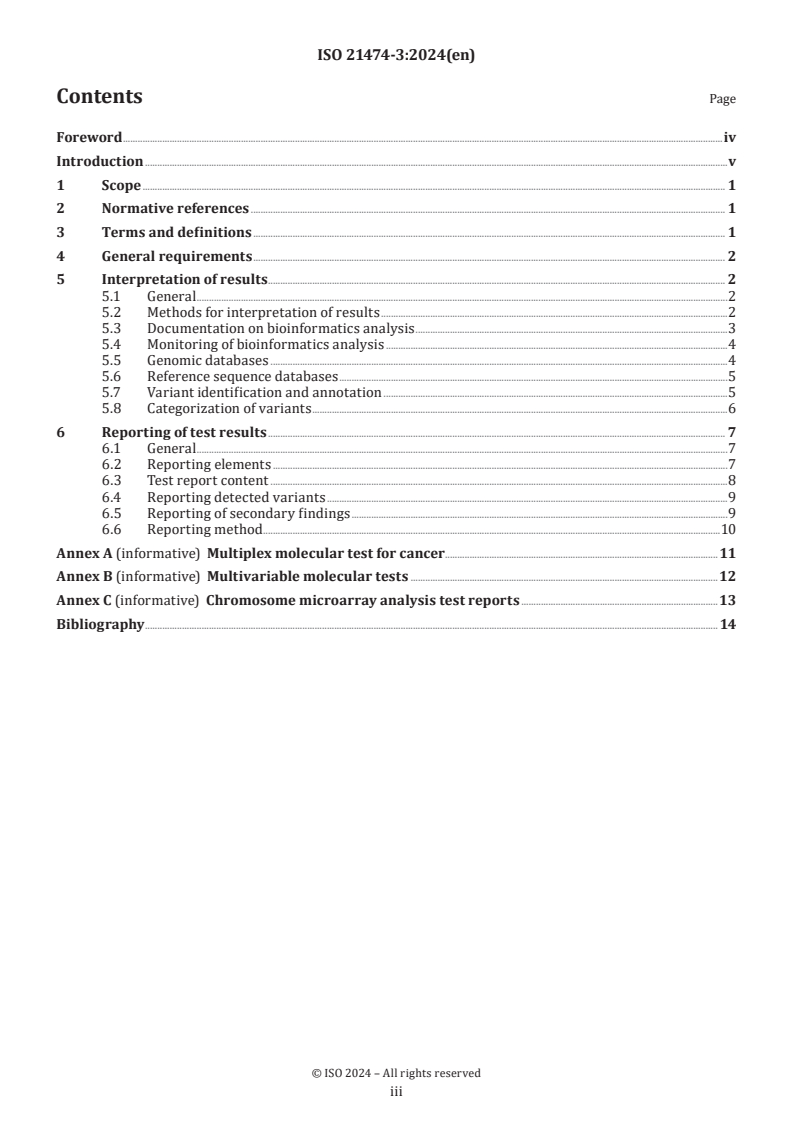
Contents Page
Foreword .iv
Introduction .v
1 Scope . 1
2 Normative references . 1
3 Terms and definitions . 1
4 General requirements . 2
5 Interpretation of results . 2
5.1 General .2
5.2 Methods for interpretation of results .2
5.3 Documentation on bioinformatics analysis .3
5.4 Monitoring of bioinformatics analysis .4
5.5 Genomic databases .4
5.6 Reference sequence databases .5
5.7 Variant identification and annotation .5
5.8 Categorization of variants .6
6 Reporting of test results . 7
6.1 General .7
6.2 Reporting elements .7
6.3 Test report content .8
6.4 Reporting detected variants .9
6.5 Reporting of secondary findings .9
6.6 Reporting method .10
Annex A (informative) Multiplex molecular test for cancer .11
Annex B (informative) Multivariable molecular tests .12
Annex C (informative) Chromosome microarray analysis test reports .13
Bibliography . 14
iii
Foreword
ISO (the International Organization for Standardization) is a worldwide federation of national standards
bodies (ISO member bodies). The work of preparing International Standards is normally carried out through
ISO technical committees. Each member body interested in a subject for which a technical committee
has been established has the right to be represented on that committee. International organizations,
governmental and non-governmental, in liaison with ISO, also take part in the work. ISO collaborates closely
with the International Electrotechnical Commission (IEC) on all matters of electrotechnical standardization.
The procedures used to develop this document and those intended for its further maintenance are described
in the ISO/IEC Directives, Part 1. In particular, the different approval criteria needed for the different types
of ISO documents should be noted. This document was drafted in accordance with the editorial rules of the
ISO/IEC Directives, Part 2 (see www.iso.org/directives).
ISO draws attention to the possibility that the implementation of this document may involve the use of (a)
patent(s). ISO takes no position concerning the evidence, validity or applicability of any claimed patent
rights in respect thereof. As of the date of publication of this document, ISO had not received notice of (a)
patent(s) which may be required to implement this document. However, implementers are cautioned that
this may not represent the latest information, which may be obtained from the patent database available at
www.iso.org/patents. ISO shall not be held responsible for identifying any or all such patent rights.
Any trade name used in this document is information given for the convenience of users and does not
constitute an endorsement.
For an explanation of the voluntary nature of standards, the meaning of ISO specific terms and expressions
related to conformity assessment, as well as information about ISO's adherence to the World Trade
Organization (WTO) principles in the Technical Barriers to Trade (TBT), see www.iso.org/iso/foreword.html.
This document was prepared by Technical Committee ISO/TC 212, Medical laboratories and in vitro diagnostic
systems.
A list of all parts in the ISO 21474 series can be found on the ISO website.
Any feedback or questions on this document should be directed to the user’s national standards body. A
complete listing of these bodies can be found at www.iso.org/members.html.
iv
Introduction
The first generation of in vitro diagnostic (IVD) medical devices for nucleic acid-based molecular tests
has been focused on detection or quantitation of a single nucleic acid sequence (e.g. viral RNA, mRNA,
or genomic DNA) within a clinical specimen. By comparison, a multiplex molecular test simultaneously
measures multiple nucleic acid sequences of interest in a single reaction tube or a system. The development
and clinical use of multiplex IVD medical devices are rapidly expanding with the technological advances and
new elucidation of the clinical significance of many biomarkers.
In comparison to single target analysis, multiplex molecular tests require an increased number of controls,
more complex performance evaluation/data analysis algorithms, and more complex interpretation and
[1,2]
reporting of results. Some multiplex systems amplify multiple targets in a single reaction step and then
[3]
split these into reactions for specific target detection.
Laboratories can develop assays in-house (“laboratory-developed test (LDT)”, “home-brew”, or “in-house
test”) or use commercially available multiplex assays involving a variety of technologies and instrument
platforms. Multiplex molecular testing provides large amounts of complicated and multifarious genetic
information, resulting in significant challenges to the laboratory with regards to appropriate data analysis,
interpretation and reporting.
Implementation of a multiplex molecular test identifies large numbers of genetic variations in a sample,
which is crucial for optimal patient care, and treatment guidelines are developed based on specific molecular
findings; therefore, it is imperative to standardize the interpretation and reporting of molecular results
among laboratories performing these tests.
This document describes the requirements and recommendations for various aspects of interpretation and
reporting of the results by multiplex molecular tests in order to ensure the quality of laboratory services of
such tests, in implementing multiplex molecular nucleic acid tests for clinical use.
v
International Standard ISO 21474-3:2024(en)
In vitro diagnostic medical devices — Multiplex molecular
testing for nucleic acids —
Part 3:
Interpretation and reports
1 Scope
This document gives the general requirements for interpretation and reporting of multiplex molecular
tests which simultaneously identify two or more nucleic acid target sequences of interest. This document is
applicable to all multiplex methods used for examination using in vitro diagnostic (IVD) medical devices and
laboratory developed tests (LDTs). It provides information for both qualitative and quantitative detection of
nucleic acid target sequences.
This document is intended as guidance for multiplex examinations that detect or quantify human nucleic
acid target sequences and microbial pathogen nucleic acid target sequences from human clinical specimens.
This document is applicable to any molecular IVD examination performed by medical laboratories. It is also
intended to be used by laboratory customers, IVD developers and manufacturers, biobanks, institutions,
commercial organizations performing biomedical research, and regulatory authorities. This document is
not applicable to metagenomic massive parallel sequencing (MPS), but it is applicable to multiplex molecular
methods including 16S sequencing.
2 Normative references
The following documents are referred to in the text in such a way that some or all of their content constitutes
requirements of this document. For dated references, only the edition cited applies. For undated references,
the latest edition of the referenced document (including any amendments) applies.
ISO 15189, Medical laboratories — Requirements for quality and competence
ISO 21474-1, In vitro diagnostic medical devices — Multiplex molecular testing for nucleic acids — Part 1:
Terminology and general requirements for nucleic acid quality evaluation
3 Terms and definitions
For the purposes of this document, terms and definitions given in ISO 21474-1 and the following apply.
ISO and IEC maintain terminology databases for use in standardization at the following addresses:
— ISO Online browsing platform: available at https:// www .iso .org/ obp
— IEC Electropedia: available at https:// www .electropedia .org/
3.1
process step
part of a process which is predominantly self-sufficient and consists of one or several unit operations
[SOURCE: ISO 10209:2022, 3.1.65]
4 General requirements
Multiplex molecular tests are IVD and medical devices that measure multiple nucleic acid sequences
simultaneously, such as multiplex PCR, DNA microarray, and MPS-based methodologies.
A multivariable molecular test is a molecular test that combines the values of multiple variables using an
interpretation function to yield a single patient-specific result including “classification”, “score” and/or
[5]
“index”. This is usually based on a platform of multiplex molecular tests, e.g. a miRNA assay. For more
guidance, see Annex B.
An increasing number of clinical and commercial laboratories have been performing multiplex molecular
tests and issuing corresponding clinical reports to provide information for the care of their patients.
However, the detected variants and relevant information in each report can differ because of the use of
different methodologies (e.g. multiplex PCR, DNA microarray, and MPS-based), panels (e.g. commercial
panels or laboratory-developed test panels), target enrichment strategies (e.g. targeted capture or multiplex
PCR), sequencing platforms, improvement countermeasures, bioinformatics analysis processes, and
databases (e.g. public databases or self-built databases) by different laboratories.
Based on accurate results of testing, laboratories shall make evidence-based testing interpretation and
release accurate and comprehensive reports, to ensure the best diagnosis and treatment strategies for
patients.
NOTE Further guidance on MPS is given in ISO 20397-2.
5 Interpretation of results
5.1 General
The interpretation method shall be fit for purpose and should be supported by a relevant validation study.
The laboratory shall have documented procedures for interpretation and reporting of results, including
algorithms, software, and databases. Procedures for interpretation shall include measures to minimize the
risk of cognitive bias.
For the implementation of quality management in the process of interpretation, see ISO/IEC/IEEE 90003,
which provides guidance for organizations in the application of ISO 9001 to the acquisition, supply,
development, operation and maintenance of computer software, and related support services.
Results by multiplex molecular tests, e.g. detected variants and combined values of multiple variables,
should be carefully reviewed by appropriately trained molecular diagnostic professionals in the context of
each complete case, including histological and clinical findings.
Evidence-based categorization, e.g. “classification”, “scoring” and/or “indexing”, shall be performed before
reporting. Genomics is a rapidly evolving field; therefore, the clinical significance of any variant in therapy,
diagnosis, or prognosis should be re-evaluated on an ongoing basis.
5.2 Methods for interpretation of results
Methods to analyse the test results can differ, depending on the intended use of the test and whether the test
results are qualitative or quantitative in nature.
Multiplex molecular tests, such as DNA microarray, and MPS-based methodologies comprise wet analysis
and bioinformatic processes. Bioinformatic processes should include considerations on genomic databases,
reference sequence databases, variant identification annotation and categorization, and curation.
In interpretation of results of multiplex molecular tests, the laboratory should take it into consideration
that the positive predictive value (PPV) and negative predictive value (NPV) of each target of detection is
influenced by the prevalence of target diseases or conditions of interest.
A multivariate assay with algorithmic analyses combines the results of two or more biomarkers, with or
without patient demographics and clinical information, into an algorithm to generate a classifier to stratify
patients into different outcome groups for subsequent clinical follow-up. The algorithm can be a simple
linear regression model or more complicated non-linear model(s) when required.
Where a cut-off is applicable to an assay, the cut-off should be used to determine the clinical sensitivity and
clinical specificity.
When the multi-variate assays, such as miRNA-based assays, are generated from multiple analytes with no
diagnostic value for the individual analytes, the result should be described using the risk scores instead of
using the reading from the individual analytes.
In case of multivariable molecular test (e.g. miRNA analysis), the algorithm integrates the expression levels
of analytes and normalizes it into a single numerical score that classifies the individuals into positive,
negative and in some cases, intermediate outcome groups. Since the inputs to algorithm are an individual
[2],[5]
analyte expression level or concentration, the validity of the algorithm shall be monitored. For more
guidance, see Annex B.
As manual interpretation is prone to missing critical information generated by multiplex molecular testing,
laboratories should put in place an automated procedure for the process of interpretation based on updating
informative databases in a timely manner.
5.3 Documentation on bioinformatics analysis
The laboratory shall use a documented standard operating procedure (SOP) for bioinformatics to analyse,
interpret, and report the results. A complete procedure manual shall be available on the workbench or in the
work area.
The laboratory shall document all algorithms, software, and databases used in the analysis, interpretation,
and reporting of results.
The versions of each of these components in the overall bioinformatics shall be recorded and traceable for
each patient result.
For each component, the laboratory can use a baseline, default installation, or it can customize the process by
using alternate configuration parameters in deploying individual bioinformatics tools or in running specific
algorithms. These customized tools should be adopted to the extent that they do not affect the performance
of the test and may be subject to additional verification and validation steps.
The laboratory shall document any customizations that vary from the specified configuration, namely which
parameters, cut-offs, and values are used.
When describing the bioinformatics process, the laboratory should document the overall workflow of the
data analysis and include the input and output files for each process step. For each step, the laboratory
should develop and document acceptable quality control parameters for ensuring the specified performance
characteristics.
Where applicable, the laboratory should develop and document criteria for variant calling and called
parameters, including thresholds for read coverage depth, variant quality scores, and allelic read
percentages.
Evidence of compliance with this document, i.e. ISO 21474-3, should be demonstrated with appropriate
documentation.
The laboratory should also document the bioinformatics processes that are used for reducing a large data
set to a list of either causal relation or candidate genes or variants or both. For example, in inherited disease
assays, the laboratory should document approaches used to identify recessive (latent or occult), dominant
(overt or explicit), and new variants.
Where applicable, bioinformatics analyses are conducted by aligning sequence reads to a reference sequence.
The reference sequence version number and assembly details shall also be identified. Further information is
available in ISO 20397-2.
Variants shall be named according to international nomenclature used by sector organizations standards
(e.g. The Human Genome Variation Society (HGVS), the Internal System for Human Cytogenetic Nomenclature
1)
(ISCN), and the International Union of Microbiological Societies) , allowing explicit mapping to standardized
reference numbers.
As the number of targets of interest increases in a multiplex assay, false negative (FN) results for certain
sequences can become more problematic. In particular, the target with the lowest abundance within the
nucleic acid sample should be assessed.
As the number of targets of interest increases, false positive (FP) results can become more problematic.
For example, intrinsic limitation of microarrays is probe cross-hybridization to similar sequences within a
genome. Sequence errors can also occur during nucleic acid amplification, leading to incorrect base calling.
There is also a risk of FP results due to contamination while collecting and handling clinical specimens. Thus,
the influence should be assessed with an appropriate method, such as using the quantitative measurement
with cut-off values.
5.4 Monitoring of bioinformatics analysis
For bioinformatic analysis of generated data, the laboratory shall monitor validated performance of
parameters, including robustness, accuracy, and reproducibility at each step.
5.5 Genomic databases
The genomic databases provide information that is necessary for accurate annotation and prioritization of
variants. Laboratories should exercise the following cautionary steps on the use of public databases:
a) Understand the content of the database and how the data are aggregated. The laboratory should review
the documentation or published literature relating to a given database to ascertain the source, type, and
intent of the database.
b) Pay specific attention to the limitation of each database to avoid overinterpretation of annotation
results.
c) Confirm the versions of the reference sequence version and assembly details as well as mRNA transcript
references to ensure appropriate HGVS annotation or ISCN.
d) Whenever possible, use genomic coordinates, instead of HGVS nomenclature or ISCN, to unambiguously
query genomic databases.
e) Assess the quality of the provided genomic data based on the source, from publications or another
database, the number of a specific entries (single or multiple), the depth of the study, the use of
appropriate controls, confirmation of a variant’s somatic origin, and functional and potential drug
response studies.
f) Verify data quality of the pathological diagnosis when provided (e.g. site, diagnosis, and subtype).
1) The Human Genome Variation Society (HGVS)
https:// hgvs -nomenclature .org/ stable/ https:// hgvs -nomenclature .org/ stable/
The Internal System for Human Cytogenetic Nomenclature (ISCN)
https:// iscn .karger .com
The International Union of Microbiological Societies
https:// www .the -icsp .org/ index .php/ international -union -of -microbiological -societies
NOTE 1 Public genomics resources include: University of California at Santa Cruz (UCSC) Genome Browser,
ENSEMBL, DECIPHER, Database of Genomic Variants (DGV), Online Mendelian Inheritance in Man (OMIM), Genome
Aggregation Database (gnomAD), The Human Gene Mutation Database (HGMD), ClinVar, Catalogue of Somatic
Mutations in Cancer (COSMIC), etc. The genotype and phenotype database is available at National Center for
2)
Biotechnology Information (NCBI) and the Center for Genomic Epidemiology.
NOTE 2 Public genomics resources for pathogen genome data include: GenBank, EzBiocloud, KmerFinder, leBIBI,
3)
Type Strains Genome (gcType) Database, pubMLST, MycoBank, etc.
NOTE 3 Nextstrain is an open-source project to harness the scientific and public health potential of pathogen
4)
genome data.
5.6 Reference sequence databases
Reference sequence databases provide information on the version of the genome assembly and related
information on human and pathogens, such as genomic coordinates, for unambiguous representation of
sequence variants.
Species identification of pathogens can be performed on genome sequencing data by either 16S
characterization, or by identifying short strings of DNA used in genome assembly (e.g. k-mer identification).
Particularly, in the case of miRNA, each sequence has its own nomination. The name and their sequences
cannot always match each other since nucleic acid databases (e.g. miRbase) release is constantly being
updated. The registered nomination should be referred to by the database name and the accession number.
5.7 Variant identification and annotation
Variant identification is a critical starting point of variant interpretation in human and pathogen genome.
There are many variant detection software tools that cater to one specific alteration, such as single
nucleotide variant (SNV), indels, structural variants, and copy number variations (CNVs). Laboratories shall
understand the limitations of these variant detection tools. The laboratory should appropriately verify and
validate the bioinformatic processes, including commercially purchased bioinformatics packages, to ensure
the quality of the results.
One of the challenging aspects of variant annotation is the conversion of genomic coordinates (i.e.
chromosome and position) to the corresponding cDNA/amino acid coordinate system (c. and p. syntax,
respectively) for interpretation.
Certain metrics for detected variants should be included in variant evaluation for the interpretation. This is
particularly important for somatic variant interpretation in the absence of paired normal and for evaluating
tumor clonal diversity.
2) UCSC Genome Browser https:// genome .ucsc .edu
ENSEMBL https:// asia .ensembl .org/ index .html
DECIPHER https:// www .deciphergenomics .org
Database of Genomic Variants (DGV) https:// www .ncbi .nlm .nih .gov/ pmc/ articles/ PMC3965079/
Online Mendelian Inheritance in Man (OMIM) https:// www .omim .org
gnomAD (Genome Aggregation Database) https:// gnomad .broadinstitute .org
The Human Gene Mutation Database (HGMD) https:// www .hgmd .cf .ac .uk/ ac/ index .php
ClinVar https:// www .ncbi .nlm .nih .gov/ clinvar/
Catalogue of Somatic Mutations in Cancer (COSMIC)
https:// www .sanger .ac .uk/ group/ cosmic -catalogue -of -somatic -mutations -in -cancer/
National Center for Biotechnology Information (NCBI) https:// www .ncbi .nlm .nih .gov/
3) GenBank https:// www .ncbi .nlm .nih .gov/ genbank/
EzBiocloud https:// www .ezbiocloud .net
KmerFinder https:// www .genomicepidemiology .org
leBIBI https:// bio .tools/ lebibipqp
Type Strains Genome (gcType) Database https:// gctype .wdcm .org
pubMLST https:// pubmlst .org
MycoBank https:// www .mycobank .org
4) Nextstrain https:// nextstrain .org
Special care should be taken when evaluating possible haematological malignancies because many
commonly mutated genes in leukaemia and myelodysplastic syndromes can also be somatically mutated
in the blood of otherwise healthy individuals (i.e. clonal haematopoiesis) and, therefore, can be incorrectly
annotated as polymorphisms.
NOTE 1 In a multiplex molecular test, certain metrics for detected variants can be critical for variant interpretation,
such as supporting reads (depth of coverage) and variant allele frequency (VAF).
NOTE 2 In chromosome microarray analysis, karyotype, gender, and other genetic information can be important
for variant interpretation.
5.8 Categorization of variants
Each detected variant shall be categorized in an evidence-based approach. Variants include SNVs, indels,
fusion genes resulting from genomic rearrangements, and CNVs. Interpretation of germline sequence
variations should be focused on pathogenicity of a variant for a specific disease or disease causality. On
the other hand, interpretation of somatic variants should be focused on their impact on clinical care. A
variant can be considered a biomarker that affects clinical care if it predicts sensitivity, resistance, toxicity,
prognosis or response to a specific therapy, or otherwise alters clinical decision-making because of its
presence or absence.
In categorization of variants, the laboratory shall consider the requirements specific to the multiplex
molecular tests in the entire workflow to ensure the accuracy of sequences, e.g. more stringency in quality
and quantity of sample, an increased number of controls, and more complex performa
...