

ISO/TS 7552-2:2024
(Main)Molecular in vitro diagnostic examinations — Specifications for pre-examination processes for circulating tumour cells (CTCs) in venous whole blood — Part 2: Isolated DNA
General Information
- Abstract
This document specifies requirements and gives recommendations on the handling, storage, CTC enrichment and isolation, DNA isolation and storage, and documentation of venous whole blood specimens intended for the examination of DNA isolated from circulating tumour cells (CTCs) during the pre-examination phase before a molecular examination is performed. This document is applicable to molecular in vitro diagnostic examinations including laboratory developed tests performed by medical laboratories. It is also intended to be used by laboratory customers, in vitro diagnostics developers and manufacturers, biobanks, institutions, and commercial organizations performing biomedical research, and regulatory authorities. This document does not cover the isolation of genomic DNA directly from venous whole blood containing CTCs. This is covered in ISO 20186-2. This document does not cover the isolation of specific white blood cells and subsequent isolation of genomic DNA therefrom or the pre-analytical workflow requirements for viable CTC cryopreservation and culturing. NOTE 1 The requirements given in this document can also be applied to other circulating rare cells (e.g. foetal cells). NOTE 2 International, national, or regional regulations or requirements can also apply to specific topics covered in this document.
- Status
- Published
- Publication Date
- 03-Nov-2024
- Current Stage
- 6060 - International Standard published
- Start Date
- 04-Nov-2024
- Due Date
- 07-Dec-2024
- Completion Date
- 04-Nov-2024
Buy Documents

ISO/TS 7552-2:2024 - Molecular in vitro diagnostic examinations — Specifications for pre-examination processes for circulating tumour cells (CTCs) in venous whole blood — Part 2: Isolated DNA Released:11/4/2024
Overview
ISO/TS 7552-2:2024 - "Molecular in vitro diagnostic examinations - Specifications for pre-examination processes for circulating tumour cells (CTCs) in venous whole blood - Part 2: Isolated DNA" is a Technical Specification that defines requirements and recommendations for the pre-examination handling of venous whole blood specimens when the intended analyte is DNA isolated from circulating tumour cells (CTCs). Published by ISO in 2024, this document focuses on steps prior to molecular testing (qPCR, dPCR, NGS and related methods) to ensure reproducible, high-quality CTC-derived DNA for molecular in vitro diagnostic (IVD) examinations and laboratory-developed tests.
Key topics and technical requirements
The specification covers the full pre-analytical workflow and provides guidance on:
- Specimen collection: patient/donor information, selection of appropriate venous whole blood collection tubes (with or without stabilizers), and venipuncture considerations.
- Specimen storage and transport: handling recommendations for tubes with stabilizers versus conventional tubes to mitigate CTC degradation.
- CTC enrichment and isolation: requirements for using commercial enrichment/isolation systems or laboratory-developed procedures; minimizing co-enrichment of white blood cells (WBCs) to improve DNA purity.
- DNA isolation and storage: procedures for isolating DNA from enriched or isolated CTCs, options for commercial DNA extraction kits and laboratory methods, plus storage conditions.
- Quality and quantity assessment: guidance on assessing DNA yield and integrity suitable for downstream molecular assays.
- Documentation and traceability: recording pre-analytical variables, storage/transport conditions, and procedural details.
- Exclusions and scope boundaries: does not cover genomic DNA isolated directly from whole blood (covered by ISO 20186-2), isolation of specific WBCs, or cryopreservation/culturing of viable CTCs.
The document also includes an informative decision guideline (Annex A) for critical pre-analytical workflow steps and notes applicability to other rare circulating cells (e.g., fetal cells).
Applications and practical value
ISO/TS 7552-2:2024 supports reliable liquid biopsy workflows by standardizing pre-analytical steps that affect CTC DNA quality. Practical benefits include:
- Improved reproducibility and comparability of molecular diagnostic results.
- Guidance for developers of IVD devices and commercial CTC enrichment/isolation systems.
- Standardized procedures for clinical laboratories, biobanks, research organizations, and regulatory bodies concerned with CTC-based assays.
- Facilitating clinical translation of CTC molecular profiling for prognosis, therapy selection, and monitoring.
Who should use this standard
- Medical laboratories and pathology departments performing CTC molecular testing
- In vitro diagnostics (IVD) developers and manufacturers
- Biobanks and translational research labs handling CTC-containing blood samples
- Regulatory authorities and organizations developing diagnostic workflows
Related standards
- ISO 20186-2 (genomic DNA isolation directly from whole blood)
- ISO 15189 (medical laboratory quality and competence)
- ISO 15190 (laboratory safety)
Keywords: ISO/TS 7552-2:2024, circulating tumour cells, CTCs, pre-analytical, DNA isolation, venous whole blood, liquid biopsy, molecular in vitro diagnostic, CTC enrichment, DNA quality.
Relations
- Effective Date
- 12-Feb-2026
- Effective Date
- 12-Nov-2022
Buy Documents
ISO/TS 7552-2:2024 - Molecular in vitro diagnostic examinations — Specifications for pre-examination processes for circulating tumour cells (CTCs) in venous whole blood — Part 2: Isolated DNA Released:11/4/2024
Get Certified
Connect with accredited certification bodies for this standard

BSI Group
BSI (British Standards Institution) is the business standards company that helps organizations make excellence a habit.

TÜV Rheinland
TÜV Rheinland is a leading international provider of technical services.

TÜV SÜD
TÜV SÜD is a trusted partner of choice for safety, security and sustainability solutions.
Sponsored listings
Frequently Asked Questions
ISO/TS 7552-2:2024 is a technical specification published by the International Organization for Standardization (ISO). Its full title is "Molecular in vitro diagnostic examinations — Specifications for pre-examination processes for circulating tumour cells (CTCs) in venous whole blood — Part 2: Isolated DNA". This standard covers: This document specifies requirements and gives recommendations on the handling, storage, CTC enrichment and isolation, DNA isolation and storage, and documentation of venous whole blood specimens intended for the examination of DNA isolated from circulating tumour cells (CTCs) during the pre-examination phase before a molecular examination is performed. This document is applicable to molecular in vitro diagnostic examinations including laboratory developed tests performed by medical laboratories. It is also intended to be used by laboratory customers, in vitro diagnostics developers and manufacturers, biobanks, institutions, and commercial organizations performing biomedical research, and regulatory authorities. This document does not cover the isolation of genomic DNA directly from venous whole blood containing CTCs. This is covered in ISO 20186-2. This document does not cover the isolation of specific white blood cells and subsequent isolation of genomic DNA therefrom or the pre-analytical workflow requirements for viable CTC cryopreservation and culturing. NOTE 1 The requirements given in this document can also be applied to other circulating rare cells (e.g. foetal cells). NOTE 2 International, national, or regional regulations or requirements can also apply to specific topics covered in this document.
This document specifies requirements and gives recommendations on the handling, storage, CTC enrichment and isolation, DNA isolation and storage, and documentation of venous whole blood specimens intended for the examination of DNA isolated from circulating tumour cells (CTCs) during the pre-examination phase before a molecular examination is performed. This document is applicable to molecular in vitro diagnostic examinations including laboratory developed tests performed by medical laboratories. It is also intended to be used by laboratory customers, in vitro diagnostics developers and manufacturers, biobanks, institutions, and commercial organizations performing biomedical research, and regulatory authorities. This document does not cover the isolation of genomic DNA directly from venous whole blood containing CTCs. This is covered in ISO 20186-2. This document does not cover the isolation of specific white blood cells and subsequent isolation of genomic DNA therefrom or the pre-analytical workflow requirements for viable CTC cryopreservation and culturing. NOTE 1 The requirements given in this document can also be applied to other circulating rare cells (e.g. foetal cells). NOTE 2 International, national, or regional regulations or requirements can also apply to specific topics covered in this document.
ISO/TS 7552-2:2024 is classified under the following ICS (International Classification for Standards) categories: 11.100.10 - In vitro diagnostic test systems. The ICS classification helps identify the subject area and facilitates finding related standards.
ISO/TS 7552-2:2024 has the following relationships with other standards: It is inter standard links to CEN ISO/TS 7552-2:2024, ISO 23778:2022. Understanding these relationships helps ensure you are using the most current and applicable version of the standard.
ISO/TS 7552-2:2024 is available in PDF format for immediate download after purchase. The document can be added to your cart and obtained through the secure checkout process. Digital delivery ensures instant access to the complete standard document.
Standards Content (Sample)
Technical
Specification
ISO/TS 7552-2
First edition
Molecular in vitro diagnostic
2024-11
examinations — Specifications
for pre-examination processes for
circulating tumour cells (CTCs) in
venous whole blood —
Part 2:
Isolated DNA
Analyses de diagnostic moléculaire in vitro — Spécifications
relatives aux processus préanalytiques pour les cellules tumorales
circulantes (CTC) dans le sang total veineux —
Partie 2: ADN isolé
Reference number
© ISO 2024
All rights reserved. Unless otherwise specified, or required in the context of its implementation, no part of this publication may
be reproduced or utilized otherwise in any form or by any means, electronic or mechanical, including photocopying, or posting on
the internet or an intranet, without prior written permission. Permission can be requested from either ISO at the address below
or ISO’s member body in the country of the requester.
ISO copyright office
CP 401 • Ch. de Blandonnet 8
CH-1214 Vernier, Geneva
Phone: +41 22 749 01 11
Email: copyright@iso.org
Website: www.iso.org
Published in Switzerland
ii
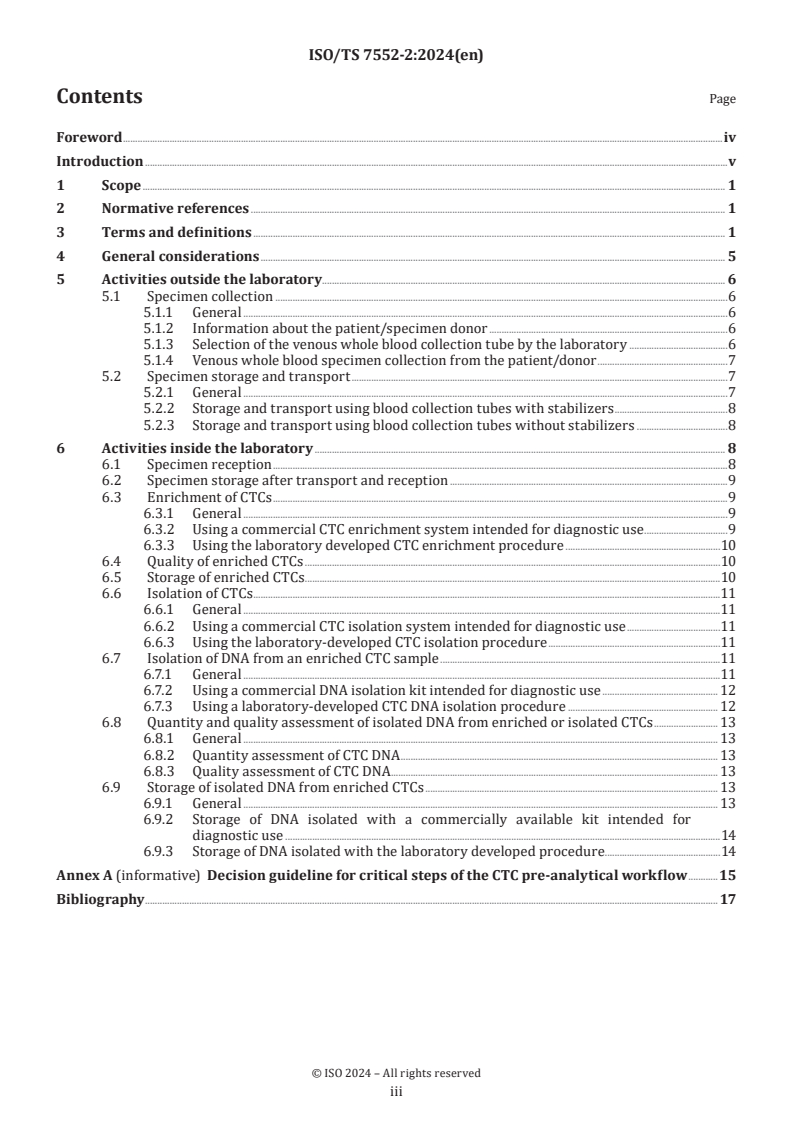
Contents Page
Foreword .iv
Introduction .v
1 Scope . 1
2 Normative references . 1
3 Terms and definitions . 1
4 General considerations . 5
5 Activities outside the laboratory. 6
5.1 Specimen collection .6
5.1.1 General .6
5.1.2 Information about the patient/specimen donor .6
5.1.3 Selection of the venous whole blood collection tube by the laboratory .6
5.1.4 Venous whole blood specimen collection from the patient/donor .7
5.2 Specimen storage and transport .7
5.2.1 General .7
5.2.2 Storage and transport using blood collection tubes with stabilizers .8
5.2.3 Storage and transport using blood collection tubes without stabilizers .8
6 Activities inside the laboratory . 8
6.1 Specimen reception .8
6.2 Specimen storage after transport and reception .9
6.3 Enrichment of CTCs .9
6.3.1 General .9
6.3.2 Using a commercial CTC enrichment system intended for diagnostic use .9
6.3.3 Using the laboratory developed CTC enrichment procedure .10
6.4 Quality of enriched CTCs .10
6.5 Storage of enriched CTCs .10
6.6 Isolation of CTCs .11
6.6.1 General .11
6.6.2 Using a commercial CTC isolation system intended for diagnostic use .11
6.6.3 Using the laboratory-developed CTC isolation procedure .11
6.7 Isolation of DNA from an enriched CTC sample .11
6.7.1 General .11
6.7.2 Using a commercial DNA isolation kit intended for diagnostic use . 12
6.7.3 Using a laboratory-developed CTC DNA isolation procedure . 12
6.8 Quantity and quality assessment of isolated DNA from enriched or isolated CTCs . 13
6.8.1 General . 13
6.8.2 Quantity assessment of CTC DNA . 13
6.8.3 Quality assessment of CTC DNA . 13
6.9 Storage of isolated DNA from enriched CTCs . 13
6.9.1 General . 13
6.9.2 Storage of DNA isolated with a commercially available kit intended for
diagnostic use .14
6.9.3 Storage of DNA isolated with the laboratory developed procedure .14
Annex A (informative) Decision guideline for critical steps of the CTC pre-analytical workflow .15
Bibliography . 17
iii
Foreword
ISO (the International Organization for Standardization) is a worldwide federation of national standards
bodies (ISO member bodies). The work of preparing International Standards is normally carried out through
ISO technical committees. Each member body interested in a subject for which a technical committee
has been established has the right to be represented on that committee. International organizations,
governmental and non-governmental, in liaison with ISO, also take part in the work. ISO collaborates closely
with the International Electrotechnical Commission (IEC) on all matters of electrotechnical standardization.
The procedures used to develop this document and those intended for its further maintenance are described
in the ISO/IEC Directives, Part 1. In particular, the different approval criteria needed for the different types
of ISO documents should be noted. This document was drafted in accordance with the editorial rules of the
ISO/IEC Directives, Part 2 (see www.iso.org/directives).
ISO draws attention to the possibility that the implementation of this document may involve the use of (a)
patent(s). ISO takes no position concerning the evidence, validity or applicability of any claimed patent
rights in respect thereof. As of the date of publication of this document, ISO had not received notice of (a)
patent(s) which may be required to implement this document. However, implementers are cautioned that
this may not represent the latest information, which may be obtained from the patent database available at
www.iso.org/patents. ISO shall not be held responsible for identifying any or all such patent rights.
Any trade name used in this document is information given for the convenience of users and does not
constitute an endorsement.
For an explanation of the voluntary nature of standards, the meaning of ISO specific terms and expressions
related to conformity assessment, as well as information about ISO's adherence to the World Trade
Organization (WTO) principles in the Technical Barriers to Trade (TBT), see www.iso.org/iso/foreword.html.
This document was prepared by Technical Committee ISO/TC 212, Medical laboratories and in vitro diagnostic
systems, in collaboration with the European Committee for Standardization (CEN) Technical Committee
CEN/TC 140, In vitro diagnostic medical devices, in accordance with the Agreement on technical cooperation
between ISO and CEN (Vienna Agreement).
A list of all parts in the ISO 7552 series can be found on the ISO website.
Any feedback or questions on this document should be directed to the user’s national standards body. A
complete listing of these bodies can be found at www.iso.org/members.html.
iv
Introduction
Solid tumours release cells and bioanalytes into blood and other body fluids. This has opened the option
of utilizing such body fluids (liquid biopsies) for a minimally-invasive procedure for tumour detection,
diagnosis and characterization. Liquid biopsies can enable earlier detection and diagnosis of cancers and
[20,22]
advance personalized patient treatment.
These applications have become one of the fastest growing segments of the entire diagnostic market.
Circulating tumour cells (CTCs) in venous whole blood can reflect the disease complexity that evolves during
[22]
tumour progression, with distinct genetic, epigenetic and gene expression biomarkers.
Beside the prognostic role of CTC identification and enumeration in cancer progression, CTC molecular
characterization can improve disease outcome prediction, therapeutic guidance and post-treatment
[20]
monitoring of the patient.
CTCs are now considered as a surrogate of tumour tissue in cancer early development, progression, and
[23]
metastatic phase.
Molecular characterization of CTCs can provide a strategy for monitoring cancer genotypes during systemic
[24]
therapies, identifying mechanisms of disease progression, identifying novel targets for biological
[25] [20]
treatment and selecting targeted therapies. Moreover, CTC single-cell sequencing is an important tool
[26-28]
for tumour genomic heterogeneity analysis. Molecular examination techniques such as qPCR, dPCR
and sequencing methods including next generation sequencing (NGS) enable characterization of the CTC
specific DNA features.
CTCs are fragile and tend to degrade within a few hours when collected in conventional blood collection
tubes, e.g. EDTA containing tubes, without dedicated CTC stabilizers. CTCs are extremely rare, especially in
early disease, e.g. less than 10 cells per 10 ml of blood, representing a ratio of approximately 1:10 CTCs to
white blood cells (WBCs). This low ratio represents a significant challenge to CTC enrichment required for
examination. Furthermore, co-enrichment of normal blood cells causes a dilution of CTCs. The challenge is
to minimize the amount of co-enriched WBCs for subsequent accurate and sensitive detection of CTC specific
genetic and epigenetic alterations, especially when dealing with minor tumour cell clones.
Special measures to remove the WBCs are necessary in order to obtain good quality DNA samples
characterized by high purity and thus representative of the mutational pattern within the tumour.
Standardization includes all steps of the pre-examination process, including blood collection and stabilization,
transport, storage, CTC enrichment, CTC isolation (if included), and DNA isolation. This pre-examination
standardization is crucial to ensure reliable examination results in current clinical use and is also critical to
[29]
develop new CTC based diagnostic examinations and to establish these in clinical healthcare.
An illustration of critical steps of the CTC pre-analytical workflow is provided in Annex A.
This document describes special measures to obtain appropriate quality and quantity of DNA from CTC-
containing blood specimens for subsequent examination.
v
Technical Specification ISO/TS 7552-2:2024(en)
Molecular in vitro diagnostic examinations — Specifications
for pre-examination processes for circulating tumour cells
(CTCs) in venous whole blood —
Part 2:
Isolated DNA
1 Scope
This document specifies requirements and gives recommendations on the handling, storage, CTC enrichment
and isolation, DNA isolation and storage, and documentation of venous whole blood specimens intended for
the examination of DNA isolated from circulating tumour cells (CTCs) during the pre-examination phase
before a molecular examination is performed.
This document is applicable to molecular in vitro diagnostic examinations including laboratory developed
tests performed by medical laboratories. It is also intended to be used by laboratory customers, in vitro
diagnostics developers and manufacturers, biobanks, institutions, and commercial organizations performing
biomedical research, and regulatory authorities.
This document does not cover the isolation of genomic DNA directly from venous whole blood containing
CTCs. This is covered in ISO 20186-2.
This document does not cover the isolation of specific white blood cells and subsequent isolation of genomic
DNA therefrom or the pre-analytical workflow requirements for viable CTC cryopreservation and culturing.
NOTE 1 The requirements given in this document can also be applied to other circulating rare cells (e.g. foetal cells).
NOTE 2 International, national, or regional regulations or requirements can also apply to specific topics covered in
this document.
2 Normative references
The following documents are referred to in the text in such a way that some or all of their content constitutes
requirements of this document. For dated references, only the edition cited applies. For undated references,
the latest edition of the referenced document (including any amendments) applies.
ISO 15189, Medical laboratories — Requirements for quality and competence
ISO 15190, Medical laboratories — Requirements for safety
3 Terms and definitions
For the purposes of this document, the following terms and definitions apply.
ISO and IEC maintain terminology databases for use in standardization at the following addresses:
— ISO Online browsing platform: available at https:// www .iso .org/ obp
— IEC Electropedia: available at https:// www .electropedia .org/
3.1
aliquot
portion of a larger amount of homogenous material, assumed to be taken with negligible sampling error
Note 1 to entry: The term is usually applied to fluids. Tissues are heterogeneous and therefore cannot be aliquoted.
[SOURCE: ISO 20166-3:2018, 3.1]
3.2
analyte
component represented in the name of a measurable quantity
[SOURCE: ISO 17511:2020, 3.1, modified — The example has been removed.]
3.3
backflow
flow of a liquid opposite to the usual or desired direction
3.4
blood collection set
intravenous device specialized for venipuncture consisting of a stainless steel beveled needle and tube
(tubing) with attached plastic wings and fitting connector
Note 1 to entry: The connector attaches to an additional blood collection device, e.g. a blood collection tube (3.5).
3.5
blood collection tube
tube used for blood collection, usually in a vacuum which forces blood from the vein through the needle and
into the tube
3.6
circulating tumour cells
CTCs
cells present in blood, originating from a primary or metastatic site(s) of a tumour
3.7
closed system
non-modifiable system provided by the vendor including all necessary components for the analysis (i.e.
hardware, software, procedures and reagents)
[SOURCE: ISO 20186-2:2019, 3.6]
3.8
CTC enrichment
method that is able to increase the ratio of CTCs (3.6) to other cells including white blood cells in a sample (3.21)
3.9
CTC isolation
method resulting in a sample (3.21) containing CTCs (3.6) without any other cell type
3.10
deoxyribonucleic acid
DNA
polymer of deoxyribonucleotides occurring in a double-stranded (dsDNA) or single-stranded (ssDNA) form
[SOURCE: ISO 22174:2024, 3.1.6]
3.11
deoxyribonucleic acid proficiency testing program
DNA PT program
proficiency testing (3.19) for DNA based examinations (3.13)
3.12
diagnosis
identification of a health or disease state from its signs and symptoms, where the diagnostic process can
involve examinations (3.13) and tests for classification of an individual’s condition into separate and distinct
categories or subclasses that allow medical decisions about treatment and prognosis to be made
[SOURCE: ISO 20184-1:2018, 3.6]
3.13
examination
analytical test
set of operations having the objective of determining the numerical value, text value or characteristics of a
property
Note 1 to entry: Processes that start with the isolated analyte (3.2) and include all kinds of parameter testing or
chemical manipulation for quantitative or qualitative examination.
[SOURCE: ISO 15189:2022, 3.8, modified — The original Notes to entry have been removed, and a new Note 1
to entry has been added; “analytical test” has been added as a preferred term.]
3.14
examination performance
analytical test performance
analytical performance
ability of an examination (3.13) procedure to measure or detect a particular analyte (3.2)
Note 1 to entry: Analytical performance is determined from analytical performance studies used to assess the ability
of an in vitro diagnostic examination (3.13) procedure to measure or detect a particular analyte (3.2).
Note 2 to entry: Analytical performance includes such characteristics as analytical sensitivity, detection limit,
analytical specificity (interference and cross-reactivity), trueness, precision and linearity.
[SOURCE: ISO 20186-3:2019, 3.11]
3.15
manufacturer
entity that is legally responsible for manufacturing a specific workflow (3.26) component
Note 1 to entry: For the purpose of this document, manufacturers can be examination (3.13) manufacturers, collection
device manufacturers, CTC enrichment (3.8) and isolation manufacturers, nucleic acid isolation manufacturers.
3.16
needle holder
barrel used in routine venipuncture procedures to hold the blood collection tube (3.5) in place and to protect
the phlebotomist from direct contact with blood
[SOURCE: ISO 20186-1:2019, 3.16]
3.17
pre-examination process
pre-analytical phase
pre-analytical workflow
process that starts, in chronological order, from the clinician’s request and includes the examination
(3.13) request, preparation and identification of the patient, collection of the primary sample(s) (3.18),
transportation to and within the laboratory, cell enrichment, and isolation of analytes (3.2), ending when the
analytical examination begins
Note 1 to entry: The pre-examination phase includes preparative processes that influence the outcome of the intended
examination.
[SOURCE: ISO 15189:2022, 3.24, modified — “pre-analytical phase” and “pre-analytical workflow” have been
added as preferred terms; in the definition, “user's request” has been changed to “clinician's request”; “storage,
cell enrichment, isolation of analytes” has been added to the definition; Note 1 to entry has been added.]
3.18
primary sample
specimen
discrete portion of a body fluid or tissue or other sample (3.21) associated with the human body taken for
examination (3.13), study or analysis of one or more quantities or characteristics to determine the character
of the whole
[SOURCE: ISO 15189:2022, 3.25, modified — Note 1 to entry has been removed.]
3.19
proficiency testing
PT
evaluation of participant performance against pre-established criteria by means of interlaboratory
comparisons
[SOURCE: ISO/IEC 17043:2023, 3.7, modified — Note 1 to entry has been removed.]
3.20
room temperature
temperature in the range of 18 °C to 25 °C
Note 1 to entry: Local or national regulations can have different definitions.
3.21
sample
one or more parts taken from a primary sample (3.18)
[SOURCE: ISO 15189:2022, 3.28]
3.22
stability
ability of a sample (3.21) material, when stored under specified conditions, to maintain a stated property
value within specified limits for a specified period of time
[SOURCE: ISO Guide 30:2015, 2.1.15, modified — The words “reference material” were replaced by “sample
material”; “specified” replaced by “stated” before “property value”. Note 1 to entry has been removed.]
3.23
storage
prolonged interruption of the pre-examination workflow (3.26) of a sample (3.21) or analyte (3.2)
respectively, or of their derivatives e.g. stained sections or tissue blocks, under appropriate conditions in
order to preserve their properties
Note 1 to entry: Long-term storage typically occurs in laboratory archives or in biobanks.
[SOURCE: ISO 20166-3:2018, 3.21]
3.24
validation
confirmation, through the provision of objective evidence, that the requirements for a specific intended use
or application have been fulfilled
Note 1 to entry: The term “validated” is used to designate the corresponding status.
[SOURCE: ISO 9000:2015, 3.8.13, modified — The original Notes 1 to 3 to entry have been removed.]
3.25
verification
confirmation, through the provision of objective evidence, that specified requirements have been fulfilled
Note 1 to entry: The term “verified” is used to designate the corresponding status.
Note 2 to entry: Confirmation can comprise activities such as:
— performing alternative calculations;
— comparing a new design specification with a similar proven design specification;
— undertaking tests and demonstrations;
— reviewing documents prior to issue.
[SOURCE: ISO 9000:2015, 3.8.12, modified — The original Notes 1 and 2 to entry have been removed and
Note 2 to entry has been added.]
3.26
workflow
series of activities necessary to complete a task
[SOURCE: ISO 20166-3:2018, 3.25]
4 General considerations
Refer to ISO 15189, ISO/IEC 17020 or ISO/IEC 17025 for general statements on medical laboratory quality
management systems. In vitro diagnostics (IVD) manufacturers should follow ISO 13485. General quality
management system requirements can be found in ISO 9001. For other general requirements on pre-
examination processes, including pre-collection activities, collection, transport, receipt, and handling of
specimen, see ISO 20658 and ISO 15189:2022,7.2.
All steps of a diagnostic workflow can influence the final analytical test result. Thus, the entire workflow
including biomolecule stability and both specimen and sample storage conditions shall be specified, verified,
and validated during the development of the examination including the development of in vitro diagnostic
medical devices. A risk assessment of relevant workflow steps including their potential impact on the
analytical test performance shall be performed and mitigation measures shall be established to enable the
required analytical test performance. Guidance is provided in ISO 14971 and ISO 35001.
CTC analysis usually involves a CTC enrichment step (e.g. by size, immunomagnetic-, or microfluidic-based
approaches) prior to DNA isolation (Annex A). Depending on the requirements of the examination, enriched
CTCs can undergo additional steps after CTC enrichment such as further characterization and selection prior
to DNA isolation (see 6.4, 6.6 and Annex A). Due to the nature of the specimen/sample and the complexity
of the procedure potentially affecting the yield, purity and integrity of DNA, appropriate measures shall be
taken during the pre-examination workflow to obtain suitable quantity and quality of DNA derived from
CTCs for the examination.
The degree of contamination of CTCs with WBCs or other cells is critical. The presence of WBCs in a
CTC enriched sample is unavoidable and can strongly affect the performance of the examination e.g. the
sensitivity of detection of a somatic mutation. To overcome this problem, an isolation step can be necessary
to obtain a pure CTC sample for DNA isolation.
During the whole pre-examination process, precautions shall be taken to avoid cross contamination
between either different specimens or samples, e.g. by using single-use material whenever feasible or by
using appropriate cleaning procedures between processing of either different specimens or samples.
Safety instructions for the whole pre-examination process shall be in place and followed. They shall be in
accordance with requirements specified in ISO 15189 and ISO 15190.
The manufacturer's material safety data sheet shall be considered before first use of any potentially
hazardous material (e.g. chemicals in stabilizers).
For all pre-examination steps, the examination manufacturer's instructions shall be followed.
Where, for justified reasons (e.g. unmet patient needs), a commercial product is not used in accordance with
the manufacturer's instructions, responsibility for its verification, validation, use and performance lies with
the laboratory.
5 Activities outside the laboratory
5.1 Specimen collection
5.1.1 General
For the collection of the blood specimen, the requirements for the intended molecular examination (e.g. type
of blood collection tube, collection procedure) laid out in Clause 6 shall be followed.
5.1.2 Information about the patient/specimen donor
The documentation shall include the ID of the specimen donor/patient, which can be in the form of a code.
The documentation should include, but is not limited to:
a) the relevant health status of the specimen donor/patient (e.g. healthy, disease type, concomitant disease,
demographics such as age, sex and gender);
b) the information about medical treatment and special treatment prior to blood collection;
c) the type and purpose of the examination requested;
d) the appropriate consent from the specimen donor/patient (see also ISO 15189);
e) time point of the blood draw where relevant (e.g. patients rest or active times).
NOTE A recent study demonstrated a higher CTC concentration in blood during the rest phase of breast cancer
[33]
patients.
5.1.3 Selection of the venous whole blood collection tube by the laboratory
Due to the low number of CTCs, a high recovery efficiency is required during enrichment. This can be
hampered by the potential instability of CTCs during transport and storage, leading to a reduction of the
[34]
CTC number in the specimen or reduced compatibility with the enrichment system.
Therefore, venous whole blood should be collected in appropriate collection tubes with stabilizers
maintaining the integrity of the CTCs for enabling sensitive DNA examination.
The examination manufacturer instructions should contain specifications on the blood collection tube(s) to
be used. Where the examination manufacturer specifies usage of dedicated blood collection tube(s), these
shall be used.
Where the examination manufacturer does not provide such specifications, but either the CTC enrichment
or the isolation manufacturer specifies a dedicated blood collection tube, this can serve as a basis for the
laboratory's tube verification for the examination. Where such specified blood collection tube does not meet
the examination requirements or none of the manufacturers specifies a blood collection tube, the blood
collection tube shall be specified, verified and documented by the laboratory. Due to the post-collection
variability of the CTC (numbers and morphology) venous whole blood should be collected in commercially
available venous whole blood collection tubes containing CTC stabilizers enabling a sufficient DNA yield
(CTC/DNA stabilizer) for the intended examination.
The blood collection tube catalogue and lot number should be documented.
Blood collection tubes not containing any CTC/DNA stabilizers should be used only if specified by the
examination manufacturer's instructions. In these cases, conventional blood collection tubes, e.g. EDTA
containing tubes, should be used, although EDTA does not prevent changes of CTCs but it prevents blood
clotting, which can minimize the potential impact of blood clots on the CTCs. Blood micro clots can impact
some CTC enrichment procedures thus changing the CTC subpopulation, or even strongly hamper the entire
CTC enrichment procedure. The examination manufacturer's specifications shall be considered for further
details.
NOTE 1 Studies have shown that CTC detection is possible in EDTA-collected venous whole blood within 4 h after
[35–40]
blood draw from patients with different tumour types.
NOTE 2 There are also alternatives to conventional blood collection-based CTC enrichments. These systems allow
[41,42]
for in vivo and ex vivo CTC sampling from larger blood volumes.
5.1.4 Venous whole blood specimen collection from the patient/donor
The identity of the person collecting the specimen shall be documented. This can be documented in form of
the name or a code. The date and time of blood collection shall be documented.
For the labelling (both specimen and sample identification) of the blood collection tube, a routine procedure
(e.g. ISO 15189 for medical laboratories or ISO 20387 for biobanks) or a similar procedure with optional
additional information (e.g. 2D-barcode) shall be used.
Standard venipuncture techniques can be used, if not specified differently by the blood collection tube
manufacturer. For avoiding significant changes of the CTC population during the blood collection (e.g. lysis
of CTCs by shearing), a suitable needle of sufficiently large gauge diameter shall be specified and verified
during the development of a blood collection tube intended for collecting CTCs contained in blood.
Steps for preventing possible backflow into the donor’s/patient’s body can be required.
The blood collection tube manufacturer shall provide specified and verified instructions on the blood
collection procedure. These shall be followed. A blood collection set and needle holder can be required when
using CTC/DNA profile stabilizer containing tubes. In this case, the instructions of the collection set and
needle holder manufacturer shall be followed, as long as not specified and verified differently (e.g. by the
blood collection tube manufacturer).
Blood collection tubes shall be filled in accordance with the manufacturer's instructions and attention should
be drawn to the correct positioning of the collection tube during the blood draw as well as the required
blood volume. Blood collection tube developers and manufacturers shall specify and verify the limits of tube
underfilling. The examination manufacturers shall verify the specification for the dedicated examination.
NOTE 1 The integrity of CTCs can be influenced by inadequate venous whole blood collection procedures.
NOTE 2 Underfilling of blood collection tubes containing CTC/DNA stabilizers can compromise the function of the
stabilizers due to an unfavourable blood to stabilizer ratio. This can in itself compromise the CTCs, which can impact
the validity and reliability of the examination results.
The blood collection tube manufacturer's instructions for mixing or inverting the tube immediately after
blood collection shall be followed. If no information about mixing or inverting is given by the manufacturer’s
instructions, each tube should be gently inverted 8 to 10 times.
Either incorrect or insufficient mixing can be one of the most frequent pre-examination variables. Unless
additives in the blood collection tubes are homogenously mixed with the specimen, the CTCs and DNA can be
compromised, which can impact the validity and reliability of the examination results. Correct mixing shall
therefore be a focus during education and periodic training of all personnel involved in blood collection.
The blood collection procedure shall be documented, as requested by the medical laboratory. Both any
tampering with and any addition to the specimen shall be documented.
5.2 Specimen storage and transport
5.2.1 General
When selecting and using transport packages (e.g. box for storing and transportation), transport regulations
can apply. A specified and verified procedure for specimen storage and transport and written instructions
shall be in place. The specified storage and transport conditions (e.g. temperature and duration) shall be
followed and documented including any deviations from them.
Temperature monitoring should be applied in a suitable manner in case the specified storage and transport
conditions cannot be ensured e.g. by the specified transport packages. The duration of temporary storage in
the blood collection facility and the duration of transport to the laboratory contribute to the total duration of
storage and transport. Special care should be taken to avoid CTC lysis as this will change the CTC population.
Therefore, the specimen shall not be frozen or shaken vigorously.
5.2.2 Storage and transport using blood collection tubes with stabilizers
The examination manufacturer shall provide specified and verified instructions for the storage and
transport of the collected blood specimen (e.g. duration, temperature) and these shall be followed.
Where the examination manufacturer does not provide such specifications (e.g. due to less stringent legal
frameworks), the procedure shall be specified, verified and documented by the laboratory.
Instructions shall be written accordingly for the user and followed. The blood collection tube manufacturer
specifications on storage and transport conditions can serve as a basis/framework for the laboratory's own
specific verification for the intended examination.
5.2.3 Storage and transport using blood collection tubes without stabilizers
Where the examination manufacturer specifies usage of blood collection tubes without stabilizers, they shall
provide specified and verified instructions for the storage and transport of the collected blood specimen
(e.g. duration, temperature) and these shall be followed.
Where the examination manufacturer does not provide such specifications (e.g. due to less stringent legal
frameworks), the procedure shall be specified, verified and documented by the laboratory. This should be
done by time course studies analysing the stability of the targeted examination analyte after blood draw.
NOTE A time course study involves repeated observations of the same variables at specific intervals over a
relevant time-period (e.g. time 0, 2 h, 6 h, 12 h, 24 h, 36 h, 48 h). This reflects any knowledge on the stability of the
analyte(s) of interest. Typically, this involves multiple aliquots from the same donor taken from the same blood draw
repeated for several donors.
Depending on the results of the time course studies, it can be necessary to process specimens without delay
or after only a short storage duration to minimize the DNA changes and to maximize the CTC recovery.
Instructions shall be written accordingly for the user and followed.
The maximum duration and temperature of storage shall be specified and verified for the intended
examination.
6 Activities inside the laboratory
6.1 Specimen reception
The identity of the person receiving the specimen or sample shall be documented. This can be documented
in form of the name or a code. The correct identity of the specimen or sample shall be checked. This should
include the clinical information (see 5.1.1 and 5.1.2), hospital admission number, name of the patient
or donor, and date of birth of the patient or donor. In certain instances, e.g. in research studies, it can be
necessary to only work with a code. The arrival date, time and nonconformities of labelling, storage and
transport conditions (e.g. temperature, duration) and blood volume differences to specifications, leaking/
broken tubes, etc. shall be documented. A procedure for handling nonconformities shall be in place.
Where there are nonconformities, e.g. usage of non-specified blood collection tubes, in transport conditions,
overall storage, and transport duration or blood volume or accidental freezing that can affect the validity
and reliability of the examination result, a new specimen should be obtained.
6.2 Specimen storage after transport and reception
Where further storage in the laboratory is needed, the storage temperature and the date and time when
starting either specimen or sample storage shall be documented.
Storage temperature and total storage duration shall not exceed specifications identified in 5.2.
The specimen total storage duration includes the duration of storage at the blood collection facility (5.1.4),
of transport to the laboratory (5.2.2) and of further storage at the laboratory or other institutions.
The maximum storage duration specified by the examination manufacturer or, if this is not provided, by the
laboratory (see 5.2.2) shall not be exceeded.
6.3 Enrichment of CTCs
6.3.1 General
CTC examinations usually require an enrichment of CTCs from other cell types, typically white blood
cells. CTC enrichment is achieved based on the physical (e.g. cell size, cell deformability) or the biological
[24]
properties (e.g. presence of specific epitopes) of these cells. More details on CTC enrichment procedures
can be found in Annex A. Different methods for CTC enrichment can result in different yields (number of
recovered CTCs) and different CTC to white blood cell ratio. Moreover, different enrichment methods can
[23]
select different CTC subpopulations (e.g. epithelial, mesenchymal ). These aspects should be considered
during the design, verification, and validation of an examination (e.g. by specifying the minimum number of
required CTCs, the maximum percentage of contaminating white blood cells that is acceptable). This can be
done by analysing the DNA of spiked-in cancer cells from established cell lines prior and after the enrichment
procedure. Where unacceptable CTC yield occurs, action should be taken to minimize changes e.g. by adding
a CTC stabilizer before starting the enrichment.
The CTC/DNA stabilizer in a blood collection tube can also be effective during the CTC enrichment depending
on the chemical characteristics of the stabilizer. If the CTC/DNA stabilizer used in the blood collection
tube is not effective anymore during CTC enrichment, an additional stabilizer should be added for the CTC
enrichment procedure.
To minimize cross contamination with amplified nucleic acids, the enrichment of CTCs should not be
performed in the same area as the nucleic acid amplification steps of the examination process, unless closed
systems are used, which are verified to avoid cross-contamination for the intended application.
6.3.2 Using a commercial CTC enrichment system intended for diagnostic use
The examination manufacturer shall provide specified and verified instructions on CTC enrichment and
these shall be followed.
Where the examination manufacturer does not provide such specifications (e.g. due to less stringent legal
frameworks), but the blood collection tube manufacturer and/or the CTC isolation manufacturer and/or
the DNA isolation kit manufacturer has/have specified and verified one or several dedicated commercially
available CTC enrichment system(s), these can serve as a basis/framework for the laboratory's examination
specific verification.
NOTE Commercial CTC enrichment systems can sometimes be integrated into parts of commercially available
pre-examination workflows together with CTC DNA, CTC RNA, and CTC protein isolation kits, while other commercial
solutions are stand-alone procedures that end with CTC enrichment.
Where none of these manufacturers has specified and verified a specific CTC enrichment system, the
laboratory shall select, specify, verify, and document an appropriate CTC enrichment system approved for
diagnostic use, where available. Instructions for use shall be written accordingly and followed.
Where the selected CTC enrichment procedure does not sufficiently support the specified examination
performance characteristics, the laboratory should modify it accordingly (e.g. by increasing the volume
of either the blood specimen or sample, by modifying the pressure applied for filtration, by adjusting the
quantity of the capture antibody or using an additional antibody for CTC enrichment).
6.3.3 Using the laboratory developed CTC enrichment procedure
Where no commercially available CTC enrichment procedure intended for diagnostic use can be successfully
verified with the intended examination (see 6.3.2), the laboratory shall develop its own procedure by either:
— modifying an existing CTC enrichment procedure for diagnostic use;
— us
...