


ISO 10976:2015
(Main)Refrigerated light hydrocarbon fluids — Measurement of cargoes on board LNG carriers
Refrigerated light hydrocarbon fluids — Measurement of cargoes on board LNG carriers
ISO 10976:2015 establishes all of the steps needed to properly measure and account for the quantities of cargoes on liquefied natural gas (LNG) carriers. This includes, but is not limited to, the measurement of liquid volume, vapour volume, temperature and pressure, and accounting for the total quantity of the cargo on board. This International Standard describes the use of common measurement systems used on board LNG carriers, the aim of which is to improve the general knowledge and processes in the measurement of LNG for all parties concerned. This International Standard provides general requirements for those involved in the LNG trade on ships and onshore.
Hydrocarbures légers réfrigérés — Mesurage des cargaisons à bord des navires méthaniers
General Information
- Status
- Withdrawn
- Publication Date
- 09-Dec-2015
- Current Stage
- 9599 - Withdrawal of International Standard
- Start Date
- 18-Aug-2023
- Completion Date
- 12-Feb-2026
Relations
- Effective Date
- 06-Jun-2022
- Effective Date
- 05-Nov-2015



Get Certified
Connect with accredited certification bodies for this standard

ABS Quality Evaluations Inc.
American Bureau of Shipping quality certification.

Element Materials Technology
Materials testing and product certification.

ABS Group Brazil
ABS Group certification services in Brazil.
Sponsored listings
Frequently Asked Questions
ISO 10976:2015 is a standard published by the International Organization for Standardization (ISO). Its full title is "Refrigerated light hydrocarbon fluids — Measurement of cargoes on board LNG carriers". This standard covers: ISO 10976:2015 establishes all of the steps needed to properly measure and account for the quantities of cargoes on liquefied natural gas (LNG) carriers. This includes, but is not limited to, the measurement of liquid volume, vapour volume, temperature and pressure, and accounting for the total quantity of the cargo on board. This International Standard describes the use of common measurement systems used on board LNG carriers, the aim of which is to improve the general knowledge and processes in the measurement of LNG for all parties concerned. This International Standard provides general requirements for those involved in the LNG trade on ships and onshore.
ISO 10976:2015 establishes all of the steps needed to properly measure and account for the quantities of cargoes on liquefied natural gas (LNG) carriers. This includes, but is not limited to, the measurement of liquid volume, vapour volume, temperature and pressure, and accounting for the total quantity of the cargo on board. This International Standard describes the use of common measurement systems used on board LNG carriers, the aim of which is to improve the general knowledge and processes in the measurement of LNG for all parties concerned. This International Standard provides general requirements for those involved in the LNG trade on ships and onshore.
ISO 10976:2015 is classified under the following ICS (International Classification for Standards) categories: 75.180.30 - Volumetric equipment and measurements. The ICS classification helps identify the subject area and facilitates finding related standards.
ISO 10976:2015 has the following relationships with other standards: It is inter standard links to ISO 10976:2023, ISO 10976:2012. Understanding these relationships helps ensure you are using the most current and applicable version of the standard.
ISO 10976:2015 is available in PDF format for immediate download after purchase. The document can be added to your cart and obtained through the secure checkout process. Digital delivery ensures instant access to the complete standard document.
Standards Content (Sample)
INTERNATIONAL ISO
STANDARD 10976
Second edition
2015-12-15
Refrigerated light hydrocarbon
fluids — Measurement of cargoes on
board LNG carriers
Hydrocarbures légers réfrigérés — Mesurage des cargaisons à bord
des navires méthaniers
Reference number
©
ISO 2015
COPYRIGHT PROTECTED DOCUMENT
© ISO 2015, Published in Switzerland
All rights reserved. Unless otherwise specified, no part of this publication may be reproduced or utilized otherwise in any form
or by any means, electronic or mechanical, including photocopying, or posting on the internet or an intranet, without prior
written permission. Permission can be requested from either ISO at the address below or ISO’s member body in the country of
the requester.
ISO copyright office
Ch. de Blandonnet 8 • CP 401
CH-1214 Vernier, Geneva, Switzerland
Tel. +41 22 749 01 11
Fax +41 22 749 09 47
copyright@iso.org
www.iso.org
ii © ISO 2015 – All rights reserved
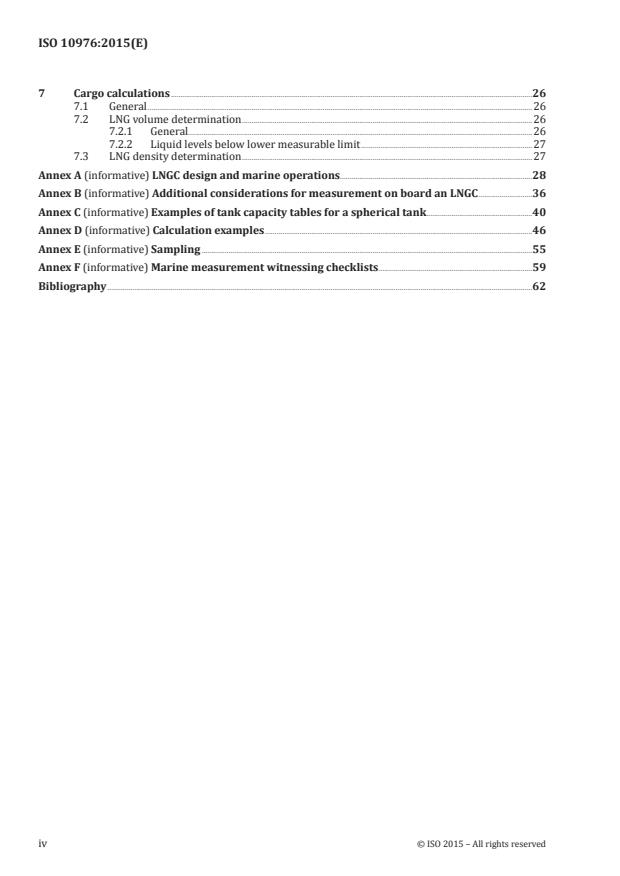
Contents Page
Foreword .v
Introduction .vi
1 Scope . 1
2 Normative references . 1
3 Terms, definitions and abbreviated terms . 1
3.1 Terms and definitions . 1
3.2 Abbreviated terms . 5
4 General operating safety precautions and regulatory requirements .6
4.1 General . 6
4.2 Electrical equipment classification . 7
4.3 Electromagnetic disturbance . 7
4.4 Maintenance . 7
4.5 Service conditions . 7
4.6 Compatibility . 7
4.7 Personnel protection . 7
4.8 Procedures . 7
5 Measurement systems and equipment . 8
5.1 General . 8
5.2 Measurement equipment performance . 8
5.3 Calibration and certification of measurement equipment . 9
5.4 Verification of measurement equipment between dry dockings . 9
5.5 Inspection of measurement equipment during transfer operations . 9
5.6 Static measurement systems and equipment.10
5.6.1 General.10
5.6.2 Tank capacity tables .10
5.6.3 Trim and list measurement .12
5.6.4 Tank gassing-up tables or means of determination .12
5.6.5 Tank cool-down tables or means of determination .13
5.6.6 Liquid level measurement equipment .13
5.6.7 Temperature measurement equipment .17
5.6.8 Pressure measurement equipment .18
5.6.9 Custody transfer measurement system.18
5.7 Dynamic measurement systems and equipment .19
6 Measurement procedures .19
6.1 General .19
6.2 Static measurement .20
6.2.1 General.20
6.2.2 Measuring liquid level .21
6.2.3 Loading .21
6.2.4 Discharge .21
6.2.5 Shipboard measurements .21
6.2.6 Liquid level .22
6.2.7 Temperature .23
6.2.8 Pressure .24
6.2.9 CTMS .24
6.2.10 Sampling.24
6.2.11 Vapour return .25
6.3 Gas-up and cool-down quantification .25
6.3.1 General.25
6.3.2 Inerting .25
6.3.3 Gas up and cool down .25
6.4 Dynamic measurement .26
7 Cargo calculations .26
7.1 General .26
7.2 LNG volume determination .26
7.2.1 General.26
7.2.2 Liquid levels below lower measurable limit .27
7.3 LNG density determination .27
Annex A (informative) LNGC design and marine operations.28
Annex B (informative) Additional considerations for measurement on board an LNGC .36
Annex C (informative) Examples of tank capacity tables for a spherical tank .40
Annex D (informative) Calculation examples .46
Annex E (informative) Sampling .55
Annex F (informative) Marine measurement witnessing checklists .59
Bibliography .62
iv © ISO 2015 – All rights reserved
Foreword
ISO (the International Organization for Standardization) is a worldwide federation of national standards
bodies (ISO member bodies). The work of preparing International Standards is normally carried out
through ISO technical committees. Each member body interested in a subject for which a technical
committee has been established has the right to be represented on that committee. International
organizations, governmental and non-governmental, in liaison with ISO, also take part in the work.
ISO collaborates closely with the International Electrotechnical Commission (IEC) on all matters of
electrotechnical standardization.
The procedures used to develop this document and those intended for its further maintenance are
described in the ISO/IEC Directives, Part 1. In particular the different approval criteria needed for the
different types of ISO documents should be noted. This document was drafted in accordance with the
editorial rules of the ISO/IEC Directives, Part 2 (see www.iso.org/directives).
Attention is drawn to the possibility that some of the elements of this document may be the subject of
patent rights. ISO shall not be held responsible for identifying any or all such patent rights. Details of
any patent rights identified during the development of the document will be in the Introduction and/or
on the ISO list of patent declarations received (see www.iso.org/patents).
Any trade name used in this document is information given for the convenience of users and does not
constitute an endorsement.
For an explanation on the meaning of ISO specific terms and expressions related to conformity
assessment, as well as information about ISO’s adherence to the WTO principles in the Technical
Barriers to Trade (TBT) see the following URL: Foreword - Supplementary information
The committee responsible for this document is ISO/TC 28, Petroleum products and lubricants,
Subcommittee SC 5, Measurement of refrigerated hydrocarbon and non-petroleum based liquefied
gaseous fuels.
This second edition cancels and replaces the first edition (ISO 10976:2012), of which it constitutes a
minor revision.
Introduction
This International Standard provides accepted methods for measuring quantities on liquefied natural
gas (LNG) carriers for those involved in the LNG trade on ships and onshore. It includes recommended
methods for measuring, reporting and documenting quantities on board these vessels.
This International Standard is intended to establish uniform practices for the measurement of the
quantity of cargo on board LNG carriers from which the energy is computed. It details the commonly
used current methods of cargo measurement, but is not intended to preclude the use or development
of any other technologies or methods or the revision of the methods presented. It is intended that the
reader review, in detail, the latest editions of the publications, standards and documents referenced in
this International Standard in order to gain a better understanding of the methods described.
This International Standard is not intended to supersede any safety or operating practices recommended
by organizations, such as the International Maritime Organization (IMO), the International Chamber of
Shipping (ICS), the Oil Companies lnternational Marine Forum (OCIMF), the International Group of LNG
Importers (GIIGNL) and the Society of International Gas Tanker and Terminal Operators (SIGTTO), or
individual operating companies. This International Standard is not intended to supersede any other
safety or environmental considerations, local regulations or the specific provisions of any contract.
The International System of units (SI) is used throughout this International Standard as the primary
units of measure since this system is commonly used in the industry for these types of cargoes.
However, as some LNG carrier tanks are calibrated in US customary units and some sales and purchase
agreements (SPA) are made in US customary units, both SI and US customary equivalents are shown.
Proper unit conversion is intended to be applied, documented and agreed upon among all parties
involved in the LNG custody transfer.
vi © ISO 2015 – All rights reserved
INTERNATIONAL STANDARD ISO 10976:2015(E)
Refrigerated light hydrocarbon fluids — Measurement of
cargoes on board LNG carriers
1 Scope
This International Standard establishes all of the steps needed to properly measure and account for
the quantities of cargoes on liquefied natural gas (LNG) carriers. This includes, but is not limited to, the
measurement of liquid volume, vapour volume, temperature and pressure, and accounting for the total
quantity of the cargo on board. This International Standard describes the use of common measurement
systems used on board LNG carriers, the aim of which is to improve the general knowledge and
processes in the measurement of LNG for all parties concerned. This International Standard provides
general requirements for those involved in the LNG trade on ships and onshore.
2 Normative references
The following documents, in whole or in part, are normatively referenced in this document and are
indispensable for its application. For dated references, only the edition cited applies. For undated
references, the latest edition of the referenced document (including any amendments) applies.
ISO 8310, Refrigerated hydrocarbon and non-petroleum based liquefied gaseous fuels — General
requirements for automatic tank thermometers on board marine carriers and floating storage
ISO 8943, Refrigerated light hydrocarbon fluids — Sampling of liquefied natural gas — Continuous and
intermittent methods
ISO 18132-1, Refrigerated hydrocarbon and non-petroleum based liquefied gaseous fuels — General
requirements for automatic tank gauges — Part 1: Automatic tank gauges for liquefied natural gas on
board marine carriers and floating storage
IEC 60533, Electrical and electronic installations in ships — Electromagnetic compatibility
EN 1160, Installations and equipment for liquefied natural gas — General characteristics of liquefied
natural gas
IACS, Unified Requirements E10
3 Terms, definitions and abbreviated terms
3.1 Terms and definitions
For the purposes of this document, the following terms and definitions apply.
3.1.1
absolute pressure
total of the gauge pressure plus the pressure of the surrounding atmosphere
3.1.2
aerating
introduction of fresh air with an acceptable dew point into the
tank to purge inert gases and to increase the oxygen content to approximately 21 % of volume so as to
ensure a breathable atmosphere
3.1.3
approved equipment
equipment of a design approved by a recognized authority, such as a governmental agency, classification
society or other accredited agency which certifies the particular equipment as safe for use in a specified
hazardous atmosphere
3.1.4
automatic tank gauge
ATG
instrument that automatically measures and displays liquid levels or ullages in one or more tanks,
either continuously, periodically or on demand
3.1.5
automatic tank thermometer
ATT
instrument that automatically measures and displays the temperature of the contents in a tank,
continuously, periodically or on demand
3.1.6
boil off
process of evaporation of a liquid resulting from heat ingress or a drop in pressure
3.1.7
boil-off gas
vapour produced by boil off
3.1.8
cool down
process of reducing the temperature of equipment, such as piping, transfer arms and tanks associated
with custody transfer cargo movements, to required operating temperatures
3.1.9
constant pressure/floating piston sample container
CP/FP sample container
sample container, usually used for intermittent sampling, capable of maintaining constant pressure
during the sampling of gas from the process line into the gas cylinder
[SOURCE: ISO 8943:2007, 3.4, modified]
3.1.10
continuous sampling
sampling from gasified LNG with constant flow rate
[SOURCE: ISO 8943:2007, 3.5]
3.1.11
drying
process of reducing the moisture in the ship tank by displacement or dilution with an inert gas or by the
use of a drying system
3.1.12
filling limit
filling ratio
quantity to which a tank may be safely filled, taking into account the possible expansion (and change in
density) of the liquid
Note 1 to entry: Filling limit (i.e. volume) and filling ratio are expressed as a percentage of the total capacity of a
tank.
2 © ISO 2015 – All rights reserved
3.1.13
gas codes
regulations on the construction of ships carrying liquefied gases developed by the International
Maritime Organization
Note 1 to entry: These include the IMO International Code for the Construction and Equipment of Ships Carrying
Liquefied Gases in Bulk (IGC Code) (generally applies to ships built after 17 July 1986), the IMO Code for Construction
and Equipment of Ships Carrying Liquefied Gases in Bulk (GC Code) (generally applies to ships built on or after 31
December 1976 but prior to 17 July 1986) and the IMO Code for Existing Ships Carrying Liquefied Gases in Bulk
(generally applies to ships delivered before 31 December 1976), as applicable to each vessel.
3.1.14
gas sample container
sample container, usually used for continuous sampling and used for the retention of the gas sample
and for its transfer to an analysing instrument
[SOURCE: ISO 8943:2007, 3.6]
3.1.15
gassing up
process of replacing an inert atmosphere in a cargo tank with the vapour from shore or from another
cargo tank to a suitable level to allow cooling down and subsequent loading to achieve a specified
environment with at least a defined methane (CH ), carbon dioxide (CO ) and oxygen (O ) content
4 2 2
3.1.16
heel
amount of cargo retained in a cargo tank prior to loading or after discharge
3.1.17
inerting
introduction of inert gas into a tank with the object of attaining the inert condition
3.1.18
intermittent sampling
sampling from gasified LNG with predetermined intervals or with predetermined flow amount intervals
[SOURCE: ISO 8943:2007, 3.9]
3.1.19
letter of protest
letter issued by any participant in a custody transfer citing any condition with which issue is taken and
which serves as a written record that a particular action or finding was observed/questioned at the
time of occurrence
3.1.20
LNG carrier
cargo ship specifically constructed and used for the carriage of LNG in bulk
3.1.21
LNG sample vaporizer
apparatus to completely gasify the LNG sample collected from the LNG transfer line
[SOURCE: ISO 8943:2007, 3.11]
3.1.22
multiple-spot ATT
multiple-point ATT
ATT consisting of multiple spot temperature element sensors to measure the temperature(s) at selected
liquid level(s)
[SOURCE: ISO 4266-5:2002, 3.4, modified]
Note 1 to entry: The readout equipment for a multiple-point averaging ATT averages the readings from the
submerged temperature elements sensors to compute the average temperature of the liquid in the tank, and can
also display the temperature profile in the tank.
3.1.23
notice of apparent discrepancy
notice issued by any participant in a custody transfer citing any discrepancy in cargo quantities and
which serves as a written record that such a discrepancy was found
3.1.24
offline analysis
procedure of analysis implemented on the representative sample gas that is once charged into a gas
sample container or a CP/FP sample container
[SOURCE: ISO 8943:2007, 3.13]
3.1.25
online analysis
procedure of analysis implemented using analytical equipment that is directly connected through
pipelines or other means to the sampling device
[SOURCE: ISO 8943:2007, 3.14, modified]
3.1.26
online gas chromatograph
gas chromatograph that is directly connected to the pipelines or sampling device to implement
online analysis
[SOURCE: ISO 8943:2007, 3.15]
3.1.27
seal water
water used in the water seal type gas sample holder to preclude contact of the gas sample with the
atmosphere
[SOURCE: ISO 8943:2007, 3.19]
3.1.28
tank capacity table
numeric tables that relate the liquid level in a tank to the volume contained in that tank
3.1.29
vapour
fluid in the gaseous state that is transferred to/from or contained within the cargo tank
3.1.30
vapour pressure
pressure at which a liquid and its vapour are in equilibrium at a given temperature
3.1.31
verification
process of confirming the accuracy of an instrument by comparing to a source with known accuracy
4 © ISO 2015 – All rights reserved
3.1.32
warming up
process of warming the cargo tanks from cargo carriage temperature to required temperature
3.1.33
waterless-type gas sample holder
holder without seal water (typically using an expandable/contractible, transformable rubber
membrane) and used for collecting gasified LNG
[SOURCE: ISO 8943:2007, 3.22]
3.1.34
water-seal-type gas sample holder
holder with seal water used for collecting gasified LNG
[SOURCE: ISO 8943:2007, 3.23]
3.2 Abbreviated terms
API American Petroleum Institute
ATG Automatic tank gauge
ATT Automatic tank thermometer
BOG Boil-off gas
CTMS Custody transfer measurement system
EMC Electromagnetic compatibility
FSRU Floating storage and re-gasification unit
GCU Gas combustion unit
GIIGNL Groupe International des Importateurs de Gaz Naturel Liquéfié
GNG Gaseous natural gas
GPA Gas Processors Association
IACS International Association of Classification Societies
IAPH International Association of Ports and Harbors
ICS International Chamber of Shipping
IEC International Electrotechnical Commission
IGC Code International Gas Carrier Code
IMO International Maritime Organization
ISGOTT International Safety Guide for Oil Tankers and Terminals
ISO International Organization for Standardization
LNG Liquefied natural gas
LNGC Liquefied natural gas carrier
MPMS Manual of Petroleum Measurement Standards
MSDS Material safety data sheet
OBQ On board quantity
OCIMF Oil Companies International Marine Forum
ROB Quantity remaining on board
SI International System of Units (Système International d’Unités)
SIGTTO Society of International Gas Tanker and Terminal Operators Limited
SPA Sales and purchase agreement
VEF Vessel experience factor
4 General operating safety precautions and regulatory requirements
4.1 General
This Clause applies to all types of measurement on board LNG carriers. However, while these precautions
represent safe operating practices, they should not be considered complete or comprehensive. In
addition to those listed in this International Standard, reference should be made to all safety precautions
contained in any relevant governmental, local or company operating guidelines.
IMPORTANT — Anyone working with the vessel’s measurement equipment shall be, at all times,
under the direction and supervision of the Master of the vessel or its designated representative
and be properly trained in its use.
Personnel involved in the handling of liquefied natural gas should be familiar with its physical and
chemical characteristics, including potential for fire, explosion, cryogenic burns (frostbite) and
reactivity, as well as the appropriate emergency procedures. These procedures should comply with
the individual company’s safe operating practices, in addition to local, state and federal regulations,
including those covering the use of proper protective clothing and equipment. Personnel should be alert
in order to avoid potential sources of ignition.
SIGTTO publications Liquefied Gas Fire Hazard Management and Liquefied Gas Handling Principles on
Ships and in Terminals should be consulted to ensure familiarity with the characteristics and hazards
of LNG, all fire protection and firefighting equipment on board LNG carriers along with the appropriate
fire hazard management plan.
API Standard 2217A and any applicable regulations should be consulted where entering into
confined spaces.
Information regarding particular material safety and conditions should be obtained from the employer,
manufacturer or supplier of that material or the material safety data sheet (MSDS).
LNG is carried and handled at extremely low temperatures. The very nature of liquids at very low
temperatures is a hazard, added to which LNG itself has properties that shall be taken into account at
all times. Any party involved in handling operations shall read and act on information contained within
the appropriate MSDS and supporting documents.
Nothing contained in this International Standard is intended to supersede any regulatory requirements
or recommended operating practices issued by the vessel’s flag administration, classification societies
or organizations, such as IMO, SIGTTO or OCIMF, or individual operating companies. This International
Standard is not intended to conflict with any safety or environmental considerations, local conditions
or the specific provisions of any contract.
Accordingly, the latest editions of relevant IMO, SIGTTO, API and OCIMF publications, and, in particular,
the latest editions of the ICS Tanker Safety Guide — Liquefied Gas, the OCIMF/ICS/IAPH International
6 © ISO 2015 – All rights reserved
Safety Guide for Oil Tankers and Terminals (ISGOTT) and SIGTTO Liquefied Gas Fire Hazard Management
should be consulted for applicable safety precautions.
Any changes to measurement systems require the approval of the vessel’s flag administration
and/or classification society and require external verification of accuracy by a competent metrological
authority for LNG custody transfer measurement purposes.
All described equipment shall meet minimum requirements as detailed by the vessel’s flag
administration and classification society.
4.2 Electrical equipment classification
All measurement equipment used shall be approved equipment (see 3.1.3), which is certified
intrinsically safe or otherwise approved for its intended use, including appropriate grounding. Also, all
measurement equipment shall be designed and installed to meet applicable national and international
marine safety codes and regulations.
4.3 Electromagnetic disturbance
All custody transfer measurement systems (CTMS) shall be designed for electromagnetic compatibility
(EMC), complying with user requirements and other proper standards. This means that the equipment
shall neither interfere with nor be affected by interference from other equipment. Requirements and
tests shall be in accordance with IACS Unified Requirements E10 and IEC 60533.
4.4 Maintenance
All measurement equipment shall be maintained in safe operating condition and in compliance with the
manufacturers’ instructions.
4.5 Service conditions
All measurement equipment shall be capable of withstanding the vibration, pressure, temperature,
humidity and other environmental operating conditions likely to be encountered in the LNG
carrier’s service.
4.6 Compatibility
All measurement equipment shall be constructed with appropriate materials suitable for use in LNG
service in accordance with the appropriate gas codes (see the note in 3.1.13) or EN 1160, and other
applicable regulations.
4.7 Personnel protection
All personnel involved in LNG cargo activities should wear the appropriate personnel protective
equipment required for the operation and be trained in its proper use. They should also be trained
regarding the inherent hazards of LNG, as required by the ICS Tanker Safety Guide — Liquefied Gas and
the LNG material safety data sheet (MSDS).
4.8 Procedures
An adequate work procedure shall be established and available as guidance for safe work by the ship
and terminal personnel.
5 Measurement systems and equipment
5.1 General
Determination of cargo quantities on board an LNG carrier by the static measurement method requires
measurement of the liquid level (which is the liquid/vapour interface) as well as the pressure of the
vapour and average liquid and vapour temperature of each cargo tank. The volume of the liquid cargo
is calculated using the tank capacity table with any necessary corrections made. The custody transfer
measurement system (CTMS) includes the following:
a) cargo tank capacity tables;
b) inclinometers and/or draft gauges;
c) automatic tank gauges (see 3.1.4);
d) multiple-spot ATTs (see 3.1.22);
e) pressure sensors;
f) a CTMS computer.
NOTE As LNG quantities are generally transferred in units of energy, an automatic sampler system, typically
located onshore, provides a representative sample of the cargo, which is analysed for the determination of cargo
quality, including density by compositional analysis using a gas chromatograph.
To determine the quantities of cargoes on board LNG carriers, the amount of liquid in each tank
shall be determined. The factors needed to accomplish this include a calibrated tank as well as liquid
level, pressure, temperature and trim/list measurement equipment. The tank gauging systems used
shall be of the closed type. The most commonly used equipment is described in this clause. Certified
systems other than those described in this International Standard may be used for custody transfer
measurement if the accuracies of each can be ascertained and if the SPA permits their use.
5.2 Measurement equipment performance
The performance criteria of the primary and secondary equipment used to determine measured
variables are established in International Standards, governmental regulations, SPAs, manufacturers’
instructions and calibration certificates, and are limited by the uncertainty of the instrument. In the
absence of specified tolerances, the maximum permissible error from certification shall meet the
tolerances described in Table 1.
Table 1 — LNG measurement equipment performance criteria
Tolerance Display resolution
a
Level ±5,0 mm 1 mm
Pressure ±0,3 kPa 0,1 kPa
Temperature
≤ –145 °C ±0,2 °C 0,1 °C
> –145 °C ±1,5 °C 0,1 °C
Draft reading ±50 mm 10 mm
List (inclinometer) ±0,05° 0,01°
a
Some existing ATGs are not able to meet this verification tolerance, in which case a
verification tolerance of ±7,5 mm may be applied.
8 © ISO 2015 – All rights reserved
5.3 Calibration and certification of measurement equipment
All specified measurement equipment used on board an LNG carrier shall be certified prior to initial
use. Subsequently, measurement equipment and systems shall be re-calibrated and re-certified on a
periodic basis, subject to SPA or national requirements. Measurement equipment shall be re-certified
where modification or repairs are carried out and which affect the accuracy of the measurement data.
The components of the CTMS and the accuracy of the quantity calculation of the CTMS shall be certified
by a recognized inspection body.
Calibration and re-calibration shall be performed by a qualified technician and witnessed by an
independent inspector. Upon successful calibration, the results shall be certified by the party witnessing
the calibration and a certificate of calibration issued.
Manufacturers of the measurement equipment and systems may participate in the calibration, which
often require setting, maintenance or replacement prior to final calibration of the equipment and the
related measurement system. For measurement equipment and systems, the calibration work should
be witnessed by the parties or their appointed independent inspector, who should be responsible for
incorporating the results in the certificate issued.
Calibration shall cover the local and remote readout, and data transmission to ensure the equipment,
which may consist of components of the measurement subsystem(s), delivers the specified accuracy.
5.4 Verification of measurement equipment between dry dockings
In addition to calibration during each dry docking, all measurement devices used in custody transfer
shall be checked before use at each loading or discharge to ensure they are in good working condition.
The comparison of the primary and secondary measurement device within a tank should be performed
as one means of verification. The results of this comparison should be recorded and tracked by the
vessel operator. One method of evaluating the results is through the use of a control chart. For control
charts, see B.3.
Other devices may be verified while the ship is in service. For example, pressure gauges may be verified
against a reference standard device. Trim/list gauges, such as inclinometers or draft gauges (if used for
level corrections) may be verified/calibrated at even keel by comparison to manual draft measurements
or other equivalent procedure.
Where equipment is suspect or has failed, secondary devices shall be used in its place until the equipment is
repaired or verified to be in good working order. For example, in situ temperature verification/calibration
at cryogenic conditions is not practicable; therefore, temperature sensors which have been shown to be
faulty when verified during normal operation shall be replaced as soon as practicable.
Where the measurement equipment can be verified against a known value, the results of this
verification should be recorded and tracked. If the primary measurement system is found to be out
of calibration, use of the secondary measurement system should be considered in accordance with
contractual agreement.
5.5 Inspection of measurement equipment during transfer operations
Prior to and during a custody transfer, the involved parties or an appointed independent inspector
should inspect the measurement equipment described in 5.1 to ensure that it is fully functional, and
should also identify any deficiencies. The ship’s records should be reviewed to determine whether the
calibration certificates are valid and current.
Exceptions and malfunction of measurement equipment, if any, prior to and during a custody transfer
should be immediately reported to the LNG carrier operator and the involved parties.
Upon specific request by the involved parties, on board testing, checks or verification may be carried
out on the measurement devices in question, and the results should be documented.
5.6 Static measurement systems and equipment
5.6.1 General
Static measurement systems and equipment are those individual systems and equipment which are
used to measure cargo in the tank. They include the following components (see 5.6.2 to 5.6.9).
5.6.2 Tank capacity tables
5.6.2.1 General
An independent company usually performs the calibration and generates the tank capacity tables during
the building of the LNG carrier. They take into account the configuration of the tank, its contraction
according to the temperature of the liquid, and the volume occupied by various devices, e.g. cargo pumps.
Tank capacity tables are divided into
a) main gauge tables correlating liquid level and volume under reference conditions, and
b) correction tables or methods, taking into account actual conditions of the LNG carrier and its
measuring instruments.
The tank capacity tables and related information, including measurements carried out and observations
made by the party performing the tank calibration and traceability of the equipment used, may be
contained in a tank calibration report. Additional discussion is provided below in 5.6.2.2 to 5.6.2.5.
Accuracy in determining cargo tank quantities is directly related to the accuracy of the LNG carrier’s
capacity tables. Therefore, the LNG carrier’s cargo tanks shall be measured and tank capacity tables
developed and maintained in accordance with API, ISO or other internationally recognized standard or
regulatory requirements.
For each LNG carrier, there is a tank capacity table applicable to each custody transfer automatic tank
gauging device (ATG) for each tank. For a typical tank equipped with a primary and secondary ATG,
this may be presented as two separate capacity tables, each with its own set of correction tables or as
a single capacity table based on the primary level device location, with separate correction tables for
each ATG and an offset correction for the secondary level device to account for any differences in gauge
reference height.
Each set of tank capacity tables and related correction tables or methods shall
— be certified as meeting the standard used,
— state the volumetric uncertainty of the capacity,
— identify the calibration method within the tank capacity tables or in the tank calibration report,
— include examples illustrating their intended use,
— be documented in English, with any additional languages optional, and
— be made available in printed form.
An example of a tank capacity table for a spherical tank is given in Annex C. The same principles
generally apply to those vessels with prismatic tanks.
Each set of tables shall include corrections for trim, list, thermal effects and any measurement
equipment adjustments as necessary to accurately adjust the quantities observed in the tank to the
tank conditions at the time of measurement. In addition, for each tank, the tank capacity tables shall
include certified values for any measured level used for verification of the tank gauging system. Tank
tables shall indicate the location of the primary and secondary level gauge (i.e. the gauge reference
10 © ISO 2015 – All rights reserved
points). One or more examples shall be included in the tank calibration report or tank capacity table
indicating the correct use and interpretation of any correction tables.
Such tables shall be made available to personnel performing the measurements as needed. If such tables
are not made available or cannot be verified, a letter of protest noting the situation shall be filed at the
time of measurement.
NOTE Tank calibrations reports typically state the tank’s volumetric uncertainty at ambient temperature to
3 3
be ±0,2 % or better, which translates to a maximum uncertainty for a tank of 26 000 m of ±52 m LNG.
5.6.2.2 Tank capacity tables resolution
Tank capacity tables shall be capable of being read to a resolution of 1 mm throughout the range of
levels commonly encountered during opening and closing gauges. In practice, this is usually achieved
by tank capacity tables in any one of three formats:
a) tables showing volumes for each centimetre of gauge height, with volumes for each millimetre
corresponding to the normal ranges during opening and closing of gauges (i.e. near the top and
bottom of the tank);
b) tables showing volumes for each centimetre of gauge height with the incremental volume for each
row;
c) tables showing volumes for each millimetre of gauge height throughout the total volume of the tank.
See Table C.1 for an example of a section of a spherical tank capacity table.
5.6.2.3 List and trim correction tables
The main gauge tables are established for an LNG carrier with zero list and trim. Therefore, it is
necessary to correct the
...
Questions, Comments and Discussion
Ask us and Technical Secretary will try to provide an answer. You can facilitate discussion about the standard in here.
Loading comments...