

ISO 11982:2025
(Main)Refrigerated hydrocarbon and non-petroleum based liquefied gaseous fuels — Liquefied Natural Gas (LNG) as marine fuel — Measurement on board LNG bunkering ship
General Information
- Abstract
This document provides requirements and guidance for quantifying liquefied natural gas (LNG) as a marine fuel on board LNG bunkering ships. It is applicable to the measurement of LNG from any source, e.g. gas from conventional reservoirs, shale gas, coalbed methane, at the time of: — ship to ship (STS) transfer to LNG-fuelled ships, — STS transfer between LNG bunkering ships, and — transfer to or from shore tanks or other facilities, irrespective of the type of tanks. This document is also applicable to the quantification of biomethane and synthetic methane from fossil fuels or renewable sources.
- Status
- Published
- Publication Date
- 06-Nov-2025
- Current Stage
- 6060 - International Standard published
- Start Date
- 07-Nov-2025
- Due Date
- 18-Oct-2025
- Completion Date
- 07-Nov-2025

Overview - ISO 11982:2025 (LNG as marine fuel - On‑board measurement)
ISO 11982:2025 specifies requirements and guidance for quantifying liquefied natural gas (LNG) as a marine fuel on board LNG bunkering ships. It covers measurement during ship-to-ship (STS) transfers to LNG‑fuelled ships, STS transfers between bunkering ships, and transfers to/from shore tanks - irrespective of tank type. The standard also applies to biomethane and synthetic methane. Key goals include accurate volume, mass and energy determination and providing a consistent basis for custody transfer and bunker delivery documentation.
Key technical topics and requirements
- On‑board measurement approaches
- Static measurement: use of tank capacity tables, liquid level/ullage measurement, temperature and pressure monitoring.
- Dynamic measurement: flowmeter-based systems and performance/calibration requirements for custody transfer.
- Custody Transfer Measurement System (CTMS): processing inputs from ATG, thermometers, pressure gauges and generating custody transfer data on board.
- On‑board sampling and analysis: provisions for taking representative liquid and vapour samples and for online/ laboratory analysis of composition.
- Calculation methods: procedures for converting measured data into volumetric, mass and energy quantities, including liquid and vapour energy, and methods to calculate Wobbe index and methane number.
- Corrections and influences: treatment of tank trim and list, vapour pressure effects, temperature/pressure corrections and handling of unsupported components.
- Annexes: practical data processing (CTMS), calculation examples, bunker delivery note parameters and guidance for comingled LNG.
Practical applications and who uses this standard
ISO 11982:2025 is intended for organizations and professionals involved in LNG bunkering and marine fuel supply, including:
- LNG bunkering ship operators and crew responsible for on‑board measurement and reporting.
- Bunker suppliers and traders preparing bunker delivery notes (BDN) and performing custody transfer.
- Shipowners/operators of LNG‑fuelled vessels verifying received quantities and fuel quality.
- Port authorities, surveyors and regulators overseeing bunkering operations and compliance.
- Equipment manufacturers (ATG, flowmeters, CTMS, analytical systems) designing products to meet measurement requirements.
- Metrology and testing laboratories performing composition and calorific analyses.
Related standards
Normative and referenced documents cited in ISO 11982:2025 include:
- ISO 6976:2016 - gas calorific value, density and Wobbe index calculation
- ISO 23306:2020 - specification of LNG as marine fuel
- Other ISO documents referenced for terminology and equipment (e.g., ATG, tank tables, custody transfer definitions)
By standardizing on‑board measurement, ISO 11982:2025 helps ensure reliable, auditable LNG bunkering transactions and supports safe, transparent adoption of LNG (and renewable methane variants) as marine fuel.
Get Certified
Connect with accredited certification bodies for this standard

Element Materials Technology
Materials testing and product certification.

ABS Group Brazil
ABS Group certification services in Brazil.

ABS Quality Evaluations Inc.
American Bureau of Shipping quality certification.
Sponsored listings
Frequently Asked Questions
ISO 11982:2025 is a standard published by the International Organization for Standardization (ISO). Its full title is "Refrigerated hydrocarbon and non-petroleum based liquefied gaseous fuels — Liquefied Natural Gas (LNG) as marine fuel — Measurement on board LNG bunkering ship". This standard covers: This document provides requirements and guidance for quantifying liquefied natural gas (LNG) as a marine fuel on board LNG bunkering ships. It is applicable to the measurement of LNG from any source, e.g. gas from conventional reservoirs, shale gas, coalbed methane, at the time of: — ship to ship (STS) transfer to LNG-fuelled ships, — STS transfer between LNG bunkering ships, and — transfer to or from shore tanks or other facilities, irrespective of the type of tanks. This document is also applicable to the quantification of biomethane and synthetic methane from fossil fuels or renewable sources.
This document provides requirements and guidance for quantifying liquefied natural gas (LNG) as a marine fuel on board LNG bunkering ships. It is applicable to the measurement of LNG from any source, e.g. gas from conventional reservoirs, shale gas, coalbed methane, at the time of: — ship to ship (STS) transfer to LNG-fuelled ships, — STS transfer between LNG bunkering ships, and — transfer to or from shore tanks or other facilities, irrespective of the type of tanks. This document is also applicable to the quantification of biomethane and synthetic methane from fossil fuels or renewable sources.
ISO 11982:2025 is classified under the following ICS (International Classification for Standards) categories: 75.180.30 - Volumetric equipment and measurements. The ICS classification helps identify the subject area and facilitates finding related standards.
ISO 11982:2025 is available in PDF format for immediate download after purchase. The document can be added to your cart and obtained through the secure checkout process. Digital delivery ensures instant access to the complete standard document.
Standards Content (Sample)
International
Standard
ISO 11982
First edition
Refrigerated hydrocarbon and non-
2025-11
petroleum based liquefied gaseous
fuels — Liquefied Natural Gas (LNG)
as marine fuel — Measurement on
board LNG bunkering ship
Hydrocarbures réfrigérés et combustibles gazeux liquéfiés à
base non pétrolière — Utilisation du Gaz Naturel Liquéfié (GNL)
comme combustible marin — Mesurage à bord des navires
avitailleurs de GNL
Reference number
© ISO 2025
All rights reserved. Unless otherwise specified, or required in the context of its implementation, no part of this publication may
be reproduced or utilized otherwise in any form or by any means, electronic or mechanical, including photocopying, or posting on
the internet or an intranet, without prior written permission. Permission can be requested from either ISO at the address below
or ISO’s member body in the country of the requester.
ISO copyright office
CP 401 • Ch. de Blandonnet 8
CH-1214 Vernier, Geneva
Phone: +41 22 749 01 11
Email: copyright@iso.org
Website: www.iso.org
Published in Switzerland
ii
Contents Page
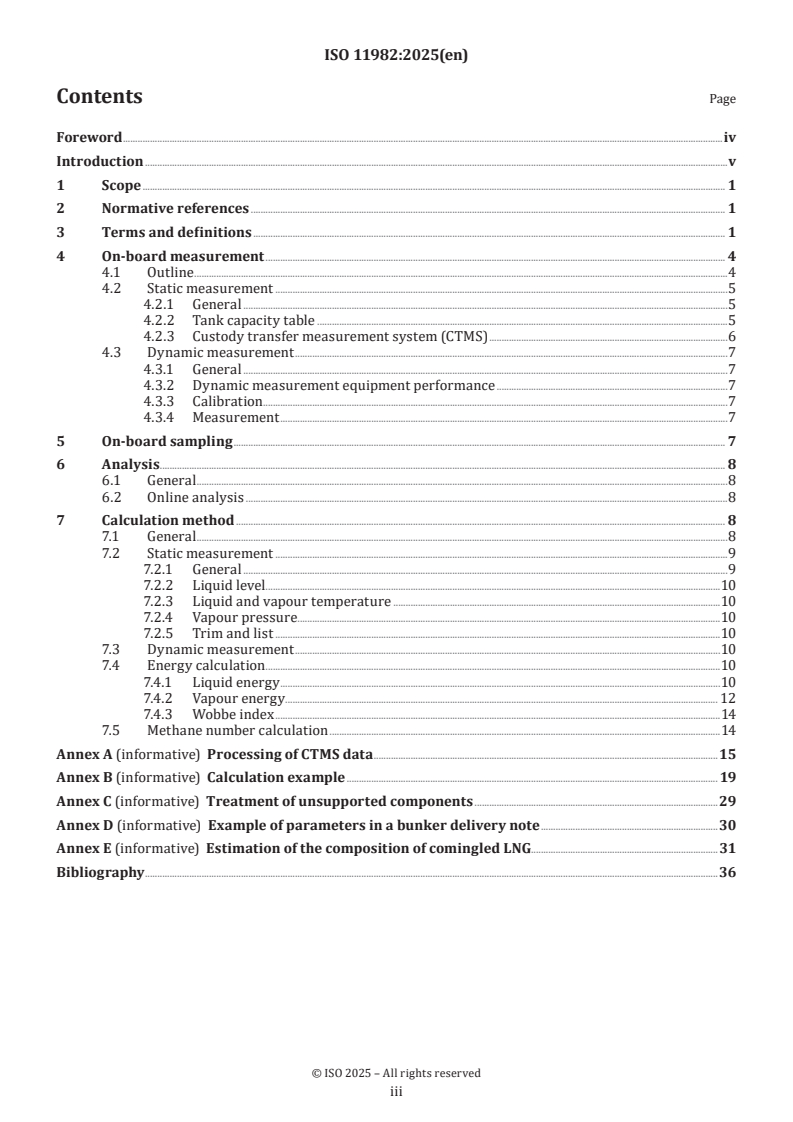
Foreword .iv
Introduction .v
1 Scope . 1
2 Normative references . 1
3 Terms and definitions . 1
4 On-board measurement . 4
4.1 Outline .4
4.2 Static measurement .5
4.2.1 General .5
4.2.2 Tank capacity table .5
4.2.3 Custody transfer measurement system (CTMS) .6
4.3 Dynamic measurement .7
4.3.1 General .7
4.3.2 Dynamic measurement equipment performance .7
4.3.3 Calibration . . .7
4.3.4 Measurement .7
5 On-board sampling . 7
6 Analysis . . 8
6.1 General .8
6.2 Online analysis .8
7 Calculation method . 8
7.1 General .8
7.2 Static measurement .9
7.2.1 General .9
7.2.2 Liquid level . . .10
7.2.3 Liquid and vapour temperature .10
7.2.4 Vapour pressure . .10
7.2.5 Trim and list .10
7.3 Dynamic measurement .10
7.4 Energy calculation .10
7.4.1 Liquid energy .10
7.4.2 Vapour energy . 12
7.4.3 Wobbe index .14
7.5 Methane number calculation .14
Annex A (informative) Processing of CTMS data .15
Annex B (informative) Calculation example . 19
Annex C (informative) Treatment of unsupported components .29
Annex D (informative) Example of parameters in a bunker delivery note .30
Annex E (informative) Estimation of the composition of comingled LNG.31
Bibliography .36
iii
Foreword
ISO (the International Organization for Standardization) is a worldwide federation of national standards
bodies (ISO member bodies). The work of preparing International Standards is normally carried out through
ISO technical committees. Each member body interested in a subject for which a technical committee
has been established has the right to be represented on that committee. International organizations,
governmental and non-governmental, in liaison with ISO, also take part in the work. ISO collaborates closely
with the International Electrotechnical Commission (IEC) on all matters of electrotechnical standardization.
The procedures used to develop this document and those intended for its further maintenance are described
in the ISO/IEC Directives, Part 1. In particular, the different approval criteria needed for the different types
of ISO document should be noted. This document was drafted in accordance with the editorial rules of the
ISO/IEC Directives, Part 2 (see www.iso.org/directives).
ISO draws attention to the possibility that the implementation of this document may involve the use of (a)
patent(s). ISO takes no position concerning the evidence, validity or applicability of any claimed patent
rights in respect thereof. As of the date of publication of this document, ISO had not received notice of (a)
patent(s) which may be required to implement this document. However, implementers are cautioned that
this may not represent the latest information, which may be obtained from the patent database available at
www.iso.org/patents. ISO shall not be held responsible for identifying any or all such patent rights.
Any trade name used in this document is information given for the convenience of users and does not
constitute an endorsement.
For an explanation of the voluntary nature of standards, the meaning of ISO specific terms and expressions
related to conformity assessment, as well as information about ISO's adherence to the World Trade
Organization (WTO) principles in the Technical Barriers to Trade (TBT), see www.iso.org/iso/foreword.html.
This document was prepared by Technical Committee ISO/TC 28, Petroleum and related products, fuels and
lubricants from natural or synthetic sources, Subcommittee SC 5, Measurement of refrigerated hydrocarbon
and non-petroleum based liquefied gaseous fuels.
Any feedback or questions on this document should be directed to the user’s national standards body. A
complete listing of these bodies can be found at www.iso.org/members.html.
iv
Introduction
[23]
Efforts such as the restriction of sulfur content in marine fuel oil introduced by IMO MARPOL ANNEX IV
and growing trends towards decarbonisation have promoted cleaner marine fuel.
Liquefied natural gas (LNG) is one of the most practical marine fuel choices. It is considered cleaner than
conventional fuel oils. The conventional trade volume of LNG transported by one shipment is large, with
a total capacity of 170 000 m at the time of publication of this document. The trade quantity is calculated
according to the method defined by the sales and purchase agreement between the cargo supplier and
receiver.
On the other hand, the trade quantity of LNG as a marine fuel by one shipment can be smaller than the
conventional trade volume of 170 000 m . Furthermore, the LNG containment system of the LNG bunkering
ship is unlike the systems of conventional LNG carriers, especially the pressure in the tanks, which is
relatively higher than that of the conventional carrier type. Tank types, including IMO type C, membrane,
and SPB type, are available.
In addition to the difference in trade quantity and the cargo containment system between LNG bunkering
shipments and conventional shipments, the energy transferred during the operations also differs.
Determining the amount of energy transfer involves calculating not only the quantity but also the quality of
transferred liquid and vapour, as well as the gas used during the transfer operation. This document provides
the data treatment, calculation methods and calculation examples.
v
International Standard ISO 11982:2025(en)
Refrigerated hydrocarbon and non-petroleum based liquefied
gaseous fuels — Liquefied Natural Gas (LNG) as marine fuel —
Measurement on board LNG bunkering ship
1 Scope
This document provides requirements and guidance for quantifying liquefied natural gas (LNG) as a marine
fuel on board LNG bunkering ships.
It is applicable to the measurement of LNG from any source, e.g. gas from conventional reservoirs, shale gas,
coalbed methane, at the time of:
— ship to ship (STS) transfer to LNG-fuelled ships,
— STS transfer between LNG bunkering ships, and
— transfer to or from shore tanks or other facilities, irrespective of the type of tanks.
This document is also applicable to the quantification of biomethane and synthetic methane from fossil fuels
or renewable sources.
2 Normative references
The following documents are referred to in the text in such a way that some or all of their content constitutes
requirements of this document. For dated references, only the edition cited applies. For undated references,
the latest edition of the referenced document (including any amendments) applies.
ISO 6976:2016, Natural gas — Calculation of calorific values, density, relative density and Wobbe indices from
composition
ISO 23306:2020, Specification of liquefied natural gas as a fuel for marine applications
3 Terms and definitions
For the purposes of this document, the following terms and definitions apply.
ISO and IEC maintain terminology databases for use in standardization at the following addresses:
— ISO Online browsing platform: available at https:// www .iso .org/ obp
— IEC Electropedia: available at https:// www .electropedia .org/
3.1
liquefied natural gas
LNG
liquid composed predominantly of methane
[SOURCE: ISO 6578: 2025, 3.1.3]
3.2
LNG bunkering ship
ship that supplies liquefied natural gas (LNG) (3.1) as marine fuel to LNG-fuelled ships
3.3
LNG-fuelled ship
ship that utilises liquefied natural gas (LNG) (3.1) for the purpose of propulsion
3.4
LNG carrier
cargo ship specifically constructed and used for the carriage of liquefied natural gas (LNG) (3.1) in bulk
[SOURCE: ISO 10976:2023, 3.1.21]
3.5
custody transfer measurement
measurement of liquid level, liquid and vapour (3.11) temperature, vapour pressure (3.12) and analysis of
the composition of liquefied natural gas (LNG) (3.1) to be delivered to/from a tank, by which volumetric and
other data are determined to be a basis of payment of cost or assessment of duty
[SOURCE: ISO 19970:2025, 3.3, modified — "measurement" has replaced "measuring" in the definition.]
3.6
custody transfer measurement system
CTMS
system that processes inputs from an automatic tank gauge (ATG) (3.7) system, thermometers, pressure
gauges, etc., and provides custody transfer measurement (3.5) information on board, generating documents
with regard to custody transfer of liquefied natural gas (LNG) (3.1)
Note 1 to entry: The ATG system can be incorporated as part of a CTMS.
[SOURCE: ISO 18132-1:2011, 2.1.4]
3.7
automatic tank gauge
ATG
instrument that automatically measures and displays liquid levels or ullages in one or more tanks, either
continuously, periodically or on demand
[SOURCE: ISO 10976:2023, 3.1.4]
3.8
tank capacity table
capacity table
calibration table
tank table
table showing the capacities of, or volumes in, a tank corresponding to various liquid levels measured from
a reference point
[SOURCE: ISO 8311:2013, 3.18]
3.9
trim
difference between the fore and aft draught of the vessel
Note 1 to entry: When the aft draught is greater than the forward draught, the vessel is said to be trimmed by the
stern. When the aft draught is less than the forward draught, the vessel is said to be trimmed by the head.
[SOURCE: ISO 8311:2013, 3.19]
3.10
list
transverse inclination of a ship
Note 1 to entry: It is expressed in degrees.
[SOURCE: ISO 8311:2013, 3.7]
3.11
vapour
fluid in the gaseous state that is transferred to/from or contained within the cargo tank
[SOURCE: ISO 10976:2023, 3.1.30]
3.12
vapour pressure
pressure at which a liquid and its vapour (3.11) are in equilibrium at a given temperature
[SOURCE: ISO 10976:2023, 3.1.31]
3.13
absolute pressure
total of the gauge pressure plus the pressure of the surrounding atmosphere
[SOURCE: ISO 10976:2023, 3.1.1]
3.14
bunker delivery note
BDN
proprietary document of the bunker supplier providing details of the quality and quantity of the bunker(s)
delivered by the liquid natural gas (LNG) bunkering ship (3.2) to the LNG-fuelled ship (3.3)
[SOURCE: ISO 22192:2021, 3.6, modified — replaced “the bunker tanker to the vessel” with “the LNG
bunkering ship to the LNG-fuelled ship”.]
3.15
gross calorific value
amount of heat that would be released by the complete combustion with oxygen of a specified quantity of
gas, in such a way that the pressure, p , at which the reaction takes place remains constant, and all the
products of combustion are returned to the same specified temperature, t , as that of the reactants, all of
these products being in the gaseous state except for water, which is condensed to the liquid state at t
Note 1 to entry: t and p are the combustion reference temperature and the combustion reference pressure,
1 1
respectively.
[SOURCE: ISO 6976:2016, 3.1, modified — Note 1 to entry has been replaced.]
3.16
net calorific value
amount of heat that would be released by the complete combustion with oxygen of a specified quantity of
gas, in such a way that the pressure, p , at which the reaction takes place remains constant, and all the
products of combustion are returned to the same specified temperature, t , as that of the reactants, all of
these products being in the gaseous state
[SOURCE: ISO 6976:2016, 3.2, modified — Note 1 to entry has been removed.]
3.17
methane number
rating indicating the knocking characteristics of a fuel gas
Note 1 to entry: It is comparable to the octane number for petrol. One expression of the methane number is the volume
percentage of methane in a methane-hydrogen mixture, that in a test engine under standard conditions has the same
tendency to knock as the fuel gas to be examined.
[SOURCE: ISO 14532:2014, 2.6.6.1]
3.18
Wobbe index
calorific value on a volumetric basis at specified reference conditions, divided by the square root of the
relative density at the same specified metering reference conditions
Note 1 to entry: The Wobbe index is specified as superior (denoted by the subscript “S”) or inferior (denoted by the
subscript “I”), depending on the calorific value.
[SOURCE: ISO 14532:2014, 2.6.4.3]
3.19
calibration
operation that, under specified conditions, in a first step, establishes a relation between the quantity values
with measurement uncertainties provided by measurement standards and corresponding indications with
associated measurement uncertainties and, in a second step, uses this information to establish a relation for
obtaining a measurement result from an indication
[SOURCE: ISO/IEC Guide 99:2007, 2.39, modified — Notes 1, 2 and 3 to entry have been removed.]
3.20
verification
process of confirming the accuracy of an instrument by comparing to a source with known uncertainty (3.24)
[SOURCE: ISO 10976:2023, 3.1.32]
3.21
biomethane
methane rich gas derived from biogas or from gasification of biomass by upgrading with the properties
similar to natural gas
[SOURCE: ISO 14532:2014, 2.1.1.15]
3.22
working range
range of an instrument in normal operation
[SOURCE: ISO 10976:2023, 3.1.36]
3.23
flowmeter
flow measuring device which indicates the measured flowrate
[SOURCE: ISO 19970:2025, 3.6]
3.24
uncertainty
non-negative parameter characterizing the dispersion of the quantity values being attributed to a
measurand, based on the information used
[SOURCE: ISO 19970:2025, 3.13]
4 On-board measurement
4.1 Outline
Proper on-board measurement is necessary to ensure reliable energy determination. Energy transferred
is calculated via volume/mass and composition of the product transferred. There are two kinds of
measurement principles: one is static, and the other is dynamic. The measurement equipment for the cargo
measurement shall be calibrated and verified with reasonable uncertainty.
Either the volume or mass, or both, of the LNG bunker is obtained by measurement on board LNG bunkering
ships. Other parameters such as density, calorific value, methane number etc. are calculated from the LNG
bunker composition. These quantity and quality measurements of LNG as a marine fuel are required by the
contract between supplier and receiver. The items described in the bunker delivery note (BDN) reflect those in
the contract between the supplier and the receiver. Refer to Annex D for an example of the parameters of a BDN.
4.2 Static measurement
4.2.1 General
To obtain the volume of the cargo by static measurement, the items and equipment listed in 4.2.2 and 4.2.3
are necessary on board the LNG bunkering ship.
4.2.2 Tank capacity table
4.2.2.1 General
Tank capacity tables consist of a main capacity table and various correction tables. The main capacity table
shows the relationship between the liquid level and cargo volume in the specified cargo tank. The volume of
the cargo can be obtained by the corrected liquid level. The main capacity table is prepared when the ship is
upright and the tanks are at the reference temperature and pressure.
The instant liquid level shall be corrected by correction tables due to trim, list, vapour temperature and
pressure. The apparent liquid volume can be found by the corrected liquid level from tank capacity tables.
The apparent liquid volume shall also be corrected due to the expansion or contraction of the tank shell by
temperature and pressure.
Tank capacity tables consist of the following individual tables depending on the type of cargo containment
system and level measuring devices for each cargo tank:
— main capacity tables;
— trim correction tables;
— list correction tables;
— float correction tables due to liquid density;
— temperature correction tables for the automatic tank gauge (ATG);
— temperature correction tables for the tank shell;
— pressure correction tables for the ATG;
— pressure correction tables for the tank shell.
NOTE ISO 12917-1 gives guidance on pressure correction of horizontal cylindrical tanks with hemispherical ends.
Tank capacity tables shall be prepared based on actual measurements of the cargo tanks. Cargo tanks
calibration should be done according to International Standards such as ISO 12917-1 for horizontal
cylindrical tanks and ISO 8311 for the membrane and prismatic tanks.
4.2.2.2 Uncertainty requirement
Uncertainty of tank capacity tables shall be smaller than or equal to 0,2 % with 95 % confidence level.
The uncertainty can be estimated according to ISO 8311:2013, Annex A; ISO 12917-1:2017, Annex C; or
ISO/IEC Guide 98-3. The confidence level of the uncertainty in this document is 95 % unless otherwise stated.
Apply two for the coverage factor (k) to combined standard uncertainty in order to obtain an expanded
uncertainty.
4.2.3 Custody transfer measurement system (CTMS)
4.2.3.1 General
The following measurands are taken by custody transfer measurement.
— liquid level
— liquid temperature
— vapour temperature
— vapour pressure
— trim and list of the ship
Refer to ISO 8310, ISO 10976, ISO 18132-1 and ISO 19636 for the details of the static measurement equipment.
There are several kinds of measurement principles, and any kind of static measurement equipment can be
used if its tolerance is according to Table 1.
4.2.3.2 Static measurement equipment performance
Tolerance and minimum display resolution of static measurement equipment are shown in Table 1. The
tolerance shall be the integration of sensor uncertainty and display uncertainty.
Table 1 — Static measurement equipment performance
Minimum
Static measurement equip-
Measurable range Tolerance display reso-
ment
lution
a
Level Near to the bottom to the top +/− 7,5 mm 1 mm
80 kPaA (kilopascal absolute) to
Pressure +/− 1 % of working range 0,1 kPa
b
460 kPaA
Temperature
c
≤ −145 °C −165 °C to 50 °C +/− 0,2 °C 0,1 °C
> −145 °C +/− 1,5 °C 0,1 °C
d
Trim (by inclinometer) Typically, −2° to +2° +/− 0,5 % of working range 0,01 m
d
List (by inclinometer) Typically, −5° to +5° +/− 0,5 % of working range 0,01°
The working range is equal to the full range or smaller. The working range shall be decided by the parties concerned.
a
As described in ISO 18132-1.
b
The range of pressure measurement is dependent on the tank design. The pressure range shown in this table is only an
example.
c
Automatic tank thermometers shall have a sufficient measurable range in accordance with the intended cargoes to be loaded.
See ISO 8310 for further details.
d
As described in ISO 19636.
4.2.3.3 Calibration
To clarify the uncertainty of the transferred volume, the static measurement equipment shall be calibrated
and verified by an independent party before initial use. Re-calibration of the static measurement equipment
shall be done on a periodic basis. The period should be determined by the LNG bunkering ship, charter
party or relevant regulations. If this period is not specified in any contracts or regulations, certification and
verification should be completed twice in five years but not exceeding three years. The LNG bunkering ship
is responsible for calibration, verification and certification.
4.2.3.4 Measurement
Efforts should be made to stabilize the cargo surface for accurate level measurement. Five successive level,
temperature, pressure, trim and list readings should be taken and recorded every 15 seconds or at specified
intervals and numbers by contracts. All the measurements should be done as soon as possible, for example,
all the measurements should be completed within 2 minutes. The temperature sensors which are placed in
the liquid or the vapour should be decided according to the sensor installation height. If there is some doubt
about the temperature, the parties concerned are required to negotiate. Pay close attention when obtaining
the temperature and pressure; the indication shall be stable and reasonable. Refer to ISO 10976 for more
details.
4.3 Dynamic measurement
4.3.1 General
Dynamic measurement is one of the options for determining the custody transfer quantity.
Refer to ISO 21903 for details on the installation and calibration of a flowmeter for LNG. Refer to ISO 19970
for information on the metering of fuel gas to the bunkering ship’s consumption.
4.3.2 Dynamic measurement equipment performance
Any type of flowmeter may be used for the liquid or vapour phase. Table 2 shows the tolerance and minimum
display resolution of dynamic measurement equipment.
Table 2 — Tolerance and minimum display resolution of dynamic measurement equipment
Phase Tolerance Minimum display resolution
Liquid 1 % (k = 2) of full scale 10 kg or 0,001 m
Vapour 2 % (k = 2) of full scale 10 kg or 1 m
The tolerance shall be the integration of flow sensor uncertainty and display uncertainty.
4.3.3 Calibration
Dynamic measurement equipment shall be calibrated by the maker’s authorized engineer and verified by
an independent party before initial use. The re-calibration of the dynamic measurement equipment shall be
done periodically. Refer to ISO 21903 for calibration of the LNG flowmeter. The period should be determined
by the LNG bunkering ship, charter party or related regulations. If no such contracts or regulations exist,
certification and verification shall be done every year on board, and calibration shall be done every five years
at the maker’s authorized calibration facility. LNG bunkering ship is responsible for calibration, verification,
and certification.
4.3.4 Measurement
Record the flowmeter counter at the time of initial custody transfer, and the counter shall not be reset to
avoid tampering. The counter shall be recorded at the time of final custody transfer.
It is preferable that the cargo is in static condition at the time of the counter reading. At the time of taking
the counter reading, ensure that the liquid lines and vapour return lines at the deck manifold are closed.
If the bunkering vessel has a reliquefication plant in operation or, is conducting gas burning, or both, it is
important to adjust the flow to the same conditions during the initial and final custody transfer. This will
ensure a similar amount of liquid and vapour in the pipelines and equipment.
5 On-board sampling
To determine the quality of the LNG bunker, on-board sampling or online sampling for analysis is used. LNG
bunker samples may be taken during a bunker transfer operation if the sampling apparatus is available on
board the LNG bunkering ship. However, if it is unavailable, the quality of the bunker shall be agreed upon
between the supplier and receiver.
LNG bunker sample shall be taken during transfer while the flow is stable.
Refer to ISO 8943 for more details about the sampling method and apparatus.
6 Analysis
6.1 General
The LNG sample is gasified and analysed to determine its composition. The analysis should be done using
the ISO 6974 series or other methods agreed upon by the supplier and receiver. According to the composition
analysis results, necessary items such as density and calorific value are calculated using ISO 6578 and
ISO 6976 or other methods agreed upon by the supplier and receiver.
The quality specification is set by ISO 23306.
Non-destructive direct composition analysis is also available if the parties concerned agree with the method.
The final point of the quality shall be determined by the contract. The quality during transfer from an LNG
bunkering ship to an LNG-fuelled ship shall be agreed upon contractually by using quality determination
on board or otherwise stated. If the composition analysis is not available on board, the quality of the shore
tank(s) or calculated composition may be used if there is an LNG bunker supply agreement. See Annex E for
the estimation of the composition of commingled LNG.
Ageing shall be considered if the time period from loading to delivery of the LNG bunkering ship is not
negligible. In this document, sampling or online analysis during the bunker transfer is recommended. If they
are not available, the mixing and ageing of the bunker should be considered.
6.2 Online analysis
Online analysis results can be used to determine the final composition of LNG fuel delivered if there is an
agreement between the supplier and receiver. The online analysis shall be conducted during the stable flow
rate period of transferring at least three times per hour. Outliers of analysis results can be eliminated by
statistical methods.
7 Calculation method
7.1 General
In this document, the combustion reference temperature of heating values expressed in megajoules is 15 °C.
The metering reference condition is 15 °C and 101,325 kPa unless otherwise stated.
There are two measurement principles: one is static, and the other is dynamic. The subjects of measurement
are liquid, vapour, and fuel gas utilized by LNG bunkering ships. The possible combinations of measurement
principles and subjects are shown in Table 3.
Table 3 — Possible combinations of measurement principle
Combination Liquid Vapour Fuel gas
Static Static Dynamic
Formulae (5) or (6) Formulae (10), (11) or (12) Formulae (15) or (16)
Static Dynamic Dynamic
Formulae (5) or (6) Formulae (13) or (14) Formulae (15) or (16)
Dynamic Dynamic
3 N/A
Formulae (7) or (8) Formulae (13) or (14)
Dynamic Static Dynamic
Formulae (7) or (8) Formulae (10), (11) or (12) Formulae (15) or (16)
The combination chosen is decided according to the contracts, availability and regulations. Combination 1
or 3 is the most available. Combination 4 is possible if the LNG bunkering ship has no dynamic measurement
tool for the vapour phase. Combination 2 is rarely used.
Formulae (1), (2), and (3) show the basic formulae for obtaining the energy, mass, and volume transferred:
QQ=−QQ± (1)
LG E
MQ= /H (2)
m
L
VM= /ρ (3)
t
L
where
Q is the energy of vapour displaced, expressed in megajoules (MJ);
G
Q is the energy of fuel gas utilized by an LNG bunkering ship, where ± represents the loading (+)
E
and unloading (−) of the LNG bunkering ship, expressed in megajoules (MJ);
Q is the energy of liquid transferred, expressed in megajoules (MJ);
L
H is the mass-based calorific value of liquid transferred, derived from the composition of the LNG,
m
L
−1
expressed in megajoules per kilogram (MJ∙kg );
M is the mass of energy transferred, expressed in kilograms (kg);
Q is the energy transferred, expressed in megajoules (MJ);
V is the volume of energy transferred, expressed in cubic meters (m );
ρ is the density of liquid transferred at liquid temperature, derived from the composition of the
t
L
−3
LNG, expressed in kilograms per cubic meter (kg∙m ). In case of unloading from the LNG
bunkering ship, the density of temperature at initial gauging shall be used, in case of loading to
the LNG bunkering ship, density of temperature at final gauging shall be used.
See Annex A for information on CTMS data processing and Annex B for a calculation example.
7.2 Static measurement
7.2.1 General
The measurands shall be taken and averaged in accordance with the contract between the supplier and the
receiver.
Typically, five successive measurands of level, temperature, pressure, trim, and list are taken. These
measurands are averaged arithmetically to obtain the representative values.
7.2.2 Liquid level
To obtain the corrected averaged liquid levels, corrections to the averaged level due to the ship’s inclinations,
vapour temperature, pressure, and liquid density shall be applied.
7.2.3 Liquid and vapour temperature
Temperatures shall be averaged arithmetically or weighted to have representative liquid and vapour
temperatures.
7.2.4 Vapour pressure
Vapour pressures should be averaged arithmetically or weighted if necessary.
7.2.5 Trim and list
Five successive measurands of trim and list shall be averaged arithmetically to obtain the ship’s hull
inclinations.
7.3 Dynamic measurement
Either mass or volume is measured by dynamic measurement due to its measurement principle. If the
volume is measured, the volume shall be properly converted into mass. Some volumetric type flowmeters
show volume on their counter.
Regardless of the measurement principle, the difference between the counter reading at the initial transfer
and the final transfer is the transferred mass or volume, as shown in Formula (4):
C=−C C (4)
FI
where
C is the transferred mass or volume of liquid or vapour after transfer, expressed in kilograms (kg)
or cubic metres (m );
C is the flowmeter counter reading of liquid or vapour after transfer, expressed in kilograms (kg)
F
or cubic metres (m );
C is the flowmeter counter reading of liquid or vapour before transfer, expressed in kilograms
I
(kg) or cubic metres (m ).
7.4 Energy calculation
7.4.1 Liquid energy
7.4.1.1 General
Formulae (5) to (8) can be used to transfer the liquid energy and are derived from ISO 6578:2025,
Formulae (8), (9) and (10). If the densities of the LNG bunker before and after transfer are known
individually, or the densities at initial and final temperatures are calculated separately, Formula (5) shall
be used. If densities are assumed to be the same, Formula (6) can be used. Formula (7) is for mass type
dynamic measurement, and Formula (8) is for volumetric type dynamic measurement:
QV=⋅ρρ⋅−HV ⋅⋅H (5)
LL,,ImttLF m
LI,,LI LF,,LF
QV=−VH⋅⋅ρ (6)
()
LL,,IL Fmt
LL
QC=−CH⋅ (7)
()
LL,,FL Im
L
QC=−CH⋅⋅ρ (8)
()
LL,,FL Imt
LL
where
H is the mass-based calorific value of liquid after transfer, delivered from the composition of LNG,
m
LF,
−1
expressed in megajoules per kilogram (MJ∙kg );
H is the mass-based calorific value of liquid before transfer, delivered from the composition of
m
LI,
−1
LNG, expressed in megajoules per kilogram (MJ∙kg );
V is the volume of liquid in the tanks of LNG bunkering ships after transfer, expressed in cubic
LF,
meters (m );
V is the volume of liquid in the tanks of LNG bunkering ships before transfer, expressed in cubic
LI,
meters (m );
ρ is the density of the liquid at liquid temperature after the transfer, derived from the composition
t
LF,
−3
of LNG, expressed in kilograms per cubic meter (kg∙m );
ρ is the density of the liquid at liquid temperature before the transfer, derived from the composition
t
LI,
−3
of LNG, expressed in kilograms per cubic meter (kg∙m );
C is the flowmeter counter reading of liquid after transfer, expressed in kilograms (kg) or cubic
LF,
metres (m );
C is the flowmeter counter reading of liquid before transfer, expressed in kilograms (kg) or cubic
LI,
metres (m ).
7.4.1.2 Liquid density
The liquid density shall be calculated per the contract between the supplier and receiver. The revised Klosek-
McKinley shown in Formula (9) is the most widely used method:
∑⋅()xM
ii
ρ = (9)
t
x
∑⋅xV −+kk −k ⋅ ⋅x
() ()
ii 12 1 1
0,0425
where
k is the correction factor, in cubic metres per kilomole, due to the presence of hydrocarbons and
based on the average molar mass and temperature of the mixture (refer to ISO 6578:2025,
Table B.1);
k is the correction factor, in cubic metres per kilomole, due to the presence of Nitrogen and based
on the average molar mass and temperature of the mixture (refer to ISO 6578:2025, Table B.2);
−1
M is the molar mass of component i, expressed in kilograms per kilomole (kg∙kmol ) (refer to
i
ISO 6578:2025, Table D.1);
3 −1
V is the molar volume of component i, expressed in cubic metres per kilomole (m ∙kmol ), as a
i
liquid at t (refer to ISO 6578:2025, Table A.2);
x is the mole fraction of the component i;
i
x is the mole fractions of Methane in LNG;
x is the mole fractions of Nitrogen in LNG.
If the pressure effect cannot be ignored, the enhanced revised Klosek-McKinley method for pressurized LNG
[21]
is introduced in GIIGNL.
Refer to Annex C for the density calculation if unsupported components are detected.
7.4.1.3 Mass-based calorific value
The mass-based calorific value shall be calculated in accordance with the contract between the supplier
and receiver. If there is no such contract, use ISO 6976:2016, Formula (4) to determine the mass-based gross
calorific value and ISO 6976:2016, Formula (6) to determine the mass-based net calorific value.
7.4.2 Vapour energy
7.4.2.1 Energy of vapour displaced
Formulae (10) to (14) can be used to transfer vapour energy and are taken out from the vapour part from
ISO 6578:2025, Formulae (8), (9) and (10). If the difference in the temperature and pressure of the vapour
phase between before and after transfer can be ignored, Formulae (11) or (12) can be used. Otherwise,
Formula (10) shall be used. Formula (11) should be used in case of loading to an LNG bunkering ship, and
Formula (12) should be used in case of unloading from an LNG bunkering ship.
Formula (13) is for mass type dynamic measurement and Formula (14) is for volumetric type dynamic
measurement. Return vapour is normally assumed to be pure Methane if the actual composition of it is
not known.
T P T P
s F s I
=⋅ ⋅⋅ −⋅ ⋅⋅
QV HV H (10)
GG,F V ,,GI VI,
F
T P T P
GF, s GI, s
T P
s I
QV=−V ⋅⋅ ⋅H (11)
()
GL,,FL I VI,
T P
GI, s
T P
s F
QV=−V ⋅⋅ ⋅H (12)
()
GL,,IL F VF,
T P
GF, s
QC=−CH⋅ (13)
()
GG,,FG Im
QC=−CH⋅ (14)
()
GG,,FG IV
where
H is the mass-based calorific value of vapour transferred, expressed in megajoules per kilogram
m
−1
(MJ∙kg );
H is the volume-based calorific value of vapour transferred, expressed in megajoules per cubic
V
−3
metre (MJ∙m );
H is the volume-based calorific value of vapour before transfer, expressed in megajoules per cubic
VI,
−3
metre (MJ∙m );
H is the volume-based calorific value of vapour after transfer, expressed in megajoules per cubic
VF,
−3
metre (MJ∙m );
P is the absolute pressure of vapour in the tanks of LNG bunkering ships after transfer, expressed
F
in kilopascals (kPa);
P is the absolute pressure of vapour in the tanks of LNG bunkering ships before transfer, expressed
I
in kilopascals (kPa);
P is the standard reference pressure, i.e. 101,325 kPaA (kilopascal absolute);
s
T is the temperature of vapour in the tanks of LNG bunkering ships after transfer, expressed in
GF,
kelvin (K);
T is the temperature of vapour in the tanks of LNG bunkering ships before transfer, expressed in
GI,
kelvin (K);
T is the standard reference temperature, i.e. 288,15 K (15 °C);
s
V is the volume of vapour in the tanks of LNG bunkering ships after transfer, expressed in cubic
GF,
metres (m );
V is the volume of vapour in the tanks of LNG bunkering ships before transfer, expressed in cubic
GI,
metres (m );
V is the volume of liquid in the tanks of LNG bunkering ships after transfer, expressed in cubic
LF,
metres (m );
V is the volume of liquid in the tanks of LNG bunkering ships before transfer, expressed in cubic
LI,
metres (m );
C is the flowmeter counter reading of return vapour after transfer, expressed in kilograms (kg) or
GF,
cubic metres (m );
C is the flowmeter counter reading of return vapour before transfer, expressed in kilograms (kg)
GI,
or cubic metres (m ).
7.4.2.2 Volume-based calorific value
The volume-based calorific value shall be calculated in accordance with the contract between the supplier and
receiver. If there is no such contract, use ISO 6976:2016, Formula (7) to determine the idea
...