


ISO 19840:2004
(Main)Paints and varnishes — Corrosion protection of steel structures by protective paint systems — Measurement of, and acceptance criteria for, the thickness of dry films on rough surfaces
Paints and varnishes — Corrosion protection of steel structures by protective paint systems — Measurement of, and acceptance criteria for, the thickness of dry films on rough surfaces
ISO 19840:2004 specifies a procedure for the verification of dry film thickness against the nominal dry film thickness on rough surfaces, including the adjustment of the instruments used, the definition of inspection areas, sampling plans, measurement methods and acceptance/rejection criteria. The procedure is based on the use of instruments of the permanent magnet and inductive magnet type, adjusted to zero and to a known thickness on a smooth surface. It does not apply to nominal dry film thicknesses less than 40 micrometres.
Peintures et vernis — Anticorrosion des structures en acier par systèmes de peinture — Mesure et critères d'acceptation de l'épaisseur d'un feuil sec sur des surfaces rugueuses
L'ISO 19840:2004 spécifie un mode opératoire destiné à vérifier l'épaisseur réelle d'un feuil sec par rapport à son épaisseur nominale sur des surfaces rugueuses, y compris le réglage des instruments, la définition des aires de contrôle, les plans d'échantillonnage, les méthodes de mesure et les critères d'acceptation ou de refus. Le mode opératoire s'appuie sur l'utilisation d'instruments basés sur les principes de l'aimantation permanente ou de l'aimantation induite. Les instruments sont réglés à zéro et à une épaisseur connue sur une surface lisse. L'ISO 19840:2004 est applicable si l'épaisseur nominale d'un feuil sec est supérieure ou égale à 40 µm.
General Information
- Status
- Withdrawn
- Publication Date
- 02-Nov-2004
- Withdrawal Date
- 02-Nov-2004
- Technical Committee
- ISO/TC 35/SC 14 - Protective paint systems for steel structures
- Drafting Committee
- ISO/TC 35/SC 14 - Protective paint systems for steel structures
- Current Stage
- 9599 - Withdrawal of International Standard
- Start Date
- 22-Aug-2012
- Completion Date
- 12-Feb-2026
Relations
- Effective Date
- 06-Jun-2022
- Effective Date
- 26-Mar-2011
ISO 19840:2004 - Paints and varnishes -- Corrosion protection of steel structures by protective paint systems -- Measurement of, and acceptance criteria for, the thickness of dry films on rough surfaces
ISO 19840:2004 - Peintures et vernis -- Anticorrosion des structures en acier par systemes de peinture -- Mesure et criteres d'acceptation de l'épaisseur d'un feuil sec sur des surfaces rugueuses
Frequently Asked Questions
ISO 19840:2004 is a standard published by the International Organization for Standardization (ISO). Its full title is "Paints and varnishes — Corrosion protection of steel structures by protective paint systems — Measurement of, and acceptance criteria for, the thickness of dry films on rough surfaces". This standard covers: ISO 19840:2004 specifies a procedure for the verification of dry film thickness against the nominal dry film thickness on rough surfaces, including the adjustment of the instruments used, the definition of inspection areas, sampling plans, measurement methods and acceptance/rejection criteria. The procedure is based on the use of instruments of the permanent magnet and inductive magnet type, adjusted to zero and to a known thickness on a smooth surface. It does not apply to nominal dry film thicknesses less than 40 micrometres.
ISO 19840:2004 specifies a procedure for the verification of dry film thickness against the nominal dry film thickness on rough surfaces, including the adjustment of the instruments used, the definition of inspection areas, sampling plans, measurement methods and acceptance/rejection criteria. The procedure is based on the use of instruments of the permanent magnet and inductive magnet type, adjusted to zero and to a known thickness on a smooth surface. It does not apply to nominal dry film thicknesses less than 40 micrometres.
ISO 19840:2004 is classified under the following ICS (International Classification for Standards) categories: 87.020 - Paint coating processes. The ICS classification helps identify the subject area and facilitates finding related standards.
ISO 19840:2004 has the following relationships with other standards: It is inter standard links to ISO 734:1979, ISO 19840:2012. Understanding these relationships helps ensure you are using the most current and applicable version of the standard.
ISO 19840:2004 is available in PDF format for immediate download after purchase. The document can be added to your cart and obtained through the secure checkout process. Digital delivery ensures instant access to the complete standard document.
Standards Content (Sample)
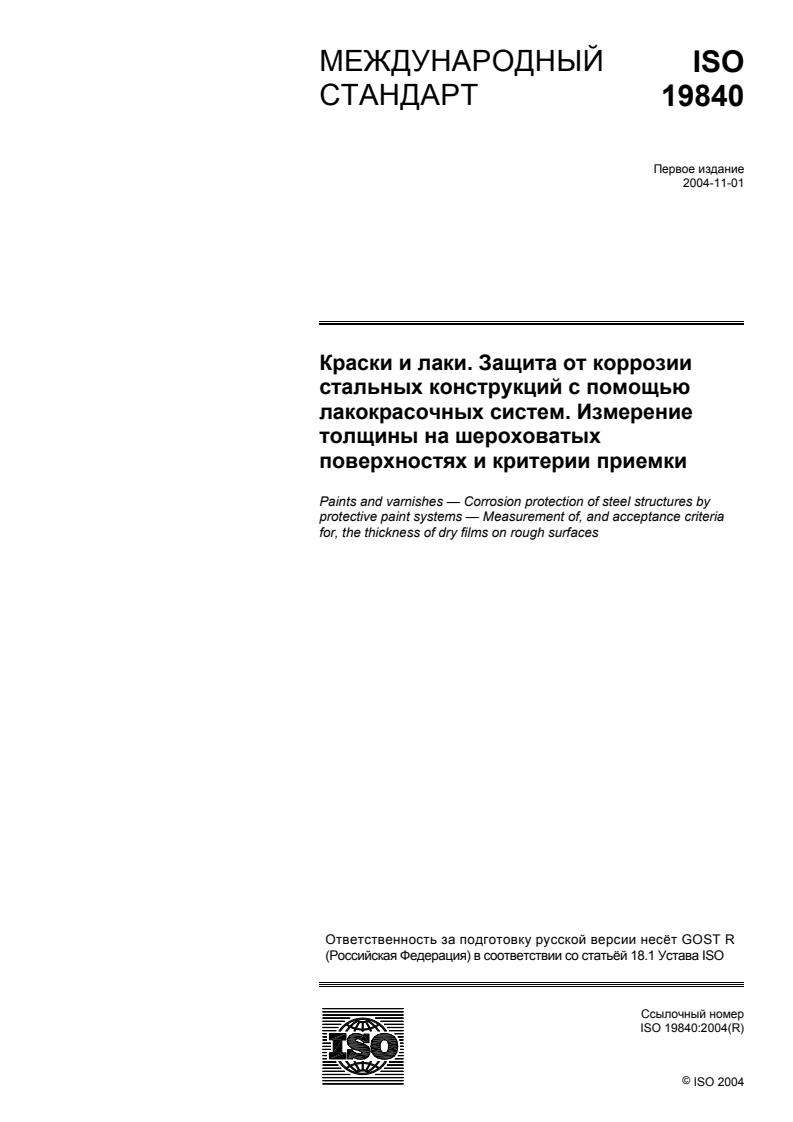
INTERNATIONAL ISO
STANDARD 19840
First edition
2004-11-01
Paints and varnishes — Corrosion
protection of steel structures by
protective paint systems — Measurement
of, and acceptance criteria for, the
thickness of dry films on rough surfaces
Peintures et vernis — Anticorrosion des structures en acier par
systèmes de peinture — Mesure et critères d'acceptation de l'épaisseur
d'un feuil sec sur des surfaces rugueuses
Reference number
©
ISO 2004
PDF disclaimer
This PDF file may contain embedded typefaces. In accordance with Adobe's licensing policy, this file may be printed or viewed but
shall not be edited unless the typefaces which are embedded are licensed to and installed on the computer performing the editing. In
downloading this file, parties accept therein the responsibility of not infringing Adobe's licensing policy. The ISO Central Secretariat
accepts no liability in this area.
Adobe is a trademark of Adobe Systems Incorporated.
Details of the software products used to create this PDF file can be found in the General Info relative to the file; the PDF-creation
parameters were optimized for printing. Every care has been taken to ensure that the file is suitable for use by ISO member bodies. In
the unlikely event that a problem relating to it is found, please inform the Central Secretariat at the address given below.
© ISO 2004
All rights reserved. Unless otherwise specified, no part of this publication may be reproduced or utilized in any form or by any means,
electronic or mechanical, including photocopying and microfilm, without permission in writing from either ISO at the address below or
ISO's member body in the country of the requester.
ISO copyright office
Case postale 56 • CH-1211 Geneva 20
Tel. + 41 22 749 01 11
Fax + 41 22 749 09 47
E-mail copyright@iso.org
Web www.iso.org
Published in Switzerland
ii © ISO 2004 – All rights reserved
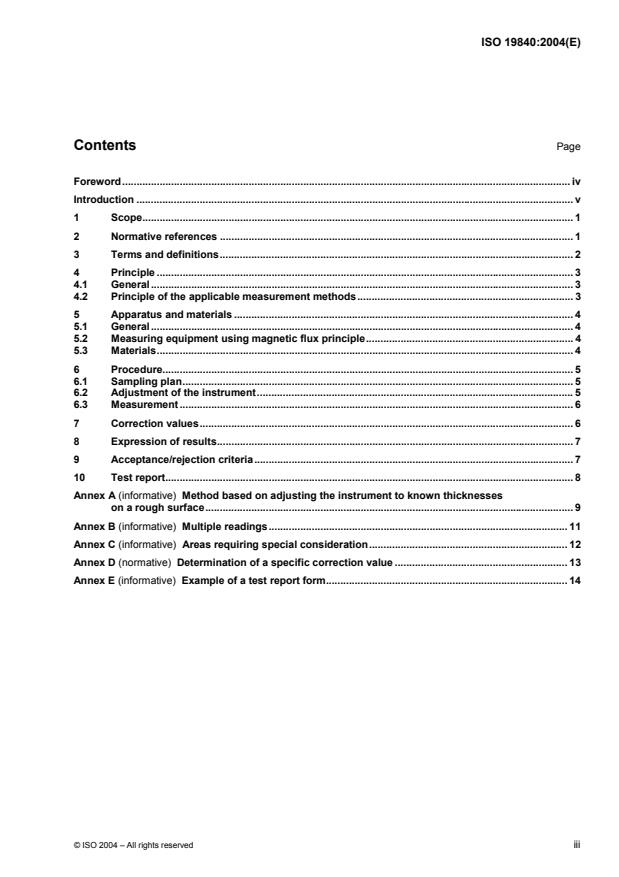
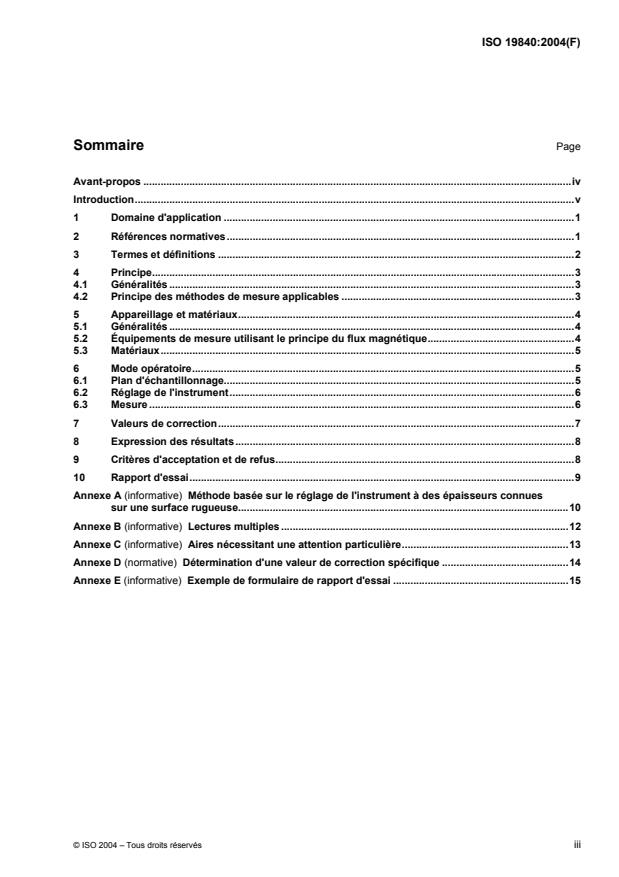
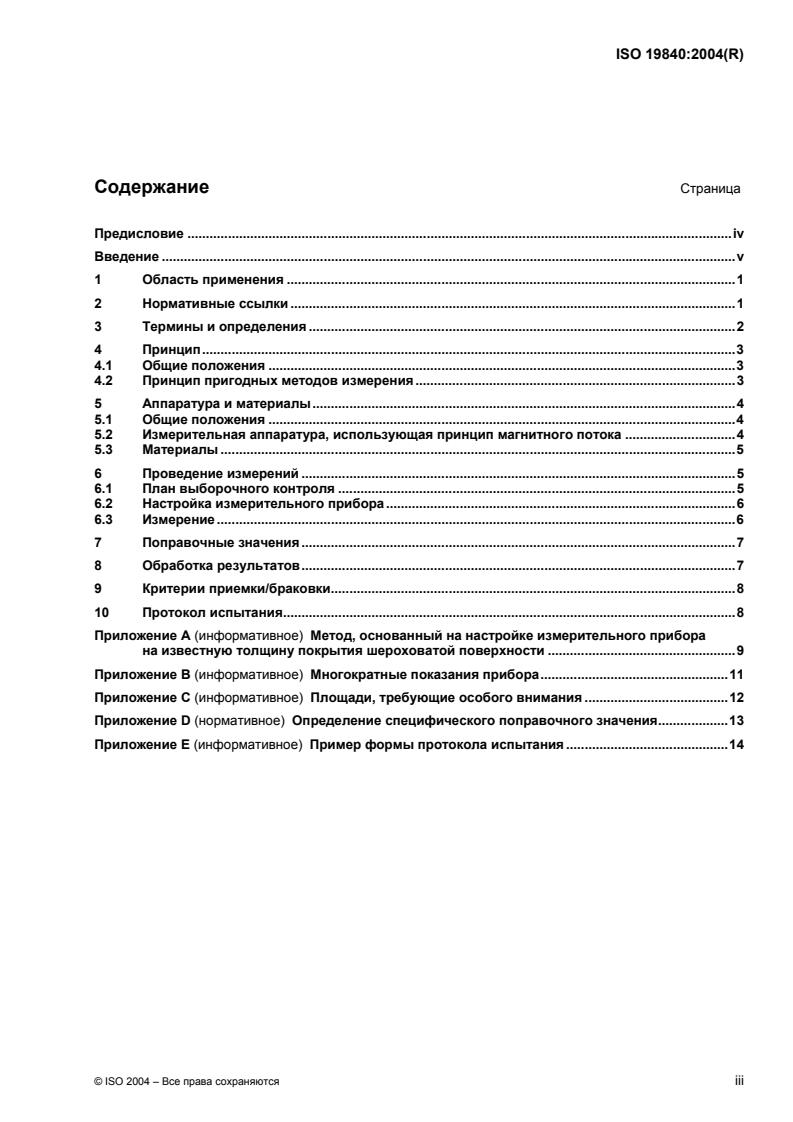
Contents Page
Foreword. iv
Introduction . v
1 Scope. 1
2 Normative references . 1
3 Terms and definitions. 2
4 Principle . 3
4.1 General. 3
4.2 Principle of the applicable measurement methods. 3
5 Apparatus and materials . 4
5.1 General. 4
5.2 Measuring equipment using magnetic flux principle. 4
5.3 Materials. 4
6 Procedure. 5
6.1 Sampling plan. 5
6.2 Adjustment of the instrument. 5
6.3 Measurement . 6
7 Correction values. 6
8 Expression of results. 7
9 Acceptance/rejection criteria. 7
10 Test report. 8
Annex A (informative) Method based on adjusting the instrument to known thicknesses
on a rough surface. 9
Annex B (informative) Multiple readings. 11
Annex C (informative) Areas requiring special consideration. 12
Annex D (normative) Determination of a specific correction value . 13
Annex E (informative) Example of a test report form. 14
Foreword
ISO (the International Organization for Standardization) is a worldwide federation of national standards bodies
(ISO member bodies). The work of preparing International Standards is normally carried out through ISO
technical committees. Each member body interested in a subject for which a technical committee has been
established has the right to be represented on that committee. International organizations, governmental and
non-governmental, in liaison with ISO, also take part in the work. ISO collaborates closely with the
International Electrotechnical Commission (IEC) on all matters of electrotechnical standardization.
International Standards are drafted in accordance with the rules given in the ISO/IEC Directives, Part 2.
The main task of technical committees is to prepare International Standards. Draft International Standards
adopted by the technical committees are circulated to the member bodies for voting. Publication as an
International Standard requires approval by at least 75 % of the member bodies casting a vote.
Attention is drawn to the possibility that some of the elements of this document may be the subject of patent
rights. ISO shall not be held responsible for identifying any or all such patent rights.
ISO 19840 was prepared by Technical Committee ISO/TC 35, Paints and varnishes, Subcommittee SC 14,
Protective paint systems for steel structures, in collaboration with European Committee for Standardization
(CEN) Technical Committee CEN/TC 139, Paints and varnishes.
iv © ISO 2004 – All rights reserved
Introduction
This International Standard supplements the ISO 12944 series with regard to the measurement and acceptance
criteria for the thickness of a dry film. If specified or agreed, the standard can also be used for other applications.
The objective of this International Standard is to achieve uniformity of practice for measuring the dry film thickness
of a coating on a roughened surface. The chosen methods entail the measurement of dry film thickness using
measurement instruments based on the permanent magnet principle and the inductive magnet principle.
Instruments using the eddy current principle can be used but their use is normally on non-ferrous metal surfaces.
If a coating is applied to a roughened steel substrate, the measurement of its dry film thickness is more complicated
than for smooth surfaces. Roughened steel substrates include those prepared by abrasive blast-cleaning or
abrading.
The effect of surface roughness on the measurement result increases with profile depth but the result will also
depend on the design of the measurement probe and the thickness of the coating.
Annex A, which is informative, is a method based on adjusting the instrument to known thicknesses on a rough
surface. In this method, no correction value is used. In this standard, individual readings are used. Annex B
describes a method for multiple readings. The methods in Annexes A and B are intended to be used only if
specified or agreed.
INTERNATIONAL STANDARD ISO 19840:2004(E)
Paints and varnishes — Corrosion protection of steel structures
by protective paint systems — Measurement of, and acceptance
criteria for, the thickness of dry films on rough surfaces
1 Scope
This International Standard specifies a procedure for the verification of dry film thickness against nominal dry
film thickness on rough surfaces, including the adjustment of the instruments used, the definition of inspection
areas, sampling plans, measurement methods and acceptance/rejection criteria.
For the purposes of this standard, any specified thickness is taken to be nominal as defined in ISO 12944-5
and the dry film thickness is the typical thickness above the peaks of the surface profile.
The procedure described in this International Standard is based on the use of instruments of the permanent
magnet and inductive magnet type. Instruments are adjusted to zero and a known thickness on a smooth surface.
Measurements taken on a coating on a roughened steel substrate will therefore be higher than the actual
value above the peaks of the profile. The thickness of the dry film above the peaks of the profile is defined as the
instrument reading minus an appropriate correction value.
The dry film thickness is obtained by using the appropriate correction value applied to readings based on
adjustment on a smooth, flat, steel surface.
Where individual readings, based on adjustment on a smooth, flat steel surface without the use of correction
values, are specified or agreed, it is important to recognise that this method does not conform with this
International Standard.
This standard is applicable if the nominal dry film thickness is 40 µm or greater.
NOTE If the nominal thickness is less than the surface roughness of the substrate the uncertainty of the
measurement will increase.
2 Normative references
The following referenced documents are indispensable for the application of this document. For dated
references, only the edition cited applies. For undated references, the latest edition of the referenced
document (including any amendments) applies.
ISO 2808, Paints and varnishes — Determination of film thickness
ISO 8503-1:1995, Preparation of steel substrates before application of paints and related products — Surface
roughness characteristics of blast-cleaned steel substrates — Part 1: Specifications and definitions for ISO
surface profile comparators for the assessment of abrasive blast-cleaned surfaces
ISO 12944-1, Paints and varnishes — Corrosion protection of steel structures by protective paint systems —
Part 1: General introduction
ISO 12944-2, Paints and varnishes — Corrosion protection of steel structures by protective paint systems —
Part 2: Classification of environments
ISO 12944-3, Paints and varnishes — Corrosion protection of steel structures by protective paint systems —
Part 3: Design considerations
ISO 12944-4, Paints and varnishes — Corrosion protection of steel structures by protective paint systems —
Part 4: Types of surface and surface preparation
ISO 12944-5, Paints and varnishes — Corrosion protection of steel structures by protective paint systems —
Part 5: Protective paint systems
ISO 12944-6, Paints and varnishes — Corrosion protection of steel structures by protective paint systems —
Part 6: Laboratory performance test methods
ISO 12944-7, Paints and varnishes — Corrosion protection of steel structures by protective paint systems —
Part 7: Execution and supervision of paint work
ISO 12944-8, Paints and varnishes — Corrosion protection of steel structures by protective paint systems —
Part 8: Development of specifications for new work and maintenance
3 Terms and definitions
For the purposes of this document, the following terms and definitions apply.
3.1
dry film thickness
DFT
thickness of a coating remaining over the peaks of a rough surface when the coating has hardened
3.2
individual reading
figure displayed by the film thickness instrument
3.3
correction value
allowance for the influence of the abrasive blast-cleaned or otherwise roughened surface on the reading of the
film thickness instrument
3.4
individual dry film thickness
individual reading minus a correction value
3.5
mean dry film thickness
arithmetic mean of all the individual dry film thicknesses in the inspection area
3.6
nominal dry film thickness
NDFT
dry film thickness specified for each coat or for the whole paint system
3.7
inspection area
designated area for which a sampling plan is established and which can be the whole structure or sections of
the whole structure
3.8
sampling plan
plan which defines the number of measurements to be taken on an inspection area
2 © ISO 2004 – All rights reserved
3.9
adjustment
process of aligning the readings of a dry film thickness gauge to known thickness values
3.10
surface profile
micro-roughness of a surface generally expressed as the height of the major peaks relative to the major
valleys
[ISO 8503-1:1995]
3.11
maximum dry film thickness
highest acceptable individual value of the dry film thickness above which the performance of the paint or the
paint system might be impaired
4 Principle
4.1 General
The thickness of the coating on the prepared steel surface is measured using non-destructive methods
described in ISO 2808. The measurement instruments used are adjusted. For the measurement a sampling
plan is laid down as well as an appropriate correction value.
The standard also specifies criteria which are used with regard to acceptance or non-acceptance of film
thickness values.
4.2 Principle of the applicable measurement methods
4.2.1 Magnetic induction principle
Instruments of this type operate on the principle that the magnetic flux between a magnet and a magnetic
substrate varies according to the distance between the two and indicate the coating thickness.
4.2.2 Permanent magnetic pull-off principle
Instruments of this type measure the force required to overcome the attraction between a magnet and the
magnetic substrate and indicate the coating thickness.
4.2.3 Electromagnetic induction principle
Instruments based on this principle use an alternating signal to produce a magnetic field. The effects on the
field of the magnetic steel substrate are a measure of the distance between the substrate and the probe tip
that is the thickness of the coating.
NOTE Other methods using a similar principle are available.
4.2.4 Eddy current principle
Eddy current instruments — mainly used for non-magnetic substrates — generate a high frequency electro-
magnetic field in the probe of the instrument which induces eddy currents in the coated metal substrate when
the probe is placed in contact. The amplitude and phase of the current are affected by the distance to the
substrate and indicate the coating thickness.
5 Apparatus and materials
5.1 General
All instruments for measuring dry film thicknesses will give variable values within very small areas on
roughened surfaces due to the influence of the surface roughness and the variations inherent in the method(s)
used to apply the paint.
The type of measuring equipment and material shall be specified or agreed between the interested parties
before the measurements commence.
5.2 Measuring equipment using magnetic flux principle
5.2.1 Electromagnet
Instruments using this principle may be equipped with either a single or twin pole probe.
This equipment may incorporate a statistical capability. This enables the minimum, maximum, mean and
standard deviation to be calculated.
NOTE When using a twin-poled instrument, it is recommended that the instrument is moved to positions 90°, 180°
and 270° from the original position where the first reading was made, for example the instrument is pivoted around the first
point of measurement. The mean value of the four readings taken should be determined and represents the dry film
thickness at the particular spot. In this case, the arithmetic mean value of the four readings is used in place of an individual
reading.
5.2.2 Permanent magnet
Instruments of this type incorporate a permanent magnet with one or more poles in the form of hemispherical
contacts which are placed on the coated surface.
NOTE When using a twin-poled instrument, it is recommended that the instrument is moved to positions 90°, 180°
and 270° from the original position where the first reading was made, for example the instrument is pivoted around the first
point of measurement. The mean value of the four readings taken should be determined and represents the dry film
thickness in the particular spot. In this case, the arithmetic mean value of the four readings is used in place of an individual
reading.
5.2.3 Magnetic pull-off
This type of instrument most commonly incorporates a permanent magnet to which is attached a spring.
Various forms of the instrument are available including a simple pencil type, spring balance and another type
to which tension is applied by turning a calibrated circular dial until the magnet and attached spring detach
from the coated surface.
NOTE Instruments as described in 5.2.2 and 5.2.3 have a fixed scale graduation and should only be used when a
lower level of accuracy can be accepted. They may be only adjusted at one particular point on the scale, and this
adjustment will have a limited effect on calibration over the full range.
5.3 Materials
5.3.1 Foils/shims
Foils/shims with verified thickness with assigned values traceable to recognised standards and with
thicknesses above the dry film thickness to be measured.
NOTE 1 The use of other foils/shims is permitted provided they are verified by a traceable method.
NOTE 2 Care should be taken to ensure that foils/shims are in good condition before they are used. Foils/shims will
wear more quickly when used on roughened surfaces.
4 © ISO 2004 – All rights reserved
5.3.2 Uncoated test plates
An uncoated smooth, flat, visually clean steel test plate free of mill scale and at least 3 mm thick and with
minimum dimensions of 25 mm × 25 mm.
5.3.3 Pre-coated test plates
Certified, smooth, flat, visually clean pre-coated steel test plates with assigned values traceable to recognised
standards and with coating thicknesses near to the expected dry film thickness to be measured. The
dimensions shall be at least equal to those specified in 5.3.2.
6 Procedure
6.1 Sampling plan
The sampling plan defines the number of measurements to be taken in an inspection area. If the structure has
not been divided into individual inspection areas, the whole structure is considered as the inspection area for
measuring the dry film thic
...
NORME ISO
INTERNATIONALE 19840
Première édition
2004-11-01
Peintures et vernis — Anticorrosion
des structures en acier par systèmes
de peinture — Mesure et critères
d'acceptation de l'épaisseur d'un feuil sec
sur des surfaces rugueuses
Paints and varnishes — Corrosion protection of steel structures by
protective paint systems — Measurement of, and acceptance criteria
for, the thickness of dry films on rough surfaces
Numéro de référence
©
ISO 2004
PDF – Exonération de responsabilité
Le présent fichier PDF peut contenir des polices de caractères intégrées. Conformément aux conditions de licence d'Adobe, ce fichier
peut être imprimé ou visualisé, mais ne doit pas être modifié à moins que l'ordinateur employé à cet effet ne bénéficie d'une licence
autorisant l'utilisation de ces polices et que celles-ci y soient installées. Lors du téléchargement de ce fichier, les parties concernées
acceptent de fait la responsabilité de ne pas enfreindre les conditions de licence d'Adobe. Le Secrétariat central de l'ISO décline toute
responsabilité en la matière.
Adobe est une marque déposée d'Adobe Systems Incorporated.
Les détails relatifs aux produits logiciels utilisés pour la création du présent fichier PDF sont disponibles dans la rubrique General Info
du fichier; les paramètres de création PDF ont été optimisés pour l'impression. Toutes les mesures ont été prises pour garantir
l'exploitation de ce fichier par les comités membres de l'ISO. Dans le cas peu probable où surviendrait un problème d'utilisation,
veuillez en informer le Secrétariat central à l'adresse donnée ci-dessous.
DOCUMENT PROTÉGÉ PAR COPYRIGHT
© ISO 2004
Droits de reproduction réservés. Sauf prescription différente, aucune partie de cette publication ne peut être reproduite ni utilisée sous
quelque forme que ce soit et par aucun procédé, électronique ou mécanique, y compris la photocopie et les microfilms, sans l'accord écrit
de l'ISO à l'adresse ci-après ou du comité membre de l'ISO dans le pays du demandeur.
ISO copyright office
Case postale 56 • CH-1211 Geneva 20
Tel. + 41 22 749 01 11
Fax + 41 22 749 09 47
E-mail copyright@iso.org
Web www.iso.org
Version française parue en 2010
Publié en Suisse
ii © ISO 2004 – Tous droits réservés
Sommaire Page
Avant-propos .iv
Introduction.v
1 Domaine d'application .1
2 Références normatives.1
3 Termes et définitions .2
4 Principe.3
4.1 Généralités .3
4.2 Principe des méthodes de mesure applicables .3
5 Appareillage et matériaux.4
5.1 Généralités .4
5.2 Équipements de mesure utilisant le principe du flux magnétique.4
5.3 Matériaux.5
6 Mode opératoire.5
6.1 Plan d'échantillonnage.5
6.2 Réglage de l'instrument.6
6.3 Mesure .6
7 Valeurs de correction.7
8 Expression des résultats.8
9 Critères d'acceptation et de refus.8
10 Rapport d'essai.9
Annexe A (informative) Méthode basée sur le réglage de l'instrument à des épaisseurs connues
sur une surface rugueuse.10
Annexe B (informative) Lectures multiples .12
Annexe C (informative) Aires nécessitant une attention particulière.13
Annexe D (normative) Détermination d'une valeur de correction spécifique .14
Annexe E (informative) Exemple de formulaire de rapport d'essai .15
Avant-propos
L'ISO (Organisation internationale de normalisation) est une fédération mondiale d'organismes nationaux de
normalisation (comités membres de l'ISO). L'élaboration des Normes internationales est en général confiée
aux comités techniques de l'ISO. Chaque comité membre intéressé par une étude a le droit de faire partie du
comité technique créé à cet effet. Les organisations internationales, gouvernementales et non
gouvernementales, en liaison avec l'ISO participent également aux travaux. L'ISO collabore étroitement avec
la Commission électrotechnique internationale (CEI) en ce qui concerne la normalisation électrotechnique.
Les Normes internationales sont rédigées conformément aux règles données dans les Directives ISO/CEI,
Partie 2.
La tâche principale des comités techniques est d'élaborer les Normes internationales. Les projets de Normes
internationales adoptés par les comités techniques sont soumis aux comités membres pour vote. Leur
publication comme Normes internationales requiert l'approbation de 75 % au moins des comités membres
votants.
L'attention est appelée sur le fait que certains des éléments du présent document peuvent faire l'objet de
droits de propriété intellectuelle ou de droits analogues. L'ISO ne saurait être tenue pour responsable de ne
pas avoir identifié de tels droits de propriété et averti de leur existence.
L'ISO 19840 a été élaborée par le comité technique ISO/TC 35, Peintures et vernis, sous-comité SC 14,
Systèmes de peinture protectrice pour les structures en acier, en collaboration avec le Comité technique
CEN/TC 139, Peintures et vernis, du Comité européen de normalisation (CEN).
iv © ISO 2004 – Tous droits réservés
Introduction
La présente Norme internationale complète la série ISO 12944 en ce qui concerne la mesure et les critères
d'acceptation de l'épaisseur d'un feuil sec. Si cela est spécifié ou fait l'objet d'un accord, la norme peut
également servir à d'autres applications.
La présente Norme internationale a pour objet de définir une pratique uniforme de mesure de l'épaisseur d'un
feuil sec d'un revêtement sur une surface rugueuse. Les méthodes choisies utilisent des instruments de
mesure de l'épaisseur du feuil sec basés sur les principes de l'aimantation permanente ou de l'aimantation
induite. Des instruments basés sur le principe du courant de Foucault peuvent être utilisés, bien qu'ils
s'appliquent normalement aux surfaces en métaux non ferreux.
La mesure de l'épaisseur d'un feuil sec est plus complexe sur un subjectile d'acier rugueux que sur une
surface lisse. Les subjectiles d'acier rugueux incluent ceux préparés par décapage à l'abrasif ou par abrasion.
L'incidence de la rugosité de surface sur la mesure est d'autant plus importante que la profondeur de profil
augmente. Le résultat dépendra également de la conception de la sonde de mesure et de l'épaisseur du
revêtement.
L'Annexe A, informative, décrit une méthode consistant à régler l'instrument à des épaisseurs connues sur
une surface rugueuse. Cette méthode n'utilise pas de valeur de correction. Cette norme utilise des lectures
individuelles. L'Annexe B décrit une méthode pour les lectures multiples. Les méthodes des Annexes A et B
sont destinées à n'être utilisées que si elles ont été spécifiées ou ont fait l'objet d'un accord.
NORME INTERNATIONALE ISO 19840:2004(F)
Peintures et vernis — Anticorrosion des structures en acier
par systèmes de peinture — Mesure et critères d'acceptation
de l'épaisseur d'un feuil sec sur des surfaces rugueuses
1 Domaine d'application
La présente Norme internationale spécifie un mode opératoire destiné à vérifier l'épaisseur réelle d'un feuil
sec par rapport à son épaisseur nominale sur des surfaces rugueuses, y compris le réglage des instruments,
la définition des aires de contrôle, les plans d'échantillonnage, les méthodes de mesure et les critères
d'acceptation ou de refus.
Pour les besoins de la présente Norme internationale, toute épaisseur spécifiée est à considérer comme
épaisseur nominale telle que définie dans l'ISO 12944-5 et l'épaisseur du feuil sec comme l'épaisseur
au-dessus des pics du profil de surface.
Le mode opératoire décrit dans la présente Norme internationale s'appuie sur l'utilisation d'instruments basés
sur les principes de l'aimantation permanente ou de l'aimantation induite. Les instruments sont réglés à zéro
et à une épaisseur connue sur une surface lisse.
Les valeurs mesurées sur un revêtement appliqué sur un subjectile d'acier rugueux seront donc supérieures
aux valeurs réelles au-dessus des pics du profil. L'épaisseur du feuil sec au-dessus des pics du profil est
définie comme la valeur lue sur l'instrument, de laquelle on retranche une valeur de correction appropriée.
L'épaisseur de feuil sec est obtenue en appliquant la correction appropriée aux lectures effectuées après
réglage de l'instrument de mesure sur un subjectile d'acier plat et lisse.
S'il est spécifié ou convenu que les lectures individuelles utilisent un réglage de l'instrument sur un subjectile
d'acier plat et lisse sans valeur de correction, il est important de souligner que cette méthode n'est pas
conforme à la présente Norme internationale.
La présente Norme internationale est applicable si l'épaisseur nominale d'un feuil sec est supérieure ou égale
à 40 µm.
NOTE Si l'épaisseur nominale est inférieure à la rugosité de surface du subjectile, l'incertitude de mesure
augmentera.
2 Références normatives
Les documents de référence suivants sont indispensables pour l'application du présent document. Pour les
références datées, seule l'édition citée s'applique. Pour les références non datées, la dernière édition du
document de référence s'applique (y compris les éventuelles corrections).
ISO 2808, Peintures et vernis — Détermination de l'épaisseur du feuil
ISO 8503-1:1988, Préparation des subjectiles d'acier avant application de peintures et de produits
assimilés — Caractéristiques de rugosité des subjectiles d'acier décapés — Partie 1: Spécifications et
définitions relatives aux échantillons de comparaison viso-tactile ISO pour caractériser les surfaces préparées
par projection d'abrasif
ISO 12944-1, Peintures et vernis — Anticorrosion des structures en acier par systèmes de peinture —
Partie 1: Introduction générale
ISO 12944-2, Peintures et vernis — Anticorrosion des structures en acier par systèmes de peinture —
Partie 2: Classification des environnements
ISO 12944-3, Peintures et vernis — Anticorrosion des structures en acier par systèmes de peinture —
Partie 3: Conception et dispositions constructives
ISO 12944-4, Peintures et vernis — Anticorrosion des structures en acier par systèmes de peinture —
Partie 4: Types de surface et de préparation de surface
ISO 12944-5, Peintures et vernis — Anticorrosion des structures en acier par systèmes de peinture —
Partie 5: Systèmes de peinture
ISO 12944-6, Peintures et vernis — Anticorrosion des structures en acier par systèmes de peinture —
Partie 6: Essais de performance en laboratoire
ISO 12944-7, Peintures et vernis — Anticorrosion des structures en acier par systèmes de peinture —
Partie 7: Exécution et surveillance des travaux de peinture
ISO 12944-8, Peintures et vernis — Anticorrosion des structures en acier par systèmes de peinture —
Partie 8: Développement de spécifications pour les travaux neufs et l'entretien
3 Termes et définitions
Pour les besoins du présent document, les termes et définitions suivants s'appliquent.
3.1
épaisseur du feuil sec
EFS
épaisseur d'un revêtement restant au-dessus des pics d'une surface rugueuse après durcissement du
revêtement
3.2
lecture individuelle
valeur affichée par l'instrument de mesure de l'épaisseur de feuil
3.3
valeur de correction
valeur permettant de prendre en compte l'influence du subjectile décapé par projection d'abrasif ou rendu
rugueux par toute autre méthode, sur la lecture de l'instrument de mesure de l'épaisseur
3.4
épaisseur individuelle du feuil sec
lecture individuelle après déduction d'une valeur de correction
3.5
épaisseur moyenne du feuil sec
moyenne arithmétique de toutes les épaisseurs individuelles du feuil sec de l'aire de contrôle
3.6
épaisseur nominale du feuil sec
ENFS
épaisseur du feuil sec spécifiée pour chaque couche ou pour l'ensemble du système de peinture
2 © ISO 2004 – Tous droits réservés
3.7
aire de contrôle
aire désignée sur laquelle un plan d'échantillonnage est établi, et qui peut couvrir l'ensemble de l'ouvrage ou
des portions de l'ouvrage
3.8
plan d'échantillonnage
plan définissant le nombre de lectures individuelles à prendre sur une aire de contrôle
3.9
réglage
processus d'alignement des lectures de l'appareil de mesure sur des valeurs connues d'épaisseur de feuil sec
3.10
profil de surface
micro-rugosité d'une surface, exprimée généralement comme la distance entre le point le plus haut des
saillies et le point le plus bas des creux
[ISO 8503-1:1988]
3.11
épaisseur maximale du feuil sec
valeur individuelle acceptable la plus élevée de l'épaisseur du feuil sec au-dessus de laquelle les
performances de la peinture ou du système de peinture sont susceptibles de se dégrader
4 Principe
4.1 Généralités
L'épaisseur du revêtement appliqué sur le subjectile d'acier préparé est déterminée au moyen de méthodes
non destructives décrites dans l'ISO 2808. Les instruments de mesure utilisés sont réglés. Un plan
d'échantillonnage est établi pour la mesure, ainsi qu'une valeur de correction appropriée.
La norme spécifie également les critères utilisés pour l'acceptation ou le refus des valeurs d'épaisseur du feuil.
4.2 Principe des méthodes de mesure applicables
4.2.1 Principe de l'induction magnétique
Les instruments de ce type fonctionnent selon le principe suivant: le flux magnétique entre un aimant et un
subjectile magnétique varie en fonction de la distance qui les sépare, et indiquent l'épaisseur du revêtement.
4.2.2 Principe de l'attraction magnétique permanente
Les instruments de ce type mesurent la force requise pour compenser l'attraction qui s'exerce entre un aimant
et le subjectile magnétique, et indiquent l'épaisseur du revêtement.
4.2.3 Principe de l'induction électromagnétique
Les instruments basés sur ce principe utilisent un courant alternatif produisant un champ magnétique. Ses
effets sur le champ magnétique du subjectile d'acier permettent de mesurer la distance entre le subjectile et la
pointe de la sonde, c'est-à-dire l'épaisseur du revêtement.
NOTE Il existe d'autres méthodes utilisant le même principe.
4.2.4 Principe du courant de Foucault
Les instruments à courant de Foucault — essentiellement utilisés pour les subjectiles non magnétiques —
génèrent un champ électromagnétique à haute fréquence dans la sonde de l'instrument, qui induit des
courants de Foucault dans le subjectile métallique revêtu lorsque celui-ci est en contact avec la sonde.
L'amplitude et la phase du courant dépendent de la distance avec le subjectile et indiquent l'épaisseur du
revêtement.
5 Appareillage et matériaux
5.1 Généralités
Sur de toutes petites surfaces, tous les instruments de mesure de l'épaisseur du feuil sec indiqueront des
valeurs variables sur les surfaces rugueuses, en raison de l'influence de la rugosité de surface et des
variations inhérentes à la (aux) méthode(s) d'application de la peinture.
Le type d'équipement et de matériel de mesure doivent être spécifiés ou faire l'objet d'un accord entre les
parties intéressées avant le début des mesures.
5.2 Équipements de mesure utilisant le principe du flux magnétique
5.2.1 Électro-aimant
Les instruments fonctionnant selon ce principe peuvent être équipés d'une sonde à un ou deux pôles.
Ces équipements peuvent être dotés de moyens de calcul statistique permettant de déterminer le minimum,
le maximum, la moyenne et l'écart-type.
NOTE Lorsqu'on utilise un instrument à deux pôles, il est recommandé de le faire pivoter de 90°, 180° et 270° par
rapport à la position d'origine après avoir procédé à la première lecture, par exemple autour du premier point de mesure. Il
convient de déterminer la valeur moyenne des quatre lectures qui représente l'épaisseur du feuil sec à cet emplacement
précis. Dans ce cas, la moyenne arithmétique des quatre lectures remplace une lecture individuelle.
5.2.2 Aimant permanent
Les instruments de ce type comportent un aimant permanent à un ou plusieurs pôles en forme de contacts
hémisphériques placés sur la surface revêtue.
NOTE Lorsqu'on utilise un instrument à deux pôles, il est recommandé de le faire pivoter de 90°, 180° et 270° par
rapport à la position d'origine après avoir procédé à la première lecture, par exemple autour du premier point de mesure. Il
convient de déterminer la valeur moyenne des quatre lectures qui représente l'épaisseur du feuil sec à cet emplacement
précis. Dans ce cas, la moyenne arithmétique des quatre lectures remplace une lecture individuelle.
5.2.3 Attraction magnétique
Ce type d'instrument comporte le plus souvent un aimant permanent auquel est fixé un ressort. L'instrument
existe sous différentes formes, notamment sous forme de simple crayon, de peson à ressort ou d'un autre
modèle auquel une tension est appliquée en tournant un cadran circulaire étalonné jusqu'à ce que l'aimant et
le ressort se détachent du subjectile revêtu.
NOTE Les instruments décrits en 5.2.2 et 5.2.3 ont une graduation d'échelle fixe et il est recommandé de ne les
utiliser que si un niveau de précision inférieur peut être accepté. Ils ne peuvent être réglés qu'en un point particulier de
l'échelle et ce réglage aura un effet limité sur l'étalonnage de l'ensemble de la plage de mesure.
4 © ISO 2004 – Tous droits réservés
5.3 Matériaux
5.3.1 Cales ou feuilles calibrées
Cales ou feuilles d'épaisseurs connues avec des valeurs attribuées traçables selon des normes reconnues et
supérieures à l'épaisseur du feuil sec à mesurer.
NOTE 1 D'autres cales ou feuilles peuvent être utilisées, à condition qu'elles soient vérifiées selon une méthode
traçable.
NOTE 2 Il convient de s'assurer que les cales ou les feuilles sont en bon état avant de les utiliser. Les cales et les
feuilles s'usent plus rapidement au contact de subjectiles rugueux.
5.3.2 Plaques de réglage non revêtues
Plaques en acier non revêtues, plates et lisses, considérées comme propres à l'examen visuel, exemptes de
calamine, d'une épaisseur d'au moins 3 mm et mesurant au moins 25 mm × 25 mm.
5.3.3 Plaques de réglage préalablement revêtues
Plaques certifiées en acier, plates et lisses, considérées comme propres à l'examen visuel, préalablement
revêtues, avec des valeurs attribuées traçables selon des normes reconnues et dont l'épaisseur est proche de
l'épaisseur escomptée du feuil sec à mesurer. Les dimensions doivent être au moins égales à celles
spécifiées en 5.3.2.
6 Mode opératoire
6.1 Plan d'échantillonnage
Le plan d'échantillonnage définit le nombre de mesures à effectuer sur une aire de contrôle. Si l'ouvrage n'a
pas été divisé en plusieurs aires de contrôle individuelles, l'ensemble de l'ouvrage est considéré comme étant
l'aire de contrôle pour la mesure de l'épaisseur du feuil sec.
NOTE Les aires de contrôle seront normalement définies dans la spécification de projet (voir également l'ISO 12944-7
et l'ISO 12944-8).
Les modes opératoires applicables aux aires à contrôler nécessitant une attention particulière, comme les
soudures, les arêtes, les coins, les fixations, les aires où des défauts ont été observés, doivent faire l'objet
d'un accord entre les parties intéressées. Pour plus de précisions, voir l'Annexe C.
Le nombre minimal de mesures à effectuer de m
...
МЕЖДУНАРОДНЫЙ ISO
СТАНДАРТ
Первое издание
2004-11-01
Краски и лаки. Защита от коррозии
стальных конструкций с помощью
лакокрасочных систем. Измерение
толщины на шероховатых
поверхностях и критерии приемки
Paints and varnishes — Corrosion protection of steel structures by
protective paint systems — Measurement of, and acceptance criteria
for, the thickness of dry films on rough surfaces
Ответственность за подготовку русской версии несёт GOST R
(Российская Федерация) в соответствии со статьёй 18.1 Устава ISO
Ссылочный номер
©
ISO 2004
Отказ от ответственности при работе в PDF
Настоящий файл PDF может содержать интегрированные шрифты. В соответствии с условиями лицензирования, принятыми
фирмой Adobe, этот файл можно распечатать или вывести на экран, но его нельзя изменить, пока не будет получена
лицензия на загрузку интегрированных шрифтов в компьютер, на котором ведется редактирование. В случае загрузки
настоящего файла заинтересованные стороны принимают на себя ответственность за соблюдение лицензионных условий
фирмы Adobe. Центральный секретариат ISO не несет никакой ответственности в этом отношении.
Adobe — торговый знак фирмы Adobe Systems Incorporated.
Подробности, относящиеся к программным продуктам, использованным для создания настоящего файла PDF, можно найти в
рубрике General Info файла; параметры создания PDF были оптимизированы для печати. Были приняты во внимание все
меры предосторожности с тем, чтобы обеспечить пригодность настоящего файла для использования комитетами-членами
ISO. В редких случаях возникновения проблемы, связанной со сказанным выше, просьба проинформировать Центральный
секретариат по адресу, приведенному ниже.
ДОКУМЕНТ ЗАЩИЩЕН АВТОРСКИМ ПРАВОМ
Все права сохраняются. Если не указано иное, никакую часть настоящей публикации нельзя копировать или использовать в
какой-либо форме или каким-либо электронным или механическим способом, включая фотокопии и микрофильмы, без
предварительного письменного согласия ISO по адресу, указанному ниже, или членов ISO в стране запрашивающей стороны.
ISO copyright office
Case postale 56 • CH-1211 Geneva 20
Tel. + 41 22 749 01 11
Fax + 41 22 749 09 47
E-mail copyright@iso.org
Web www.iso.org
Опубликовано в Швейцарии
ii © ISO 2004 – Все права сохраняются
Содержание Страница
Предисловие .iv
Введение .v
1 Область применения .1
2 Нормативные ссылки .1
3 Термины и определения .2
4 Принцип.3
4.1 Общие положения .3
4.2 Принцип пригодных методов измерения.3
5 Аппаратура и материалы.4
5.1 Общие положения .4
5.2 Измерительная аппаратура, использующая принцип магнитного потока .4
5.3 Материалы .5
6 Проведение измерений .5
6.1 План выборочного контроля .5
6.2 Настройка измерительного прибора.6
6.3 Измерение .6
7 Поправочные значения .7
8 Обработка результатов.7
9 Критерии приемки/браковки.8
10 Протокол испытания.8
Приложение А (информативное) Метод, основанный на настройке измерительного прибора
на известную толщину покрытия шероховатой поверхности .9
Приложение В (информативное) Многократные показания прибора.11
Приложение С (информативное) Площади, требующие особого внимания .12
Приложение D (нормативное) Определение специфического поправочного значения.13
Приложение Е (информативное) Пример формы протокола испытания .14
Предисловие
Международная организация по стандартизации (ISO) является всемирной федерацией национальных
организаций по стандартизации (комитетов-членов ISO). Разработка международных стандартов
обычно осуществляется техническими комитетами ISO. Каждый комитет-член, заинтересованный в
деятельности, для которой был создан технический комитет, имеет право быть представленным в этом
комитете. Международные правительственные и неправительственные организации, имеющие связи с
ISO, также принимают участие в работах. Что касается стандартизации в области электротехники, то
ISO работает в тесном сотрудничестве с Международной электротехнической комиссией (IEC).
Проекты международных стандартов разрабатываются в соответствии с правилами Директив ISO/IEC,
Часть 2.
Основная задача технических комитетов заключается в подготовке международных стандартов.
Проекты международных стандартов, принятые техническими комитетами, рассылаются комитетам-
членам на голосование. Их опубликование в качестве международных стандартов требует одобрения
не менее 75 % комитетов-членов, принимающих участие в голосовании.
Следует иметь в виду, что некоторые элементы настоящего международного стандарта могут быть
объектом патентных прав. ISO не должна нести ответственность за идентификацию какого-либо
одного или всех патентных прав.
Документ ISO 19840 подготовлен техническим комитетом ISO/TC 35, Краски и лаки, Подкомитетом
SC 14, Защитные лакокрасочные системы для стальных конструкций при сотрудничестве с
Техническим комитетом CEN/TC 139, Краски и лаки, Технического комитета по стандартизации (CEN).
iv © ISO 2004 – Все права сохраняются
Введение
Настоящий международный стандарт дополняет серию ISO 12944 в том, что касается измерения и
критериев приемки для толщины высушенного покрытия. Если этот стандарт задан или согласован, то
он может быть также использован для других применений.
Задачей настоящего международного стандарта является достижение практического единообразия
для измерения толщины высушенного покрытия на шероховатой поверхности. Выбранные методы
определяют порядок измерения толщины высушенного покрытия с помощью измерительных приборов,
работающих на принципе постоянного и индуктивного магнита. Измерительные приборы,
использующие принцип вихревого тока, могут быть применены, но с ними обычно работают на
поверхностях цветных металлов.
Если лакокрасочный материал нанесен на шероховатую стальную основу, то измерение толщины
высушенного покрытия является более сложной задачей по сравнению с гладкими поверхностями. К
шероховатым стальным основам относятся поверхности, подготовленные абразивной пескоструйной
обработкой или притиркой.
Влияние шероховатости поверхности на результат измерения увеличивается с глубиной профиля, но
этот результат будет также зависеть от конструктивного решения измерительного зонда и толщины
покрытия.
В информативном Приложении A дается метод, основанный на настройке измерительного прибора на
известную толщину покрытия шероховатой поверхности. В этом методе поправочное значение не
используется. В настоящем стандарте используются отдельные показания прибора. В Приложении B
дается описание метода для многократных показаний. Методы в Приложениях A и B предназначаются
для использования только в случае, если они заданы или согласованы.
МЕЖДУНАРОДНЫЙ СТАНДАРТ ISO 19840:2004(R)
Краски и лаки. Защита от коррозии стальных конструкций с
помощью лакокрасочных систем. Измерение толщины
высушенных покрытий на шероховатых поверхностях и
критерии приемки
1 Область применения
Настоящий международный стандарт устанавливает процедуру проверки толщины высушенного
покрытия в сравнении с его номинальной толщиной на шероховатых поверхностях. Эта процедура
включает настройку используемого измерительного прибора, определение площадей для
обследования, планы выборочного контроля, методы измерения и критерии приемки/браковки.
В настоящем стандарте любая заданная толщина принимается за номинальную величину, как
определено в ISO 12944-5, а за толщину высушенного покрытия принимают толщину над пиками
поверхностного профиля.
Процедура, описываемая в настоящем международном стандарте, основывается на использовании
измерительных приборов с постоянным магнитом и индуктивным магнитом. Измерительные приборы
настраиваются на нуль и известную толщину гладкой поверхности.
Следовательно, измерения на покрытии шероховатой стальной основы будут выше действительного
значения над пиками профиля. Толщина высушенного покрытия над пиками профиля определяется
как показание прибора минус соответствующее поправочное значение.
Толщина высушенного покрытия устанавливается путем использования подходящего
корректирующего значения, примененного к показаниям прибора, полученным на основе настройки по
гладкой, плоской стальной поверхности.
В случае, кода задаются или согласовываются отдельные показания, полученные на основе
настройки по гладкой, плоской, стальной поверхности без использования поправочных значений, то
важно признать, что этот метод не согласуется с настоящим международным стандартом.
Настоящий стандарт применяют, если номинальная толщина высушенного покрытия составляет 40 мкм
или больше.
ПРИМЕЧАНИЕ Если номинальная толщина меньше поверхностной шероховатости поверхности основы, то
неточность измерения будет увеличиваться.
2 Нормативные ссылки
Следующие нормативные документы являются обязательными для применения с настоящим
международным стандартом. Для жестких ссылок применяются только указанное по тексту издание.
Для плавающих ссылок необходимо использовать самое последнее издание нормативного ссылочного
документа (включая любые изменения).
ISO 2808, Краски и лаки. Определение толщины покрытия
ISO 8503-1:1995, Обработка стальной основы перед нанесением краски и относящихся к ним
продуктов. Шероховатость поверхности стальных основ после пескоструйной очистки. Часть 1.
Технические условия и определение блоков сравнения профилей поверхностей после пескоструйной
обработки
ISO 12944-1, Краски и лаки. Антикоррозионная защита стальных конструкций с помощью защитных
лакокрасочных систем. Часть 1. Введение
ISO 12944-2, Краски и лаки. Антикоррозионная защита стальных конструкций с помощью защитных
лакокрасочных систем. Часть 2. Классификация окружающих сред
ISO 12944-3, Краски и лаки. Антикоррозионная защита стальных конструкций с помощью защитных
лакокрасочных систем. Часть 3. Конструктивные соображения
ISO 12944-4, Краски и лаки. Антикоррозионная защита стальных конструкций с помощью защитных
лакокрасочных систем. Часть 4. Виды поверхностей и подготовка поверхностей
ISO 12944-5, Краски и лаки. Антикоррозионная защита стальных конструкций с помощью защитных
лакокрасочных систем. Часть 5. Защитные лакокрасочные системы
ISO 12944-6, Краски и лаки. Антикоррозионная защита стальных конструкций с помощью защитных
лакокрасочных систем. Часть 6. Лабораторные методы испытания
ISO 12944-7, Краски и лаки. Антикоррозионная защита стальных конструкций с помощью защитных
лакокрасочных систем. Часть 7. Производство лакокрасочных работ и надзор за ними
ISO 12944-8, Краски и лаки. Антикоррозионная защита стальных конструкций с помощью защитных
лакокрасочных систем. Часть 8. Разработка технических условий на новую работу и ее
обеспечение
3 Термины и определения
3.1
толщина высушенного покрытия
dry film thickness
DFT
толщина покрытия, остающаяся над пиками шероховатой поверхности после затвердевания покрытия
3.2
отдельное показание прибора
individual reading
цифра, отображенная прибором для измерения толщины покрытия
3.3
поправочное значение
correction value
допуск, учитывающий влияние шероховатой поверхности, полученной после абразивной
пескоструйной или другой обработки, на показание прибора для измерения толщины покрытия
3.4
отдельная толщина высушенного покрытия
individual dry film thickness
отдельное показание измерительного прибора минус поправочное значение
3.5
средняя толщина высушенного покрытия
mean dry film thickness
арифметическое среднее всех отдельных величин толщины высушенного покрытия на площади
обследования
2 © ISO 2004 – Все права сохраняются
3.6
номинальная толщина высушенного покрытия
nominal dry film thickness
NDFT
толщина высушенного покрытия, установленная для каждого слоя или всей лакокрасочной системы
3.7
площадь обследования
inspection area
назначенный участок, для которого составляется план выборочного контроля и который может быть
целой конструкцией или частью целой конструкции
3.8
план выборочного контроля
sampling plan
план, определяющий число измерений, которые предполагается сделать на обследуемой площади
3.9
настройка
adjustment
процесс выравнивания показаний прибора, измеряющего толщины высушенного покрытия, до
известных значений толщины
3.10
профиль поверхности
surface profile
микро-шероховатость поверхности, обычно выраженная как высота основных пиков относительно
основных впадин
[ISO 8503-1:1995]
3.11
максимальная толщина высушенного покрытия
maximum dry film thickness
наибольшее допустимое отдельное значение толщины высушенного покрытия, выше которого
нанесение краски или лакокрасочной системы может осуществляться с ухудшением качества
4 Принцип
4.1 Общие положения
Измеряется толщина покрытия на подготовленной стальной поверхности. Для этого применяются
методы неразрушающего контроля, изложенные в ISO 2808. Осуществляется настройка используемых
измерительных приборов. Для проведения измерений составляется план выборочного контроля, а
также определяется соответственное поправочное значение.
Настоящий стандарт задает также критерии, которые применяются в том, что касается приемки
значений толщины покрытия или определения брака окрашенной поверхности.
4.2 Принцип пригодных методов измерения
4.2.1 Принцип магнитной индукции
Измерительные приборы этого типа работают на том принципе, что величина магнитного потока между
магнитом и магнитной основой изменяется в зависимости от расстояния между ними, и тем самым
показывает толщину покрытия.
4.2.2 Принцип отвода постоянного магнита
Измерительные приборы этого типа измеряют усилие, которое требуется, чтобы преодолеть
притяжение между магнитом и магнитной основой, и тем самым показывают толщину покрытия
4.2.3 Принцип электромагнитной индукции
В измерительных приборах на основе этого принципа используется сигнал переменного тока для
создания магнитного поля. Воздействия на поле стальной магнитной основы являются мерой
расстояния между основой и кончиком зонда, что составляет толщину покрытия.
ПРИМЕЧАНИЕ Имеются другие методы, использующие аналогичный принцип.
4.2.4 Принцип вихревых токов
Приборы на основе вихревых токов (используемые в основном на немагнитных основах) генерируют
высокочастотное электромагнитное поле в зонде прибора. При соприкосновении зонда с окрашенной
поверхностью в металлической основе наводятся вихревые токи. Амплитуда и фаза тока зависят от
расстояния до основы, что указывает на толщину покрытия.
5 Аппаратура и материалы
5.1 Общие положения
Все приборы для измерения толщины высушенного покрытия дают различные значения в пределах
очень маленьких участков на шероховатых поверхностях. Это происходит вследствие влияния
поверхностных шероховатостей и факторов, присущих способу нанесения краски.
Тип измерительной аппаратуры и материал должны быть заданы или согласованы между
заинтересованными сторонами до начала измерений.
5.2 Измерительная аппаратура, использующая принцип магнитного потока
5.2.1 Электромагнит
Приборы, работающие на этом принципе, могут быть оснащены зондом с одним или сдвоенным
электродом.
Эта аппаратура позволяет использовать статистические методы, что дает возможность вычислять
минимум, максимум, среднюю величину толщины покрытия и среднеквадратическое отклонение.
ПРИМЕЧАНИЕ При использовании прибора со сдвоенным электродом рекомендуется перемещать его в
позиции 90º, 180º и 270º от исходного положения в случае, когда снято первое показание, например, вокруг первой
точки измерения. Следует определить среднюю величину четырех снятых показаний, которая представляет
толщину высушенного покрытия в пределах отдельного пятна. В этом случае используется арифметическое
среднее четырех показаний вместо отдельного показания прибора.
5.2.2 Постоянный магнит
Приборы этого типа имеют постоянный магнит с одним или больше полюсами в форме
полусферических контактов, которые помещаются на поверхность с покрытием.
ПРИМЕЧАНИЕ При использовании прибора со сдвоенным электродом рекомендуется перемещать его в
позиции 90º, 180º и 270º от исходного положения в случае, когда снято первое показание, например, вокруг первой
точки измерения. Следует определить среднюю величину четырех снятых показаний, которая представляет
толщину высушенного покрытия в пределах отдельного пятна. В этом случае используется арифметическое
среднее четырех показаний вместо отдельного показания прибора.
5.2.3 Отвод магнита
Этот тип прибора в большинстве случаев имеет постоянный магнит с прикрепленной пружиной.
4 © ISO 2004 – Все права сохраняются
Имеются в наличии приборы разной формы, в том числе в виде простого карандаша, пружинного
балансира и другого типа. Натяжение, создаваемое поворотом градуированного круглого диска,
прикладывается до тех пор, пока магнит с пружиной не отделится от поверхности с покрытием.
ПРИМЕЧАНИЕ Измерительные приборы, характеризуемые в 5.2.2 и 5.2.3, имеют градуировку на закрепленной
шкале. Их следует применять только в случае, когда может быть принят нижний уровень точности. Эти приборы
настраиваются только на одну определенную точку шкалы, и такая настройка будет оказывать ограниченное
влияние на градуировку по всему диапазону.
5.3 Материалы
5.3.1 Фольга/тонкие прокладки
Применяются фольга/тонкие прокладки с известной значениями толщины, прослеживаемыми до
установленных эталонов, и со значениями толщины выше толщины измеряемого высушенного
покрытия.
ПРИМЕЧАНИЕ 1 Использование другой фольги/прокладок допускается при условии, что их можно проверить с
помощью прослеживаемого метода.
ПРИМЕЧАНИЕ 2 Следует обеспечить хорошее состояние фольги/прокладок прежде, чем они будут применяться.
Фольга/прокладки изнашиваются быстрее при их использовании на шероховатых поверхностях.
5.3.2 Испытуемые пластины без покрытия
Применяется визуально чистая стальная пластина, гладкая, плоская, без следов вторичной окалины и
толщиной, по меньшей мере, 3 мм и минимальным размерами 25 мм × 25 мм.
5.3.3 Испытуемые пластины с предварительным покрытием
Применяются сертифицированные, гладкие, плоские, визуально чистые, предварительно окрашенные
стальные пластины с назначенными значениями, которые прослеживаются до признанных эталонов, и
с величинами толщины покрытия, близкой к ожидаемой толщине высушенного покрытия, подлежащей
измерению. Размеры должны быть, по меньшей мере, равны значениям, заданным в 5.3.2.
6 Проведение измерений
6.1 План выборочного контроля
План выборочного контроля определяет количество измерений, которые предполагается сделать на
проверяемой площади. Если конструкция не была разделена на отдельные проверяемые участки, то
вся поверхность конструкции считается контролируемой площадью для измерения толщины
высушенного покрытия.
ПРИМЕЧАНИЕ Площади для проверки, как правило, указываются в проектной спецификации (см. также
ISO 12944-7 и ISO 12944-8).
Измерения для участков, требующих особого внимания, например, сварных швов, кромок, углов,
зажимов, площадей с видимыми дефектами, должны быть согласованы с заинтересованными
сторонами. Подробности см. в Приложении C.
Минимальное число произвольно сделанных измерений для проверки толщины высушенного покрытия
...
Questions, Comments and Discussion
Ask us and Technical Secretary will try to provide an answer. You can facilitate discussion about the standard in here.
Loading comments...