

ISO 3631:2019
(Main)Citrus fruits — Guidelines for storage
General Information
- Abstract
This document specifies the conditions required for good keeping of the following groups of citrus fruits during their storage with or without refrigeration, in stores or in various transport equipment (such as containers, railway cars, trucks or ships): — oranges: Citrus sinensis (Linnaeus) Osbeck; — mandarins: Citrus reticulata Blanco; — lemons: Citrus limon (Linnaeus) N. L. Burman; — grapefruits: Citrus paradisi Macfadyen; — limes: — Citrus aurantifolia (Christmann) Swingle; — Citrus latifolia Tanaka. Detailed information concerning cultivars in these different groups is given in Annexes A and B.
- Status
- Published
- Publication Date
- 29-Sep-2019
- Technical Committee
- ISO/TC 34/SC 3 - Fruits and vegetables and their derived products
- Drafting Committee
- ISO/TC 34/SC 3 - Fruits and vegetables and their derived products
- Current Stage
- 9060 - Close of review
- Completion Date
- 04-Mar-2030
Buy Documents




ISO 3631:2019 - Citrus fruits -- Guidelines for storage
ISO 3631:2019 - Citrus fruits — Guidelines for storage/30/2019
Overview
ISO 3631:2019 - Citrus fruits: Guidelines for storage provides internationally agreed recommendations for storing major groups of citrus fruits, with or without refrigeration, in stores and transport equipment (containers, trucks, railway cars, ships). Covered species include oranges (Citrus sinensis), mandarins (C. reticulata), lemons (C. limon), grapefruits (C. paradisi) and limes (C. aurantifolia, C. latifolia). Annexes list cultivars, principal commercial varieties and common storage damage.
Key topics and technical requirements
- Scope and fruit groups: Guidance separated by species and cultivar because storage behaviour varies by type and region.
- Harvesting criteria: Fruits must be harvested fit for consumption; fallen (ground) fruit should not be harvested. Maturity indicators include juice content, flavour and TSS/TA ratios (refer to ISO 2173 / ISO 750 for measurements).
- Post-harvest handling:
- Sorting to remove damaged or infected fruit; washing, rinsing and brushing recommended (lemons/limes sometimes not washed).
- Fungicidal treatments applied promptly after harvest; heat dips (35–48 °C for 1.5–5 min) may be used for Phytophthora control.
- Wax coatings (e.g., carnauba, paraffin) can be applied after washing; permitted amounts noted (up to 140 mg/kg is an example given).
- Ethylene degreening is discouraged for fruit intended for long storage.
- Packing and storage preparation: Fruit may be stored loose or wrapped (tissue or fungicide-impregnated substrates). Careful packing prevents movement without causing bruising.
- Storage conditions:
- Non-refrigerated: typically 10–18 °C in well-ventilated premises.
- Refrigerated: includes pre-cooling (final temperature reached in 3–4 days) and controlled storage.
- Typical environmental controls: relative humidity 85–95%, air-circulation ratios (pre-cooling 100–200; storage 25–50), fresh air exchange once or twice per hour to avoid CO2 accumulation (~0.2–1.0%).
- Temperature limits depend on species, variety and intended storage duration (examples: grapefruit short-term at 9–10 °C; some varieties tolerate brief 0 °C treatments for pest control).
- Keeping life: Depends on variety, harvest timing, growing conditions and handling.
Applications and users
ISO 3631 is practical for:
- Citrus growers and orchard managers (harvest timing, pre-storage handling)
- Packing houses and post-harvest processors (washing, fungicide/wax application, grading)
- Cold chain operators, refrigerated storage facilities and transport companies
- Quality assurance teams, food safety auditors and regulators
- Exporters/importers needing consistent storage practices and reference to cultivar-specific guidance
Related standards
- ISO 2169 (measurement of physical quantities affecting storage)
- ISO 2173, ISO 750 (analytical methods referenced for maturity assessment)
- Annexes A–C in ISO 3631 give cultivar lists and common storage damage, aiding practical implementation.
Keywords: ISO 3631, citrus storage guidelines, refrigerated storage, pre-cooling, relative humidity, fungicidal treatment, wax coating, citrus cold chain.
Relations
- Effective Date
- 06-Jun-2022
- Effective Date
- 10-Dec-2016
Buy Documents
ISO 3631:2019 - Citrus fruits -- Guidelines for storage
ISO 3631:2019 - Citrus fruits — Guidelines for storage/30/2019
Get Certified
Connect with accredited certification bodies for this standard

BSI Group
BSI (British Standards Institution) is the business standards company that helps organizations make excellence a habit.

Bureau Veritas
Bureau Veritas is a world leader in laboratory testing, inspection and certification services.

DNV
DNV is an independent assurance and risk management provider.
Sponsored listings
Frequently Asked Questions
ISO 3631:2019 is a standard published by the International Organization for Standardization (ISO). Its full title is "Citrus fruits — Guidelines for storage". This standard covers: This document specifies the conditions required for good keeping of the following groups of citrus fruits during their storage with or without refrigeration, in stores or in various transport equipment (such as containers, railway cars, trucks or ships): — oranges: Citrus sinensis (Linnaeus) Osbeck; — mandarins: Citrus reticulata Blanco; — lemons: Citrus limon (Linnaeus) N. L. Burman; — grapefruits: Citrus paradisi Macfadyen; — limes: — Citrus aurantifolia (Christmann) Swingle; — Citrus latifolia Tanaka. Detailed information concerning cultivars in these different groups is given in Annexes A and B.
This document specifies the conditions required for good keeping of the following groups of citrus fruits during their storage with or without refrigeration, in stores or in various transport equipment (such as containers, railway cars, trucks or ships): — oranges: Citrus sinensis (Linnaeus) Osbeck; — mandarins: Citrus reticulata Blanco; — lemons: Citrus limon (Linnaeus) N. L. Burman; — grapefruits: Citrus paradisi Macfadyen; — limes: — Citrus aurantifolia (Christmann) Swingle; — Citrus latifolia Tanaka. Detailed information concerning cultivars in these different groups is given in Annexes A and B.
ISO 3631:2019 is classified under the following ICS (International Classification for Standards) categories: 67.080.10 - Fruits and derived products. The ICS classification helps identify the subject area and facilitates finding related standards.
ISO 3631:2019 has the following relationships with other standards: It is inter standard links to ISO 6579-4:2025, ISO 3631:1978. Understanding these relationships helps ensure you are using the most current and applicable version of the standard.
ISO 3631:2019 is available in PDF format for immediate download after purchase. The document can be added to your cart and obtained through the secure checkout process. Digital delivery ensures instant access to the complete standard document.
Standards Content (Sample)
SLOVENSKI STANDARD
01-december-2020
Nadomešča:
SIST ISO 3631:1996
Citrusi - Smernice za skladiščenje
Citrus fruits -- Guidelines for storage
Agrumes -- Lignes directrices pour l'entreposage
Ta slovenski standard je istoveten z: ISO 3631:2019
ICS:
67.080.10 Sadje in sadni proizvodi Fruits and derived products
2003-01.Slovenski inštitut za standardizacijo. Razmnoževanje celote ali delov tega standarda ni dovoljeno.
INTERNATIONAL ISO
STANDARD 3631
Second edition
2019-09
Citrus fruits — Guidelines for storage
Agrumes — Lignes directrices pour l'entreposage
Reference number
©
ISO 2019
© ISO 2019
All rights reserved. Unless otherwise specified, or required in the context of its implementation, no part of this publication may
be reproduced or utilized otherwise in any form or by any means, electronic or mechanical, including photocopying, or posting
on the internet or an intranet, without prior written permission. Permission can be requested from either ISO at the address
below or ISO’s member body in the country of the requester.
ISO copyright office
CP 401 • Ch. de Blandonnet 8
CH-1214 Vernier, Geneva
Phone: +41 22 749 01 11
Fax: +41 22 749 09 47
Email: copyright@iso.org
Website: www.iso.org
Published in Switzerland
ii © ISO 2019 – All rights reserved
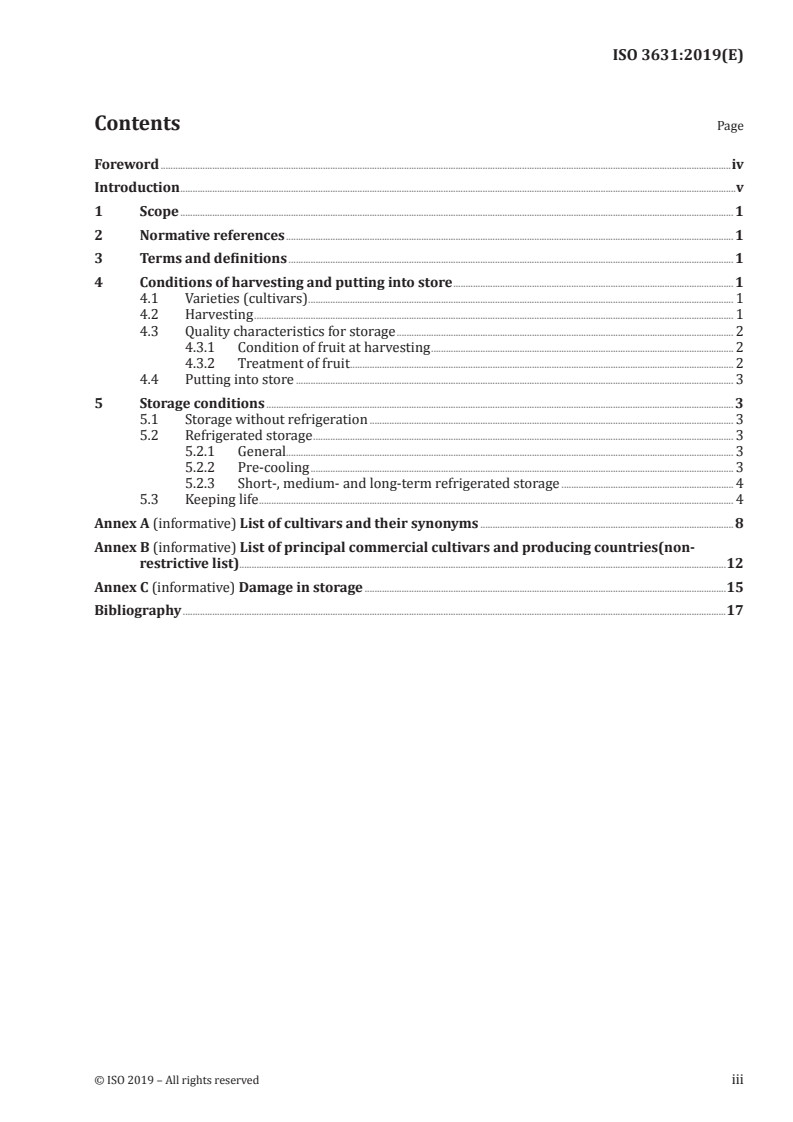
Contents Page
Foreword .iv
Introduction .v
1 Scope . 1
2 Normative references . 1
3 Terms and definitions . 1
4 Conditions of harvesting and putting into store . 1
4.1 Varieties (cultivars) . 1
4.2 Harvesting . 1
4.3 Quality characteristics for storage . 2
4.3.1 Condition of fruit at harvesting . 2
4.3.2 Treatment of fruit . 2
4.4 Putting into store . 3
5 Storage conditions . 3
5.1 Storage without refrigeration . 3
5.2 Refrigerated storage . 3
5.2.1 General. 3
5.2.2 Pre-cooling . 3
5.2.3 Short-, medium- and long-term refrigerated storage . 4
5.3 Keeping life . 4
Annex A (informative) List of cultivars and their synonyms . 8
Annex B (informative) List of principal commercial cultivars and producing countries(non-
restrictive list).12
Annex C (informative) Damage in storage .15
Bibliography .17
Foreword
ISO (the International Organization for Standardization) is a worldwide federation of national standards
bodies (ISO member bodies). The work of preparing International Standards is normally carried out
through ISO technical committees. Each member body interested in a subject for which a technical
committee has been established has the right to be represented on that committee. International
organizations, governmental and non-governmental, in liaison with ISO, also take part in the work.
ISO collaborates closely with the International Electrotechnical Commission (IEC) on all matters of
electrotechnical standardization.
The procedures used to develop this document and those intended for its further maintenance are
described in the ISO/IEC Directives, Part 1. In particular, the different approval criteria needed for the
different types of ISO documents should be noted. This document was drafted in accordance with the
editorial rules of the ISO/IEC Directives, Part 2 (see www .iso .org/directives).
Attention is drawn to the possibility that some of the elements of this document may be the subject of
patent rights. ISO shall not be held responsible for identifying any or all such patent rights. Details of
any patent rights identified during the development of the document will be in the Introduction and/or
on the ISO list of patent declarations received (see www .iso .org/patents).
Any trade name used in this document is information given for the convenience of users and does not
constitute an endorsement.
For an explanation of the voluntary nature of standards, the meaning of ISO specific terms and
expressions related to conformity assessment, as well as information about ISO's adherence to the
World Trade Organization (WTO) principles in the Technical Barriers to Trade (TBT) see www .iso
.org/iso/foreword .html.
This document was prepared by Technical Committee ISO/TC 34, Food products, Subcommittee SC 3,
Fruits and vegetables and their derived products.
This second edition cancels and replaces the first edition (ISO 3631:1978), which has been technically
revised. The main changes compared with the previous edition relate to storage temperatures,
durations and cultivars.
Any feedback or questions on this document should be directed to the user’s national standards body. A
complete listing of these bodies can be found at www .iso .org/members .html.
iv © ISO 2019 – All rights reserved
Introduction
Citrus fruits are divided into five major groups from different species which differ from each other in
their behaviour during transport and should therefore be considered separately from the point of view
of storage conditions. The groups are the following:
— oranges;
— mandarins, tangerines and their hybrids;
— lemons;
— grapefruits and their hybrids;
— limes.
Citrus fruits undergo little change after harvesting. They have no climacteric phase, and should
therefore be harvested ready for consumption.
Peel colour is not always an indication of maturity; there is not necessarily a direct relation between
colour and degree of ripeness.
The keeping life of the fruit depends on several factors, including the following:
— growing climate conditions;
— agrotechnical factors (nature of rootstock, size of fruits, method of pruning, etc.);
— harvesting conditions (time of picking, condition of fruit at harvest);
— degree of maturity and treatments during storage; keeping temperature;
— relative humidity of the store.
The longer the fruits remain on the trees after they have reached edible condition, the shorter the time
they can be kept after harvest. However, growth regulators can be used to enhance the keeping quality
of late harvest fruit.
INTERNATIONAL STANDARD ISO 3631:2019(E)
Citrus fruits — Guidelines for storage
1 Scope
This document specifies the conditions required for good keeping of the following groups of citrus
fruits during their storage with or without refrigeration, in stores or in various transport equipment
(such as containers, railway cars, trucks or ships):
— oranges: Citrus sinensis (Linnaeus) Osbeck;
— mandarins: Citrus reticulata Blanco;
— lemons: Citrus limon (Linnaeus) N. L. Burman;
— grapefruits: Citrus paradisi Macfadyen;
— limes:
— Citrus aurantifolia (Christmann) Swingle;
— Citrus latifolia Tanaka.
Detailed information concerning cultivars in these different groups is given in Annexes A and B.
2 Normative references
There are no normative references in this document.
3 Terms and definitions
No terms and definitions are listed in this document.
ISO and IEC maintain terminological databases for use in standardization at the following addresses:
— ISO Online browsing platform: available at https: //www .iso .org/obp
— IEC Electropedia: available at http: //www .electropedia .org/
4 Conditions of harvesting and putting into store
4.1 Varieties (cultivars)
This document concerns fresh fruit intended for storage and belonging to the varieties listed in Annex A.
4.2 Harvesting
The fruits should be harvested when they have reached the stage of maturity that makes them fit for
consumption. Harvesting may be temporarily interrupted when weather conditions (rain, etc.) are
likely to have an adverse influence on the keeping qualities.
Fruit collected from the ground is often infected with Phytophthora, and therefore dropped fruit should
not be harvested.
The maturity criteria usually considered are the following:
— juice content, expressed as a percentage by mass (the juice content may vary slightly as a result of
the conditions and duration of storage);
— flavour;
x
— titrable acid (TA) and/or the TSS/TA ratio, which is calculated by the formula
y
where
x is the total soluble solids content (see ISO 2173);
y is the acidity expressed as an hydrous citric acid (see ISO 750).
The values to be adopted for these last two criteria depend on the varieties under consideration, and
on ecological conditions. They should therefore be considered only in relation to the variety and to a
well-defined area of production. Reference should be made to the specialized documents that have been
published on the subject in the different areas of production.
4.3 Quality characteristics for storage
4.3.1 Condition of fruit at harvesting
Fruits intended for storage should be clean, firm and without blemishes (damage caused by pickers'
fingernails, insect punctures, bruises, etc.). There should be no evidence of fungal or physiological
disorders. They should retain their calyces.
Ethylene degreening is not advisable for fruit intended for long storage. This treatment hastens the
physiological development of the fruit and shortens its keeping life. If it has been carried out, this fact
should be brought to the attention of prospective purchasers. Ethylene-degreened fruit may be packed
without stem-ends.
4.3.2 Treatment of fruit
4.3.2.1 After a first sorting in order to remove leaves, trash and defective fruits (such as those that
are damaged or heavily infected with Penicillium), the fruits are preferably washed by spraying (which
reduces the risk of infection) or by sprinkling or soaking in tanks. They are then rinsed and brushed
and receive a fungicidal treatment. This should be applied as soon as possible after harvesting. For fruit
picked with a high degree of turgidity, treatment should be delayed for 24 h after picking. Lemons and
limes are not always washed.
The fungicidal treatment is carried out with a solution or a suspension of a fungicidal product and, in
the case of infection by Phytophthora, can include a heat treatment carried out by dipping the fruit in a
treating solution or water for 1,5 min to 5 min, at a temperature varying between 35 °C and 48 °C. This
treatment is effective when carried out shortly after rains and infection in the grove.
Fungicidal treatments are applied as applicable. They should not leave visible deposits on the fruits.
The fungicidal treatment is generally followed by rinsing in order to ensure that the fungicide residues
after treatment do not exceed the limits authorized.
A certain period of exposure to air before washing and fungicidal treatment renders the skins less
turgid and less subject to bruising, which may arise during subsequent handling. As any bruising may
lead to rotting, this procedure should only be followed in the case of fruit from areas of production in a
dry climate. As a general rule, this period should not exceed 24 h.
2 © ISO 2019 – All rights reserved
4.3.2.2 After treatment, the fruit can be covered with a wax in order to replace the natural coating
of the fruits which is partly or entirely removed by washing and brushing. By way of an example,
emulsions of carnauba wax, beeswax, extracted or paraffin waxes, and polyethylene based wax may be
used for this purpose. An approved fungicide may be incorporated into the wax (e.g. orthophenylphenol,
benzimidazol).
The amount of wax can be increased if long storage is contemplated. (Up to 140 mg per kilogram of fruit
is permitted.)
A second sorting is usually carried out after treatment and is followed by size grading. These operations
should be carried out very carefully to avoid damage to the skin of the fruit.
4.3.2.3 It is advisable that information on the surface treatment used be made av
...
INTERNATIONAL ISO
STANDARD 3631
Second edition
2019-09
Citrus fruits — Guidelines for storage
Agrumes — Lignes directrices pour l'entreposage
Reference number
©
ISO 2019
© ISO 2019
All rights reserved. Unless otherwise specified, or required in the context of its implementation, no part of this publication may
be reproduced or utilized otherwise in any form or by any means, electronic or mechanical, including photocopying, or posting
on the internet or an intranet, without prior written permission. Permission can be requested from either ISO at the address
below or ISO’s member body in the country of the requester.
ISO copyright office
CP 401 • Ch. de Blandonnet 8
CH-1214 Vernier, Geneva
Phone: +41 22 749 01 11
Fax: +41 22 749 09 47
Email: copyright@iso.org
Website: www.iso.org
Published in Switzerland
ii © ISO 2019 – All rights reserved
Contents Page
Foreword .iv
Introduction .v
1 Scope . 1
2 Normative references . 1
3 Terms and definitions . 1
4 Conditions of harvesting and putting into store . 1
4.1 Varieties (cultivars) . 1
4.2 Harvesting . 1
4.3 Quality characteristics for storage . 2
4.3.1 Condition of fruit at harvesting . 2
4.3.2 Treatment of fruit . 2
4.4 Putting into store . 3
5 Storage conditions . 3
5.1 Storage without refrigeration . 3
5.2 Refrigerated storage . 3
5.2.1 General. 3
5.2.2 Pre-cooling . 3
5.2.3 Short-, medium- and long-term refrigerated storage . 4
5.3 Keeping life . 4
Annex A (informative) List of cultivars and their synonyms . 8
Annex B (informative) List of principal commercial cultivars and producing countries(non-
restrictive list).12
Annex C (informative) Damage in storage .15
Bibliography .17
Foreword
ISO (the International Organization for Standardization) is a worldwide federation of national standards
bodies (ISO member bodies). The work of preparing International Standards is normally carried out
through ISO technical committees. Each member body interested in a subject for which a technical
committee has been established has the right to be represented on that committee. International
organizations, governmental and non-governmental, in liaison with ISO, also take part in the work.
ISO collaborates closely with the International Electrotechnical Commission (IEC) on all matters of
electrotechnical standardization.
The procedures used to develop this document and those intended for its further maintenance are
described in the ISO/IEC Directives, Part 1. In particular, the different approval criteria needed for the
different types of ISO documents should be noted. This document was drafted in accordance with the
editorial rules of the ISO/IEC Directives, Part 2 (see www .iso .org/directives).
Attention is drawn to the possibility that some of the elements of this document may be the subject of
patent rights. ISO shall not be held responsible for identifying any or all such patent rights. Details of
any patent rights identified during the development of the document will be in the Introduction and/or
on the ISO list of patent declarations received (see www .iso .org/patents).
Any trade name used in this document is information given for the convenience of users and does not
constitute an endorsement.
For an explanation of the voluntary nature of standards, the meaning of ISO specific terms and
expressions related to conformity assessment, as well as information about ISO's adherence to the
World Trade Organization (WTO) principles in the Technical Barriers to Trade (TBT) see www .iso
.org/iso/foreword .html.
This document was prepared by Technical Committee ISO/TC 34, Food products, Subcommittee SC 3,
Fruits and vegetables and their derived products.
This second edition cancels and replaces the first edition (ISO 3631:1978), which has been technically
revised. The main changes compared with the previous edition relate to storage temperatures,
durations and cultivars.
Any feedback or questions on this document should be directed to the user’s national standards body. A
complete listing of these bodies can be found at www .iso .org/members .html.
iv © ISO 2019 – All rights reserved
Introduction
Citrus fruits are divided into five major groups from different species which differ from each other in
their behaviour during transport and should therefore be considered separately from the point of view
of storage conditions. The groups are the following:
— oranges;
— mandarins, tangerines and their hybrids;
— lemons;
— grapefruits and their hybrids;
— limes.
Citrus fruits undergo little change after harvesting. They have no climacteric phase, and should
therefore be harvested ready for consumption.
Peel colour is not always an indication of maturity; there is not necessarily a direct relation between
colour and degree of ripeness.
The keeping life of the fruit depends on several factors, including the following:
— growing climate conditions;
— agrotechnical factors (nature of rootstock, size of fruits, method of pruning, etc.);
— harvesting conditions (time of picking, condition of fruit at harvest);
— degree of maturity and treatments during storage; keeping temperature;
— relative humidity of the store.
The longer the fruits remain on the trees after they have reached edible condition, the shorter the time
they can be kept after harvest. However, growth regulators can be used to enhance the keeping quality
of late harvest fruit.
INTERNATIONAL STANDARD ISO 3631:2019(E)
Citrus fruits — Guidelines for storage
1 Scope
This document specifies the conditions required for good keeping of the following groups of citrus
fruits during their storage with or without refrigeration, in stores or in various transport equipment
(such as containers, railway cars, trucks or ships):
— oranges: Citrus sinensis (Linnaeus) Osbeck;
— mandarins: Citrus reticulata Blanco;
— lemons: Citrus limon (Linnaeus) N. L. Burman;
— grapefruits: Citrus paradisi Macfadyen;
— limes:
— Citrus aurantifolia (Christmann) Swingle;
— Citrus latifolia Tanaka.
Detailed information concerning cultivars in these different groups is given in Annexes A and B.
2 Normative references
There are no normative references in this document.
3 Terms and definitions
No terms and definitions are listed in this document.
ISO and IEC maintain terminological databases for use in standardization at the following addresses:
— ISO Online browsing platform: available at https: //www .iso .org/obp
— IEC Electropedia: available at http: //www .electropedia .org/
4 Conditions of harvesting and putting into store
4.1 Varieties (cultivars)
This document concerns fresh fruit intended for storage and belonging to the varieties listed in Annex A.
4.2 Harvesting
The fruits should be harvested when they have reached the stage of maturity that makes them fit for
consumption. Harvesting may be temporarily interrupted when weather conditions (rain, etc.) are
likely to have an adverse influence on the keeping qualities.
Fruit collected from the ground is often infected with Phytophthora, and therefore dropped fruit should
not be harvested.
The maturity criteria usually considered are the following:
— juice content, expressed as a percentage by mass (the juice content may vary slightly as a result of
the conditions and duration of storage);
— flavour;
x
— titrable acid (TA) and/or the TSS/TA ratio, which is calculated by the formula
y
where
x is the total soluble solids content (see ISO 2173);
y is the acidity expressed as an hydrous citric acid (see ISO 750).
The values to be adopted for these last two criteria depend on the varieties under consideration, and
on ecological conditions. They should therefore be considered only in relation to the variety and to a
well-defined area of production. Reference should be made to the specialized documents that have been
published on the subject in the different areas of production.
4.3 Quality characteristics for storage
4.3.1 Condition of fruit at harvesting
Fruits intended for storage should be clean, firm and without blemishes (damage caused by pickers'
fingernails, insect punctures, bruises, etc.). There should be no evidence of fungal or physiological
disorders. They should retain their calyces.
Ethylene degreening is not advisable for fruit intended for long storage. This treatment hastens the
physiological development of the fruit and shortens its keeping life. If it has been carried out, this fact
should be brought to the attention of prospective purchasers. Ethylene-degreened fruit may be packed
without stem-ends.
4.3.2 Treatment of fruit
4.3.2.1 After a first sorting in order to remove leaves, trash and defective fruits (such as those that
are damaged or heavily infected with Penicillium), the fruits are preferably washed by spraying (which
reduces the risk of infection) or by sprinkling or soaking in tanks. They are then rinsed and brushed
and receive a fungicidal treatment. This should be applied as soon as possible after harvesting. For fruit
picked with a high degree of turgidity, treatment should be delayed for 24 h after picking. Lemons and
limes are not always washed.
The fungicidal treatment is carried out with a solution or a suspension of a fungicidal product and, in
the case of infection by Phytophthora, can include a heat treatment carried out by dipping the fruit in a
treating solution or water for 1,5 min to 5 min, at a temperature varying between 35 °C and 48 °C. This
treatment is effective when carried out shortly after rains and infection in the grove.
Fungicidal treatments are applied as applicable. They should not leave visible deposits on the fruits.
The fungicidal treatment is generally followed by rinsing in order to ensure that the fungicide residues
after treatment do not exceed the limits authorized.
A certain period of exposure to air before washing and fungicidal treatment renders the skins less
turgid and less subject to bruising, which may arise during subsequent handling. As any bruising may
lead to rotting, this procedure should only be followed in the case of fruit from areas of production in a
dry climate. As a general rule, this period should not exceed 24 h.
2 © ISO 2019 – All rights reserved
4.3.2.2 After treatment, the fruit can be covered with a wax in order to replace the natural coating
of the fruits which is partly or entirely removed by washing and brushing. By way of an example,
emulsions of carnauba wax, beeswax, extracted or paraffin waxes, and polyethylene based wax may be
used for this purpose. An approved fungicide may be incorporated into the wax (e.g. orthophenylphenol,
benzimidazol).
The amount of wax can be increased if long storage is contemplated. (Up to 140 mg per kilogram of fruit
is permitted.)
A second sorting is usually carried out after treatment and is followed by size grading. These operations
should be carried out very carefully to avoid damage to the skin of the fruit.
4.3.2.3 It is advisable that information on the surface treatment used be made available to prospective
purchasers.
4.4 Putting into store
Citrus fruits should be put into store immediately following the end of the treatment of the fruits.
The fruits can be stored unwrapped or wrapped in tissue paper (wraps which may be impregnated
with diphenyl). Wrapping prevents damaged fruits from spreading contamination to neighbouring
fruits
...
INTERNATIONAL ISO
STANDARD 3631
Second edition
2019-09
Citrus fruits — Guidelines for storage
Agrumes — Lignes directrices pour l'entreposage
Reference number
©
ISO 2019
© ISO 2019
All rights reserved. Unless otherwise specified, or required in the context of its implementation, no part of this publication may
be reproduced or utilized otherwise in any form or by any means, electronic or mechanical, including photocopying, or posting
on the internet or an intranet, without prior written permission. Permission can be requested from either ISO at the address
below or ISO’s member body in the country of the requester.
ISO copyright office
CP 401 • Ch. de Blandonnet 8
CH-1214 Vernier, Geneva
Phone: +41 22 749 01 11
Fax: +41 22 749 09 47
Email: copyright@iso.org
Website: www.iso.org
Published in Switzerland
ii © ISO 2019 – All rights reserved
Contents Page
Foreword .iv
Introduction .v
1 Scope . 1
2 Normative references . 1
3 Terms and definitions . 1
4 Conditions of harvesting and putting into store . 1
4.1 Varieties (cultivars) . 1
4.2 Harvesting . 1
4.3 Quality characteristics for storage . 2
4.3.1 Condition of fruit at harvesting . 2
4.3.2 Treatment of fruit . 2
4.4 Putting into store . 3
5 Storage conditions . 3
5.1 Storage without refrigeration . 3
5.2 Refrigerated storage . 3
5.2.1 General. 3
5.2.2 Pre-cooling . 3
5.2.3 Short-, medium- and long-term refrigerated storage . 4
5.3 Keeping life . 4
Annex A (informative) List of cultivars and their synonyms . 8
Annex B (informative) List of principal commercial cultivars and producing countries(non-
restrictive list).12
Annex C (informative) Damage in storage .15
Bibliography .17
Foreword
ISO (the International Organization for Standardization) is a worldwide federation of national standards
bodies (ISO member bodies). The work of preparing International Standards is normally carried out
through ISO technical committees. Each member body interested in a subject for which a technical
committee has been established has the right to be represented on that committee. International
organizations, governmental and non-governmental, in liaison with ISO, also take part in the work.
ISO collaborates closely with the International Electrotechnical Commission (IEC) on all matters of
electrotechnical standardization.
The procedures used to develop this document and those intended for its further maintenance are
described in the ISO/IEC Directives, Part 1. In particular, the different approval criteria needed for the
different types of ISO documents should be noted. This document was drafted in accordance with the
editorial rules of the ISO/IEC Directives, Part 2 (see www .iso .org/directives).
Attention is drawn to the possibility that some of the elements of this document may be the subject of
patent rights. ISO shall not be held responsible for identifying any or all such patent rights. Details of
any patent rights identified during the development of the document will be in the Introduction and/or
on the ISO list of patent declarations received (see www .iso .org/patents).
Any trade name used in this document is information given for the convenience of users and does not
constitute an endorsement.
For an explanation of the voluntary nature of standards, the meaning of ISO specific terms and
expressions related to conformity assessment, as well as information about ISO's adherence to the
World Trade Organization (WTO) principles in the Technical Barriers to Trade (TBT) see www .iso
.org/iso/foreword .html.
This document was prepared by Technical Committee ISO/TC 34, Food products, Subcommittee SC 3,
Fruits and vegetables and their derived products.
This second edition cancels and replaces the first edition (ISO 3631:1978), which has been technically
revised. The main changes compared with the previous edition relate to storage temperatures,
durations and cultivars.
Any feedback or questions on this document should be directed to the user’s national standards body. A
complete listing of these bodies can be found at www .iso .org/members .html.
iv © ISO 2019 – All rights reserved
Introduction
Citrus fruits are divided into five major groups from different species which differ from each other in
their behaviour during transport and should therefore be considered separately from the point of view
of storage conditions. The groups are the following:
— oranges;
— mandarins, tangerines and their hybrids;
— lemons;
— grapefruits and their hybrids;
— limes.
Citrus fruits undergo little change after harvesting. They have no climacteric phase, and should
therefore be harvested ready for consumption.
Peel colour is not always an indication of maturity; there is not necessarily a direct relation between
colour and degree of ripeness.
The keeping life of the fruit depends on several factors, including the following:
— growing climate conditions;
— agrotechnical factors (nature of rootstock, size of fruits, method of pruning, etc.);
— harvesting conditions (time of picking, condition of fruit at harvest);
— degree of maturity and treatments during storage; keeping temperature;
— relative humidity of the store.
The longer the fruits remain on the trees after they have reached edible condition, the shorter the time
they can be kept after harvest. However, growth regulators can be used to enhance the keeping quality
of late harvest fruit.
INTERNATIONAL STANDARD ISO 3631:2019(E)
Citrus fruits — Guidelines for storage
1 Scope
This document specifies the conditions required for good keeping of the following groups of citrus
fruits during their storage with or without refrigeration, in stores or in various transport equipment
(such as containers, railway cars, trucks or ships):
— oranges: Citrus sinensis (Linnaeus) Osbeck;
— mandarins: Citrus reticulata Blanco;
— lemons: Citrus limon (Linnaeus) N. L. Burman;
— grapefruits: Citrus paradisi Macfadyen;
— limes:
— Citrus aurantifolia (Christmann) Swingle;
— Citrus latifolia Tanaka.
Detailed information concerning cultivars in these different groups is given in Annexes A and B.
2 Normative references
There are no normative references in this document.
3 Terms and definitions
No terms and definitions are listed in this document.
ISO and IEC maintain terminological databases for use in standardization at the following addresses:
— ISO Online browsing platform: available at https: //www .iso .org/obp
— IEC Electropedia: available at http: //www .electropedia .org/
4 Conditions of harvesting and putting into store
4.1 Varieties (cultivars)
This document concerns fresh fruit intended for storage and belonging to the varieties listed in Annex A.
4.2 Harvesting
The fruits should be harvested when they have reached the stage of maturity that makes them fit for
consumption. Harvesting may be temporarily interrupted when weather conditions (rain, etc.) are
likely to have an adverse influence on the keeping qualities.
Fruit collected from the ground is often infected with Phytophthora, and therefore dropped fruit should
not be harvested.
The maturity criteria usually considered are the following:
— juice content, expressed as a percentage by mass (the juice content may vary slightly as a result of
the conditions and duration of storage);
— flavour;
x
— titrable acid (TA) and/or the TSS/TA ratio, which is calculated by the formula
y
where
x is the total soluble solids content (see ISO 2173);
y is the acidity expressed as an hydrous citric acid (see ISO 750).
The values to be adopted for these last two criteria depend on the varieties under consideration, and
on ecological conditions. They should therefore be considered only in relation to the variety and to a
well-defined area of production. Reference should be made to the specialized documents that have been
published on the subject in the different areas of production.
4.3 Quality characteristics for storage
4.3.1 Condition of fruit at harvesting
Fruits intended for storage should be clean, firm and without blemishes (damage caused by pickers'
fingernails, insect punctures, bruises, etc.). There should be no evidence of fungal or physiological
disorders. They should retain their calyces.
Ethylene degreening is not advisable for fruit intended for long storage. This treatment hastens the
physiological development of the fruit and shortens its keeping life. If it has been carried out, this fact
should be brought to the attention of prospective purchasers. Ethylene-degreened fruit may be packed
without stem-ends.
4.3.2 Treatment of fruit
4.3.2.1 After a first sorting in order to remove leaves, trash and defective fruits (such as those that
are damaged or heavily infected with Penicillium), the fruits are preferably washed by spraying (which
reduces the risk of infection) or by sprinkling or soaking in tanks. They are then rinsed and brushed
and receive a fungicidal treatment. This should be applied as soon as possible after harvesting. For fruit
picked with a high degree of turgidity, treatment should be delayed for 24 h after picking. Lemons and
limes are not always washed.
The fungicidal treatment is carried out with a solution or a suspension of a fungicidal product and, in
the case of infection by Phytophthora, can include a heat treatment carried out by dipping the fruit in a
treating solution or water for 1,5 min to 5 min, at a temperature varying between 35 °C and 48 °C. This
treatment is effective when carried out shortly after rains and infection in the grove.
Fungicidal treatments are applied as applicable. They should not leave visible deposits on the fruits.
The fungicidal treatment is generally followed by rinsing in order to ensure that the fungicide residues
after treatment do not exceed the limits authorized.
A certain period of exposure to air before washing and fungicidal treatment renders the skins less
turgid and less subject to bruising, which may arise during subsequent handling. As any bruising may
lead to rotting, this procedure should only be followed in the case of fruit from areas of production in a
dry climate. As a general rule, this period should not exceed 24 h.
2 © ISO 2019 – All rights reserved
4.3.2.2 After treatment, the fruit can be covered with a wax in order to replace the natural coating
of the fruits which is partly or entirely removed by washing and brushing. By way of an example,
emulsions of carnauba wax, beeswax, extracted or paraffin waxes, and polyethylene based wax may be
used for this purpose. An approved fungicide may be incorporated into the wax (e.g. orthophenylphenol,
benzimidazol).
The amount of wax can be increased if long storage is contemplated. (Up to 140 mg per kilogram of fruit
is permitted.)
A second sorting is usually carried out after treatment and is followed by size grading. These operations
should be carried out very carefully to avoid damage to the skin of the fruit.
4.3.2.3 It is advisable that information on the surface treatment used be made available to prospective
purchasers.
4.4 Putting into store
Citrus fruits should be put into store immediately following the end of the treatment of the fruits.
The fruits can be stored unwrapped or wrapped in tissue paper (wraps which may be impregnated
with diphenyl). Wrapping prevents damaged fruits from spreading contamination to neighbouring
fruits
...