


ISO 4992-2:2006
(Main)Steel castings — Ultrasonic examination — Part 2: Steel castings for highly stressed components
Steel castings — Ultrasonic examination — Part 2: Steel castings for highly stressed components
ISO 4992-2:2006 specifies the requirements for the ultrasonic examination of steel castings (with ferritic structure) for highly stressed components, and the methods for determining internal discontinuities by the pulse echo technique. ISO 4992-2:2006 applies to the ultrasonic examination of steel castings which have usually received a grain-refining heat treatment and which have wall thicknesses up to and including 600 mm. For greater wall thicknesses, special agreements apply with respect to the test procedure and recording levels. ISO 4992-2:2006 does not apply to austenitic steels and joint welds.
Pièces moulées en acier — Contrôle aux ultrasons — Partie 2: Pièces moulées en acier pour composants fortement sollicités
General Information
- Status
- Withdrawn
- Publication Date
- 16-Feb-2006
- Withdrawal Date
- 16-Feb-2006
- Technical Committee
- ISO/TC 17/SC 11 - Steel castings
- Drafting Committee
- ISO/TC 17/SC 11 - Steel castings
- Current Stage
- 9599 - Withdrawal of International Standard
- Start Date
- 15-Mar-2020
- Completion Date
- 12-Feb-2026
Relations
- Effective Date
- 14-Jan-2017
Get Certified
Connect with accredited certification bodies for this standard

Element Materials Technology
Materials testing and product certification.

Inštitut za kovinske materiale in tehnologije
Institute of Metals and Technology. Materials testing, metallurgical analysis, NDT.
Sponsored listings
Frequently Asked Questions
ISO 4992-2:2006 is a standard published by the International Organization for Standardization (ISO). Its full title is "Steel castings — Ultrasonic examination — Part 2: Steel castings for highly stressed components". This standard covers: ISO 4992-2:2006 specifies the requirements for the ultrasonic examination of steel castings (with ferritic structure) for highly stressed components, and the methods for determining internal discontinuities by the pulse echo technique. ISO 4992-2:2006 applies to the ultrasonic examination of steel castings which have usually received a grain-refining heat treatment and which have wall thicknesses up to and including 600 mm. For greater wall thicknesses, special agreements apply with respect to the test procedure and recording levels. ISO 4992-2:2006 does not apply to austenitic steels and joint welds.
ISO 4992-2:2006 specifies the requirements for the ultrasonic examination of steel castings (with ferritic structure) for highly stressed components, and the methods for determining internal discontinuities by the pulse echo technique. ISO 4992-2:2006 applies to the ultrasonic examination of steel castings which have usually received a grain-refining heat treatment and which have wall thicknesses up to and including 600 mm. For greater wall thicknesses, special agreements apply with respect to the test procedure and recording levels. ISO 4992-2:2006 does not apply to austenitic steels and joint welds.
ISO 4992-2:2006 is classified under the following ICS (International Classification for Standards) categories: 77.040.20 - Non-destructive testing of metals; 77.140.80 - Iron and steel castings. The ICS classification helps identify the subject area and facilitates finding related standards.
ISO 4992-2:2006 has the following relationships with other standards: It is inter standard links to ISO 4992-2:2020. Understanding these relationships helps ensure you are using the most current and applicable version of the standard.
ISO 4992-2:2006 is available in PDF format for immediate download after purchase. The document can be added to your cart and obtained through the secure checkout process. Digital delivery ensures instant access to the complete standard document.
Standards Content (Sample)
INTERNATIONAL ISO
STANDARD 4992-2
First edition
2006-02-15
Steel castings — Ultrasonic
examination —
Part 2:
Steel castings for highly stressed
components
Pièces moulées en acier — Contrôle aux ultrasons —
Partie 2: Pièces moulées en acier pour composants fortement sollicités
Reference number
©
ISO 2006
PDF disclaimer
This PDF file may contain embedded typefaces. In accordance with Adobe's licensing policy, this file may be printed or viewed but
shall not be edited unless the typefaces which are embedded are licensed to and installed on the computer performing the editing. In
downloading this file, parties accept therein the responsibility of not infringing Adobe's licensing policy. The ISO Central Secretariat
accepts no liability in this area.
Adobe is a trademark of Adobe Systems Incorporated.
Details of the software products used to create this PDF file can be found in the General Info relative to the file; the PDF-creation
parameters were optimized for printing. Every care has been taken to ensure that the file is suitable for use by ISO member bodies. In
the unlikely event that a problem relating to it is found, please inform the Central Secretariat at the address given below.
© ISO 2006
All rights reserved. Unless otherwise specified, no part of this publication may be reproduced or utilized in any form or by any means,
electronic or mechanical, including photocopying and microfilm, without permission in writing from either ISO at the address below or
ISO's member body in the country of the requester.
ISO copyright office
Case postale 56 • CH-1211 Geneva 20
Tel. + 41 22 749 01 11
Fax + 41 22 749 09 47
E-mail copyright@iso.org
Web www.iso.org
Published in Switzerland
ii © ISO 2006 – All rights reserved
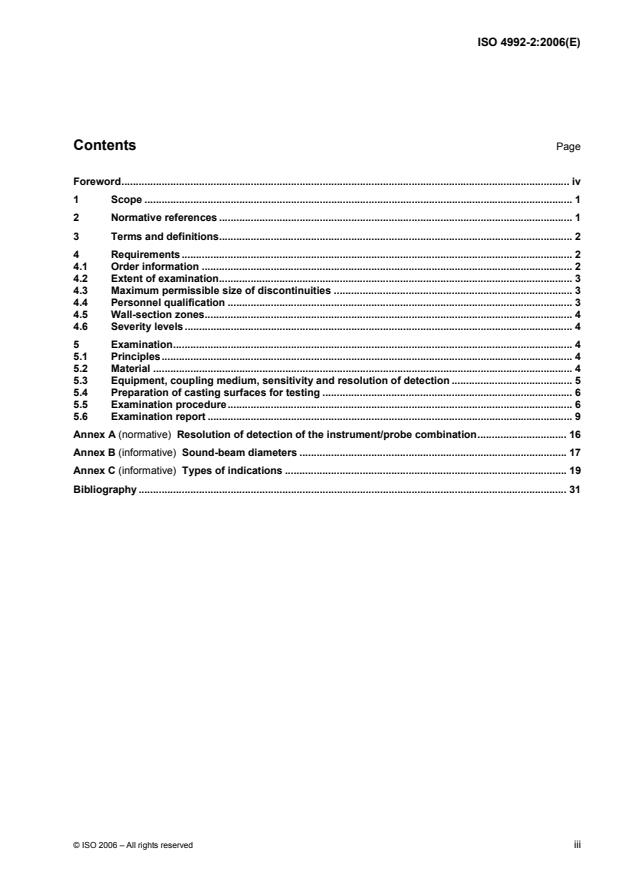
Contents Page
Foreword. iv
1 Scope . 1
2 Normative references . 1
3 Terms and definitions. 2
4 Requirements . 2
4.1 Order information . 2
4.2 Extent of examination. 3
4.3 Maximum permissible size of discontinuities . 3
4.4 Personnel qualification . 3
4.5 Wall-section zones. 4
4.6 Severity levels. 4
5 Examination. 4
5.1 Principles. 4
5.2 Material . 4
5.3 Equipment, coupling medium, sensitivity and resolution of detection . 5
5.4 Preparation of casting surfaces for testing . 6
5.5 Examination procedure. 6
5.6 Examination report . 9
Annex A (normative) Resolution of detection of the instrument/probe combination. 16
Annex B (informative) Sound-beam diameters . 17
Annex C (informative) Types of indications . 19
Bibliography . 31
Foreword
ISO (the International Organization for Standardization) is a worldwide federation of national standards bodies
(ISO member bodies). The work of preparing International Standards is normally carried out through ISO
technical committees. Each member body interested in a subject for which a technical committee has been
established has the right to be represented on that committee. International organizations, governmental and
non-governmental, in liaison with ISO, also take part in the work. ISO collaborates closely with the
International Electrotechnical Commission (IEC) on all matters of electrotechnical standardization.
International Standards are drafted in accordance with the rules given in the ISO/IEC Directives, Part 2.
The main task of technical committees is to prepare International Standards. Draft International Standards
adopted by the technical committees are circulated to the member bodies for voting. Publication as an
International Standard requires approval by at least 75 % of the member bodies casting a vote.
Attention is drawn to the possibility that some of the elements of this document may be the subject of patent
rights. ISO shall not be held responsible for identifying any or all such patent rights.
ISO 4992-2 was prepared by Technical Committee ISO/TC 17, Steel, Subcommittee SC 11, Steel castings.
ISO 4992 consists of the following parts, under the general title Steel castings — Ultrasonic examination:
⎯ Part 1: Steel castings for general purposes
⎯ Part 2: Steel castings for highly stressed conponents
iv © ISO 2006 – All rights reserved
INTERNATIONAL STANDARD ISO 4992-2:2006(E)
Steel castings — Ultrasonic examination —
Part 2:
Steel castings for highly stressed components
1 Scope
This part of ISO 4992 specifies the requirements for the ultrasonic examination of steel castings (with ferritic
structure) for highly stressed components, and the methods for determining internal discontinuities by the
pulse echo technique.
This part of ISO 4992 applies to the ultrasonic examination of steel castings which have usually received a
grain-refining heat treatment and which have wall thicknesses up to and including 600 mm. For greater wall
thicknesses, special agreements apply with respect to the test procedure and recording levels.
This part of ISO 4992 does not apply to austenitic steels and joint welds.
2 Normative references
The following referenced documents are indispensable for the application of this document. For dated
references, only the edition cited applies. For undated references, the latest edition of the referenced
document (including any amendments) applies.
ISO 5577, Non-destructive testing — Ultrasonic inspection — Vocabulary
ISO 7963, Non-destructive testing — Ultrasonic testing — Specification for calibration block No. 2
EN 583-1, Non-destructive testing — Ultrasonic examination — Part 1: General principles
EN 583-2, Non-destructive testing — Ultrasonic examination — Part 2: Sensitivity and range setting
EN 583-5,2005, Non-destructive testing — Ultrasonic examination — Part 5: Characterization and sizing of
discontinuities
EN 1330-4, Non-destructive testing — Terminology — Part 4: Terms used in ultrasonic testing
EN 12223, Non-destructive testing — Ultrasonic examination — Specification for calibration block No. 1
EN 12668-1, Non-destructive testing — Characterization and verification of ultrasonic examination
equipment — Part 1: Instruments
EN 12668-2, Non-destructive testing — Characterization and verification of ultrasonic examination
equipment — Part 2: Probes
EN 12668-3, Non-destructive testing — Characterization and verification of ultrasonic examination
equipment — Part 3: Combined equipment
3 Terms and definitions
For the purposes of this document, the terms and definitions given in ISO 5577, EN 583-1, EN 583-2,
EN 583-5 and EN 1330-4, and the following, apply.
3.1
reference discontinuity echo size
smallest indication to be recorded during the assessment phase of an ultrasonic examination, usually
expressed as an equivalent flat-bottomed hole diameter
3.2
point discontinuity
discontinuity, the dimensions of which are smaller than or equal to the sound-beam diameter
NOTE Dimensions in this part of ISO 4992 relate to length, width and/or dimension in the through-wall direction.
3.3
complex discontinuity
discontinuity, the dimensions of which are larger than the sound-beam diameter
NOTE Dimensions in this part of ISO 4992 relate to length, width and/or dimension in the through-wall direction.
3.4
planar discontinuity
discontinuity having two measurable dimensions
3.5
volumetric discontinuity
discontinuity having three measurable dimensions
3.6
special rim zone
outer rim-zone part with special requirements
NOTE Examples of special requirements are machined surfaces, higher stresses and sealing surfaces.
3.7
production welding
any welding carried out during manufacturing before final delivery to the purchaser
3.7.1
joint welding
production welding used to assemble components together to obtain an integral unit
3.7.2
finishing welding
production welding carried out in order to ensure the agreed quality of the casting
4 Requirements
4.1 Order information
The following information shall be available at the time of enquiry and order (see also EN 583-1):
⎯ the areas of the casting and the number or percentage of castings to which the ultrasonic examination
requirements apply;
⎯ the severity level to be applied to the various zones or areas of the casting;
2 © ISO 2006 – All rights reserved
⎯ requirements for a written examination procedure;
⎯ whether there are any additional requirements for the examination procedure, see also 5.5.1.
4.2 Extent of examination
The casting shall be examined so that the agreed areas are totally covered (insofar as this is possible from the
shape of the casting) by the use of the best applicable examination technique.
For wall thicknesses greater than 600 mm, agreement shall be made between the parties concerned on the
test procedure and also on the recording and acceptance levels.
4.3 Maximum permissible size of discontinuities
4.3.1 General
The purchaser shall specify the acceptance level according to the required severity level for planar and
volumetric discontinuities within each zone and in each specified area of the casting.
The wall section shall be divided into zones as shown in Figure 1. These sections relate to the sizes of
castings ready for assembly (finish machined).
4.3.2 Indications without measurable dimensions
In special rim zones and at weld preparation ends, indications without measurable dimensions are limited to a
maximum number of indications.
These indications shall not exceed the limits given in Table 1.
4.3.3 Indications with measurable dimensions
4.3.3.1 Planar discontinuities
Planar discontinuities shall not exceed the limits given in Figure 2.
The area of indication with measurable length, but with a non-measurable dimension in the through-wall
direction, shall be calculated in accordance with the formula given in Figure 2.
The sizing of small planar discontinuities, as given in Figure 2, becomes more difficult with increasing beam-
path length and sound-beam diameter. As a guide, these sizings are normally applied to a rim zone of 30 mm.
This makes the use of probes with focussed beams, such as twin-crystal probes, necessary.
4.3.3.2 Volumetric discontinuities
Volumetric discontinuities shall not exceed the sizes given in Figure 3 for the rim zone and Figure 4 for the
core zone. Indications with measurable dimensions are not permissible in severity level 1. The area of an
indication with measurable length but non-measurable width shall be calculated in accordance with the
formula given in Figures 3 and 4.
4.4 Personnel qualification
It is assumed that ultrasonic examination is performed by qualified and capable personnel. In order to prove
this qualification, it is recommended to certify personnel according to ISO 9712 or EN 473.
4.5 Wall-section zones
The wall section shall be divided into zones as shown in Figure 1. These sections relate to the dimensions of
the casting ready for assembly (finish machined).
4.6 Severity levels
If the purchaser specifies different severity levels in different areas of the same casting, all of these areas shall
be clearly identified on the purchaser's drawing and shall include:
⎯ all necessary dimensions for accurate location of zones;
⎯ the full extent of all weld preparations and the thickness of any special rim zone.
Severity level 1 is only applied to weld preparations and special rim zones.
Unless other requirements have been agreed by the time of acceptance of the order, for finishing welds, the
requirements for the parent metal shall apply.
5 Examination
5.1 Principles
The principles of ultrasonic examination given in EN 583-1, EN 583-2 and EN 583-5 shall apply.
5.2 Material
The suitability of material for ultrasonic examination is assessed by comparison with the echo height of a
reference reflector (usually the first backwall echo) and the noise signal. This assessment shall be carried out
on selected casting areas which are representative of the surface finish and of the total thickness range. The
assessment areas shall have parallel surfaces.
The reference echo height according to Table 2 shall be at least 6 dB above the noise signal.
If the echo height of this smallest detectable flat-bottomed or equivalent side-drilled hole diameter at the end
of the test range to be assessed is less than 6 dB above the grass level, then the ultrasonic testability is
reduced. In this case, the flat-bottomed or side-drilled hole diameter which can be detected with a signal-noise
ratio of at least 6 dB shall be noted in the test report and the additional procedure shall be agreed between the
manufacturer and the purchaser.
NOTE For the definition of an adequate flat-bottomed hole size, the distance gain size system (DGS) or a test block
of identical material, heat treatment condition and section thickness containing flat-bottomed holes with a diameter
according to Table 2 or equivalent side-drilled holes, can be used. The following formula is used for converting the
flat-bottomed hole diameter into the side-drilled hole diameter:
4,935 × D
FBH
D = (1)
Q
λ × s
where
D is the side-drilled hole diameter, in millimetres;
Q
D is the flat-bottomed hole diameter, in millimetres;
FBH
λ is the wave length, in millimetres;
s is the path length, in millimetres.
The formula is applicable for D W 2λ and s W 5 × near-field length and is only defined for single element
Q
probes.
4 © ISO 2006 – All rights reserved
5.3 Equipment, coupling medium, sensitivity and resolution of detection
5.3.1 Ultrasonic instrument
The ultrasonic instrument shall meet the requirements given in EN 12668-1 and shall have the following
characteristics:
⎯ range setting, from at least 10 mm to 2 m continuously selectable, for longitudinal and transverse waves
transmitted in steel;
⎯ gain, adjustable in 2 dB maximum steps over a range of at least 80 dB with a measuring accuracy of
1 dB;
⎯ time-base and vertical linearities less than 5 % of the adjustment range of the screen;
⎯ suitability, at least for nominal frequencies from 1 MHz up to and including 6 MHz, in the pulse-echo
technique with single-crystal and twin-crystal probes.
5.3.2 Probes and transducer frequencies
The probes and transducer frequencies shall be as given in EN 12668-2 and EN 12668-3 with the following
exceptions:
⎯ nominal frequencies shall be in the range 1 MHz to 6 MHz;
⎯ for oblique incidence, angle probes with angles between 35° and 70° shall be used.
NOTE Normal or angle probes can be used for the examination of steel castings for highly stressed components. The
type of probe used depends on the geometry of the casting and the type of discontinuity to be detected.
For examining zones close to the surface, twin-crystal probes (normal or angle) should be preferred.
5.3.3 Checking the ultrasonic examination equipment
The ultrasonic examination equipment shall be checked regularly by the operator in accordance with
EN 12668-3.
5.3.4 Coupling medium
A coupling medium in accordance with EN 583-1 shall be used. The coupling medium shall wet the
examination area to ensure satisfactory sound transmission. The same coupling medium shall be used for
calibration and all subsequent examination operations.
NOTE The sound transmission can be checked by ensuring one or more stable backwall echoes in areas with
parallel surfaces.
5.3.5 Sensitivity and resolution of detection
The detection sensitivity of the instrument shall allow at least the setting of the sensitivity in accordance with
the requirements of 5.5.2.
The resolution of detection of the instrument/probe combination shall meet the requirements of Annex A.
5.4 Preparation of casting surfaces for testing
For the preparation of casting surfaces for examination, see EN 583-1.
The casting surfaces to be examined shall be such that satisfactory coupling with the probe can be achieved.
In the case of single-crystal probes, satisfactory coupling can be achieved if the condition of the surfaces to be
examined corresponds at least to the limit comparator 4 S1 or 4 S2 according to EN 1370.
The roughness of any machined surface to be examined shall be R u 12,5 µm.
a
For special techniques, higher surface qualities such as 2 S1, 2 S2 (see EN 1370) and R u 6,3 µm can be
a
necessary.
5.5 Examination procedure
5.5.1 General
Because the choice of both the direction of incidence and suitable probes largely depends on the shape of the
casting, or on the possible casting discontinuities or on the possible discontinuities from finishing welding, the
applicable examination procedure shall be specified by the manufacturer of the casting. In special cases,
specific agreements can be made.
If possible, the areas to be tested shall be examined from both sides. When testing from one side only, short-
range resolving probes shall be used additionally for the detection of discontinuities close to the surface.
Testing with twin-crystal probes is only adequate for wall thicknesses up to 50 mm.
Additionally, when not otherwise agreed between the purchaser and the manufacturer, for all castings, twin-
crystal normal and/or angle probes shall be used to examine the following areas up to a depth of 50 mm:
⎯ critical areas, e.g. fillets, changes in cross-section, areas with external chills;
⎯ finishing welds;
⎯ weld preparation areas, as specified in the order;
⎯ special rim zones, as specified in the order, critical for the performance of the casting.
Finishing welds which are deeper than 50 mm shall be subject to supplementary examination with other
suitable angle probes.
For angle probes with angles over 60°, the sound beam path shall not exceed 150 mm.
Complete coverage of all areas specified for examination shall be conducted by carrying out systematically
overlapping scans.
The scanning rate shall not exceed 150 mm/s.
5.5.2 Range setting
Range setting shall be carried out in accordance with EN 583-2 on the screen of the test instrument, using
normal or angle probes in accordance with one of the three options given below:
⎯ with the calibration block No. 1 in accordance with EN 12223, or No. 2 in accordance with ISO 7963;
⎯ with an alternative calibration block made in a material exhibiting similar acoustic properties to those of
the material to be examined;
⎯ on the casting itself when using normal probes. In this case, the casting to be tested shall have parallel
surfaces, the distance between which shall be measured.
6 © ISO 2006 – All rights reserved
5.5.3 Sensitivity setting
5.5.3.1 General
Sensitivity setting shall be carried out after range setting (see 5.5.2) in accordance with EN 583-2. One of the
following two techniques shall be used:
⎯ Distance-amplitude correction curve technique (DAC)
The distance-amplitude correction curve technique makes use of the echo-heights of a series of identical
reflectors (flat-bottomed holes FBH or side-drilled holes SDH), each reflector having a different sound-
beam path.
NOTE A frequency of 2 MHz and a diameter of 6 mm for the flat-bottomed holes are most commonly used.
⎯ Distance gain size technique (DGS)
The distance gain size technique makes use of a series of theoretically derived curves which link the
sound-beam path, the apparatus gain and the diameter of a disc-shaped reflector which is perpendicular
to the beam axis.
5.5.3.2 Transfer correction
Transfer correction shall be determined in accordance with EN 583-2.
When calibration blocks are used, transfer correction can be necessary. When determining the transfer
correction, consideration shall be given not only to the quality of the coupling surface but also to that of the
opposite surface, because the opposite surface also influences the height of the backwall echo (used for
calibration). If the opposite surface is machined or complies at least to the limit comparator 4 S1 or 4 S2
according to EN 1370, this surface has a quality which is sufficient for transfer correction measurements.
5.5.3.3 Detection of discontinuities
For discontinuity detection, the gain shall be increased until the noise level becomes visible on the screen
(search sensitivity).
The echo heights of the flat-bottomed holes given in Table 2, or of the equivalent side-drilled holes, shall be at
least 40 % of the screen height at the end of the thickness range to be tested.
If, during testing, suspicion arises that the reduction of backwall-echo indication exceeds the recordable value
(see Table 3), testing shall be repeated using locally reduced test sensitivity and the reduction of
backwall-echo indication shall be determined quantitatively in decibels.
The sensitivity setting of angle-beam probes shall be such that the typical dynamic echo pattern of these
reflectors (see Figure 3) is clearly visible on the screen.
It is recommended that the sensitivity setting of angle-beam probes i
...
Questions, Comments and Discussion
Ask us and Technical Secretary will try to provide an answer. You can facilitate discussion about the standard in here.
Loading comments...