

ISO/IEC 23003-3:2020/Amd 1:2021
(Amendment)Information technology — MPEG audio technologies — Part 3: Unified speech and audio coding — Amendment 1: Reference software and conformance
General Information
- Abstract
- Status
- Published
- Publication Date
- 19-Dec-2021
- Technical Committee
- ISO/IEC JTC 1/SC 29 - Coding of audio, picture, multimedia and hypermedia information
- Drafting Committee
- ISO/IEC JTC 1/SC 29/WG 6 - MPEG Audio coding
- Current Stage
- 6060 - International Standard published
- Start Date
- 20-Dec-2021
- Due Date
- 28-Jul-2022
- Completion Date
- 20-Dec-2021

Overview
ISO/IEC 23003-3:2020/Amd 1:2021 is an international standard published by ISO and IEC that serves as an amendment to Part 3 of the MPEG audio technologies series. This part focuses on Unified Speech and Audio Coding (USAC), which integrates speech and audio coding techniques into one efficient framework. The 2021 Amendment 1 specifically addresses reference software and conformance testing related to USAC, ensuring consistent implementation and interoperability of MPEG audio technologies worldwide.
As a crucial extension, this amendment enhances the reliability and practical deployment of USAC by defining standardized software tools and conformance procedures. It supports developers, manufacturers, and service providers in validating their products and solutions against established benchmarks, fostering a globally harmonized technical landscape in audio coding.
Key Topics
- Unified Speech and Audio Coding (USAC): An integrated codec that combines speech and audio compression methods within a single framework for efficient streaming and storage.
- Reference Software: Standardized code implementations provided to demonstrate compliance and support development of USAC-compliant products.
- Conformance Testing: Procedures and criteria used to verify that implementations adhere to the USAC specification, ensuring interoperability and performance consistency across different platforms and devices.
- Standard Amendment: Updates and modifications to the original Part 3 standard focusing on software tools and conformance aspects, underscoring evolving requirements in audio technology.
- International Collaboration: Developed by ISO/IEC JTC 1/SC 29, fostering cooperation among national bodies and experts in audio coding standards.
Applications
The ISO/IEC 23003-3:2020/Amd 1:2021 amendment provides practical value for a wide range of applications involving speech and audio processing, including:
- Digital Broadcasting: Enables high-quality, low-bitrate audio streaming for radio, TV, and online media using unified coding schemes.
- Multimedia Streaming Services: Supports adaptive streaming platforms by providing efficient audio compression with broad device compatibility.
- Communication Systems: Enhances voice clarity and audio quality in telephony, VoIP, and conferencing solutions with advanced USAC techniques.
- Consumer Electronics: Facilitates incorporation of standardized audio codecs in smartphones, tablets, and smart speakers for consistent media playback.
- Professional Audio Production: Assists developers of audio tools and hardware to maintain conformity to international standards, resulting in reliable audio encoding and decoding.
Related Standards
- ISO/IEC 23003 series: Comprises multiple parts covering various aspects of MPEG audio technologies beyond USAC, such as parametric coding and metadata handling.
- ISO/IEC 23001: Systems technologies for coding audio, video, and other media information, relevant for integrated multimedia solutions.
- ISO/IEC 23008: High efficiency video coding (HEVC) standards, often deployed alongside audio coding in multimedia delivery.
- MPEG Audio Layer III (MP3): An earlier audio compression standard that preceded USAC but is widely referenced for backward compatibility.
- ISO/IEC JTC 1/SC 29: The subcommittee responsible for standardizing audio and multimedia formats, overseeing updates and maintenance of MPEG standards.
ISO/IEC 23003-3:2020/Amd 1:2021 plays a vital role in the continued development and enforcement of unified speech and audio coding standards. It ensures that industry stakeholders have access to trusted reference materials and conformance frameworks, which are essential for innovation and quality assurance in the audio technology ecosystem. For organizations involved in audio codec development, deployment, and testing, compliance with this amendment guarantees alignment with internationally recognized best practices.
Relations
- Effective Date
- 19-Jun-2021
Get Certified
Connect with accredited certification bodies for this standard

BSI Group
BSI (British Standards Institution) is the business standards company that helps organizations make excellence a habit.

NYCE
Mexican standards and certification body.
Sponsored listings
Frequently Asked Questions
ISO/IEC 23003-3:2020/Amd 1:2021 is a standard published by the International Organization for Standardization (ISO). Its full title is "Information technology — MPEG audio technologies — Part 3: Unified speech and audio coding — Amendment 1: Reference software and conformance". This standard covers: Information technology — MPEG audio technologies — Part 3: Unified speech and audio coding — Amendment 1: Reference software and conformance
Information technology — MPEG audio technologies — Part 3: Unified speech and audio coding — Amendment 1: Reference software and conformance
ISO/IEC 23003-3:2020/Amd 1:2021 is classified under the following ICS (International Classification for Standards) categories: 35.040.40 - Coding of audio, video, multimedia and hypermedia information. The ICS classification helps identify the subject area and facilitates finding related standards.
ISO/IEC 23003-3:2020/Amd 1:2021 has the following relationships with other standards: It is inter standard links to ISO/IEC 23003-3:2020. Understanding these relationships helps ensure you are using the most current and applicable version of the standard.
ISO/IEC 23003-3:2020/Amd 1:2021 is available in PDF format for immediate download after purchase. The document can be added to your cart and obtained through the secure checkout process. Digital delivery ensures instant access to the complete standard document.
Standards Content (Sample)
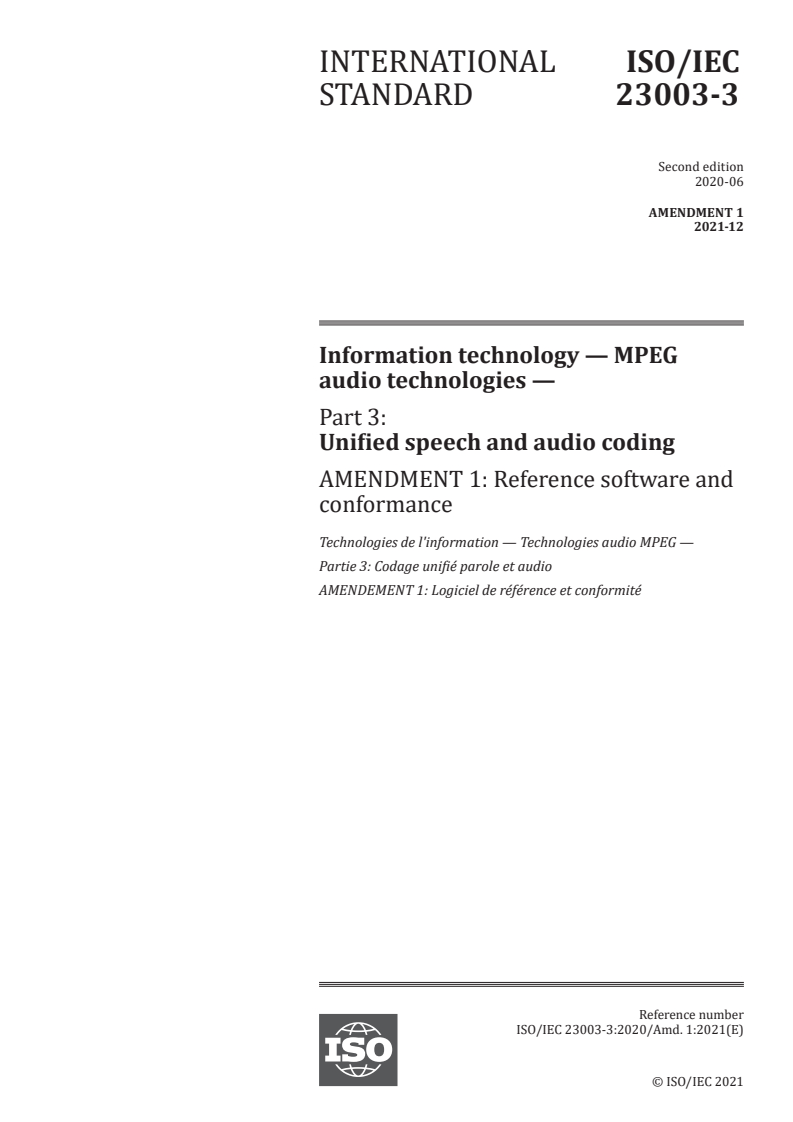
INTERNATIONAL ISO/IEC
STANDARD 23003-3
Second edition
2020-06
AMENDMENT 1
2021-12
Information technology — MPEG
audio technologies —
Part 3:
Unified speech and audio coding
AMENDMENT 1: Reference software and
conformance
Technologies de l'information — Technologies audio MPEG —
Partie 3: Codage unifié parole et audio
AMENDEMENT 1: Logiciel de référence et conformité
Reference number
ISO/IEC 23003-3:2020/Amd. 1:2021(E)
© ISO/IEC 2021
ISO/IEC 23003-3:2020/Amd. 1:2021(E)
© ISO/IEC 2021
All rights reserved. Unless otherwise specified, or required in the context of its implementation, no part of this publication may
be reproduced or utilized otherwise in any form or by any means, electronic or mechanical, including photocopying, or posting on
the internet or an intranet, without prior written permission. Permission can be requested from either ISO at the address below
or ISO’s member body in the country of the requester.
ISO copyright office
CP 401 • Ch. de Blandonnet 8
CH-1214 Vernier, Geneva
Phone: +41 22 749 01 11
Email: copyright@iso.org
Website: www.iso.org
Published in Switzerland
ii
© ISO/IEC 2021 – All rights reserved
ISO/IEC 23003-3:2020/Amd. 1:2021(E)
Foreword
ISO (the International Organization for Standardization) and IEC (the International Electrotechnical
Commission) form the specialized system for worldwide standardization. National bodies that are
members of ISO or IEC participate in the development of International Standards through technical
committees established by the respective organization to deal with particular fields of technical
activity. ISO and IEC technical committees collaborate in fields of mutual interest. Other international
organizations, governmental and non-governmental, in liaison with ISO and IEC, also take part in the
work.
The procedures used to develop this document and those intended for its further maintenance
are described in the ISO/IEC Directives, Part 1. In particular, the different approval criteria
needed for the different types of document should be noted. Thi
...