

ISO/IEC 23003-3:2020
(Main)Information technology — MPEG audio technologies — Part 3: Unified speech and audio coding
General Information
- Abstract
This document specifies a unified speech and audio codec which is capable of coding signals having an arbitrary mix of speech and audio content. The codec has a performance comparable to, or better than, the best known coding technology that might be tailored specifically to coding of either speech or general audio content. The codec supports single and multi-channel coding at high bitrates and provides perceptually transparent quality. At the same time, it enables very efficient coding at very low bitrates while retaining the full audio bandwidth. This document incorporates several perceptually-based compression techniques developed in previous MPEG standards: perceptually shaped quantization noise, parametric coding of the upper spectrum region and parametric coding of the stereo sound stage. However, it combines these well-known perceptual techniques with a source coding technique: a model of sound production, specifically that of human speech.
- Status
- Published
- Publication Date
- 23-Jun-2020
- Current Stage
- 9060 - Close of review
- Completion Date
- 02-Dec-2030
Buy Documents


ISO/IEC 23003-3:2020 - Information technology -- MPEG audio technologies

ISO/IEC 23003-3:2020 - Information technology — MPEG audio technologies — Part 3: Unified speech and audio coding/24/2020
Overview
ISO/IEC 23003-3:2020 - Unified Speech and Audio Coding (USAC) - is an international standard in the MPEG audio technologies family that defines a unified speech and audio codec. It is designed to efficiently code signals containing arbitrary mixes of speech and general audio, delivering perceptually transparent quality at high bitrates and very efficient coding at low bitrates while retaining full audio bandwidth. The standard integrates perceptual audio techniques with a source model of human speech to achieve robust compression across content types.
Key topics and technical requirements
- Codec scope and goals: Single codec for mixed speech/audio content with comparable or better performance than specialized speech or audio codecs.
- Support: Single and multi-channel coding, profiles and levels for interoperability, decoder behaviour and configuration (UsacConfig).
- Perceptual compression techniques incorporated:
- Perceptually shaped quantization noise
- Parametric coding of the upper spectral region (e.g., SBR/eSBR)
- Parametric stereo/stage coding (MPEG Surround)
- Source coding: Integration of a speech production model to improve coding of voiced speech.
- Bitstream and syntax: Detailed payloads, element definitions and buffer requirements for reliable decoding.
- Core tools described: Spectral noiseless coding, quantization, noise filling, TNS (Temporal Noise Shaping), filterbanks and block switching, time-warped filterbank, inter-subband temporal envelope shaping (inter-TES), joint stereo tools, and enhancements (eSBR, MPEG Surround, SAOC).
- Interoperability: Interfaces with MPEG Surround, SAOC, MPEG-D DRC, and backward compatibility considerations (e.g., AAC profiles).
Applications and users
ISO/IEC 23003-3:2020 is relevant for:
- Codec implementers - developers of audio encoders/decoders for software and hardware.
- Streaming services and broadcasters - seeking efficient delivery of mixed speech/music content across bandwidth-constrained networks.
- Mobile and IoT audio device manufacturers - where low-bitrate, full-bandwidth audio is required.
- Telecommunication and conferencing platforms - to improve speech intelligibility and mixed-content efficiency.
- Audio research and standards bodies - for extending or combining USAC with spatial/audio scene tools. Practical benefits include simplified distribution (one codec for both speech and music), reduced bandwidth costs, and improved quality across diverse content types.
Related standards
- MPEG audio family (AAC, HE-AAC)
- MPEG Surround and SAOC (spatial upmix/scene coding)
- MPEG-D DRC (dynamic range control) Refer to ISO/IEC documentation for normative references, codec profiles/levels, and full syntax and tool definitions.
Keywords: ISO/IEC 23003-3:2020, Unified Speech and Audio Coding, USAC, MPEG audio technologies, audio codec, speech and audio coding, perceptual coding, SBR, MPEG Surround.
Relations
- Effective Date
- 17-May-2025
- Effective Date
- 19-Jun-2021
- Effective Date
- 30-Jun-2018
- Effective Date
- 30-Jun-2018
- Effective Date
- 30-Jun-2018
- Effective Date
- 30-Jun-2018
- Effective Date
- 30-Jun-2018
- Effective Date
- 30-Jun-2018
Buy Documents
ISO/IEC 23003-3:2020 - Information technology -- MPEG audio technologies
ISO/IEC 23003-3:2020 - Information technology — MPEG audio technologies — Part 3: Unified speech and audio coding/24/2020
Get Certified
Connect with accredited certification bodies for this standard

BSI Group
BSI (British Standards Institution) is the business standards company that helps organizations make excellence a habit.

NYCE
Mexican standards and certification body.
Sponsored listings
Frequently Asked Questions
ISO/IEC 23003-3:2020 is a standard published by the International Organization for Standardization (ISO). Its full title is "Information technology — MPEG audio technologies — Part 3: Unified speech and audio coding". This standard covers: This document specifies a unified speech and audio codec which is capable of coding signals having an arbitrary mix of speech and audio content. The codec has a performance comparable to, or better than, the best known coding technology that might be tailored specifically to coding of either speech or general audio content. The codec supports single and multi-channel coding at high bitrates and provides perceptually transparent quality. At the same time, it enables very efficient coding at very low bitrates while retaining the full audio bandwidth. This document incorporates several perceptually-based compression techniques developed in previous MPEG standards: perceptually shaped quantization noise, parametric coding of the upper spectrum region and parametric coding of the stereo sound stage. However, it combines these well-known perceptual techniques with a source coding technique: a model of sound production, specifically that of human speech.
This document specifies a unified speech and audio codec which is capable of coding signals having an arbitrary mix of speech and audio content. The codec has a performance comparable to, or better than, the best known coding technology that might be tailored specifically to coding of either speech or general audio content. The codec supports single and multi-channel coding at high bitrates and provides perceptually transparent quality. At the same time, it enables very efficient coding at very low bitrates while retaining the full audio bandwidth. This document incorporates several perceptually-based compression techniques developed in previous MPEG standards: perceptually shaped quantization noise, parametric coding of the upper spectrum region and parametric coding of the stereo sound stage. However, it combines these well-known perceptual techniques with a source coding technique: a model of sound production, specifically that of human speech.
ISO/IEC 23003-3:2020 is classified under the following ICS (International Classification for Standards) categories: 35.040.40 - Coding of audio, video, multimedia and hypermedia information. The ICS classification helps identify the subject area and facilitates finding related standards.
ISO/IEC 23003-3:2020 has the following relationships with other standards: It is inter standard links to ISO/IEC 23003-3:2020/Amd 2, ISO/IEC 23003-3:2020/Amd 1:2021, ISO/IEC 23003-3:2012/Amd 1:2014, ISO/IEC 23003-3:2012, ISO/IEC 23003-3:2012/Amd 3:2016, ISO/IEC 23003-3:2012/Cor 1:2012, ISO/IEC 23003-3:2012/Cor 3:2015, ISO/IEC 23003-3:2012/Amd 2:2015. Understanding these relationships helps ensure you are using the most current and applicable version of the standard.
ISO/IEC 23003-3:2020 is available in PDF format for immediate download after purchase. The document can be added to your cart and obtained through the secure checkout process. Digital delivery ensures instant access to the complete standard document.
Standards Content (Sample)
INTERNATIONAL ISO/IEC
STANDARD 23003-3
Second edition
2020-06
Information technology — MPEG
audio technologies —
Part 3:
Unified speech and audio coding
Technologies de l'information — Technologies audio MPEG —
Partie 3: Codage unifié parole et audio
Reference number
©
ISO/IEC 2020
© ISO/IEC 2020
All rights reserved. Unless otherwise specified, or required in the context of its implementation, no part of this publication may
be reproduced or utilized otherwise in any form or by any means, electronic or mechanical, including photocopying, or posting
on the internet or an intranet, without prior written permission. Permission can be requested from either ISO at the address
below or ISO’s member body in the country of the requester.
ISO copyright office
CP 401 • Ch. de Blandonnet 8
CH-1214 Vernier, Geneva
Phone: +41 22 749 01 11
Fax: +41 22 749 09 47
Email: copyright@iso.org
Website: www.iso.org
Published in Switzerland
ii © ISO/IEC 2020 – All rights reserved
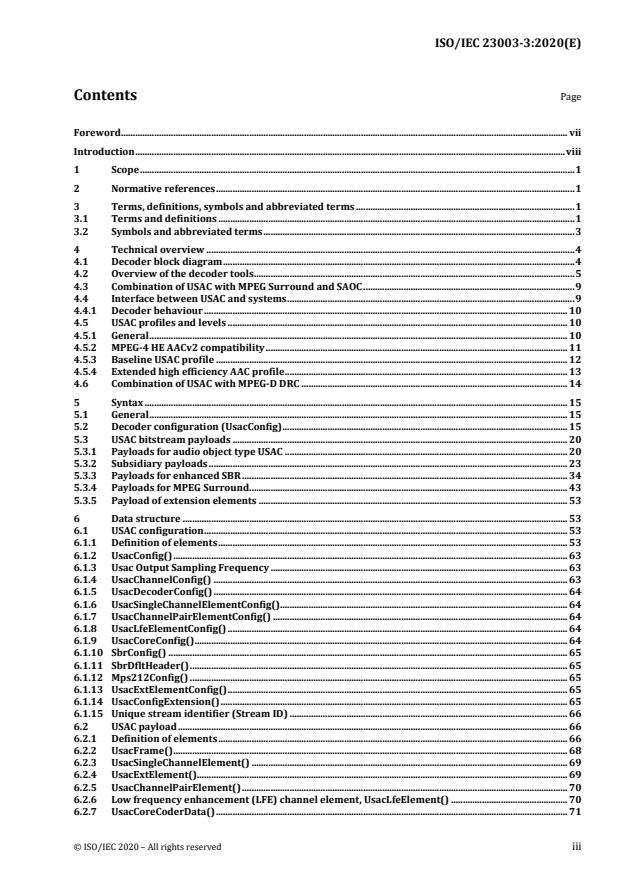
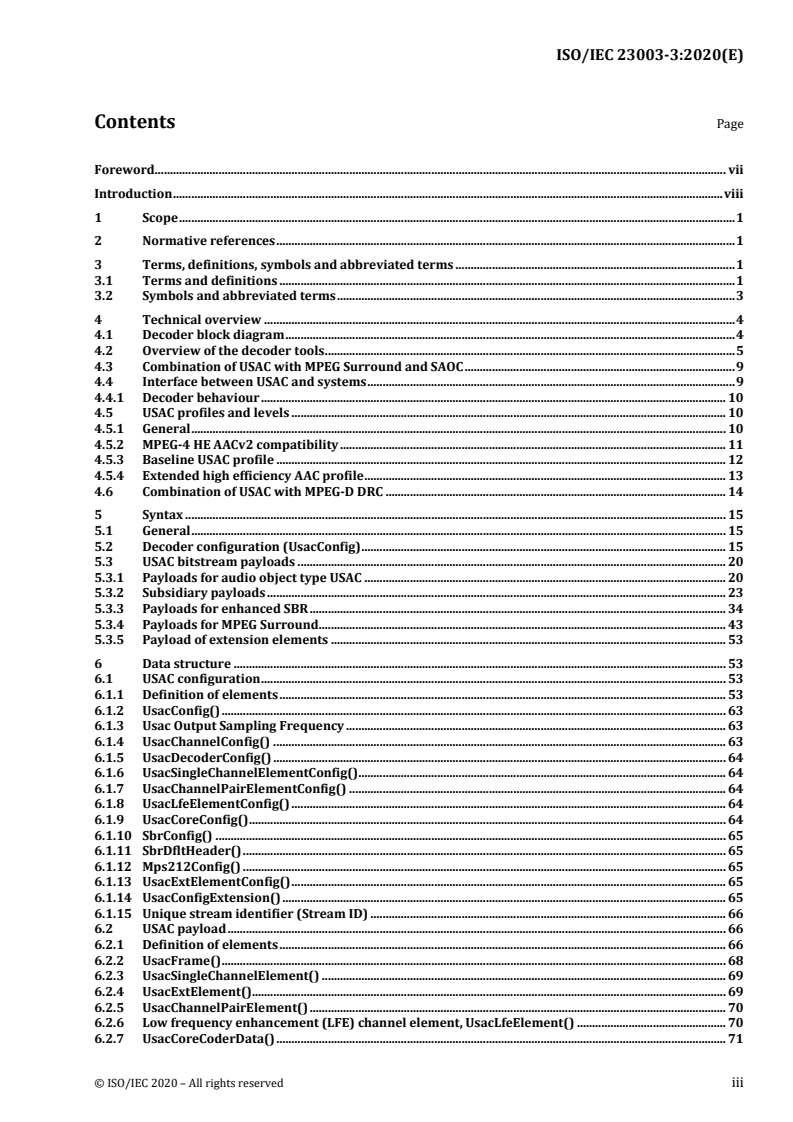
Contents Page
Foreword. vii
Introduction . viii
1 Scope . 1
2 Normative references . 1
3 Terms, definitions, symbols and abbreviated terms . 1
3.1 Terms and definitions . 1
3.2 Symbols and abbreviated terms . 3
4 Technical overview . 4
4.1 Decoder block diagram . 4
4.2 Overview of the decoder tools . 5
4.3 Combination of USAC with MPEG Surround and SAOC . 9
4.4 Interface between USAC and systems . 9
4.4.1 Decoder behaviour . 10
4.5 USAC profiles and levels . 10
4.5.1 General . 10
4.5.2 MPEG-4 HE AACv2 compatibility . 11
4.5.3 Baseline USAC profile . 12
4.5.4 Extended high efficiency AAC profile . 13
4.6 Combination of USAC with MPEG-D DRC . 14
5 Syntax . 15
5.1 General . 15
5.2 Decoder configuration (UsacConfig) . 15
5.3 USAC bitstream payloads . 20
5.3.1 Payloads for audio object type USAC . 20
5.3.2 Subsidiary payloads . 23
5.3.3 Payloads for enhanced SBR . 34
5.3.4 Payloads for MPEG Surround. 43
5.3.5 Payload of extension elements . 53
6 Data structure . 53
6.1 USAC configuration . 53
6.1.1 Definition of elements . 53
6.1.2 UsacConfig() . 63
6.1.3 Usac Output Sampling Frequency . 63
6.1.4 UsacChannelConfig() . 63
6.1.5 UsacDecoderConfig() . 64
6.1.6 UsacSingleChannelElementConfig(). 64
6.1.7 UsacChannelPairElementConfig() . 64
6.1.8 UsacLfeElementConfig() . 64
6.1.9 UsacCoreConfig() . 64
6.1.10 SbrConfig() . 65
6.1.11 SbrDfltHeader() . 65
6.1.12 Mps212Config() . 65
6.1.13 UsacExtElementConfig() . 65
6.1.14 UsacConfigExtension() . 65
6.1.15 Unique stream identifier (Stream ID) . 66
6.2 USAC payload . 66
6.2.1 Definition of elements . 66
6.2.2 UsacFrame() . 68
6.2.3 UsacSingleChannelElement() . 69
6.2.4 UsacExtElement(). 69
6.2.5 UsacChannelPairElement() . 70
6.2.6 Low frequency enhancement (LFE) channel element, UsacLfeElement() . 70
6.2.7 UsacCoreCoderData() . 71
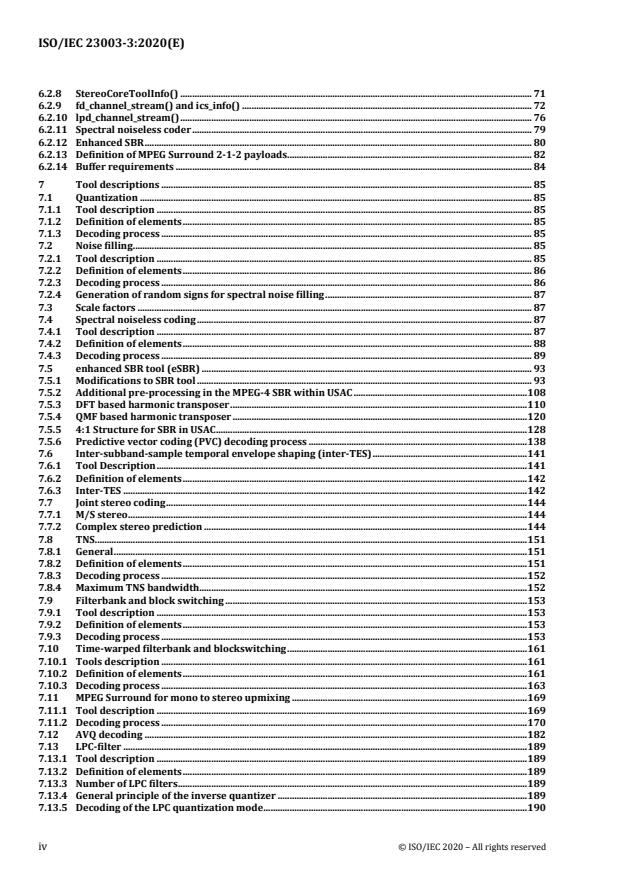
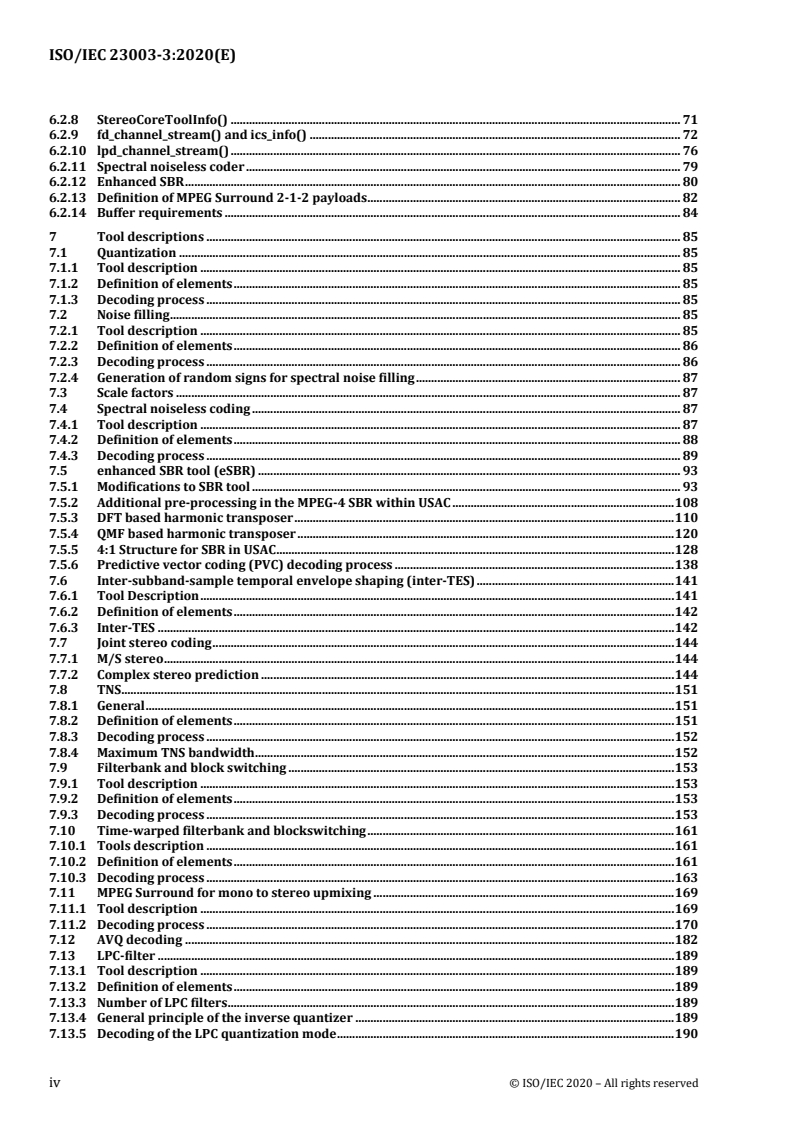
© ISO/IEC 2020 – All rights reserved iii
6.2.8 StereoCoreToolInfo() . 71
6.2.9 fd_channel_stream() and ics_info() . 72
6.2.10 lpd_channel_stream() . 76
6.2.11 Spectral noiseless coder . 79
6.2.12 Enhanced SBR . 80
6.2.13 Definition of MPEG Surround 2-1-2 payloads. 82
6.2.14 Buffer requirements . 84
7 Tool descriptions . 85
7.1 Quantization . 85
7.1.1 Tool description . 85
7.1.2 Definition of elements . 85
7.1.3 Decoding process . 85
7.2 Noise filling . 85
7.2.1 Tool description . 85
7.2.2 Definition of elements . 86
7.2.3 Decoding process . 86
7.2.4 Generation of random signs for spectral noise filling . 87
7.3 Scale factors . 87
7.4 Spectral noiseless coding . 87
7.4.1 Tool description . 87
7.4.2 Definition of elements . 88
7.4.3 Decoding process . 89
7.5 enhanced SBR tool (eSBR) . 93
7.5.1 Modifications to SBR tool . 93
7.5.2 Additional pre-processing in the MPEG-4 SBR within USAC . 108
7.5.3 DFT based harmonic transposer . 110
7.5.4 QMF based harmonic transposer . 120
7.5.5 4:1 Structure for SBR in USAC . 128
7.5.6 Predictive vector coding (PVC) decoding process . 138
7.6 Inter-subband-sample temporal envelope shaping (inter-TES) . 141
7.6.1 Tool Description . 141
7.6.2 Definition of elements . 142
7.6.3 Inter-TES . 142
7.7 Joint stereo coding . 144
7.7.1 M/S stereo . 144
7.7.2 Complex stereo prediction . 144
7.8 TNS. 151
7.8.1 General . 151
7.8.2 Definition of elements . 151
7.8.3 Decoding process . 152
7.8.4 Maximum TNS bandwidth. 152
7.9 Filterbank and block switching . 153
7.9.1 Tool description . 153
7.9.2 Definition of elements . 153
7.9.3 Decoding process . 153
7.10 Time-warped filterbank and blockswitching . 161
7.10.1 Tools description . 161
7.10.2 Definition of elements . 161
7.10.3 Decoding process . 163
7.11 MPEG Surround for mono to stereo upmixing . 169
7.11.1 Tool description . 169
7.11.2 Decoding process . 170
7.12 AVQ decoding . 182
7.13 LPC-filter . 189
7.13.1 Tool description . 189
7.13.2 Definition of elements . 189
7.13.3 Number of LPC filters . 189
7.13.4 General principle of the inverse quantizer . 189
7.13.5 Decoding of the LPC quantization mode . 190
iv © ISO/IEC 2020 – All rights reserved
7.13.6 First-stage approximation . 191
7.13.7 AVQ refinement . 191
7.13.8 Reordering of quantized LSFs . 193
7.13.9 Conversion into LSP parameters . 193
7.13.10 Interpolation of LSP parameters . 194
7.13.11 LSP to LP conversion . 194
7.13.12 LPC initialization at decoder start-up . 195
7.14 ACELP . 196
7.14.1 General . 196
7.14.2 Definition of elements . 196
7.14.3 ACELP initialization at USAC decoder start-up . 197
7.14.4 Setting of the ACELP excitation buffer using the past FD synthesis and LPC0. 197
7.14.5 Decoding of CELP excitation . 197
7.14.6 Excitation postprocessing . 203
7.14.7 Synthesis . 204
7.14.8 Writing in the output buffer . 204
7.15 MDCT based TCX . 205
7.15.1 Tool description . 205
7.15.2 Decoding process . 205
7.16 Forward aliasing cancellation (FAC) tool . 209
7.16.1 Tool description . 209
7.16.2 Definition of elements . 209
7.16.3 Decoding process . 210
7.16.4 Writing in the output buffer . 211
7.17 Post-processing of the synthesis signal . 212
7.18 Audio pre-roll . 214
7.18.1 General . 214
7.18.2 Semantics . 214
7.18.3 Decoding process . 215
8 Conformance testing . 217
8.1 General . 217
8.2 USAC conformance testing . 217
8.2.1 Profiles . 217
8.2.2 Conformance tools and test procedure . 218
8.3 USAC bitstreams . 222
8.3.1 General . 222
8.3.2 USAC configuration . 222
8.3.3 Framework . 225
8.3.4 Frequency domain coding (FD mode) . 226
8.3.5 Linear predictive domain coding (LPD mode) . 228
8.3.6 Common core coding tools . 229
8.3.7 Enhanced spectral band replication (eSBR) . 230
8.3.8 eSBR – Predictive vector coding (PVC) . 232
8.3.9 eSBR – Inter temporal envelope shaping (inter-TES). 233
8.3.10 MPEG Surround 2-1-2 . 233
8.3.11 Configuration Extensions . 235
8.3.12 AudioPreRoll. 235
8.3.13 DRC . 236
8.3.14 Restrictions depending on profiles and levels . 236
8.4 USAC decoders . 238
8.4.1 General . 238
8.4.2 FD core mode tests . 238
8.4.3 LPD core mode tests . 245
8.4.4 Combined core coding tests . 250
8.4.5 eSBR tests . 251
8.4.6 MPEG Surround 212 tests . 260
8.4.7 Bitstream extensions . 262
8.5 Decoder settings . 265
8.5.1 General . 265
© ISO/IEC 2020 – All rights reserved v
8.5.2 Target loudness [Lou-] . 265
8.5.3 DRC effect type request [Eff-] . 265
8.6 Decoding of MPEG-4 file format parameters to support exact time alignment in file-to-file
coding . 265
9 Reference software . 266
9.1 Reference software structure . 266
9.1.1 General . 266
9.1.2 Copyright disclaimer for software modules . 266
9.2 Bitstream decoding software . 268
9.2.1 General . 268
9.2.2 USAC decoding software . 268
Annex A (normative) Tables . 269
Annex B (informative) Encoder tools . 274
Annex C (normative) Tables for arithmetic decoder . 314
Annex D (normative) Tables for predictive vector coding . 320
Annex E (informative) Adaptive time/frequency post-processing . 329
Annex F (informative) Audio/systems interaction . 335
Annex G (informative) Reference software . 337
Annex H (normative) Carriage of MPEG-D USAC in ISO base media file format . 338
Bibliography . 339
vi © ISO/IEC 2020 – All rights reserved
Foreword
ISO (the International Organization for Standardization) and IEC (the International Electrotechnical Commission)
form the specialized system for worldwide standardization. National bodies that are members of ISO or IEC
participate in the development of International Standards through technical committees established by the
respective organization to deal with particular fields of technical activity. ISO and IEC technical committees
collaborate in fields of mutual interest. Other international organizations, governmental and non-governmental, in
liaison with ISO and IEC, also take part in the work.
The procedures used to develop this document and those intended for its further maintenance are described in
the ISO/IEC Directives, Part 1. In particular, the different approval criteria needed for the different types of
document should be noted. This document was drafted in accordance with the editorial rules of the ISO/IEC
Directives, Part 2 (see www.iso.org/directives).
Attention is drawn to the possibility that some of the elements of this document may be the subject of patent
rights. ISO and IEC shall not be held responsible for identifying any or all such patent rights. Details of any patent
rights identified during the development of the document will be in the Introduction and/or on the ISO list of
patent declarations received (see www.iso.org/patents) or the IEC list of patent declarations received (see
http://patents.iec.ch).
Any trade name used in this document is information given for the convenience of users and does not constitute
an endorsement.
For an explanation of the voluntary nature of standards, the meaning of ISO specific terms and expressions related
to conformity assessment, as well as information about ISO's adherence to the World Trade Organization (WTO)
principles in the Technical Barriers to Trade (TBT) see www.iso.org/iso/foreword.html.
This document was prepared by Joint Technical Committee ISO/IEC JTC 1, Information technology, Subcommittee
SC 29, Coding of audio, picture, multimedia and hypermedia information.
This second edition cancels and replaces the first edition (ISO/IEC 23003-3:2012), which has been technically
revised. It also incorporates ISO/IEC 23003-3:2012/Cor.1:2012, ISO/IEC 23003-3:2012/Cor.2:2013,
ISO/IEC 23003-3:2012/Cor.3:2015, ISO/IEC 23003-3:2012/Cor.4:2015, ISO/IEC 23003-3:2012/Amd.1:2014,
ISO/IEC 23003-3:2012/Amd.1:2014/Cor.1:2015, ISO/IEC 23003-3:2012/Amd.2:2015, ISO/IEC 23003-
3:2012/Amd.2:2015/Cor.1:2015 and ISO/IEC 23003-3:2012/Amd.3:2016.
A list of all parts in the ISO/IEC 23003 series can be found on the ISO website.
Any feedback or questions on this document should be directed to the user’s national standards body. A complete
listing of these bodies can be found at www.iso.org/members.html.
© ISO/IEC 2020 – All rights reserved vii
Introduction
As mobile appliances become multi-functional, multiple devices converge into a single device. Typically, a wide
variety of multimedia content is required to be played on or streamed to these mobile devices, including audio
data that consists of a mix of speech and music.
This document specifies unified speech and audio coding (USAC), which allows for coding of speech, audio or any
mixture of speech and audio with a consistent audio quality for all sound material over a wide range of bitrates. It
supports single and multi-channel coding at high bitrates and provides perceptually transparent quality. At the
same time, it enables very efficient coding at very low bitrates while retaining the full audio bandwidth.
Where previous audio codecs had specific strengths in coding either speech or audio content, USAC is able to
encode all content equally well, regardless of the content type.
In order to achieve equally good quality for coding audio and speech, the developers of USAC employed the proven
MDCT-based transform coding techniques known from MPEG-4 audio and combined them with specialized speech
coder elements like ACELP. Parametric coding tools such as MPEG-4 spectral band replication (SBR) and MPEG-D
MPEG surround were enhanced and tightly integrated into the codec. The result delivers highly efficient coding
and operates down to the lowest bit rates.
The main focus of this codec are applications in the field of typical broadcast scenarios, multimedia download to
mobile devices, user-generated content such as podcasts, digital radio, mobile TV, audio books, etc.
The International Organization for Standardization (ISO) and International Electrotechnical Commission (IEC)
draw attention to the fact that it is claimed that compliance with this document may involve the use of a patent.
ISO and IEC take no position concerning the evidence, validity and scope of this patent right.
The holder of this patent right has assured ISO and IEC that he/she is willing to negotiate licences under
reasonable and non-discriminatory terms and conditions with applicants throughout the world. In this respect,
the statement of the holder of this patent right is registered with ISO and IEC. Information may be obtained from
the patent database available at www.iso.org/patents.
Attention is drawn to the possibility that some of the elements of this document may be the subject of patent
rights other than those in the patent database. ISO and IEC shall not be held responsible for identifying any or all
such patent rights.
viii © ISO/IEC 2020 – All rights reserved
INTERNATIONAL STANDARD ISO/IEC 23003-3:2020(E)
Information technology — MPEG audio technologies —
Part 3:
Unified speech and audio coding
1 Scope
This document specifies a unified speech and audio codec which is capable of coding signals having an arbitrary
mix of speech and audio content. The codec has a performance comparable to, or better than, the best known
coding technology that might be tailored specifically to coding of either speech or general audio content. The
codec supports single and multi-channel coding at high bitrates and provides perceptually transparent quality. At
the same time, it enables very efficient coding at very low bitrates while retaining the full audio bandwidth.
This document incorporates several perceptually-based compression techniques developed in previous MPEG
standards: perceptually shaped quantization noise, parametric coding of the upper spectrum region and
parametric coding of the stereo sound stage. However, it combines these well-known perceptual techniques with a
source coding technique: a model of sound production, specifically that of human speech.
2 Normative references
The following documents are referred to in the text in such a way that some or all of their content constitutes
requirements of this document. For dated references, only the edition cited applies. For undated references, the
latest edition of the referenced document (including any amendments) applies.
ISO/IEC 14496-3:2019, Information technology — Coding of audio-visual objects — Part 3: Audio
ISO/IEC 14496-26:2010, Information technology — Coding of audio-visual objects — Part 26: Audio conformance
ISO/IEC 23003-1, Information technology — MPEG audio technologies — Part 1: MPEG Surround
ISO/IEC 23003-4, Information technology — MPEG audio technologies — Part 4: Dynamic range control
3 Terms, definitions, symbols and abbreviated terms
3.1 Terms and definitions
For the purposes of this document, the terms and definitions given in ISO/IEC 14496-3, ISO/IEC 23003-1 and the
following apply.
ISO and IEC maintain terminological databases for use in standardization at the following addresses:
— ISO Online browsing platform: available at https://www.iso.org/obp
— IEC Electropedia: available at http://www.electropedia.org/
3.1.1
algebraic codebook
fixed codebook where an algebraic code is used to populate the excitation vectors (innovation vectors)
© ISO/IEC 2020 – All rights reserved 1
Note 1 to entry: The excitation contains a small number of nonzero pulses with predefined interlaced sets of potential
th
positions. The amplitudes and positions of the pulses of the k excitation codevector can be derived from its index k through a
rule requiring no or minimal physical storage, in contrast with stochastic codebooks whereby the path from the index to the
associated codevector involves look-up tables.
3.1.2
algebraic vector quantizer
AVQ
process associating, to an input block of 8 coefficients, the nearest neighbour from an 8-dimensional lattice and a
set of binary indices to represent the selected lattice point
Note 1 to entry: This definition describes the encoder. At the decoder, AVQ describes the process to obtain, from the received
set of binary indices, the 8-dimensional lattice point that was selected at the encoder.
3.1.3
closed-loop pitch
result of the adaptive codebook search, a process of estimating the pitch (lag) value from the weighted input
speech and the long-term filter state
Note 1 to entry: In the closed-loop search, the lag is searched using error minimization loop (analysis-by-synthesis). In USAC,
closed-loop pitch search is performed for every subframe.
3.1.4
fractional pitch
set of pitch lag values having sub-sample resolution
th nd
Note 1 to entry: In the LPD USAC, a sub-sample resolution of 1/4 or 1/2 of a sample is used.
3.1.5
zero-input response
ZIR
out
...
INTERNATIONAL ISO/IEC
STANDARD 23003-3
Second edition
2020-06
Information technology — MPEG
audio technologies —
Part 3:
Unified speech and audio coding
Technologies de l'information — Technologies audio MPEG —
Partie 3: Codage unifié parole et audio
Reference number
©
ISO/IEC 2020
© ISO/IEC 2020
All rights reserved. Unless otherwise specified, or required in the context of its implementation, no part of this publication may
be reproduced or utilized otherwise in any form or by any means, electronic or mechanical, including photocopying, or posting
on the internet or an intranet, without prior written permission. Permission can be requested from either ISO at the address
below or ISO’s member body in the country of the requester.
ISO copyright office
CP 401 • Ch. de Blandonnet 8
CH-1214 Vernier, Geneva
Phone: +41 22 749 01 11
Fax: +41 22 749 09 47
Email: copyright@iso.org
Website: www.iso.org
Published in Switzerland
ii © ISO/IEC 2020 – All rights reserved
Contents Page
Foreword. vii
Introduction . viii
1 Scope . 1
2 Normative references . 1
3 Terms, definitions, symbols and abbreviated terms . 1
3.1 Terms and definitions . 1
3.2 Symbols and abbreviated terms . 3
4 Technical overview . 4
4.1 Decoder block diagram . 4
4.2 Overview of the decoder tools . 5
4.3 Combination of USAC with MPEG Surround and SAOC . 9
4.4 Interface between USAC and systems . 9
4.4.1 Decoder behaviour . 10
4.5 USAC profiles and levels . 10
4.5.1 General . 10
4.5.2 MPEG-4 HE AACv2 compatibility . 11
4.5.3 Baseline USAC profile . 12
4.5.4 Extended high efficiency AAC profile . 13
4.6 Combination of USAC with MPEG-D DRC . 14
5 Syntax . 15
5.1 General . 15
5.2 Decoder configuration (UsacConfig) . 15
5.3 USAC bitstream payloads . 20
5.3.1 Payloads for audio object type USAC . 20
5.3.2 Subsidiary payloads . 23
5.3.3 Payloads for enhanced SBR . 34
5.3.4 Payloads for MPEG Surround. 43
5.3.5 Payload of extension elements . 53
6 Data structure . 53
6.1 USAC configuration . 53
6.1.1 Definition of elements . 53
6.1.2 UsacConfig() . 63
6.1.3 Usac Output Sampling Frequency . 63
6.1.4 UsacChannelConfig() . 63
6.1.5 UsacDecoderConfig() . 64
6.1.6 UsacSingleChannelElementConfig(). 64
6.1.7 UsacChannelPairElementConfig() . 64
6.1.8 UsacLfeElementConfig() . 64
6.1.9 UsacCoreConfig() . 64
6.1.10 SbrConfig() . 65
6.1.11 SbrDfltHeader() . 65
6.1.12 Mps212Config() . 65
6.1.13 UsacExtElementConfig() . 65
6.1.14 UsacConfigExtension() . 65
6.1.15 Unique stream identifier (Stream ID) . 66
6.2 USAC payload . 66
6.2.1 Definition of elements . 66
6.2.2 UsacFrame() . 68
6.2.3 UsacSingleChannelElement() . 69
6.2.4 UsacExtElement(). 69
6.2.5 UsacChannelPairElement() . 70
6.2.6 Low frequency enhancement (LFE) channel element, UsacLfeElement() . 70
6.2.7 UsacCoreCoderData() . 71
© ISO/IEC 2020 – All rights reserved iii
6.2.8 StereoCoreToolInfo() . 71
6.2.9 fd_channel_stream() and ics_info() . 72
6.2.10 lpd_channel_stream() . 76
6.2.11 Spectral noiseless coder . 79
6.2.12 Enhanced SBR . 80
6.2.13 Definition of MPEG Surround 2-1-2 payloads. 82
6.2.14 Buffer requirements . 84
7 Tool descriptions . 85
7.1 Quantization . 85
7.1.1 Tool description . 85
7.1.2 Definition of elements . 85
7.1.3 Decoding process . 85
7.2 Noise filling . 85
7.2.1 Tool description . 85
7.2.2 Definition of elements . 86
7.2.3 Decoding process . 86
7.2.4 Generation of random signs for spectral noise filling . 87
7.3 Scale factors . 87
7.4 Spectral noiseless coding . 87
7.4.1 Tool description . 87
7.4.2 Definition of elements . 88
7.4.3 Decoding process . 89
7.5 enhanced SBR tool (eSBR) . 93
7.5.1 Modifications to SBR tool . 93
7.5.2 Additional pre-processing in the MPEG-4 SBR within USAC . 108
7.5.3 DFT based harmonic transposer . 110
7.5.4 QMF based harmonic transposer . 120
7.5.5 4:1 Structure for SBR in USAC . 128
7.5.6 Predictive vector coding (PVC) decoding process . 138
7.6 Inter-subband-sample temporal envelope shaping (inter-TES) . 141
7.6.1 Tool Description . 141
7.6.2 Definition of elements . 142
7.6.3 Inter-TES . 142
7.7 Joint stereo coding . 144
7.7.1 M/S stereo . 144
7.7.2 Complex stereo prediction . 144
7.8 TNS. 151
7.8.1 General . 151
7.8.2 Definition of elements . 151
7.8.3 Decoding process . 152
7.8.4 Maximum TNS bandwidth. 152
7.9 Filterbank and block switching . 153
7.9.1 Tool description . 153
7.9.2 Definition of elements . 153
7.9.3 Decoding process . 153
7.10 Time-warped filterbank and blockswitching . 161
7.10.1 Tools description . 161
7.10.2 Definition of elements . 161
7.10.3 Decoding process . 163
7.11 MPEG Surround for mono to stereo upmixing . 169
7.11.1 Tool description . 169
7.11.2 Decoding process . 170
7.12 AVQ decoding . 182
7.13 LPC-filter . 189
7.13.1 Tool description . 189
7.13.2 Definition of elements . 189
7.13.3 Number of LPC filters . 189
7.13.4 General principle of the inverse quantizer . 189
7.13.5 Decoding of the LPC quantization mode . 190
iv © ISO/IEC 2020 – All rights reserved
7.13.6 First-stage approximation . 191
7.13.7 AVQ refinement . 191
7.13.8 Reordering of quantized LSFs . 193
7.13.9 Conversion into LSP parameters . 193
7.13.10 Interpolation of LSP parameters . 194
7.13.11 LSP to LP conversion . 194
7.13.12 LPC initialization at decoder start-up . 195
7.14 ACELP . 196
7.14.1 General . 196
7.14.2 Definition of elements . 196
7.14.3 ACELP initialization at USAC decoder start-up . 197
7.14.4 Setting of the ACELP excitation buffer using the past FD synthesis and LPC0. 197
7.14.5 Decoding of CELP excitation . 197
7.14.6 Excitation postprocessing . 203
7.14.7 Synthesis . 204
7.14.8 Writing in the output buffer . 204
7.15 MDCT based TCX . 205
7.15.1 Tool description . 205
7.15.2 Decoding process . 205
7.16 Forward aliasing cancellation (FAC) tool . 209
7.16.1 Tool description . 209
7.16.2 Definition of elements . 209
7.16.3 Decoding process . 210
7.16.4 Writing in the output buffer . 211
7.17 Post-processing of the synthesis signal . 212
7.18 Audio pre-roll . 214
7.18.1 General . 214
7.18.2 Semantics . 214
7.18.3 Decoding process . 215
8 Conformance testing . 217
8.1 General . 217
8.2 USAC conformance testing . 217
8.2.1 Profiles . 217
8.2.2 Conformance tools and test procedure . 218
8.3 USAC bitstreams . 222
8.3.1 General . 222
8.3.2 USAC configuration . 222
8.3.3 Framework . 225
8.3.4 Frequency domain coding (FD mode) . 226
8.3.5 Linear predictive domain coding (LPD mode) . 228
8.3.6 Common core coding tools . 229
8.3.7 Enhanced spectral band replication (eSBR) . 230
8.3.8 eSBR – Predictive vector coding (PVC) . 232
8.3.9 eSBR – Inter temporal envelope shaping (inter-TES). 233
8.3.10 MPEG Surround 2-1-2 . 233
8.3.11 Configuration Extensions . 235
8.3.12 AudioPreRoll. 235
8.3.13 DRC . 236
8.3.14 Restrictions depending on profiles and levels . 236
8.4 USAC decoders . 238
8.4.1 General . 238
8.4.2 FD core mode tests . 238
8.4.3 LPD core mode tests . 245
8.4.4 Combined core coding tests . 250
8.4.5 eSBR tests . 251
8.4.6 MPEG Surround 212 tests . 260
8.4.7 Bitstream extensions . 262
8.5 Decoder settings . 265
8.5.1 General . 265
© ISO/IEC 2020 – All rights reserved v
8.5.2 Target loudness [Lou-] . 265
8.5.3 DRC effect type request [Eff-] . 265
8.6 Decoding of MPEG-4 file format parameters to support exact time alignment in file-to-file
coding . 265
9 Reference software . 266
9.1 Reference software structure . 266
9.1.1 General . 266
9.1.2 Copyright disclaimer for software modules . 266
9.2 Bitstream decoding software . 268
9.2.1 General . 268
9.2.2 USAC decoding software . 268
Annex A (normative) Tables . 269
Annex B (informative) Encoder tools . 274
Annex C (normative) Tables for arithmetic decoder . 314
Annex D (normative) Tables for predictive vector coding . 320
Annex E (informative) Adaptive time/frequency post-processing . 329
Annex F (informative) Audio/systems interaction . 335
Annex G (informative) Reference software . 337
Annex H (normative) Carriage of MPEG-D USAC in ISO base media file format . 338
Bibliography . 339
vi © ISO/IEC 2020 – All rights reserved
Foreword
ISO (the International Organization for Standardization) and IEC (the International Electrotechnical Commission)
form the specialized system for worldwide standardization. National bodies that are members of ISO or IEC
participate in the development of International Standards through technical committees established by the
respective organization to deal with particular fields of technical activity. ISO and IEC technical committees
collaborate in fields of mutual interest. Other international organizations, governmental and non-governmental, in
liaison with ISO and IEC, also take part in the work.
The procedures used to develop this document and those intended for its further maintenance are described in
the ISO/IEC Directives, Part 1. In particular, the different approval criteria needed for the different types of
document should be noted. This document was drafted in accordance with the editorial rules of the ISO/IEC
Directives, Part 2 (see www.iso.org/directives).
Attention is drawn to the possibility that some of the elements of this document may be the subject of patent
rights. ISO and IEC shall not be held responsible for identifying any or all such patent rights. Details of any patent
rights identified during the development of the document will be in the Introduction and/or on the ISO list of
patent declarations received (see www.iso.org/patents) or the IEC list of patent declarations received (see
http://patents.iec.ch).
Any trade name used in this document is information given for the convenience of users and does not constitute
an endorsement.
For an explanation of the voluntary nature of standards, the meaning of ISO specific terms and expressions related
to conformity assessment, as well as information about ISO's adherence to the World Trade Organization (WTO)
principles in the Technical Barriers to Trade (TBT) see www.iso.org/iso/foreword.html.
This document was prepared by Joint Technical Committee ISO/IEC JTC 1, Information technology, Subcommittee
SC 29, Coding of audio, picture, multimedia and hypermedia information.
This second edition cancels and replaces the first edition (ISO/IEC 23003-3:2012), which has been technically
revised. It also incorporates ISO/IEC 23003-3:2012/Cor.1:2012, ISO/IEC 23003-3:2012/Cor.2:2013,
ISO/IEC 23003-3:2012/Cor.3:2015, ISO/IEC 23003-3:2012/Cor.4:2015, ISO/IEC 23003-3:2012/Amd.1:2014,
ISO/IEC 23003-3:2012/Amd.1:2014/Cor.1:2015, ISO/IEC 23003-3:2012/Amd.2:2015, ISO/IEC 23003-
3:2012/Amd.2:2015/Cor.1:2015 and ISO/IEC 23003-3:2012/Amd.3:2016.
A list of all parts in the ISO/IEC 23003 series can be found on the ISO website.
Any feedback or questions on this document should be directed to the user’s national standards body. A complete
listing of these bodies can be found at www.iso.org/members.html.
© ISO/IEC 2020 – All rights reserved vii
Introduction
As mobile appliances become multi-functional, multiple devices converge into a single device. Typically, a wide
variety of multimedia content is required to be played on or streamed to these mobile devices, including audio
data that consists of a mix of speech and music.
This document specifies unified speech and audio coding (USAC), which allows for coding of speech, audio or any
mixture of speech and audio with a consistent audio quality for all sound material over a wide range of bitrates. It
supports single and multi-channel coding at high bitrates and provides perceptually transparent quality. At the
same time, it enables very efficient coding at very low bitrates while retaining the full audio bandwidth.
Where previous audio codecs had specific strengths in coding either speech or audio content, USAC is able to
encode all content equally well, regardless of the content type.
In order to achieve equally good quality for coding audio and speech, the developers of USAC employed the proven
MDCT-based transform coding techniques known from MPEG-4 audio and combined them with specialized speech
coder elements like ACELP. Parametric coding tools such as MPEG-4 spectral band replication (SBR) and MPEG-D
MPEG surround were enhanced and tightly integrated into the codec. The result delivers highly efficient coding
and operates down to the lowest bit rates.
The main focus of this codec are applications in the field of typical broadcast scenarios, multimedia download to
mobile devices, user-generated content such as podcasts, digital radio, mobile TV, audio books, etc.
The International Organization for Standardization (ISO) and International Electrotechnical Commission (IEC)
draw attention to the fact that it is claimed that compliance with this document may involve the use of a patent.
ISO and IEC take no position concerning the evidence, validity and scope of this patent right.
The holder of this patent right has assured ISO and IEC that he/she is willing to negotiate licences under
reasonable and non-discriminatory terms and conditions with applicants throughout the world. In this respect,
the statement of the holder of this patent right is registered with ISO and IEC. Information may be obtained from
the patent database available at www.iso.org/patents.
Attention is drawn to the possibility that some of the elements of this document may be the subject of patent
rights other than those in the patent database. ISO and IEC shall not be held responsible for identifying any or all
such patent rights.
viii © ISO/IEC 2020 – All rights reserved
INTERNATIONAL STANDARD ISO/IEC 23003-3:2020(E)
Information technology — MPEG audio technologies —
Part 3:
Unified speech and audio coding
1 Scope
This document specifies a unified speech and audio codec which is capable of coding signals having an arbitrary
mix of speech and audio content. The codec has a performance comparable to, or better than, the best known
coding technology that might be tailored specifically to coding of either speech or general audio content. The
codec supports single and multi-channel coding at high bitrates and provides perceptually transparent quality. At
the same time, it enables very efficient coding at very low bitrates while retaining the full audio bandwidth.
This document incorporates several perceptually-based compression techniques developed in previous MPEG
standards: perceptually shaped quantization noise, parametric coding of the upper spectrum region and
parametric coding of the stereo sound stage. However, it combines these well-known perceptual techniques with a
source coding technique: a model of sound production, specifically that of human speech.
2 Normative references
The following documents are referred to in the text in such a way that some or all of their content constitutes
requirements of this document. For dated references, only the edition cited applies. For undated references, the
latest edition of the referenced document (including any amendments) applies.
ISO/IEC 14496-3:2019, Information technology — Coding of audio-visual objects — Part 3: Audio
ISO/IEC 14496-26:2010, Information technology — Coding of audio-visual objects — Part 26: Audio conformance
ISO/IEC 23003-1, Information technology — MPEG audio technologies — Part 1: MPEG Surround
ISO/IEC 23003-4, Information technology — MPEG audio technologies — Part 4: Dynamic range control
3 Terms, definitions, symbols and abbreviated terms
3.1 Terms and definitions
For the purposes of this document, the terms and definitions given in ISO/IEC 14496-3, ISO/IEC 23003-1 and the
following apply.
ISO and IEC maintain terminological databases for use in standardization at the following addresses:
— ISO Online browsing platform: available at https://www.iso.org/obp
— IEC Electropedia: available at http://www.electropedia.org/
3.1.1
algebraic codebook
fixed codebook where an algebraic code is used to populate the excitation vectors (innovation vectors)
© ISO/IEC 2020 – All rights reserved 1
Note 1 to entry: The excitation contains a small number of nonzero pulses with predefined interlaced sets of potential
th
positions. The amplitudes and positions of the pulses of the k excitation codevector can be derived from its index k through a
rule requiring no or minimal physical storage, in contrast with stochastic codebooks whereby the path from the index to the
associated codevector involves look-up tables.
3.1.2
algebraic vector quantizer
AVQ
process associating, to an input block of 8 coefficients, the nearest neighbour from an 8-dimensional lattice and a
set of binary indices to represent the selected lattice point
Note 1 to entry: This definition describes the encoder. At the decoder, AVQ describes the process to obtain, from the received
set of binary indices, the 8-dimensional lattice point that was selected at the encoder.
3.1.3
closed-loop pitch
result of the adaptive codebook search, a process of estimating the pitch (lag) value from the weighted input
speech and the long-term filter state
Note 1 to entry: In the closed-loop search, the lag is searched using error minimization loop (analysis-by-synthesis). In USAC,
closed-loop pitch search is performed for every subframe.
3.1.4
fractional pitch
set of pitch lag values having sub-sample resolution
th nd
Note 1 to entry: In the LPD USAC, a sub-sample resolution of 1/4 or 1/2 of a sample is used.
3.1.5
zero-input response
ZIR
out
...