

ISO/IEC 23090-14:2025
(Main)Information technology — Coded representation of immersive media — Part 14: Scene description
General Information
- Abstract
This document specifies extensions to existing scene description formats in order to support MPEG media, in particular immersive media. MPEG media includes but is not limited to media encoded with MPEG codecs, media stored in MPEG containers, MPEG media and application formats as well as media provided through MPEG delivery mechanisms. Extensions include scene description format syntax and semantics and the processing model when using these extensions by a Presentation Engine. It also defines a media access function (MAF) API for communication between the Presentation Engine and the media access function for these extensions. While the extensions defined in this document can be applicable to other scene description formats, they are provided for ISO/IEC 12113.
- Status
- Published
- Publication Date
- 06-Nov-2025
- Technical Committee
- ISO/IEC JTC 1/SC 29 - Coding of audio, picture, multimedia and hypermedia information
- Drafting Committee
- ISO/IEC JTC 1/SC 29/WG 3 - MPEG Systems
- Current Stage
- 6060 - International Standard published
- Start Date
- 07-Nov-2025
- Due Date
- 22-Jan-2026
- Completion Date
- 07-Nov-2025

Overview
ISO/IEC 23090-14:2025 - "Information technology - Coded representation of immersive media - Part 14: Scene description" defines extensions to scene description formats to support MPEG media, with a focus on immersive media (VR/AR/volumetric). The standard specifies scene description format syntax and semantics, a timing and processing model for Presentation Engines, and a media access function (MAF) API to connect scene presentation logic with media delivery and buffering. While tailored for ISO/IEC 12113 (glTF-based scene formats), the extensions are applicable to other scene description systems.
Key Topics and Requirements
- Scene description extensions: Generic and domain-specific extensions such as MPEG_media, MPEG_accessor_timed, MPEG_buffer_circular, and MPEG_scene_dynamic for synchronized media handling.
- Visual and mesh features: MPEG_texture_video, MPEG_mesh_linking, and carriage formats for glTF JSON, glTF objects, mesh correspondence, pose & weight - enabling timed textures, mesh linking, and shadow/mesh associations.
- Audio and spatialization: MPEG_audio_spatial extensions and audio attenuation models to support immersive audio rendering.
- Timing and synchronization: A defined timing model and animation timing extensions to align media samples, animations, and interactive state.
- MAF API and buffer model: A Media Access Function API and buffer API that standardize communication between the Presentation Engine and media sources/decoders.
- Carriage formats & brands: Packaging rules for carrying scene items, glTF patches, animation samples, and related metadata in media containers.
- Advanced features: AR anchoring, interactivity semantics, avatar definitions and processing, lighting semantics and processing models.
- Annexes: JSON schema references, attribute registries, real-time media support, glTF extension examples, and MPEG-I media support.
Practical Applications
- Implementing interoperable VR/AR scene players and Presentation Engines that integrate MPEG-encoded video, audio and object streams.
- Enabling streaming platforms and content providers to package immersive experiences with standardized timing, buffering, and carriage formats.
- Assisting game engines, 3D application developers, and device manufacturers in supporting synchronized media textures, spatial audio and avatar/lighting semantics.
- Guiding tooling and authoring vendors to export glTF scenes with MPEG-aware extensions for delivery over MPEG containers and delivery mechanisms.
Who Should Use This Standard
- Developers of immersive media players, Presentation Engines, and media frameworks
- Content authors and VFX/AR/VR producers using glTF and MPEG codecs
- Streaming service architects and device OEMs implementing MPEG-based delivery
- Standards implementers and tool vendors seeking interoperability for spatial audio, timed textures, avatars, AR anchoring and real-time scene updates
Related Standards (if applicable)
- ISO/IEC 12113 (glTF scene description) - target format for many extensions in this document
- MPEG and MPEG-I media specifications (referenced for media formats and delivery)
Keywords: ISO/IEC 23090-14:2025, scene description, immersive media, MPEG, glTF, Presentation Engine, MAF API, carriage format, AR anchoring, spatial audio, mesh linking.
Relations
- Effective Date
- 24-Aug-2024
- Effective Date
- 17-Aug-2024
- Effective Date
- 17-Aug-2024
Get Certified
Connect with accredited certification bodies for this standard

BSI Group
BSI (British Standards Institution) is the business standards company that helps organizations make excellence a habit.

NYCE
Mexican standards and certification body.
Sponsored listings
Frequently Asked Questions
ISO/IEC 23090-14:2025 is a standard published by the International Organization for Standardization (ISO). Its full title is "Information technology — Coded representation of immersive media — Part 14: Scene description". This standard covers: This document specifies extensions to existing scene description formats in order to support MPEG media, in particular immersive media. MPEG media includes but is not limited to media encoded with MPEG codecs, media stored in MPEG containers, MPEG media and application formats as well as media provided through MPEG delivery mechanisms. Extensions include scene description format syntax and semantics and the processing model when using these extensions by a Presentation Engine. It also defines a media access function (MAF) API for communication between the Presentation Engine and the media access function for these extensions. While the extensions defined in this document can be applicable to other scene description formats, they are provided for ISO/IEC 12113.
This document specifies extensions to existing scene description formats in order to support MPEG media, in particular immersive media. MPEG media includes but is not limited to media encoded with MPEG codecs, media stored in MPEG containers, MPEG media and application formats as well as media provided through MPEG delivery mechanisms. Extensions include scene description format syntax and semantics and the processing model when using these extensions by a Presentation Engine. It also defines a media access function (MAF) API for communication between the Presentation Engine and the media access function for these extensions. While the extensions defined in this document can be applicable to other scene description formats, they are provided for ISO/IEC 12113.
ISO/IEC 23090-14:2025 is classified under the following ICS (International Classification for Standards) categories: 35.040.40 - Coding of audio, video, multimedia and hypermedia information. The ICS classification helps identify the subject area and facilitates finding related standards.
ISO/IEC 23090-14:2025 has the following relationships with other standards: It is inter standard links to ISO/IEC 23090-14:2025/FDAmd 1, ISO/IEC 23090-14:2023, ISO/IEC 23090-14:2023/Amd 1:2023. Understanding these relationships helps ensure you are using the most current and applicable version of the standard.
ISO/IEC 23090-14:2025 is available in PDF format for immediate download after purchase. The document can be added to your cart and obtained through the secure checkout process. Digital delivery ensures instant access to the complete standard document.
Standards Content (Sample)
International
Standard
ISO/IEC 23090-14
Second edition
Information technology — Coded
2025-11
representation of immersive media —
Part 14:
Scene description
Technologies de l'information — Représentation codée de média
immersifs —
Partie 14: Description de scènes
Reference number
© ISO/IEC 2025
All rights reserved. Unless otherwise specified, or required in the context of its implementation, no part of this publication may
be reproduced or utilized otherwise in any form or by any means, electronic or mechanical, including photocopying, or posting on
the internet or an intranet, without prior written permission. Permission can be requested from either ISO at the address below
or ISO’s member body in the country of the requester.
ISO copyright office
CP 401 • Ch. de Blandonnet 8
CH-1214 Vernier, Geneva
Phone: +41 22 749 01 11
Email: copyright@iso.org
Website: www.iso.org
Published in Switzerland
© ISO/IEC 2025 – All rights reserved
ii
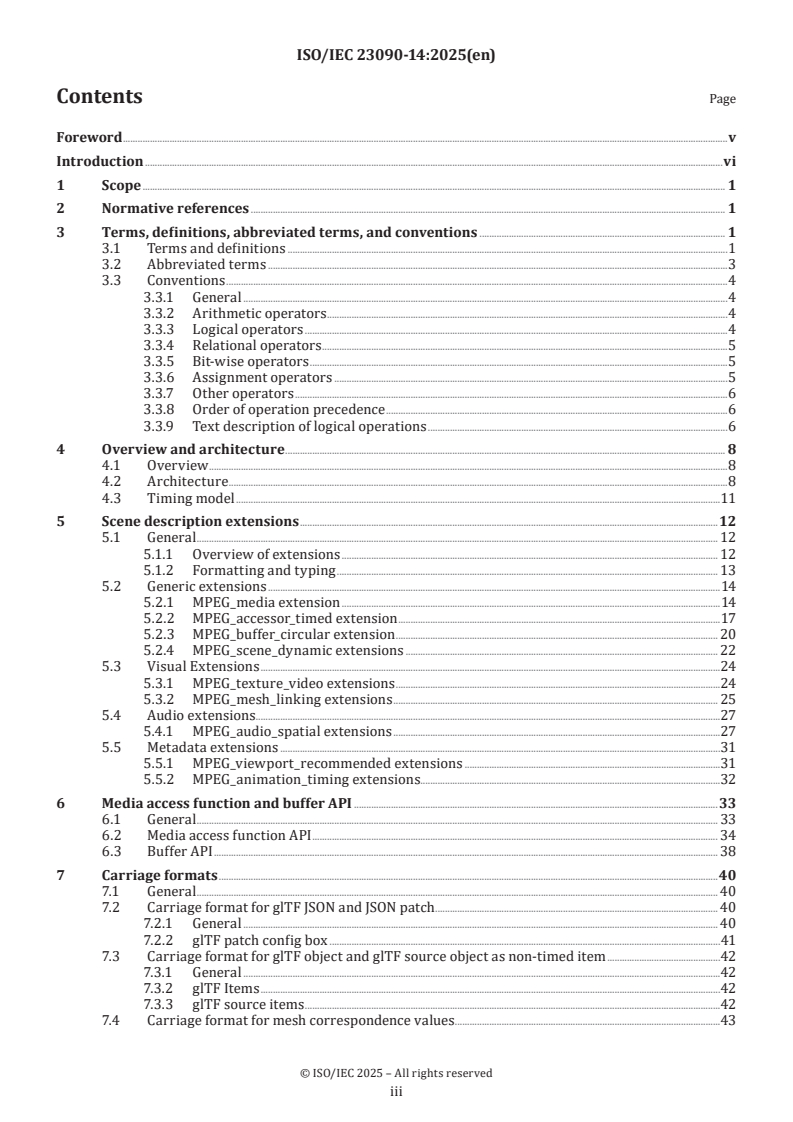
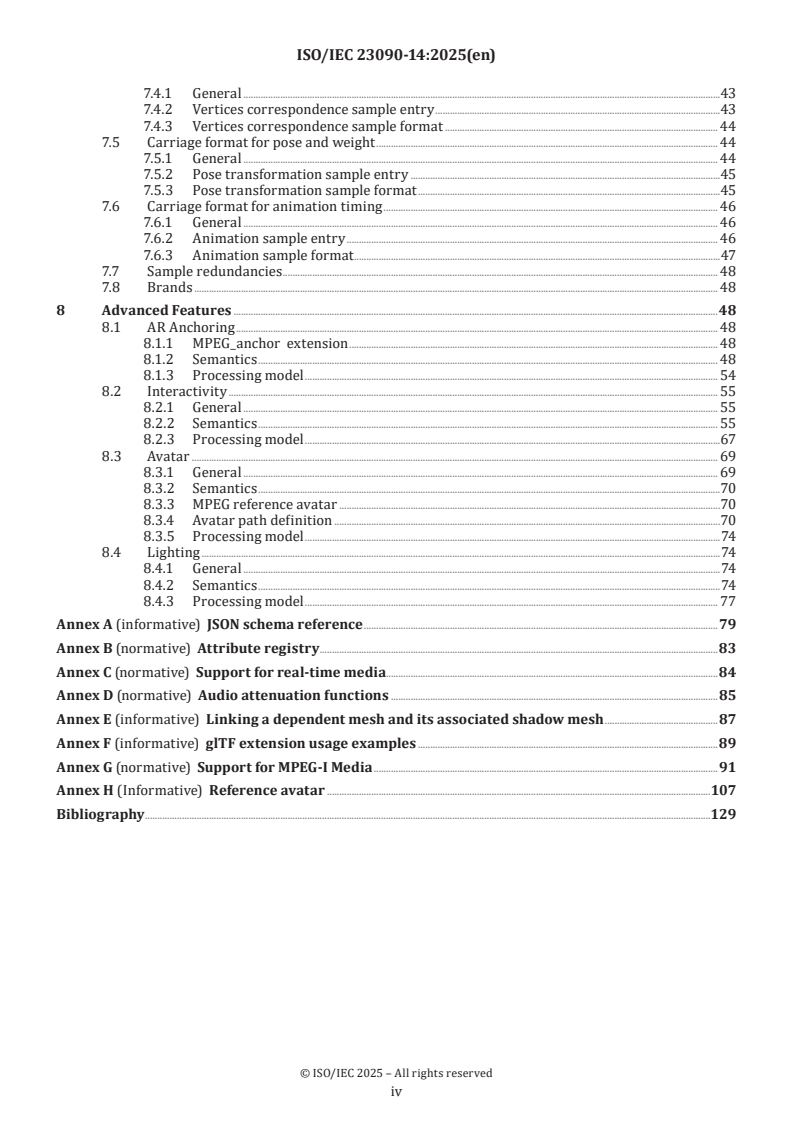
Contents Page
Foreword .v
Introduction .vi
1 Scope . 1
2 Normative references . 1
3 Terms, definitions, abbreviated terms, and conventions . 1
3.1 Terms and definitions .1
3.2 Abbreviated terms .3
3.3 Conventions .4
3.3.1 General .4
3.3.2 Arithmetic operators .4
3.3.3 Logical operators .4
3.3.4 Relational operators .5
3.3.5 Bit-wise operators .5
3.3.6 Assignment operators .5
3.3.7 Other operators .6
3.3.8 Order of operation precedence .6
3.3.9 Text description of logical operations .6
4 Overview and architecture . 8
4.1 Overview .8
4.2 Architecture .8
4.3 Timing model .11
5 Scene description extensions .12
5.1 General . 12
5.1.1 Overview of extensions . 12
5.1.2 Formatting and typing . 13
5.2 Generic extensions .14
5.2.1 MPEG_media extension .14
5.2.2 MPEG_accessor_timed extension .17
5.2.3 MPEG_buffer_circular extension . 20
5.2.4 MPEG_scene_dynamic extensions . 22
5.3 Visual Extensions .24
5.3.1 MPEG_texture_video extensions .24
5.3.2 MPEG_mesh_linking extensions . 25
5.4 Audio extensions.27
5.4.1 MPEG_audio_spatial extensions .27
5.5 Metadata extensions .31
5.5.1 MPEG_viewport_recommended extensions .31
5.5.2 MPEG_animation_timing extensions.32
6 Media access function and buffer API .33
6.1 General . 33
6.2 Media access function API . 34
6.3 Buffer API . 38
7 Carriage formats .40
7.1 General . 40
7.2 Carriage format for glTF JSON and JSON patch . 40
7.2.1 General . 40
7.2.2 glTF patch config box .41
7.3 Carriage format for glTF object and glTF source object as non-timed item .42
7.3.1 General .42
7.3.2 glTF Items .42
7.3.3 glTF source items .42
7.4 Carriage format for mesh correspondence values .43
© ISO/IEC 2025 – All rights reserved
iii
7.4.1 General .43
7.4.2 Vertices correspondence sample entry .43
7.4.3 Vertices correspondence sample format . 44
7.5 Carriage format for pose and weight . 44
7.5.1 General . 44
7.5.2 Pose transformation sample entry .45
7.5.3 Pose transformation sample format .45
7.6 Carriage format for animation timing . 46
7.6.1 General . 46
7.6.2 Animation sample entry . 46
7.6.3 Animation sample format .47
7.7 Sample redundancies . 48
7.8 Brands . 48
8 Advanced Features .48
8.1 AR Anchoring . 48
8.1.1 MPEG_anchor extension . 48
8.1.2 Semantics . 48
8.1.3 Processing model . 54
8.2 Interactivity . 55
8.2.1 General . 55
8.2.2 Semantics . 55
8.2.3 Processing model .67
8.3 Avatar . 69
8.3.1 General . 69
8.3.2 Semantics .70
8.3.3 MPEG reference avatar .70
8.3.4 Avatar path definition .70
8.3.5 Processing model .74
8.4 Lighting .74
8.4.1 General .74
8.4.2 Semantics .74
8.4.3 Processing model . 77
Annex A (informative) JSON schema reference .79
Annex B (normative) Attribute registry . .83
Annex C (normative) Support for real-time media.84
Annex D (normative) Audio attenuation functions .85
Annex E (informative) Linking a dependent mesh and its associated shadow mesh .87
Annex F (informative) glTF extension usage examples .89
Annex G (normative) Support for MPEG-I Media .91
Annex H (Informative) Reference avatar .107
Bibliography .129
© ISO/IEC 2025 – All rights reserved
iv
Foreword
ISO (the International Organization for Standardization) and IEC (the International Electrotechnical
Commission) form the specialized system for worldwide standardization. National bodies that are
members of ISO or IEC participate in the development of International Standards through technical
committees established by the respective organization to deal with particular fields of technical activity.
ISO and IEC technical committees collaborate in fields of mutual interest. Other international organizations,
governmental and non-governmental, in liaison with ISO and IEC, also take part in the work.
The procedures used to develop this document and those intended for its further maintenance are described
in the ISO/IEC Directives, Part 1. In particular, the different approval criteria needed for the different types
of document should be noted. This document was drafted in accordance with the editorial rules of the ISO/
IEC Directives, Part 2 (see www.iso.org/directives or www.iec.ch/members_experts/refdocs).
ISO and IEC draw attention to the possibility that the implementation of this document may involve the
use of (a) patent(s). ISO and IEC take no position concerning the evidence, validity or applicability of any
claimed patent rights in respect thereof. As of the date of publication of this document, ISO and IEC had
received notice of (a) patent(s) which may be required to implement this document. However, implementers
are cautioned that this may not represent the latest information, which may be obtained from the patent
database available at www.iso.org/patents and https://patents.iec.ch. ISO and IEC shall not be held
responsible for identifying any or all such patent rights.
Any trade name used in this document is information given for the convenience of users and does not
constitute an endorsement.
For an explanation of the voluntary nature of standards, the meaning of ISO specific terms and expressions
related to conformity assessment, as well as information about ISO's adherence to the World Trade
Organization (WTO) principles in the Technical Barriers to Trade (TBT) see www.iso.org/iso/foreword.html.
In the IEC, see www.iec.ch/understanding-standards.
This document was prepared by Joint Technical Committee ISO/IEC JTC 1, Information technology,
Subcommittee SC 29, Coding of audio, picture, multimedia and hypermedia information.
This second edition cancels and replaces the first edition (ISO/IEC 23090-14:2023), which has been
technically revised. It also incorporates the Amendment ISO/IEC 23090-14/Amd 1:2023.
The main changes are as follows:
— addition of the support of MPEG-I immersive media codecs, AR anchoring, interactivity, avatar, lighting
and MPEG-I haptics;
— various minor improvements and corrections.
A list of all parts in the ISO 23090 series can be found on the ISO and IEC websites.
Any feedback or questions on this document should be directed to the user’s national standards
body. A complete listing of these bodies can be found at www.iso.org/members.html and
www.iec.ch/national-committees.
© ISO/IEC 2025 – All rights reserved
v
Introduction
This document defines the MPEG-I Scene Description. It provides an architecture for the MPEG-I Scene
Description, a set of extensions based on ISO/IEC 12113, a set of APIs, and storage formats for scene
description documents and scene description updates documents.
© ISO/IEC 2025 – All rights reserved
vi
International Standard ISO/IEC 23090-14:2025(en)
Information technology — Coded representation of
immersive media —
Part 14:
Scene description
IMPORTANT — The electronic file of this document contains colours which are considered to be
useful for the correct understanding of the document. Users should therefore consider printing this
document using a colour printer.
1 Scope
This document specifies extensions to existing scene description formats in order to support MPEG media,
in particular immersive media. MPEG media includes but is not limited to media encoded with MPEG codecs,
media stored in MPEG containers, MPEG media and application formats as well as media provided through
MPEG delivery mechanisms. Extensions include scene description format syntax and semantics and the
processing model when using these extensions by a Presentation Engine. It also defines a media access
function (MAF) API for communication between the Presentation Engine and the media access function for
these extensions. While the extensions defined in this document can be applicable to other scene description
formats, they are provided for ISO/IEC 12113.
2 Normative references
The following documents are referred to in the text in such a way that some or all of their content constitutes
requirements of this document. For dated references, only the edition cited applies. For undated references,
the latest edition of the referenced document (including any amendments) applies.
ISO/IEC 12113, Information technology — Runtime 3D asset delivery format — Khronos glTF™ 2.0
ISO/IEC 14496-12, Information technology — Coding of audio-visual objects — Part 12: ISO base media file format
ISO/IEC 21778, Information technology — The JSON data interchange syntax
IEEE 754-2019, IEEE Standard for Floating-Point Arithmetic
IETF RFC 6902, JavaScript Object Notation (JSON) Patch
IETF RFC 8259, The JavaScript Object Notation (JSON) Data Interchange Format
ISO/IEC 23090-5, Information technology – Coded Representation of Immersive Media – Part 5: Visual
Volumetric Video-based Coding (V3C) and Video-based Point Cloud Compression (V-PCC)
ISO/IEC 23090-12, Information technology — Coded representation of immersive media — Part 12: MPEG
immersive video
3 Terms, definitions, abbreviated terms, and conventions
3.1 Terms and definitions
For the purposes of this document, the terms and definitions given in ISO/IEC 12113 and the following apply.
© ISO/IEC 2025 – All rights reserved
ISO and IEC maintain terminology databases for use in standardization at the following addresses:
— ISO Online browsing platform: available at https:// www .iso .org/ obp
— IEC Electropedia: available at https:// www .electropedia .org/
3.1.1
asset
3D scene described by a scene description document (3.1.10) together with corresponding scene description
data (3.1.9)
3.1.2
node
element in the scene graph (3.1.12)
3.1.3
media access function
function that retrieves and prepares media for rendering on request by the presentation engine (3.1.7)
3.1.4
media pipeline
chain of media processing components to process media
3.1.5
object
node in a scene description document (3.1.10)
3.1.6
patch document
document that contains update instructions
Note 1 to entry: For example, update instruction can be provided as defined in RFC 6902.
3.1.7
presentation engine
engine that processes and renders the asset (3.1.1)
3.1.8
scene activation time
time on the media timeline at which the scene described by a scene description document (3.1.10) takes effect
in the presentation engine (3.1.7)
3.1.9
scene description data
binary data that is described by scene description document (3.1.10)
3.1.10
scene description document
document describing a 3D scene
Note 1 to entry: For example, scene description document is containing description of node hierarchy, materials,
cameras, as well as description information for meshes, animations, and other constructs.
3.1.11
scene description update
patch document (3.1.6) to a scene description document (3.1.10) or a scene description document (3.1.10)
3.1.12
scene graph
data structure used to represent objects (3.1.5) in a 3D scene and their hierarchical relationships
© ISO/IEC 2025 – All rights reserved
3.1.13
timed accessor
accessor defined in ISO/IEC 12113 that has an MPEG_accessor_timed extension and is used to describe
access to timed data
3.1.14
timed data
timed media
media, which when decoded results in content, possibly containing internal timing values, to be presented at
a given presentation time and for a certain duration
3.1.15
augmented reality AR
technique of composing a view from virtual objects and the user’s real-world environment
3.1.16
trackable
real-world object that can be tracked by the XR runtime
Note 1 to entry: Each trackable provides a local reference space, also known as a trackable space, in which an anchor
can be expressed.
3.1.17
AR anchor
virtual element for which its position, orientation, scale, and other properties are expressed in the trackable
space defined by the trackable
Note 1 to entry: A virtual asset’s position, orientation, scale and other properties are expressed in relation to an anchor.
3.1.18
avatar
virtual representation of a user
3.1.19
XR Space
Representation of a virtual coordinate system with an origin that corresponds to a physical location
3.2 Abbreviated terms
3D three-dimensional
3DoF three degrees of freedom
6DoF six degrees of freedom
API application programming interface
AR augmented reality
DASH dynamic adaptive streaming over http
dB decibel
DSR diffuse to source ratio
EOM enhanced occupancy mode
ERP equirectangular projection
glTF graphics language transmission format
© ISO/IEC 2025 – All rights reserved
HOA higher order ambisonics
ISOBMFF ISO base media file format
JSON JavaScript object notation
MAF media access function
MPEG moving picture experts group
MIV mpeg immersive video
IDL interface definition language
PCM pulse-code modulation
PLR point local reconstruction
RT60 60 db reverberation time
SDP session description protocol
TRS translation, rotation and scale
3.3 Conventions
3.3.1 General
The mathematical operators used in this document are similar to those used in the C programming language.
However, the results of integer division and arithmetic shift operations are defined more precisely, and
additional operations are defined, such as exponentiation and real-valued division. Numbering and counting
conventions generally begin from 0.
3.3.2 Arithmetic operators
+ addition
− subtraction (as a two-argument operator) or negation (as a unary prefix operator)
* multiplication, including matrix multiplication
integer division with truncation of the result toward zero. For example, 7 / 4 and −7 / −4 are
/
truncated to 1 and −7 / 4 and 7 / −4 are truncated to −1.
÷ division in mathematical equations where no truncation or rounding is intended.
3.3.3 Logical operators
! Boolean logical "not".
© ISO/IEC 2025 – All rights reserved
3.3.4 Relational operators
> Greater than.
>= Greater than or equal to.
< Less than.
<= Less than or equal to.
== Equal to.
!= Not equal to.
3.3.5 Bit-wise operators
~ bit-wise "not".
When operating on integer arguments, operates on a two's complement representation of the inte-
ger value. When operating on a binary argument that contains fewer bits than another argument,
the shorter argument is extended by adding more significant bits equal to 0.
& bit-wise "and".
When operating on integer arguments, operates on a two's complement representation of the inte-
ger value. When operating on a binary argument that contains fewer bits than another argument,
the shorter argument is extended by adding more significant bits equal to 0.
| bit-wise "or".
When operating on integer arguments, operates on a two's complement representation of the inte-
ger value. When operating on a binary argument that contains fewer bits than another argument,
the shorter argument is extended by adding more significant bits equal to 0.
^ bit-wise "exclusive or".
When operating on integer arguments, operates on a two's complement representation of the inte-
ger value. When operating on a binary argument that contains fewer bits than another argument,
the shorter argument is extended by adding more significant bits equal to 0.
x >> y arithmetic right shift of a two's complement integer representation of x by y binary digits.
This function is defined only for non-negative integer values of y. Bits shifted into the MSBs as a
result of the right shift have a value equal to the MSB of x prior to the shift operation.
x << y arithmetic left shift of a two's complement integer representation of x by y binary digits.
This function is defined only for non-negative integer values of y. Bits shifted into the LSBs as a
result of the left shift have a value equal to 0.
3.3.6 Assignment operators
= assignment operator.
++ increment, i.e. x++ is equivalent to x = x + 1; when used in an array index, evaluates to the value
of the variable prior to the increment operation.
-- decrement, i.e. x-- is equivalent to x = x − 1; when used in an array index, evaluates to the value
of the variable prior to the decrement operation.
+= increment by amount specified, i.e. x += 3 is equivalent to x = x + 3, and x += (−3) is equivalent
to x = x + (−3).
−= decrement by amount specified, i.e. x −= 3 is equivalent to x = x − 3, and x −= (−3) is equivalent
to x = x − (−3).
© ISO/IEC 2025 – All rights reserved
3.3.7 Other operators
y.z range operator/notation.
This function is defined only for integer values of y and z. When z is larger than or equal to y, it
defines an ordered set of values from y to z in increments of 1. Otherwise, when z is smaller than
y, the output of this function is an empty set. If this operator is used within the context of a loop,
it specifies that any subsequent operations defined are performed using each element of this set,
unless this set is empty.
3.3.8 Order of operation precedence
When order of precedence in an expression is not indicated explicitly by use of parentheses, the following
rules apply:
— Operations of a higher precedence are evaluated before any operation of a lower precedence.
— Operations of the same precedence are evaluated sequentially from left to right.
Table 1 specifies the precedence of operations from highest to lowest; a higher position in the table indicates
a higher precedence.
NOTE For those operators that are also used in the C programming language, the order of precedence used in this
document is the same as used in the C programming language.
Table 1 — Operation precedence from highest (at top of table) to lowest (at bottom of table)
operations (with operands x, y, and z)
"x++", "x--"
"!x", "−x" (as a unary prefix operator)
"x * y", "x / y", "x ÷ y", "x % y"
"x + y", "x − y" (as a two-argument operator)
"x << y", "x >> y"
"x < y", "x <= y", "x > y", "x >= y"
"x == y", "x != y"
"x & y"
"x | y"
"x && y"
"x || y"
"x ? y : z"
"x.y"
"x = y", "x += y", "x −= y"
3.3.9 Text description of logical operations
In the text, a statement of logical operations as would be described mathematically in the following form:
if( condition 0 )
statement 0
else if( condition 1 )
statement 1
...
else /* informative remark on remaining condition */
statement n
— may be described in the following manner:
© ISO/IEC 2025 – All rights reserved
— . as follows / . the following applies:
— If condition 0, statement 0
— Otherwise, if condition 1, statement 1
— .
— Otherwise (informative remark on remaining condition), statement n
Each "If . Otherwise, if . Otherwise, ." statement in the text is introduced with ". as follows" or ". the
following applies" immediately followed by "If . ". The last condition of the "If . Otherwise, if . Otherwise,
..." is always an "Otherwise, ...". Interleaved "If ... Otherwise, if ... Otherwise, ..." statements can be identified
by matching ". as follows" or ". the following applies" with the ending "Otherwise, .".
In the text, a statement of logical operations as would be described mathematically in the following form:
if( condition 0a && condition 0b )
statement 0
else if( condition 1a || condition 1b )
statement 1
...
else
statement n
— may be described in the following manner:
— . as follows / . the following applies:
— If all of the following conditions are true, statement 0:
— condition 0a
— condition 0b
— Otherwise, if one or more of the following conditions are true, statement 1:
— condition 1a
— condition 1b
— .
— Otherwise, statement n
In the text, a statement of logical operations as would be described mathematically in the following form:
if( condition 0 )
statement 0
if( condition 1 )
statement 1
may be described in the following manner:
When condition 0, statement 0
When condition 1, statement 1
In addition, a “continue” statement, which is used within loops, is defined as follows:
© ISO/IEC 2025 – All rights reserved
The “continue” statement, when encountered inside a loop, jumps to the beginning of the loop for the next
iteration. This results in skipping the execution of subsequent statements inside the body of the loop for the
current iteration. For example:
for( j =0; j < N; j++ ) {
statement 0
if( condition 1 )
continue
statement 1
statement 2
}
is equivalent to the following:
for( j =0; j < N; j++ ) {
statement 0
if( !condition 1 ) {
statement 1
statement 2
}
}
4 Overview and architecture
4.1 Overview
This document enables inclusion of timed media in a scene description. This is achieved through first defining
features of a scene description that describe how to get the timed media, and second how a rendering process
expects the data once it is decoded. In this version of the document, the features are defined as extensions to
the glTF format defined in ISO/IEC 12113, see Clause 5.
In addition to the extensions, which provide an integration of timed media with the scene description, the
document describes a reference scene description architecture that includes components such as media
access function, Presentation Engine, Buffer Control & Management, and Pipelines. To enable cross-platform/
cross-vendor interoperability, the document defines media access function (MAF) API and Buffer API,
see Clause 6. The MAF API provides an interface between the media access function and the Presentation
Engine. The Buffer API is used to allocate and control buffers for the exchange of data between media access
function and Presentation Engine.
Not only the timed media described by the scene description may change over the time but also the scene
description itself. The document defines how such change of a scene description document is signalled to the
Presentation Engine.
Finally, a scene description may be stored, delivered, or extended in a way that is consistent with MPEG
formats. The document defines a number of new features that allow a carriage utilizing ISO/IEC 14496-12
and its derived specifications, see Clause 7.
The Annex A provides JSON schemas for the defined extensions to the glTF format.
The support for MPEG-I Media shall be carried out as specified in Annex G.
4.2 Architecture
The scene description is consumed by a Presentation Engine to render a 3D scene to the viewer. The
extensions defined in this document, allow for the creation of immersive experiences using timed media.
The scene description extensions are designed with the goal of decoupling the Presentation Engine from
the media access function. Presentation Engine and media access function communicate through the media
access function API, which allows the Presentation Engine to request timed media required for the rendering
of the scene. The media access function will retrieve the requested timed media and make it available in a
timely manner and in a format that can be immediately processed by the Presentation Engine. For instance,
© ISO/IEC 2025 – All rights reserved
a requested timed media asset may be compressed and residing in the network, so the media access function
will retrieve and decode the asset and pass the resulting decoded media data to the Presentation Engine
for rendering. The decoded media data is passed in form of buffers from the media access function to the
Presentation Engine. The requests for timed media are passed through the media access function API from
the Presentation Engine to the media access function.
Figure 1 depicts the reference architecture.
Figure 1 — Scene description reference architecture
The interfaces (MAF API, Buffer API) and extensions to ISO/IEC 12113 are within the scope of this document.
The following principles apply:
— The format of the buffers shall be provided by the scene description document and shall be passed to the
MAF through the media access function API.
— Pipeline shall perform necessary transformations to match the buffer format and layout declared in the
scene description for that buffer.
— The fetching of scene description document and scene description updates may be triggered by the MAF.
Figure 1 depicts the reference architecture for scene description. The corresponding procedures are
described as follows:
a) The Presentation Engine receives and parses the scene description document and following scene
description updates.
b) The Presentation Engine identifies timed media that needs to be presented and identifies the required
presentation time.
c) The Presentation Engine then uses the MAF API to request the media and provides the following
information:
1) where the MAF can find the requested media;
2) what parts of the media and at what level of detail;
3) when the requested media has to be made available;
© ISO/IEC 2025 – All rights reserved
4) in which format it wants the data and how it is passed to the Presentation Engine.
d) The MAF instantiates the media fetching and decoding pipeline for the requested media at the
appropriate time.
1) it ensures that the requested media is available at the appropriate time in the appropriate buffers
for access by the Presentation Engine;
2) it ensures that the media is decoded and reformatted to match the expected format by the
Presentation Engine as described by the scene description document.
The exchange of data (media and metadata) shall be done through buffers (circular and static buffers). The
buffer management shall be controlled through the Buffer API. Each buffer should contain sufficient header
information to describe its content and timing.
The information provided to the media access function by the Presentation Engine allows it to:
— Select the appropriate source for the media (multiple could be specified) and the MAF may select based
on preferences and capabilities. Capabilities may for example be decoding capabilities or supported
formats. Preferences may for example be user settings.
— For each selected source,
e) access the media by using a media access protocol;
f) setup the media pipeline to provide the information in the correct buffer format.
The MAF may obtain additional information from the Presentation Engine in order to optimize the delivery,
for example the required quality for each of the buffers, the exact timing information, etc.
The media access function shall setup and manage the pipeline for each requested media or metadata. A
pipeline takes as input one or more media or metadata tracks and outputs one or more buffers. The pipeline
shall perform all the necessary processing, such as streaming, demultiplexing, decoding, decryption, and
format conversion to match the expected buffer format. The final buffer or set of buffers are then used to
exchange data with the Presentation Engine.
An example of pipelines setup is depicted in Figure 2 for the case of a V-PCC compressed point cloud object
that is referenced in the scene description. Pipeline #1 creates four video decoders and one patch data
decoder. The pipeline is also responsible for processing this data and performing 3D reconstruction based
on the received information. The reconstructed data is then fed to the final buffer that is accessed by the
Presentation Engine. Pipeline #2 on the other hand is not performing the 3D reconstruction process and
provides decoded raw data onto the buffers, which are accessed by the Presentation Engine.
© ISO/IEC 2025 – All rights reserved
Figure 2 — An example of pipelines in scene description
4.3
...