

ISO/IEC 23008-3:2026
(Main)Information technology — High efficiency coding and media delivery in heterogeneous environments — Part 3: 3D audio
General Information
- Abstract
This document specifies technology that supports the efficient transmission of immersive audio signals and flexible rendering for the playback of immersive audio in a wide variety of listening scenarios. These include home theatre setups with 3D loudspeaker configurations, 22.2 loudspeaker systems, automotive entertainment systems and playback over headphones connected to a tablet or smartphone.
- Status
- Published
- Publication Date
- 02-Feb-2026
- Technical Committee
- ISO/IEC JTC 1/SC 29 - Coding of audio, picture, multimedia and hypermedia information
- Drafting Committee
- ISO/IEC JTC 1/SC 29/WG 6 - MPEG Audio coding
- Current Stage
- 6060 - International Standard published
- Start Date
- 03-Feb-2026
- Due Date
- 21-Jan-2026
- Completion Date
- 03-Feb-2026

Overview
ISO/IEC 23008-3:2026 establishes international standards for high efficiency coding and media delivery of 3D audio in heterogeneous environments. Published by ISO and IEC, this fourth edition focuses on supporting the efficient transmission and flexible rendering of immersive audio signals. The standard addresses a broad spectrum of playback systems and listening scenarios, including home theater setups with 3D loudspeaker configurations, advanced 22.2 channel systems, automotive infotainment, and mobile headphone-based environments. By standardizing 3D audio technology, the document ensures compatibility, efficient delivery, and an enhanced user experience for immersive sound applications across platforms.
Key Topics
ISO/IEC 23008-3:2026 covers comprehensive topics related to 3D audio coding, transport, and rendering. Key areas include:
Efficient Audio Signal Coding
Enables high-quality, bandwidth-efficient encoding of immersive audio suitable for a range of network environments.Flexible Rendering Architecture
Defines techniques for rendering audio for different loudspeaker layouts, such as 3D audio arrays, 22.2 systems, and binaural playback for headphones.Support for Heterogeneous Playback
Covers the needs of variable end-user systems, from high-end home theaters and automotive setups to portable devices.Metadata Support
Provides for object metadata and scene information, enabling advanced features like interactive audio, downmixing, and personalization.Advanced Channel and Object-Based Audio
Facilitates both channel-based (traditional surround) and object-based (audio objects placed in space) 3D audio.Dynamic Range Control and Loudness Processing
Ensures consistent audio playback across different environments and devices.Higher Order Ambisonics (HOA) and Binaural Rendering
Supports spatial audio reproduction for immersive experiences, including headphone-based playback.
Applications
The practical applications of ISO/IEC 23008-3:2026 span a wide range of industries and consumer products, including:
Home Theater Systems
Delivers fully immersive 3D audio experiences for setups with advanced speaker arrays, supporting formats like 5.1.4, 7.1.4, and 22.2 configurations.Automotive Audio
Enhances in-car entertainment with spatial sound, adapting playback to vehicle-specific speaker placements and challenging acoustic environments.Mobile Devices and Headphones
Offers immersive audio on smartphones and tablets via binaural rendering, optimizing sound for headphones and varied listening locations.Broadcast and Streaming
Facilitates efficient transmission of 3D audio for live broadcast, television, and online streaming services, ensuring compatibility across receivers.Virtual and Augmented Reality (VR/AR)
Enables precise spatial sound placement for VR/AR applications, elevating realism and user engagement.Cinema and Professional Audio Production
Provides audio engineers with standardized tools for producing and delivering surround and object-based audio content.
Related Standards
ISO/IEC 23008-3:2026 is part of a broader suite of media delivery and coding standards. Notable related standards include:
- ISO/IEC 23008-1: High efficiency coding and media delivery in heterogeneous environments - System aspects
- ISO/IEC 23008-2: High efficiency video coding (HEVC)
- ISO/IEC 23003-3: MPEG audio technologies, including spatial and immersive audio
- ISO/IEC 14496-3: Audio coding (MPEG-4 Audio)
- ITU-R BS.2051: Advanced audio systems for program production
- IEC 60268-16: Objective rating of speech intelligibility
These standards collectively ensure interoperability, high-quality media experiences, and robust media transport solutions for diverse platforms. By adhering to ISO/IEC 23008-3:2026, manufacturers, content creators, and service providers can deliver state-of-the-art 3D audio solutions that meet stringent performance and compatibility requirements globally.
Relations
- Effective Date
- 08-Nov-2025
- Effective Date
- 17-Aug-2024
Get Certified
Connect with accredited certification bodies for this standard

BSI Group
BSI (British Standards Institution) is the business standards company that helps organizations make excellence a habit.

NYCE
Mexican standards and certification body.
Sponsored listings
Frequently Asked Questions
ISO/IEC 23008-3:2026 is a standard published by the International Organization for Standardization (ISO). Its full title is "Information technology — High efficiency coding and media delivery in heterogeneous environments — Part 3: 3D audio". This standard covers: This document specifies technology that supports the efficient transmission of immersive audio signals and flexible rendering for the playback of immersive audio in a wide variety of listening scenarios. These include home theatre setups with 3D loudspeaker configurations, 22.2 loudspeaker systems, automotive entertainment systems and playback over headphones connected to a tablet or smartphone.
This document specifies technology that supports the efficient transmission of immersive audio signals and flexible rendering for the playback of immersive audio in a wide variety of listening scenarios. These include home theatre setups with 3D loudspeaker configurations, 22.2 loudspeaker systems, automotive entertainment systems and playback over headphones connected to a tablet or smartphone.
ISO/IEC 23008-3:2026 is classified under the following ICS (International Classification for Standards) categories: 35.040.40 - Coding of audio, video, multimedia and hypermedia information. The ICS classification helps identify the subject area and facilitates finding related standards.
ISO/IEC 23008-3:2026 has the following relationships with other standards: It is inter standard links to ISO/IEC 23008-3:2026/Amd 1, ISO/IEC 23008-3:2022. Understanding these relationships helps ensure you are using the most current and applicable version of the standard.
ISO/IEC 23008-3:2026 is available in PDF format for immediate download after purchase. The document can be added to your cart and obtained through the secure checkout process. Digital delivery ensures instant access to the complete standard document.
Standards Content (Sample)
International
Standard
ISO/IEC 23008-3
Fourth edition
Information technology — High
efficiency coding and media
2026-02
delivery in heterogeneous
environments —
Part 3:
3D audio
Technologies de l'information — Codage à haute efficacité et
livraison des medias dans des environnements hétérogènes —
Partie 3: Audio 3D
Reference number
© ISO/IEC 2026
All rights reserved. Unless otherwise specified, or required in the context of its implementation, no part of this publication may
be reproduced or utilized otherwise in any form or by any means, electronic or mechanical, including photocopying, or posting on
the internet or an intranet, without prior written permission. Permission can be requested from either ISO at the address below
or ISO’s member body in the country of the requester.
ISO copyright office
CP 401 • Ch. de Blandonnet 8
CH-1214 Vernier, Geneva
Phone: +41 22 749 01 11
Email: copyright@iso.org
Website: www.iso.org
Published in Switzerland
© ISO/IEC 2026 – All rights reserved
ii
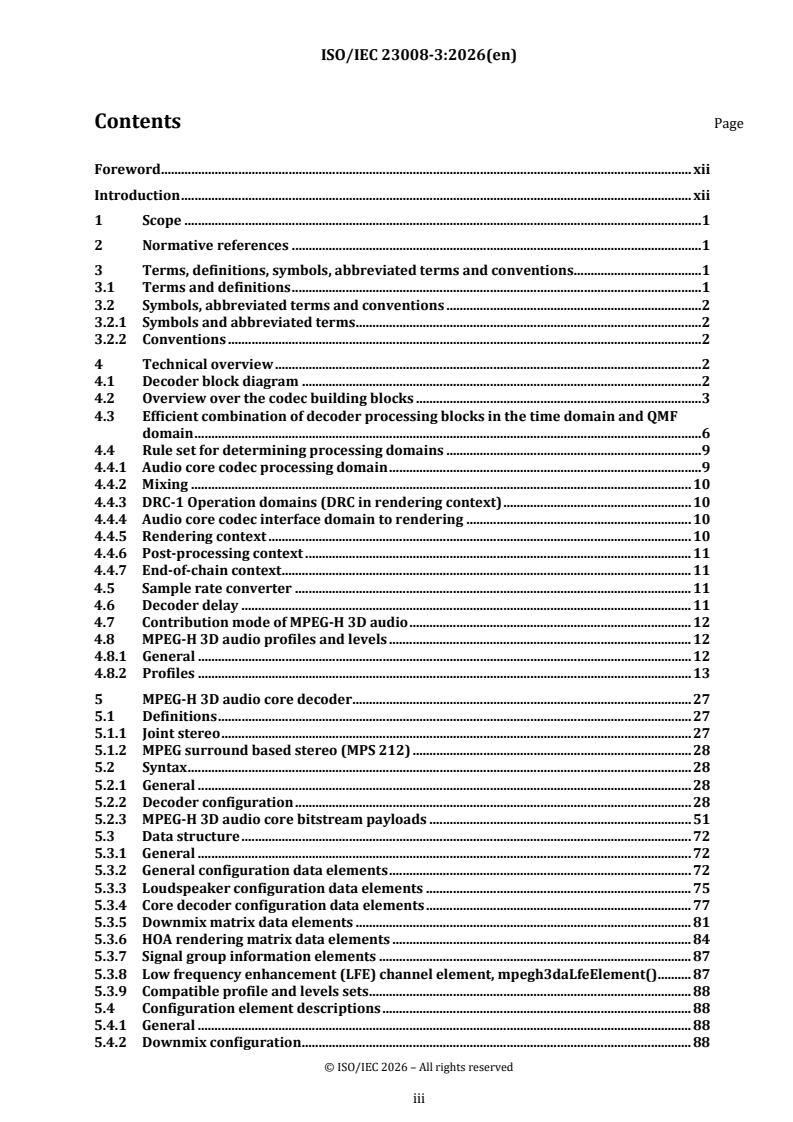
Contents Page
Foreword . xii
Introduction . xii
1 Scope . 1
2 Normative references . 1
3 Terms, definitions, symbols, abbreviated terms and conventions . 1
3.1 Terms and definitions . 1
3.2 Symbols, abbreviated terms and conventions . 2
3.2.1 Symbols and abbreviated terms . 2
3.2.2 Conventions . 2
4 Technical overview . 2
4.1 Decoder block diagram . 2
4.2 Overview over the codec building blocks . 3
4.3 Efficient combination of decoder processing blocks in the time domain and QMF
domain . 6
4.4 Rule set for determining processing domains . 9
4.4.1 Audio core codec processing domain . 9
4.4.2 Mixing . 10
4.4.3 DRC-1 Operation domains (DRC in rendering context) . 10
4.4.4 Audio core codec interface domain to rendering . 10
4.4.5 Rendering context . 10
4.4.6 Post-processing context . 11
4.4.7 End-of-chain context . 11
4.5 Sample rate converter . 11
4.6 Decoder delay . 11
4.7 Contribution mode of MPEG-H 3D audio . 12
4.8 MPEG-H 3D audio profiles and levels . 12
4.8.1 General . 12
4.8.2 Profiles . 13
5 MPEG-H 3D audio core decoder . 27
5.1 Definitions . 27
5.1.1 Joint stereo . 27
5.1.2 MPEG surround based stereo (MPS 212) . 28
5.2 Syntax . 28
5.2.1 General . 28
5.2.2 Decoder configuration . 28
5.2.3 MPEG-H 3D audio core bitstream payloads . 51
5.3 Data structure . 72
5.3.1 General . 72
5.3.2 General configuration data elements . 72
5.3.3 Loudspeaker configuration data elements . 75
5.3.4 Core decoder configuration data elements . 77
5.3.5 Downmix matrix data elements . 81
5.3.6 HOA rendering matrix data elements . 84
5.3.7 Signal group information elements . 87
5.3.8 Low frequency enhancement (LFE) channel element, mpegh3daLfeElement() . 87
5.3.9 Compatible profile and levels sets. 88
5.4 Configuration element descriptions . 88
5.4.1 General . 88
5.4.2 Downmix configuration . 88
© ISO/IEC 2026 – All rights reserved
iii
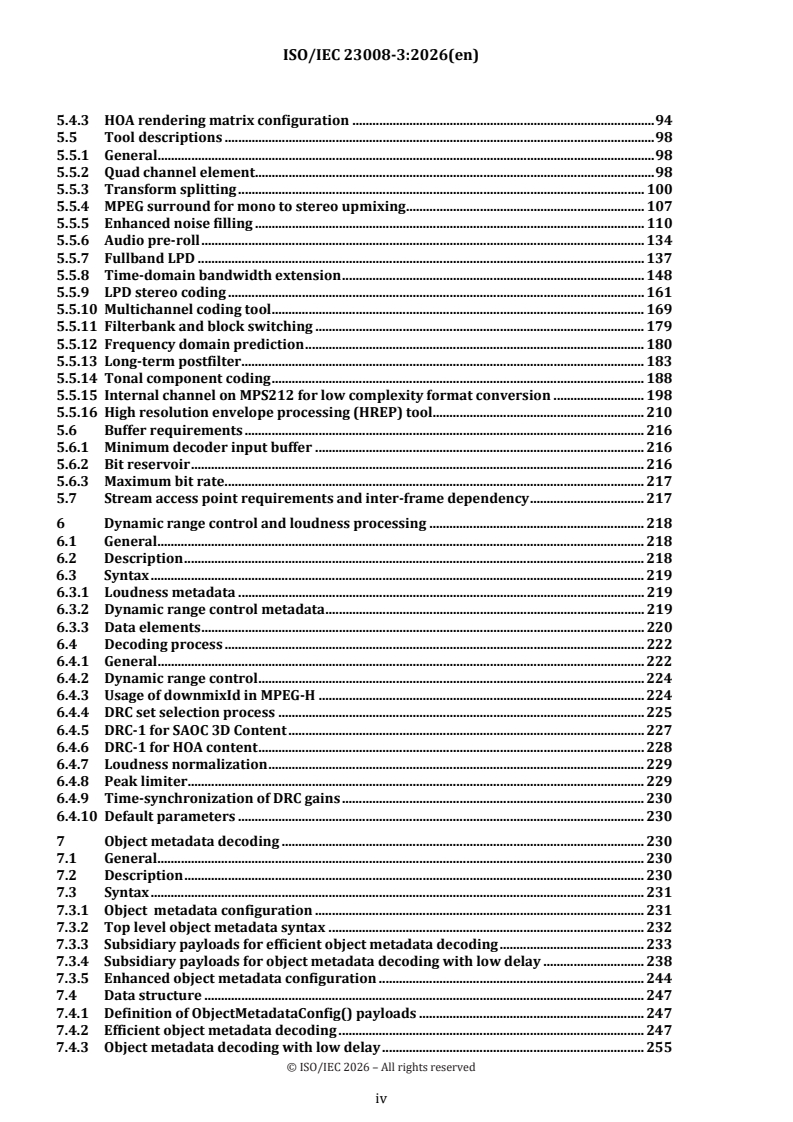
5.4.3 HOA rendering matrix configuration . 94
5.5 Tool descriptions . 98
5.5.1 General . 98
5.5.2 Quad channel element. 98
5.5.3 Transform splitting . 100
5.5.4 MPEG surround for mono to stereo upmixing . 107
5.5.5 Enhanced noise filling . 110
5.5.6 Audio pre-roll . 134
5.5.7 Fullband LPD . 137
5.5.8 Time-domain bandwidth extension . 148
5.5.9 LPD stereo coding . 161
5.5.10 Multichannel coding tool . 169
5.5.11 Filterbank and block switching . 179
5.5.12 Frequency domain prediction . 180
5.5.13 Long-term postfilter . 183
5.5.14 Tonal component coding . 188
5.5.15 Internal channel on MPS212 for low complexity format conversion . 198
5.5.16 High resolution envelope processing (HREP) tool. 210
5.6 Buffer requirements . 216
5.6.1 Minimum decoder input buffer . 216
5.6.2 Bit reservoir . 216
5.6.3 Maximum bit rate . 217
5.7 Stream access point requirements and inter-frame dependency . 217
6 Dynamic range control and loudness processing . 218
6.1 General . 218
6.2 Description . 218
6.3 Syntax . 219
6.3.1 Loudness metadata . 219
6.3.2 Dynamic range control metadata . 219
6.3.3 Data elements . 220
6.4 Decoding process . 222
6.4.1 General . 222
6.4.2 Dynamic range control . 224
6.4.3 Usage of downmixId in MPEG-H . 224
6.4.4 DRC set selection process . 225
6.4.5 DRC-1 for SAOC 3D Content . 227
6.4.6 DRC-1 for HOA content . 228
6.4.7 Loudness normalization . 229
6.4.8 Peak limiter . 229
6.4.9 Time-synchronization of DRC gains . 230
6.4.10 Default parameters . 230
7 Object metadata decoding . 230
7.1 General . 230
7.2 Description . 230
7.3 Syntax . 231
7.3.1 Object metadata configuration . 231
7.3.2 Top level object metadata syntax . 232
7.3.3 Subsidiary payloads for efficient object metadata decoding . 233
7.3.4 Subsidiary payloads for object metadata decoding with low delay . 238
7.3.5 Enhanced object metadata configuration . 244
7.4 Data structure . 247
7.4.1 Definition of ObjectMetadataConfig() payloads . 247
7.4.2 Efficient object metadata decoding . 247
7.4.3 Object metadata decoding with low delay . 255
© ISO/IEC 2026 – All rights reserved
iv
7.4.4 Enhanced object metadata . 260
8 Object rendering . 263
8.1 Description . 263
8.2 Terms and definitions . 263
8.3 Input data . 264
8.4 Processing . 265
8.4.1 General remark . 265
8.4.2 Imaginary loudspeakers . 265
8.4.3 Dividing the loudspeaker setup into a triangle mesh . 266
8.4.4 Rendering algorithm . 268
9 SAOC 3D . 272
9.1 Description . 272
9.2 Definitions . 272
9.3 Delay and synchronization . 274
9.4 Syntax . 274
9.4.1 Payloads for SAOC 3D . 274
9.4.2 Definition of SAOC 3D payloads . 278
9.5 SAOC 3D processing . 280
9.5.1 Compressed data stream decoding and dequantization of SAOC 3D data . 280
9.5.2 Time/frequency transforms . 280
9.5.3 Signals and parameters . 281
9.5.4 SAOC 3D decoding . 283
9.5.5 Dual mode . 288
10 Generic loudspeaker rendering/format conversion . 288
10.1 Description . 288
10.2 Definitions . 290
10.2.1 General remarks . 290
10.2.2 Variable definitions . 290
10.3 Processing . 290
10.3.1 Application of transmitted downmix matrices . 290
10.3.2 Application of transmitted equalizer settings . 295
10.3.3 Downmix processing involving multiple channel groups . 295
10.3.4 Initialization of the format converter . 296
10.3.5 Audio signal processing . 312
11 Immersive loudspeaker rendering/format conversion . 318
11.1 Description . 318
11.2 Syntax . 320
11.3 Definitions . 320
11.3.1 General remarks . 320
11.3.2 Variable definitions . 321
11.4 Processing . 322
11.4.1 Initialization of the format converter . 322
11.4.2 Audio signal processing . 364
12 Higher order ambisonics (HOA) . 372
12.1 Technical overview . 372
12.1.1 Block diagram . 372
12.1.2 Overview of the decoder tools . 373
12.2 Syntax . 374
12.2.1 Configuration of HOA elements . 374
12.2.2 Payloads of HOA elements . 378
12.3 Data structure . 391
12.3.1 Definitions of HOA Config . 391
© ISO/IEC 2026 – All rights reserved
v
12.3.2 Syntax of getSubbandBandwidths() . 395
12.3.3 Definitions of HOA payload . 396
12.4 HOA tool description . 403
12.4.1 HOA frame converter . 403
12.4.2 Spatial HOA decoding . 419
12.4.3 HOA renderer . 448
12.4.4 Layered coding for HOA . 457
13 Binaural renderer . 460
13.1 General . 460
13.2 Frequency-domain binaural renderer . 460
13.2.1 General . 460
13.2.2 Definitions . 462
13.2.3 Parameterization of binaural room impulse responses . 466
13.2.4 Frequency-domain binaural processing . 478
13.3 Time-domain binaural renderer . 485
13.3.1 General . 485
13.3.2 Definitions . 486
13.3.3 Parameterization of binaural room impulse responses . 488
13.3.4 Time-domain binaural processing . 492
14 MPEG-H 3D audio stream (MHAS) . 493
14.1 Overview . 493
14.2 Syntax . 494
14.2.1 Main MHAS syntax elements . 494
14.2.2 Subsidiary MHAS syntax elements . 496
14.3 Semantics . 496
14.3.1 mpeghAudioStreamPacket() . 496
14.3.2 MHASPacketPayload() . 497
14.3.3 Subsidiary MHAS packets . 499
14.4 Description of MHASPacketTypes . 499
14.4.1 PACTYP_FILLDATA . 499
14.4.2 PACTYP_MPEGH3DACFG . 499
14.4.3 PACTYP_MPEGH3DAFRAME . 499
14.4.4 PACTYP_SYNC . 500
14.4.5 PACTYP_SYNCGAP . 500
14.4.6 PACTYP_MARKER . 500
14.4.7 PACTYP_CRC16 and PACTYP_CRC32 . 501
14.4.8 PACTYP_DESCRIPTOR . 501
14.4.9 PACTYP_USERINTERACTION . 501
14.4.10 PACTYP_LOUDNESS_DRC . 501
14.4.11 PACTYP_BUFFERINFO . 502
14.4.12 PACTYP_GLOBAL_CRC16 and PACTYP_ GLOBAL_CRC32 . 502
14.4.13 PACTYP_AUDIOTRUNCATION . 502
14.4.14 PACTYP_AUDIOSCENEINFO . 503
14.4.15 PACTYP_EARCON . 503
14.4.16 PACTYP_PCMCONFIG . 504
14.4.17 PACTYP_PCMDATA . 504
14.4.18 PACTYP_LOUDNESS . 504
14.4.19 MHASPacketType specific requirements for MHASPacketLabel . 504
14.5 Application examples . 505
14.5.1 Light-weighted broadcast . 505
14.5.2 MPEG-2 transport stream . 506
14.5.3 CRC error detection . 506
14.5.4 Audio sample truncation . 507
14.6 Multi-stream delivery and interface . 507
© ISO/IEC 2026 – All rights reserved
vi
14.7 Carriage of generic data . 510
14.7.1 Syntax . 510
14.7.2 Semantics . 511
14.7.3 Processing at the MPEG-H 3D audio decoder . 512
15 Metadata audio elements (MAE) . 512
15.1 General . 512
15.2 Syntax . 513
15.3 Semantics . 522
15.4 Definition of mae_metaDataElementIDs . 534
15.5 Loudness compensation after gain interactivity . 535
16 Loudspeaker distance compensation . 537
17 Interfaces to the MPEG-H 3D audio decoder . 538
17.1 General . 538
17.2 Interface for local setup information . 538
17.2.1 General . 538
17.2.2 WIRE output . 538
17.2.3 Syntax for local setup information . 539
17.2.4 Semantics for local setup information . 539
17.3 Interface for local loudspeaker setup and rendering. 540
17.3.1 General . 540
17.3.2 Syntax for local loudspeaker signalling . 540
17.3.3 Semantics for local loudspeaker signalling . 541
17.4 Interface for binaural room impulse responses (BRIRs) . 542
17.4.1 General . 542
17.4.2 Syntax of binaural renderer interface . 542
17.4.3 Semantics . 547
17.5 Interface for local screen size information . 551
17.5.1 General . 551
17.5.2 Syntax . 551
17.5.3 Semantics . 551
17.6 Interface for signaling of local zoom area . 552
17.6.1 General . 552
17.6.2 Syntax . 552
17.6.3 Semantics . 552
17.7 Interface for user interaction . 553
17.7.1 General . 553
17.7.2 Definition of user interaction categories . 553
17.7.3 Definition of an interface for user interaction . 554
17.7.4 Syntax of interaction interface . 555
17.7.5 Semantics of interaction interface . 556
17.8 Interface for loudness normalization and dynamic range control (DRC) . 558
17.9 Interface for scene displacement data . 558
17.9.1 General . 558
17.9.2 Definition of an interface for scene-displacement data . 559
17.9.3 Syntax of the scene displacement interface . 560
17.9.4 Semantics of the scene displacement interface . 560
17.10 Interfaces for channel-based, object-based, and HOA metadata and audio data . 561
17.10.1 General . 561
17.10.2 Expectations on external renderers . 561
17.10.3 Object-based metadata and audio data (object output interface) . 561
17.10.4 Channel-based metadata and audio data . 569
17.10.5 HOA metadata and audio data . 573
17.10.6 Audio PCM data . 577
© ISO/IEC 2026 – All rights reserved
vii
17.11 Interface for positional scene displacement data . 577
17.11.1 General . 577
17.11.2 Syntax of the positional scene displacement interface . 578
17.11.3 Semantics of the positional scene displacement interface . 578
17.11.4 Processing . 578
18 Application and processing of local setup information and interaction data and
scene displacement data . 579
18.1 Element metadata preprocessing . 579
18.1.1 General information . 579
18.1.2 Initialization . 580
18.1.3 Processing loop . 581
18.1.4 Element routing . 585
18.2 Interactivity limitations and restrictions . 585
18.2.1 General information . 585
18.2.2 WIRE interactivity . 585
18.2.3 Position interactivity . 586
18.2.4 Screen-related element remapping and object remapping for zooming . 586
18.2.5 Closest loudspeaker playout . 587
18.3 Screen-related element remapping . 587
18.4 Screen-related adaptation and zooming for higher order ambisonics (HOA) . 590
18.5 Object remapping for zooming . 592
18.6 Determination of the closest loudspeaker . 594
18.7 Determination of a list of loudspeakers for conditioned closest loudspeaker
playback . 594
18.8 Processing of scene displacement angles for channels and objects (CO) . 596
18.9 Processing of scene displacement angles for scene-based content (HOA) . 598
18.10 Determination of a reduced reproduction layout based on excluded sectors . 600
18.11 Diffuseness rendering . 601
19 MPEG-H 3D audio profile definition . 603
20 Carriage of MPEG-H 3D audio in ISO base media file format . 603
20.1 General . 603
20.2 Random access and stream access . 603
20.3 Overview of new box structures . 603
20.4 MHA decoder configuration record . 604
20.4.1 Definition . 604
20.4.2 Syntax .
...