


ISO/IEC 15408-3:2005
(Main)Information technology — Security techniques — Evaluation criteria for IT security — Part 3: Security assurance requirements
Information technology — Security techniques — Evaluation criteria for IT security — Part 3: Security assurance requirements
ISO/IEC 15408-3:2005 defines the assurance requirements of ISO/IEC 15408. It includes the evaluation assurance levels (EALs) that define a scale for measuring assurance, the individual assurance components from which the assurance levels are composed, and the criteria for evaluation of protection profiles and security targets.
Technologies de l'information — Techniques de sécurité — Critères d'évaluation pour la sécurité TI — Partie 3: Exigences d'assurance de sécurité
General Information
- Status
- Withdrawn
- Publication Date
- 06-Oct-2005
- Withdrawal Date
- 06-Oct-2005
- Current Stage
- 9599 - Withdrawal of International Standard
- Start Date
- 19-Aug-2008
- Completion Date
- 12-Feb-2026
Relations
- Effective Date
- 15-Apr-2008
- Effective Date
- 15-Apr-2008

Get Certified
Connect with accredited certification bodies for this standard

BSI Group
BSI (British Standards Institution) is the business standards company that helps organizations make excellence a habit.

Bureau Veritas
Bureau Veritas is a world leader in laboratory testing, inspection and certification services.

DNV
DNV is an independent assurance and risk management provider.
Sponsored listings
Frequently Asked Questions
ISO/IEC 15408-3:2005 is a standard published by the International Organization for Standardization (ISO). Its full title is "Information technology — Security techniques — Evaluation criteria for IT security — Part 3: Security assurance requirements". This standard covers: ISO/IEC 15408-3:2005 defines the assurance requirements of ISO/IEC 15408. It includes the evaluation assurance levels (EALs) that define a scale for measuring assurance, the individual assurance components from which the assurance levels are composed, and the criteria for evaluation of protection profiles and security targets.
ISO/IEC 15408-3:2005 defines the assurance requirements of ISO/IEC 15408. It includes the evaluation assurance levels (EALs) that define a scale for measuring assurance, the individual assurance components from which the assurance levels are composed, and the criteria for evaluation of protection profiles and security targets.
ISO/IEC 15408-3:2005 is classified under the following ICS (International Classification for Standards) categories: 35.030 - IT Security; 35.040 - Information coding. The ICS classification helps identify the subject area and facilitates finding related standards.
ISO/IEC 15408-3:2005 has the following relationships with other standards: It is inter standard links to ISO/IEC 15408-3:2008, ISO/IEC 15408-3:1999. Understanding these relationships helps ensure you are using the most current and applicable version of the standard.
ISO/IEC 15408-3:2005 is available in PDF format for immediate download after purchase. The document can be added to your cart and obtained through the secure checkout process. Digital delivery ensures instant access to the complete standard document.
Standards Content (Sample)
INTERNATIONAL ISO/IEC
STANDARD 15408-3
Second edition
2005-10-01
Information technology — Security
techniques — Evaluation criteria for IT
security —
Part 3:
Security assurance requirements
Technologies de l'information — Techniques de sécurité — Critères
d'évaluation pour la sécurité TI —
Partie 3: Exigences d'assurance de sécurité
Reference number
©
ISO/IEC 2005
PDF disclaimer
This PDF file may contain embedded typefaces. In accordance with Adobe's licensing policy, this file may be printed or viewed but
shall not be edited unless the typefaces which are embedded are licensed to and installed on the computer performing the editing. In
downloading this file, parties accept therein the responsibility of not infringing Adobe's licensing policy. The ISO Central Secretariat
accepts no liability in this area.
Adobe is a trademark of Adobe Systems Incorporated.
Details of the software products used to create this PDF file can be found in the General Info relative to the file; the PDF-creation
parameters were optimized for printing. Every care has been taken to ensure that the file is suitable for use by ISO member bodies. In
the unlikely event that a problem relating to it is found, please inform the Central Secretariat at the address given below.
© ISO/IEC 2005
All rights reserved. Unless otherwise specified, no part of this publication may be reproduced or utilized in any form or by any means,
electronic or mechanical, including photocopying and microfilm, without permission in writing from either ISO at the address below or
ISO's member body in the country of the requester.
ISO copyright office
Case postale 56 • CH-1211 Geneva 20
Tel. + 41 22 749 01 11
Fax + 41 22 749 09 47
E-mail copyright@iso.org
Web www.iso.org
Published in Switzerland
ii © ISO/IEC 2005 – All rights reserved
Contents Page
Foreword .ix
Introduction.xi
1 Scope.1
2 Normative references.1
3 Terms, definitions, symbols and abbreviated terms.1
4 Overview.1
4.1 Organisation of this part of ISO/IEC 15408.1
5 ISO/IEC 15408 assurance paradigm .2
5.1 ISO/IEC 15408 philosophy.2
5.2 Assurance approach.2
5.2.1 Significance of vulnerabilities.2
5.2.2 Cause of vulnerabilities.3
5.2.3 ISO/IEC 15408 assurance.3
5.2.4 Assurance through evaluation.3
5.3 ISO/IEC 15408 evaluation assurance scale .3
6 Security assurance requirements.4
6.1 Structures.4
6.1.1 Class structure.4
6.1.2 Assurance family structure.5
6.1.3 Assurance component structure.6
6.1.4 Assurance elements.8
6.1.5 EAL structure.8
6.2 Component taxonomy.10
6.3 Protection Profile and Security Target evaluation criteria class structure.11
6.4 Usage of terms in this part of ISO/IEC 15408 .11
6.5 Assurance categorisation.13
6.6 Assurance class and family overview.13
6.6.1 Class ACM:Configuration management.13
6.6.2 Class ADO:Delivery and operation.14
6.6.3 Class ADV:Development.14
6.6.4 Class AGD:Guidance documents.15
6.6.5 Class ALC:Life cycle support .15
6.6.6 Class APE:Protection Profile evaluation .16
6.6.7 Class ASE:Security Target evaluation .16
6.6.8 Class ATE:Tests.16
6.6.9 Class AVA:Vulnerability assessment.17
7 Protection Profile and Security Target evaluation criteria.17
7.1 Overview.17
7.2 Protection Profile criteria overview.18
7.2.1 Protection Profile evaluation.18
7.2.2 Relation to the Security Target evaluation criteria .18
7.2.3 Evaluator tasks.18
7.3 Security Target criteria overview.19
7.3.1 Security Target evaluation.19
7.3.2 Relation to the other evaluation criteria in this part of ISO/IEC 15408 .19
7.3.3 Evaluator tasks.19
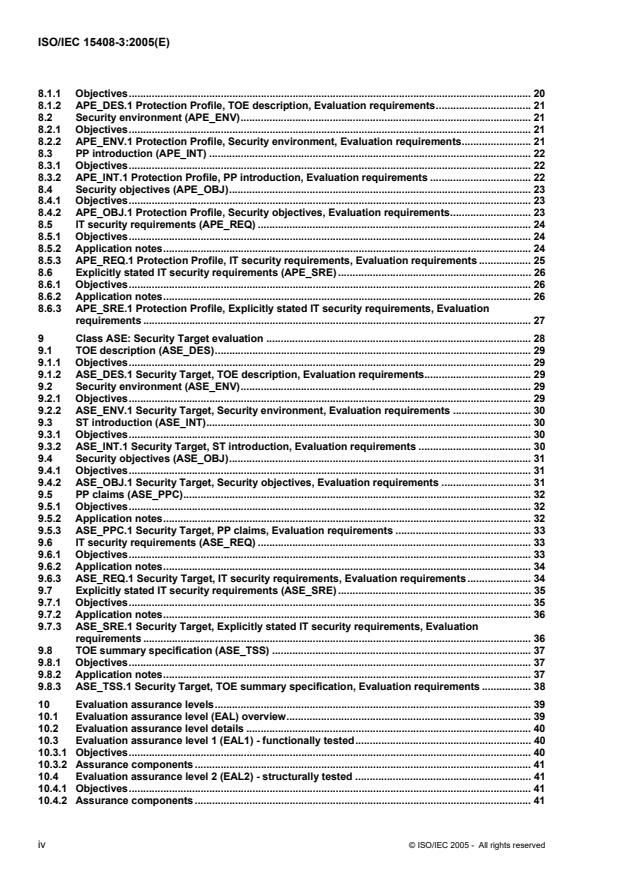
8 Class APE: Protection Profile evaluation .20
8.1 TOE description (APE_DES).20
© ISO/IEC 2005 - All rights reserved iii
8.1.1 Objectives. 20
8.1.2 APE_DES.1 Protection Profile, TOE description, Evaluation requirements. 21
8.2 Security environment (APE_ENV). 21
8.2.1 Objectives. 21
8.2.2 APE_ENV.1 Protection Profile, Security environment, Evaluation requirements. 21
8.3 PP introduction (APE_INT). 22
8.3.1 Objectives. 22
8.3.2 APE_INT.1 Protection Profile, PP introduction, Evaluation requirements . 22
8.4 Security objectives (APE_OBJ). 23
8.4.1 Objectives. 23
8.4.2 APE_OBJ.1 Protection Profile, Security objectives, Evaluation requirements. 23
8.5 IT security requirements (APE_REQ) . 24
8.5.1 Objectives. 24
8.5.2 Application notes. 24
8.5.3 APE_REQ.1 Protection Profile, IT security requirements, Evaluation requirements . 25
8.6 Explicitly stated IT security requirements (APE_SRE) . 26
8.6.1 Objectives. 26
8.6.2 Application notes. 26
8.6.3 APE_SRE.1 Protection Profile, Explicitly stated IT security requirements, Evaluation
requirements . 27
9 Class ASE: Security Target evaluation . 28
9.1 TOE description (ASE_DES). 29
9.1.1 Objectives. 29
9.1.2 ASE_DES.1 Security Target, TOE description, Evaluation requirements. 29
9.2 Security environment (ASE_ENV). 29
9.2.1 Objectives. 29
9.2.2 ASE_ENV.1 Security Target, Security environment, Evaluation requirements . 30
9.3 ST introduction (ASE_INT). 30
9.3.1 Objectives. 30
9.3.2 ASE_INT.1 Security Target, ST introduction, Evaluation requirements . 30
9.4 Security objectives (ASE_OBJ). 31
9.4.1 Objectives. 31
9.4.2 ASE_OBJ.1 Security Target, Security objectives, Evaluation requirements . 31
9.5 PP claims (ASE_PPC). 32
9.5.1 Objectives. 32
9.5.2 Application notes. 32
9.5.3 ASE_PPC.1 Security Target, PP claims, Evaluation requirements . 33
9.6 IT security requirements (ASE_REQ) . 33
9.6.1 Objectives. 33
9.6.2 Application notes. 34
9.6.3 ASE_REQ.1 Security Target, IT security requirements, Evaluation requirements. 34
9.7 Explicitly stated IT security requirements (ASE_SRE) . 35
9.7.1 Objectives. 35
9.7.2 Application notes. 36
9.7.3 ASE_SRE.1 Security Target, Explicitly stated IT security requirements, Evaluation
requirements . 36
9.8 TOE summary specification (ASE_TSS) . 37
9.8.1 Objectives. 37
9.8.2 Application notes. 37
9.8.3 ASE_TSS.1 Security Target, TOE summary specification, Evaluation requirements . 38
10 Evaluation assurance levels. 39
10.1 Evaluation assurance level (EAL) overview. 39
10.2 Evaluation assurance level details . 40
10.3 Evaluation assurance level 1 (EAL1) - functionally tested. 40
10.3.1 Objectives. 40
10.3.2 Assurance components. 41
10.4 Evaluation assurance level 2 (EAL2) - structurally tested . 41
10.4.1 Objectives. 41
10.4.2 Assurance components. 41
iv © ISO/IEC 2005 - All rights reserved
10.5 Evaluation assurance level 3 (EAL3) - methodically tested and checked.42
10.5.1 Objectives.42
10.5.2 Assurance components.42
10.6 Evaluation assurance level 4 (EAL4) - methodically designed, tested, and reviewed.43
10.6.1 Objectives.43
10.6.2 Assurance components.43
10.7 Evaluation assurance level 5 (EAL5) - semiformally designed and tested .44
10.7.1 Objectives.44
10.7.2 Assurance components.44
10.8 Evaluation assurance level 6 (EAL6) - semiformally verified design and tested.45
10.8.1 Objectives.45
10.8.2 Assurance components.45
10.9 Evaluation assurance level 7 (EAL7) - formally verified design and tested.46
10.9.1 Objectives.46
10.9.2 Assurance components.46
11 Assurance classes, families, and components.47
12 Class ACM: Configuration management.47
12.1 CM automation (ACM_AUT).48
12.1.1 Objectives.48
12.1.2 Component levelling.48
12.1.3 Application notes.48
12.1.4 ACM_AUT.1 Partial CM automation.48
12.1.5 ACM_AUT.2 Complete CM automation .49
12.2 CM capabilities (ACM_CAP).50
12.2.1 Objectives.50
12.2.2 Component levelling.51
12.2.3 Application notes.51
12.2.4 ACM_CAP.1 Version numbers.51
12.2.5 ACM_CAP.2 Configuration items.52
12.2.6 ACM_CAP.3 Authorisation controls.53
12.2.7 ACM_CAP.4 Generation support and acceptance procedures .54
12.2.8 ACM_CAP.5 Advanced support.56
12.3 CM scope (ACM_SCP).59
12.3.1 Objectives.59
12.3.2 Component levelling.59
12.3.3 Application notes.59
12.3.4 ACM_SCP.1 TOE CM coverage .59
12.3.5 ACM_SCP.2 Problem tracking CM coverage.60
12.3.6 ACM_SCP.3 Development tools CM coverage .60
13 Class ADO: Delivery and operation.61
13.1 Delivery (ADO_DEL).61
13.1.1 Objectives.61
13.1.2 Component levelling.62
13.1.3 Application notes.62
13.1.4 ADO_DEL.1 Delivery procedures.62
13.1.5 ADO_DEL.2 Detection of modification.62
13.1.6 ADO_DEL.3 Prevention of modification.63
13.2 Installation, generation and start-up (ADO_IGS) .64
13.2.1 Objectives.64
13.2.2 Component levelling.64
13.2.3 Application notes.64
13.2.4 ADO_IGS.1 Installation, generation, and start-up procedures .64
13.2.5 ADO_IGS.2 Generation log.65
14 Class ADV: Development.66
14.1 Functional specification (ADV_FSP).70
14.1.1 Objectives.70
14.1.2 Component levelling.70
14.1.3 Application notes.70
© ISO/IEC 2005 - All rights reserved v
14.1.4 ADV_FSP.1 Informal functional specification. 71
14.1.5 ADV_FSP.2 Fully defined external interfaces. 71
14.1.6 ADV_FSP.3 Semiformal functional specification.72
14.1.7 ADV_FSP.4 Formal functional specification. 73
14.2 High-level design (ADV_HLD). 74
14.2.1 Objectives. 74
14.2.2 Component levelling. 74
14.2.3 Application notes. 74
14.2.4 ADV_HLD.1 Descriptive high-level design. 75
14.2.5 ADV_HLD.2 Security enforcing high-level design.76
14.2.6 ADV_HLD.3 Semiformal high-level design. 77
14.2.7 ADV_HLD.4 Semiformal high-level explanation .78
14.2.8 ADV_HLD.5 Formal high-level design . 79
14.3 Implementation representation (ADV_IMP). 81
14.3.1 Objectives. 81
14.3.2 Component levelling. 81
14.3.3 Application notes. 81
14.3.4 ADV_IMP.1 Subset of the implementation of the TSF. 81
14.3.5 ADV_IMP.2 Implementation of the TSF . 82
14.3.6 ADV_IMP.3 Structured implementation of the TSF . 83
14.4 TSF internals (ADV_INT). 84
14.4.1 Objectives. 84
14.4.2 Component levelling. 84
14.4.3 Application notes. 84
14.4.4 ADV_INT.1 Modularity. 85
14.4.5 ADV_INT.2 Reduction of complexity. 86
14.4.6 ADV_INT.3 Minimisation of complexity . 87
14.5 Low-level design (ADV_LLD). 89
14.5.1 Objectives. 89
14.5.2 Component levelling. 89
14.5.3 Application notes. 89
14.5.4 ADV_LLD.1 Descriptive low-level design. 89
14.5.5 ADV_LLD.2 Semiformal low-level design. 91
14.5.6 ADV_LLD.3 Formal low-level design . 92
14.6 Representation correspondence (ADV_RCR).93
14.6.1 Objectives. 93
14.6.2 Component levelling. 93
14.6.3 Application notes. 93
14.6.4 ADV_RCR.1 Informal correspondence demonstration. 94
14.6.5 ADV_RCR.2 Semiformal correspondence demonstration. 94
14.6.6 ADV_RCR.3 Formal correspondence demonstration . 95
14.7 Security policy modeling (ADV_SPM). 96
14.7.1 Objectives. 96
14.7.2 Component levelling. 96
14.7.3 Application notes. 96
14.7.4 ADV_SPM.1 Informal TOE security policy model. 96
14.7.5 ADV_SPM.2 Semiformal TOE security policy model . 97
14.7.6 ADV_SPM.3 Formal TOE security policy model. 98
15 Class AGD: Guidance documents . 99
15.1 Administrator guidance (AGD_ADM). 99
15.1.1 Objectives. 99
15.1.2 Component levelling. 99
15.1.3 Application notes. 99
15.1.4 AGD_ADM.1 Administrator guidance. 100
15.2 User guidance (AGD_USR). 101
15.2.1 Objectives. 101
15.2.2 Component levelling. 101
15.2.3 Application notes. 101
15.2.4 AGD_USR.1 User guidance. 101
vi © ISO/IEC 2005 - All rights reserved
16 Class ALC: Life cycle support .102
16.1 Development security (ALC_DVS).102
16.1.1 Objectives.102
16.1.2 Component levelling.102
16.1.3 Application notes.103
16.1.4 ALC_DVS.1 Identification of security measures .103
16.1.5 ALC_DVS.2 Sufficiency of security measures .103
16.2 Flaw remediation (ALC_FLR) .104
16.2.1 Objectives.104
16.2.2 Component levelling.104
16.2.3 Application notes.104
16.2.4 ALC_FLR.1 Basic flaw remediation.105
16.2.5 ALC_FLR.2 Flaw reporting procedures.105
16.2.6 ALC_FLR.3 Systematic flaw remediation.107
16.3 Life cycle definition (ALC_LCD).108
16.3.1 Objectives.108
16.3.2 Component levelling.109
16.3.3 Application notes.109
16.3.4 ALC_LCD.1 Developer defined life-cycle model .109
16.3.5 ALC_LCD.2 Standardised life-cycle model.110
16.3.6 ALC_LCD.3 Measurable life-cycle model.111
16.4 Tools and techniques (ALC_TAT).112
16.4.1 Objectives.112
16.4.2 Component levelling.112
16.4.3 Application notes.112
16.4.4 ALC_TAT.1 Well-defined development tools.112
16.4.5 ALC_TAT.2 Compliance with implementation standards .113
16.4.6 ALC_TAT.3 Compliance with implementation standards - all parts .114
17 Class ATE: Tests.114
17.1 Coverage (ATE_COV).115
17.1.1 Objectives.115
17.1.2 Component levelling.115
17.1.3 ATE_COV.1 Evidence of coverage .115
17.1.4 ATE_COV.2 Analysis of coverage.116
17.1.5 ATE_COV.3 Rigorous analysis of coverage .117
17.2 Depth (ATE_DPT).118
17.2.1 Objectives.118
17.2.2 Component levelling.118
17.2.3 Application notes.118
17.2.4 ATE_DPT.1 Testing: high-level design.118
17.2.5 ATE_DPT.2 Testing: low-level design .119
17.2.6 ATE_DPT.3 Testing: implementation representation .120
17.3 Functional tests (ATE_FUN).121
17.3.1 Objectives.121
17.3.2 Component levelling.121
17.3.3 Application notes.121
17.3.4 ATE_FUN.1 Functional testing.122
17.3.5 ATE_FUN.2 Ordered functional testing.122
17.4 Independent testing (ATE_IND).124
17.4.1 Objectives.124
17.4.2 Component levelling.124
17.4.3 Application notes.124
17.4.4 ATE_IND.1 Independent testing - conformance.125
17.4.5 ATE_IND.2 Independent testing - sample .125
17.4.6 ATE_IND.3 Independent testing - complete.126
18 Class AVA: Vulnerability assessment.127
18.1 Covert channel analysis (AVA_CCA).128
18.1.1 Objectives.128
18.1.2 Component levelling.128
© ISO/IEC 2005 - All rights reserved vii
18.1.3 Application notes. 128
18.1.4 AVA_CCA.1 Covert channel analysis . 128
18.1.5 AVA_CCA.2 Systematic covert channel analysis. 130
18.1.6 AVA_CCA.3 Exhaustive covert channel analysis. 130
18.2 Misuse (AVA_MSU). 132
18.2.1 Objectives. 132
18.2.2 Component levelling. 132
18.2.3 Application notes. 132
18.2.4 AVA_MSU.1 Examination of guidance . 133
18.2.5 AVA_MSU.2 Validation of analysis.
...
Questions, Comments and Discussion
Ask us and Technical Secretary will try to provide an answer. You can facilitate discussion about the standard in here.
Loading comments...